
Agricultural Coatings Market Growth, Trends & Forecast by 2034
Agricultural Coatings Market Size and Forecasts (2021 - 2034), Global and Regional Share, Trends, and Growth Opportunity Analysis Report Coverage : by Category (Seed Coatings, Fertilizers Coatings, Pesticides Coatings); Type (Polymers, Colorant, Pellets); End Use (Insecticides, Herbicides, Fungicides, Rodenticides); and Geography (North America, Europe, Asia Pacific, and South and Central America)
- Status : Data Released
- Report Code : TIPRE00040470
- Category : Chemicals and Materials
- No. of Pages : 150
- Available Report Formats :


- Last update date : July 21, 2026


2025 Market Size
US$ 5.79 Bn
Base year value
2034 Forecast
US$ 9.77 Bn
Projected by 2034
CAGR 2026-2034
5.99 %
Growth rate
Addressable Market
US$ 70.49 Bn
(2026-2034)
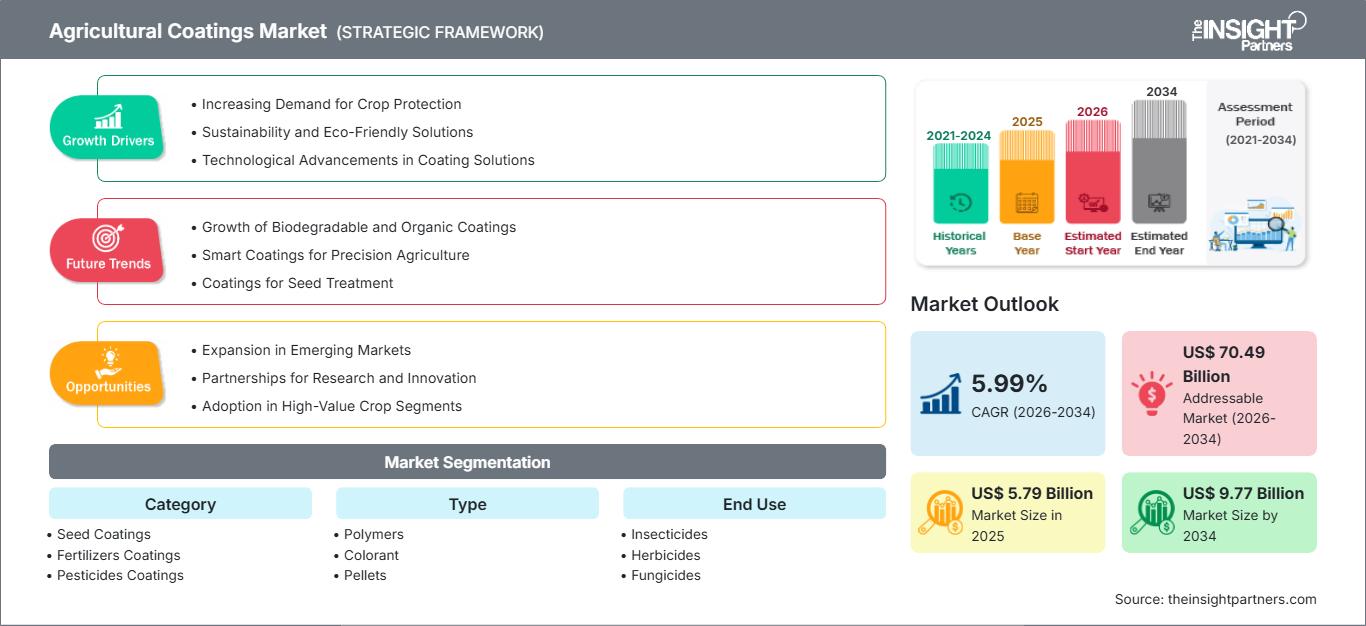
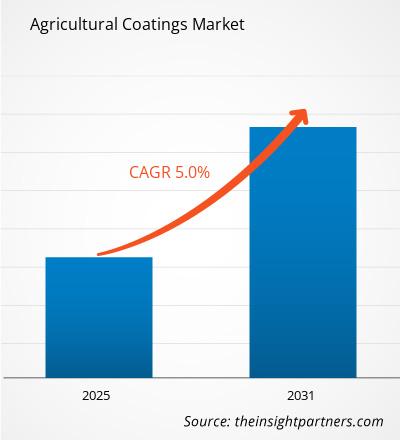
The agricultural coatings market was valued at US$ 5.79 billion in 2025 and is projected to reach US$ 9.77 billion by 2034, registering a CAGR of 5.99% during 2026–2034. Market expansion is being driven by the increasing adoption of precision agriculture, enhanced seed treatment technologies, and the growing need to improve crop productivity while minimizing environmental losses. Agricultural coatings are widely used to improve seed handling, regulate agrochemical release, enhance product stability, and support sustainable farming practices across major agricultural economies.
Across North America, the agricultural coatings market size continues to expand as growers increasingly adopt coated seeds and controlled-release crop protection technologies to improve planting efficiency and reduce input losses. Rising investments in biological seed treatments, stringent regulations on agrochemical applications, and continuous innovation in polymer-based coating formulations are expected to support a regional CAGR of 5.5%–6.2% during the forecast period, with the United States remaining the largest contributor to regional demand.
Agricultural Coatings Market Assessment and Insights
- North America: North America accounted for 30%–34% share in 2025 and is projected to grow at a CAGR of 5.5%–6.2% during 2026–2034. Strong adoption of coated seeds, advanced crop protection technologies, and high agricultural mechanization continue to support regional demand.
- U.S.: The U.S. represented 76%–80% of the North American market in 2025 and is expected to expand at a CAGR of 5.6%–6.3% during 2026–2034, supported by increasing investments in seed enhancement technologies and sustainable farming practices.
- Europe: Europe held 24%–28% share in 2025 and is forecast to register a CAGR of 5.4%–6.0% during 2026–2034. Germany, France, Italy, and Spain continue to lead regional demand owing to advanced agricultural practices and stringent environmental regulations.
- Asia Pacific: Asia Pacific accounted for 31%–35% share in 2025 and is anticipated to witness a CAGR of 6.4%–7.0% during 2026–2034. China, India, Japan, Australia, and South Korea are experiencing increasing adoption of coated agricultural inputs to improve crop productivity and resource efficiency.
- Largest Segment: Seed Coatings represented 44%–48% market share in 2025 and are projected to grow at a CAGR of 6.1%–6.7% during 2026–2034, supported by rising demand for precision planting and enhanced seed performance.
- High Growth Segment: Polymers are anticipated to record the fastest expansion, with a 2025 market share of 37%–41% and a CAGR of 6.5%–7.2% during 2026–2034, driven by advancements in biodegradable and controlled-release coating technologies.
- Key companies analyzed in detail: BASF SE, Bayer AG, The Sherwin-Williams Company, Akzo Nobel N.V., PPG Industries, Inc., The Valspar Corporation, Hempel A/S, Covestro AG, RPM International Inc., Croda International Plc.
Source: The Insight Partners' analysis based on proprietary research, government publications, company annual reports, investor presentations, industry databases, and expert interviews.
Continuous innovations in seed treatment technology, controlled-release formulation, and eco-friendly coating chemistry have greatly influenced the agricultural coatings market in the last decade. Companies are currently placing more emphasis on developing multi-functional coatings that can increase seed flow, adhesion of crop protection actives, nutrient release control, and reduction of dust-off. The increased use of biodegradable polymers and aqueous systems in coating formulation is another trend being pushed by regulatory authorities due to environmental concerns.
The future prospects will arise out of the Asia Pacific, Latin America, and certain African nations wherein there is an ongoing expansion of agricultural modernization schemes. The investment in advanced precision farming techniques, bio-based crop protection solutions, and sustainable seed coating technologies has encouraged manufacturers to design coatings for specific regional agronomics. It is expected that further environmentally friendly farming regulations will ensure sustained adoption of these coatings.
Agricultural Coatings Market Report Scope
| Report Attribute | Details |
|---|---|
| Market size in 2025 | US$ 5.79 Billion |
| Market Size by 2034 | US$ 9.77 Billion |
| Global CAGR (2026 - 2034) | 5.99% |
| Historical Data | 2021-2024 |
| Forecast period | 2026-2034 |
Agricultural Coatings Market Analysis
The growing need for increased agricultural productivity and growing pressure to cut down on wastage of chemicals have continuously boosted the growth of the agriculture coating market throughout the globe. Agricultural coating is widely used in order to improve seed germination and protection as well as for precise sowing and efficient nutrient usage. There has been an increase in the use of biological pesticides, controlled release fertilizers, and other technologies which help improve seeds. The development of bio-based polymers and better pigment and binder technologies have further fueled the market growth.
Coatings in agriculture comprise a value chain consisting of raw material suppliers, polymer producers, pigment manufacturers, formulators, seed firms, agrochemical companies, distributors, and agriculturists. The collaboration between coating formulators and seed technology companies has gained momentum due to the rising demand for coatings that have multiple functionalities including protection, nutrition, and better seed handling capacity. Digital agriculture is another factor contributing to the growing demand for customized coatings.
According to the analysis of the agricultural coatings market, the competition is becoming more dependent on innovation, sustainability, and collaboration efforts. BASF SE, Bayer AG, Akzo Nobel N.V., Covestro AG, and Croda International Plc continue to invest in research concerning the development of coating materials and advanced formulations. On the other hand, companies like PPG Industries, Inc., Hempel A/S, RPM International Inc., and The Sherwin-Williams Company take advantage of their experience in specialty coatings and polymers to develop agricultural products via technology collaboration and distribution systems.
Investments in strategic sectors still revolve around biodegradable polymers, seed enhancements, and coating additives that can enhance the products’ performances while minimizing their impact on the environment. Capacity building, collaborative research into new products, and mergers and acquisitions are likely to be some of the important competitive strategies that will be used by companies in response to growing commercial agricultural sector demands. Increased attention to sustainability and stricter regulations on agrochemical use are bound to spur innovation and competitiveness.
● REPORT CUSTOMIZATION
Tailor This Report To Align With Your Specific Business Requirements
This report can be customized to align precisely with your business objectives, scope, and target markets. Customization options include tailored segmentation, geography, competitive analysis, and strategic insights to support informed decision-making.
Customize This Report →WHAT YOU CAN ADJUST
- ● Segmentations
- ● Geography
- ● Competitive Analysis
- ● Language Preferences
Agricultural Coatings Market: Strategic Insights
Regional Insights
North America Agricultural Coatings Market
North America accounted for 30%–34% of the agricultural coatings market share in 2025 and is projected to register a CAGR of 5.5%–6.2% during 2026–2034. The region benefits from widespread adoption of coated seeds, advanced crop protection technologies, and precision agriculture practices. Strong investments in seed enhancement, biological crop protection products, and sustainable farming technologies continue to support demand for innovative coating formulations across the agricultural value chain.
There are considerable investments being made in North America in seed coatings technology that improves efficiency during planting, reduces dust-off, and helps deliver nutrients. There has been increased focus by regulation on environmentally friendly farming methods, which has resulted in increased efforts toward developing biodegradable polymers and waterborne coating solutions. In addition, there is availability of top-notch coating manufacturers, solid research and development facilities, along with cooperation among seed and agrochemicals companies.
U.S. Agricultural Coatings Market
The U.S. represented 76%–80% of the North American market in 2025 and is expected to grow at a CAGR of 5.6%–6.3% through 2034. Large-scale commercial farming, extensive adoption of genetically improved seeds, and increasing demand for high-performance crop protection solutions continue to drive market expansion. Rising investments in biological seed treatments and precision farming technologies further support product innovation and commercialization.
The major players like BASF SE, Bayer AG, PPG Industries Inc., The Sherwin-Williams Company, and RPM International Inc. have extensive research, production, and distribution facilities throughout the nation. Seed coatings have been the most prevalent applications due to greater use of precision planters, whereas there has been a continuous rise in the use of polymer-based seed coating systems because of their efficiency in making seeds more flowable.
Europe Agricultural Coatings Market
Europe captured 24%–28% of the global agricultural coatings market in 2025 and is anticipated to expand at a CAGR of 5.4%–6.0% during the forecast period. Stringent environmental regulations, increasing adoption of sustainable crop production technologies, and widespread use of coated seeds continue to support market development. The region also benefits from ongoing investments in biological agriculture and low-emission farming practices.
Germany continues to be the top European market due to the high level of technology utilized in the country’s agricultural industry, the importance that is placed on seeds innovation and the availability of multinational agrochemical companies. Investment in precision agriculture and sustainable crop protection systems has been responsible for the growing demand for advanced coating solutions.
The countries of France, Italy and Spain form a growth cluster due to the extensive planting of cereals, oilseeds, fruits and vegetables. Growing interest in the improvement of seed efficiency through minimizing the use of agrochemicals has contributed to the acceptance of environmentally friendly coating products.
APAC Agricultural Coatings Market
Asia Pacific accounted for 31%–35% of the global market in 2025 and is projected to record the fastest regional CAGR of 6.4%–7.0% through 2034. Rapid agricultural modernization, expanding commercial farming activities, and increasing awareness regarding seed quality continue to support market growth across the region.
China leads regional demand, followed by India, Japan, South Korea, and Australia. Government initiatives promoting precision agriculture, rising investments in seed technology, and increasing use of controlled-release agricultural inputs are encouraging wider adoption of advanced coating materials throughout the region.
Middle East & Africa Agricultural Coatings Market
The Middle East & Africa are projected to register a CAGR of 5.8%–6.4% during 2026–2034. Increasing efforts to improve agricultural productivity under water-constrained conditions, coupled with expanding adoption of coated seeds, are supporting steady market growth. Government initiatives focused on food security further contribute to demand.
Saudi Arabia and the UAE are investing in advanced agricultural technologies, while South Africa remains the largest agricultural coatings market within Africa due to its commercial farming sector. Continued investments in climate-resilient agriculture and efficient crop input technologies are expected to create additional opportunities across the Rest of the Middle East & Africa.
Segmentation Analysis
Category
The Category segment is projected to grow at a CAGR of 6.0%–6.6% during 2026–2034. The agricultural coatings market scope continues to expand as coated agricultural inputs become increasingly important for improving seed performance, reducing agrochemical losses, and enhancing application efficiency. Manufacturers are introducing advanced coating formulations that provide better adhesion, controlled release, and environmental compatibility, supporting higher adoption across modern farming systems.
- Seed Coatings – The largest sub-segment, driven by increasing adoption of precision planting, improved germination rates, enhanced seed protection, and compatibility with biological seed treatment technologies across commercial agriculture.
- Fertilizers Coatings – Growing demand for controlled-release fertilizers and nutrient efficiency is encouraging wider adoption of polymer-coated fertilizers that minimize nutrient loss and improve fertilizer utilization.
- Pesticides Coatings – Coating technologies improve handling characteristics, stability, and controlled release of crop protection products while supporting safer application and compliance with environmental regulations.
Type
The Type segment is anticipated to register a CAGR of 6.3%–6.9% during the forecast period. Continuous innovation in coating materials is enabling manufacturers to improve durability, color uniformity, adhesion, and product functionality. The shift toward sustainable and biodegradable materials continues to reshape product development strategies across the industry.
- Polymers – Polymer-based coatings dominate owing to excellent film-forming properties, durability, controlled-release capability, and compatibility with a wide range of agricultural formulations.
- Colorant – Colorants improve product identification, application accuracy, brand differentiation, and operator safety while supporting regulatory compliance and quality control during seed treatment.
- Pellets – Pellet technologies improve seed size uniformity and planting precision, particularly for small and irregular seeds requiring enhanced mechanical handling characteristics.
End Use
The End Use segment is expected to grow at a CAGR of 5.8%–6.4% between 2026 and 2034. Agricultural coatings are increasingly tailored to specific crop protection products to improve application efficiency, product stability, and overall field performance while reducing environmental losses and enhancing operational efficiency.
- Insecticides – Coating technologies improve adhesion and controlled delivery of insecticidal active ingredients, enhancing seed protection during early crop establishment.
- Herbicides – Coated herbicide formulations support improved handling, application consistency, and reduced product losses while contributing to efficient weed management programs.
- Fungicides – Fungicide coatings remain widely adopted for protecting seeds against soil-borne and seed-borne diseases while improving crop establishment and early-stage plant health.
- Rodenticides – Specialized coating systems improve product stability, handling characteristics, and controlled delivery in targeted agricultural pest management applications.
Opportunity Snapshot
| End Use | Revenue Contribution | Trend Tag | Adoption Stage |
| Insecticides | High | Seed Protection | Mature |
| Herbicides | High | Precision Farming | Mature |
| Fungicides | Medium | Disease Control | Scaling |
| Rodenticides | Low | Targeted Control | Emerging |
Agricultural Coatings Market Growth Drivers and Impact Analysis
Growing Adoption of Precision Agriculture and High-Performance Seed Technologies
The widespread application of precision agriculture technology has greatly influenced the management of crop inputs through enhancing precision planting, avoiding wastage of resources and increasing crop productivity. Advanced seed coating technologies contribute to better flowability and planting of seeds, as well as the delivery of crop protection products. Seed coatings are becoming essential for mechanized farms. Agricultural farmers are employing coated seeds in order to increase germination efficiency, avoid reseeding, and enhance planting of crops under various weather conditions. Moreover, digital farming technology, GPS planters and precision planting have encouraged the development of custom seed coatings suitable for modern agricultural equipment.
Expansion of Controlled-Release Agrochemical and Fertilizer Technologies
Increasing adoption of controlled release fertilizers and crop protection agents is being seen as producers are trying to make use of efficient nutrient use along with minimal environmental losses. The agricultural coating provides for the gradual release of nutrients and other active components, thus preventing any leaching, volatilization, and field reapplication. Advanced polymer technologies are also aiding in improving the performance of the coatings of fertilizers under various weather conditions. Growing concerns about soil erosion, nutrient loss, and water contamination are leading companies to come up with environmentally friendly coating technologies that not only help in improving agricultural productivity but also help in achieving regulatory compliance.
Increasing Regulatory Focus on Sustainable Agricultural Inputs
The regulatory bodies in the large agricultural economies are tightening up environmental laws with the objective of cutting down excess use of agrochemicals and encouraging the practice of sustainable agriculture. This has led to an increase in the development and application of coating technologies that would improve the application process, decrease dust formation when using seeds, and also increase the performance of biological crop protection solutions. The manufacturers have started producing water-based products, biodegradable polymers, and coating products that have low toxicity levels and would meet the stringent environmental laws.
Agricultural Coatings Market Future Trends
Development of Bio-Based and Biodegradable Coating Materials
Growing environmental concerns and increasingly stringent sustainability regulations are accelerating the development of bio-based agricultural coatings manufactured from renewable raw materials. Agricultural coatings market trends indicate that manufacturers are replacing conventional synthetic polymers with biodegradable alternatives that maintain coating performance while minimizing environmental impact. Future innovations are expected to focus on multifunctional formulations capable of delivering biological agents, micronutrients, and crop protection ingredients through a single coating layer. Continued research into sustainable material chemistry will create opportunities for premium coating technologies across commercial agriculture.
Integration of Biological Crop Protection with Advanced Coating Technologies
Biological crop protection products are expected to become increasingly integrated with seed coating formulations as agricultural producers seek environmentally responsible alternatives to conventional chemicals. Future coating systems will be designed to improve microbial viability, stabilize biological active ingredients, and enhance field performance under diverse environmental conditions. Advanced encapsulation technologies and precision application methods will enable manufacturers to develop customized coating solutions supporting integrated pest management strategies while improving crop productivity and regulatory compliance.
Agricultural Coatings Market Opportunities
Expansion Across Emerging Agricultural Economies
Rapid agricultural modernization across Asia Pacific, Latin America, and Africa presents substantial investment opportunities for coating manufacturers. Agricultural coatings market Forecasts indicate increasing demand for coated seeds, controlled-release fertilizers, and sustainable crop protection technologies as governments prioritize food security and productivity improvements. Rising mechanization, expanding commercial farming operations, and supportive agricultural policies are encouraging manufacturers to establish regional production facilities and strategic partnerships. Companies capable of delivering cost-effective, climate-specific coating technologies are expected to strengthen their competitive position while benefiting from expanding agricultural input markets.
Innovation in Multifunctional Seed Enhancement Solutions
Manufacturers are increasingly investing in multifunctional coating technologies that combine seed protection, nutrient delivery, biological stimulants, and improved planting performance within a single formulation. Such integrated solutions reduce operational complexity while improving seed establishment and crop productivity. Advances in polymer chemistry, encapsulation techniques, and controlled-release technologies are enabling the development of premium coating products tailored to diverse crop types and environmental conditions. Continued collaboration among seed companies, agrochemical manufacturers, and specialty chemical suppliers is expected to accelerate commercialization and create new long-term revenue opportunities across the agricultural coatings industry.
Recent Developments
- November 2025: BASF SE announced that Integral® Pro, its biological fungicide seed treatment, received regulatory approval in France for sunflower cultivation. Available across the European Union from the 2026 sowing season, the solution enhances early seed vigor and protects against seed- and soil-borne fungal diseases, highlighting continued innovation in biological seed treatment and agricultural coating technologies.
- May 2025: BASF SE launched Valexio Insecticide and Mibelya Fungicide in India to strengthen its rice crop protection portfolio. While the products are part of the broader crop protection market, the launch is expected to support demand for advanced agricultural coating technologies that improve active ingredient stability, adhesion, and field performance in seed treatment and crop protection formulations.
Frequently Asked Questions

- Comprehensive Market Sizing and Forecast Analysis
- Detailed Segmentation Analysis
- In-Depth Market Dynamics Assessment
- Regional and Country-Level Insights
- Competitive Landscape and Company Benchmarking
- Strategic Business Intelligence
Recent Reports
Testimonials

The Insight Partners' SCADA System Market report is comprehensive, with valuable insights on current trends and future forecasts. The team was highly professional, responsive, and supportive throughout. We are very satisfied and highly recommend their services.
RAN KEDEM Partner, Reali Technologies LTDs
I requested a report on a very specific software market and the team produced the report in a few days. The information was very relevant and well presented. I then requested some changes and additions to the report. The team was again very responsive and I got the final report in less than a week.
JEAN-HERVE JENN Chairman, Future Analytica
We worked with The Insight Partners for an important market study and forecast. They gave us clear insights into opportunities and risks, which helped shape our plans. Their research was easy to use and based on solid data. It helped us make smart, confident decisions. We highly recommend them.
PIYUSH NAGPAL Sr. Vice President, High Beam Global
The Insight Partners delivered insightful, well-structured market research with strong domain expertise. Their team was professional and responsive throughout. The user-friendly website made accessing industry reports seamless. We highly recommend them for reliable, high-quality research services
YUKIHIKO ADACHI CEO, Deep Blue, LLC.
This is the first time I have purchased a market report from The Insight Partners.While I was unsure at first, I visited their web site and felt more comfortable to take the risk and purchase a market report.I am completely satisfied with the quality of the report and customer service. I had several questions and comments with the initial report, but after a couple of dialogs over email with their analyst I believe I have a report that I can use as input to our strategic planning process.Thank you so much for taking the extra time and making this a positive experience.I will definitely recommend your service to others and you will be my first call when we need further market data.
JOHN SUZUKI President and Chief Executive Officer, Board Director, BK Technologies
I wish to appreciate your support and the professionalism you displayed in the course of attending to my request for information regarding to infectious disease IVD market in Nigeria. I appreciate your patience, your guidance, and the fact that you were willing to offer a discount, which eventually made it possible for us to close a deal. I look forward to engaging The Insight Partners in the future, all thanks to the impression you have created in me as a result of this first encounter.
DR CHIJIOKE ONYIA MANAGING DIRECTOR, PineCrest Healthcare Ltd.Reason to Buy
- Informed Decision-Making
- Understanding Market Dynamics
- Competitive Analysis
- Identifying Emerging Markets
- Customer Insights
- Market Forecasts
- Risk Mitigation
- Boosting Operational Efficiency
- Strategic Planning
- Investment Justification
- Tracking Industry Innovations
- Aligning with Regulatory Trends





 Get Free Sample for