
Agriculture Compact Tractors Market Analysis and Opportunities by 2034
Coverage: By Type (Two Wheel Drive and Four Wheel Drive), Capacity (Below 30 HP, 30–40 HP, and 40–60 HP), and Application (Agriculture and Forestry)
- Status : Data Released
- Report Code : TIPRE00023228
- Category : Manufacturing and Construction
- No. of Pages : 150
- Available Report Formats :


- Last update date : July 15, 2026


2025 Market Size
US$ 6.25 Bn
Base year value
2034 Forecast
US$ 8.82 Bn
Projected by 2034
CAGR 2026-2034
3.9 %
Growth rate
Addressable Market
US$ 68.44 Bn
(2026-2034)
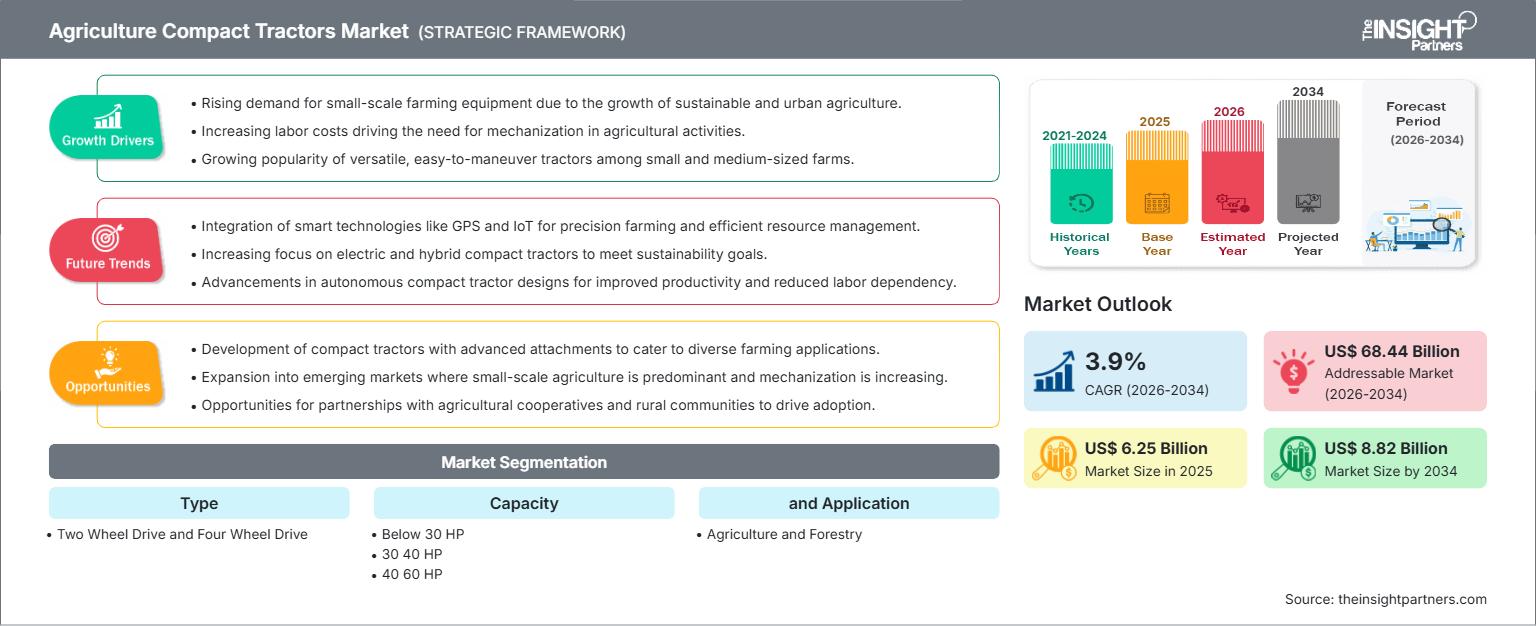
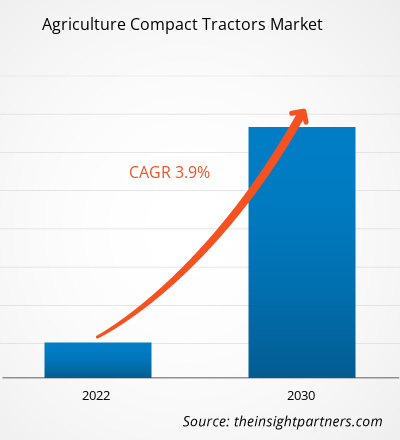
The agriculture compact tractors market size was valued at US$ 6.25 Billion in 2025 and is projected to reach US$ 8.82 Billion by 2034; it is expected to register a CAGR of 3.9% from 2026 to 2034. The demand for compact tractors will be driven by their requirements for mechanization on small farms, orchards, vineyards, and mixed agricultural land where considerations such as maneuverability, fuel economy, and attachment versatility determine purchases.
North America will grow at a CAGR rate between 3.5% and 4.1% from 2026 to 2034 owing to their use in hobby farming, rural estates, and attachment ecosystems. The United States is the key driver as compact tractors are extensively used for mowing, loading, snow ploughing, and small acreage farming operations.
Agriculture Compact Tractors Market Assessment and Insights
- North America accounted for 28–31% share in 2025 and is projected to grow at a CAGR of 3.5–4.1% between 2026–2034, supported by property maintenance, specialty farming, and strong dealership coverage.
- US represented 78–82% of North America share in 2025 and is expected to grow at a CAGR of 3.4–4.0% between 2026–2034, led by compact utility demand.
- Europe held 19–22% share in 2025 and is projected to grow at a CAGR of 2.8–3.4% between 2026–2034, with Germany, France, Italy, Spain, and the UK shaping demand.
- Asia Pacific accounted for 35–38% share in 2025 and is expected to grow at a CAGR of 4.2–4.8% between 2026–2034, led by India, China, Japan, South Korea, and Australia.
- Largest Segment: Four Wheel Drive held 61–65% market share in 2025 and is projected to grow at a CAGR of 4.0–4.6% between 2026–2034 due to traction and loader suitability.
- High Growth Segment: 30 40 HP held 42–46% market share in 2025 and is projected to grow at a CAGR of 4.3–4.9% between 2026–2034 due to multipurpose farm use.
- Key companies analyzed in detail: Yanmar Holdings Co., Ltd.; Mahindra & Mahindra Limited; TYM Corporation; Solectrac Inc.; Deere & Company; AGCO Corporation; Doosan Bobcat Inc.; CNH Industrial N.V.; TAFE Limited; Jiangsu Yueda Intelligent Agricultural Equipment Co., Ltd.; LS Mtron Ltd.; Kubota Corporation.
Source: The Insight Partners' analysis based on proprietary research, government publications, company annual reports, investor presentations, industry databases, and expert interviews.
The agriculture compact tractors market forecast highlights a shift from basic low-horsepower machines to compact platforms that combine hydrostatic transmissions, ergonomic controls, quick-attach implements, and digitally supported maintenance. Production strategies increasingly balance diesel reliability with selective electric development, while manufacturers localize assembly and dealer inventory to reduce lead times. The market also reflects a widening buyer base that includes smallholders, commercial landscapers, vineyards, municipalities, and rural lifestyle owners.
Forward momentum in the agriculture compact tractors market report is expected from mechanization programs in Asia, replacement cycles in North America, and low-emission machinery policies in Europe. Investment is likely to prioritize modular attachment systems, telematics-ready models, and financing packages for small farms. As labor availability tightens and farm consolidation changes equipment economics, agriculture compact tractors growth will depend on productivity gains per acre rather than horsepower expansion alone.
Agriculture Compact Tractors Market Report Scope
| Report Attribute | Details |
|---|---|
| Market size in 2025 | US$ 6.25 Billion |
| Market Size by 2034 | US$ 8.82 Billion |
| Global CAGR (2026 - 2034) | 3.9% |
| Historical Data | 2021-2024 |
| Forecast period | 2026-2034 |
Agriculture Compact Tractors Market Analysis
Demands arise due to small-sized farmlands, high cost of labor in rural areas, and the necessity for equipment that could perform tasks such as plowing, harvesting, transporting, sprayer operations, and loaders. Agricultural compact tractor size is also justified economically due to the fact that one tractor can be used in different season applications. The dealer network, implement makers, financiers, and maintenance network constitute the core ecosystem.
Supply dynamics remain shaped by engine availability, emissions compliance, steel costs, and regional assembly footprints. CEMA reported 26,500 European agricultural tractors of 37 kW and under registered in 2024, indicating a measurable compact-equipment base even amid weaker overall tractor demand. This context supports a cautious agriculture compact tractors analysis for developed markets, where replacement and specialization matter more than volume expansion.
The competition profile comprises both international full-line producers and small specialists. These companies include Deere & Company, CNH Industrial N.V., AGCO Corporation, Kubota Corporation, Mahindra & Mahindra Limited, Yanmar Holdings Co., Ltd., and TYM Corporation, competing in terms of dealer distribution, product range, implementation capabilities, and re-selling efficiency. Doosan Bobcat Inc., Solectrac Inc., TAFE Limited, LS Mtron Ltd., and Jiangsu Yueda Intelligent Agricultural Equipment Co., Ltd. contribute to the competitiveness in value, electric, and export segments.
Investment trends point toward electrification pilots, factory cab options, telematics, financing bundles, and attachment-led differentiation. Strategic positioning is shifting from horsepower claims toward total cost of ownership, service responsiveness, and operator comfort. The agriculture compact tractors market share held by established brands remains protected by aftersales networks, but challenger brands gain relevance where buyers prioritize price, lift capacity, and warranty coverage.
● REPORT CUSTOMIZATION
Tailor This Report To Align With Your Specific Business Requirements
This report can be customized to align precisely with your business objectives, scope, and target markets. Customization options include tailored segmentation, geography, competitive analysis, and strategic insights to support informed decision-making.
Customize This Report →WHAT YOU CAN ADJUST
- ● Segmentations
- ● Geography
- ● Competitive Analysis
- ● Language Preferences
Agriculture Compact Tractors Market: Strategic Insights
Regional Insights
North America agriculture compact tractors
North America accounted for 28–31% agriculture compact tractors market share in 2025 and is projected to expand at a CAGR of 3.5–4.1% from 2026 to 2034. Demands are high for compact tractors that can be used in small acreage farming, horse farms, vineyard management, orchard management, maintenance and rural residential operations. Higher cost and shortage of seasonal labor keeps the demands for loader-ready and mower-friendly compact tractors strong.
Financing from dealerships, attachment packages and easy availability of replacement parts helps replacement demands. Some of the regional trends in agriculture compact tractors include the use of hydrostatic transmission, factory-installed cabs, LED lights and quick attach systems.
U.S. agriculture compact tractors Market
The U.S. represented 78–82% of North America agriculture compact tractors market share in 2025 and is expected to grow at a CAGR of 3.4–4.0% from 2026 to 2034. Demand is resilient from hobby farmers, landowners, landscapers, and municipalities that reside in the “snow belt” areas due to the compact tractors with loaders, mid-mount mowers, backhoes, and rear attachments.
The companies with visible distribution within the U.S. market include Deere & Company, Kubota Corporation, Mahindra & Mahindra Limited, Yanmar Holdings Co., Ltd., TYM Corporation, Doosan Bobcat Inc., and CNH Industrial N.V. The trend of applications is to utilize 25-40 HP tractors.
Europe agriculture compact tractors Market
Europe held 19–22% agriculture compact tractors market share in 2025 and is forecast to grow at a CAGR of 2.8–3.4% from 2026 to 2034. Demand comes through professional agricultural operations, municipal operations, and high expectations for safety, cab comfort, and emission performance from Germany.
Livestock farms, estates, ground keeping and contracting are some of the features that define demand in the UK. Compact tractors continue to be important in areas where wet field operations, paddocks and rural services are involved.
Vineyards, orchards and horticulture in addition to niche crop requirements contribute to demand in France, Italy, and Spain. France has the advantage of diverse agriculture, Italy that of specialty crops, and Spain that of irrigated horticulture and fruits.
APAC agriculture compact tractors Market
APAC accounted for 35–38% agriculture compact tractors market share in 2025 and is projected to grow at a CAGR of 4.2–4.8% from 2026 to 2034. India leads volume because smallholdings, subsidy schemes, and rural financing support mechanization. China adds demand through consolidation and horticulture mechanization.
Japanese and Korean markets favor small and reliable equipment designed for intensive agriculture, orchards, and older operators. The Australian market generates demand for lifestyle farms and small livestock farms that use loaders, slashing, and fencing for their maintenance.
Middle East & Africa agriculture compact tractors Market
The Middle East & Africa agriculture compact tractors market is expected to grow at a CAGR of 3.6–4.2% from 2026 to 2034. Saudi Arabia and the UAE focus on controlled-environment agriculture, landscaping, and food-security projects, while South Africa leads regional demand through commercial farms and rural service networks.
The rest of the MEA demand is contingent on irrigation facilities, finance availability, and investments in infrastructure. Tractorettes apply to areas requiring cost-effective mechanization of smaller farms, but poor distribution of the equipment and higher costs of imported spare parts impede rapid uptake.
Segmentation Analysis
Type
Type segment in the agriculture compact tractors market is projected to grow at a CAGR of 3.7–4.3% from 2026 to 2034 as buyers weigh traction, cost, soil conditions, and attachment intensity. Four Wheel Drive dominates because compact tractors increasingly perform loader, slope, snow, and wet-field tasks. Two Wheel Drive remains relevant in cost-sensitive markets and lighter-duty operations.
- Two Wheel Drive tractors serve price-sensitive buyers, flat terrain, and light hauling applications where lower acquisition cost, simpler maintenance, and adequate field performance remain decisive purchase factors.
- Four Wheel Drive tractors hold the strongest position because improved traction, loader stability, and year-round usability support adoption across orchards, vineyards, landscaping, livestock farms, and snow operations.
Capacity
Capacity segment in the agriculture compact tractors market is projected to grow at a CAGR of 3.8–4.4% from 2026 to 2034 as buyers match horsepower to implements, emissions thresholds, and operating budgets. The 30 40 HP category is strategically important because it supports loader work, mowing, tillage, and hauling without moving into larger equipment classes.
- Below 30 HP models attract hobby farmers, estate owners, and smallholders seeking manageable machines for mowing, light loader work, garden preparation, and routine property maintenance.
- 30 40 HP tractors balance affordability and capability, making them central to agriculture compact tractors scope across mixed farms, orchards, municipalities, and rural service contractors.
- 40 60 HP tractors serve heavier implements, loader-intensive use, and commercial applications where buyers need greater lift, hydraulic output, and durability while retaining compact maneuverability.
Opportunity Snapshot
| Capacity | Revenue Contribution | Trend Tag | Adoption Stage |
| Below 30 HP | Medium | Estate Care | Mature |
| 30 40 HP | High | Utility Core | Scaling |
| 40 60 HP | Medium | Loader Duty | Scaling |
Agriculture Compact Tractors Market Growth Drivers and Impact Analysis
Small-Farm Mechanization and Labor Substitution
Farms of small to medium sizes are in more need of mechanization that provides an option for replacing the manpower without the need for large tractors. Compact tractors save time spent on tillage, transportation, mowing, spraying, and handling operations while being feasible for narrow fields. Scarcity of labor increases the importance of machinery that can be operated by one person throughout different seasons. This effect will be felt most in farms that diversified into vegetable growing, fruit tree growing, animal husbandry, and farm services.
Attachment Ecosystems Expanding Tractor Utilization
Use of compatibility results in making compact tractors into all-year-round useful items instead of being specific to certain tasks. Loader, backhoe, rotary cutter, tiller, snow blower, seeder, and pallet forks make compact tractors more versatile and increase their utility value for those who do not have vast land areas. This is beneficial for manufacturers and dealers due to increased sales, servicing opportunities, and spare part income, while the user can enjoy greater versatility.
Policy Support for Efficient Agricultural Machinery
The availability of government schemes related to mechanization, food security, emission reduction, and rural productivity makes compact tractors more affordable. Concessions, concessional loans, depreciation, and replacement policies encourage users to prefer new units over used units. These effects are evident in the developing economies where the size of farms is smaller and finances are constrained. In developed economies, the policy influence promotes cleaner engines, safety cabins, and precision equipment.
Agriculture Compact Tractors Market Future Trends
Selective Electrification in Low-Duty Applications
Electric compact tractors are likely to gain traction first in vineyards, municipalities, greenhouses, campuses, and livestock facilities where noise reduction, indoor air quality, and predictable duty cycles matter. Adoption will remain selective until battery cost, charging access, and runtime expectations improve. However, electric platforms can strengthen the agriculture compact tractors market trends by offering instant torque, lower maintenance, and compatibility with sustainability procurement rules. Dealers will need new service capabilities for batteries, software, and charging diagnostics.
Telematics-Enabled Ownership Models
With telematics, the usage of small tractors will move towards uptime management rather than being reactive when it comes to maintenance. Through information such as operating hours, fault information, location tracking, and service reminders, downtime can be reduced for fleet owners, municipalities, rental services, and contractors. Connected diagnostics can provide farmers with additional information regarding the sale of tractors as well as financial information when deciding to invest.
Agriculture Compact Tractors Market Opportunities
Dealer-Led Bundles for Smallholders
Dealers can create strong opportunities by bundling tractors with loaders, cutters, trailers, financing, insurance, and service plans tailored to smallholders. This approach reduces purchase complexity and improves buyer confidence, especially in markets where first-time mechanization is increasing. Bundles also help manufacturers protect margins when price competition intensifies. For buyers, bundled solutions clarify total ownership cost and ensure implements match tractor capability, reducing underutilization and service complaints.
Localized Assembly and Parts Availability
Localized assembly, regional sourcing, and parts stocking can improve competitiveness in markets affected by import duties, currency volatility, and long delivery times. Companies that shorten lead times and provide dependable spares can win trust among small farmers who cannot afford extended downtime. The opportunity is particularly relevant in Asia, Africa, and Latin America, where mechanization demand is rising but service gaps remain. Local partnerships can also align products with soil, crop, and financing conditions.
Recent Developments
- June 2024: Doosan Bobcat Inc. — Bobcat Company expanded its tractor lineup with the launch of three utility tractors: the Bobcat UT6066, UT6566 and UT6573. Bobcat utility tractors are built for heavy-duty work, while making it easier for operators.
- September 2025: Kubota Corporation- Kubota Tractor Corporation introduces the new Grand L70 Series, the further evolution of its flagship compact tractor. Engineered for residential and commercial operators, the Grand L70 Series includes three model options (premium, deluxe and cold weather) and delivers advanced technology in the operator seat with a multi-function loader joystick and Intelligent Hydrostatic Transmission (iHST). Plus, the all-new Kubota ProCab allows for optimal comfort and productivity year-round. All this, backed by Kubota’s quality, durability, and reliable performance.
- September 2025: Mahindra & Mahindra Limited — Mahindra launched its next-generation OJA tractor range in Australia, extending its compact and light utility tractor strategy into a developed market where small farms, lifestyle properties, and specialty operations require versatile machines.
Frequently Asked Questions

- Comprehensive Market Sizing and Forecast Analysis
- Detailed Segmentation Analysis
- In-Depth Market Dynamics Assessment
- Regional and Country-Level Insights
- Competitive Landscape and Company Benchmarking
- Strategic Business Intelligence
Recent Reports
Testimonials

The Insight Partners provided valuable market intelligence that supported our global go-to-market strategy. Their team was professional, responsive, and attentive to our feedback, providing thoughtful analysis and helpful methodological clarifications throughout the project.
Junmo Kim Chief Financial Officer (CFO), Enertech Co., Ltd.
The Insight Partners' SCADA System Market report is comprehensive, with valuable insights on current trends and future forecasts. The team was highly professional, responsive, and supportive throughout. We are very satisfied and highly recommend their services.
RAN KEDEM Partner, Reali Technologies LTDs
I requested a report on a very specific software market and the team produced the report in a few days. The information was very relevant and well presented. I then requested some changes and additions to the report. The team was again very responsive and I got the final report in less than a week.
JEAN-HERVE JENN Chairman, Future Analytica
We worked with The Insight Partners for an important market study and forecast. They gave us clear insights into opportunities and risks, which helped shape our plans. Their research was easy to use and based on solid data. It helped us make smart, confident decisions. We highly recommend them.
PIYUSH NAGPAL Sr. Vice President, High Beam Global
The Insight Partners delivered insightful, well-structured market research with strong domain expertise. Their team was professional and responsive throughout. The user-friendly website made accessing industry reports seamless. We highly recommend them for reliable, high-quality research services
YUKIHIKO ADACHI CEO, Deep Blue, LLC.
This is the first time I have purchased a market report from The Insight Partners.While I was unsure at first, I visited their web site and felt more comfortable to take the risk and purchase a market report.I am completely satisfied with the quality of the report and customer service. I had several questions and comments with the initial report, but after a couple of dialogs over email with their analyst I believe I have a report that I can use as input to our strategic planning process.Thank you so much for taking the extra time and making this a positive experience.I will definitely recommend your service to others and you will be my first call when we need further market data.
JOHN SUZUKI President and Chief Executive Officer, Board Director, BK Technologies
I wish to appreciate your support and the professionalism you displayed in the course of attending to my request for information regarding to infectious disease IVD market in Nigeria. I appreciate your patience, your guidance, and the fact that you were willing to offer a discount, which eventually made it possible for us to close a deal. I look forward to engaging The Insight Partners in the future, all thanks to the impression you have created in me as a result of this first encounter.
DR CHIJIOKE ONYIA MANAGING DIRECTOR, PineCrest Healthcare Ltd.Reason to Buy
- Informed Decision-Making
- Understanding Market Dynamics
- Competitive Analysis
- Identifying Emerging Markets
- Customer Insights
- Market Forecasts
- Risk Mitigation
- Boosting Operational Efficiency
- Strategic Planning
- Investment Justification
- Tracking Industry Innovations
- Aligning with Regulatory Trends





 Get Free Sample for