
Agricultural Films and Bonding Market Share, Growth & Forecast by 2034
Coverage: By Product Type (Agricultural Films, Twine, Netting, Others); Application (Agricultural Films, Twine, Netting), and Geography (North America, Europe, Asia Pacific, and South and Central America)
- Status : Data Released
- Report Code : TIPRE00015477
- Category : Chemicals and Materials
- No. of Pages : 150
- Available Report Formats :


- Last update date : July 27, 2026


2025 Market Size
US$ 12.24 Bn
Base year value
2034 Forecast
US$ 17.05 Bn
Projected by 2034
CAGR 2026-2034
3.75 %
Growth rate
Addressable Market
US$ 133.02 Bn
(2026-2034)
The Agricultural Films Market was valued at US$ 12.81 Billion in 2025 and is projected to reach US$ 23.24 Billion by 2034, registering a CAGR of 3.75% during 2026–2034. Agricultural films have become an integral component of modern farming systems by improving crop productivity, conserving water, suppressing weeds, and protecting crops from adverse weather conditions. Continuous innovations in polymer formulations, recyclable materials, and precision agriculture are further supporting adoption across commercial farming operations and controlled-environment agriculture.
Across North America, the market benefits from large-scale commercial farming, increasing greenhouse cultivation, and widespread adoption of precision agriculture technologies. The region is anticipated to expand at a CAGR of 5.8–6.4% through 2034, supported by rising investments in protected cultivation, labor optimization, and water conservation initiatives. The agricultural films market size continues to benefit from government programs encouraging sustainable agricultural practices and the commercialization of advanced multilayer polyethylene films.
Agricultural Films and Bonding Market Assessment and Insights
- North America: Accounted for 29–32% share in 2025 and is expected to register a CAGR of 3.3–3.9% during 2026–2034. Growth is supported by extensive greenhouse farming, precision agriculture adoption, and strong replacement demand for premium agricultural films and crop protection materials.
- U.S.: Represented 80–84% of the North American market in 2025 and is projected to grow at a CAGR of 3.4–4.0% during 2026–2034, supported by commercial agriculture, greenhouse investments, and large-scale mechanized farming operations.
- Europe: Held 26–29% share in 2025 and is forecast to expand at a CAGR of 3.5–4.1% during 2026–2034. Spain, Italy, Germany, France, and the Netherlands remain leading markets owing to advanced protected cultivation and horticultural production.
- Asia Pacific: Accounted for 31–34% share in 2025 and is anticipated to witness the fastest CAGR of 4.3–4.9% during 2026–2034. China, India, Japan, South Korea, and Australia continue expanding greenhouse cultivation, horticulture, and water-efficient farming practices.
- Largest Segment: Product Type – Agricultural Films accounted for 60–64% market share in 2025 and is expected to register a CAGR of 3.8–4.2% during 2026–2034, supported by growing use of mulch, greenhouse, and silage films.
- High Growth Segment: Application – Agricultural Films represented 58–62% market share in 2025 and is anticipated to grow at a CAGR of 4.0–4.5% during 2026–2034, driven by increasing protected cultivation and demand for climate-resilient farming solutions.
- Key companies analyzed in detail: Armando Álvarez Group, Barbier Group, BASF SE, Berry Global Group, Inc., BPI Agriculture Ltd., British Polythene Industries PLC, Britton Group, Exxon Mobil Corporation, RKW SE, Dow Inc.
Source: The Insight Partners' analysis based on proprietary research, government publications, company annual reports, investor presentations, industry databases, and expert interviews.
There have been considerable changes in agricultural production systems owing to the greater importance attached to efficient use of resources, yield improvements, and adaptability to the climate. Developments in multilayer polyethylene products, UV stabilization technologies, anti-drip technology, and increased durability have made the agricultural film applicable in greenhouses, mulch, and silage applications. At the same time, there is investment in sustainable products that are recyclable and bio-based in compliance with sustainability regulations.
In the future, investment trends will be oriented towards emerging agricultural economies as the application of protected cultivation and horticulture will continue to grow. The government policies on efficient water utilization, food security, and sustainable agriculture are driving the use of advanced agricultural films. There will be closer cooperation between polymer companies, agricultural technology suppliers, and farming organizations.
Agricultural Films and Bonding Market Report Scope
| Report Attribute | Details |
|---|---|
| Market size in 2025 | US$ 12.24 Billion |
| Market Size by 2034 | US$ 17.05 Billion |
| Global CAGR (2026 - 2034) | 3.75% |
| Historical Data | 2021-2024 |
| Forecast period | 2026-2034 |
Agricultural Films and Bonding Market Analysis
Growing pressure on global agriculture to improve productivity using limited natural resources continues to stimulate demand for advanced agricultural films. Rising adoption of protected cultivation, increasing climate variability, and growing focus on efficient water utilization are encouraging farmers to deploy high-performance polymer films across diverse applications. The agricultural films market growth is also supported by expanding commercial horticulture, increasing cultivation of fruits and vegetables, and wider implementation of precision farming technologies that maximize land productivity while minimizing operational losses.
The industry’s value chain extends from petrochemical feedstock suppliers and polymer manufacturers to film converters, distributors, agricultural cooperatives, greenhouse developers, and commercial growers. Material innovations involving LDPE, LLDPE, HDPE, and EVA formulations have enhanced durability, UV resistance, and thermal performance, enabling agricultural films to deliver longer service life while reducing replacement frequency. Simultaneously, growing emphasis on circular economy principles is encouraging the development of recyclable and biodegradable film solutions across major agricultural economies.
The agricultural films market analysis indicates that competition is increasingly centered on product innovation, sustainability initiatives, regional manufacturing expansion, and long-term supply agreements with commercial farming enterprises. Companies including BASF SE, Berry Global Group, Inc., Coveris Management GmbH, RKW SE, POLIFILM GmbH, and Novamont S.p.A. continue investing in specialty polymer technologies, recycled-content products, and bio-based materials to strengthen competitive positioning amid tightening environmental regulations and evolving customer preferences.
Investment activity across the sector increasingly targets production capacity expansion, sustainable material development, and advanced extrusion technologies capable of manufacturing multilayer films with improved optical and mechanical properties. Strategic collaborations between polymer producers, agricultural technology firms, and greenhouse infrastructure developers are accelerating the commercialization of next-generation agricultural films. Meanwhile, manufacturers are expanding regional production facilities to improve supply security, shorten delivery timelines, and better serve rapidly growing agricultural markets across Asia Pacific, Latin America, and parts of the Middle East.
● REPORT CUSTOMIZATION
Tailor This Report To Align With Your Specific Business Requirements
This report can be customized to align precisely with your business objectives, scope, and target markets. Customization options include tailored segmentation, geography, competitive analysis, and strategic insights to support informed decision-making.
Customize This Report →WHAT YOU CAN ADJUST
- ● Segmentations
- ● Geography
- ● Competitive Analysis
- ● Language Preferences
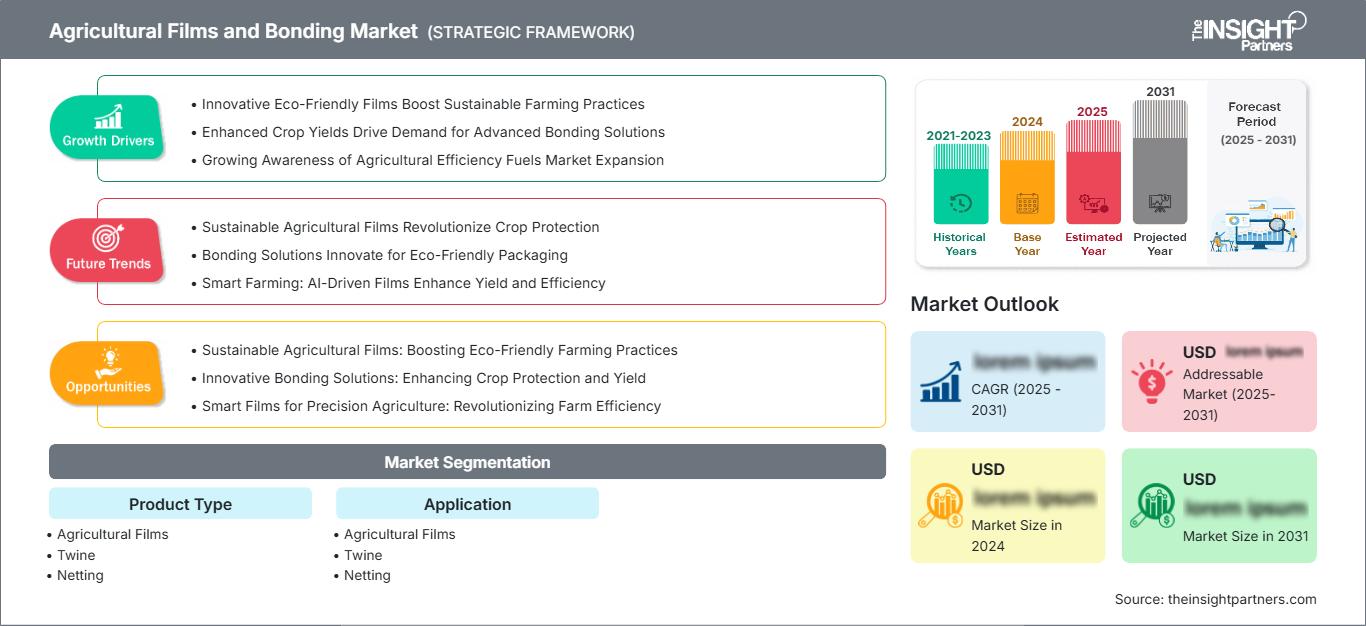
Agricultural Films and Bonding Market: Strategic Insights
Regional Insights
North America Agricultural Films and Bonding Market
North America accounted for 29–32% of the agricultural films and bonding market share in 2025 and is projected to expand at a CAGR of 3.3–3.9% during 2026–2034. The region benefits from highly mechanized farming, widespread adoption of protected cultivation, and strong investments in greenhouse infrastructure. Increasing labor shortages and climate variability have accelerated the adoption of mulch films, silage films, crop protection netting, and high-strength baling twines that improve operational efficiency while reducing production losses.
The United States and Canada continue investing in precision agriculture, water-efficient farming, and sustainable crop production systems. Commercial fruit, vegetable, and forage producers increasingly utilize advanced multilayer agricultural films with UV resistance and improved durability. Regulatory emphasis on recycling agricultural plastics and the development of circular economy initiatives are encouraging manufacturers to introduce recyclable polyethylene products with longer service life. Continuous product innovation and established distribution networks are expected to sustain regional market expansion throughout the forecast period.
U.S. Agricultural Films and Bonding Market
The United States represented 80–84% of the North American market in 2025 and is anticipated to register a CAGR of 3.4–4.0% during 2026–2034. The country remains the largest regional consumer because of extensive commercial farming, advanced greenhouse production, and widespread use of silage management systems across livestock operations. Strong presence of major polymer manufacturers and agricultural input suppliers further strengthens domestic product availability and technological innovation.
Demand continues to increase across vegetable cultivation, fruit orchards, vineyards, and forage production, where agricultural films improve soil moisture retention, temperature regulation, and crop quality. Investments in protected cultivation, coupled with growing adoption of recyclable polymer solutions and precision farming technologies, are encouraging farmers to replace conventional materials with higher-performance alternatives. Product development emphasizing durability, UV stability, and environmental compliance is expected to support long-term industry competitiveness.
Europe Agricultural Films and Bonding Market
Europe held 26–29% of the global market in 2025 and is projected to grow at a CAGR of 3.5–4.1% during 2026–2034. It is known for the advancement in horticulture and greenhouses with regulations for sustainability in agricultural production. Spain is at the forefront amongst the European countries owing to its large scale of greenhouses, whereas Italy and the Netherlands are responsible for demand in quality agricultural films and protective products.
Germany sustains its demand due to technologically advanced farming processes and sustainability in polymer materials used for agriculture. The United Kingdom is constantly growing in its controlled-environment agriculture and demands for greenhouse films and crop support products. Together, France, Italy and Spain account for significant consumption of products due to intensive fruit, vegetable and grape cultivation. More and more manufacturers from Europe are investing in recyclable agricultural plastics and biodegradable materials along with closed-loop recycling systems.
APAC Agricultural Films and Bonding Market
Asia Pacific accounted for 31–34% of the global market in 2025 and is forecast to record the highest CAGR of 4.3–4.9% during 2026–2034. China leads regional demand owing to extensive greenhouse farming and government support for modern agricultural infrastructure. India is witnessing increasing adoption of mulch films for water conservation, while Japan and South Korea emphasize high-value horticultural cultivation.
Australia continues investing in climate-resilient farming technologies, including silage films and protective netting for large-scale agricultural operations. Rapid agricultural modernization, expanding protected cultivation, and increasing awareness regarding resource-efficient farming practices are expected to sustain strong regional demand.
Middle East & Africa Agricultural Films and Bonding Market
The Middle East & Africa is projected to register a CAGR of 3.7–4.3% during 2026–2034. Saudi Arabia and the United Arab Emirates continue investing in greenhouse agriculture and water-efficient farming technologies to improve domestic food security. South Africa remains the region's largest agricultural production hub, supporting stable demand for crop protection films and baling materials.
Growing investments in irrigation infrastructure, protected cultivation, and climate-smart agriculture across the Rest of MEA are encouraging the adoption of durable agricultural polymer products. Government initiatives promoting efficient water utilization and higher crop productivity are expected to create additional opportunities for manufacturers supplying advanced agricultural films, twines, and netting solutions.
Segmentation Analysis
Type
Type remains a critical factor influencing product selection in the agricultural films market, as polymer composition determines durability, flexibility, light transmission, and resistance to environmental stress. The segment is projected to grow at a CAGR of 6.7–7.2% during 2026–2034. Continuous advancements in polymer engineering, multilayer extrusion technologies, and recyclable material development are enabling manufacturers to offer films tailored for diverse climatic conditions and farming practices. The agricultural films market scope continues to broaden as demand rises for high-performance materials that improve crop productivity while supporting sustainability objectives.
- LDPE: Low-density polyethylene remains the most widely used material owing to its excellent flexibility, transparency, and ease of processing. It is extensively utilized in greenhouse and mulching films where balanced mechanical strength and cost efficiency are essential.
- LLDPE: Linear low-density polyethylene is increasingly preferred for applications requiring higher puncture resistance, tensile strength, and durability. Its superior mechanical performance makes it suitable for multilayer agricultural films exposed to demanding field conditions.
- HDPE: High-density polyethylene offers greater rigidity, chemical resistance, and dimensional stability. It is commonly incorporated into specialized agricultural films where enhanced durability and longer service life are required under harsh environmental conditions.
- EVA: Ethylene vinyl acetate provides improved elasticity, thermal insulation, and optical clarity, making it particularly suitable for greenhouse films. The material enhances light diffusion while helping maintain stable internal temperatures for high-value crop cultivation.
Application
Application remains the primary determinant of purchasing decisions, with product performance varying according to cultivation requirements and climatic conditions. This segment is expected to expand at a CAGR of 6.9–7.5% during 2026–2034. Increasing adoption of protected cultivation, efficient water management, and modern forage preservation techniques continues driving demand across greenhouse, mulching, and silage applications. Mulching remains the dominant application, while greenhouse cultivation is witnessing the fastest expansion as commercial growers increasingly invest in climate-controlled agricultural systems.
- Greenhouse: Greenhouse films support controlled-environment agriculture by optimizing light transmission, regulating temperature, and protecting crops from adverse weather. Growing investments in year-round vegetable, fruit, and floriculture production continue to strengthen demand globally.
- Mulching: Mulching films remain the leading application because they effectively suppress weeds, reduce soil moisture evaporation, improve soil temperature regulation, and increase crop yields. Their widespread adoption across commercial farming supports sustained long-term market demand.
- Silage: Silage films are extensively used for preserving forage quality by minimizing oxygen exposure and maintaining nutritional value during storage. Rising livestock production and increasing emphasis on high-quality feed continue supporting adoption across dairy and animal farming operations.
Opportunity Snapshot
| Application | Revenue Contribution | Trend Tag | Adoption Stage |
|---|---|---|---|
| Greenhouse | High | Protected Farming | Scaling |
| Mulching | High | Soil Conservation | Mature |
| Silage | Medium | Feed Preservation | Scaling |
Agricultural Films and Bonding Market Growth Drivers and Impact Analysis
Expansion of protected cultivation and greenhouse farming
Use of protected cultivation is one of the major driving forces behind the demand for agricultural films due to increased productivity, quality crops and seasonal cultivation needs. Protected cultivation through greenhouses allows better regulation of temperature, moisture levels and pests, thus becoming highly popular in the cultivation of vegetables, fruits, herbs and flowers. Nations like China, Spain, the Netherlands, Mexico and Canada are consistently increasing their greenhouse areas in order to ensure better food security and protection from climate change. This development demands higher technology films with improved light transmission, thermal insulation, resistance to ultraviolet rays and anti-drip films. As global commercial horticulture keeps growing, companies start using multilayer films, which allow better durability and less frequent change of films.
Growing emphasis on water conservation and sustainable farming
The shortage of water supply and increase in the cost of production is making the farmers more inclined towards the usage of technology that will allow them to optimize their water use and increase soil moisture. Mulching films not only minimize evaporation loss, inhibit weed growth but also ensure the reduction in the use of herbicides and enhance agricultural production. The governments of the countries in Asia Pacific, North America, and Europe is still promoting micro-irrigation and precision agriculture by offering subsidies and investing in modernization programs, indirectly helping the agricultural film market. However, environmental legislation is also compelling producers to come up with reusable and biodegradable films.
Advancements in polymer technology and specialty film manufacturing
The continuous advancements in the field of polymers have led to the improvement of the properties of films that help producers to develop films as per the demands of farmers. The modern technology of multilayer extrusion helps in making a perfect blend of LDPE, LLDPE, HDPE and EVA so that better mechanical strength, light transmission capacity, heat insulation and higher life expectancy can be achieved. Special ingredients such as anti-fog, anti-drip, infrared retention, and UV stabilization increase the production of crops and protect them. This advancement brings down the operating costs of farmers and increases the value of products for manufacturers. With the growing interest in recycling materials and bio-based polymers, the future of film technology is very promising.
Agricultural Films and Bonding Market Future Trends
Accelerating adoption of biodegradable and circular material solutions
Growing environmental concerns surrounding agricultural plastic waste are encouraging manufacturers to commercialize biodegradable and recyclable agricultural films. The agricultural films market trends increasingly reflect investments in bio-based polymers, mechanical recycling technologies, and circular material management systems that reduce environmental impact without compromising field performance. Partnerships between polymer producers, agricultural cooperatives, and recycling organizations are expected to strengthen collection infrastructure and improve end-of-life management. As sustainability regulations become more stringent across Europe and other developed markets, the adoption of environmentally responsible agricultural films is anticipated to expand rapidly across commercial farming operations.
Integration of smart agriculture with high-performance film technologies
The future generation of agricultural production is anticipated to be the combination of advanced films along with digital farming techniques that would increase the efficiency of the process and improve crop production. The demand for optical, durable, and suitable films to be used with smart irrigation systems, climate-controlled greenhouses, remote sensing, and nutrient management technology has resulted from the above-mentioned trends. Film manufacturers would be required to produce tailor-made films that can cater to the needs of different crops in different environments.
Agricultural Films and Bonding Market Opportunities
Expanding investments in emerging agricultural economies
Emerging economies across Asia, Latin America, and Africa present substantial opportunities as governments prioritize agricultural modernization, food security, and efficient resource utilization. The agricultural films market Forecasts indicate sustained investment in greenhouse cultivation, protected horticulture, and precision irrigation across these regions. Rising production of export-oriented fruits, vegetables, and floriculture products is encouraging commercial growers to adopt advanced agricultural films that improve yield consistency and reduce climate-related risks. Manufacturers establishing regional production facilities, localized distribution networks, and technical support capabilities are likely to strengthen market penetration while benefiting from expanding commercial agriculture and favorable public-sector investment initiatives.
Development of premium specialty films for high-value crop production
Demand for high-end agricultural films is rising because farmers are growing more valuable crops that require controlled environments, such as fruits, vegetables, medicines, and ornamental plants. There are opportunities for companies to create differentiated products, such as those with advanced UV filtering, IR heat retention, anti-drip coating, selective light diffusing, and extended lifespan. This type of differentiated product allows growers to increase their production without having to incur additional expenses on maintenance and replacement of films. Those firms that are involved in research and formulation of specialized polymers suited to specific climatic regions can take advantage of this market trend.
Recent Developments
- June 12, 2026: CTK Bio Canada launched Bio-ACT, a compostable blown film designed for agricultural applications such as mulch films. The product is intended to improve biodegradability while maintaining field performance, aligning with the industry's shift toward sustainable agricultural plastics.
- August 27, 2025: BASF SE announced new VALERAS additive solutions at K 2025, including the new Tinuvin NOR 112 light stabilizer specifically developed to improve the durability and agrochemical resistance of greenhouse and plasticulture films. The innovation is designed to extend agricultural film service life while supporting circular plastics initiatives and organic farming requirements.
Frequently Asked Questions

- Comprehensive Market Sizing and Forecast Analysis
- Detailed Segmentation Analysis
- In-Depth Market Dynamics Assessment
- Regional and Country-Level Insights
- Competitive Landscape and Company Benchmarking
- Strategic Business Intelligence
Recent Reports
Testimonials

The Insight Partners' SCADA System Market report is comprehensive, with valuable insights on current trends and future forecasts. The team was highly professional, responsive, and supportive throughout. We are very satisfied and highly recommend their services.
RAN KEDEM Partner, Reali Technologies LTDs
I requested a report on a very specific software market and the team produced the report in a few days. The information was very relevant and well presented. I then requested some changes and additions to the report. The team was again very responsive and I got the final report in less than a week.
JEAN-HERVE JENN Chairman, Future Analytica
We worked with The Insight Partners for an important market study and forecast. They gave us clear insights into opportunities and risks, which helped shape our plans. Their research was easy to use and based on solid data. It helped us make smart, confident decisions. We highly recommend them.
PIYUSH NAGPAL Sr. Vice President, High Beam Global
The Insight Partners delivered insightful, well-structured market research with strong domain expertise. Their team was professional and responsive throughout. The user-friendly website made accessing industry reports seamless. We highly recommend them for reliable, high-quality research services
YUKIHIKO ADACHI CEO, Deep Blue, LLC.
This is the first time I have purchased a market report from The Insight Partners.While I was unsure at first, I visited their web site and felt more comfortable to take the risk and purchase a market report.I am completely satisfied with the quality of the report and customer service. I had several questions and comments with the initial report, but after a couple of dialogs over email with their analyst I believe I have a report that I can use as input to our strategic planning process.Thank you so much for taking the extra time and making this a positive experience.I will definitely recommend your service to others and you will be my first call when we need further market data.
JOHN SUZUKI President and Chief Executive Officer, Board Director, BK Technologies
I wish to appreciate your support and the professionalism you displayed in the course of attending to my request for information regarding to infectious disease IVD market in Nigeria. I appreciate your patience, your guidance, and the fact that you were willing to offer a discount, which eventually made it possible for us to close a deal. I look forward to engaging The Insight Partners in the future, all thanks to the impression you have created in me as a result of this first encounter.
DR CHIJIOKE ONYIA MANAGING DIRECTOR, PineCrest Healthcare Ltd.Reason to Buy
- Informed Decision-Making
- Understanding Market Dynamics
- Competitive Analysis
- Identifying Emerging Markets
- Customer Insights
- Market Forecasts
- Risk Mitigation
- Boosting Operational Efficiency
- Strategic Planning
- Investment Justification
- Tracking Industry Innovations
- Aligning with Regulatory Trends





 Get Free Sample for