
Agricultural Genotyping Market Growth, Size & Forecast by 2034
Coverage: By Product Type (Instruments and Platforms, Consumables and Reagents and Genotyping Services), Technology [PCR-Based Genotyping, NGS-Based Genotyping, Microarray-Based Genotyping, SNP Genotyping, Genotyping-by-Sequencing (GBS), and Others], Application [Marker-Assisted Selection (MAS), Trait Discovery, Germplasm Characterization, Genetic Purity Testing, Seed Quality Testing, Disease Resistance Screening, Abiotic Stress Tolerance Screening, Research Applications, and Others], End User [Agricultural Biotechnology Companies, Commercial Seed Companies, Government Agencies, Research Institutes and Universities, Contract Research Organizations (CROs), and Other], and Geography
- Status : Published
- Report Code : TIPRE00043819
- Category : Life Sciences
- No. of Pages : 407
- Available Report Formats :


- Last update date : September 07, 2026


2025 Market Size
US$ 3,469.77 Mn
Base year value
2034 Forecast
US$ 11,839.87 Mn
Projected by 2034
CAGR 2026-2034
14.6 %
Growth rate
Addressable Market
US$ 65,617.27 Mn
(2026-2034)
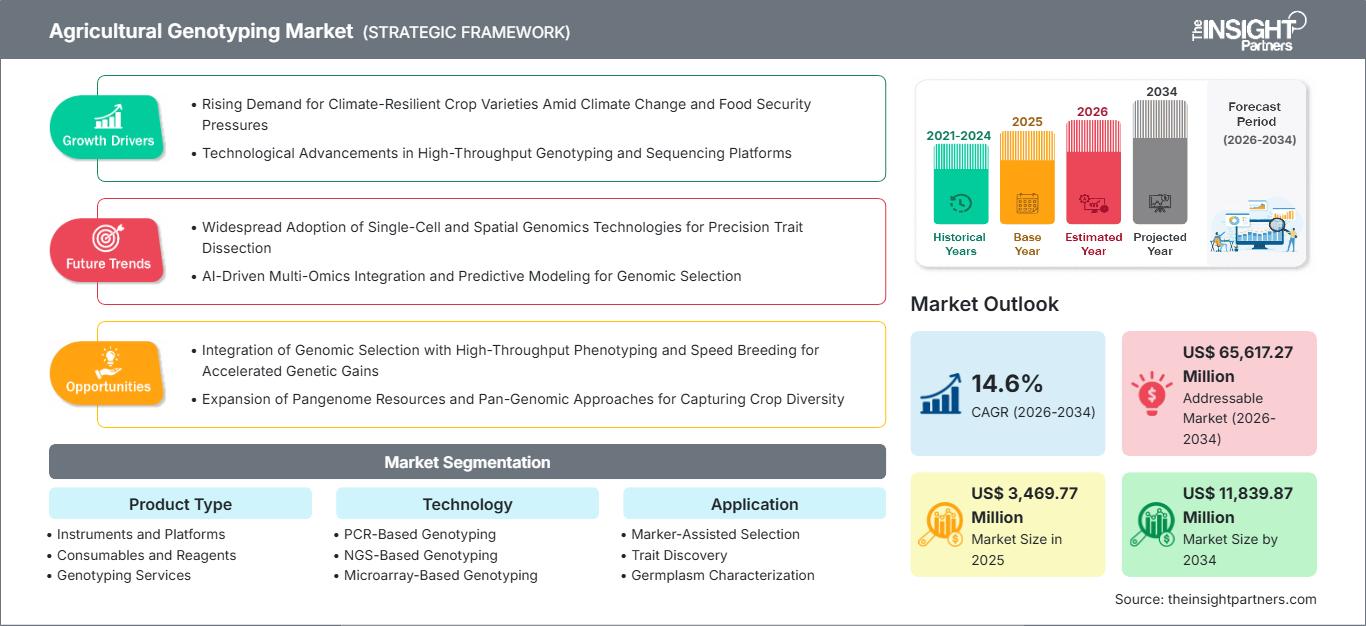
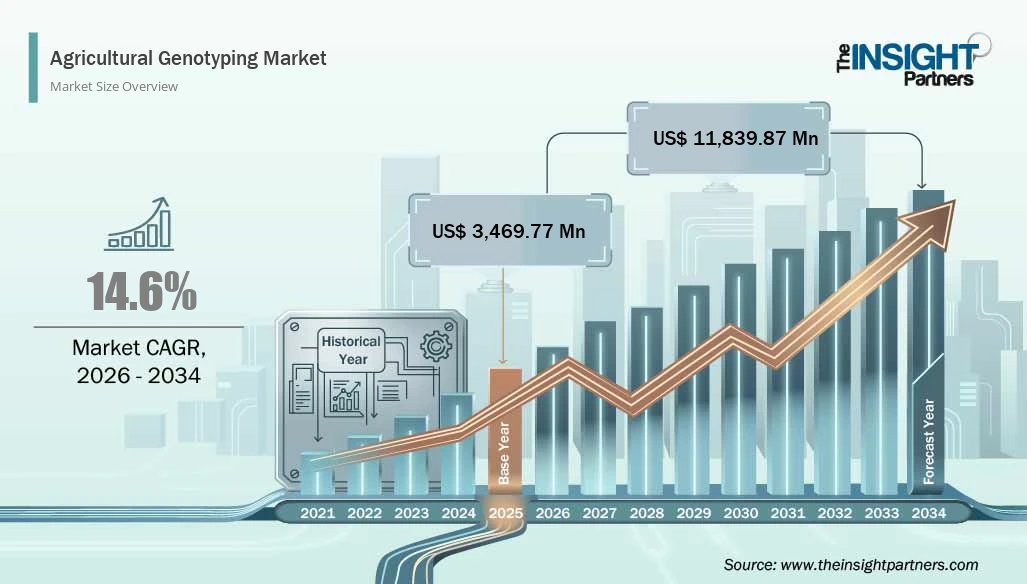
The Agricultural Genotyping Market reached US$ 3,469.77 Million in 2025 and is projected to reach US$ 11,839.87 Million by 2034, registering a CAGR of 14.6% during 2026–2034. Market growth is driven by the adoption of molecular markers, sequencing, and the use of automated genotyping workflows for crop breeding as well as traits introduction, gene quality control, and agricultural research programs where decisions need to be more rapid and reproducible.
North America have also grown steadily, and seed companies that are in place provide biotechnology capabilities and breeding infrastructure, university-industry RND collaborations help the market to grow there. The market is also set to witness strong growth with an approximate CAGR of 13.2-14.0% from 2026 to 2034 driven by demand from various sectors including high-throughput breeding, trait validation and genomic selection and major investment made by crop developers to create climate-resilient crop varieties.
Agricultural Genotyping Market Assessment and Insights
- North America: North America maintains a leading position, with a 2025 share of 38–40% and a CAGR of 13.2–14.0% during 2026–2034, supported by commercial breeding scale and established genomics infrastructure.
- US: The US represents 64–68% of North American demand in 2025 and is projected to grow at a CAGR of 12.8–13.7%, led by seed and biotechnology programs.
- Europe: Europe accounts for 25–27% in 2025 and is expected to expand at a CAGR of 13.6–14.4%, with Germany, the UK, France, Italy, and Spain supporting advanced breeding programs.
- Asia Pacific: Asia Pacific holds 23–25% in 2025 and is forecast to grow at a CAGR of 16.0–17.0%, led by China, Japan, India, South Korea, and Australia.
- Largest Segment: Consumables and Reagents represents a 43–47% market share in 2025 and is expected to expand at a CAGR of 13.8–14.7% through 2034.
- High Growth Segment: NGS-Based Genotyping represents a 17–21% market share in 2025 and is projected to grow at a CAGR of 17.5–18.5% through 2034.
- Key companies analyzed in detail: Agilent Technologies Inc., LGC Biosearch Technologies, Thermo Fisher Scientific Inc., Illumina, Inc., Bio-Rad Laboratories, Inc., Standard BioTools Inc., BGI Genomics, Neogen Corporation, Eurofins Scientific SE, QIAGEN N.V., Bayer AG, Syngenta AG, BASF SE, MolBreeding Biotech, AgriPlex Genomics, Ag-Biotech, Inc., Orion Genomics, Plant Sciences Genetics, MGI Tech Co., Ltd., 3CR Bioscience Ltd., Advanta Seeds, Nutrien Ag Solutions, Inc., and KWS SAAT SE & Co. KGaA.
Source: The Insight Partners' analysis based on proprietary research, government publications, company annual reports, investor presentations, industry databases, and expert interviews.
Agricultural genotyping market has moved beyond traditional marker assays to incorporate workflows of PCR, SNP markers, chip arrays, DNA sequencing, automation, and bioinformatics. Modern breeding programs choose technologies as per marker density, number of samples handled, time required and character complexity of trait. PCR is still a cost-effective method for screening large populations whereas new technologies based on DNA sequencing are extending the discovery and characterization in the different crop genomes and breeding populations.
The trend is to have more of these technologies in the agriculture of the developing countries, setting up local sequencing facilities, and promoting the development of plants resistant to various environmental stresses. Concerns of seed quality traceability biodiversity, and food security in the regulations will lead to even more thorough genetic description. Public research funding together with private breeding investment is expected to drive the market growth in the sector of interoperable data sets, services capable of being scaled up, and the analytical platforms able to connect genetic information to data on the phenotypes and the environment.
Agricultural Genotyping Market Report Scope
| Report Attribute | Details |
|---|---|
| Market size in 2025 | US$ 3,469.77 Million |
| Market Size by 2034 | US$ 11,839.87 Million |
| Global CAGR (2026 - 2034) | 14.6% |
| Historical Data | 2021-2024 |
| Forecast period | 2026-2034 |
Agricultural Genotyping Market Analysis
The increasing demand for agricultural genotyping is because of the need to speed up selection while also decreasing breeding cycles. Genotyping information assists the breeding companies and biotech firms to identify the right traits, check if the markers are correct, characterize the genetic pool, and identify breeding populations. The whole process from gathering samples to sequencing and integrating the results in the breeding databases is part of this area of work. That means, apart from instruments, one finds a growing demand for recurring reagents, sequencing services, library preparation, and assay panels.
Scalable approaches that are suitable for varied marker densities and sample quantities are the ones that suppliers will offer as compared to others. For instance, PCR-based tests are still a viable method of detection if you want to focus on some areas or have a limited number of DNA markers since you can run a lot of PCR tests using the same automation machine. Then again, NGS-based ways are useful for the discovery of new genes and the profiling of many markers at once. Lab processing, customization of assays, informatics, and technical service combination by the suppliers could help them deal with the diversity that crops and different breeding phases present.
The competitive nature has been analyzed as Agricultural Genotyping market comprises of varied life sciences suppliers, sequencing companies, agricultural biotechnology firms, and dedicated genomics services. In the platforms, reagents, or laboratory technologies segment, Agilent Technologies Inc. Thermo Fisher Scientific Inc. Illumina Inc. Bio-Rad Laboratories, Inc. Standard BioTools Inc. QIAGEN N.V. and MGI Tech Co. Ltd. take a lead role whereas, agricultural genotyping workflows or assaying are the areas where LGC Biosearch Technologies and AgriPlex Genomics stand out among competitors. To keep up with changes and developments, the main point is not only to get a particular tool, but also to have the ability of handling whole workflow. Companies such as Bayer AG, Syngenta AG, and BASF SE have their breeding activities and because of this rely heavily on marker systems that do not fail and are able to scale up their genetic analyses. While these companies offer products and solutions to breeding and biotechnology fields, other specialists such as Eurofins Scientific SE. MolBreeding Biotech and BGI Genomics differentiate themselves among others through their services customization crop specialization, and/or geographic reachability.
● REPORT CUSTOMIZATION
Tailor This Report To Align With Your Specific Business Requirements
This report can be customized to align precisely with your business objectives, scope, and target markets. Customization options include tailored segmentation, geography, competitive analysis, and strategic insights to support informed decision-making.
Customize This Report →WHAT YOU CAN ADJUST
- ● Segmentations
- ● Geography
- ● Competitive Analysis
- ● Language Preferences
Agricultural Genotyping Market: Strategic Insights
Regional Insights
North America Agricultural Genotyping Market
North America accounted for 38–40% of Agricultural Genotyping Market revenue in 2025 and is expected to grow at a CAGR of 13.2–14.0% during 2026–2034. The region benefits from concentrated commercial seed operations, advanced agricultural biotechnology, extensive university research, and mature laboratory networks. High-throughput marker-assisted breeding remains an important demand source.
The US represents 64–68% of regional demand in 2025, while Canada contributes through cereal, oilseed, pulse, and specialty crop research. Climate adaptation, disease resistance, and productivity objectives are increasing the need for rapid genetic screening. Established procurement channels also support adoption of automated PCR, microarray, sequencing, and genotyping services across commercial and public breeding programs.
U.S. Agricultural Genotyping Market
The U.S. Agricultural Genotyping Market represents 64–68% of North American demand in 2025 and is projected to grow at a CAGR of 12.8–13.7% through 2034. The country combines large commercial seed operations with extensive public breeding and biotechnology research capacity, supporting recurring genotyping requirements.
Company presence spans major platform suppliers and specialized agricultural genomics providers. Applications increasingly emphasize marker-assisted selection, trait discovery, genetic purity testing, and disease-resistance screening. The scale of corn, soybean, cotton, wheat, and specialty crop breeding also encourages automated workflows that process large sample volumes while preserving compatibility with existing breeding databases and analytical systems.
Europe Agricultural Genotyping Market
Europe represented 25–27% of Agricultural Genotyping Market revenue in 2025 and is forecast to expand at a CAGR of 13.6–14.4%. Germany is a leading national market because of its agricultural research base, seed industry, and biotechnology capabilities. The UK also maintains strong genomics expertise across universities, breeding programs, and agricultural research organizations.
France, Italy, and Spain provide additional demand through cereal, oilseed, horticultural, and specialty crop programs. France benefits from large-scale crop research, Italy from horticultural and specialty breeding, while Spain combines seed development with increasing climate-resilience priorities. Across Europe, regulatory scrutiny and traceability requirements reinforce demand for reliable genetic characterization and quality-control workflows.
APAC Agricultural Genotyping Market
APAC Agricultural Genotyping Market held 23–25% in 2025 and is projected to grow at a CAGR of 16.0–17.0%, making it the fastest-growing major region. China leads regional adoption, followed by Japan, India, South Korea, and Australia. Expansion is supported by crop improvement programs, biotechnology investment, and food-security priorities.
China combines extensive breeding capacity with genomics infrastructure, while India is strengthening agricultural biotechnology and research capabilities. Japan and South Korea emphasize advanced crop science, and Australia has strong requirements for grain and drought-resilience breeding. Public programs, private seed investment, and expanding sequencing access should continue broadening adoption.
Middle East & Africa Agricultural Genotyping Market
Middle East & Africa Agricultural Genotyping Market is expected to grow at a CAGR of 11.8–12.8%. Saudi Arabia and the UAE are developing biotechnology and controlled-environment agriculture capabilities, while South Africa remains a leading regional base for crop research and seed development. Infrastructure investment is gradually improving access to advanced testing.
Saudi Arabia and the UAE increasingly link genomics with food-security strategies, water efficiency, and agricultural technology. South Africa supports maize, horticultural, and livestock-related research ecosystems, while the Rest of MEA remains more dependent on public research and specialized service providers. Energy costs, laboratory infrastructure, and technical workforce availability remain important adoption considerations.
Segmentation Analysis
Product Type
The Product Type segment is projected to grow at a CAGR of 14.0–14.8% during 2026–2034. Recurring laboratory consumption supports consumables and reagents, while instruments and platforms remain essential for laboratories scaling throughput. Genotyping services provide flexible capacity for organizations lacking specialized infrastructure or seeking outsourced processing.
- Instruments and Platforms: Demand centers on automated PCR, microarray, and sequencing systems capable of supporting increasing sample throughput, workflow reproducibility, and integration with laboratory information systems.
- Consumables and Reagents: Consumables and reagents retain strategic importance because recurring assay chemistry, probes, primers, enzymes, library preparation materials, and plates directly support routine genotyping volumes.
- Genotyping Services: Services address outsourcing requirements, specialized assay development, capacity constraints, and access to advanced sequencing or analytical expertise without equivalent capital investment.
Technology
The Technology segment is expected to register a CAGR of 14.8–15.6% during 2026–2034. Adoption increasingly reflects application-specific tradeoffs involving marker density, turnaround time, cost, discovery capability, and genome complexity, encouraging coexistence of established and emerging approaches.
- PCR-Based Genotyping: PCR remains important for targeted, high-volume assays where breeders require predictable turnaround, relatively straightforward workflows, and cost control across routine selection programs.
- NGS-Based Genotyping: NGS-based workflows support high-density characterization, marker discovery, and complex genomic analysis, strengthening their role in research-intensive breeding and increasingly scalable commercial applications.
- Microarray-Based Genotyping: Microarrays provide standardized high-density marker interrogation and remain strategically useful where established marker sets, reproducibility, and large cohort processing are priorities.
- SNP Genotyping: SNP genotyping supports rapid identification of allelic variation and remains central to marker-assisted selection, genetic purity testing, parentage assessment, and trait-linked screening.
- Genotyping-by-Sequencing (GBS): GBS enables simultaneous marker discovery and genotyping across populations, making it particularly useful for diverse germplasm and breeding programs with incomplete reference resources.
- Others: Other technologies retain specialized relevance where particular crop genomes, marker configurations, or research objectives require approaches outside dominant PCR, sequencing, array, or SNP workflows.
Application
The Application segment is forecast to grow at a CAGR of 14.3–15.1% during 2026–2034. Commercial breeding remains the principal demand engine, while discovery, quality testing, stress screening, and research applications broaden utilization across the agricultural value chain.
- Marker-Assisted Selection (MAS): MAS remains a core breeding application because genetic markers enable breeders to prioritize plants carrying favorable alleles before extensive field evaluation.
- Trait Discovery: Trait discovery applications use genomic information to identify associations supporting improved yield, quality, disease resistance, stress tolerance, and other breeding objectives.
- Germplasm Characterization: Genotyping helps classify genetic diversity, establish relationships among accessions, and guide conservation and utilization of valuable breeding resources.
- Genetic Purity Testing: Genetic purity testing supports seed identity, parent verification, hybrid integrity, and quality assurance where conventional visual assessment cannot resolve genetic differences.
- Seed Quality Testing: Genomic approaches strengthen seed testing by enabling identity confirmation and detection of genetic characteristics relevant to commercial quality programs.
- Disease Resistance Screening: Disease resistance screening uses marker information to accelerate identification of resistant breeding material and reduce dependence on lengthy phenotype-only evaluations.
- Abiotic Stress Tolerance Screening: Genotyping supports selection for drought, salinity, temperature, and other stress-related traits, particularly where climate variability increases breeding priorities.
- Research Applications: Research applications encompass population studies, genome-wide association analysis, functional genomics, and validation of candidate markers across breeding populations.
- Others: Other applications address specialized agricultural research and quality-control requirements where genetic information provides additional evidence for selection or characterization decisions.
End User
The End User segment is projected to grow at a CAGR of 14.1–14.9% during 2026–2034. Commercial seed organizations and agricultural biotechnology companies drive recurring demand, while research institutions and service providers expand access to advanced genotyping capabilities.
- Agricultural Biotechnology Companies: Agricultural biotechnology companies use genotyping to connect molecular findings with breeding, trait validation, research, and commercialization decisions across multiple crop development programs.
- Commercial Seed Companies: Commercial seed companies require scalable genetic screening for parental selection, hybrid development, purity assessment, trait validation, and accelerated breeding pipelines.
- Government Agencies: Government agencies apply genotyping to germplasm conservation, agricultural research, seed regulation, food-security initiatives, and national crop improvement programs.
- Research Institutes and Universities: Research institutes and universities use diverse genotyping technologies for discovery, population analysis, breeding science, genetic resource characterization, and experimental validation.
- Contract Research Organizations (CROs): CROs provide specialized laboratory and analytical capacity for organizations requiring outsourced genotyping, custom assays, sequencing, or population-scale data generation.
- Other: Other users include specialized agricultural laboratories and organizations conducting targeted genetic testing, quality assessment, or applied breeding activities outside the principal end-user categories.
Opportunity Snapshot
| Segment Name | Revenue Contribution | Trend Tag | Adoption Stage |
|---|---|---|---|
| Agricultural Biotechnology Companies | High | Trait Validation | Scaling |
| Commercial Seed Companies | High | Genomic Selection | Mature |
| Government Agencies | Medium | Germplasm Mapping | Scaling |
| Research Institutes and Universities | Medium | SNP Discovery | Mature |
| Contract Research Organizations (CROs) | Medium | Outsourced Genotyping | Scaling |
| Other | Low | Custom Screening | Emerging |
Agricultural Genotyping Market Growth Drivers and Impact Analysis
Acceleration of Climate-Resilient Crop Breeding
The unpredictable climate is emphasizing the importance of having plants genetically screened to be drought resistant, able to cope with heat stress, to tolerate salinity, to be disease resistant and finally to be yield stable. With genotyping, breeding agencies can determine the presence of the favorable alleles earlier during the development stage, this way avoiding the need in most cases to phenotypically characterize the whole season on such plants. The commercial effect of this is most marked in the cases where very large breeding populations lead to high costs for field evaluation. Breeding efforts related to the climatic changes are now more diverse than before. As a result, the buyers want marker panels that can detect a number of characteristics all at once, not just marker-assisted selection for individual traits such as disease resistance. The companies able to deliver tailored gene content, flexible sample turnaround, and data analysis support, more favorable reactions from the buyers. This also opens a market opportunity for public breeders and in particular in areas where food-security needs call for quicker development of cultivars adapted to local conditions as well as the better use of limited resources of agricultural research.
Expansion of Genomic Selection in Commercial Seed Pipelines
Because genomic data can help in ranking breeding lines for testing, commercial seed companies are increasingly relying on genotype data when making the selection of material. So, the demand pattern is shifting from one-off research testing to consistent workflow-based requests for DNA extraction, assay processing, genotyping, and data analysis. Larger breeding programs place more emphasis on automation and consistent and fast turnaround of assays than just having an isolated analytical capability. Because of this, the market change is not limited to one technology but encompasses different stages from PCR and SNP to microarray and sequencing. As each stage - discovery validation selection, and quality control - needs different levels of marker coverage, the breeding programs make choices based on marker density. Those data and service providers can get the greatest workflow-related benefit who can seamlessly connect various breeding stages through the data. Such a request pattern creates a regular stream of consumables revenue and is a driver of investment in scalable service models.
Integration of Genotyping With Digital Breeding Systems
The combination of genotyping results with managing platforms for breeding is becoming a very important operational need. Breeders are increasingly requiring genotype information connected with pedigree phenotype environment observations, trial results, and the history of selection. This integration of information reduces the need for manually handling data and enables molecular results to rapidly influence breeding decisions. Vendors with interoperable software, standardized data formats, automated quality-control functions, and analytical pipelines that can handle large marker datasets will probably benefit from this change in the market. Service providers who are able to combine lab work with bioinformatics will probably see a greater demand for their services rather than those who only supply genotype calls. Integrated workflows over time should be able to reduce operational bottlenecks, leading to an enhanced use of the existing sequencing, PCR, and array facilities of the commercial and public breeding organisations.
Agricultural Genotyping Market Future Trends
AI-Enabled Interpretation of Genomic and Phenotypic Data
A shift in the Agricultural Genotyping Market will reflect artificial intelligence systems that bring genotype phenotype environment, pedigree, and pedigree plus breeding data together. Genotyping has usually been perceived through laboratory output. In contrast, a new generation of systems will, select breeding candidates, recognize interesting markers identify problems in the data, and develop models showing how traits are connected. These technologies mainly appear in cases where a large breeding population produces a big set of standardized dataset for algorithm training and verification. The use of AI may result in sequencing laboratories and breeding-management software becoming more integrated. Apart from instrument features vendors may stand out using decision-support tools, workflow automation, and clear analytical models. This development might bring the economic valuation of genotypes higher, and it would be a good support of breeders in transforming big molecular datasets to decision points for breeding.
Distributed and Targeted Sequencing Workflows
Targeted sequencing will probably become more common because breeders want a large number of markers but do not want to run the entire genomes through the equipment for each sample. New targeted sets, library prep, automation and economical sequencer usage will facilitate the development of flexible and diverse pipelines of discovery validation genomic selection and quality control. A system with multiple, decentralized laboratories at various levels may also be extended as breeding centers in different regions aim at faster processing of the result as well as reducing the transport of the samples. This new setup would involve the preparation of samples locally and the sequencing and data analysis to be carried out by the centralized or by the cloud-based facilities. This would help mainly the developing agricultural sectors where building infrastructure with high capital inputs is a problem. The use of uniform sample panels, data systems which can work together and offering laboratory services through access could reduce the barriers for entry and at the same time enable breeders to change laboratory testing volumes according to the time of the season and the priorities of the respective projects.
Agricultural Genotyping Market Opportunities
Localized Genomics Capacity in Emerging Agricultural Economies
The agricultural genotyping market proposes that suppliers who set localized testing centers, technical support and service capabilities in high agriculture growth economies will benefit greatly from such market conditions and have substantial potential for their business development activities. This is mainly supported by countries such as China India Southeast Asia, and parts of Middle East have very high agricultural populations and at the same time, are becoming more invested in biotechnology and foodsecurity. Setting up local labs can help cut down on sample transportation time, boost result speed, and allow for the development of region-specific crops and characteristics that may receive less attention from global gene panels. Besides, joint ventures with universities, government bodies, seed producers, and contract labs are an efficient way to break into new markets while spreading construction costs. This way, possible investment targets go further than instrument sales, covering sequencing services, DNA analysis tools, sample processing bioinformatics education, and after-sales service. Customer retention through regional business models will be enhanced by adapting work processes to local planting schedules and regulatory needs.
Integrated Genotyping Platforms for Multi-Trait Breeding
Another major opportunity lies in the creation of tools that bring together different molecular breeding technologies and data analytics functionalities within a shared breeding setup. With breeders handling many traits from high yield to resistance to diseases and stresses, as well as traits related to genetic purity, there is a clear trend toward using multifunctional flexible gene markers panels and combining datasets from different platforms rather than having separate test panels. By providing flexible test panel content, automating sample tracking, offering quality-control analytics and data interpretation alongside physical laboratory supplies, suppliers stand to gain more value than usual. Technology providers and seed company alliances would be able to bring about crop-specific panel validation very swiftly and at the same time create a base of regular testing volumes. Resources should be directed to such platforms which help users transit from one development stage to another seamlessly without requiring them to redo their laboratory setup repeatedly. These combinations not only can help in developing services-oriented purchasing models for companies that have fluctuating seasonal workloads but also allow for more sustainable procurement methods.
Recent Developments
- February 2026: Illumina, Inc. launched TruPath Genome, introducing a whole-genome workflow designed to simplify sample-to-sequencer processing. Although the launch is primarily positioned for genomic research, its relevance to agricultural genomics lies in continued advancement of sequencing workflow efficiency, data quality, and throughput. The development reinforces the broader technology trajectory toward increasingly streamlined genomic analysis platforms. Illumina press release
- December 2025: Agilent Technologies Inc. opened an India Refurbishment Center in Manesar, Haryana, expanding access to certified pre-owned laboratory instruments and supporting localized scientific infrastructure. The investment is relevant to agricultural genomics because lower-cost access to laboratory equipment can broaden the addressable base for advanced molecular workflows across research, food, environmental, and applied agricultural laboratories. Agilent announcement
- March 2026: Neogen Corporation announced the sale of its Genomics business to Zoetis. The transaction represents a strategic reshaping of the genomics competitive landscape and transfers the business to a company with a strong animal-health orientation. For market participants, the development is relevant because ownership changes can alter service portfolios, customer relationships, technology investment priorities, and competitive positioning within agricultural genomics.
Frequently Asked Questions

- Comprehensive Market Sizing and Forecast Analysis
- Detailed Segmentation Analysis
- In-Depth Market Dynamics Assessment
- Regional and Country-Level Insights
- Competitive Landscape and Company Benchmarking
- Strategic Business Intelligence
Recent Reports
Testimonials

The Insight Partners provided valuable market intelligence that supported our global go-to-market strategy. Their team was professional, responsive, and attentive to our feedback, providing thoughtful analysis and helpful methodological clarifications throughout the project.
Junmo Kim Chief Financial Officer (CFO), Enertech Co., Ltd.
The Insight Partners' SCADA System Market report is comprehensive, with valuable insights on current trends and future forecasts. The team was highly professional, responsive, and supportive throughout. We are very satisfied and highly recommend their services.
RAN KEDEM Partner, Reali Technologies LTDs
I requested a report on a very specific software market and the team produced the report in a few days. The information was very relevant and well presented. I then requested some changes and additions to the report. The team was again very responsive and I got the final report in less than a week.
JEAN-HERVE JENN Chairman, Future Analytica
We worked with The Insight Partners for an important market study and forecast. They gave us clear insights into opportunities and risks, which helped shape our plans. Their research was easy to use and based on solid data. It helped us make smart, confident decisions. We highly recommend them.
PIYUSH NAGPAL Sr. Vice President, High Beam Global
The Insight Partners delivered insightful, well-structured market research with strong domain expertise. Their team was professional and responsive throughout. The user-friendly website made accessing industry reports seamless. We highly recommend them for reliable, high-quality research services
YUKIHIKO ADACHI CEO, Deep Blue, LLC.
This is the first time I have purchased a market report from The Insight Partners.While I was unsure at first, I visited their web site and felt more comfortable to take the risk and purchase a market report.I am completely satisfied with the quality of the report and customer service. I had several questions and comments with the initial report, but after a couple of dialogs over email with their analyst I believe I have a report that I can use as input to our strategic planning process.Thank you so much for taking the extra time and making this a positive experience.I will definitely recommend your service to others and you will be my first call when we need further market data.
JOHN SUZUKI President and Chief Executive Officer, Board Director, BK Technologies
I wish to appreciate your support and the professionalism you displayed in the course of attending to my request for information regarding to infectious disease IVD market in Nigeria. I appreciate your patience, your guidance, and the fact that you were willing to offer a discount, which eventually made it possible for us to close a deal. I look forward to engaging The Insight Partners in the future, all thanks to the impression you have created in me as a result of this first encounter.
DR CHIJIOKE ONYIA MANAGING DIRECTOR, PineCrest Healthcare Ltd.Reason to Buy
- Informed Decision-Making
- Understanding Market Dynamics
- Competitive Analysis
- Identifying Emerging Markets
- Customer Insights
- Market Forecasts
- Risk Mitigation
- Boosting Operational Efficiency
- Strategic Planning
- Investment Justification
- Tracking Industry Innovations
- Aligning with Regulatory Trends





 Get Free Sample for