
Agricultural Pheromones Market Demand, Trends & Forecast by 2034
Agricultural Pheromones Market Size and Forecasts (2021–2034), Global and Regional Share, Trends, and Growth Opportunity Analysis Report Coverage : by Type (Sex Pheromones, Aggregation Pheromones); Function (Mating Disruption, Mass Trapping, Detection and Monitoring); Mode of Application (Dispensers, Traps, Sprays); Crop Type (Fruits and Nuts, Field Crops, Vegetable Crops); and Geography (North America, Europe, Asia Pacific, and South and Central America)
- Status : Data Released
- Report Code : TIPRE00040379
- Category : Chemicals and Materials
- No. of Pages : 150
- Available Report Formats :


- Last update date : July 27, 2026


2025 Market Size
US$ 3.76 Bn
Base year value
2034 Forecast
US$ 11.11 Bn
Projected by 2034
CAGR 2026-2034
14.50 %
Growth rate
Addressable Market
US$ 70.74 Bn
(2026-2034)
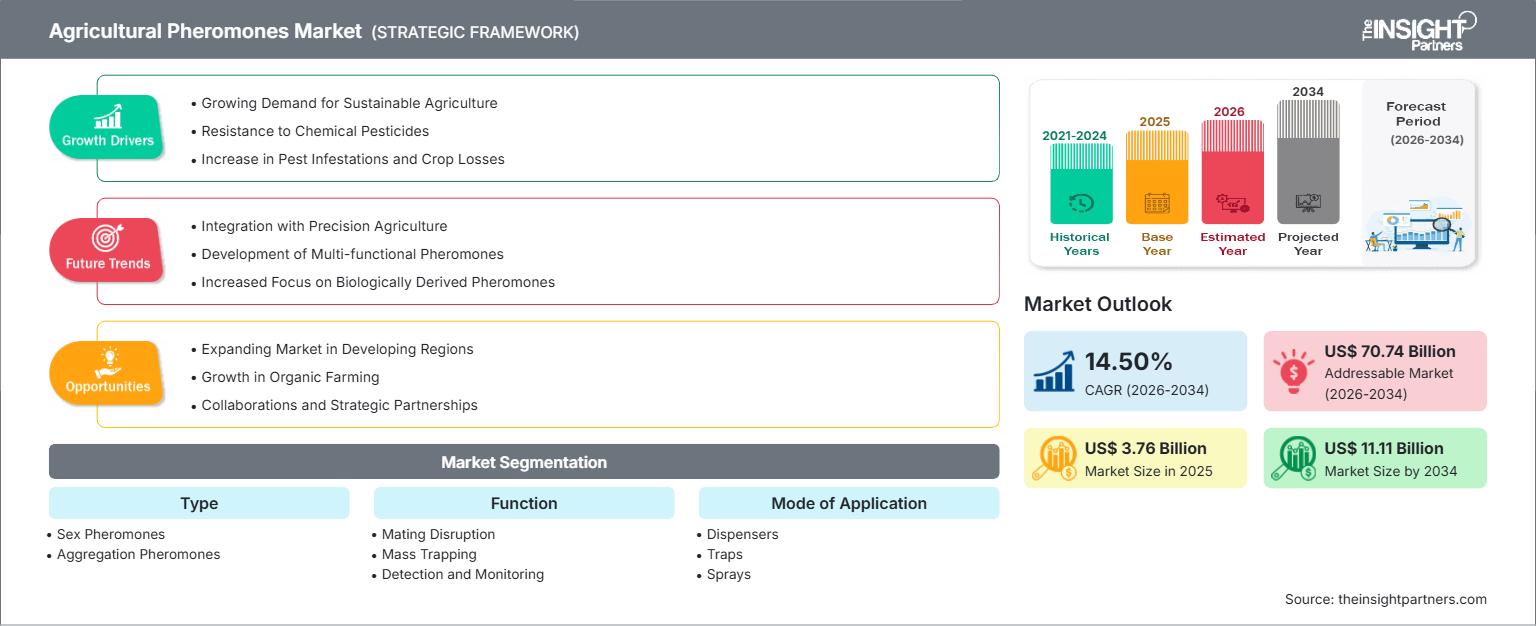
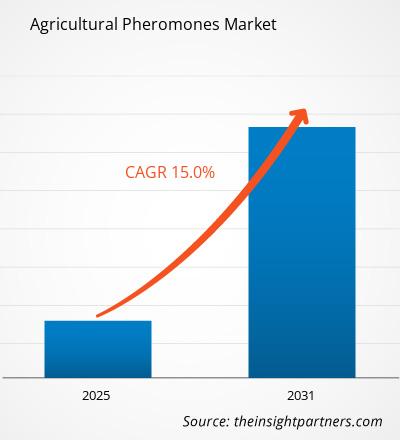
The agricultural pheromones market size is valued at US$ 3.76 Billion in 2025, which is expected to grow to US$ 11.11 Billion by 2034 with a CAGR of 14.50% from 2026 to 2034. Increasing use of IPM, rising regulation of conventional chemical pesticides, and the growing significance of sustainable crop protection solutions are among the key factors that are fueling the development of technology based on pheromones for pest management in commercial agriculture. Advancements in controlled release technologies and precision spraying systems add up to the prospects for long-term growth of the market.
Adoption of these products continues to gain momentum in North America owing to advanced programs on integrated pest management, regulatory support for biological crop protection products, as well as the growing cultivation of premium horticulture crops in the region. Agricultural pheromones market size in North America is also driven by the increasing investments in precision agriculture and sustainable farming practices. Market for agricultural pheromones in North America is expected to record a CAGR of 13.0–13.8% from 2026 to 2034.
Agricultural Pheromones Market Assessment and Insights
- North America: North America accounted for 31–33% share in 2025 and is projected to expand at a CAGR of 13.0–13.8% during 2026–2034, supported by widespread adoption of integrated pest management, advanced farming technologies, and favorable regulatory pathways for semiochemical-based crop protection.
- U.S.: The U.S. represented 84–87% of the North American market in 2025 and is expected to grow at a CAGR of 13.2–14.0% during 2026–2034, driven by extensive fruit and nut cultivation, biological crop protection programs, and strong commercialization of pheromone technologies.
- Europe: Europe held 28–30% share in 2025 and is anticipated to register a CAGR of 13.6–14.4% during 2026–2034, with Spain, Italy, France, Germany, and the Netherlands leading adoption due to stringent pesticide regulations and sustainable farming initiatives.
- Asia Pacific: Asia Pacific accounted for 27–29% of the agricultural pheromones market share in 2025 and is forecast to expand at a CAGR of 15.6–16.4% during 2026–2034, led by China, Japan, India, and Australia through increasing horticultural production and government support for biological crop protection.
- Largest Segment: Sex Pheromones remained the dominant type segment with a market share of 68–72% in 2025 and is projected to grow at a CAGR of 14.0–14.8% during 2026–2034, owing to their extensive use in mating disruption and monitoring applications.
- High Growth Segment: Mating Disruption emerged as the fastest-growing function segment with a market share of 41–45% in 2025 and is expected to register a CAGR of 15.2–16.0% during 2026–2034, reflecting increasing replacement of broad-spectrum insecticides in specialty crop cultivation.
- Key companies analyzed in detail: Shin-Etsu Chemical Co., Ltd., BASF SE, Mitsui & Co., Ltd., Biobest Group NV, The Wonderful Company LLC, Laboratorios Agrochem S.L., International Pheromone Systems Ltd., SEDQ Healthy Crops S.L., Koppert B.V., Russell IPM Ltd.
Source: The Insight Partners' analysis based on proprietary research, government publications, company annual reports, investor presentations, industry databases, and expert interviews.
Technological developments in semiochemical synthesis, controlled-release dispenser design, and sophisticated monitoring tools have led the industry to develop from a niche biological control application to an essential element of integrated pest management. The industry participants are constantly upgrading formulation stability, applicability in the field, and specificity while increasing capacity to satisfy growing demands of valuable crops. Such technological development makes the efficacy against economically important insects higher, decreasing the influence on environment and presence of chemical residues in the environment.
The future development of the industry will be fostered by increasing regulatory emphasis on the use of biological crop protection, development of digital agriculture, and investment in sustainable pest management technologies. Emerging economies are developing their integrated pest management programs, and the producers focus on production of residue-free crops for domestic and export markets. Research on novel pheromones and improved delivery systems is likely to produce commercial opportunities for the agricultural pheromones market.
Agricultural Pheromones Market Report Scope
| Report Attribute | Details |
|---|---|
| Market size in 2025 | US$ 3.76 Billion |
| Market Size by 2034 | US$ 11.11 Billion |
| Global CAGR (2026 - 2034) | 14.50% |
| Historical Data | 2021-2024 |
| Forecast period | 2026-2034 |
Agricultural Pheromones Market Analysis
Continued tightening of regulations on the use of traditional insecticides, combined with an increase in the use of integrated pest management strategies, will drive the agricultural pheromones market in commercial agriculture. More and more farmers are relying on pheromone solutions to manage commercially important insect pests without leaving any residues and keeping good insects intact. Increasing consumer demand for residue-free fruits, vegetables, and nuts along with an increasing area under organic farming will contribute to commercial adoption of pheromones in the agricultural pheromone market. The increasing awareness about managing insect resistance and protecting biodiversity is making farmers adopt pheromones as their crop protection method.
The agricultural pheromone supply chain includes chemical intermediates, synthesis of pheromones, formulation development, dispensers manufacturing, distribution partners, crop consultants, and agricultural producers. The collaboration between research organizations, crop protection companies, and precision agriculture technology providers will continue to improve product effectiveness while lowering application costs. Digital platforms for monitoring, automation of trapping, and predictive models of pest forecasts are increasingly being used together with pheromone solutions.
According to the agricultural pheromones market report, the competitive landscape will be determined by innovations in formulation, species-specific product lines, approval of products, and strategic alliances, apart from just manufacturing capacity in the coming years. Companies like Shin-Etsu Chemical Co., Ltd., BASF SE, Koppert B.V., Russell IPM Ltd., Biobest Group NV, and International Pheromone Systems Ltd. will keep spending on research as well as on the commercialization of cutting-edge mating disruption technology, while Laboratorios Agrochem S.L. and SEDQ Healthy Crops S.L. will bolster their regional product line within the agricultural industry in the Mediterranean region.
Investments will be concentrated on controlled release technologies, biodegradable dispensers, automated monitoring systems, and entering emerging agricultural markets that have favorable policies in biological crop protection. Manufacturers will increase their manufacturing capabilities and will get new product registrations covering more pest species and more crops. The collaborative efforts of agricultural research institutes, technology providers, and crop protection companies will help them launch the next generation of pheromone technology that will help improve the efficiency of pest management and will support sustainable agriculture production.
● REPORT CUSTOMIZATION
Tailor This Report To Align With Your Specific Business Requirements
This report can be customized to align precisely with your business objectives, scope, and target markets. Customization options include tailored segmentation, geography, competitive analysis, and strategic insights to support informed decision-making.
Customize This Report →WHAT YOU CAN ADJUST
- ● Segmentations
- ● Geography
- ● Competitive Analysis
- ● Language Preferences
Agricultural Pheromones Market: Strategic Insights
Regional Insights
North America Agricultural Pheromones Market
North America contributed to a share of 31-33% in the market of agricultural pheromones in 2025 and is estimated to grow at a CAGR of 13.0-13.8% through 2026-2034. Robust regulatory initiatives in favor of biological crop protection products, use of IPM programs, and extensive planting of high-value crops such as fruits, nuts, and vegetables continue to boost market demand. Increasing penetration of precision agriculture solutions and advanced digital pest surveillance technologies further improve the efficiency of pheromone-based crop protection programs on commercial farms.
In addition, availability of well-established supply chain for biological crop protection products, ongoing research partnerships, and awareness among growers about residue-free farming techniques further support the regional market demand. Strict regulation on the use of insecticides along with growing investments in sustainable agriculture are further boosting adoption of pheromones. Ongoing innovations in product offerings, registration of pests, and collaboration between pheromone makers and agricultural extension agencies are likely to consolidate the leadership of North America through the assessment period.
U.S. Agricultural Pheromones Market
The U.S. represented 84–87% of the North American market in 2025 and is anticipated to register a CAGR of 13.2–14.0% during 2026–2034. Extensive cultivation of almonds, apples, grapes, citrus fruits, berries, and vegetables creates significant demand for pheromone-based pest management solutions. Increasing adoption of integrated pest management programs and strong regulatory acceptance of biological crop protection technologies continue to strengthen commercial deployment across major agricultural regions.
The availability of companies such as The Wonderful Company LLC, Russell IPM Ltd., BASF SE, and Koppert B.V., along with university and agricultural research partnerships, ensures continuous innovation of products. Farmers have started using pheromone dispensers in conjunction with automatic traps and pest prediction systems to increase efficiency and minimize reliance on insecticides. The growing number of exports of high-quality agricultural produce is likely to ensure sustained market growth.
Europe Agricultural Pheromones Market
Europe represented 28–30% share of the world market in 2025 and estimated to experience growth at a CAGR of 13.6–14.4% in 2026-2034. Europe enjoys favorable conditions including strict policies controlling usage of chemical pesticides, good practices of integrated pest management and rising demand for biological crop protection products. Spain is still considered the leader due to vast agricultural areas of vegetables and fruits, while Italy, France, Germany and the Netherlands keep on developing pheromones application in specialty crops.
Spain is characterized by rapid commercialization of mating disruption technologies used in vineyards, citrus orchards, olive trees, and stone fruits with the support of governmental sustainable agriculture programs. Italy and France are developing further in terms of growing pheromones applications in vineyards, orchards, and vegetable farming, while Germany and the Netherlands focus on precise farming technologies along with automated pest monitoring systems.
APAC Agricultural Pheromones Market
Asia Pacific accounted for 27–29% of the global market in 2025 and is projected to record the fastest regional expansion at a CAGR of 15.6–16.4% during 2026–2034. China leads regional demand, followed by Japan, India, Australia, and South Korea, driven by expanding horticultural production, increasing government support for biological crop protection, and rising export-oriented agriculture.
Greater awareness about IPM, rise in organics farming, and investments in sustainable agriculture technology would be propelling growth in the region. Positive developments by the government favoring reduction in the use of pesticides, along with commercialization of domestic pheromone-based products are anticipated to drive growth of the regional market in the coming years.
Middle East & Africa Agricultural Pheromones Market
It is expected that the MEA market will grow with a CAGR of 14.1–14.8% from 2026–2034 due to the increased use of integrated pest management in horticulture and protected farming. The leading demanders in the region are South Africa, Saudi Arabia, and UAE where the government keeps investing in food security and greenhouse farming.
Due to increasing fruit exports, greenhouse farming expansion, and sustainable pest management awareness, farmers will increasingly be adopting crop protection products that use pheromones. The government's encouragement of agricultural productivity without the need for pesticides will increase the growth opportunities of the pheromones market.
Segmentation Analysis
Type
The Type segment is projected to register a CAGR of 14.2–15.0% during 2026–2034. Product innovation continues to focus on improving species specificity, controlled-release performance, and field longevity. The agricultural pheromones market scope is expanding as manufacturers introduce advanced formulations targeting a broader range of economically significant insect pests while improving compatibility with integrated pest management programs.
- Sex Pheromones: This remains the dominant sub-segment because of its proven effectiveness in mating disruption, monitoring, and early pest detection across fruit orchards, vineyards, nut plantations, and vegetable cultivation. Continuous product registrations continue supporting wider commercial adoption.
- Aggregation Pheromones: Demand is increasing for pest monitoring and mass trapping applications, particularly against beetles and other economically important insect species. Advancements in formulation technologies continue improving trapping efficiency across commercial agricultural production systems.
Function
The Function segment is anticipated to expand at a CAGR of 14.8–15.6% during 2026–2034 as growers increasingly integrate pheromone technologies into comprehensive pest management strategies. Regulatory restrictions on conventional insecticides and increasing demand for residue-free agricultural products continue driving adoption across both conventional and organic farming operations.
- Mating Disruption: The leading application owing to its effectiveness in suppressing pest populations while reducing insecticide use. It is widely adopted across orchards, vineyards, and other high-value crops requiring sustainable pest management solutions.
- Mass Trapping: Increasingly utilized for reducing pest populations before economic damage occurs. The technique complements integrated pest management programs and supports reduced reliance on conventional chemical insecticides.
- Detection and Monitoring: Demand continues to grow as precision agriculture expands. Monitoring systems provide early pest detection, improve spray timing, reduce unnecessary pesticide applications, and strengthen overall crop protection efficiency.
Mode of Application
The Mode of Application segment is expected to record a CAGR of 14.5–15.3% during 2026–2034. Continuous improvements in application technologies are enhancing pheromone release consistency, operational convenience, and treatment effectiveness. Manufacturers increasingly develop solutions compatible with mechanized farming and digital pest monitoring platforms.
- Dispensers: The most widely adopted application method because they provide controlled pheromone release over extended periods, making them highly effective for mating disruption programs in orchards, vineyards, and plantations.
- Traps: Extensively used for pest surveillance, threshold determination, and integrated pest management decision-making. Automated trap technologies continue improving monitoring accuracy and reducing labor requirements.
- Sprays: Sprayable pheromone formulations are gaining commercial interest by enabling broader field coverage and easier application using conventional agricultural spraying equipment, particularly for large-scale farming operations.
Crop Type
The Crop Type segment is projected to grow at a CAGR of 14.9–15.7% during 2026–2034 as biological pest management expands across commercial agriculture. Adoption remains strongest in crops with high economic value, export orientation, and stringent residue requirements, encouraging greater investment in sustainable pest management technologies.
- Fruits and Nuts: The largest crop segment owing to extensive pheromone use in apples, grapes, citrus, almonds, walnuts, and stone fruits where effective insect management directly influences crop quality and export value.
- Field Crops: Adoption continues to increase as new pheromone technologies become commercially available for broader pest management applications, supporting integrated crop protection programs across large cultivated areas.
- Vegetable Crops: Demand is expanding steadily due to increasing production of high-value vegetables requiring residue-free cultivation and sustainable pest management to satisfy retailer specifications and export standards.
Opportunity Snapshot
| Function | Revenue Contribution | Trend Tag | Adoption Stage |
|---|---|---|---|
| Mating Disruption | High | Residue-Free | Mature |
| Mass Trapping | Medium | IPM Expansion | Scaling |
| Detection and Monitoring | Medium | Smart Monitoring | Emerging |
Agricultural Pheromones Market Growth Drivers and Impact Analysis
Expansion of integrated pest management programs worldwide
Integrated pest management (IPM) has become a cornerstone of sustainable agriculture as governments and agricultural agencies encourage practices that reduce dependence on conventional insecticides. Organizations such as the FAO and national agricultural authorities continue promoting biological pest management to improve environmental sustainability and resistance management. Agricultural pheromones play an important role within IPM by enabling species-specific pest suppression without affecting beneficial insects. Their compatibility with biological control agents and reduced environmental impact make them increasingly attractive across high-value crops. As commercial growers seek long-term pest management strategies that support productivity while complying with regulatory requirements, adoption of pheromone technologies continues to accelerate across developed and emerging agricultural markets.
Growing regulatory restrictions on conventional insecticides
Many countries continue strengthening regulations governing chemical pesticide residues, environmental protection, and pollinator conservation. These regulatory developments encourage growers to evaluate biological alternatives capable of maintaining effective pest control while reducing chemical inputs. Agricultural pheromones market provide targeted insect management with minimal environmental impact and are increasingly incorporated into sustainable crop protection programs. Manufacturers are expanding product registrations covering additional pest species and crop categories to address evolving regulatory requirements. Continued policy support for biological crop protection is expected to stimulate investments in pheromone research, manufacturing capacity, and commercialization, creating favorable long-term conditions for market expansion.
Increasing cultivation of high-value horticultural crops
Global production of fruits, nuts, vegetables, vineyards, and specialty crops continues to increase as consumer demand shifts toward healthy diets and premium agricultural products. These crops require effective pest management because insect damage directly affects yield quality, export acceptance, and commercial value. Agricultural pheromones market offer highly selective pest control while minimizing pesticide residues, making them particularly suitable for export-oriented farming systems. Increasing investments in protected cultivation, precision agriculture, and orchard management are further strengthening adoption. As horticultural acreage expands globally, growers are expected to increase investments in pheromone-based technologies that support sustainable crop protection and long-term profitability.
Agricultural Pheromones Market Future Trends
Integration of digital pest monitoring with pheromone technologies
The most significant agricultural pheromones market trends involve combining pheromone lures with digital sensors, automated traps, artificial intelligence, and cloud-based pest monitoring platforms. These integrated systems enable real-time pest detection, predictive forecasting, and data-driven intervention decisions that improve crop protection efficiency. Commercial farms increasingly utilize connected monitoring solutions to optimize labor, reduce unnecessary pesticide applications, and improve pest surveillance accuracy. Continued advances in precision agriculture technologies are expected to accelerate commercialization of intelligent pheromone-based monitoring systems across global agricultural production.
Development of biodegradable and long-duration pheromone dispensers
Manufacturers are increasingly investing in biodegradable dispenser materials and advanced controlled-release technologies that extend field longevity while reducing environmental impact. Longer-lasting dispensers minimize labor requirements by reducing replacement frequency and improve overall treatment efficiency across commercial farming operations. Advances in polymer science and formulation engineering are expected to enhance release consistency under varying climatic conditions. These innovations will strengthen adoption among large-scale agricultural producers seeking operational efficiency while supporting sustainability objectives and regulatory compliance throughout the forecast period.
Agricultural Pheromones Market Opportunities
Expansion into emerging horticultural economies
Rapid growth in commercial fruit, vegetable, and nut production across Latin America, Southeast Asia, the Middle East, and Africa presents attractive investment opportunities for pheromone manufacturers. Increasing exports of premium agricultural products require sustainable pest management solutions that comply with international residue standards. Strategic investments in local manufacturing, product registration, technical advisory services, and distribution partnerships can improve market access while strengthening customer relationships. The Agricultural Pheromones Market Forecasts suggest that emerging agricultural economies will contribute significantly to future demand as governments continue promoting environmentally responsible crop protection technologies and integrated pest management adoption.
Commercialization of species-specific pheromone portfolios
Significant opportunities exist in developing pheromone formulations targeting additional economically important insect pests affecting cereals, vegetables, orchards, and plantation crops. Companies investing in research, regulatory approvals, and precision delivery technologies can broaden their product portfolios while serving new agricultural applications. Strategic collaborations with research institutes, universities, and agricultural extension agencies are expected to accelerate innovation and improve commercial adoption. Expanding crop-specific solutions will strengthen long-term competitiveness by enabling manufacturers to address increasingly diverse pest management requirements across global agricultural production systems.
Recent Developments
- August 2025: Koppert B.V. entered a strategic partnership with Insect Science to strengthen its global semiochemical portfolio. Under the agreement, Insect Science became Koppert's preferred supplier for semiochemical solutions, including monitoring lures, mating disruption, mass trapping, and attract-and-kill technologies. The collaboration initially targets Southern Europe and the Middle East & Africa before expanding globally, supporting sustainable integrated pest management across commercial agriculture.
- March 2025: Russell IPM Ltd. introduced its Protected Salad Solutions portfolio, showcasing pheromone lures, monitoring traps, and integrated pest management products developed for protected salad crop production. The new offering supports early pest detection, reduces insecticide dependence, and helps greenhouse growers improve crop quality through precision monitoring and sustainable pest control practices.
Frequently Asked Questions

- Comprehensive Market Sizing and Forecast Analysis
- Detailed Segmentation Analysis
- In-Depth Market Dynamics Assessment
- Regional and Country-Level Insights
- Competitive Landscape and Company Benchmarking
- Strategic Business Intelligence
Recent Reports
Testimonials

The Insight Partners' SCADA System Market report is comprehensive, with valuable insights on current trends and future forecasts. The team was highly professional, responsive, and supportive throughout. We are very satisfied and highly recommend their services.
RAN KEDEM Partner, Reali Technologies LTDs
I requested a report on a very specific software market and the team produced the report in a few days. The information was very relevant and well presented. I then requested some changes and additions to the report. The team was again very responsive and I got the final report in less than a week.
JEAN-HERVE JENN Chairman, Future Analytica
We worked with The Insight Partners for an important market study and forecast. They gave us clear insights into opportunities and risks, which helped shape our plans. Their research was easy to use and based on solid data. It helped us make smart, confident decisions. We highly recommend them.
PIYUSH NAGPAL Sr. Vice President, High Beam Global
The Insight Partners delivered insightful, well-structured market research with strong domain expertise. Their team was professional and responsive throughout. The user-friendly website made accessing industry reports seamless. We highly recommend them for reliable, high-quality research services
YUKIHIKO ADACHI CEO, Deep Blue, LLC.
This is the first time I have purchased a market report from The Insight Partners.While I was unsure at first, I visited their web site and felt more comfortable to take the risk and purchase a market report.I am completely satisfied with the quality of the report and customer service. I had several questions and comments with the initial report, but after a couple of dialogs over email with their analyst I believe I have a report that I can use as input to our strategic planning process.Thank you so much for taking the extra time and making this a positive experience.I will definitely recommend your service to others and you will be my first call when we need further market data.
JOHN SUZUKI President and Chief Executive Officer, Board Director, BK Technologies
I wish to appreciate your support and the professionalism you displayed in the course of attending to my request for information regarding to infectious disease IVD market in Nigeria. I appreciate your patience, your guidance, and the fact that you were willing to offer a discount, which eventually made it possible for us to close a deal. I look forward to engaging The Insight Partners in the future, all thanks to the impression you have created in me as a result of this first encounter.
DR CHIJIOKE ONYIA MANAGING DIRECTOR, PineCrest Healthcare Ltd.Reason to Buy
- Informed Decision-Making
- Understanding Market Dynamics
- Competitive Analysis
- Identifying Emerging Markets
- Customer Insights
- Market Forecasts
- Risk Mitigation
- Boosting Operational Efficiency
- Strategic Planning
- Investment Justification
- Tracking Industry Innovations
- Aligning with Regulatory Trends





 Get Free Sample for