
Agriculture Equipment Market Share, Demand & Growth by 2034
Coverage: by Product Type (Agriculture tractors, Harvesters, Agriculture Spraying Equipment, Hay & Forage Equipment, Others), and Geography (North America, Europe, Asia Pacific, and South and Central America)
- Status : Data Released
- Report Code : TIPRE00002839
- Category : Manufacturing and Construction
- No. of Pages : 150
- Available Report Formats :


- Last update date : July 13, 2026


2025 Market Size
US$ 205.15 Bn
Base year value
2034 Forecast
US$ 403.41 Bn
Projected by 2034
CAGR 2026-2034
7.80 %
Growth rate
Addressable Market
US$ 2,738.69 Bn
(2026-2034)
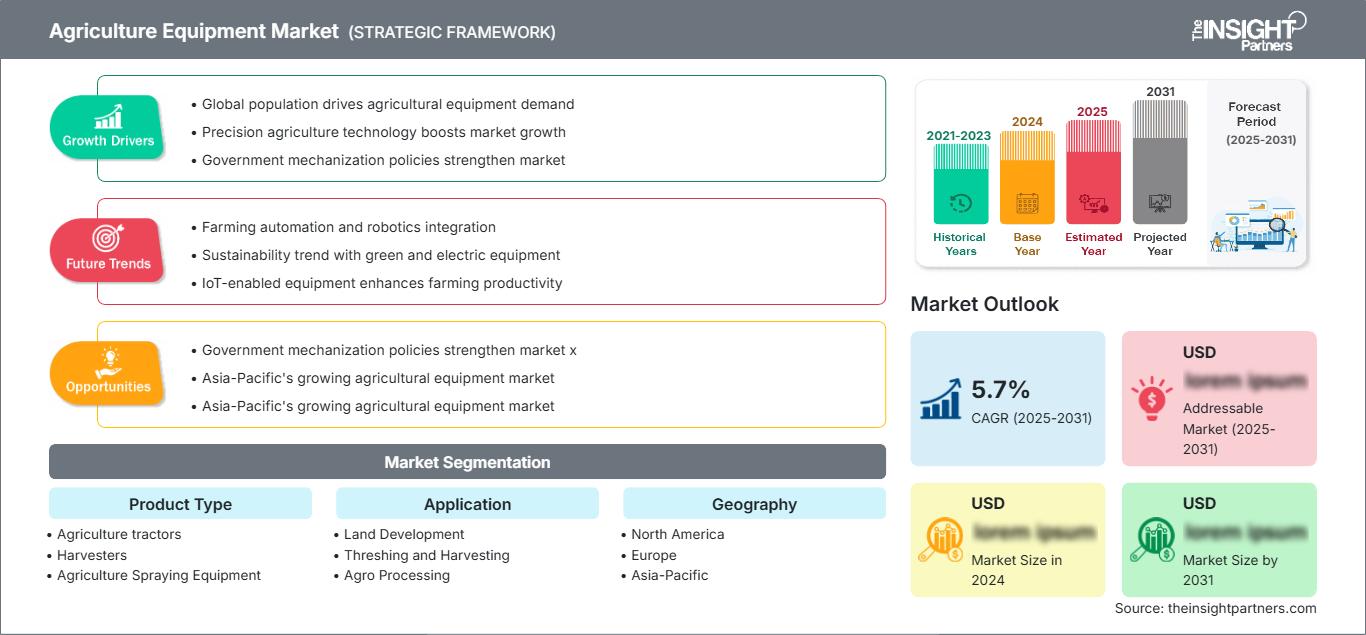
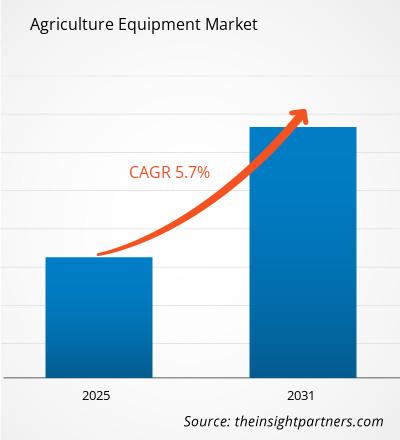
The agriculture equipment market size is expected to grow from US$ 205.15 Billion in 2025 to US$ 403.41 Billion by 2034; it is anticipated to record a CAGR of 7.80% from 2026 to 2034. The market is growing because farmers are replacing manual labor systems with automated, interconnected, and higher-capacity machines in all stages of farming, including preparing the land, harvesting, spraying, and post-harvest.
North America has the potential to grow at a 6.8–7.2% CAGR from 2026 to 2034 due to large commercial farms, need for replacement, and precision agriculture adoption. The farmers of the United States are adopting tractors equipped with guiding technology, high-capacity harvesters, and spraying equipment.
Agriculture Equipment Market Assessment and Insights
- North America: The region accounted for 31–34% share in 2025 and is growing at a CAGR of 6.8–7.2% between 2026–2034, led by replacement demand, dealer financing, and digital fleet management.
- US: The U.S. represented 78–82% of North America agriculture equipment market in 2025 and is growing at a CAGR of 6.7–7.1% between 2026–2034, driven by autonomous tractor trials and precision spraying adoption.
- Europe: Europe held 24–27% share in 2025 and is growing at a CAGR of 5.9–6.4% between 2026–2034, with Germany, France, Italy, Spain, and the UK leading demand.
- Asia Pacific: Asia Pacific represented 29–32% share in 2025 and is growing at a CAGR of 8.6–9.2% between 2026–2034, led by China, India, Japan, South Korea, and Australia.
- Largest Segment: Agriculture tractors held 42–46% agriculture equipment market share in 2025 and is growing at a CAGR of 7.1–7.6% between 2026–2034, reflecting broad use across land development and hauling.
- High Growth Segment: Agriculture Spraying Equipment held 11–14% agriculture equipment market share in 2025 and is growing at a CAGR of 9.0–9.6% between 2026–2034, supported by precision application and pesticide efficiency needs.
- Key companies analyzed in detail: Mahindra & Mahindra Limited, Kubota Corporation, Valmont Industries, Inc., Deere & Company, AGCO Corporation, SDF S.p.A., Agrostroj Pelhřimov a.s., Weifang Euroking Machinery Co., Ltd., China National Machinery Industry Corporation, CLAAS KGaA mbH.
Source: The Insight Partners' analysis based on proprietary research, government publications, company annual reports, investor presentations, industry databases, and expert interviews.
The agriculture equipment market report highlights a shift from mechanical capacity expansion toward integrated productivity platforms. Tractor makers now combine engines, hydraulics, telematics, guidance systems, and implements into connected ecosystems that improve fuel use, operator efficiency, and crop-cycle timing. Production dynamics are also changing as OEMs localize assembly, strengthen parts availability, and redesign equipment for fragmented farms in Asia while maintaining high-horsepower portfolios for North America and Europe.
Looking ahead, emerging demand will come from mechanization gaps in India, Southeast Asia, Africa, and Latin America, where custom hiring, subsidized machinery banks, and rural credit programs lower ownership barriers. Regulatory pressure on emissions, chemical application, and soil conservation will also shape agriculture equipment trends, favoring electric compact tractors, selective spraying, low-tillage implements, and digital compliance records.
Agriculture Equipment Market Report Scope
| Report Attribute | Details |
|---|---|
| Market size in 2025 | US$ 205.15 Billion |
| Market Size by 2034 | US$ 403.41 Billion |
| Global CAGR (2026 - 2034) | 7.80% |
| Historical Data | 2021-2024 |
| Forecast period | 2026-2034 |
Agriculture Equipment Market Analysis
The agriculture equipment market forecast is anchored in the need to raise crop output with fewer workers and tighter input budgets. Farm operators are buying tractors, harvesters, sprayers, and hay equipment that reduce field passes, shorten harvesting windows, and support data-led agronomy. USDA ERS reported that autosteering adoption reached 52% among midsize U.S. crop farms and 70% among large farms in 2023, validating the role of connected machinery in productivity improvement.
The industry consists of suppliers of engines, hydraulics, sensors, dealers, financiers, software, and aftersales. The supply will continue to be affected by the cost of steel, availability of electronics, engines complying with emissions standards, and local manufacture. The future for agriculture equipment sizes, therefore, is not only dependent on the farmer’s income but also on credit, part availability, and service in rural areas.
The market is moderately concentrated globally but fragmented according to the type of crop, horsepower, and regional distribution strength. The competitors – Deere & Company, AGCO Corporation, Kubota Corporation, CLAAS KGaA mbH, Mahindra & Mahindra Limited, and SDF S.p.A. – compete through offering wide product lines, technology, dealer networks, and financial solutions and not equipment prices.
The focus of investments is on autonomous systems, computer vision spraying, electric compact tractors, and predictive maintenance. Valmont Industries, Inc. is assisting with mechanized irrigation system infrastructure, while China National Machinery Industry Corporation and Weifang Euroking Machinery Co., Ltd. are improving export-oriented machinery supplies. The combined approach increases the scope of agricultural equipment from high-end to low-end farms.
● REPORT CUSTOMIZATION
Tailor This Report To Align With Your Specific Business Requirements
This report can be customized to align precisely with your business objectives, scope, and target markets. Customization options include tailored segmentation, geography, competitive analysis, and strategic insights to support informed decision-making.
Customize This Report →WHAT YOU CAN ADJUST
- ● Segmentations
- ● Geography
- ● Competitive Analysis
- ● Language Preferences
Agriculture Equipment Market: Strategic Insights
Regional Insights
North America Agriculture Equipment
North America accounted for 31–34% share in 2025 and is projected to grow at a 6.8–7.2% CAGR during 2026–2034. The driving factor here is the need for huge acreage farm operations which rely on high-horsepower tractors, combines, sprayers, balers, and fleet management systems. The cycle time has reduced due to the adoption of guidance, telematics, and precision technology for managing labor and inputs.
Structural factors are mature dealership channels, financing plans backed by crop insurance, and widespread use of precision agriculture. The agriculture equipment market share is skewed in favor of the United States, although Canada helps drive demand through its agricultural grain, oilseed, and livestock mechanization.
U.S. Agriculture Equipment Market
The U.S. represented 78–82% of North America in 2025 and is expected to grow at a 6.7–7.1% CAGR from 2026 to 2034. Farms with large corn, soybean, wheat, cotton, and forage production are responsible for purchasing high-powered equipment, while crop-specific areas will need small-sized tractors, specialized spraying equipment, and machinery for mechanized harvest.
Companies like Deere & Company, AGCO Corporation, Kubota Corporation, CLAAS KGaA mbH, and Mahindra & Mahindra Limited have good dealer networks and products. The application trends include autonomous tillage, variable rate fertilization, mechanized harvesting of hay and forage, and performance-based service contracts.
Europe Agriculture Equipment Market
Europe held 24–27% agriculture equipment market share in 2025 and is projected to grow at a 5.9–6.4% CAGR during 2026–2034. Germany is the leading country because of advanced farm machinery manufacturing, high mechanization maturity, and demand for precision tractors, harvesters, and implements aligned with low-emission and soil conservation requirements.
Recovery in the UK market comes from replacement buying, use of the equipment by contractors, and arable farm mechanization. Use of GPS equipped tractors, balers and spraying systems is widespread as these help in compliance with nutrient management and crop protection regulations in addition to providing better productivity season-wise.
There is diversity in the demand of France, Italy, and Spain. France focuses on cereals and forage equipment, Italy on vineyards and orchards, and Spain on spraying and irrigation associated equipment. According to CEMA, there were 144,400 registrations of agricultural tractors in Europe in 2024 which witnessed an 8.1% decline.
APAC Agriculture Equipment Market
APAC accounted for 29–32% agriculture equipment market share in 2025 and is expected to grow at an 8.6–9.2% CAGR through 2034, making it the fastest-expanding regional opportunity. Whereas China dominates in size, India promotes volume using tractors, employment centers, and machinery subsidies.
On the other hand, Japan and South Korea focus on robots, mini-machinery, and automation due to an aging farming population. Whereas Australia promotes demand using broad acre grains, livestock, and hay farming, agricultural equipment is experiencing growth in other areas like harvesters and sprayers.
Middle East & Africa Agriculture Equipment Market
The Middle East & Africa agriculture equipment market is projected to grow at a 7.4–8.0% CAGR during 2026–2034. Both Saudi Arabia and the UAE dominate capital-intensive demand via controlled environment agriculture, irrigation facilities, and food security projects; meanwhile, South Africa continues to be the region's largest market for mechanized field crops.
Rest of MEA demand is related to financing of agricultural mechanization, foreign aid for food production, and dependence on imports for machinery. Energy infrastructure influences operating costs as fuel supply, irrigation, and logistics influence equipment productivity. Highest growth potential is in those countries that promote machinery use together with grain sufficiency and rural job creation programs.
Segmentation Analysis
Product Type
The product type segment in the agriculture equipment market is projected to grow at a 7.5–8.0% CAGR during 2026–2034. Demand reflects a transition from standalone machines to integrated platforms combining tractors, harvesters, sprayers, balers, and forage systems. Buyers increasingly evaluate lifecycle cost, fuel efficiency, service availability, and compatibility with sensors, guidance, and farm management software.
- Agriculture tractors remain the largest product group because they support land preparation, haulage, planting support, and implement operation across smallholder, mid-size, and commercial farms.
- Harvesters are strategically important in grains, oilseeds, rice, and forage crops where narrow harvest windows and labor shortages raise demand for high-throughput machinery.
- Agriculture Spraying Equipment is gaining importance as growers adopt precision application, drone-compatible workflows, and selective spraying to reduce chemical use and improve crop protection efficiency.
- Hay & Forage Equipment supports livestock and dairy operations, with demand driven by balers, mowers, rakes, and forage harvesters that improve feed quality and storage efficiency.
Application
The application segment in the agriculture equipment market is projected to grow at a 7.6–8.1% CAGR from 2026 to 2034. Land development remains foundational because soil preparation, leveling, and primary tillage influence yield potential. Threshing and harvesting demand is rising as farms seek faster crop evacuation, while agro processing equipment links field productivity with value addition and reduced post-harvest losses.
- Land Development has high revenue contribution because tractors, plows, harrows, cultivators, and leveling equipment are required before most field operations and support multi-season utilization.
- Threshing and Harvesting shows strong strategic relevance as growers mechanize crop collection, reduce field losses, and manage shrinking labor availability during seasonal peaks.
- Agro Processing is expanding as farms and cooperatives invest in cleaning, grading, milling, and handling equipment to retain value closer to production regions.
Opportunity Snapshot
| Application | Revenue Contribution | Trend Tag | Adoption Stage |
| Land Development | High | Soil Prep | Mature |
| Threshing and Harvesting | High | Loss Reduction | Scaling |
| Agro Processing | Medium | Value Addition | Scaling |
| Others | Low | Mixed Use | Emerging |
Agriculture Equipment Market Growth Drivers and Impact Analysis
Rising Labor Constraints Accelerate Mechanization
Labor shortages are shifting the approach to machine investments from something that is optional to one that is necessary. Labor shortages, aging of rural populations in places like Japan, Europe, and North America, along with the movement of labor out of agriculture in developing countries, raises the worth of machinery that can do more with less labor input. The effect is felt most during crop planting and harvesting periods, when the delay in time affects the quality of the output and the earnings of the farm owner.
Precision Agriculture Improves Input Efficiency
While precision technology is enhancing the offerings that come with machinery beyond horsepower, GPS guidance, section control, variable rate, yield monitoring, and telematics enable farmers to minimize overlap, chemical loss, soil compaction, and fuel usage. According to GAO, precision agriculture is a means of ensuring efficient management of water, fertilizer, and feed. As digital capabilities are integrated into tractors, spray applicators, and combines, manufacturers have recurring revenue streams through software licensing and predictive maintenance deals.
Policy Support Expands Access for Smallholders
A key agriculture equipment market trend is that government programs are expanding access to machinery in markets where individual ownership remains expensive. India’s Sub-Mission on Agricultural Mechanization supports custom hiring centers, machinery banks, demonstrations, and performance testing, improving adoption among small and marginal farmers. Similar subsidy and rural finance programs in Asia, Africa, and Latin America create demand for affordable tractors, implements, sprayers, and post-harvest systems. The market impact is durable because shared-use models increase equipment utilization, stimulate local service ecosystems, and encourage manufacturers to design lower-cost, crop-specific machines.
Agriculture Equipment Market Future Trends
Autonomous and Semi-Autonomous Field Operations
Autonomy is going to shift from being demonstrated in a lab to commercial relevance for fleets through advancements in guidance systems, machine vision, geofencing, and remote monitoring capabilities. The first areas of adoption will be in repetitive tasks like tilling, spraying, mowing, and moving grain carts where known paths and consistent field conditions will allow for easier deployment. OEMs will differentiate themselves by their validation, dealer network, and software capability, not just hardware alone. This paradigm will change equipment ownership through allowing increased uptime and reduced driver fatigue.
Autonomy will move from limited demonstrations to commercially relevant fleet applications as guidance, machine vision, geofencing, and remote monitoring mature. Early adoption will concentrate in repetitive operations such as tillage, spraying, mowing, and grain cart movement, where controlled routes and predictable field conditions reduce deployment complexity. OEMs will compete on safety validation, dealer support, and software reliability rather than hardware alone. This trend will reshape equipment ownership by enabling farms and contractors to run longer hours, reduce operator fatigue, and improve machinery utilization across seasonal peaks.
Electrification in Compact and Specialty Equipment
Electrification is likely to occur first in small tractors, orchard machinery, greenhouse equipment, utility vehicles, and low duty cycle machines where battery charge facilities are relatively simple. The benefits of reduced maintenance and emissions would make battery electric systems ideal for use in vineyards, livestock and environmentally-controlled farms. General acceptance will be determined by battery prices, charging capabilities, and appropriate duty cycles. Suppliers of equipment that combine batteries with energy control and solar charging have distinctive advantages in sustainability-based purchasing environments.
Agriculture Equipment Market Opportunities
Custom Hiring and Equipment-as-a-Service Models
Custom hiring creates a major opportunity in countries with fragmented landholdings and limited farmer capital. Instead of selling only individual machines, OEMs and dealers can build revenue through rental fleets, operator training, maintenance contracts, and financing partnerships with cooperatives or rural entrepreneurs. This model improves access to tractors, harvesters, sprayers, and post-harvest equipment while raising utilization rates. It also gives manufacturers field-level usage data that can guide product design, spare parts planning, and crop-specific service packages in emerging markets.
Aftermarket Digital Services and Predictive Maintenance
Connected machinery creates an opportunity to monetize uptime, diagnostics, and agronomic performance after the initial equipment sale. Dealers can use telematics to predict component failures, schedule service before seasonal peaks, and reduce downtime for harvesters, tractors, and sprayers. OEMs can package software updates, fleet dashboards, operator coaching, and parts subscriptions into recurring revenue streams. The opportunity is especially attractive in North America and Europe, where high-value machines justify digital service contracts, and in APAC where growing fleets need scalable maintenance support.
Recent Developments
- June 2026: Kubota Corporation — announced an additional investment in French startup UV Boosting, strengthening collaboration around ultraviolet irradiation equipment for plants and expanding its technology exposure beyond conventional machinery into crop resilience solutions. The move supports Kubota’s long-term strategy of combining agriculture equipment with sustainable plant-health technologies.
- June 2026: SDF S.p.A. — expanded DEUTZ-FAHR’s presence in northern Germany through Clemens Hoping GmbH, reinforcing dealer coverage and service proximity in a key European machinery market. The development improves customer access to tractors, harvesters, and aftersales support during a period when European farmers are prioritizing reliability and lifecycle cost.
- March 2026: CLAAS KGaA mbH — advanced its dealer strategy with new genAG locations in North and South Dakota and continued investments in Iowa and Minnesota. The expansion strengthens CLAAS service coverage in U.S. grain and forage regions and supports demand for combines, tractors, and smart farming solutions.
Frequently Asked Questions

- Comprehensive Market Sizing and Forecast Analysis
- Detailed Segmentation Analysis
- In-Depth Market Dynamics Assessment
- Regional and Country-Level Insights
- Competitive Landscape and Company Benchmarking
- Strategic Business Intelligence
Recent Reports
Testimonials

The Insight Partners provided valuable market intelligence that supported our global go-to-market strategy. Their team was professional, responsive, and attentive to our feedback, providing thoughtful analysis and helpful methodological clarifications throughout the project.
Junmo Kim Chief Financial Officer (CFO), Enertech Co., Ltd.
The Insight Partners' SCADA System Market report is comprehensive, with valuable insights on current trends and future forecasts. The team was highly professional, responsive, and supportive throughout. We are very satisfied and highly recommend their services.
RAN KEDEM Partner, Reali Technologies LTDs
I requested a report on a very specific software market and the team produced the report in a few days. The information was very relevant and well presented. I then requested some changes and additions to the report. The team was again very responsive and I got the final report in less than a week.
JEAN-HERVE JENN Chairman, Future Analytica
We worked with The Insight Partners for an important market study and forecast. They gave us clear insights into opportunities and risks, which helped shape our plans. Their research was easy to use and based on solid data. It helped us make smart, confident decisions. We highly recommend them.
PIYUSH NAGPAL Sr. Vice President, High Beam Global
The Insight Partners delivered insightful, well-structured market research with strong domain expertise. Their team was professional and responsive throughout. The user-friendly website made accessing industry reports seamless. We highly recommend them for reliable, high-quality research services
YUKIHIKO ADACHI CEO, Deep Blue, LLC.
This is the first time I have purchased a market report from The Insight Partners.While I was unsure at first, I visited their web site and felt more comfortable to take the risk and purchase a market report.I am completely satisfied with the quality of the report and customer service. I had several questions and comments with the initial report, but after a couple of dialogs over email with their analyst I believe I have a report that I can use as input to our strategic planning process.Thank you so much for taking the extra time and making this a positive experience.I will definitely recommend your service to others and you will be my first call when we need further market data.
JOHN SUZUKI President and Chief Executive Officer, Board Director, BK Technologies
I wish to appreciate your support and the professionalism you displayed in the course of attending to my request for information regarding to infectious disease IVD market in Nigeria. I appreciate your patience, your guidance, and the fact that you were willing to offer a discount, which eventually made it possible for us to close a deal. I look forward to engaging The Insight Partners in the future, all thanks to the impression you have created in me as a result of this first encounter.
DR CHIJIOKE ONYIA MANAGING DIRECTOR, PineCrest Healthcare Ltd.Reason to Buy
- Informed Decision-Making
- Understanding Market Dynamics
- Competitive Analysis
- Identifying Emerging Markets
- Customer Insights
- Market Forecasts
- Risk Mitigation
- Boosting Operational Efficiency
- Strategic Planning
- Investment Justification
- Tracking Industry Innovations
- Aligning with Regulatory Trends





 Get Free Sample for