
AI in Automotive Market Size, Share & Forecast by 2034
Coverage: By Component (Software, Hardware, and Services), Deployment (Cloud and On Premises), Organization Size (Large Enterprises and SMEs), and Geography (North America, Europe, Asia Pacific, Middle East and Africa, and South America)
- Status : Published
- Report Code : TIPRE00042233
- Category : Technology, Media and Telecommunications
- No. of Pages : 290
- Available Report Formats :


- Last update date : February 25, 2026


2025 Market Size
US$ 11.71 Bn
Base year value
2034 Forecast
US$ 172.95 Bn
Projected by 2034
CAGR 2026-2034
35.7 %
Growth rate
Addressable Market
US$ 650.01 Bn
(2026-2034)
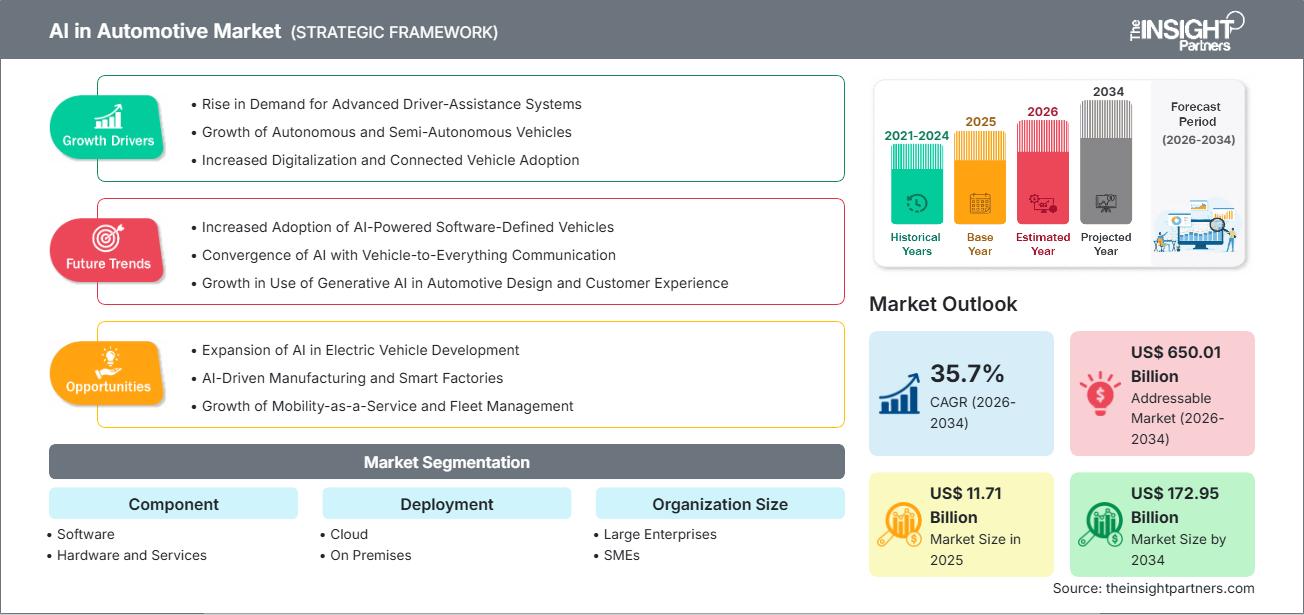
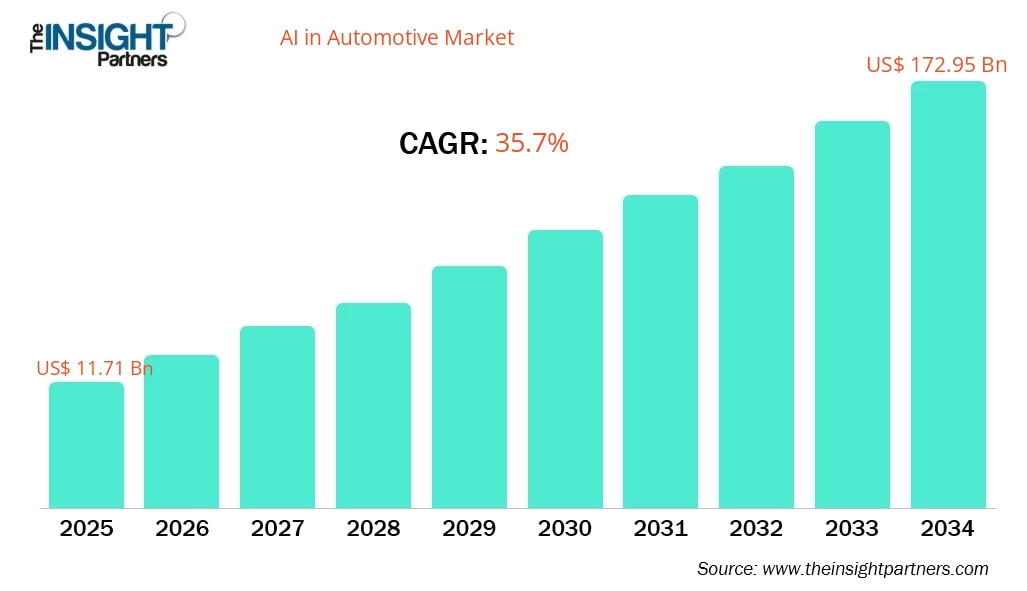
The AI in automotive market size is projected to reach US$ 11.71 billion in 2025 and is expected to reach US$ 172.95 billion by 2034. The AI in automotive market is estimated to register a CAGR of 35.7% during 2026–2034.
AI in Automotive Market Analysis
The AI in automotive market is rapidly evolving as vehicles increasingly integrate intelligent technologies to enhance safety, efficiency, and user experience. Artificial intelligence is widely used in advanced driver-assistance systems (ADAS), autonomous driving, predictive maintenance, and connected vehicle platforms. Automakers and technology providers are focusing on software-driven solutions that enable real-time data processing, decision-making, and continuous learning. Growing demand for smart mobility, stricter safety regulations, and advancements in sensors, edge computing, and machine learning are supporting market growth.
AI in Automotive Market Overview
The market is driven by increasing investments in autonomous driving technologies and rising adoption of ADAS features across passenger and commercial vehicles. Software remains the dominant component, supported by advancements in deep learning and data analytics. Hardware innovation in processors and sensors enables faster AI inference, while services support system integration and maintenance. Key challenges include high development costs, data security concerns, and regulatory uncertainties. However, growing government support, partnerships between automakers and AI firms, and expanding use cases such as fleet management and in-vehicle personalization are expected to create strong opportunities.
Market Assessment and Insights
- North America dominated the market with 41.2% share in 2025.
- Asia Pacific is poised to grow at a CAGR of 37.8% over the forecast period.
- United States market is projected to grow at a CAGR of 36.5% over the forecast period.
- By Component, the Software segment accounted for the largest market share of 60.1% in 2025.
- By Deployment, the Cloud segment is anticipated to witness the fastest growth, registering a CAGR of 37.7% over the forecast period
- By Organization Size, the Large Enterprises segment accounted for the largest market share of 69.6% in 2025.
- The report profiles key industry players such as Amazon Web Services Inc, International Business Machines Corp, Microsoft Corp, SAP SE, Google LLC, Accenture Plc, SAS Institute Inc, Intel Corp, NVIDIA Corp, Advanced Micro Devices Inc, while also analyzing key developments in novel ideas, disruptive products, and innovative services that could reshape the future market and reveal emerging themes across the industry.
Source: The Insight Partners' analysis based on proprietary research, government publications, company annual reports, investor presentations, industry databases, and expert interviews.
● REPORT CUSTOMIZATION
Tailor This Report To Align With Your Specific Business Requirements
This report can be customized to align precisely with your business objectives, scope, and target markets. Customization options include tailored segmentation, geography, competitive analysis, and strategic insights to support informed decision-making.
Customize This Report →WHAT YOU CAN ADJUST
- ● Segmentations
- ● Geography
- ● Competitive Analysis
- ● Language Preferences
AI in Automotive Market: Strategic Insights
-
Get Top Key Market Trends of this report.This FREE sample will include data analysis, ranging from market trends to estimates and forecasts.
AI in Automotive Market Drivers and Opportunities
Market Drivers:
- Demand for Vehicle Safety and Automation: Increasing adoption of ADAS and safety systems is driving AI integration to reduce accidents and improve driving efficiency.
- Adoption of Connected and Autonomous Vehicles: The integration of connected and autonomous vehicles increases reliance on AI for real-time decision-making and vehicle communication.
- Advancements in Computing and Sensor Technologies: Improvements in AI software, processors, and sensors enable accurate perception, faster processing, and reliable automotive applications.
Market Opportunities:
- Expansion of AI-Enabled Electric Vehicles: Rising electric vehicle adoption creates opportunities for AI-based battery management, energy optimization, and predictive maintenance solutions.
- Growth in Smart Mobility and Fleet Management: AI adoption in fleet and mobility services supports route optimization, cost reduction, and enhanced operational efficiency.
- Software-Driven Revenue Models: Software-defined vehicles enable AI-powered subscriptions, over-the-air updates, and recurring revenue opportunities for automakers.
AI in Automotive Market Report Segmentation Analysis
The AI in automotive market is divided into different segments to give a clearer view of how it works, its growth potential, and the latest trends. Below is the standard segmentation approach used in industry reports:
By Component:
- Software: AI-based automotive software enables advanced functionalities such as autonomous driving, ADAS, predictive maintenance, and vehicle connectivity, driving efficiency and intelligence across modern vehicles.
- Hardware: AI automotive hardware includes processors, sensors, cameras, and computing units that support real-time data processing, perception, and decision-making, but it involves higher costs and integration complexity.
- Services: AI automotive services provide system integration, data management, training, and maintenance support, helping automakers deploy, optimize, and scale AI solutions effectively across vehicle platforms.
By Deployment:
- Cloud
- On Premises
By Organization Size:
- Large Enterprises
- SMEs
By Geography:
- North America
- Europe
- Asia Pacific
- South America
- Middle East & Africa
AI in Automotive Market Report Scope
| Report Attribute | Details |
|---|---|
| Market size in 2025 | US$ 11.71 Billion |
| Market Size by 2034 | US$ 172.95 Billion |
| Global CAGR (2026 - 2034) | 35.7% |
| Historical Data | 2021-2024 |
| Forecast period | 2026-2034 |
| Segments Covered |
By Component
|
| Regions and Countries Covered |
North America
|
| Market leaders and key company profiles |
|
AI in Automotive Market Players Density: Understanding Its Impact on Business Dynamics
The AI in Automotive Market is growing rapidly, driven by increasing end-user demand due to factors such as evolving consumer preferences, technological advancements, and greater awareness of the product's benefits. As demand rises, businesses are expanding their offerings, innovating to meet consumer needs, and capitalizing on emerging trends, which further fuels market growth.
AI in Automotive Market Share Analysis by Geography
The market in Asia Pacific is expanding rapidly due to increasing urbanization, growing vehicle production, and rising consumer demand for safety, convenience, and smart mobility. Advances in autonomous driving, connected vehicles, and in-vehicle AI systems are driving adoption. Supportive government initiatives, technological innovation, and the push for efficient, sustainable, and intelligent transportation solutions are further accelerating market growth.
Below is a summary of market share and trends by region:
1. North America
- Market Share: A mature market with significant AI adoption in passenger and commercial vehicles, driven by autonomous driving and ADAS integration.
- Key Drivers:
- Investment in connected vehicle infrastructure and ADAS.
- Government support for safety and smart mobility solutions.
- Trends: Deployment of AI software platforms, real-time data analytics for predictive maintenance, and vehicle-to-everything (V2X) communication systems.
2. Europe
- Market Share: Europe holds a leading position due to stringent safety regulations, emission standards, and strong investment in autonomous vehicle testing.
- Key Drivers:
- Government incentives for electric and autonomous vehicles.
- Increasing adoption of AI-enabled ADAS.
- Research and development in intelligent transport systems.
- Trends: Expansion of smart mobility solutions, AI-driven fleet management, and integration of vehicles with urban traffic monitoring and control systems.
3. MEA
- Market Share: A developing market, driven by the growing adoption of AI technologies in passenger vehicles and commercial fleets, particularly in Gulf countries.
- Key Drivers:
- Rising urbanization, fleet modernization, and demand for safety, efficiency, and connected mobility solutions in commercial and public transport.
- Trends: Adoption of AI-based navigation, telematics, predictive maintenance, and integration with smart city initiatives in urban centers.
4. Asia Pacific
- Market Share: The fastest-growing region, led by China, Japan, India, and Southeast Asia, driven by rapid vehicle production and autonomous vehicle trials.
- Key Drivers:
- Rising consumer demand for autonomous and connected vehicles, government initiatives supporting AI in mobility, and technological advancements in sensors and computing.
- Trends: Expansion of AI-enabled electric vehicles, smart fleet management, real-time vehicle monitoring, and integration with regional traffic management systems.
5. South America
- Market Share: The market is gradually expanding—concentrated in Brazil, Chile, and Colombia—with growing interest in connected and semi-autonomous vehicles.
- Key Drivers:
- Growth in vehicle production, demand for AI-assisted safety features, and increasing investments in telematics and fleet optimization.
- Trends: Integration of AI with navigation and infotainment systems, predictive maintenance for commercial fleets, and adoption of smart mobility platforms.
AI in Automotive Market Players Density: Understanding Its Impact on Business Dynamics
High Market Density and Competition
Competition is strong due to the presence of established players such as Microsoft Corp, Accenture Plc, International Business Machines Corp, NVIDIA Corp, and Google LLC. Regional and niche providers—such as Advanced Micro Devices Inc, SAP SE, and SAS Institute Inc—add to the competitive landscape.
This high level of competition urges companies to stand out by offering:
- Advanced AI-powered vehicle systems, including autonomous driving modules, ADAS, predictive maintenance, and energy-efficient electric vehicle management.
- Customized connected vehicle solutions for passenger cars, commercial fleets, ride-sharing services, and smart mobility platforms.
- Cost-effective vehicle operations through AI-driven fleet optimization, predictive analytics, route planning, and energy management.
- Comprehensive after-sales support, enabled by real-time vehicle monitoring, remote diagnostics, over-the-air updates, and predictive maintenance solutions.
Opportunities and Strategic Moves
- Automakers and fleet operators are collaborating with AI technology providers to enhance vehicle safety, efficiency, and real-time decision-making capabilities.
- Companies are advancing intelligent automotive solutions by integrating AI-driven software, sensor fusion, autonomous driving modules, and cloud-based platforms for predictive analytics and real-time performance optimization.
- Modular and scalable AI systems are gaining adoption, allowing gradual integration into existing vehicle fleets and infrastructure without requiring full replacement of hardware or software platforms.
Major Companies operating in the AI in Automotive Market are:
- Accenture Plc
- Advanced Micro Devices Inc
- Google LLC
- International Business Machines Corp
- Intel Corp
- Microsoft Corp
- NVIDIA Corp
- Amazon Web Services Inc
- SAP SE
- SAS Institute Inc
Disclaimer: The companies listed above are not ranked in any particular order.
Other companies analyzed during the course of research:
- Tesla, Inc.
- Mobileye (Intel)
- Qualcomm Technologies, Inc.
- Aptiv plc
- Waymo LLC
- Robert Bosch GmbH
- Ford Motor Company
- Toyota Research Institute
- General Motors (GM)
- Cerence Inc.
- Eyeris Technologies
AI in Automotive Market News and Recent Developments
- IBM Unveils watsonx AI Labs: In June 2025, IBM announced watsonx AI Labs, a new, developer-first innovation hub in New York City, designed to supercharge AI builders and accelerate AI adoption at scale. watsonx AI Labs connects IBM's enterprise resources and expertise with the next generation of AI developers to build breakthrough AI applications for business.
- SAS Debuts New, Custom AI Models to Bust Business Bottlenecks: In June 2025, SAS debuted new, custom AI models designed to address business bottlenecks. Each model targeted specific labor- and time-intensive processes that had previously slowed operations. SAS’s packaged models were offered either ready-to-go or designed to tailor and accelerate model training on customer data. All were capable of quick and easy integration with the existing systems of organizations of all sizes.
AI in Automotive Market Report Coverage and Deliverables
The "AI in Automotive Market Size and Forecast (2021–2034)" report provides a detailed analysis of the market covering below areas:
- AI in automotive market size and forecast at global, regional, and country levels for all the segments covered under the scope
- AI in automotive market trends, as well as dynamics such as drivers, restraints, and key opportunities
- Detailed PEST and SWOT analysis
- AI in automotive market analysis covering key trends, global and regional framework, major players, regulations, and recent developments
- Industry landscape and competition analysis covering market concentration, heat map analysis, prominent players, and recent developments for the AI in automotive market
- Detailed company profiles
Frequently Asked Questions

- Comprehensive Market Sizing and Forecast Analysis
- Detailed Segmentation Analysis
- In-Depth Market Dynamics Assessment
- Regional and Country-Level Insights
- Competitive Landscape and Company Benchmarking
- Strategic Business Intelligence
Recent Reports
Testimonials

The Insight Partners' SCADA System Market report is comprehensive, with valuable insights on current trends and future forecasts. The team was highly professional, responsive, and supportive throughout. We are very satisfied and highly recommend their services.
RAN KEDEM Partner, Reali Technologies LTDs
I requested a report on a very specific software market and the team produced the report in a few days. The information was very relevant and well presented. I then requested some changes and additions to the report. The team was again very responsive and I got the final report in less than a week.
JEAN-HERVE JENN Chairman, Future Analytica
We worked with The Insight Partners for an important market study and forecast. They gave us clear insights into opportunities and risks, which helped shape our plans. Their research was easy to use and based on solid data. It helped us make smart, confident decisions. We highly recommend them.
PIYUSH NAGPAL Sr. Vice President, High Beam Global
The Insight Partners delivered insightful, well-structured market research with strong domain expertise. Their team was professional and responsive throughout. The user-friendly website made accessing industry reports seamless. We highly recommend them for reliable, high-quality research services
YUKIHIKO ADACHI CEO, Deep Blue, LLC.
This is the first time I have purchased a market report from The Insight Partners.While I was unsure at first, I visited their web site and felt more comfortable to take the risk and purchase a market report.I am completely satisfied with the quality of the report and customer service. I had several questions and comments with the initial report, but after a couple of dialogs over email with their analyst I believe I have a report that I can use as input to our strategic planning process.Thank you so much for taking the extra time and making this a positive experience.I will definitely recommend your service to others and you will be my first call when we need further market data.
JOHN SUZUKI President and Chief Executive Officer, Board Director, BK Technologies
I wish to appreciate your support and the professionalism you displayed in the course of attending to my request for information regarding to infectious disease IVD market in Nigeria. I appreciate your patience, your guidance, and the fact that you were willing to offer a discount, which eventually made it possible for us to close a deal. I look forward to engaging The Insight Partners in the future, all thanks to the impression you have created in me as a result of this first encounter.
DR CHIJIOKE ONYIA MANAGING DIRECTOR, PineCrest Healthcare Ltd.Reason to Buy
- Informed Decision-Making
- Understanding Market Dynamics
- Competitive Analysis
- Identifying Emerging Markets
- Customer Insights
- Market Forecasts
- Risk Mitigation
- Boosting Operational Efficiency
- Strategic Planning
- Investment Justification
- Tracking Industry Innovations
- Aligning with Regulatory Trends





 Get Free Sample for