
Data Lakehouse Market Opportunities & Trends Analysis by 2031
Coverage: By Component (Solution and Services), Deployment (Cloud based, On-Premises),, Organization (Large Enterprise and SMEs), Application(Operation, Finance, Marketing, HR, Others and Geography
- Status : Data Released
- Report Code : TIPRE00042062
- Category : Technology, Media and Telecommunications
- No. of Pages : 150
- Available Report Formats :


- Last update date : December 04, 2025


2024 Market Size
US$ 11.27 Bn
Base year value
2031 Forecast
US$ 42.89 Bn
Projected by 2031
CAGR 2025-2031
18.5 %
Growth rate
Addressable Market
US$ 164.68 Bn
(2025-2031)
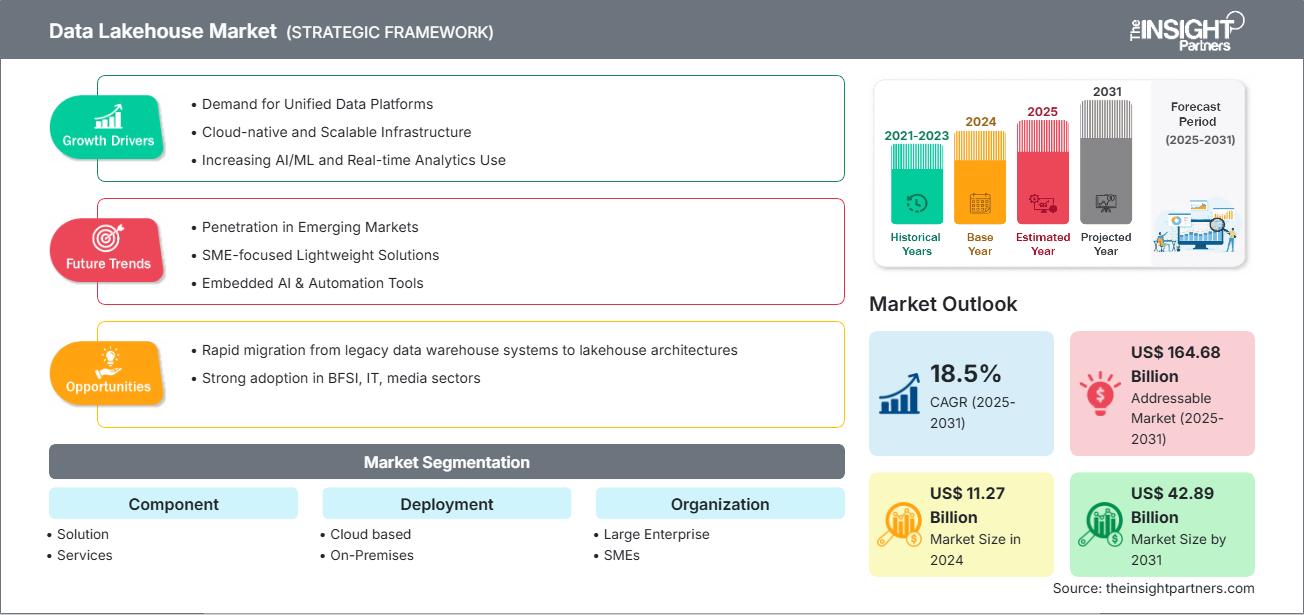
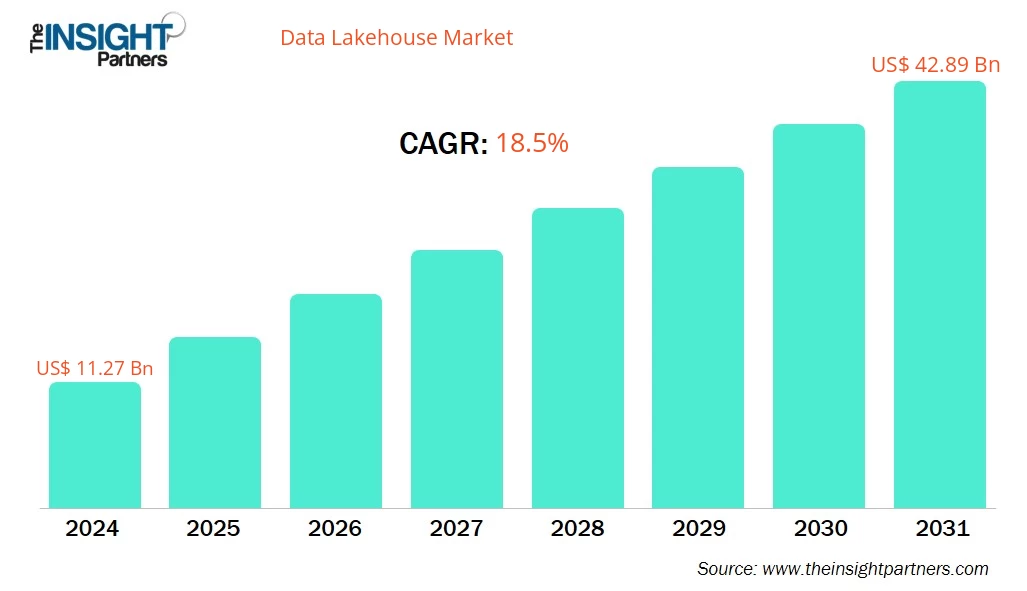
The Data Lakehouse Market size is expected to reach US$ 42.89 billion by 2031 from US$ 11.27 billion in 2024. The market is anticipated to register a CAGR of 18.5% during 2025–2031.
Data Lakehouse Market Analysis
The data lakehouse market is poised for strong expansion, fueled by increasing demand for unified data platforms that combine the flexibility of data lakes with the performance and governance features of data warehouses. Key enabling trends include the shift to cloud‑native architectures, rising adoption of AI/ML and real‑time analytics, and consolidation of multiple data stacks into simplified, scalable solutions.
Data Lakehouse Market Overview
A data lakehouse is an architectural paradigm that merges capabilities of data lakes (large-scale storage of structured, semi-structured, and unstructured data) with features traditionally associated with data warehouses (e.g., schema enforcement, transactional support, data governance, high-performance analytics). By enabling ACID transactions, unified metadata layers, and efficient querying, data lakehouses reduce complexity and latency in analytics pipelines, support machine learning workloads, and simplify data governance across large datasets.
Organizations use lakehouse solutions to ingest, store, transform, and analyze massive volumes of data in a single architecture, thereby reducing data duplication, infrastructure costs, and operational overhead. The adoption is especially compelling when workloads demand real‑time analytics, AI/ML integration, and strong governance across heterogeneous data sources.
Market Research Highlights
- Global market for Data Lakehouse was valued at US$ 11.27 Billion in 2024
- Annual market size is expected to reach US$ 42.89 Billion by 2031
- Total addressable market (TAM) during 2025-2031 is projected to reach approximately US$ 164.68 Billion
- Market is anticipated to register a CAGR of 18.5% during the forecast period
- The United States represents a key market, supported by Demand for Unified Data Platforms, Cloud-native and Scalable Infrastructure, Increasing AI/ML and Real-time Analytics Use, as well as evolving industry dynamics
- Market analysis covers North America, Europe, Asia-Pacific, South and Central America, Middle East and Africa, with growth evaluated across the forecast period
- Market opportunities such as Rapid migration from legacy data warehouse systems to lakehouse architectures, Strong adoption in BFSI, IT, media sectors are expected to influence market dynamics and addressable market
- Report profiles industry participants, including Databricks, Snowflake Inc., Microsoft Corporation, Amazon Web Services, Inc., Google LLC, IBM Corporation, Cloudera, Inc., Teradata, Dremio, Starburst Data, Inc., while analyzing competitive strategies and innovation developments
-
Source: The Insight Partners' analysis based on proprietary research, government publications, company annual reports, investor presentations, industry databases, and expert interviews.
● REPORT CUSTOMIZATION
Tailor This Report To Align With Your Specific Business Requirements
This report can be customized to align precisely with your business objectives, scope, and target markets. Customization options include tailored segmentation, geography, competitive analysis, and strategic insights to support informed decision-making.
Customize This Report →WHAT YOU CAN ADJUST
- ● Segmentations
- ● Geography
- ● Competitive Analysis
- ● Language Preferences
Data Lakehouse Market: Strategic Insights
-
Get Top Key Market Trends of this report.This FREE sample will include data analysis, ranging from market trends to estimates and forecasts.
Data Lakehouse Market Drivers and Opportunities
Market Drivers
- Demand for Unified Data Platforms: Enterprises are consolidating disparate data systems (data lakes, warehouses, streaming platforms) into a unified architecture to reduce complexity, enable real-time analytics, and cut costs.
- Cloud-native and Scalable Infrastructure: The shift toward cloud-native deployments enables flexible scaling, cost optimization, and easier integration with modern services, making lakehouses more attractive.
- Increasing AI/ML and Real-time Analytics Use: As organizations deploy advanced analytics and AI/ML models, they require architectures that can support large-scale experimentation, low-latency querying, and seamless data access.
- Cost Efficiency via Storage-Compute Decoupling: Lakehouse architectures allow separation of storage and compute, enabling more efficient resource use and lower total cost of ownership compared to monolithic warehousing solutions.
Market Opportunities
- Penetration in Emerging Markets: Regions with growing digital infrastructure investments (e.g., Asia Pacific, Latin America) present strong opportunities for lakehouse vendors offering cloud and hybrid solutions.
- SME-focused Lightweight Solutions: Tailored, low-cost lakehouse solutions for small and medium enterprises (SMEs) present a high-growth niche, allowing smaller organizations to leverage advanced analytics without heavy infrastructure.
- Embedded AI & Automation Tools: Embedding AI/ML pipelines, automated data cataloging, governance, and transformation tools directly into lakehouse platforms can differentiate solutions and increase adoption.
- Interoperability & Open Standards: Support for open table formats (e.g., Delta Lake, Apache Iceberg, Hudi) and compatibility with existing data ecosystems (BI tools, streaming platforms) offers differentiation and ease of integration.
Data Lakehouse Market Report Segmentation Analysis
By Component
- Solution
- Services
By Deployment
- On‑premise / Hybrid
- Cloud-based
By Organization Size
- Large Enterprises
- SMEs (Small & Medium-sized Enterprises)
By Application / Use Case
- Data Engineering / ETL / Ingestion
- Data Science & Machine Learning
- Business Intelligence & Analytics
- Operational Analytics / Real-time Insights
- Others (Governance, Cataloging, etc.)
By End-Use Industry
- Banking, Financial Services & Insurance (BFSI)
- Information Technology & Telecom
- Retail & E-commerce
- Healthcare & Life Sciences
- Manufacturing
- Energy & Utilities
- Government & Public Sector
- Others
By Geography
- North America
- Europe
- Asia Pacific
- South & Central America
- Middle East & Africa
Data Lakehouse Market Report Scope
| Report Attribute | Details |
|---|---|
| Market size in 2024 | US$ 11.27 Billion |
| Market Size by 2031 | US$ 42.89 Billion |
| Global CAGR (2025 - 2031) | 18.5% |
| Historical Data | 2021-2023 |
| Forecast period | 2025-2031 |
| Segments Covered |
By Component
|
| Regions and Countries Covered |
North America
|
| Market leaders and key company profiles |
|
Data Lakehouse Market Players Density: Understanding Its Impact on Business Dynamics
The Data Lakehouse Market is growing rapidly, driven by increasing end-user demand due to factors such as evolving consumer preferences, technological advancements, and greater awareness of the product's benefits. As demand rises, businesses are expanding their offerings, innovating to meet consumer needs, and capitalizing on emerging trends, which further fuels market growth.
Data Lakehouse Market Share Analysis by Geography
North America
- Market Share: The largest regional share, owing to early adoption of cloud-native analytics and presence of major vendors.
- Key Drivers: High maturity in digital transformation, advanced cloud infrastructure, strong demand for real-time analytics, and presence of leading technology providers.
- Trends: Rapid migration from legacy data warehouse systems to lakehouse architectures; strong adoption in BFSI, IT, and media sectors.
Europe
- Market Share: Significant share supported by strong enterprise data initiatives and regulatory frameworks.
- Key Drivers: GDPR and data privacy mandates, push for cross-border data interoperability, governmental digitalization programs.
- Trends: Emphasis on secure, compliant lakehouse implementations with hybrid cloud architectures and decentralized analytics.
Asia Pacific
- Market Share: Fastest-growing region during the forecast period.
- Key Drivers: Rapid digital transformation in India, China, Southeast Asia; growing cloud adoption; government investments in AI & smart cities.
- Trends: Localized deployments, multilingual & localized analytics capabilities, demand for cost-effective solutions.
South & Central America
- Market Share: Emerging region with increasing uptake in fintech, e-commerce, and government sectors.
- Key Drivers: Digital modernization efforts, demand for scalable analytics, and adoption of cloud-first strategies in urban centers.
- Trends: Preference for cloud-based lakehouse solutions, regional data sovereignty features, partnerships with global cloud players.
Middle East & Africa
- Market Share: Developing region with high growth potential.
- Key Drivers: National data strategies, investment in digital infrastructure, interest in AI and smart infrastructure projects.
- Trends: Leapfrogging legacy systems, adoption of modular lakehouse platforms, emphasis on data governance and security.
Market Players Density: Understanding Its Impact on Business Dynamics
The data lakehouse market is increasingly competitive, featuring established cloud and analytics vendors alongside specialized platform providers. Differentiation is driven by:
- Support for open table formats and interoperability (Delta, Iceberg, Hudi)
- Embedded AI/ML, automation, and self-service analytics
- Scalable, multi-cloud, hybrid deployments
- Strong data governance, metadata, and catalog capabilities
- Flexible pricing and consumption models
Major Companies operating in the Data Lakehouse Market are:
- Databricks
- Snowflake Inc.
- Microsoft Corporation
- Amazon Web Services, Inc.
- Google LLC
- IBM Corporation
- Cloudera, Inc.
- Teradata
- Dremio
- Starburst Data, Inc.
Other companies analysed during the course of research:
- Apache Hudi / Uber
- Apache Iceberg community projects
- Qubole
- Datadog
- AtScale
- Vertica (HP)
- SAP
- Oracle
- Alibaba Cloud
- Huawei
Data Lakehouse Market News and Recent Developments
- According to a Dremio report, 85% of organizations now leverage data lakehouses for AI model development, and over 3 out of 5 organizations plan to run most analytics workloads on lakehouses within the next three years.
- The “State of the Data Lakehouse in the AI Era” survey shows cost efficiency, unified analytics, and AI readiness ranking as key drivers for adoption in 2025.
- Cloud vendors and lakehouse platform providers are expanding offerings: for example, many now natively support open table formats (Delta Lake, Iceberg) to improve interoperability and performance.
- Several enterprises are migrating from traditional cloud data warehouses (e.g., Redshift, BigQuery) to lakehouse architectures to consolidate data silos and reduce redundancy.
Data Lakehouse Market Report Coverage and Deliverables
The “Data Lakehouse Market Size and Forecast (2024–2033)” report provides:
- Global, regional, and country-level market size and forecasts for all covered segments
- Trends, drivers, restraints, and key opportunities in the data lakehouse space
- Detailed PEST and SWOT analysis
- Market dynamics, competitive framework, and recent developments
- Competitive landscape, company profiles, market concentration, and heat maps
- Strategic insights and potential moves for vendors and investors
Frequently Asked Questions
2. Asia Pacific is the fastest growing region due to digital transformation and rising cloud adoption.
2. Cloud-native architectures and scalable infrastructure
3. Growing use of AI/ML, real-time analytics, and data democratization
4. Cost efficiency from decoupled storage and compute

- Comprehensive Market Sizing and Forecast Analysis
- Detailed Segmentation Analysis
- In-Depth Market Dynamics Assessment
- Regional and Country-Level Insights
- Competitive Landscape and Company Benchmarking
- Strategic Business Intelligence
Recent Reports
Testimonials

The Insight Partners' SCADA System Market report is comprehensive, with valuable insights on current trends and future forecasts. The team was highly professional, responsive, and supportive throughout. We are very satisfied and highly recommend their services.
RAN KEDEM Partner, Reali Technologies LTDs
I requested a report on a very specific software market and the team produced the report in a few days. The information was very relevant and well presented. I then requested some changes and additions to the report. The team was again very responsive and I got the final report in less than a week.
JEAN-HERVE JENN Chairman, Future Analytica
We worked with The Insight Partners for an important market study and forecast. They gave us clear insights into opportunities and risks, which helped shape our plans. Their research was easy to use and based on solid data. It helped us make smart, confident decisions. We highly recommend them.
PIYUSH NAGPAL Sr. Vice President, High Beam Global
The Insight Partners delivered insightful, well-structured market research with strong domain expertise. Their team was professional and responsive throughout. The user-friendly website made accessing industry reports seamless. We highly recommend them for reliable, high-quality research services
YUKIHIKO ADACHI CEO, Deep Blue, LLC.
This is the first time I have purchased a market report from The Insight Partners.While I was unsure at first, I visited their web site and felt more comfortable to take the risk and purchase a market report.I am completely satisfied with the quality of the report and customer service. I had several questions and comments with the initial report, but after a couple of dialogs over email with their analyst I believe I have a report that I can use as input to our strategic planning process.Thank you so much for taking the extra time and making this a positive experience.I will definitely recommend your service to others and you will be my first call when we need further market data.
JOHN SUZUKI President and Chief Executive Officer, Board Director, BK Technologies
I wish to appreciate your support and the professionalism you displayed in the course of attending to my request for information regarding to infectious disease IVD market in Nigeria. I appreciate your patience, your guidance, and the fact that you were willing to offer a discount, which eventually made it possible for us to close a deal. I look forward to engaging The Insight Partners in the future, all thanks to the impression you have created in me as a result of this first encounter.
DR CHIJIOKE ONYIA MANAGING DIRECTOR, PineCrest Healthcare Ltd.Reason to Buy
- Informed Decision-Making
- Understanding Market Dynamics
- Competitive Analysis
- Identifying Emerging Markets
- Customer Insights
- Market Forecasts
- Risk Mitigation
- Boosting Operational Efficiency
- Strategic Planning
- Investment Justification
- Tracking Industry Innovations
- Aligning with Regulatory Trends





 Get Free Sample for