
AI in Retail and E-Commerce Market Growth, Trends & Forecast by 2034
Coverage: By Component (Software, Hardware, and Services), Deployment (Cloud and On Premises), Organization Size (Large Enterprises and SMEs), and Geography (North America, Europe, Asia Pacific, Middle East and Africa, and South America)
- Status : Data Released
- Report Code : TIPRE00042232
- Category : Technology, Media and Telecommunications
- No. of Pages : 290
- Available Report Formats :


- Last update date : August 12, 2026


2025 Market Size
US$ 19.98 Bn
Base year value
2034 Forecast
US$ 398.65 Bn
Projected by 2034
CAGR 2026-2034
40.3 %
Growth rate
Addressable Market
US$ 1,395.54 Bn
(2026-2034)
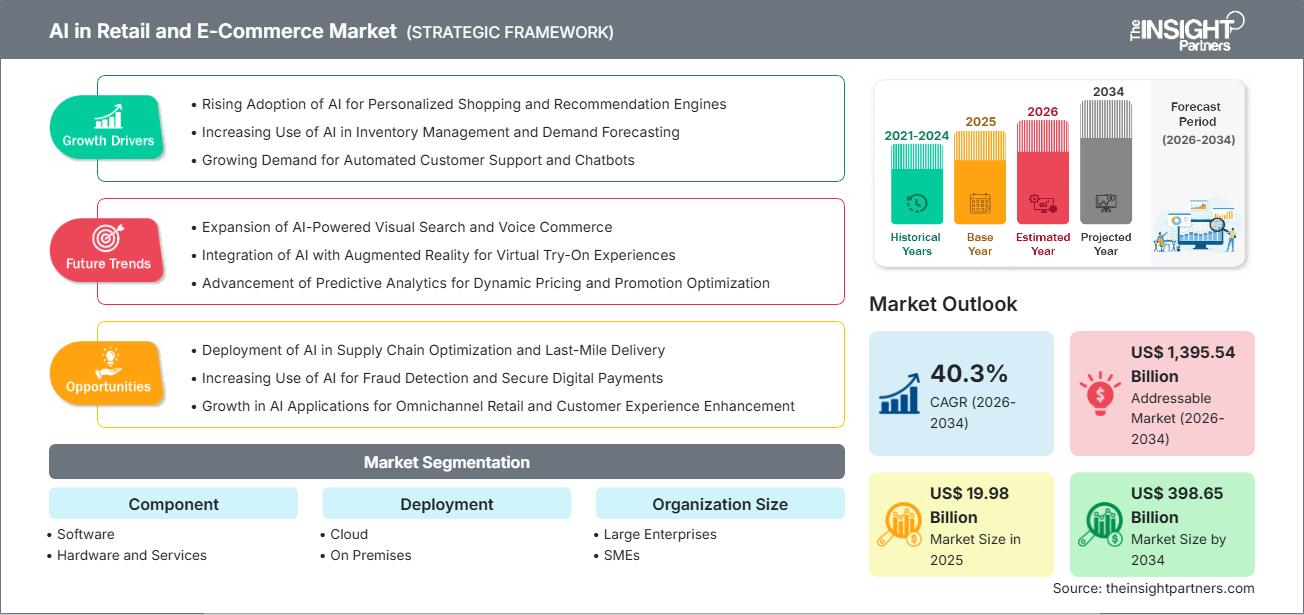
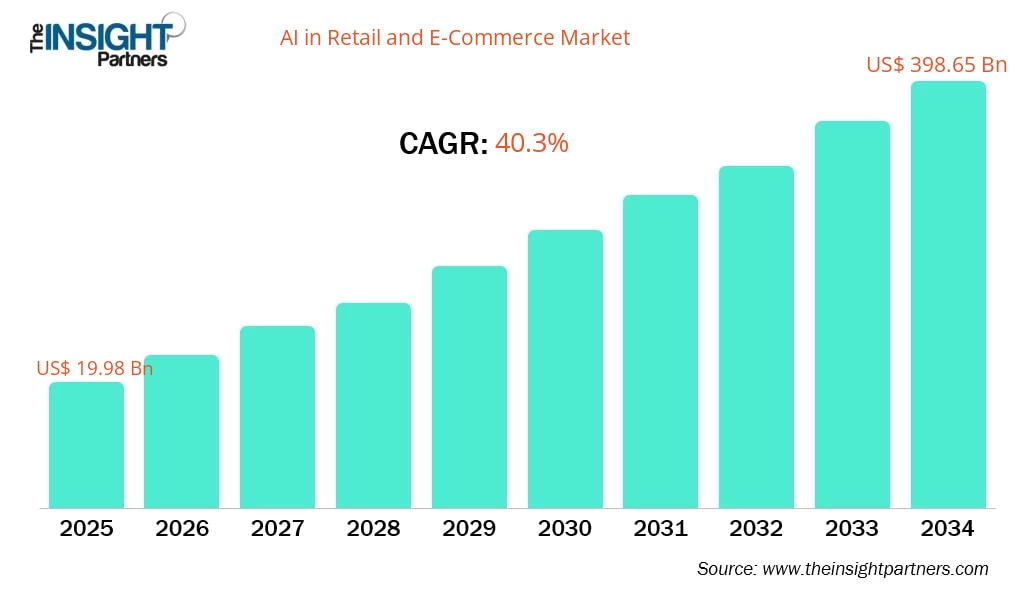
The AI in retail and e-commerce market size is projected to grow from US$ 19.98 Billion in 2025 to US$ 398.65 Billion by 2034, registering a CAGR of 40.3% during 2026–2034. Adoption is moving beyond pilot projects as retailers deploy AI across recommendation engines, commerce search, pricing, fraud detection, inventory planning, service automation, and intelligent fulfillment operations.
North America remains the most mature regional demand center as large retailers, cloud providers, and AI infrastructure companies expand use cases across omnichannel commerce. The regional AI in retail and e-commerce market size is expected to benefit from a 39–42% CAGR range, supported by high digital sales penetration, advanced data ecosystems, and rapid deployment of generative shopping assistants.
AI in Retail and E-Commerce Market Assessment and Insights
- North America: Accounted for 34–37% share in 2025 and is expected to grow at a CAGR of 39–42% during 2026–2034, driven by enterprise AI budgets, cloud maturity, and strong retail analytics adoption.
- US: Represented 78–82% of North America share in 2025 and is expected to grow at a CAGR of 39–41% during 2026–2034, led by large platform retailers.
- Europe: Held a 24–27% share in 2025 and is projected to grow at a CAGR of 36–39% during 2026–2034, with the UK, Germany, France, Italy, and Spain leading adoption.
- Asia Pacific: Captured 28–31% share in 2025 and is expected to expand at a CAGR of 43–46% during 2026–2034, supported by China, Japan, South Korea, India, and Australia.
- Largest Segment: Software held 55–60% market share in 2025 and is expected to grow at a CAGR of 39–42% during 2026–2034 as AI platforms scale across retail functions.
- High Growth Segment: Services held 20–25% market share in 2025 and is expected to grow at a CAGR of 42–45% during 2026–2034 as implementation and managed AI demand rises.
- Key companies analyzed in detail: Accenture plc, Advanced Micro Devices, Inc., Google LLC, International Business Machines Corporation, Intel Corporation, Microsoft Corporation, NVIDIA Corporation, Amazon Web Services, Inc., SAP SE, and SAS Institute Inc.
Source: The Insight Partners' analysis based on proprietary research, government publications, company annual reports, investor presentations, industry databases, and expert interviews.
Retail AI has evolved from rules-based merchandising tools into real-time decision infrastructure. Earlier deployments centered on demand forecasting, fraud scoring, and product recommendations, while current implementations combine generative AI, computer vision, conversational commerce, and predictive analytics. This shift is changing production dynamics across digital storefronts, physical stores, and distribution networks, as retailers prioritize faster data refresh cycles, model governance, and lower-latency cloud or edge deployment.
Over the forecast period, emerging geographies will accelerate adoption as digital payments, mobile commerce, and marketplace ecosystems deepen. Investment is expected to move toward explainable AI, localized product discovery, and supply chain orchestration. Regulatory expectations around data privacy, consumer transparency, and AI governance will favor vendors that can combine scalable automation with auditability and measurable operating impact.
AI in Retail and E-Commerce Market Report Scope
| Report Attribute | Details |
|---|---|
| Market size in 2025 | US$ 19.98 Billion |
| Market Size by 2034 | US$ 398.65 Billion |
| Global CAGR (2026 - 2034) | 40.3% |
| Historical Data | 2021-2024 |
| Forecast period | 2026-2034 |
AI in Retail and E-Commerce Market Analysis
AI in retail and e-commerce market growth is being driven by higher demand for personalized shopping, faster fulfillment, and real-time inventory accuracy. Retailers increasingly use AI to interpret browsing behavior, purchase history, basket patterns, and location signals to improve conversion. NVIDIA reported that 89% of retail and CPG respondents were using or assessing AI in 2025, indicating mainstream adoption across core functions.
Value creation is expanding across the ecosystem as cloud providers, chipmakers, software vendors, systems integrators, and retailers collaborate on scalable deployments. Demand forecasting, dynamic pricing, fraud detection, product content automation, and service bots reduce manual intervention while improving shopper relevance. Supply dynamics are shaped by GPU availability, enterprise data readiness, integration complexity, and the shortage of AI implementation talent.
Competitive positioning in the AI in retail and e-commerce market analysis is increasingly tied to platform depth and deployment flexibility. Microsoft Corporation, Google LLC, Amazon Web Services, Inc., International Business Machines Corporation, SAP SE, and SAS Institute Inc. compete through analytics, AI services, and enterprise software integration, while NVIDIA Corporation, Advanced Micro Devices, Inc., and Intel Corporation support accelerated computing infrastructure.
Accenture plc plays a central role in consulting, implementation, and operating model transformation as retailers move AI from experiments into production workflows. Investment trends favor agentic commerce, retail media optimization, automated merchandising, and supply chain intelligence. Vendors with strong partner ecosystems and industry-specific templates are positioned to capture higher enterprise spending as retailers seek faster payback.
● REPORT CUSTOMIZATION
Tailor This Report To Align With Your Specific Business Requirements
This report can be customized to align precisely with your business objectives, scope, and target markets. Customization options include tailored segmentation, geography, competitive analysis, and strategic insights to support informed decision-making.
Customize This Report →WHAT YOU CAN ADJUST
- ● Segmentations
- ● Geography
- ● Competitive Analysis
- ● Language Preferences
AI in Retail and E-Commerce Market: Strategic Insights
Regional Insights
North America AI in retail and e-commerce market
North America held 34–37% AI in retail and e-commerce market share in 2025 and is expected to grow at a CAGR of 39–42% during 2026–2034. The region benefits from high cloud adoption, advanced retail media networks, mature data lakes, and strong experimentation with generative AI assistants.
Retailers in the region are using AI to improve product discovery, automate customer service, optimize last-mile operations, and raise inventory visibility. US-based hyperscalers and AI infrastructure companies continue to shape technology availability, while Canadian retailers are expanding personalization, fraud analytics, and omnichannel loyalty applications.
U.S. AI in retail and e-commerce Market
The US accounted for 78–82% of North America share in 2025 and is projected to grow at a CAGR of 39–41% during 2026–2034. Large retailers are prioritizing AI-driven search, recommendation engines, inventory orchestration, automated checkout, and retail media campaign optimization.
Company presence is especially strong across cloud, semiconductor, and enterprise software ecosystems. NVIDIA Corporation, Microsoft Corporation, Google LLC, Amazon Web Services, Inc., IBM, AMD, Intel, SAS, and Accenture support deployments that link shopper data, commerce operations, content generation, and supply chain decisioning into integrated retail platforms.
Europe AI in retail and e-commerce Market
Europe represented a 24–27% share in 2025 and is expected to grow at a CAGR of 36–39% during 2026–2034. Adoption is shaped by privacy regulation, cross-border commerce, grocery digitization, and retail modernization in the UK, Germany, France, Italy, and Spain.
The UK leads in digital grocery, retail media, and AI-powered loyalty analytics, while Germany emphasizes supply chain optimization, automated inventory planning, and enterprise governance. France, Italy, and Spain are expanding use cases in luxury retail, fashion e-commerce, marketplace search, and customer service automation, creating steady regional demand.
APAC AI in retail and e-commerce Market
APAC held a 28–31% share in 2025 and is projected to grow at a CAGR of 43–46% during 2026–2034. China leads through large marketplace ecosystems, livestream commerce, and AI recommendation engines, while Japan and South Korea invest in convenience retail automation and robotics.
India and Australia are scaling AI across logistics, fraud prevention, conversational commerce, and catalog automation. Government digitalization programs, mobile-first consumers, and rapid payment infrastructure growth are strengthening regional demand, while local language AI is becoming important for broader shopper engagement.
Middle East & Africa AI in retail and e-commerce Market
Middle East and Africa is expected to grow at a CAGR of 38–41% during 2026–2034. Saudi Arabia and the UAE lead adoption through smart city programs, premium retail modernization, digital payments, and AI-enabled logistics infrastructure.
South Africa and the Rest of MEA are adopting AI in marketplace fraud detection, customer service automation, and inventory planning. Growth is supported by e-commerce expansion, cloud migration, and investment in data centers, although uneven connectivity and talent availability remain constraints.
Segmentation Analysis
Component
Component is expected to grow at a CAGR of 40–43% during 2026–2034. The AI in retail and e-commerce market scope across components is broadening as software platforms, accelerated hardware, and services combine to support personalization, forecasting, product content automation, fraud analytics, and fulfillment optimization.
- Software remains the largest sub-segment because retailers need scalable recommendation engines, predictive analytics, AI search, pricing tools, and workflow automation across digital storefronts, stores, and supply chains.
- Hardware supports AI workloads through GPUs, edge devices, sensors, and in-store computing infrastructure used for computer vision, smart checkout, robotics, and real-time inventory monitoring.
- Services are strategically important as retailers require consulting, model customization, integration, managed operations, governance frameworks, and employee training to move AI use cases into production.
Deployment
Deployment is expected to grow at a CAGR of 39%–42% between 2026 and 2034. The cloud deployment type takes the lead, offering advantages such as ease of model updates, elasticity, and integration with commerce platforms, whereas on-premises deployment remains significant for regulatory workloads.
- Cloud is preferred by retailers scaling AI search, recommendations, marketing automation, and analytics because it offers flexible compute, API access, partner ecosystems, and faster innovation cycles.
- On-premises remains important for retailers with strict data sovereignty, security, or latency requirements, particularly for sensitive transaction analytics, store operations, and proprietary customer data.
Organization Size
Organization Size is expected to grow at a CAGR of 40–44% during 2026–2034. Large enterprises lead spending because they operate complex omnichannel networks and richer data assets, while SMEs are adopting packaged AI tools for customer service, marketing, catalog management, and inventory forecasting.
- Large Enterprises use AI to coordinate merchandising, pricing, retail media, supply chain planning, and customer engagement at scale, supported by larger technology budgets and data engineering teams.
- SMEs are adopting AI through cloud-based commerce platforms, chatbots, automated content tools, and analytics dashboards that lower implementation barriers and improve competitive reach.
Opportunity Snapshot
| Component | Revenue Contribution | Trend Tag | Adoption Stage |
| Software | High | AI Search | Scaling |
| Hardware | Medium | Edge Vision | Scaling |
| Services | Medium | ModelOps | Scaling |
AI in Retail and E-Commerce Market Growth Drivers and Impact Analysis
Expansion of AI-Powered Personalization
Personalization will become a major growth enabler as AI helps to better understand customer intentions during browsing, searching, buying, returning, and loyalty activities. According to DHL, 7 out of 10 customers are looking for an AI-enabled shopping experience, which includes virtual try-ons, voice search, and shopping assistants. This demand requires retailers to personalize their communication with customers to increase conversion rates. Personalization also enables media monetization, as retailers can provide sponsored products or promotions based on a shopper's context.
Operational Automation Across Inventory and Fulfillment
AI is being used by retailers to minimize inventory distortion, improve forecast accuracy, and enhance the efficiency of fulfillment routing. This effect is most pronounced where omnichannel operations present challenging inventory allocation problems through stores, warehouses, marketplaces, and last-mile logistics providers. AI can spot changes in demand more quickly than manual planners can, thereby enabling retailers to prevent stockouts, markdowns, and delays. The greater the volume of e-commerce traffic, the greater the need for automation to sustain customer service and margin preservation.
Enterprise Investment in Generative and Agentic AI
AI generation and agency are redefining retailers' operating models through the automation of content creation, conversational shopping, customer service co-pilots, and autonomous workflows. NVIDIA revealed that over 80% of retailers and consumer packaged goods (CPG) companies had deployed or piloted a generative AI project in 2025. It alters competitive dynamics since retailers will be able to refresh their catalogs quickly, localize campaigns, synthesize reviews, and support store staff with information.
AI in Retail and E-Commerce Market Future Trends
Agentic Commerce Interfaces
AI in retail and e-commerce market trends will increasingly center on agentic commerce, where AI-powered helpers would shop, compare, recommend, and make purchases with minimal customer intervention. Microsoft rolled out AI services for retail agencies in 2026, including commerce services that integrated discovery and shopping. In this scenario, retailers will need effective product data management, a proper consent process, and efficient fulfillment. This step can address navigation issues and make conversational commerce a common sales channel.
Physical AI in Stores and Warehouses
Physical AI will expand in scope as retailers deploy computer vision, robots, edge computing, and digital twins for better store execution and warehouse operations. These include shelf management, robot picking, shrink reduction, queuing, and self-checkout systems, which will move beyond standalone pilots into implementation in real-world environments. This will entail reduced hardware and connectivity costs, and greater acceptance by individuals. Those who combine physical AI with predictive planning will be able to improve availability and avoid labor constraints.
AI in Retail and E-Commerce Market Opportunities
Retail Media and Dynamic Merchandising
Retail media offers a major opportunity because AI can improve targeting, creative optimization, bidding, and closed-loop measurement. As retailers monetize first-party data, AI helps connect product visibility with shopper intent across digital shelves, apps, email, and in-store screens. AI in retail and e-commerce market: Forecasts indicate that platforms that combine merchandising logic with advertising intelligence will gain strategic value. Retailers can use these systems to improve supplier collaboration, increase conversion rates, and protect the customer experience from irrelevant promotions.
AI Implementation Services for Mid-Market Retailers
There is an interesting opportunity in mid-market retailers, since most lack in-house AI engineering yet need the technology to compete with big platforms. It will be easy for service providers to commoditize services such as data readiness, integration, governance, model monitoring, and end-user training. There is definitely an opportunity for vendors in catalog automation, customer support, demand forecasting, fraud detection, and marketplace optimization.
Frequently Asked Questions

- Comprehensive Market Sizing and Forecast Analysis
- Detailed Segmentation Analysis
- In-Depth Market Dynamics Assessment
- Regional and Country-Level Insights
- Competitive Landscape and Company Benchmarking
- Strategic Business Intelligence
Recent Reports
Testimonials

The Insight Partners provided valuable market intelligence that supported our global go-to-market strategy. Their team was professional, responsive, and attentive to our feedback, providing thoughtful analysis and helpful methodological clarifications throughout the project.
Junmo Kim Chief Financial Officer (CFO), Enertech Co., Ltd.
The Insight Partners' SCADA System Market report is comprehensive, with valuable insights on current trends and future forecasts. The team was highly professional, responsive, and supportive throughout. We are very satisfied and highly recommend their services.
RAN KEDEM Partner, Reali Technologies LTDs
I requested a report on a very specific software market and the team produced the report in a few days. The information was very relevant and well presented. I then requested some changes and additions to the report. The team was again very responsive and I got the final report in less than a week.
JEAN-HERVE JENN Chairman, Future Analytica
We worked with The Insight Partners for an important market study and forecast. They gave us clear insights into opportunities and risks, which helped shape our plans. Their research was easy to use and based on solid data. It helped us make smart, confident decisions. We highly recommend them.
PIYUSH NAGPAL Sr. Vice President, High Beam Global
The Insight Partners delivered insightful, well-structured market research with strong domain expertise. Their team was professional and responsive throughout. The user-friendly website made accessing industry reports seamless. We highly recommend them for reliable, high-quality research services
YUKIHIKO ADACHI CEO, Deep Blue, LLC.
This is the first time I have purchased a market report from The Insight Partners.While I was unsure at first, I visited their web site and felt more comfortable to take the risk and purchase a market report.I am completely satisfied with the quality of the report and customer service. I had several questions and comments with the initial report, but after a couple of dialogs over email with their analyst I believe I have a report that I can use as input to our strategic planning process.Thank you so much for taking the extra time and making this a positive experience.I will definitely recommend your service to others and you will be my first call when we need further market data.
JOHN SUZUKI President and Chief Executive Officer, Board Director, BK Technologies
I wish to appreciate your support and the professionalism you displayed in the course of attending to my request for information regarding to infectious disease IVD market in Nigeria. I appreciate your patience, your guidance, and the fact that you were willing to offer a discount, which eventually made it possible for us to close a deal. I look forward to engaging The Insight Partners in the future, all thanks to the impression you have created in me as a result of this first encounter.
DR CHIJIOKE ONYIA MANAGING DIRECTOR, PineCrest Healthcare Ltd.Reason to Buy
- Informed Decision-Making
- Understanding Market Dynamics
- Competitive Analysis
- Identifying Emerging Markets
- Customer Insights
- Market Forecasts
- Risk Mitigation
- Boosting Operational Efficiency
- Strategic Planning
- Investment Justification
- Tracking Industry Innovations
- Aligning with Regulatory Trends





 Get Free Sample for