
Air Dried Food Market Trends, Size & Growth by 2034
Coverage: By Product Type (Fruits and Vegetables, Herbs and Spices, Meat and Seafood Products, Others); Form (Whole, Slices, Powder and Granules, Others); Distribution Channel (Supermarkets and Hypermarkets, Convenience Stores, Online Retail, Others), and Geography (North America, Europe, Asia Pacific, and South and Central America)
- Status : Data Released
- Report Code : TIPRE00015510
- Category : Food and Beverages
- No. of Pages : 150
- Available Report Formats :


- Last update date : August 12, 2026


2025 Market Size
US$ 39.73 Bn
Base year value
2034 Forecast
US$ 83.24 Bn
Projected by 2034
CAGR 2026-2034
8.57 %
Growth rate
Addressable Market
US$ 551.64 Bn
(2026-2034)
The air dried food market is projected to expand from US$ 39.73 Billion in 2025 to US$ 83.24 Billion by 2034, registering a CAGR of 8.57% during 2026–2034. Demand is being shaped by shelf-stable nutrition, cleaner ingredient labels, lower dependence on refrigeration, and wider use of dried fruits, vegetables, herbs, spices, meat, and seafood across retail, foodservice, and packaged food manufacturing.
North America remains a strategically important demand center, supported by strong snack consumption, processed food innovation, outdoor recreation use cases, and well-developed online retail networks. The air-dried food market size in the region is expected to benefit from clean-label launches, premium fruit snacks, and ingredient applications in cereals, meal kits, soups, and ready-to-cook products.
Air Dried Food Market Assessment and Insights
- North America: The region accounted for an estimated 31–34% share in 2025 and is expected to grow at a CAGR of 7.8–8.4% during 2026–2034, supported by healthy snacking and convenience-led retail demand.
- US: The US represented around 76–80% of North America revenue in 2025, with CAGR estimated at 7.9–8.5% through 2034.
- Europe: Europe held an estimated 27–30% share in 2025, with Germany, the UK, France, Italy, and Spain leading adoption across bakery, cereal, and clean-label snack applications.
- Asia Pacific: Asia Pacific represented nearly 24–27% share in 2025 and is forecast to grow at 9.0–9.8% CAGR, led by China, India, Japan, South Korea, and Australia.
- Largest Segment: Fruits and Vegetables held the largest product share at 40–43% in 2025, with a CAGR range of 8.6–9.1% during 2026–2034.
- High Growth Segment: Online Retail is expected to be the fastest-growing distribution channel, with 2025 share of 18–21% and CAGR of 10.0–10.8%.
- Key companies analyzed in detail: Crispy Green Inc.; HOWENIA FOOD BIOTECH ENTERPRISES LTD; JIYAN FOOD INGREDIENTS; Xinghua Lianfu Food Co., Ltd.; Zama Organics; BB Products; Harmony House Foods, Inc.; Seawind Foods; The Seasoned Pioneers; Nim’s Fruit Crisps Limited; Delixious; OliveNation; Penzeys Spices; Silva International, Inc.; Brooklyn Cured LLC; Kalahari Snacks; Brooklyn Biltong; Ceylon Flavors; Braaitime.
Source: The Insight Partners' analysis based on proprietary research, government publications, company annual reports, investor presentations, industry databases, and expert interviews.
Processing economics are improving as manufacturers shift from basic dehydration toward controlled hot-air systems, hybrid drying, and packaging formats that protect color, aroma, and texture. The air dried food market growth is also linked to reduced food waste because drying extends usable life for seasonal produce and supports ingredient availability across supply chains.
Forward-looking demand will be shaped by e-commerce, premium snack positioning, and broader adoption in emerging Asian and Middle Eastern urban centers. Producers with consistent sourcing, allergen controls, and export-ready certifications are likely to gain preference among retailers and food processors seeking reliable shelf-stable ingredients.
Air Dried Food Market Report Scope
| Report Attribute | Details |
|---|---|
| Market size in 2025 | US$ 39.73 Billion |
| Market Size by 2034 | US$ 83.24 Billion |
| Global CAGR (2026 - 2034) | 8.57% |
| Historical Data | 2021-2024 |
| Forecast period | 2026-2034 |
Air Dried Food Market Analysis
Consumer demand is moving beyond traditional dried fruits toward meal solutions, seasoning blends, jerky-style proteins, and vegetable-based snacks. The air dried food market analysis indicates that manufacturers are using air drying to preserve flavor while reducing reliance on synthetic preservatives. This supports applications in cereals, bakery mixes, soup bases, instant meals, and travel-friendly foods.
The supply dynamics are still influenced by the seasonality of raw materials, drying capabilities, packaging costs, and consistency in quality. Companies that have vertical integration capabilities or good connections with suppliers may deal with the supply of fruit, vegetables, herbs, and protein better. This becomes critical when the products are positioned by brand as natural tasting and minimally processed snacks, retaining nutrients.
The competition involves specialists in snack production, ingredient processors, spice manufacturers, and meat snacks producers. The competition is done based on the quality of products, innovative flavors, private label cooperation, and visibility online. Some of the competitors include Crispy Green Inc., Harmony House Foods, Inc., Seawind Foods, Silva International, Inc., and Nim’s Fruit Crisps Limited.
Current investment directions are related to automation, moisture control improvement, sustainable packaging, and channel development. The premium brands are concentrating on developing single-ingredient snacks and clean labels, while ingredient suppliers are focusing on foodservice and industrial clients.
● REPORT CUSTOMIZATION
Tailor This Report To Align With Your Specific Business Requirements
This report can be customized to align precisely with your business objectives, scope, and target markets. Customization options include tailored segmentation, geography, competitive analysis, and strategic insights to support informed decision-making.
Customize This Report →WHAT YOU CAN ADJUST
- ● Segmentations
- ● Geography
- ● Competitive Analysis
- ● Language Preferences
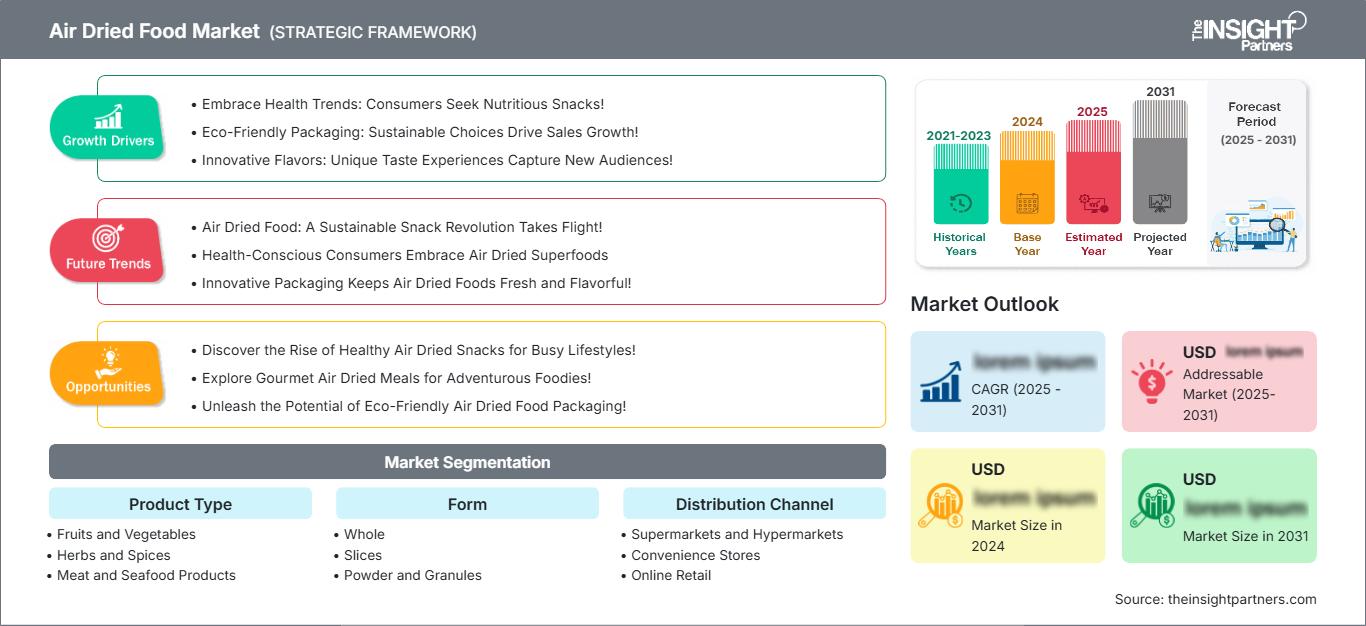
Air Dried Food Market: Strategic Insights
Regional Insights
North America Air Dried Food Market
North America is expected to maintain a 31–34% air dried food market share in 2025, supported by strong packaged snack penetration, a mature health-and-wellness retail environment, and sustained demand for shelf-stable ingredients. The region is forecast to grow at a CAGR of 7.8–8.4% during 2026–2034. Consumers increasingly favor convenient, nutritious, and minimally processed food products, creating favorable conditions for air-dried fruits, vegetables, herbs, and specialty ingredients.
Growth is being enabled by growing demand for clean-label fruit snacks, camping & outdoors nutrition products, pantry food products, and food service products using dried fruits and herbs. Growing trends of healthy snacking, vegetarian foods, and natural ingredients-based products are providing an additional boost to market acceptance. E-commerce platforms and specialty retailers are also aiding smaller players and new entrants to expand their reach beyond conventional stores. Consistent product innovation and premium positioning of products are also enabling market growth over the long term.
U.S. Air Dried Food Market
The US accounted for an estimated 76–80% of North America revenue in 2025 and is projected to grow at a CAGR of 7.9–8.5%. Demand is supported by high snack frequency, ongoing product innovation, and a large base of food processors utilizing dried fruit, vegetable, and specialty ingredient inclusions. According to the Air Dried Food Market Report, increasing consumer preference for convenient, minimally processed, and shelf-stable food products continues to support market expansion. Growing demand for clean-label snacks and healthy ingredient alternatives is further strengthening adoption across the food manufacturing sector.
Company presence is strongest across fruit snacks, dehydrated vegetables, jerky-style protein products, and bulk ingredient formats. Retailers are expanding premium and private-label options, while e-commerce supports repeat purchases for specialty diets and pantry-stable meal preparation.
Europe Air Dried Food Market
Europe held an estimated 27–30% share in 2025 and is forecast to expand at a CAGR of 7.4–8.0% during 2026–2034. Demand from the UK and Germany arises from robust consumption of breakfast cereals, bakery inclusions, dried vegetables, and spices. Preference by consumers for ready-to-eat, healthy, and minimally processed foods continues to drive the uptake of air-dried ingredients in the market.
Consumption of herbs, vegetables, fruits, and high-value pantry ingredients by French, Italians, and Spanish cuisines is adding impetus to the market demand from households and the food service industry. Clean label and reduction of additives in food items through regulations continue to be a driver of air-drying of ingredients that have natural product positioning. Increased consumption of plant-based foods, organic products, and premium snacks is driving market growth. Innovation in functional foods and healthy convenience products is opening up opportunities in the market.
APAC Air Dried Food Market
APAC represented an estimated 24–27% Air Dried Food Market share in 2025 and is expected to grow at a 9.0–9.8% CAGR through 2034. Due to a large food processing industry as well as high demands for shelf-stable food products, China dominates in the regional volume. Japan, South Korea, India, and Australia help to expand the market with growing consumption of convenience foods, healthy snacks, and foodservice ingredients. In addition, consumer preference for natural and unprocessed food contributes to the development of demand in the region.
Urbanization, disposable income growth, the adoption of online grocery, and the development of modern retail improve product availability and penetration rate. Moreover, manufacturers begin using locally sourced fruits, vegetables, seafood, and spices to create a distinctive product range that can be consumed domestically and exported. Finally, increased demand for clean-label products, the development of food processing capacities, and innovations in ready-to-eat food segments contribute to the formation of attractive opportunities for air-dried food manufacturers in the Asia Pacific region.
Middle East & Africa Air Dried Food Market
The Middle East & Africa Air Dried Food Market is projected to grow at a CAGR of 8.1–8.8% during 2026–2034. Saudi Arabia, the UAE, and South Africa are the leading markets, supported by rising consumption of imported packaged foods, expanding hospitality sectors, and growing preference for pantry-stable grocery products. Increasing urbanization and changing dietary habits are also contributing to the demand for convenient and long-shelf-life food options across the region.
Hot climates and long distribution routes make shelf-stable foods particularly attractive for retailers, distributors, and foodservice operators. Demand is also emerging for dried fruits, spices, meat snacks, and convenient ingredients that reduce dependence on refrigerated storage and cold-chain logistics. Additionally, growth in modern retail formats, e-commerce grocery platforms, and tourism-related food consumption is creating new opportunities for air-dried food manufacturers throughout the region.
Segmentation Analysis
Product Type
Product Type is expected to grow at a CAGR of 8.5–9.1% during 2026–2034. The air dried food market scope spans fruits and vegetables, herbs and spices, and meat and seafood products, with demand shaped by snacking, culinary use, protein formats, and industrial ingredient requirements.
- Fruits and Vegetables: This sub-segment leads demand due to clean-label snacking, cereal inclusions, smoothie mixes, soups, and ready-meal applications requiring flavor, color, and long shelf life.
- Herbs and Spices: Demand is supported by household cooking, foodservice seasoning, sauces, marinades, and packaged food formulations that require concentrated aroma and consistent quality.
- Meat and Seafood Products: Adoption is linked to jerky-style snacks, travel foods, emergency meals, and protein-rich options with extended storage stability.
Form
Form is projected to grow at a CAGR of 8.3–8.9% during 2026–2034. Whole, sliced, powder, and granule formats serve different use cases, from direct snacking to seasoning systems and food manufacturing.
- Whole: Whole formats appeal to premium snack buyers and culinary users seeking recognizable ingredients with minimal processing and strong natural positioning.
- Slices: Sliced products support portion control, faster rehydration, and snack convenience, especially in fruit, vegetable, and meat applications.
- Powder and Granules: Powder and granule formats are important for soups, sauces, seasoning blends, bakery mixes, beverages, and industrial formulations.
Distribution Channel
Distribution Channel is expected to expand at a CAGR of 8.6–9.3% during 2026–2034. Supermarkets, convenience stores, and online retail collectively determine brand visibility, impulse purchase behavior, and repeat demand.
- Supermarkets and Hypermarkets: These outlets remain central for mainstream dried fruit, vegetable snacks, spices, and meat products because they provide shelf visibility and cross-category placement.
- Convenience Stores: Convenience stores support single-serve packs, impulse snacks, meat products, and travel-friendly formats targeted at busy consumers.
- Online Retail: Online retail supports specialty brands, bulk buying, subscription models, and broader discovery of clean-label, vegan, organic, and high-protein products.
Opportunity Snapshot
| Distribution Channel | Revenue Contribution | Trend Tag | Adoption Stage |
| Supermarkets and Hypermarkets | High | Retail Visibility | Mature |
| Convenience Stores | Medium | Impulse Packs | Scaling |
| Online Retail | Medium | Subscription Snacks | Scaling |
Air Dried Food Market Growth Drivers and Impact Analysis
Clean-Label Snacking and Shelf-Stable Nutrition
There is an increase in consumer preference towards snack items made of identifiable components, minimal processing, and extended shelf life. Drying via air is in line with this trend since it allows for the elimination of moisture content while maintaining the integrity of the product, thus making fruits, vegetables, herbs, and proteins fit for packaging and use as ingredients. This has led to increased demand from consumers at home, outdoors, in schools, institutions, and packaged food companies, which require products that combine convenience and naturalness. There has also been increased focus on healthy living and minimally processed foods.
Expansion of Packaged Foods and Foodservice Applications
These food products have incorporated the use of dried ingredients in cereals, baked goods, instant soup, sauces, seasonings, meal packages, and ready-to-cook food products. Drying the ingredients prevents spoilage, makes storage easier, and enhances the availability of seasonal ingredients throughout the year. The foodservice establishments get convenience because the food products require less time to prepare, and the products are safe from the risks of going bad before they are utilized in the cooking process. There will be consistency in the taste and texture of the meals prepared in a standardized manner. There is more incentive in terms of the demand for convenient food products.
Online Retail and Premium Specialty Brand Growth
There is an increasing availability of unique air-dried foods through digital platforms, such as organic fruit snacks, vegan pantry products, specialized spices, and meat products that are high in protein content. Digital commerce enables brands to connect directly with consumers by bypassing the need to exclusively depend on grocery store shelves. This also facilitates brand development through repeat orders, subscription models, product education, and feedback mechanisms that help improve flavor, packaging, and positioning of the brand. Additionally, through online marketplaces, it is easier to market the product directly to specialty consumer groups.
Air Dried Food Market Future Trends
Hybrid Drying and Texture-Focused Innovation
Future air-dried food market trends will include greater use of hybrid drying systems that balance energy efficiency with improved texture, flavor retention, and color stability. Producers are expected to refine airflow, temperature, and moisture controls to reduce batch variability. This will help brands develop crisp fruit snacks, rehydratable vegetables, premium herbs, and protein products with more consistent sensory quality. In addition, manufacturers are likely to invest in advanced processing technologies that preserve nutritional value while improving production efficiency. These developments can support premium product positioning, enhance consumer satisfaction, and expand the application of air-dried ingredients across retail and foodservice markets.
Sustainable Packaging and Waste Reduction Positioning
Brands are likely to strengthen sustainability claims by linking air drying with reduced spoilage, lighter transportation weight, and longer shelf life. Packaging innovation will focus on moisture barriers, recyclable materials, and portion control. These improvements can help retailers lower shrinkage while giving consumers pantry-stable options that align with responsible consumption and reduced food waste priorities. Growing environmental awareness is also encouraging companies to adopt eco-friendly packaging formats and optimize supply chains to reduce carbon footprints. As sustainability becomes a key purchasing factor, brands with strong waste reduction and environmental credentials may gain a competitive advantage in the market.
Air Dried Food Market Opportunities
Premium Fruit and Vegetable Snacks for Urban Consumers
Air-dried food market forecasts indicate strong opportunities in premium fruit and vegetable snacks designed for urban households, children, office workers, and travelers. Brands can differentiate through single-origin sourcing, no-added-sugar claims, high-fiber positioning, and resealable packaging. Retailers can also build category growth by placing products near breakfast, lunchbox, wellness, and on-the-go snack aisles. Rising consumer interest in convenient, healthy snacking alternatives is creating demand for products that combine nutrition, portability, and clean-label attributes. Premium packaging, innovative flavor combinations, and functional health benefits can further strengthen brand appeal and support higher-value market segments.
Ingredient Partnerships with Food Manufacturers
Ingredient suppliers can expand by partnering with cereal, bakery, soup, sauce, and ready-meal manufacturers that require stable and reliable inputs. Opportunities exist for custom cut sizes, clean-label vegetable powders, herb blends, and fruit inclusions tailored to specific product formulations. Suppliers that offer traceability, food safety documentation, and consistent moisture specifications will be better positioned for long-term procurement contracts. Growing demand for natural ingredients and simplified product formulations is encouraging manufacturers to seek dependable ingredient partners. Companies that provide technical support, product customization, and supply chain reliability can strengthen customer relationships and secure recurring business opportunities.
Frequently Asked Questions

- Comprehensive Market Sizing and Forecast Analysis
- Detailed Segmentation Analysis
- In-Depth Market Dynamics Assessment
- Regional and Country-Level Insights
- Competitive Landscape and Company Benchmarking
- Strategic Business Intelligence
Recent Reports
Testimonials

The Insight Partners' SCADA System Market report is comprehensive, with valuable insights on current trends and future forecasts. The team was highly professional, responsive, and supportive throughout. We are very satisfied and highly recommend their services.
RAN KEDEM Partner, Reali Technologies LTDs
I requested a report on a very specific software market and the team produced the report in a few days. The information was very relevant and well presented. I then requested some changes and additions to the report. The team was again very responsive and I got the final report in less than a week.
JEAN-HERVE JENN Chairman, Future Analytica
We worked with The Insight Partners for an important market study and forecast. They gave us clear insights into opportunities and risks, which helped shape our plans. Their research was easy to use and based on solid data. It helped us make smart, confident decisions. We highly recommend them.
PIYUSH NAGPAL Sr. Vice President, High Beam Global
The Insight Partners delivered insightful, well-structured market research with strong domain expertise. Their team was professional and responsive throughout. The user-friendly website made accessing industry reports seamless. We highly recommend them for reliable, high-quality research services
YUKIHIKO ADACHI CEO, Deep Blue, LLC.
This is the first time I have purchased a market report from The Insight Partners.While I was unsure at first, I visited their web site and felt more comfortable to take the risk and purchase a market report.I am completely satisfied with the quality of the report and customer service. I had several questions and comments with the initial report, but after a couple of dialogs over email with their analyst I believe I have a report that I can use as input to our strategic planning process.Thank you so much for taking the extra time and making this a positive experience.I will definitely recommend your service to others and you will be my first call when we need further market data.
JOHN SUZUKI President and Chief Executive Officer, Board Director, BK Technologies
I wish to appreciate your support and the professionalism you displayed in the course of attending to my request for information regarding to infectious disease IVD market in Nigeria. I appreciate your patience, your guidance, and the fact that you were willing to offer a discount, which eventually made it possible for us to close a deal. I look forward to engaging The Insight Partners in the future, all thanks to the impression you have created in me as a result of this first encounter.
DR CHIJIOKE ONYIA MANAGING DIRECTOR, PineCrest Healthcare Ltd.Reason to Buy
- Informed Decision-Making
- Understanding Market Dynamics
- Competitive Analysis
- Identifying Emerging Markets
- Customer Insights
- Market Forecasts
- Risk Mitigation
- Boosting Operational Efficiency
- Strategic Planning
- Investment Justification
- Tracking Industry Innovations
- Aligning with Regulatory Trends





 Get Free Sample for