
Air Purifier Market Size, Share & Growth by 2034
Coverage: By Technique [High-Efficiency Particulate Air (HEPA), Ultraviolet Germicidal Irradiation (UVGI), Activated Carbon Filtration, Ionizer Purifiers, Others], End-User (Commercial, Residential, and Industrial), and Geography
- Status : Data Released
- Report Code : TIPRE00009516
- Category : Electronics and Semiconductor
- No. of Pages : 150
- Available Report Formats :


- Last update date : July 20, 2026


2025 Market Size
US$ 17.47 Bn
Base year value
2034 Forecast
US$ 30.88 Bn
Projected by 2034
CAGR 2026-2034
6.53 %
Growth rate
Addressable Market
US$ 218.61 Bn
(2026-2034)
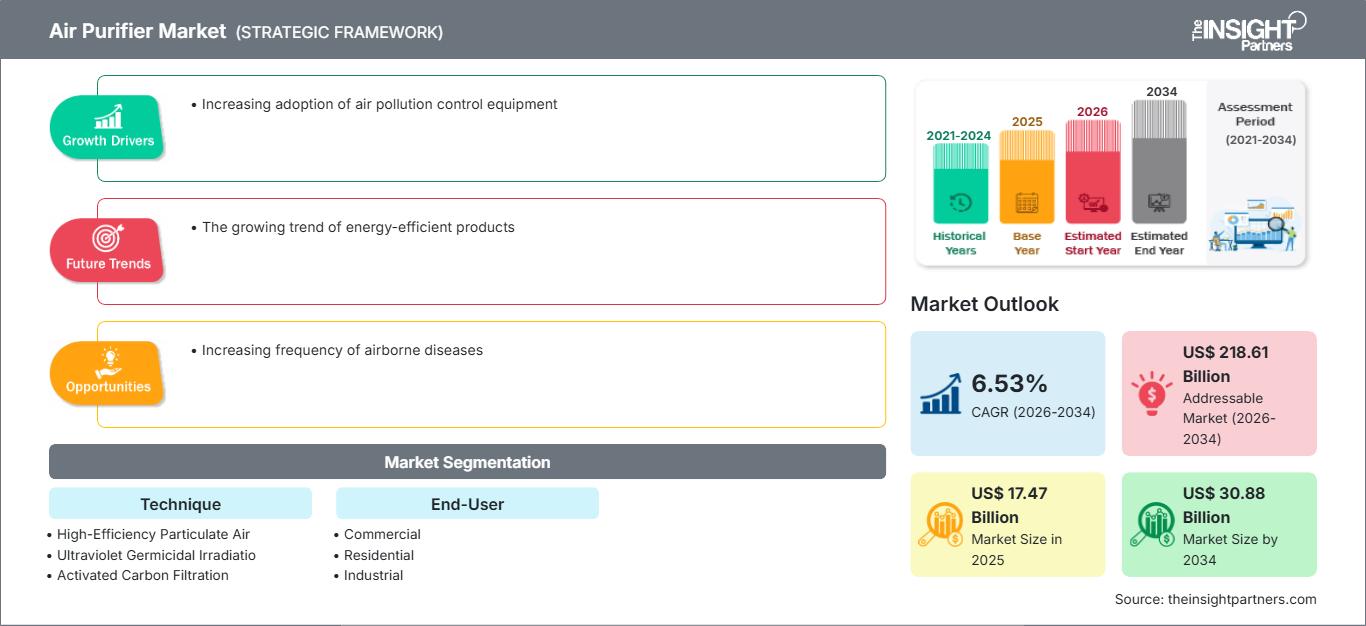
The Air Purifier market size is expected to grow from US$ 17.47 Billion in 2025 to US$ 30.88 Billion by 2034, registering a CAGR of 6.53% during 2026–2034. Demand is shaped by health-driven indoor air quality priorities, increasing particulate exposure in cities, and wider adoption of connected filtration devices across residential, commercial, and industrial spaces.
North America remains a high-value demand center as building owners, households, and healthcare facilities prioritize filtration performance, energy efficiency, and connected monitoring. The Air Purifier size in the region is expected to advance at a 5.8–6.4% CAGR range, supported by asthma and allergy prevalence, wildfire smoke exposure, and stricter indoor air quality expectations in schools, offices, and multifamily housing.
Air Purifier Market Assessment and Insights
- North America accounted for 31–33% share in 2025 and is projected to grow at a 5.8–6.4% CAGR between 2026–2034 as wildfire smoke, asthma management, and school ventilation upgrades increase replacement demand.
- US represented 76–79% of North America in 2025 and is expected to expand at a 5.7–6.3% CAGR between 2026–2034, led by premium residential and healthcare installations.
- Europe held 24–26% share in 2025 and is expected to record a 5.5–6.1% CAGR between 2026–2034, with Germany, the UK, France, Italy, and Spain leading demand.
- Asia Pacific captured 34–36% of the Air Purifier market share in 2025 and is forecast to grow at a 7.1–7.8% CAGR between 2026–2034, led by China, India, Japan, South Korea, and Australia.
- Largest Segment High-Efficiency Particulate Air held 42–45% market share in 2025 and is projected to grow at a 6.1–6.7% CAGR between 2026–2034.
- High Growth Segment Ultraviolet Germicidal Irradiation held 13–16% market share in 2025 and is expected to grow at a 7.4–8.1% CAGR between 2026–2034
- Key companies analyzed in detail: Whirlpool Corporation, Atlanta Healthcare Private Limited, Blue Star Limited, Crusaders India Private Limited, Daikin Industries, Ltd., Samsung Electronics Co., Ltd., Hindware Home Innovation Limited, LG Electronics Inc., Eureka Forbes Limited, Hamilton Beach Brands, Inc.
Source: The Insight Partners' analysis based on proprietary research, government publications, company annual reports, investor presentations, industry databases, and expert interviews.
Product evolution has moved from single-filter appliances to multi-stage platforms combining HEPA media, carbon beds, UV-C modules, sensors, and app-based controls. Manufacturers now optimize clean air delivery rate, filter life, acoustic comfort, and power draw together because buyers compare lifecycle cost as closely as room coverage. Production is increasingly regionalized, with Asian electronics supply chains supporting compact residential models and HVAC-linked specialists serving institutional projects.
Looking ahead, the Air Purifier market report is shifting toward emerging urban corridors where pollution alerts, rising disposable income, and formal building standards converge. Investment is flowing into low-noise motors, recyclable filter materials, predictive maintenance, and commercial systems that integrate with building management software. Regulatory tailwinds around indoor air quality, occupational safety, and energy labeling are expected to favor tested, efficient units over low-cost unverified devices.
Air Purifier Market Report Scope
| Report Attribute | Details |
|---|---|
| Market size in 2025 | US$ 17.47 Billion |
| Market Size by 2034 | US$ 30.88 Billion |
| Global CAGR (2026 - 2034) | 6.53% |
| Historical Data | 2021-2024 |
| Forecast period | 2026-2034 |
Air Purifier Market Analysis
Air Purifier growth is tied to the widening gap between outdoor pollution exposure and the quality of air people expect indoors. WHO data indicate that almost the entire global population breathes air exceeding guideline limits, while EPA guidance notes that people spend most time indoors and that filtration can supplement ventilation and source control.
The value chain includes filter-media suppliers, fan and sensor makers, electronics assemblers, appliance brands, HVAC distributors, and service providers managing filter replacement. Supply dynamics favor companies that can secure certified HEPA media, activated carbon, UV components, and low-noise brushless motors while keeping energy consumption competitive for continuous-use households and commercial buyers.
Air Purifier analysis shows a moderately fragmented competitive field where global appliance groups compete with specialist filtration brands and regional manufacturers. LG Electronics Inc., Samsung Electronics Co., Ltd., Daikin Industries, Ltd., and Whirlpool Corporation emphasize connected platforms, while Blue Star Limited, Atlanta Healthcare Private Limited, and Crusaders India Private Limited address localized pollution conditions and service-led sales.
Investment is concentrated in smart sensing, washable or longer-life filters, compact formats, and commercial-grade systems for offices, clinics, hotels, and education facilities. Strategic positioning increasingly depends on verifiable clean air delivery, low ozone risk, device interoperability, and after-sales economics. Brands that combine credible testing with affordable filter replacement are positioned to defend margins as online price comparison intensifies.
● REPORT CUSTOMIZATION
Tailor This Report To Align With Your Specific Business Requirements
This report can be customized to align precisely with your business objectives, scope, and target markets. Customization options include tailored segmentation, geography, competitive analysis, and strategic insights to support informed decision-making.
Customize This Report →WHAT YOU CAN ADJUST
- ● Segmentations
- ● Geography
- ● Competitive Analysis
- ● Language Preferences
Air Purifier Market: Strategic Insights
Regional Insights
North America Air Purifier Market
North America held 31–33% share in 2025 and is expected to grow at a 5.8–6.4% CAGR through 2034. The Air Purifier market share is supported by wildfire smoke mitigation, high allergy incidence, and institutional spending on classrooms, clinics, offices, and senior-care facilities. ENERGY STAR efficiency guidance also encourages buyers to compare annual power use, strengthening demand for premium low-consumption units.
Purchasing behavior is shifting from seasonal use to continuous monitoring, particularly in smoke-prone western states and densely occupied commercial buildings. Manufacturers are responding with higher CADR ratings, quiet sleep modes, and integrated particulate sensors. Replacement filters and service programs are becoming recurring revenue streams, while commercial buyers prioritize documentation for workplace health, leasing quality, and risk management.
U.S. Air Purifier Market
The U.S. represented 76–79% of North America in 2025 and is forecast to expand at a 5.7–6.3% CAGR. Demand is strongest in residential premium retail, healthcare, education, hospitality, and small offices where filtration is positioned as a complement to HVAC upgrades rather than a substitute for ventilation.
Daikin Industries, Ltd. and Whirlpool Corporation have established U.S. channel presence, while LG Electronics Inc., Samsung Electronics Co., Ltd., and Hamilton Beach Brands, Inc. compete through consumer electronics and appliance retail networks. Application trends favor connected room purifiers, dormitory and back-to-school campaigns, and medical waiting-area installations that require predictable filter replacement schedules.
Europe Air Purifier Market
Europe held a 24–26% market share in 2025 and is projected to grow at a CAGR of 5.5–6.1%. Germany has the largest country market share due to high expectations for HVAC system quality, heightened allergy awareness, and industrial settings where dust and odor reduction are necessary. In the United Kingdom, expansion is driven by investments in home wellness, office remodeling, and ventilation upgrades in schools.
In France, the driver of market growth is found in apartment blocks, retail, and the hospitality industry segments. In Italy and Spain, seasonal pollens, tourism installations, and heatwave-related indoor occupancy increase demand. Energy-efficient products are becoming important in Europe; therefore, this trend drives manufacturers to provide quiet motors and lower power consumption. Customers are now looking for purification performance relative to electricity usage, waste filtration, and indoor product requirements for low emissions.
APAC Air Purifier Market
The APAC region accounted for 34-36% of the global market in 2025 and is forecast to register a CAGR of 7.1-7.8%. This makes it the largest contributor in the region. China leads in manufacturing capacity and urban sales, whereas India shows strong growth due to extremely high PM2.5 levels, thereby making filtration in domestic units a valid purchase decision.
Japanese and South Korean companies require smaller, quieter, and more sophisticated models, while Australia already has a market due to its preparations for smoke from bushfires and business wellness initiatives. Urban air quality regulations, industrial pollutants regulations, and healthy buildings create the need for HEPA filters and multi-stage filtration systems. A shorter research and development cycle and greater access to electronic components favor local manufacturers in this market.
Middle East & Africa Air Purifier Market
Middle East & Africa is projected to grow at a 6.8–7.4% CAGR, led by the UAE and Saudi Arabia, where there is demand for dust removal, odor control, and particulate filtration in hospitality, healthcare, airport, and luxury residential projects. South Africa will contribute to demand through retrofitting and urban households.
Integration of air purification technologies is more common in power-intensive cooling settings due to the need for controlled filtration in a closed system. The need for commercial uses will also emerge from investments in infrastructure for shopping centers, hotels, hospitals, and transportation systems. Dust storms and construction will create maintenance needs, giving an edge to companies with strong local partners.
Segmentation Analysis
Technique
Technique is expected to grow at a 6.4–7.0% CAGR during 2026–2034. The Air Purifier market scope is broadening as buyers combine particulate capture, odor removal, microbial reduction, and smart diagnostics. Selection is increasingly application-led: homes prioritize quiet HEPA devices, clinics require validated multi-stage performance, and industrial users need larger airflow capacity with predictable maintenance economics.
- High-Efficiency Particulate Air remains the largest technique because it captures fine particles, allergens, smoke, and dust with measurable efficiency, making it central to residential, healthcare, and education purchases.
- Ultraviolet Germicidal Irradiation is gaining relevance in commercial and healthcare environments where microbial control, duct integration, and layered purification strategies support differentiated indoor air quality programs.
- Activated Carbon Filtration is strategically important for odor, smoke, and volatile organic compound reduction, especially in kitchens, hotels, pet households, and urban apartments exposed to traffic emissions.
- Ionizer Purifiers retain niche demand where compact designs and low maintenance are prioritized, but adoption is constrained by buyer scrutiny of ozone generation and certification claims.
End-User
End-User demand is projected to expand at a 6.2–6.8% CAGR during 2026–2034. Residential purchases provide scale, commercial projects increase average selling value, and industrial facilities support specialized filtration. The segment is influenced by health risk awareness, facility management standards, and the need to document air quality improvement in occupied indoor spaces.
- Commercial adoption is rising across offices, hospitals, hotels, schools, and retail venues where occupant confidence, maintenance documentation, and centralized procurement support higher-value devices and recurring filter contracts.
- Residential remains the broadest user base as households respond to pollution alerts, allergies, cooking emissions, pet dander, and wildfire smoke through portable, quiet, and connected room purifiers.
- Industrial demand is selective but strategic, covering laboratories, electronics facilities, manufacturing areas, and workshops requiring particulate control, odor reduction, and compatibility with broader ventilation and safety systems.
Opportunity Snapshot
| Segment Name | Revenue Contribution | Trend Tag | Adoption Stage |
| Commercial | High | Healthy Buildings | Scaling |
| Residential | High | Smart Rooms | Mature |
| Industrial | Medium | Process Air | Emerging |
Air Purifier Market Growth Drivers and Impact Analysis
Rising Health Burden from Fine Particulate Exposure
Fine particulate exposure is an example of a structural demand generator because it links outdoor pollution, indoor infiltration, and respiratory risk. The WHO estimates that millions of deaths are prematurely linked to air pollution in ambient and household settings, making indoor filtration a sensible risk-management approach rather than a lifestyle choice. The impact of the Air Purifier market will be most significant in urban centers, where homes, schools, hospitals, and offices contend with smoke, dust, vehicle emissions, and pollen.
Commercial Buildings Prioritizing Measurable Indoor Air Quality
Buyers of commercial equipment are transitioning from an informal approach of purchasing devices to indoor air quality programs with measurable results. Offices, schools, clinics, hotels, airports, and retail outlets want data on the effectiveness of reducing particulate levels, noise, energy use, and maintenance schedules. These needs translate into bigger purchase averages because buyers favor devices that can be easily implemented across facilities. Evidence of the effect can be seen in the demand for dashboard sensors, bulk purchase, filter maintenance packages, and portable air cleaners that complement HVAC units.
Energy-Efficient Smart Devices Improving Replacement Economics
Efficiency has become an important factor in buying decision-making, as most of these devices have to run for hours each day. As noted by ENERGY STAR, energy-efficient room air cleaners consume less power than their standard counterparts, which is important for consumers and facility managers when considering overall costs. Intelligent operation, which adjusts fan speed based on particle presence, will lower noise levels and save power. It is important for the speedy adoption of new technology and for higher prices in smart platforms.
Air Purifier Market Future Trends
AI-Led Sensing and Predictive Purification
Air Purifier market trends are increasingly inclined towards AI-driven sensing that detects pollution types, usage patterns, room occupancy levels, and signs of outdoor air pollution before switching to operating mode. The future trend is to focus on predictive purification rather than on fan speed adjustment based on the reaction. The products will learn about cooking hours, traffic pollution, pollen season, and smoke detection, and handle energy consumption without sacrificing effectiveness. Such a trend is advantageous for companies with sensor calibration, software ecosystem, and data privacy features.
Lower-Waste Filter Platforms and Service Models
Filter sustainability will emerge as a more prominent differentiating factor as the installed base grows and a new cycle of replacements creates an unmistakable waste problem. Manufacturers will likely start offering longer-lasting filters, washable pre-filters, recycled cartridges, and subscription plans that make it easier to schedule replacements. Commercial clients will prefer solutions that record a complete filter-exchange history and maintain consistent performance across sites. This means that companies need to move their business model towards a more sustainable one by shifting the margin source to services.
Air Purifier Market Opportunities
Commercial Retrofit Programs in High-Occupancy Buildings
Air Purifier market Forecasts point to attractive investment prospects within the retrofit projects for offices, schools, hospitality establishments, clinics, and transportation hubs. Such settings often require improved indoor air quality without substantial renovation of the existing HVAC system, making mobile and semi-centralized solutions relevant. Companies can add value by conducting facility evaluation, device sizing, regular filter delivery, and dashboard monitoring services. The greatest investment potential lies with vendors who can turn people’s health needs into an actionable packaged solution.
Affordable Smart Models for Emerging Urban Households
More households in urban areas create opportunities due to higher pollution levels, smaller apartments, and first-time buyers' sensitivity to price points and filters. The firms will be able to penetrate the market more effectively using reliable HEPA air purifiers with some sensors, quiet technology, and easily replaceable filters. Marketing in appliance retailers, online distribution, and through healthcare partners will help increase the penetration rate. Firms that differentiate themselves by customizing room sizes, warranties, and payment terms are poised to dominate the market before smart air purifiers become a trend.
Recent Developments
- June 2026: IQAir, a global leader in air quality technology, today announced the launch of the Atem Eco, its most affordable room air purifier to date. Designed to bring medical-grade air purification to more homes and businesses, Atem Eco combines advanced filtration, intelligent air quality monitoring, and connected technology for $799.99 USD ($1,139.99 CAD).
- February 2026: LG Electronics (LG) is introducing the LG PuriCare AeroMini, a compact air purifier designed to deliver powerful, reliable air purification in a space-efficient form. Featuring 360-degree airflow, smart connectivity and flexible placement, the AeroMini expands LG’s air care portfolio for modern residential environments1 such as bedrooms, children’s rooms and single room apartments.
- August 2024: Daikin launches two new plug-and-play air purifier models to effectively improve indoor air quality and give access to real-time insights on air quality. The models MCK70Z and MC80Z connect to Daikin’s Onecta app, which allows users to control, monitor, and schedule air purification through a smartphone or tablet. The app gives insights into both indoor and outdoor air quality data. Indoor air quality is measured through the sensors integrated in Daikin’s new air purifiers, while outdoor air quality data is made available via Google Maps Platform.
Frequently Asked Questions

- Comprehensive Market Sizing and Forecast Analysis
- Detailed Segmentation Analysis
- In-Depth Market Dynamics Assessment
- Regional and Country-Level Insights
- Competitive Landscape and Company Benchmarking
- Strategic Business Intelligence
Recent Reports
Testimonials

The Insight Partners' SCADA System Market report is comprehensive, with valuable insights on current trends and future forecasts. The team was highly professional, responsive, and supportive throughout. We are very satisfied and highly recommend their services.
RAN KEDEM Partner, Reali Technologies LTDs
I requested a report on a very specific software market and the team produced the report in a few days. The information was very relevant and well presented. I then requested some changes and additions to the report. The team was again very responsive and I got the final report in less than a week.
JEAN-HERVE JENN Chairman, Future Analytica
We worked with The Insight Partners for an important market study and forecast. They gave us clear insights into opportunities and risks, which helped shape our plans. Their research was easy to use and based on solid data. It helped us make smart, confident decisions. We highly recommend them.
PIYUSH NAGPAL Sr. Vice President, High Beam Global
The Insight Partners delivered insightful, well-structured market research with strong domain expertise. Their team was professional and responsive throughout. The user-friendly website made accessing industry reports seamless. We highly recommend them for reliable, high-quality research services
YUKIHIKO ADACHI CEO, Deep Blue, LLC.
This is the first time I have purchased a market report from The Insight Partners.While I was unsure at first, I visited their web site and felt more comfortable to take the risk and purchase a market report.I am completely satisfied with the quality of the report and customer service. I had several questions and comments with the initial report, but after a couple of dialogs over email with their analyst I believe I have a report that I can use as input to our strategic planning process.Thank you so much for taking the extra time and making this a positive experience.I will definitely recommend your service to others and you will be my first call when we need further market data.
JOHN SUZUKI President and Chief Executive Officer, Board Director, BK Technologies
I wish to appreciate your support and the professionalism you displayed in the course of attending to my request for information regarding to infectious disease IVD market in Nigeria. I appreciate your patience, your guidance, and the fact that you were willing to offer a discount, which eventually made it possible for us to close a deal. I look forward to engaging The Insight Partners in the future, all thanks to the impression you have created in me as a result of this first encounter.
DR CHIJIOKE ONYIA MANAGING DIRECTOR, PineCrest Healthcare Ltd.Reason to Buy
- Informed Decision-Making
- Understanding Market Dynamics
- Competitive Analysis
- Identifying Emerging Markets
- Customer Insights
- Market Forecasts
- Risk Mitigation
- Boosting Operational Efficiency
- Strategic Planning
- Investment Justification
- Tracking Industry Innovations
- Aligning with Regulatory Trends





 Get Free Sample for