
Air Separation Equipment Market Trends, Size & Forecast by 2034
Coverage: By Product (Below 20 K CMPH, 20-60 K CMPH, Above 60 K CMPH); Gas Type (Oxygen, Argon, Nitrogen, Others); Application (Chemical Industry, Oil and Gas Industry, Metallurgy Industry, Healthcare Industry, Others) , and Geography (North America, Europe, Asia Pacific, and South and Central America)
- Status : Data Released
- Report Code : TIPRE00022022
- Category : Manufacturing and Construction
- No. of Pages : 150
- Available Report Formats :


- Last update date : July 13, 2026


2025 Market Size
US$ 5.86 Bn
Base year value
2034 Forecast
US$ 8.12 Bn
Projected by 2034
CAGR 2026-2034
4.16 %
Growth rate
Addressable Market
US$ 65.02 Bn
(2026-2034)
The air separation equipment market was valued at US$ 5.86 Billion in 2025 and is projected to reach US$ 8.12 Billion by 2034, growing at a CAGR of 4.16% from 2026 to 2034. The demand for the products is backed by the industrial need for oxygen, nitrogen, and argon in chemical processing, oil and gas industry, metallurgy, and medical purposes. There is an evident shift in the industry towards high capacity and energy efficient systems.
Across North America, the air separation equipment market size is shaped by gas-intensive manufacturing clusters, refinery modernization, aerospace activity, and healthcare oxygen resilience. The growth in the region for 2026-2034 is anticipated at a CAGR of 3.6-4.1%, driven by the US as a key market for most projects. The need for replacements of old cryogenic plants and new merchant liquefaction capacity drive investments, and energy expenses make buyers emphasize efficiency and reliability.
Air Separation Equipment Market Assessment and Insights
- North America accounted for 25–27% share in 2025 and is expected to grow at a CAGR of 3.6–4.1% during 2026–2034, supported by industrial gas networks, ammonia projects, space launch demand, and healthcare infrastructure.
- US represented 82–85% of North America in 2025 and is projected to expand at a 3.7–4.2% CAGR, led by chemicals, metals, energy, and aerospace gases.
- Europe held 22–24% air separation equipment market share in 2025 and may grow at a 3.1–3.7% CAGR, with Germany, France, the UK, Italy, and Spain leading demand through chemicals and metals decarbonization.
- Asia Pacific captured 36–39% share in 2025 and is forecast to grow at a 4.8–5.4% CAGR, led by China, India, Japan, and South Korea across steel, chemicals, electronics, and healthcare.
- Largest Segment Above 60 K CMPH held 42–45% air separation equipment market share in 2025 and is expected to grow at a 4.0–4.5% CAGR as large industrial complexes prioritize scale economics.
- High Growth Segment Healthcare Industry held 11–13% market share in 2025 and is projected to grow at a 5.2–5.8% CAGR due to centralized oxygen networks and medical gas reliability planning.
- Key companies analyzed in detail: Linde plc, L'Air Liquide S.A., Air Products and Chemicals, Inc., Nippon Sanso Holdings Corporation, Hangzhou Hangyang Co., Ltd., Sichuan Air Separation Plant Group Co., Ltd., JSC Cryogenmash, Gas Engineering LLC, Messer SE & Co. KGaA, and Universal Industrial Gases, Inc.
Source: The Insight Partners' analysis based on proprietary research, government publications, company annual reports, investor presentations, industry databases, and expert interviews.
Modern air separation equipment market has evolved from standardized cryogenic plants into integrated gas supply platforms combining digital controls, high-efficiency compressors, advanced heat exchangers, and flexible storage. In production, there is an increasing trend towards production based on load curves as opposed to production based on base loads. Steel, chemical, and energy-intensive industries are using captive plants in order to minimize the risk of disruption in supply, while merchant gas plants are building regional liquids facilities to cater to small clients.
During the forecast period, investments will shift to Asia Pacific, the United States Gulf Coast, Japan, and selected industrial regions of the Middle East. With policies encouraging semiconductors, carbon-free fuels, oxygen availability for medical use, and manufacturing within their respective regions, the pipeline of projects has been augmented. Suppliers capable of providing modularity, energy efficiency, lifecycle services, and delivery will have the chance to capitalize on replacement as well as new capacities.
Air Separation Equipment Market Report Scope
| Report Attribute | Details |
|---|---|
| Market size in 2025 | US$ 5.86 Billion |
| Market Size by 2034 | US$ 8.12 Billion |
| Global CAGR (2026 - 2034) | 4.16% |
| Historical Data | 2021-2024 |
| Forecast period | 2026-2034 |
Air Separation Equipment Market Analysis
The air separation equipment market growth profile is tied to customers that cannot operate without continuous high-purity gas supply. Steel plants require oxygen for furnace productivity, chemical plants require nitrogen for inerting and oxygen for oxidation, while hospitals need quality medical oxygen. Hence, industrial gases manufacturers have a value chain whereby the equipment manufacturer, EPC contractor, utility company, and end user are involved in their purchase and installation due to the importance of uptime and energy efficiency in their decision-making process.
There is discipline in the supply chain since there is specialized design, engineering, fabrication, and installation that takes time for large cryogenic installations. Availability of compressors, electricity cost, and cold boxes are some of the factors that determine project schedules. End users now take into account the total life-cycle cost rather than capital cost alone, since electricity becomes a major operating cost factor.
Positioning in a competitive manner is focused on technical skills and networking ability. Linde plc, L’Air Liquide S.A., and Air Products and Chemicals, Inc., are highly competitive for large-scale on-site projects, whereas Nippon Sanso Holdings Corporation, Messer SE & Co. KGaA, Hangzhou Hangyang Co., Ltd., and Sichuan Air Separation Plant Group Co., Ltd., cater to regional needs. The air separation equipment market analysis indicates that financing capacity and execution reliability often decide awards.
The investment trends indicate that there has been a transition from independent merchant plants towards integration of supply agreements associated with ammonia, refining, metals, and electronics facilities. Companies like Universal Industrial Gases, Inc., JSC Cryogenmash, and Gas Engineering LLC retain their relevance in cases where there is need for consultancy services or retrofits within specific regions. Differentiation is no longer based on simple separation technology but rather on energy efficiency, gas recovery, online services, and customer embedment.
● REPORT CUSTOMIZATION
Tailor This Report To Align With Your Specific Business Requirements
This report can be customized to align precisely with your business objectives, scope, and target markets. Customization options include tailored segmentation, geography, competitive analysis, and strategic insights to support informed decision-making.
Customize This Report →WHAT YOU CAN ADJUST
- ● Segmentations
- ● Geography
- ● Competitive Analysis
- ● Language Preferences
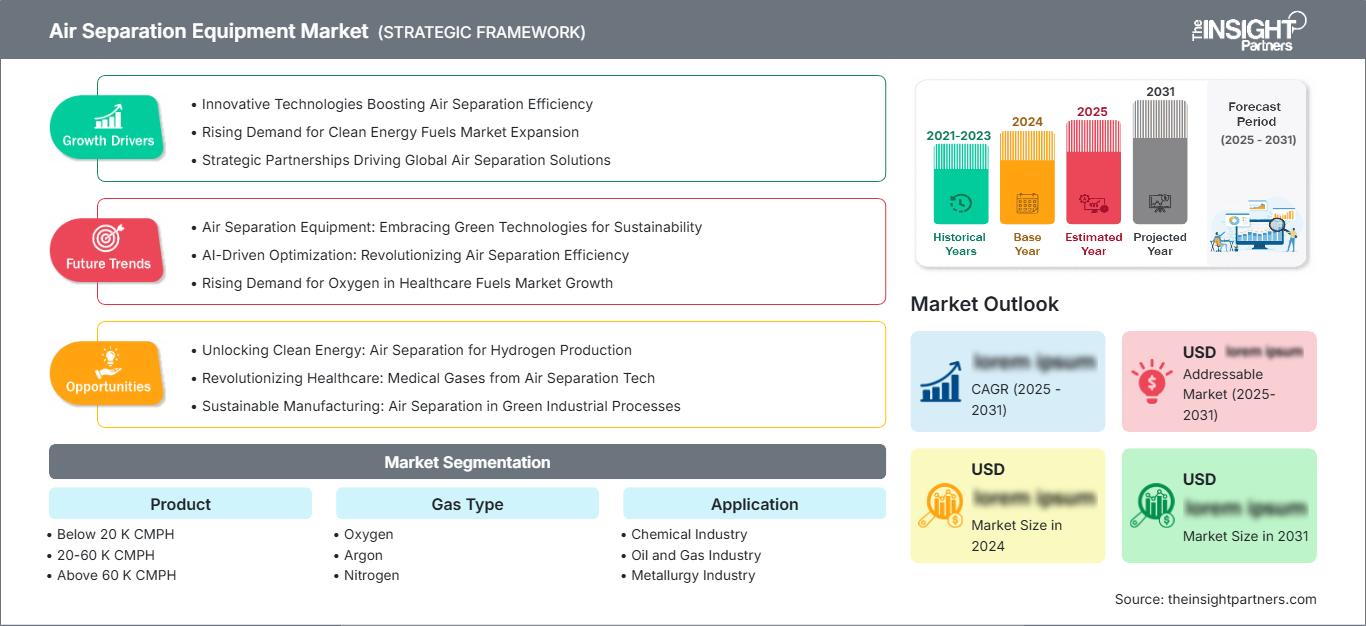
Air Separation Equipment Market: Strategic Insights
Regional Insights
North America Air Separation Equipment Market
North America accounted for 25–27% of global demand in 2025 and is forecast to grow at a 3.6–4.1% CAGR through 2034. The air separation equipment market share is supported by refinery corridors, chemical clusters, metals processing, healthcare systems, and expanding launch infrastructure. US Gulf Coast investments in ammonia and hydrogen-adjacent projects are creating oxygen and nitrogen requirements at industrial scale.
Metallurgy, energy, and medical gases make up the contributions of Canada, and Mexico’s contribution comes in form of relocated industries and automotive supply chains. The regional buyers focus on efficiency in terms of energy because the cost of energy will affect the cost economics of the facility. However, the new contracts, expansions, and replacing old cryogenic units will ensure demand stability.
U.S. Air Separation Equipment Market
The US represented 82–85% of North American demand in 2025 and is estimated to expand at a 3.7–4.2% CAGR during 2026–2034. Demand is anchored in the Gulf Coast chemical belt, Midwest metals production, healthcare systems, food processing, and the growing space launch economy. Large operators are adding oxygen, nitrogen, and argon capacity near industrial corridors to lower logistics risk.
Corporate presence is high with companies such as Linde plc, L'Air Liquide S.A., Air Products and Chemicals, Inc., Messer SE & Co. KGaA, and Universal Industrial Gases, Inc. supplying both onsite and merchant needs. The application trend for cryogenic plants is toward bigger facilities for chemical and metallurgical purposes, with smaller installations being used for hospitals and distributed manufacturing sites.
Europe Air Separation Equipment Market
Europe held 22–24% share in 2025 and is expected to grow at a 3.1–3.7% CAGR through 2034. Germany is the leading country because its chemicals, steel, automotive, and engineering base sustains continuous industrial gas consumption. Energy transition programs are encouraging oxygen use in cleaner combustion, process optimization, and low-carbon industrial pilots.
There is oxygen resilience, refining, and specialty manufacturing capacity in the UK market, even if the current high energy costs make procurement more cautious. Efficiency improvements and captive production at industrial sites are still key priorities in Germany. France, Italy, and Spain have increasing demand from chemicals, metallurgy, medical gases, and industrial sites that are close to hydrogen production.
APAC Air Separation Equipment Market
APAC region holds 36-39% share in 2025 and is expected to expand with a 4.8-5.4% CAGR rate to become the fastest-growing region. APAC will continue to be led by China due to growth in steel, chemical, electronics, and industrial gases infrastructure. Growth will come from India due to manufacturing growth, hospital oxygen infrastructure, and refineries.
Growth will also come from Japan and South Korea due to the need for high-purity for electronics, copper, specialty gases, and shipbuilding. Australia will add its contribution due to mining industry, LNG industry, and healthcare applications. Regional investment will be further supported by government initiatives for domestic supply chain of semiconductors, clean energy materials, and medical oxygen infrastructure.
Middle East & Africa Air Separation Equipment Market
MEA region will witness growth in the 4.4–5.0% CAGR from 2026 to 2034, with Saudi Arabia being the key driver in the region. Factors responsible for increased demand include petrochemicals, refining, steel, water desalination infrastructure projects, and future low carbon ammonia and hydrogen plants. UAE also adds to the demand from the region by developing industrial zones and healthcare facilities.
Mining/metallurgy and medical gases continue to be important for South Africa. Rest of MEA grows from a lower level but will benefit more from development of industrial parks and hospital oxygen projects. Availability of power, lead times for imported equipment, and services locally become critical for project implementation. Large energy projects offer excellent potential for oxygen and nitrogen integration.
Segmentation Analysis
Product
Product is projected to grow at a 4.0–4.6% CAGR during 2026–2034. The air separation equipment market scope across product capacities reflects a split between compact distributed systems and large cryogenic assets. Large plants dominate revenue because steel, chemicals, and energy users require continuous tonnage gases, while smaller systems are preferred where hospitals, workshops, or specialty users need localized supply.
- Below 20 K CMPH units serve distributed users that value compact installation, lower upfront investment, and faster commissioning for healthcare, laboratories, food processing, and smaller manufacturing sites.
- 20-60 K CMPH systems address mid-scale industrial clusters, offering balanced economics for regional gas suppliers, chemical sites, and metallurgy users needing stable but not world-scale output.
- Above 60 K CMPH plants hold the largest position because integrated steel, ammonia, refining, and chemical complexes require high-volume oxygen and nitrogen with long-term supply reliability.
Gas Type
Gas Type is expected to grow at a 4.1–4.7% CAGR during 2026–2034. Oxygen remains essential for metals and healthcare, nitrogen supports inerting and purging across process industries, and argon is strategically important for welding, specialty metals, and electronics. Equipment selection depends on purity targets, recovery economics, coproduct value, and whether the buyer needs gaseous pipeline supply or liquid merchant distribution.
- Oxygen demand is strongest in metallurgy, healthcare, chemicals, and energy applications, where purity, uninterrupted delivery, and production scale directly influence plant selection.
- Argon is a valuable coproduct in cryogenic units, with demand tied to welding, specialty metals, electronics, and applications requiring stable inert atmospheres.
- Nitrogen is widely used for inerting, blanketing, purging, and pressure control, making it critical across chemicals, oil and gas, electronics, and food-related manufacturing.
Application
Application is projected to grow at a 4.2–4.8% CAGR during 2026–2034. Chemical industry demand leads because nitrogen and oxygen are embedded in continuous production, safety, and process control. Metallurgy remains a high-volume base, oil and gas uses nitrogen for inerting and enhanced operations, and healthcare is the fastest growth pocket as medical oxygen systems become more resilient and centralized.
- Chemical Industry remains a core revenue contributor because nitrogen blanketing, oxygen-based oxidation, process safety, and pipeline supply contracts create recurring equipment demand.
- Oil and Gas Industry uses nitrogen for purging, pressure maintenance, and inerting, while oxygen supports selected refining and gasification processes requiring reliable industrial gas access.
- Metallurgy Industry depends on oxygen enrichment and inert gases for furnace productivity, metal quality, and welding, making large-capacity cryogenic systems strategically important.
- Healthcare Industry is gaining strategic importance as hospitals, regional oxygen networks, and emergency preparedness programs invest in dependable medical gas infrastructure.
Opportunity Snapshot
| Segment Name | Revenue Contribution | Trend Tag | Adoption Stage |
| Chemical Industry | High | Process Safety | Mature |
| Oil and Gas Industry | Medium | Nitrogen Purging | Scaling |
| Metallurgy Industry | High | Oxygen Enrichment | Mature |
| Healthcare Industry | Medium | Medical Oxygen | Scaling |
Air Separation Equipment Market Growth Drivers and Impact Analysis
Industrial Gas Demand from Metals and Chemicals
The most compelling rationale for air separation units is steel manufacturing, non-ferrous metallurgy, and chemical production, which require uninterrupted supply of gases in large volumes. Oxygen facilitates better burn efficiency, whereas nitrogen prevents reactions that could be hazardous to reactors, storage facilities, and pipelines. As industries scale up their manufacturing processes in complex plants, it becomes more favorable to install captive units than to depend on external gas suppliers. Practically speaking, this means longer-term contracts, greater capacity of plants, and increased need for service during the life cycle. Those vendors who are capable of integrating engineering and operational skills have an advantage, as customers want reliable operation.
Healthcare Oxygen Resilience and Distributed Supply
Healthcare systems are reassessing oxygen resilience after supply disruptions highlighted the risks of relying only on cylinders or long logistics chains. Hospitals, regional medical gas networks, and public health agencies are investing in local generation, storage, and backup capacity. This supports smaller air separation equipment units, vacuum pressure swing adsorption systems, and cryogenic liquid supply expansions. The market impact is not limited to emergency demand. Routine surgery, intensive care, respiratory therapy, and rural health access all require dependable oxygen availability. Equipment vendors that meet medical purity standards, provide monitoring, and support maintenance can capture recurring demand beyond one-time installations.
Energy Transition Projects Requiring Oxygen and Nitrogen
Low-carbon ammonia, hydrogen-adjacent industrial projects, carbon management pilots, and cleaner combustion initiatives are creating new gas consumption patterns. Oxygen is used in gasification, oxy-fuel processes, and selected chemical pathways, while nitrogen is needed for purging, safety, and storage integrity. These projects often require large, dedicated supply infrastructure integrated with long-term energy assets. The impact on air separation equipment is a shift toward world-scale units with efficiency guarantees and flexible operation. Suppliers must align plant design with renewable power availability, emissions targets, and customer offtake schedules, making project engineering and energy optimization key sources of differentiation.
Air Separation Equipment Market Future Trends
Digital Optimization of Cryogenic Plant Operations
The strongest air separation equipment market trends will involve digital optimization that reduces electricity consumption, predicts equipment wear, and adjusts production to changing customer demand. Advanced controls, compressor analytics, and remote monitoring will help operators maintain purity while improving turndown flexibility. This matters because power can represent the largest operating cost in cryogenic separation. Over time, digitally managed plants will support dynamic production scheduling, better liquid inventory planning, and lower unplanned downtime. Vendors able to embed software, sensors, and service teams into long-term contracts will gain an advantage over suppliers focused only on plant construction.
Integration with Low-Carbon Industrial Hubs
Industrial hubs designed around hydrogen, ammonia, carbon capture, and advanced materials will increasingly integrate air separation assets at the planning stage. Instead of treating oxygen and nitrogen as utilities added late in development, project sponsors will design gas supply, storage, and pipelines alongside power and feedstock infrastructure. This trend should improve project reliability and reduce duplicated investment. It also creates opportunities for equipment suppliers to participate earlier in feasibility studies, where plant capacity, energy profile, and coproduct recovery economics are defined. Integrated hub planning will favor vendors with engineering scale and operating experience.
Air Separation Equipment Market Opportunities
Captive Supply for Emerging Industrial Corridors
Emerging industrial corridors in India, Southeast Asia, the Middle East, and parts of Africa offer investment opportunities where delivered gas logistics remain costly or unreliable. New chemicals, metals, electronics, and healthcare clusters can justify captive plants or regional liquid supply hubs. The air separation equipment market forecasts indicate that suppliers should prioritize partnerships with anchor customers, utilities, and local EPC firms to reduce execution risk. Early engagement can secure land, power access, and offtake agreements before competitors enter. Modular designs, financing support, and local service teams will be decisive for converting pipeline discussions into installed capacity.
Retrofit and Efficiency Upgrades for Installed Plants
Aging installed plants create a practical opportunity for compressor upgrades, control modernization, heat exchanger improvements, and argon recovery enhancements. Many operators face rising electricity tariffs and stricter emissions accounting, making efficiency projects easier to justify than full replacement. Retrofit programs can reduce downtime risk while improving unit economics for industrial gas suppliers and captive users. Vendors with audit capabilities, spare parts availability, and performance-based service contracts can capture this demand. The opportunity is especially attractive in North America and Europe, where mature industrial sites require reliability but may have limited appetite for large greenfield construction.
Recent Developments
- July 2025: Linde plc — announced major US investments to support commercial space operations, including expansion of its Mims, Florida industrial gases facility and a new Brownsville, Texas air separation unit expected to supply liquid oxygen, nitrogen, and argon for regional space operations and merchant customers.
- June 2025: Impact Air Systems - introduced an enhanced range of solutions aimed at improving recycling efficiency. As part of this development, the company has redesigned its Air Drum Separator (ADS) through a comprehensive engineering upgrade, creating a system focused on greater adaptability, performance, and operational efficiency. With recycling facilities facing increasing demands for higher-quality recovered materials, cost control, and evolving environmental requirements, Impact Air Systems developed the upgraded ADS to help operators address these challenges more effectively.
- September 2025: Nikkiso Clean Energy & Industrial Gases Group- announced the launch of its new multistage process pump (MSPP 210), designed to enhance safety and reduce downtime on air separation equipment.
Frequently Asked Questions

- Comprehensive Market Sizing and Forecast Analysis
- Detailed Segmentation Analysis
- In-Depth Market Dynamics Assessment
- Regional and Country-Level Insights
- Competitive Landscape and Company Benchmarking
- Strategic Business Intelligence
Recent Reports
Testimonials

The Insight Partners' SCADA System Market report is comprehensive, with valuable insights on current trends and future forecasts. The team was highly professional, responsive, and supportive throughout. We are very satisfied and highly recommend their services.
RAN KEDEM Partner, Reali Technologies LTDs
I requested a report on a very specific software market and the team produced the report in a few days. The information was very relevant and well presented. I then requested some changes and additions to the report. The team was again very responsive and I got the final report in less than a week.
JEAN-HERVE JENN Chairman, Future Analytica
We worked with The Insight Partners for an important market study and forecast. They gave us clear insights into opportunities and risks, which helped shape our plans. Their research was easy to use and based on solid data. It helped us make smart, confident decisions. We highly recommend them.
PIYUSH NAGPAL Sr. Vice President, High Beam Global
The Insight Partners delivered insightful, well-structured market research with strong domain expertise. Their team was professional and responsive throughout. The user-friendly website made accessing industry reports seamless. We highly recommend them for reliable, high-quality research services
YUKIHIKO ADACHI CEO, Deep Blue, LLC.
This is the first time I have purchased a market report from The Insight Partners.While I was unsure at first, I visited their web site and felt more comfortable to take the risk and purchase a market report.I am completely satisfied with the quality of the report and customer service. I had several questions and comments with the initial report, but after a couple of dialogs over email with their analyst I believe I have a report that I can use as input to our strategic planning process.Thank you so much for taking the extra time and making this a positive experience.I will definitely recommend your service to others and you will be my first call when we need further market data.
JOHN SUZUKI President and Chief Executive Officer, Board Director, BK Technologies
I wish to appreciate your support and the professionalism you displayed in the course of attending to my request for information regarding to infectious disease IVD market in Nigeria. I appreciate your patience, your guidance, and the fact that you were willing to offer a discount, which eventually made it possible for us to close a deal. I look forward to engaging The Insight Partners in the future, all thanks to the impression you have created in me as a result of this first encounter.
DR CHIJIOKE ONYIA MANAGING DIRECTOR, PineCrest Healthcare Ltd.Reason to Buy
- Informed Decision-Making
- Understanding Market Dynamics
- Competitive Analysis
- Identifying Emerging Markets
- Customer Insights
- Market Forecasts
- Risk Mitigation
- Boosting Operational Efficiency
- Strategic Planning
- Investment Justification
- Tracking Industry Innovations
- Aligning with Regulatory Trends





 Get Free Sample for