
Aircraft Tugs Market Demand, Trends & Forecast by 2034
Coverage: by Type (Conventional or Towbars, Towbarless); Handling Capacity (Up to 50 Tonnes, 51-150 Tonnes, 151-260 Tonnes, More than 260 Tonnes); Fuel (Diesel, Gas, Electric); Aircraft Type (Civil, Cargo, Military, Executive Jet) , and Geography (North America, Europe, Asia Pacific, and South and Central America)
- Status : Data Released
- Report Code : TIPRE00007665
- Category : Aerospace and Defense
- No. of Pages : 150
- Available Report Formats :


- Last update date : November 03, 2026


2025 Market Size
US$ 4.87 Bn
Base year value
2034 Forecast
US$ 9.3 Bn
Projected by 2034
CAGR 2026-2034
7.45 %
Growth rate
Addressable Market
US$ 63.86 Bn
(2026-2034)
The aircraft tugs market was valued at US$ 4.87 Billion in 2025 and is projected to reach US$ 9.3 Billion by 2034, expanding at a CAGR of 7.45% from 2026 to 2034. Growth is supported by rising aircraft movements, airport capacity expansion, replacement of aging ground support equipment, and increasing adoption of electric towing technologies. Demand is also being shaped by requirements for safer aircraft positioning, lower ground-operation emissions, improved maneuverability, and more efficient pushback and maintenance workflows.
Increasing fleet modernization across North America is supporting steady demand, while the region's extensive installed base creates a substantial replacement opportunity. The aircraft tugs market size in the region is also influenced by airport electrification programs, expansion of maintenance facilities, and growing interest in towbarless equipment that can reduce attachment time and improve maneuverability in congested ramp and hangar environments.
Aircraft Tugs Market Assessment and Insights
Regional Outlook
- North America: ~35% of the global market in 2025 | ~6% CAGR through 2034. Market position: North America holds the largest regional position, supported by a mature airport network, extensive commercial and military aircraft fleets, established MRO infrastructure, and continuing replacement of conventional ground support equipment with higher-efficiency towing solutions.
- US: ~78% of North American market revenue in 2025 | ~6% CAGR through 2034. Market position: The US accounts for most North American demand because of its large airport system, airline fleet base, military aviation activity, and broad installed base of aircraft towing equipment serving airports, MRO facilities, and fixed-base operators.
- Europe: ~27% of the global market in 2025 | ~6% CAGR through 2034. Market position: Europe represents a mature market with strong equipment replacement demand and sustainability requirements. Germany is the leading country in Europe, followed by substantial activity in the UK, France, Italy, and Spain across commercial and MRO operations.
- Asia Pacific: ~25% of the global market in 2025 | ~9% CAGR through 2034. Market position: Asia Pacific is the fastest-growing region, supported by airport construction, expanding airline fleets, MRO capacity additions, and ground-equipment modernization. China is the leading country in Asia Pacific, with India and other markets adding substantial incremental demand.
Segment Outlook
- Conventional or Towbars: ~60% Share in 2025 | ~7% CAGR through 2034. Market position: Conventional or Towbars remain the largest segment because of their broad installed base, compatibility with mixed aircraft fleets, comparatively straightforward maintenance, and suitability for airport, MRO, military, and executive aviation operations.
- Electric: ~20% Share in 2025 | ~10% CAGR through 2034. Market position: Electric equipment has the strongest growth outlook as airports and operators pursue lower local emissions, quieter ramp operations, reduced maintenance requirements, and improved indoor usability. Battery technology and charging infrastructure are broadening commercial applications.
Competitive Coverage
Textron GSE, JBT Corporation, TREPEL Airport Equipment GmbH, TLD Group SAS, LEKTRO, Inc., Airtug LLC, Mototok International GmbH, Tronair Inc., MULAG Fahrzeugwerk Heinz Wössner GmbH u. Co. KG, Kalmar Motor AB
Methodology
The Insight Partners follows Data Collection & Secondary Research, Primary Research, Data Analysis, and Data Triangulation & Final Review to validate market estimates and insights.
Source: The Insight Partners' analysis based on proprietary research, government publications, company annual reports, investor presentations, industry databases, and expert interviews.
Over time, the aircraft tugs market has progressed from tow equipment based on mechanical considerations to ground mobility systems featuring greater maneuverability, safety, energy efficiency, and the ability to operate with aircraft that are becoming more diversified. Towbarless design reduces reliance on coupling equipment, and electric power trains become viable options in case of frequent airport movements. Meanwhile, manufacturers of aircraft tugs are including features like enhanced visibility, automatic loading capabilities, safety systems using sensors, and electronic drive systems in their products. This evolution is driven by the necessity to not just move aircraft but optimize the process of ground movement.
Market growth in the future will be based on electrification of airports, renewal cycles, and development of aviation infrastructures in developing countries. Equipment selection is now done based on the total cost of ownership, requirements for recharging, operation cycle, compatibility with aircraft, and maintenance service instead of simple acquisition costs. Airport infrastructure upgrades in Asia Pacific and Middle East regions will open up new possibilities, whereas traditional markets will focus on replacements and efficient solutions.
Aircraft Tugs Market Report Scope
| Report Attribute | Details |
|---|---|
| Market size in 2025 | US$ 4.87 Billion |
| Market Size by 2034 | US$ 9.3 Billion |
| Global CAGR (2026 - 2034) | 7.45% |
| Historical Data | 2021-2024 |
| Forecast period | 2026-2034 |
Aircraft Tugs Market Analysis
Growth in aircraft tugs will be directly related to aircraft usage and repositioning without engine-powered assistance. Airlines, airports, MRO providers, military establishments, and FBOs have need for tugging equipment in order to conduct pushback and movement of the aircraft within the hangar facilities, as well as intergate moves. The value chain will include manufacturers, powertrains and batteries, couplings systems suppliers, airport GSE ground handlers, aircraft operators, MRO providers, and aftermarket service providers. Therefore, demand will depend on both aircraft fleet operations and on the capital replacement cycle of the ground support fleet.
From the supply side, competition is becoming increasingly segmented based on such criteria as towing capacity, aircraft compatibility, powertrain systems, maneuverability, and service support. Traditional equipment will remain significant wherever the infrastructure conditions and operational processes support the use of diesel and gas-based powertrains, whereas the electric-powered vehicles will enjoy growing popularity in cases where access to charging stations and environmental targets promote the conversion of the entire fleet. Therefore, manufacturers will continue to maintain diverse product offerings rather than sticking to just one technology type.
The competition in the aircraft tugs market report consists of existing manufacturers of GSE, who have experience in operating within airports, and providers specializing in towbarless, compact, or electric tractors. The conventional and towbarless pushback of Textron GSE offers different types of drivetrain, whereas JBT Corporation engages in the market thanks to its aviation ground support product range. TREPEL Airport Equipment GmbH and TLD Group SAS compete with high-capacity aircraft tractors that include electric options. LEKTRO, Inc., Airtug LLC, Mototok International GmbH, and Tronair Inc. focus on specialized towing products, whereas MULAG Fahrzeugwerk Heinz Wössner GmbH u. Co. KG and Kalmar Motor AB compete thanks to their expertise in airport vehicles.
The investments are being made into electric powertrain, charging technologies, automation of coupling, small-size vehicle production, and digital control. In addition, strategic planning is based on after-market network due to the fact that the operation of aircraft towing equipment takes place in safety critical environment in which the downtime might cause delay of the aircraft turnaround and maintenance process. The suppliers of aircraft towing equipment with geographic presence, spare parts delivery and equipment suitable for various types of aircraft can satisfy the procurement needs outside the purchase of the vehicle.
● REPORT CUSTOMIZATION
Tailor This Report To Align With Your Specific Business Requirements
This report can be customized to align precisely with your business objectives, scope, and target markets. Customization options include tailored segmentation, geography, competitive analysis, and strategic insights to support informed decision-making.
Customize This Report →WHAT YOU CAN ADJUST
- ● Segmentations
- ● Geography
- ● Competitive Analysis
- ● Language Preferences
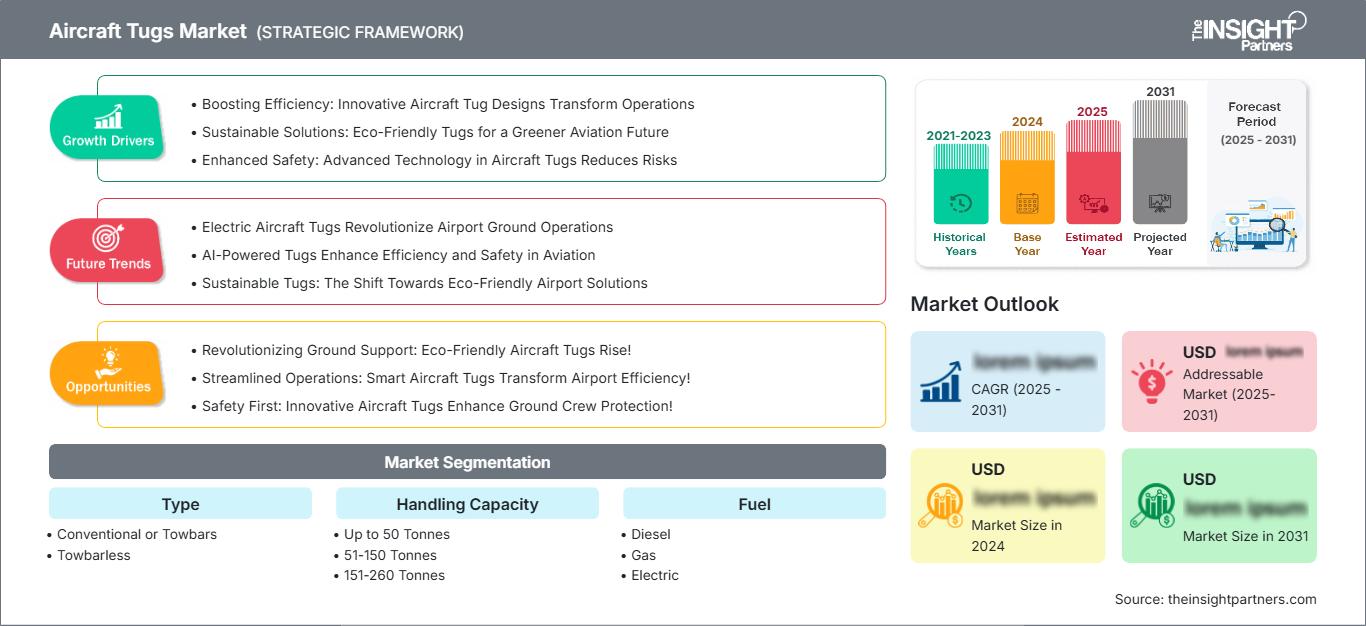
Aircraft Tugs Market: Strategic Insights
Regional Insights
North America aircraft tugs market
North America represented ~35% of the global aircraft tugs market in 2025 and is projected to expand at ~6% CAGR through 2034. The region benefits from a large installed fleet of commercial, cargo, military, and business aircraft together with extensive airport and MRO infrastructure. Replacement of aging towing equipment is an important source of demand because established airports operate fleets accumulated over multiple equipment cycles. Fleet operators are also assessing electric alternatives where charging infrastructure and operating patterns support predictable daily utilization.
The US represents the largest national demand center in the region, supported by major airline hubs, military installations, cargo airports, and independent MRO providers. Canada contributes through commercial aviation, regional airports, and maintenance activity, while Mexico adds demand as airport infrastructure and aviation connectivity expand. Towbarless tractors are increasingly relevant for high-frequency aircraft movement, whereas conventional equipment continues to serve mixed fleets and applications where flexibility and established maintenance practices remain important.
U.S. aircraft tugs market
The U.S. accounted for ~78% of North American aircraft tugs market share in 2025 and is expected to record ~6% CAGR through 2034. Its position reflects the scale of the country's airline and cargo networks, military aviation infrastructure, general aviation activity, and MRO ecosystem. Airports and ground handlers operate across highly varied aircraft categories, creating demand for towing systems ranging from compact electric units to high-capacity tractors capable of moving large commercial aircraft.
Among the players in this market are seasoned firms like Textron GSE, JBT Corporation, Tronair Inc., and LEKTRO, Inc., apart from providers for business aviation and MROs. The use of electric aircraft is especially important in case of enclosed hangar facilities looking for quiet equipment, whereas towbarless units are adopted in those cases where quick connections and maneuverability are advantageous.
Europe aircraft tugs market
Europe accounted for ~27% of the global aircraft tugs market in 2025 and is projected to grow at ~6% CAGR through 2034. The region combines a mature airport network with substantial aircraft manufacturing, airline, MRO, and ground-handling capabilities. Germany is the leading country in Europe, supported by a strong industrial base and established GSE manufacturing ecosystem. The UK remains significant because of its large aviation infrastructure and MRO activity, while France benefits from major aerospace clusters and international airport operations.
The German market benefits from a domestic supply of equipment and needs of big airports, airlines, and industrial aviation. Similar replacement potential exists in France and the United Kingdom, where the sustainability goals shape the decision on purchasing electric or low-emission GSE. The Italian and Spanish markets receive additional demand from the developed network of commercial airports and tourist flows. In Europe, energy efficiency, working environment, noise reduction, and the compatibility of the equipment with airport sustainability initiatives become crucial when selecting equipment.
The towbarless tractors attract more and more attention for frequent use, but the aircraft tractors will continue to be significant in the current fleets. The electric GSE will play a crucial role in MROs and in the airports that are equipped with charging stations. The process of equipment transition will not be sudden due to regulatory requirements and modernization initiatives.
APAC aircraft tugs market
APAC represented ~25% of the global aircraft tugs market share in 2025 and is forecast to expand at ~9% CAGR through 2034, making it the fastest-growing region. China is the leading country in Asia Pacific, supported by airport investment, airline fleet expansion, and increasing domestic aviation capacity. India is also generating demand through airport development and airline expansion, while Japan, South Korea, and Australia contribute through established airport and MRO networks.
China's infrastructure investment and fleet modernization provide a broad customer base for conventional and towbarless equipment. India is increasingly focused on airport capacity and operational modernization, while Japan and South Korea emphasize reliability and equipment efficiency. Australia contributes through geographically dispersed airport operations and specialized aviation facilities. Electric towing equipment is gaining relevance as operators assess emissions, noise, maintenance, and indoor maneuverability alongside conventional performance requirements.
Middle East & Africa aircraft tugs market
The Middle East & Africa aircraft tugs market is projected to grow at ~7% CAGR through 2034. Saudi Arabia is the leading country in the Middle East & Africa region where airport investment, airline expansion, and aviation infrastructure development are supporting equipment demand. The UAE also represents an important procurement center because of its large international airports, cargo operations, and aviation services ecosystem.
Saudi Arabia's aviation infrastructure programs are creating opportunities for new ground support fleets, while the UAE combines high-volume airport activity with established MRO and logistics capabilities. South Africa remains a major aviation market in Africa, supported by commercial airports and maintenance requirements. Rest of MEA demand is linked to airport modernization, regional connectivity, and replacement of aging equipment. Energy availability, airport sustainability programs, and the operating economics of electric versus conventional vehicles will influence technology selection across the region.
Segmentation Analysis
Type
Type is a central determinant of aircraft towing workflow, equipment configuration, maneuverability, and fleet economics. Operators select equipment according to aircraft compatibility, frequency of movement, ramp layout, and the degree of flexibility required across different aircraft. Established towing practices continue to support demand for conventional configurations, while towbarless designs gain adoption where rapid connection, direct nose-gear engagement, and reduced equipment handling can improve operational efficiency. The leading subsegment within this category is expected to expand at ~7% CAGR through 2034.
- Conventional or Towbars: These units connect aircraft through dedicated towing interfaces and remain widely used across mixed fleets. Their established operating procedures, broad compatibility, and familiar maintenance requirements make them practical for commercial, military, regional, and MRO applications.
- Towbarless: Towbarless systems lift and secure the aircraft nose gear directly, reducing dependence on separate towbars. They are particularly relevant where operators prioritize quick attachment, tight maneuvering, improved visibility, and efficient aircraft movement in congested operating environments.
Handling Capacity
Handling Capacity determines the aircraft classes a tug can serve and influences vehicle mass, traction requirements, powertrain configuration, and procurement cost. Operators typically build fleets around the aircraft weights encountered most frequently while retaining higher-capacity equipment for occasional heavy movements. Capacity requirements are especially important for airports, MRO organizations, and military operators serving diverse fleets, because insufficient towing capability can restrict operational flexibility and create dependence on specialized equipment.
- Up to 50 Tonnes: This category serves lighter aircraft and many business, regional, and specialized aviation applications. Compact dimensions and maneuverability are important, particularly for hangars, FBOs, maintenance facilities, and operations where available floor space is limited.
- 51-150 Tonnes: This range addresses a broad portion of commercial and regional aircraft movements. Demand is supported by narrowbody fleets and operators seeking versatile tractors capable of handling routine pushback, repositioning, and maintenance towing.
- 151-260 Tonnes: Equipment in this capacity class is designed for heavier aircraft and higher traction requirements. It is relevant to large commercial fleets, cargo operations, and MRO environments where reliable towing performance is required for repeated aircraft movements.
- More than 260 Tonnes: The highest-capacity equipment serves large widebody and specialized aircraft. Procurement is typically concentrated among major airports, cargo operators, military organizations, and heavy-maintenance facilities with requirements for substantial drawbar performance.
Fuel
Fuel selection increasingly affects procurement decisions because operators are balancing towing performance with emissions, maintenance, noise, energy availability, and lifecycle cost. Conventional powertrains remain important for demanding duty cycles and locations without adequate charging infrastructure, while battery-electric equipment is expanding as airport operators modernize ground fleets. The category's strongest expansion is expected from electric systems, whose leading subsegment is projected to record ~10% CAGR through 2034.
- Diesel: Diesel remains established in demanding airport and military environments because of established refueling networks, high energy density, and familiarity among operators. It continues to support heavy-duty applications where long operating cycles and rapid refueling are priorities.
- Gas: Gas-powered equipment provides an alternative conventional configuration for operators seeking dependable towing performance while using established internal-combustion infrastructure. Adoption is concentrated where fleet operators value familiar vehicle architecture and operational flexibility.
- Electric: Electric tugs combine high low-speed torque with quieter operation and zero tailpipe emissions. They are increasingly suited to airports and MRO facilities pursuing lower local emissions, reduced maintenance, indoor operation, and integration with broader electrification strategies.
Aircraft Type
Aircraft Type determines towing requirements through aircraft weight, nose-gear configuration, maneuverability, operating environment, and movement frequency. Demand is distributed across commercial and specialized aviation users, with procurement decisions influenced by fleet composition and the number of aircraft movements performed by each operator. Manufacturers therefore develop platforms covering multiple aircraft classes while also offering configurations tailored to military, cargo, and executive aviation requirements.
- Civil: Civil aviation creates sustained demand because airlines, airports, MRO organizations, and ground handlers require towing equipment for pushback, maintenance, parking, and aircraft repositioning. Fleet diversity encourages suppliers to provide flexible configurations.
- Cargo: Cargo operators require dependable towing equipment for freighter movements, maintenance activity, and high-utilization airport environments. Heavy-duty performance and reliability are particularly important where aircraft schedules involve frequent night operations and concentrated turnaround windows.
- Military: Military applications require rugged equipment capable of supporting varied aircraft and operating conditions. Procurement can emphasize reliability, specialized interfaces, maneuverability, and compatibility with hangars, bases, and maintenance facilities.
- Executive Jet: Executive aviation favors compact, precise, and easy-to-maneuver tugs suitable for FBOs, private hangars, and corporate aviation facilities. Electric towbarless systems are particularly relevant where space, noise, and indoor operating conditions influence equipment selection.
Opportunity Snapshot
| Segment Name | Revenue Contribution | Trend Tag | Adoption Stage |
| Civil | High | Fleet Expansion | Mature |
| Cargo | Medium | Freighter Growth | Scaling |
| Military | Medium | Base Modernization | Mature |
| Executive Jet | Low | Compact Electric | Scaling |
Aircraft Tugs Market Growth Drivers and Impact Analysis
Expansion of Airport and Aircraft Fleet Infrastructure
Growth in airport capacity and aircraft utilization directly increases the requirement for reliable ground movement equipment. New terminals, additional gates, expanded MRO facilities, and growing cargo operations require towing fleets that can support pushback, parking, maintenance, and repositioning. Fleet expansion also increases the number of aircraft that must be moved during peak operating periods, encouraging airports and ground handlers to add or replace equipment. The impact is strongest in regions where aviation infrastructure is being built alongside rising passenger and cargo activity. For manufacturers, this creates opportunities to supply new fleets rather than relying solely on replacement cycles. It also favors modular product portfolios because airport customers may require different towing capacities for narrowbody, widebody, cargo, regional, and specialized aircraft.
Electrification of Ground Support Equipment
Electrification is changing aircraft tug procurement by adding energy efficiency, noise, emissions, and charging considerations to conventional performance criteria. Electric GSE can reduce local emissions and noise while lowering maintenance requirements associated with internal-combustion powertrains. IATA identifies electrification as an important component of more sustainable ground operations, while equipment suppliers are expanding electric towing portfolios. The market impact extends beyond the tug itself because operators must evaluate charging capacity, battery duty cycles, power availability, parking arrangements, and fleet scheduling. As infrastructure improves, electric equipment can move from pilot deployments toward larger fleet procurement, particularly at airports and MRO facilities with predictable operating cycles.
Demand for Safer and More Efficient Aircraft Movement
Ground damage prevention and operational efficiency are becoming important equipment-selection criteria. IATA notes that GSE operations can account for a substantial proportion of aircraft ground damage, increasing attention on enhanced equipment, proximity sensing, operating procedures, and safer ground workflows. Aircraft tugs therefore increasingly compete on visibility, maneuverability, controlled movement, attachment systems, and operator ergonomics rather than towing force alone. Towbarless architectures can simplify aircraft connection and reduce handling steps, while electronically controlled systems can provide more precise vehicle behavior. These improvements support purchasing decisions where operators are seeking to reduce operational risk while maintaining fast aircraft turnaround and efficient use of ramp and hangar space.
Aircraft Tugs Market Future Trends
Integration of Intelligent Controls and Assisted Towing
Future aircraft towing systems are likely to incorporate greater levels of sensing, digital control, and assisted operation. Enhanced GSE initiatives are already encouraging the use of proximity sensors and other safety technologies, creating a foundation for more connected towing workflows. Over time, operators may use equipment data to monitor utilization, battery condition, maintenance requirements, and towing cycles across an entire fleet. Assisted maneuvering can also help operators maintain precise aircraft positioning in constrained environments. The aircraft tugs market trend does not necessarily imply fully autonomous towing across all airports. Instead, adoption is likely to progress through features that reduce operator workload, improve visibility, provide collision warnings, and support repeatable movement procedures.
Battery-Electric Tugs Across Higher Capacity Classes
Electric aircraft tugs are likely to extend progressively into higher-capacity applications as battery performance, charging infrastructure, and power-management systems improve. Current products already demonstrate that electric architectures can support aircraft ranging from business jets to narrowbody and widebody platforms. Mototok, for example, offers fully electric towbarless equipment across multiple capacity classes, including models designed for aircraft up to 200 tonnes. The next phase of adoption will depend on operating economics and infrastructure suitability. High-utilization airports may increasingly combine opportunity charging, scheduled charging, and fleet rotation to support electric towing without compromising aircraft turnaround requirements.
Aircraft Tugs Market Opportunities
Electrification Programs at Airports and MRO Facilities
Airport and MRO electrification programs create opportunities for suppliers that can provide complete towing solutions rather than isolated electric vehicles. Customers need equipment matched with charging strategies, duty cycles, battery capacities, maintenance plans, and facility layouts. Suppliers that can support fleet transition planning may capture demand from operators replacing equipment progressively rather than purchasing an entirely new fleet at once. The opportunity in the aircraft tugs market forecast is especially relevant for indoor MRO facilities where noise and exhaust emissions are operational considerations. Electric towbarless equipment can also improve maneuverability in confined areas. Tronair's recent material on electric GSE transition highlights the importance of planning charging infrastructure, replacement timing, and operating patterns when converting towing fleets.
High-Capacity and Specialized Towing Applications
Demand for specialized towing equipment provides opportunities beyond standard airport pushback applications. Cargo operators, military organizations, heavy-maintenance facilities, and airports serving large widebody aircraft require equipment capable of handling high loads while maintaining precise control. Suppliers can differentiate through high-capacity electric systems, modular towing interfaces, specialized nose-gear protection, and configurations designed for unusual aircraft or restricted spaces. Specialized applications can also create aftermarket opportunities because customers value long equipment life, spare-parts availability, and technical support. As aircraft fleets become more diverse and maintenance operations expand in emerging aviation hubs, manufacturers with scalable platforms can address new procurement requirements without developing entirely separate vehicle architectures for every aircraft category.
Frequently Asked Questions

- Comprehensive Market Sizing and Forecast Analysis
- Detailed Segmentation Analysis
- In-Depth Market Dynamics Assessment
- Regional and Country-Level Insights
- Competitive Landscape and Company Benchmarking
- Strategic Business Intelligence
Recent Reports
Testimonials

The Insight Partners provided valuable market intelligence that supported our global go-to-market strategy. Their team was professional, responsive, and attentive to our feedback, providing thoughtful analysis and helpful methodological clarifications throughout the project.
Junmo Kim Chief Financial Officer (CFO), Enertech Co., Ltd.
The Insight Partners' SCADA System Market report is comprehensive, with valuable insights on current trends and future forecasts. The team was highly professional, responsive, and supportive throughout. We are very satisfied and highly recommend their services.
RAN KEDEM Partner, Reali Technologies LTDs
I requested a report on a very specific software market and the team produced the report in a few days. The information was very relevant and well presented. I then requested some changes and additions to the report. The team was again very responsive and I got the final report in less than a week.
JEAN-HERVE JENN Chairman, Future Analytica
We worked with The Insight Partners for an important market study and forecast. They gave us clear insights into opportunities and risks, which helped shape our plans. Their research was easy to use and based on solid data. It helped us make smart, confident decisions. We highly recommend them.
PIYUSH NAGPAL Sr. Vice President, High Beam Global
The Insight Partners delivered insightful, well-structured market research with strong domain expertise. Their team was professional and responsive throughout. The user-friendly website made accessing industry reports seamless. We highly recommend them for reliable, high-quality research services
YUKIHIKO ADACHI CEO, Deep Blue, LLC.
This is the first time I have purchased a market report from The Insight Partners.While I was unsure at first, I visited their web site and felt more comfortable to take the risk and purchase a market report.I am completely satisfied with the quality of the report and customer service. I had several questions and comments with the initial report, but after a couple of dialogs over email with their analyst I believe I have a report that I can use as input to our strategic planning process.Thank you so much for taking the extra time and making this a positive experience.I will definitely recommend your service to others and you will be my first call when we need further market data.
JOHN SUZUKI President and Chief Executive Officer, Board Director, BK Technologies
I wish to appreciate your support and the professionalism you displayed in the course of attending to my request for information regarding to infectious disease IVD market in Nigeria. I appreciate your patience, your guidance, and the fact that you were willing to offer a discount, which eventually made it possible for us to close a deal. I look forward to engaging The Insight Partners in the future, all thanks to the impression you have created in me as a result of this first encounter.
DR CHIJIOKE ONYIA MANAGING DIRECTOR, PineCrest Healthcare Ltd.Reason to Buy
- Informed Decision-Making
- Understanding Market Dynamics
- Competitive Analysis
- Identifying Emerging Markets
- Customer Insights
- Market Forecasts
- Risk Mitigation
- Boosting Operational Efficiency
- Strategic Planning
- Investment Justification
- Tracking Industry Innovations
- Aligning with Regulatory Trends





 Get Free Sample for