
Airfreight Forwarding Market Demand, Trends & Forecast by 2034
Coverage: By Cargo Type (General Cargo and Special Cargo), Service Type (Freight, Express, Mail, and Others), Destination (Domestic and International), Industry (E-commerce & Retail, Automotive, Healthcare & Pharmaceuticals, Manufacturing, Perishable Goods, High-Tech & Electronics, and Others), and Geography (North America, Europe, Asia Pacific, Middle East and Africa, South and Central America)
- Status : Data Released
- Report Code : TIPTE100000493
- Category : Automotive and Transportation
- No. of Pages : 150
- Available Report Formats :


- Last update date : August 10, 2026


2025 Market Size
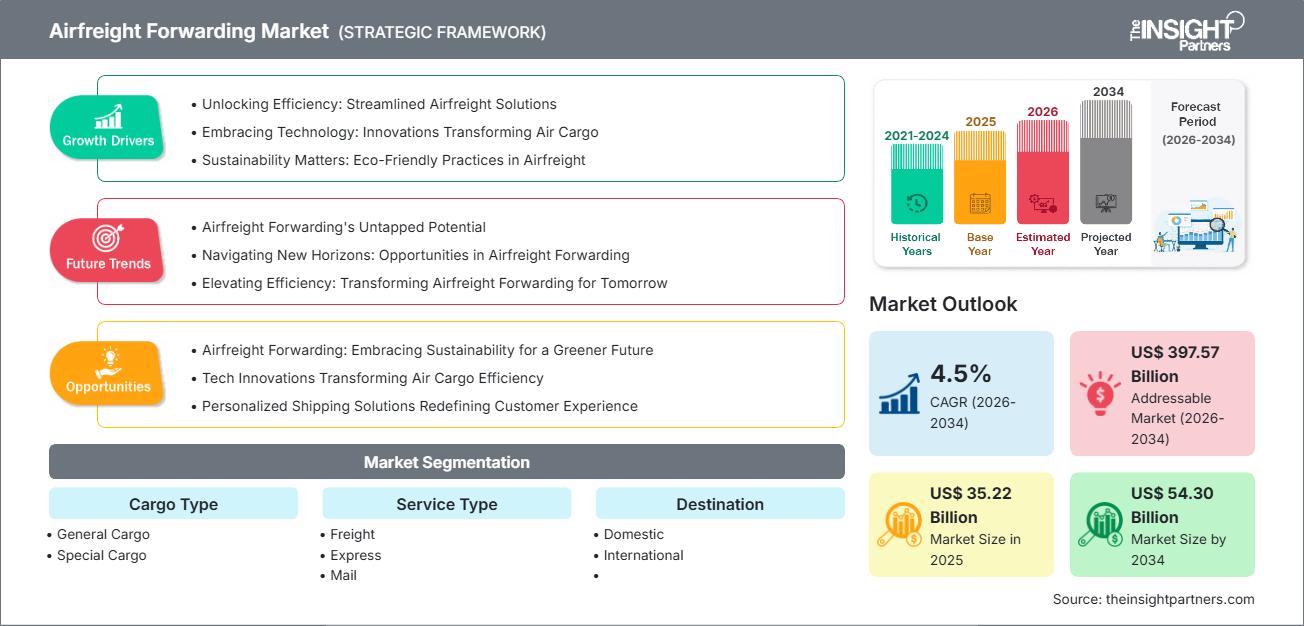
US$ 35.22 Bn
Base year value
2034 Forecast
US$ 54.30 Bn
Projected by 2034
CAGR 2026-2034
4.93 %
Growth rate
Addressable Market
US$ 406.33 Bn
(2026-2034)
The global Airfreight Forwarding market was valued at US$ 35.22 billion in 2025 and is expected to reach US$ 54.3 billion by 2034; it is estimated to record a CAGR of 4.93% during 2026-2034.
Airfreight Forwarding Market Assessment and Insights
- North America: North America accounted for an estimated 31–33% share in 2025 and is expected to grow at a CAGR of 4.1–4.6% during 2026–2034, supported by express logistics, pharmaceutical distribution, and e-commerce replenishment.
- US: The US represented nearly 78–82% of North America in 2025 and is projected to expand at 4.0–4.5% CAGR, driven by airport hubs and integrated forwarder networks.
- Europe: Europe held an estimated 25–27% share in 2025 and is forecast to grow at 3.8–4.3% CAGR, led by Germany, the UK, France, the Netherlands, and Italy.
- Asia Pacific: Asia Pacific represented about 29–31% share in 2025 and is expected to grow at 5.0–5.6% CAGR, supported by China, Japan, India, South Korea, and Southeast Asian manufacturing corridors.
- Largest Segment: General Cargo held an estimated 58–62% market share in 2025 and is likely to grow at 4.0–4.5% CAGR as diversified industrial and retail shipments dominate volumes.
- High Growth Segment: Special Cargo held an estimated 38–42% share in 2025 and is projected to grow at 5.0–5.8% CAGR due to healthcare, perishables, and high-tech logistics.
- Key companies analyzed in detail: Kuehne + Nagel International AG, DHL Group, Schenker AG, Nippon Express Holdings, Inc., DSV A/S, UPS Supply Chain Solutions Inc., Expeditors International of Washington, Inc., Sinotrans Limited, Panalpina World Transport Holding Ltd., and Hellmann Worldwide Logistics SE & Co. KG.
Source: The Insight Partners' analysis based on proprietary research, government publications, company annual reports, investor presentations, industry databases, and expert interviews.
Digital booking, predictive capacity allocation, and shipment visibility are changing how forwarders manage air cargo procurement. Historically, manual rate negotiation is giving way to platform-led routing, while airport congestion and belly-capacity availability continue to influence service quality. The airfreight forwarding market growth is increasingly linked to how providers combine airline relationships, customs expertise, temperature-controlled handling, and multimodal recovery options when disruption affects scheduled uplift.
Prospective investments are focused on healthcare corridors, semiconductor products, cloud infrastructure, and premium consumer electronics. Regulators are giving attention to security screening, pharmaceutical regulations, emissions reporting, and customs digitization to affect operating models. Freight forwarders that have good data connectivity, certified service providers, and flexible block space arrangements stand a better chance of benefiting from such resilient demand.
Airfreight Forwarding Market Report Scope
| Report Attribute | Details |
|---|---|
| Market size in 2025 | US$ 35.22 Billion |
| Market Size by 2034 | US$ 54.30 Billion |
| Global CAGR (2026 - 2034) | 4.93% |
| Historical Data | 2021-2024 |
| Forecast period | 2026-2034 |
Airfreight Forwarding Market Analysis
Demand is expanding as shippers use air freight selectively for inventory protection, high-margin products, and delivery commitments that cannot tolerate long ocean lead times. E-commerce marketplaces, pharma manufacturers, and electronics suppliers require predictable transit times and milestone visibility. The airfreight forwarding market growth also benefits from nearshoring and China Plus One sourcing, where suppliers need flexible air capacity to connect new production bases with established consumer markets.
Supply dynamics continue to be well-behaved as the forwarders rely on the capacity of the airlines, efficiency of the airport and speed of the customs clearance. According to IATA, air cargo demand during full-year 2025 grew by 3.4% in comparison to the capacity increase of 3.7%. It means that the market balance has become more stable than before during the period of pandemic.
The competition in the industry is focused on the development of the global networks with efficient procurement of the carriers, compliance programs and specialization. The major competitors of Kuehne + Nagel International AG include DHL Group, DSV A/S, Schenker AG, Nippon Express Holdings, Inc. and Expeditors International of Washington, Inc. Their airfreight forwarding market analysis increasingly focuses on vertical depth rather than generic lane coverage.
Strategy positioning is also influenced by consolidation and investments in technology. The consolidation of DSV and Schenker increased the scale in global forwarding services, whereas Kuehne + Nagel has witnessed an increase in market share in the Air Logistics sector in 2025. UPS Supply Chain Solutions Inc., Sinotrans Limited, Hellmann Worldwide Logistics SE & Co. KG, and the Panalpina-related legacy businesses still matter when customer-specific relationships, execution, or sector-specific know-how influence purchasing decisions.
● REPORT CUSTOMIZATION
Tailor This Report To Align With Your Specific Business Requirements
This report can be customized to align precisely with your business objectives, scope, and target markets. Customization options include tailored segmentation, geography, competitive analysis, and strategic insights to support informed decision-making.
Customize This Report →WHAT YOU CAN ADJUST
- ● Segmentations
- ● Geography
- ● Competitive Analysis
- ● Language Preferences
Airfreight Forwarding Market: Strategic Insights
Regional Insights
North America airfreight forwarding market
North America represented an estimated 31–33% share in 2025 and is expected to grow at a CAGR of 4.1–4.6% during 2026–2034. The region benefits from strong express networks, high-value healthcare shipments, and integrated customs brokerage across major airport gateways. The airfreight forwarding market share is anchored by the US, where e-commerce, life sciences, aerospace, and technology supply chains require reliable uplift and exception management.
Capacity planning is still important since tariff issues and changing trade flows between Asia and North America create routing challenges. Forwarders have been adopting contingency planning, bonded storage, and enhanced milestone awareness to minimize any disruptions. Canada and Mexico are contributing to cross-border manufacturing and automotive requirements, while US airport centers have continued to define regional standards.
U.S. airfreight forwarding Market
The US accounted for an estimated 78–82% of North America in 2025 and is forecast to expand at a CAGR of 4.0–4.5%, according to the Airfreight Forwarding Market report. The demand for the industry is backed by pharmaceutical cold chain operations, technology products, aerospace components, luxury retail, and marketplaces logistics. Logistics networks can integrate all aspects of customs clearing, trucking domestically, storage in bonded facilities, and international air cargo capacity into one operating network.
Changes in policy and tariff risks are driving shippers to diversify their supply chain and keep replenishment routes quicker. American freight forwarders are focusing on automated booking, customs compliance checking, and alerts for exceptions. Operations are mainly concentrated in Chicago, Los Angeles, New York, Atlanta, Dallas, Fort Worth, and Miami.
Europe airfreight forwarding Market
Europe held an estimated 25–27% share of the Airfreight Forwarding Market in 2025 and is expected to grow at a CAGR of 3.8–4.3% during 2026–2034. Germany is leading in automotive, machinery, pharmaceuticals, and industrial demand within Europe. Other noteworthy players are the UK, France, the Netherlands, Italy, and Spain, with credible airport connectivity and logistics infrastructure. European freight forwarders have been able to capitalize on the strong Asia-Europe route and comprehensive customs brokerage services.
The UK is still doing a good job in medicines, aerospace, and premium retail cargo; therefore, London and regional airports are used for international transport. In Germany, the airports in Frankfurt and Leipzig handle many cargoes coming from these two industries and express companies. France, Italy, and Spain have started including luxury items, medical goods, perishable goods, and vehicles in their cargo list.
APAC airfreight forwarding Market
APAC represented an estimated 29–31% share of the Airfreight Forwarding Market in 2025 and is projected to grow at a CAGR of 5.0–5.6% during 2026–2034, making it the fastest-expanding regional market. China is the leading exporter, while Japan and South Korea are important players due to their electronics, automotive, and precision manufacturing exports. India is increasing its presence in this market with its pharmaceutical exports, electronics assembly activities, and investment in e-commerce logistics. The growth of cross-border trade, the diversification of manufacturing, and investments in airport development and supply chains help support the development of the region.
The growth of the region is driven by trade within Asia, the emergence of China Plus One sourcing, and the upgrade of cargo facilities at airports in Southeast Asia. In turn, Australia provides the demand for healthcare, perishable goods, and mining.
Middle East & Africa airfreight forwarding Market
The Middle East & Africa is expected to grow at 4.2–4.8% CAGR during 2026–2034. The UAE and Saudi Arabia are central to transshipment, e-commerce, healthcare, and energy-sector logistics, supported by airport investments and free-zone infrastructure. South Africa remains the region’s key gateway for pharmaceuticals, perishables, mining equipment, and industrial cargo.
The region benefits from its position between Asia, Europe, and Africa, but demand is uneven across markets. Forwarders are focusing on reliable customs processes, cold-chain capability, and project cargo coordination. Airport-led logistics clusters in Dubai, Abu Dhabi, Riyadh, Jeddah, and Johannesburg create a stronger base for international and regional distribution.
Segmentation Analysis
Cargo Type
Cargo Type is expected to grow at a CAGR of 4.3–4.8% during 2026–2034. The airfreight forwarding market scope across cargo categories is shaped by urgency, value density, compliance needs, and handling complexity. General cargo dominates due to broad industrial and retail usage, while special cargo grows faster as temperature control, documentation, and certified handling become critical purchasing criteria.
- General Cargo: General cargo includes standard industrial goods, apparel, electronics, accessories, and commercial shipments that require reliable transit without specialized handling, making it the volume backbone of forwarding networks.
- Special Cargo: Special cargo covers pharmaceuticals, perishables, dangerous goods, live animals, and high-value goods where compliance, packaging, temperature control, and trained handling partners influence forwarder selection.
Service Type
The Airfreight Forwarding Market service type segment is projected to grow at a CAGR of 4.2–4.7% during 2026–2034. Freight services retain the largest role because manufacturers and retailers rely on scheduled consolidation, customs support, and airport-to-door solutions. Express and mail services are gaining relevance as marketplace sellers and omnichannel retailers demand faster delivery promises and shipment-level visibility.
- Freight: Freight services remain the core offering for industrial, healthcare, automotive, and electronics shippers that need consolidation, carrier procurement, customs brokerage, and scheduled air capacity.
- Express: Express forwarding supports urgent, premium, and small-batch shipments where speed, tracking, and delivery reliability are more important than the lowest transport cost.
- Mail: Mail-related forwarding supports postal and parcel-linked flows, especially where cross-border e-commerce requires efficient airport handling and simplified customs processing.
Destination
The Airfreight Forwarding Market destination segment is expected to grow at a CAGR of 4.1–4.6% during 2026–2034. International forwarding holds the strategic lead because cross-border trade requires airline capacity, documentation management, customs brokerage, regulatory compliance, and destination delivery coordination. Domestic services remain important in large markets where air transport supports urgent replenishment, remote-area delivery, time-sensitive healthcare shipments, and critical industrial movements requiring rapid and reliable transportation solutions.
- Domestic: Domestic services are important in geographically large countries where urgent spare parts, healthcare shipments, and premium retail replenishment require faster movement than ground transport.
- International: International services dominate value creation because shippers depend on forwarders for customs clearance, airline procurement, regulatory documentation, and destination network execution.
Industry
The Airfreight Forwarding Market industry segment is forecast to grow at a CAGR of 4.4–5.0% during 2026–2034. E-commerce and retail provide recurring demand through rapid order fulfillment and cross-border shipments, while healthcare, high-tech, automotive, and perishables create higher-margin specialized forwarding requirements. Manufacturing shippers use air freight selectively for line stoppage prevention, product launches, and inventory protection when ocean or road alternatives are too slow. Increasing demand for time-definite logistics, supply chain resilience, and shipment visibility continues to support the strategic importance of airfreight services across diverse end-use industries.
- E-commerce & Retail: Online marketplaces and omnichannel retailers rely on air forwarding for rapid replenishment, cross-border parcels, seasonal peaks, and premium customer delivery commitments.
- Automotive: Automotive demand is driven by line-down prevention, prototype movements, electronics components, and spare parts, where delay costs exceed premium freight expenditure.
- Healthcare & Pharmaceuticals: Healthcare shipments require validated packaging, temperature monitoring, regulatory documentation, and secure custody, making certified forwarding networks essential for biologics, vaccines, and diagnostics.
- Manufacturing: Manufacturing users deploy air freight for critical components, product launches, plant maintenance, and supplier disruptions that require fast inventory recovery.
- Perishable Goods: Perishables such as seafood, flowers, fruits, and specialty foods depend on rapid airport handling, cold-chain coordination, and predictable customs clearance.
- High-Tech & Electronics: High-tech and electronics shipments need secure, fast, and traceable movement due to high product values, short launch cycles, and sensitive component supply chains.
Opportunity Snapshot
| Industry | Revenue Contribution | Trend Tag | Adoption Stage |
| E-commerce & Retail | High | Cross-border | Scaling |
| Automotive | Medium | Line-stop | Mature |
| Healthcare & Pharmaceuticals | High | Cold Chain | Scaling |
| Manufacturing | Medium | Inventory Rescue | Mature |
| Perishable Goods | Medium | Fresh Logistics | Scaling |
| High-Tech & Electronics | High | AI Hardware | Scaling |
Airfreight Forwarding Market Growth Drivers and Impact Analysis
E-commerce and High-Value Trade Require Faster Inventory Cycles
The growing need for faster inventory cycles and visibility of shipments is attributed to cross-border e-commerce, premium retail, and technology product launches. Air forwarding is utilized when the timetable for delivery, stock-out analysis, or the product value makes air transport worthwhile. According to IATA, air cargo demand will increase by 3.4% in 2025, showing that air logistics is still of great relevance even amidst trading uncertainty. Forwarders gain benefits when they are able to provide a combination of airline procurement, custom brokering, parcel injection, and exception management. All these results indicate that integrated control towers are in demand and also that providers have to develop more flexible capacity strategies for peak periods due to the ongoing increase in demands.
Healthcare and Special Cargo Increase Compliance-Led Forwarding
The handling of specific cargo categories such as healthcare, pharmaceuticals and perishables as well as others, is possible only with certified procedures, approved packaging and temperature tracking, as well as airport collaborators trained according to standards. Such considerations increase the price of switching with competitors and allow freight forwarders with a unique quality management system to keep an advantage. The market is on its way to developing beyond simple booking services.
Supply-Chain Volatility Raises Demand for Flexible Air Solutions
The effects of changing trade policies, port disruptions, capacity limitations at airports, and regionalization of the supply chain are creating more uncertainty in logistics. Air forwarding can serve as a means to recover from situations created by any disruption in the ocean schedule, inventory planning, or supplier change process. With an extensive network of carriers, the ability to charter planes, multimodal contingency plans, and customs compliance, forwarding companies can turn a problem into an opportunity. This is particularly true for automotive, electronics, medical industry, and manufacturing customers who will face production problems if there are delays in the supply chain.
Airfreight Forwarding Market Future Trends
AI-Led Capacity Planning and Exception Management
Airfreight forwarding market trends are moving toward AI-led capacity planning, automated rate comparison, and predictive exception management. Forwarders are using shipment histories, route performance, weather disruption signals, and airport dwell-time data to recommend better routings. This will help customers balance speed, cost, service reliability, and carbon reporting. AI will not replace operational expertise, but it will improve early warning systems and reduce manual coordination. Providers that integrate data across airlines, warehouses, customs brokers, and trucking partners will build stronger customer retention and more scalable service models.
Sustainable Air Logistics and Verified Emissions Reporting
The concept of sustainability is going to be more influential as far as buying decisions go since the shippers will have emission reporting requirements and pressure from their customers. Forwarders should be able to offer route-specific carbon emissions information, alternatives for sustainable aviation fuel, consolidation services, and modal shift suggestions where possible. In this scenario, the companies that can prove their emissions information will gain an advantage over those that can only offer general green solutions. Airlines, airports, and forwarders are going to require better coordination in making capacity decisions aligned with sustainability reporting.
Airfreight Forwarding Market Opportunities
Specialized Healthcare Corridors and Cold-Chain Control Towers
Airfreight forwarding market Forecasts indicate strong opportunities in healthcare corridors where biologics, vaccines, diagnostics, and clinical trial materials require strict custody and temperature performance. Forwarders have the possibility of making investments in certified facilities, package solutions, monitoring tools, and control towers operating round-the-clock for managing risks. This market segment is lucrative owing to the fact that healthcare shippers are concerned about compliance, performance, and speed of response. Companies that will be able to provide global lanes and local expertise will get long-term contracts.
High-Tech, Cloud Infrastructure, and Semiconductor Logistics
Logistics for high-tech and electronics provide great potential as infrastructure for AI, semiconductor machines, and cloud computing hardware need to be moved in a secure, timely, and traceable manner. Forwarders may develop tailor-made solutions involving shock-proofing, secure locations, white glove service, and knowledge of customs procedures for premium components. The demand will especially be seen in Asia, North America, and Europe, since production, assembly, and data centers are interrelated there. Forwarders who can coordinate launch plans, inventories, and emergency stocks can win strategic clients.
Frequently Asked Questions

- Comprehensive Market Sizing and Forecast Analysis
- Detailed Segmentation Analysis
- In-Depth Market Dynamics Assessment
- Regional and Country-Level Insights
- Competitive Landscape and Company Benchmarking
- Strategic Business Intelligence
Recent Reports
Testimonials

The Insight Partners' SCADA System Market report is comprehensive, with valuable insights on current trends and future forecasts. The team was highly professional, responsive, and supportive throughout. We are very satisfied and highly recommend their services.
RAN KEDEM Partner, Reali Technologies LTDs
I requested a report on a very specific software market and the team produced the report in a few days. The information was very relevant and well presented. I then requested some changes and additions to the report. The team was again very responsive and I got the final report in less than a week.
JEAN-HERVE JENN Chairman, Future Analytica
We worked with The Insight Partners for an important market study and forecast. They gave us clear insights into opportunities and risks, which helped shape our plans. Their research was easy to use and based on solid data. It helped us make smart, confident decisions. We highly recommend them.
PIYUSH NAGPAL Sr. Vice President, High Beam Global
The Insight Partners delivered insightful, well-structured market research with strong domain expertise. Their team was professional and responsive throughout. The user-friendly website made accessing industry reports seamless. We highly recommend them for reliable, high-quality research services
YUKIHIKO ADACHI CEO, Deep Blue, LLC.
This is the first time I have purchased a market report from The Insight Partners.While I was unsure at first, I visited their web site and felt more comfortable to take the risk and purchase a market report.I am completely satisfied with the quality of the report and customer service. I had several questions and comments with the initial report, but after a couple of dialogs over email with their analyst I believe I have a report that I can use as input to our strategic planning process.Thank you so much for taking the extra time and making this a positive experience.I will definitely recommend your service to others and you will be my first call when we need further market data.
JOHN SUZUKI President and Chief Executive Officer, Board Director, BK Technologies
I wish to appreciate your support and the professionalism you displayed in the course of attending to my request for information regarding to infectious disease IVD market in Nigeria. I appreciate your patience, your guidance, and the fact that you were willing to offer a discount, which eventually made it possible for us to close a deal. I look forward to engaging The Insight Partners in the future, all thanks to the impression you have created in me as a result of this first encounter.
DR CHIJIOKE ONYIA MANAGING DIRECTOR, PineCrest Healthcare Ltd.Reason to Buy
- Informed Decision-Making
- Understanding Market Dynamics
- Competitive Analysis
- Identifying Emerging Markets
- Customer Insights
- Market Forecasts
- Risk Mitigation
- Boosting Operational Efficiency
- Strategic Planning
- Investment Justification
- Tracking Industry Innovations
- Aligning with Regulatory Trends





 Get Free Sample for