
Airport Smart Lighting Market Size, Growth & Trends by 2034
Coverage: By Type (Runway Lightings, Taxiway Lightings, Visual Glide Scope Indicator, Other); Application (Airside, Airport Terminal, Airport Landside, Other) , and Geography (North America, Europe, Asia Pacific, and South and Central America)
- Status : Data Released
- Report Code : TIPRE00021218
- Category : Aerospace and Defense
- No. of Pages : 150
- Available Report Formats :


- Last update date : November 03, 2026


2025 Market Size
US$ 1.62 Bn
Base year value
2034 Forecast
US$ 2.64 Bn
Projected by 2034
CAGR 2026-2034
5.56 %
Growth rate
Addressable Market
US$ 19.30 Bn
(2026-2034)
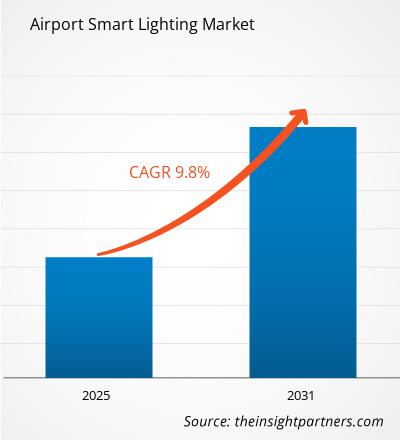
The airport smart lighting market was valued at US$ 1.62 Billion in 2025 and is expected to reach US$ 2.64 Billion by 2034, registering a CAGR of 5.56% from 2026 to 2034. Growth is supported by LED conversion, centralized controls, sensor-enabled illumination, and airport programs focused on energy efficiency, operational visibility, and maintenance optimization. Increasing integration of lighting with airfield management systems is also shifting procurement from standalone fixtures toward connected infrastructure.
North America remains a structurally important market as airports modernize aging airfield assets and terminal infrastructure. The region is expected to register a ~5% CAGR through 2034, supported by replacement of legacy fixtures, demand for digitally monitored lighting, stringent operational requirements, and investments in runway, taxiway, apron, and terminal modernization. These conditions underpin the airport smart lighting market size outlook.
Airport Smart Lighting Market Assessment and Insights
Regional Outlook
- North America: ~34% of the global market in 2025 | ~5% CAGR through 2034. Market position: North America holds the largest regional position, supported by established airport infrastructure, recurring rehabilitation programs, LED conversion, and strong demand for centralized monitoring and control.
- US: ~86% of North American market revenue in 2025 | ~5% CAGR through 2034. Market position: The US represents the largest country market within North America, with modernization of runway and taxiway systems, terminal upgrades, and automated lighting control supporting replacement demand.
- Europe: ~28% of the global market in 2025 | ~5% CAGR through 2034. Market position: Europe is a mature market led by Germany, the UK, France, Italy, and Spain, where energy-efficiency requirements, airport decarbonization programs, and infrastructure refurbishment sustain demand.
- Asia Pacific: ~25% of the global market in 2025 | ~7% CAGR through 2034. Market position: Asia Pacific is the fastest-growing region, supported by airport capacity expansion, modernization of existing facilities, and increasing use of intelligent lighting controls across major aviation hubs.
Segment Outlook
- LED Lighting: ~62% Share in 2025 | ~5% CAGR through 2034. Market position: LED Lighting leads because airports increasingly replace conventional fixtures with longer-life, lower-maintenance systems that can integrate with dimming, monitoring, fault detection, and centralized operational controls.
- Sensor-based Lighting: ~12% Share in 2025 | ~10% CAGR through 2034. Market position: Sensor-based Lighting is expanding rapidly as airports seek occupancy-aware illumination, adaptive control, and real-time operating data across terminals, concourses, aprons, and intermittently occupied areas.
Competitive Coverage
Airport Lighting Specialists Pty Ltd, C2 SmartLight Oy, Carmanah Technologies Corp., Eaton Corporation plc, HELLA GmbH & Co. KGaA, Honeywell International Inc., Signify N.V., OSRAM GmbH, Schréder SA, Verizon Communications Inc.
Methodology
The Insight Partners follows Data Collection & Secondary Research, Primary Research, Data Analysis, and Data Triangulation & Final Review to validate market estimates and insights.
Source: The Insight Partners' analysis based on proprietary research, government publications, company annual reports, investor presentations, industry databases, and expert interviews.
The airport smart lighting market are moving on from fixture substitution to infrastructure integration using both energy-efficient light sources and control, sensing, communication and condition monitoring capabilities. The main driver for that is LED technologies, which allow making lighting controllable and decreasing maintenance complexity. For airfields, there is an increased need in connecting runway and taxiway lighting systems to a common monitoring system, whereas terminal and apron applications require scheduling, dimming, occupancy sensing, and remote diagnosis. It means that procurement will be made not only in terms of illumination equipment but also regarding operation reliability and energy management.
Development perspectives of the sector are becoming increasingly focused on airport expansion in Asia Pacific, modernization initiatives in North America and Europe, and huge investments into airport infrastructure in the Middle East. Modernization or new build of terminals and airfields provides an opportunity to incorporate a connected lighting system already in the design process to bypass limitations related to existing electrical infrastructure. At the same time, requirements of energy performance and aviation safety are driving the adoption of systems providing illumination and monitoring.
Airport Smart Lighting Market Report Scope
| Report Attribute | Details |
|---|---|
| Market size in 2025 | US$ 1.62 Billion |
| Market Size by 2034 | US$ 2.64 Billion |
| Global CAGR (2026 - 2034) | 5.56% |
| Historical Data | 2021-2024 |
| Forecast period | 2026-2034 |
Airport Smart Lighting Market Analysis
The driving forces for demand include the requirement of sustaining dependable lighting over safety-critical airfield zones with cost management of energy and maintenance spending. The airports buy equipment through an ecosystem that includes lighting solution suppliers, control systems providers, electric contractors, engineering services, airport organizations, and technology solution integrators. Demand is generated via replacements of aging equipment in brownfield airports and through installations in greenfield terminals and new runways. As such, the growth in the airport smart lighting market comes from both brownfield and new constructions.
The supply dynamics tend to be favoring the vendors that have the capacity to combine their compliant lighting solutions with control solutions, communication, software, and monitoring capabilities. The standardization and compatibility continue to be vital for the airports since they have to integrate the new lighting with existing power and control systems without shutting down operations. Competition in the industry tends to be based increasingly on product offering. For instance, Eaton Corporation plc offers airfield lighting and controls, Honeywell International Inc. offers intelligent lighting together with airside automation, and Schréder SA specializes in connected transport lighting.
According to the airport smart lighting market report, specialized service providers also cater to certain segments of the value chain. For example, Airport Lighting Specialists Pty Ltd and Carmanah Technologies Corp. serve the airfield segment, while C2 SmartLight Oy caters to smart control aspects. OSRAM GmbH and Signify N.V. bring in wider experience in lighting technologies, and Verizon Communications Inc. could help in connectivity-based infrastructure. Thus, the investment is headed towards interoperability, remote monitoring, and software-driven operations management.
● REPORT CUSTOMIZATION
Tailor This Report To Align With Your Specific Business Requirements
This report can be customized to align precisely with your business objectives, scope, and target markets. Customization options include tailored segmentation, geography, competitive analysis, and strategic insights to support informed decision-making.
Customize This Report →WHAT YOU CAN ADJUST
- ● Segmentations
- ● Geography
- ● Competitive Analysis
- ● Language Preferences
Airport Smart Lighting Market: Strategic Insights

Regional Insights
North America airport smart lighting market
North America accounted for ~34% of the global airport smart lighting market share in 2025 and is expected to expand at a ~5% CAGR through 2034. The region benefits from a large installed airport base requiring rehabilitation of runway, taxiway, apron, and terminal lighting. Replacement projects can be phased around airport operating schedules, creating sustained demand for LED fixtures, control equipment, and monitoring capabilities rather than relying only on new construction.
The US represents the principal demand center, while Canada contributes through airport modernization and energy-efficiency programs. Operators increasingly evaluate lighting projects through lifecycle cost, maintainability, failure visibility, and compatibility with existing airfield control infrastructure. Smart systems can coordinate illumination with operating conditions, reducing unnecessary runtime while maintaining required safety performance.
U.S. airport smart lighting market
The US held around 86% airport smart lighting market share in North America in 2025 and will grow at a ~5% CAGR during 2024–34. The demand was driven by the presence of an extensive network of airports, regular upgrade of airfield electrical infrastructure and modernization of terminals. Procurement trends are moving towards procurement of LED airport lighting products, lighting control and monitoring systems, and digital maintenance.
Some of the companies such as Eaton Corporation plc and Honeywell International Inc. are operating in the airfield lighting, controls or airport automation ecosystem whereas some are specialist suppliers offering discrete runway or taxiway solutions. Applications include taxiway lighting, apron lighting, terminal lighting and operational controls.
Europe airport smart lighting market
Europe was ~28% of the total global airport smart lighting market share in 2025 and expected to expand at a ~5% CAGR up to 2034. Germany is the dominant country within Europe, owing to significant airport infrastructure as well as an established industrial base. The UK continues to be relevant due to the balancing of capacity with energy and carbon targets at airports. France and Italy offer established demand in terms of large airport network as well as airport infrastructure modernization.
Spain creates additional demand through airport commercial modernization and terminal operations. Germany offers mature airport infrastructure as well as strong engineering, whereas France profits from major hub airport infrastructure. Italy and Spain have airport networks in which lighting upgrades could support energy as well as maintenance needs. Within Europe, the use of LED replacement has been associated with control that would allow dimming, scheduling, diagnostics as well as remote monitoring of lights. This is encouraging the demand for the overall system rather than individual lighting products.
APAC airport smart lighting market
Asia Pacific accounted for ~25% of the global market in 2025 and is expected to expand at a ~7% CAGR through 2034, making it the fastest-growing region. China is the leading country in Asia Pacific, supported by extensive airport infrastructure development and modernization. Japan and South Korea contribute through mature technology-intensive airport systems, while India and Australia add demand through airport expansion and asset upgrades.
New facilities, runway capacity, airfield rehabilitation, and sustainability programs make up a diverse addressable base. Controls integration is pertinent for large campuses with varying occupancy levels, while greenfield airports can opt for smarter systems when designing them. New construction along with replacement of old structures forms a diversified means for growth.
Middle East & Africa airport smart lighting market
The Middle East and Africa market is expected to register a ~6% CAGR through 2034. Saudi Arabia is a leading country in the Middle East and Africa market, supported by airport development, tourism-related infrastructure investment, and aviation modernization. The UAE remains a major demand center, while South Africa contributes through established commercial airports and infrastructure refurbishment.
Hot temperatures, dust, hours of operation, and the need for high visibility highlight the importance of robust hardware, energy efficiency, remote diagnostics, and maintenance planning. The new projects at Gulf airports will allow installation of smart lights during design, while existing airports will need retrofitting solutions that integrate with the existing power infrastructure. For Africa, wireless and solar-based solutions are available for certain use cases.
Segmentation Analysis
Type
Type is a core category in the airport smart lighting market because technology selection determines energy consumption, controllability, maintenance requirements, and integration potential. Airport preference is shifting toward efficient fixtures and digitally managed illumination, particularly where lighting operates for long periods. LED Lighting provides the principal technology base, while connected architectures create opportunities for adaptive solutions. The leading technology subsegment is estimated to grow at a ~5% CAGR through 2034 as replacement programs continue across established airports.
- LED Lighting: LED fixtures suit airport environments because long operating life, lower maintenance requirements, precise optics, and controllability support safety and lifecycle-cost objectives.
- LED Lighting: This supplied taxonomy entry reflects continued emphasis on efficient solid-state illumination. Demand is supported by conventional fixture replacement and compatibility with modern dimming and monitoring architectures.
- Sensor-based Lighting: Sensor integration enables illumination to respond to occupancy, movement, environmental conditions, or operational status, particularly across terminals, concourses, and intermittently used areas.
- Wireless Lighting: Wireless architectures can reduce cabling requirements and simplify deployment where trenching, network expansion, or physical access is difficult, supporting flexible modernization.
Application
Application segment in the airport smart lighting market determines how systems are specified, controlled, maintained, and integrated into airport operations. Demand varies according to safety requirements, traffic intensity, operating schedules, and the consequences of lighting failure. Airfield applications require highly reliable systems and standardized performance, while passenger-facing areas emphasize comfort, energy management, and occupancy response. The leading application subsegment is expected to expand at a ~5% CAGR through 2034 as modernization encompasses airside and landside infrastructure.
- Runways: Runway lighting is safety-critical and requires precise illumination, robust housings, compliant optical performance, and reliable control architectures for demanding operating conditions.
- Taxiways: Taxiway systems support aircraft movement and routing, creating demand for controllable centerline, edge, and guidance lighting coordinated with traffic and visibility requirements.
- Apron: Apron lighting serves aircraft stands and ground-handling areas where visibility, glare management, energy efficiency, and maintenance access support continuous turnaround operations.
- Terminals: Terminal lighting combines passenger experience with energy management, making scheduling, dimming, occupancy sensing, and centralized building controls increasingly relevant.
- Concourses: Concourse lighting supports passenger circulation and operational visibility, with smart controls enabling illumination changes according to footfall, time, and facility usage.
Opportunity Snapshot
| Application | Revenue Contribution | Trend Tag | Adoption Stage |
| Runways | High | Adaptive Guidance | Mature |
| Taxiways | High | Route Control | Mature |
| Apron | Medium | Smart Illumination | Scaling |
| Terminals | High | Occupancy Control | Scaling |
| Concourses | Medium | Dynamic Dimming | Scaling |
Airport Smart Lighting Market Growth Drivers and Impact Analysis
Replacement of legacy airport lighting with efficient LED systems
Replacement of conventional airport lighting with LED systems is a direct driver because airports operate lighting assets for long periods and require high reliability. LED technology enables lower power demand, longer operating life, precise optical control, and compatibility with modern dimming architectures. These characteristics improve the economics of phased replacement, especially when operators combine fixture upgrades with control modernization. Longer service intervals can also reduce maintenance activity in restricted airside zones. As airports renew aging electrical infrastructure, LED conversion can act as an entry point for broader smart deployment and create demand for monitoring, fault detection, and centralized management capabilities.
Integration of lighting with airfield and building control systems
Integration is a major growth mechanism as airport operators seek consolidated infrastructure visibility. Smart lighting can exchange information with control platforms, enabling centralized switching, scheduled operation, adaptive illumination, status monitoring, and fault alerts. In airfield environments, this can support responsive taxiway and runway management, while terminals and concourses can use occupancy and time-based controls. The commercial impact is a shift from individual luminaires toward connected systems including controllers, communications, software, and service support. Vendors with interoperability capabilities can participate in larger modernization projects, while airports can prioritize systems demonstrating measurable improvements in energy use, maintenance workload, or equipment availability. These mechanisms strengthen the airport smart lighting market analysis.
Expansion of airport infrastructure and modernization programs
Airport capacity expansion creates demand for new lighting installations, while modernization of existing facilities broadens the retrofit addressable base. Emerging aviation markets are adding terminals, runways, taxiways, and passenger facilities, creating opportunities to specify smart lighting from the design stage. Mature airports are simultaneously upgrading aging assets to improve operational resilience and efficiency. This dual demand pattern supports a balanced market structure in which greenfield projects drive system adoption and brownfield programs sustain replacement volumes. Smart lighting is particularly relevant where projects include centralized infrastructure management because lighting can be incorporated into electrical, building automation, and airfield control packages. Long-term infrastructure renewal therefore supports sustained demand.
Airport Smart Lighting Market Future Trends
Adaptive lighting based on real-time airport activity
Future systems are likely to move from scheduled lighting toward adaptive illumination responding to actual airport conditions. Sensors, connected controllers, and operational data can enable lighting levels to change according to passenger movement, vehicle activity, aircraft routing, occupancy, or predefined safety conditions. In terminals and concourses, this approach can balance visibility with energy management. On aprons and selected airfield areas, adaptive operation can support targeted illumination while maintaining safety performance. The airport smart lighting market trends will increasingly include software, communications, and analytics alongside luminaires. Vendors connecting lighting assets with airport operating systems may therefore gain a larger role in modernization projects, while buyers increasingly evaluate interoperability, cybersecurity, data quality, and lifecycle support.
Convergence of smart lighting with airport sustainability programs
Lighting is likely to become more closely connected with airport sustainability measurement as operators seek improvements that can be tracked at asset level. LED conversion provides the hardware foundation, while controls and monitoring create the ability to measure operating patterns and identify inefficient use. New projects can incorporate lighting performance into broader energy-management strategies, while retrofit programs can target high-runtime areas first. The resulting trend is a shift toward measurable performance rather than simple equipment replacement. Airports may increasingly specify remote monitoring, automated fault reporting, dimming capability, and system-level data access. This convergence can create service opportunities around optimization, maintenance planning, and continuous performance improvement.
Airport Smart Lighting Market Opportunities
Smart retrofit packages for existing airport assets
A significant commercial opportunity exists in bundled retrofit packages combining LED fixtures, controls, sensors, communications, and monitoring without requiring complete replacement of airport electrical infrastructure. Existing airports often have established circuits, control rooms, and maintenance procedures that cannot be discarded during modernization. Vendors can differentiate through compatible upgrade paths, phased installation, and migration support. Retrofit packages can target runway and taxiway assets before extending into aprons, terminals, and concourses. The opportunity is particularly relevant for airports seeking measurable energy and maintenance improvements while minimizing operational disruption. Service models covering commissioning, remote monitoring, fault analytics, and lifecycle maintenance can expand revenue beyond equipment sales and contribute to airport smart lighting market Forecasts.
Connected lighting platforms for new airport developments
Greenfield airports and major terminal expansions provide an opportunity to specify connected lighting architectures before legacy constraints are established. Developers can integrate controllers, sensors, communications networks, energy monitoring, and maintenance interfaces during design and construction. This creates a pathway for lighting to become part of broader digital infrastructure rather than a standalone electrical package. Suppliers can pursue partnerships with engineering firms, systems integrators, electrical contractors, and airport technology providers to participate earlier in project planning. The opportunity is particularly relevant in regions with active airport construction programs, where standardized digital infrastructure can be deployed across multiple facilities. Long-term support agreements can create recurring value through monitoring, software updates, and optimization.
Frequently Asked Questions

- Comprehensive Market Sizing and Forecast Analysis
- Detailed Segmentation Analysis
- In-Depth Market Dynamics Assessment
- Regional and Country-Level Insights
- Competitive Landscape and Company Benchmarking
- Strategic Business Intelligence
Recent Reports
Testimonials

The Insight Partners provided valuable market intelligence that supported our global go-to-market strategy. Their team was professional, responsive, and attentive to our feedback, providing thoughtful analysis and helpful methodological clarifications throughout the project.
Junmo Kim Chief Financial Officer (CFO), Enertech Co., Ltd.
The Insight Partners' SCADA System Market report is comprehensive, with valuable insights on current trends and future forecasts. The team was highly professional, responsive, and supportive throughout. We are very satisfied and highly recommend their services.
RAN KEDEM Partner, Reali Technologies LTDs
I requested a report on a very specific software market and the team produced the report in a few days. The information was very relevant and well presented. I then requested some changes and additions to the report. The team was again very responsive and I got the final report in less than a week.
JEAN-HERVE JENN Chairman, Future Analytica
We worked with The Insight Partners for an important market study and forecast. They gave us clear insights into opportunities and risks, which helped shape our plans. Their research was easy to use and based on solid data. It helped us make smart, confident decisions. We highly recommend them.
PIYUSH NAGPAL Sr. Vice President, High Beam Global
The Insight Partners delivered insightful, well-structured market research with strong domain expertise. Their team was professional and responsive throughout. The user-friendly website made accessing industry reports seamless. We highly recommend them for reliable, high-quality research services
YUKIHIKO ADACHI CEO, Deep Blue, LLC.
This is the first time I have purchased a market report from The Insight Partners.While I was unsure at first, I visited their web site and felt more comfortable to take the risk and purchase a market report.I am completely satisfied with the quality of the report and customer service. I had several questions and comments with the initial report, but after a couple of dialogs over email with their analyst I believe I have a report that I can use as input to our strategic planning process.Thank you so much for taking the extra time and making this a positive experience.I will definitely recommend your service to others and you will be my first call when we need further market data.
JOHN SUZUKI President and Chief Executive Officer, Board Director, BK Technologies
I wish to appreciate your support and the professionalism you displayed in the course of attending to my request for information regarding to infectious disease IVD market in Nigeria. I appreciate your patience, your guidance, and the fact that you were willing to offer a discount, which eventually made it possible for us to close a deal. I look forward to engaging The Insight Partners in the future, all thanks to the impression you have created in me as a result of this first encounter.
DR CHIJIOKE ONYIA MANAGING DIRECTOR, PineCrest Healthcare Ltd.Reason to Buy
- Informed Decision-Making
- Understanding Market Dynamics
- Competitive Analysis
- Identifying Emerging Markets
- Customer Insights
- Market Forecasts
- Risk Mitigation
- Boosting Operational Efficiency
- Strategic Planning
- Investment Justification
- Tracking Industry Innovations
- Aligning with Regulatory Trends





 Get Free Sample for