
Airport Solar Power Market Size, Share & Demand by 2034
Coverage: By Technology (Photovoltaic Systems and Concentrated Solar Power), By Capacity (Small Scale, Medium Scale, and Large Scale), By Type (Ground Mounted Systems, Roof Mounted Systems), and Geography
- Status : Data Released
- Report Code : TIPTE100001277
- Category : Energy and Power
- No. of Pages : 150
- Available Report Formats :


- Last update date : November 03, 2026


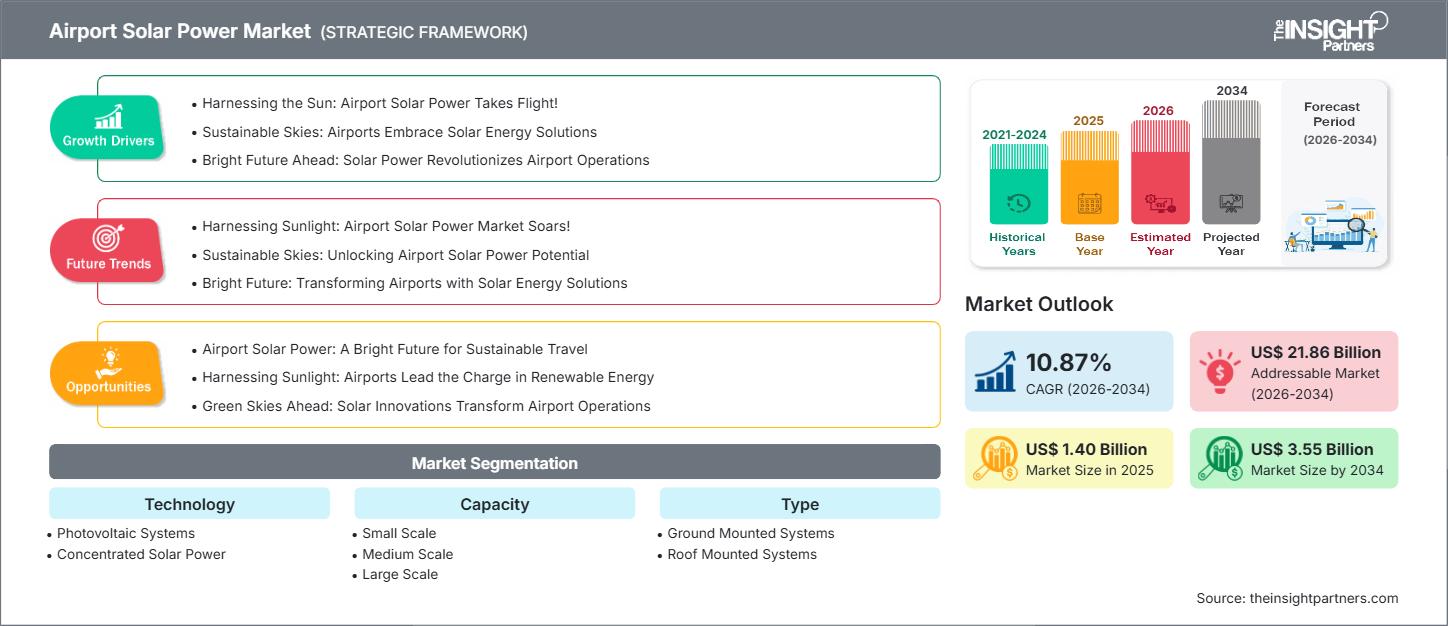
2025 Market Size
US$ 1.40 Bn
Base year value
2034 Forecast
US$ 3.55 Bn
Projected by 2034
CAGR 2026-2034
10.87 %
Growth rate
Addressable Market
US$ 21.86 Bn
(2026-2034)
The airport solar power market was valued at US$ 1.40 Billion in 2025 and is projected to reach US$ 3.55 Billion by 2034, registering a CAGR of 10.87% from 2026 to 2034. Growth is supported by rising airport electricity consumption, decarbonization targets, improving photovoltaic economics, and the availability of large rooftops, parking structures, and airport-adjacent land for solar installations. Increasing use of renewable power procurement models is also broadening deployment opportunities.
In North America, the airport solar power market size is being shaped by airport sustainability programs, energy-cost management, and the use of power purchase agreements and energy-service contracts. The region is projected to register a ~9% CAGR through 2034, supported by modernization of airport facilities, distributed generation projects, solar canopies over parking areas, and increasing emphasis on resilient electricity supply.
Airport Solar Power Market Assessment and Insights
Regional Outlook
- North America: ~34% of the global market in 2025 | ~9% CAGR through 2034. Market position: North America represents the largest regional market, supported by established airport sustainability programs, mature solar financing structures, extensive parking infrastructure, and strong demand for onsite generation that can reduce exposure to conventional electricity costs.
- US: ~82% of North American market revenue in 2025 | ~9% CAGR through 2034. Market position: The US accounts for most North American demand, with airport operators deploying rooftop arrays, solar parking canopies, and ground-mounted systems alongside energy-efficiency programs and long-term renewable power procurement arrangements.
- Europe: ~27% of the global market in 2025 | ~10% CAGR through 2034. Market position: Europe has a mature airport decarbonization environment, with Germany, France, the UK, Italy, and Spain supporting deployment through renewable-energy targets, electrification, infrastructure modernization, and increasingly integrated airport sustainability programs.
- Asia Pacific: ~25% of the global market in 2025 | ~13% CAGR through 2034. Market position: Asia Pacific is the fastest-growing regional market as airport expansion, strong solar manufacturing capacity, rising electricity demand, and national renewable-energy programs accelerate solar deployment across China, Japan, South Korea, India, and Australia.
Segment Outlook
- Photovoltaic Systems: ~93% Share in 2025 | ~11% CAGR through 2034. Market position: Photovoltaic Systems lead because modular PV can be deployed across rooftops, parking structures, and available airport land with scalable project sizes, while established supply chains and improving conversion efficiency support broad airport adoption.
- Large Scale: ~55% Share in 2025 | ~12% CAGR through 2034. Market position: Large Scale projects are gaining importance where airport authorities can dedicate substantial land or parking infrastructure to generation. Larger installations can support material reductions in grid purchases and improve project economics through scale.
Competitive Coverage
Ameresco, Canadian Solar Inc., Emmvee Solar Systems Pvt. Ltd., Gaiasolar A/S, Indosolar, Robert Bosch GmbH, Solar Energy Corporation of India, Solar Frontier K.K., TECO Energy, Vikram Solar Limited
Methodology
The Insight Partners follows Data Collection & Secondary Research, Primary Research, Data Analysis, and Data Triangulation & Final Review to validate market estimates and insights.
Source: The Insight Partners' analysis based on proprietary research, government publications, company annual reports, investor presentations, industry databases, and expert interviews.
The use of solar power systems at airports has moved on from being limited to rooftop installations of modest size to include a variety of energy projects that include all of the airport's buildings – terminal facilities, car parking structures, maintenance hangars, and land owned by the airports. Reduced cost, improved efficiency, and advances in the technology for converting electricity have made an increasing number of installations feasible. In addition to assessing solar, airport companies will need to consider it along with energy efficiency, electric vehicle charging, batteries, and renewable energy procurement.
In the future, there will be a greater spread of locations of airport solar power projects as emerging aviation centers use airport development plans to meet their renewable energy goals. An example of such airport activities is India, where according to the Indian Airports Authority, there has been installed 57.5 MW of solar PV systems at 64 airports as of March 2025. There are also several other projects of airport solar power at various airports showing the ongoing development of this industry.
Airport Solar Power Market Report Scope
| Report Attribute | Details |
|---|---|
| Market size in 2025 | US$ 1.40 Billion |
| Market Size by 2034 | US$ 3.55 Billion |
| Global CAGR (2026 - 2034) | 10.87% |
| Historical Data | 2021-2024 |
| Forecast period | 2026-2034 |
Airport Solar Power Market Analysis
Airport electricity demand provides a solid base upon which to build solar power deployment due to the continuous power requirement by terminals, baggage handling systems, lighting, air conditioning, security technology, parking facilities, and commercial activities. The value chain involves project developers, photovoltaic cell producers, engineering and construction companies, inverter and balance of system suppliers, financiers, utilities, and airports. Airport energy procurement may involve outright capital expenditure, PPAs or energy services, giving airports options according to capital and energy needs.
Supply dynamics in the airport solar power market report are inclined towards modular projects, which can be staged in development. Roof-top and parking solar installations make use of existing built structures, and the ground mounted ones provide increased generation capacity where there is suitable land. Engineering needs particular to an airport can complicate projects since solar installation has to avoid disruption and aviation safety issues. Suppliers having experience in engineering, procurement, construction, monitoring, and maintenance can therefore operate at different levels of the airport energy value chain.
Competing in the airport solar energy market include renewable energy services firms, photovoltaic system suppliers, engineering firms, and government-sponsored solar enterprises. In the case of Ameresco, its competitive positioning strategy involves project development along with energy services frameworks while Canadian Solar Inc. engages itself in modules and solar project initiatives. Vikram Solar Limited has a track record of executing projects in India involving airport roofs and ground-mounted photovoltaic solar power generation projects. Solar Energy Corporation of India facilitates large-scale solar power generation and procurement systems while Robert Bosch GmbH and others engage themselves through their diversified nature in energy technology.
The investment decisions for such projects are increasingly being inclined towards solar projects along with modernizing airports as compared to standalone renewable energy projects. For instance, parking canopy-based projects can provide for electricity generation as well as facility needs of the passengers while rooftop projects can be executed using rooftops which otherwise remain idle. This means that competing in such an environment requires more than just having better module or solar systems.
● REPORT CUSTOMIZATION
Tailor This Report To Align With Your Specific Business Requirements
This report can be customized to align precisely with your business objectives, scope, and target markets. Customization options include tailored segmentation, geography, competitive analysis, and strategic insights to support informed decision-making.
Customize This Report →WHAT YOU CAN ADJUST
- ● Segmentations
- ● Geography
- ● Competitive Analysis
- ● Language Preferences
Airport Solar Power Market: Strategic Insights
Regional Insights
North America Airport Solar Power Market
The North American region held about 34% of the worldwide airport solar power market in 2025 and will witness growth at around 9% CAGR till 2034. North America is favored by a strong installed base of airports, ample parking infrastructure, well-developed financing of renewable energy projects, and strong planning regarding airport sustainability. The US constitutes the major share of demand in this region, while Canada plays a role through utility-scale and distributed airport projects. The use of solar canopies would be highly effective in cases where there are ample passenger and rental car parking spaces in the airport.
The combination of solar power generation, LED lighting retrofitting, energy management systems, electric vehicle charging, and long-term renewable power purchase agreements is becoming increasingly common in the airport sector. Such a combination enhances the efficiency of onsite solar power generation and provides strong financial motivation to upgrade infrastructure. There are also prospects for airport solar projects in Canada in the event of availability of suitable land and parking resources.
U.S. Airport Solar Power Market
The US accounted for ~82% of North American airport solar market revenue in 2025 and is expected to grow at a ~9% CAGR through 2034. Airport operators have access to established project-financing structures, federal and state renewable-energy incentives, and energy-service models. Large passenger airports can deploy solar across parking facilities, terminal roofs, and other suitable areas, while regional airports can use smaller systems to offset facility electricity consumption.
The United States market features already existing companies like Ameresco, which has its airports and shows how solar power can be used together with energy efficiency and contractual arrangements. Solar power demand at airports can also be driven by the increasing electrification of the ground transportation at terminals. As the load of electricity increases, on-site generation of electricity can be used to satisfy the part of the demand during the day and to reduce the dependence on grid power.
Europe Airport Solar Power Market
Europe had around 27% of the global airport solar power market share in 2025 and was expected to witness a CAGR of around 10% until 2034. The region boasts an advanced sustainability policy framework, yet it continues to explore new possibilities of installing onsite renewable energy production solutions as terminal facilities grow and increase their electricity consumption needs. Decarbonizing airports and purchasing renewable energy solutions is a top priority in the UK, while Germany successfully combines efficient solar deployment and industrial energy transition policies. The French country, in turn, expands its renewable energy infrastructure.
Germany is the most successful nation within the European region in terms of solar deployment maturity, industrial capability, and renewable energy infrastructure development. Opportunities in France and the UK are significant due to a large number of airports in these countries and the presence of decarbonization plans. Italy and Spain enjoy a high solar irradiance level along with significant airport infrastructure, which allows installing both rooftop and ground-mounted solar solutions. Solar resource availability can be beneficial for southern European nations.
APAC Airport Solar Power Market
Asia Pacific accounted for ~25% of the global airport solar power market in 2025 and is expected to expand at a ~13% CAGR through 2034, making it the fastest-growing region. China is the leading country in Asia Pacific, supported by its extensive solar manufacturing ecosystem, large airport infrastructure base, and national renewable-energy expansion. Japan and South Korea are advancing distributed renewable generation, particularly where airport land constraints favor rooftop systems.
India is a major growth market because airport operators are increasingly deploying solar across terminals and associated facilities. Australia also provides favorable conditions for larger airport solar projects because of strong solar resources and established renewable-energy adoption. Across the region, airport expansion, electricity demand growth, domestic module manufacturing, renewable procurement programs, and public-sector sustainability initiatives are supporting deployment.
Middle East & Africa Airport Solar Power Market
The Middle East & Africa market is expected to expand at a ~11% CAGR through 2034. Saudi Arabia represents the leading country in the Middle East & Africa region where airport modernization, renewable-energy development, and large infrastructure investment create opportunities for airport-scale solar generation. The UAE also has strong potential because of high solar irradiation, major international airports, and established clean-energy investment programs.
South Africa provides an additional demand center because airports face electricity-cost and grid-reliability considerations that can strengthen the case for onsite generation. Across the wider region, large airport developments can incorporate solar during the initial design stage, reducing retrofit constraints. Ground-mounted systems are particularly relevant where land is available, while rooftop and parking installations can provide distributed generation without requiring additional airport land.
Segmentation Analysis
Technology
Technology segment in the airport solar power market is a core determinant of project economics because airport operators evaluate generation efficiency, land utilization, operational compatibility, and lifecycle performance when selecting systems. The category is dominated by photovoltaic deployment because PV can be scaled across multiple airport surfaces and project sizes. Solar modules, inverters, mounting systems, monitoring equipment, and grid interfaces form an established supply chain. Photovoltaic Systems are expected to record a ~11% CAGR through 2034 as airport operators prioritize modular renewable generation.
- Photovoltaic Systems: Photovoltaic Systems are widely suited to airport environments because modules can be installed on rooftops, parking structures, and ground-mounted arrays. Their modular architecture allows projects to expand as electricity demand and available capital increase.
- Concentrated Solar Power: Concentrated Solar Power has more limited airport deployment because its spatial, thermal, and infrastructure requirements are less compatible with many airport sites. It can nevertheless be relevant for specialized large-scale facilities where land and solar resources support thermal generation.
Capacity
Capacity segment in the airport solar power market determines the scale of electricity offset, project financing requirements, and infrastructure integration. Airport operators can select capacity according to available land, rooftop area, electricity demand, grid conditions, and investment objectives. Large projects can capture economies of scale, whereas smaller systems provide a practical entry point for regional airports and facilities with constrained infrastructure. Large Scale capacity is expected to register a ~12% CAGR through 2034 as major airports expand renewable-energy programs.
- Small Scale: Small Scale systems are suitable for individual airport buildings, remote facilities, or constrained sites. Their relatively limited physical footprint can simplify phased deployment and enable airports to test onsite generation before expanding across additional assets.
- Medium Scale: Medium Scale installations provide a balance between project complexity and energy contribution. They can serve terminals, administrative buildings, cargo facilities, or parking structures where electricity demand is meaningful but available installation space remains moderate.
- Large Scale: Large Scale systems address substantial airport electricity requirements and can use extensive land or parking infrastructure. Their economics benefit from project scale, making them relevant to major airports with strong renewable-energy targets and sufficient interconnection capacity.
Type
Type segment in the airport solar power market influences installation economics, land utilization, construction complexity, and airport operational compatibility. Ground-mounted and roof-mounted systems can both contribute to onsite renewable generation, but their suitability depends on available space, structural conditions, aviation safety requirements, and grid configuration. Ground Mounted Systems are expected to record a ~11% CAGR through 2034 as large airports increasingly evaluate land-intensive generation alongside other infrastructure uses.
- Ground Mounted Systems: Ground Mounted Systems can support comparatively large generation capacities where airport-owned land is available. Site selection must account for aviation safety, drainage, access, security, glare, wildlife considerations, and electrical infrastructure.
- Roof Mounted Systems: Roof Mounted Systems use existing terminal, cargo, parking, or maintenance buildings, minimizing additional land requirements. Adoption depends on structural loading, roof condition, maintenance access, shading, electrical routing, and compatibility with airport renovation schedules.
Opportunity Snapshot
| Segment Name | Revenue Contribution | Trend Tag | Adoption Stage |
| Photovoltaic Systems | High | Modular PV | Mature |
| Concentrated Solar Power | Low | Thermal Integration | Emerging |
Airport Solar Power Market Growth Drivers and Impact Analysis
Expansion of Airport Decarbonization and Renewable-Energy Programs
Airport operators are increasingly incorporating renewable generation into broader environmental and energy-management strategies. Solar provides a direct pathway for reducing dependence on conventional electricity while supporting measurable emissions-reduction objectives. The impact is strongest where airports operate continuously and maintain predictable daytime electricity loads. Public-sector airport authorities are also using renewable-energy procurement and onsite generation to strengthen long-term energy planning. In India, airport solar capacity reported by the Airports Authority of India illustrates how deployment can progress across a distributed airport network rather than being limited to major international hubs. As sustainability requirements become integrated into infrastructure planning, solar is increasingly evaluated during terminal construction, expansion, and refurbishment projects. This creates opportunities for developers that can provide engineering, financing, installation, monitoring, and maintenance as an integrated service.
High Electricity Consumption Creates a Strong Onsite Generation Case
Airports operate energy-intensive facilities that require electricity for terminals, lighting, cooling, baggage handling, security systems, commercial areas, and supporting infrastructure. Solar installations can therefore address a meaningful portion of daytime electricity demand when system orientation and load profiles are appropriately matched. Parking structures and rental-car facilities provide additional opportunities because they combine large surfaces with substantial electricity requirements and can accommodate solar canopies. The economic impact extends beyond energy generation because integrated projects can incorporate lighting upgrades, charging infrastructure, and energy-management technologies. Airport operators can also select financing structures that distribute capital requirements over the project life. This combination of electricity-cost management, infrastructure utilization, and sustainability objectives is supporting broader consideration of solar during airport modernization programs.
Increasing Availability of Scalable Solar Technology and Financing Models
Improvements in photovoltaic module efficiency, system monitoring, power electronics, and project engineering are expanding the practical range of airport solar applications. At the same time, PPAs, energy-service contracts, leasing structures, and other financing arrangements can reduce the requirement for airport operators to fund the entire project upfront. This is particularly relevant for airports that prioritize operational continuity and capital expenditure discipline. Suppliers able to combine technology procurement with engineering and financing support can address a broader portion of the procurement process. The market impact is therefore extending beyond equipment pricing. Project bankability, contractual flexibility, maintenance support, grid interconnection capability, and compliance with aviation-specific requirements increasingly influence supplier selection and project execution.
Airport Solar Power Market Future Trends
Integration of Solar with Airport Energy Management and Storage
Future airport solar projects are expected to become more integrated with digital energy-management platforms, battery storage, electric-vehicle charging, and flexible electricity procurement. Instead of operating solar as an isolated generation asset, airport operators can coordinate renewable output with building loads and charging demand to improve energy utilization. Battery storage can help manage differences between solar generation and electricity consumption, although project economics will vary according to tariffs, storage costs, and grid conditions. Advanced monitoring can also provide performance information at module, inverter, and system levels, enabling operators to identify faults and optimize maintenance. The resulting project model is likely to emphasize integrated energy infrastructure rather than standalone solar capacity.
Greater Use of Parking Structures and Previously Underutilized Airport Assets
Airport solar deployment is expected to increasingly use parking garages, rental-car facilities, terminal roofs, cargo buildings, and other existing assets. These locations can provide usable surfaces without requiring airports to allocate additional land exclusively for energy generation. Solar canopies over parking areas can also support passenger convenience, vehicle electrification, and distributed electricity supply within the same infrastructure investment. As airport campuses become more electrified, combining generation with charging and energy-management infrastructure can increase the strategic value of solar installations. Design practices will continue to emphasize structural assessment, glare controls, drainage, emergency access, security, and aviation safety. This trend favors engineering providers capable of integrating solar into complex operating environments.
Airport Solar Power Market Opportunities
Airport Solar-as-a-Service and Long-Term Power Purchase Models
A significant commercial opportunity lies in financing structures that allow airport operators to procure renewable electricity without bearing the full upfront project cost. Under PPA and energy-service arrangements, developers can finance, own, operate, or maintain solar assets while airports purchase generated electricity under agreed contractual terms. This approach can be particularly relevant for airports with constrained capital budgets but strong sustainability objectives. Developers can differentiate through contract flexibility, guaranteed performance, maintenance capabilities, and integration with airport energy-management systems. Opportunities are strongest where electricity prices, renewable incentives, and airport load profiles support predictable project economics. As more airports evaluate portfolios of renewable assets rather than isolated installations, experienced developers can also build multi-site programs that standardize procurement and maintenance.
Integrated Solar Infrastructure for Emerging Airport Expansion Programs
Emerging aviation provide opportunities in the airport solar power market forecast to incorporate solar during airport design rather than retrofitting systems after construction. New terminals, parking facilities, cargo centers, and support buildings can be designed with structural provisions, electrical pathways, and roof orientations suitable for photovoltaic systems. This approach can reduce retrofit complexity and allow solar generation to become part of the initial energy architecture. India, Southeast Asia, the Middle East, and selected African markets offer potential where airport infrastructure investment is combined with renewable-energy objectives. Suppliers can capture value through integrated engineering, module supply, EPC services, monitoring, and long-term operations and maintenance. Early involvement in airport master planning can also help identify suitable surfaces and grid connections before construction constraints become significant.
Frequently Asked Questions

- Comprehensive Market Sizing and Forecast Analysis
- Detailed Segmentation Analysis
- In-Depth Market Dynamics Assessment
- Regional and Country-Level Insights
- Competitive Landscape and Company Benchmarking
- Strategic Business Intelligence
Recent Reports
Testimonials

The Insight Partners provided valuable market intelligence that supported our global go-to-market strategy. Their team was professional, responsive, and attentive to our feedback, providing thoughtful analysis and helpful methodological clarifications throughout the project.
Junmo Kim Chief Financial Officer (CFO), Enertech Co., Ltd.
The Insight Partners' SCADA System Market report is comprehensive, with valuable insights on current trends and future forecasts. The team was highly professional, responsive, and supportive throughout. We are very satisfied and highly recommend their services.
RAN KEDEM Partner, Reali Technologies LTDs
I requested a report on a very specific software market and the team produced the report in a few days. The information was very relevant and well presented. I then requested some changes and additions to the report. The team was again very responsive and I got the final report in less than a week.
JEAN-HERVE JENN Chairman, Future Analytica
We worked with The Insight Partners for an important market study and forecast. They gave us clear insights into opportunities and risks, which helped shape our plans. Their research was easy to use and based on solid data. It helped us make smart, confident decisions. We highly recommend them.
PIYUSH NAGPAL Sr. Vice President, High Beam Global
The Insight Partners delivered insightful, well-structured market research with strong domain expertise. Their team was professional and responsive throughout. The user-friendly website made accessing industry reports seamless. We highly recommend them for reliable, high-quality research services
YUKIHIKO ADACHI CEO, Deep Blue, LLC.
This is the first time I have purchased a market report from The Insight Partners.While I was unsure at first, I visited their web site and felt more comfortable to take the risk and purchase a market report.I am completely satisfied with the quality of the report and customer service. I had several questions and comments with the initial report, but after a couple of dialogs over email with their analyst I believe I have a report that I can use as input to our strategic planning process.Thank you so much for taking the extra time and making this a positive experience.I will definitely recommend your service to others and you will be my first call when we need further market data.
JOHN SUZUKI President and Chief Executive Officer, Board Director, BK Technologies
I wish to appreciate your support and the professionalism you displayed in the course of attending to my request for information regarding to infectious disease IVD market in Nigeria. I appreciate your patience, your guidance, and the fact that you were willing to offer a discount, which eventually made it possible for us to close a deal. I look forward to engaging The Insight Partners in the future, all thanks to the impression you have created in me as a result of this first encounter.
DR CHIJIOKE ONYIA MANAGING DIRECTOR, PineCrest Healthcare Ltd.Reason to Buy
- Informed Decision-Making
- Understanding Market Dynamics
- Competitive Analysis
- Identifying Emerging Markets
- Customer Insights
- Market Forecasts
- Risk Mitigation
- Boosting Operational Efficiency
- Strategic Planning
- Investment Justification
- Tracking Industry Innovations
- Aligning with Regulatory Trends





 Get Free Sample for