
Alfalfa Derivatives Market Demand, Share & Growth by 2034
Coverage: By Product Type (Bales, Pellets, Cubes, Others); Livestock (Ruminants, Equine, Others) , and Geography (North America, Europe, Asia Pacific, and South and Central America)
- Status : Data Released
- Report Code : TIPRE00019955
- Category : Food and Beverages
- No. of Pages : 150
- Available Report Formats :


- Last update date : August 18, 2026


2025 Market Size
US$ 4.84 Bn
Base year value
2034 Forecast
US$ 7.84 Bn
Projected by 2034
CAGR 2026-2034
5.51 %
Growth rate
Addressable Market
US$ 57.51 Bn
(2026-2034)
The Alfalfa derivatives market was valued at US$ 4.84 Billion in 2025 and is projected to reach US$ 7.84 Billion by 2034, expanding at a CAGR of 5.51% during 2026–2034. Demand continues to be supported by the increasing use of nutrient-rich forage products in commercial livestock operations, growing emphasis on feed efficiency, and expanding consumption of premium livestock feed ingredients across dairy, beef, and equine production systems worldwide.
Within North America, the alfalfa derivatives market size is supported by large-scale dairy farming, advanced feed management practices, and established export networks serving Asia and the Middle East. Regional growth is expected to remain in the range of 4.8–5.6% through the forecast period, driven by increasing demand for high-protein forage products, improved forage preservation technologies, and rising focus on animal nutrition optimization among commercial livestock producers.
Alfalfa Derivatives Market Assessment and Insights
- North America: Leading production infrastructure and strong dairy feed consumption position the region as a key revenue contributor. Share in 2025: 36–40%. CAGR between 2026–2034: 4.8–5.6%.
- US: Extensive cultivation acreage and export-oriented forage production strengthen regional demand fundamentals. Share in 2025: 78–82% of North America. CAGR between 2026–2034: 4.7–5.5%.
- Europe: Adoption of quality feed programs and sustainable livestock systems supports growth. Share in 2025: 24–28%. CAGR between 2026–2034: 4.5–5.3%. Leading countries include Germany, France, Spain, and the UK.
- Asia Pacific: Rising livestock productivity targets and feed modernization initiatives drive expansion. Share in 2025: 22–26%. CAGR between 2026–2034: 6.0–6.8%. China, India, Japan, and Australia remain key markets.
- Largest Segment: Bales remain dominant due to established storage and transportation practices. Market share in 2025: 48–52%. CAGR between 2026–2034: 4.8–5.6%.
- High Growth Segment: Pellets benefit from improved handling efficiency and consistent nutritional composition. Market share in 2025: 28–32%. CAGR between 2026–2034: 6.2–7.0%.
- Key companies analyzed in detail: Alfalfa Monegros, Anderson Hay & Grain Co., Border Valley Trading, Carli Group S.r.l., Cubeit Hay Company, M&C Hay, McCracken Hay Company, Riverina (Australia) Pty Ltd., S&W Seed Company, Standlee Premium Products LLC.
Source: The Insight Partners' analysis based on proprietary research, government publications, company annual reports, investor presentations, industry databases, and expert interviews.
Production techniques, forage conditioning methods, and compressed-feed technologies have transformed the alfalfa derivatives market over the last decade. As a result of more attention paid to protein preservation, moisture control, and logistics efficiency, the demand for pellet and cube forms has grown. Export-oriented cultivation, use of advanced irrigation techniques, and better harvesting machines have made the output more valuable for inclusion in commercial livestock feeding programs based on alfalfa products.
As the future development trends, efforts aimed at feed improvement, traceability and climate-resilient agriculture are likely to promote the wider adoption of alfalfa-based products in emerging livestock-producing countries. The growth in dairy production in Asia, beef farming modernization in the Middle East, and the rise in the demand for premium horse feed are providing new income sources.
Alfalfa Derivatives Market Report Scope
| Report Attribute | Details |
|---|---|
| Market size in 2025 | US$ 4.84 Billion |
| Market Size by 2034 | US$ 7.84 Billion |
| Global CAGR (2026 - 2034) | 5.51% |
| Historical Data | 2021-2024 |
| Forecast period | 2026-2034 |
Alfalfa Derivatives Market Analysis
The alfalfa derivatives market growth is primarily driven by increasing demand for high-protein feed ingredients within the dairy, beef, and equine sectors. However, the livestock farmers are still in search of feeds that can enhance their digestibility, milk output, weight gain, and herd productivity. The increasing demand to enhance the feed conversion ratios has been one of the reasons for the emergence of nutritionally-balanced forage products. In addition, increased global exports of forage products have resulted in demand for processed forms of alfalfa that will allow for better storage and transport.
In terms of the value chain, the processes of cultivation, harvest, dehydration, processing, packaging, and transportation become key processes. There have been technological improvements in baling, dehydration, and compression machines that have enhanced the quality of the product and prevented losses. The supply process is affected by such factors as weather conditions, irrigation access, agricultural input prices, and land use patterns.
The market analysis reveals a somewhat fragmented competitive landscape, comprising regional specialists and forage integration providers. The key strategies involve productivity, geographic growth, supply contracts and product quality differentiation. Standlee Premium Products LLC, Anderson Hay & Grain Co., and Riverina (Australia) Pty Ltd have strong market presence owing to their existing networks and high-quality product range.
Growing investments are made into the development of dehydration equipment, nutrient preservation technology and export transportation facilities. Certain companies try to build up cooperation with dairy co-operatives, horse feed distributors, and feed manufacturing companies. Alfalfa Monegros, Carli Group S.r.l., Border Valley Trading, Cubeit Hay Company, M&C Hay, McCracken Hay Company, S&W Seed Company, among others, concentrate on supply reliability and improvement of cultivation process and quality.
● REPORT CUSTOMIZATION
Tailor This Report To Align With Your Specific Business Requirements
This report can be customized to align precisely with your business objectives, scope, and target markets. Customization options include tailored segmentation, geography, competitive analysis, and strategic insights to support informed decision-making.
Customize This Report →WHAT YOU CAN ADJUST
- ● Segmentations
- ● Geography
- ● Competitive Analysis
- ● Language Preferences
Alfalfa Derivatives Market: Strategic Insights
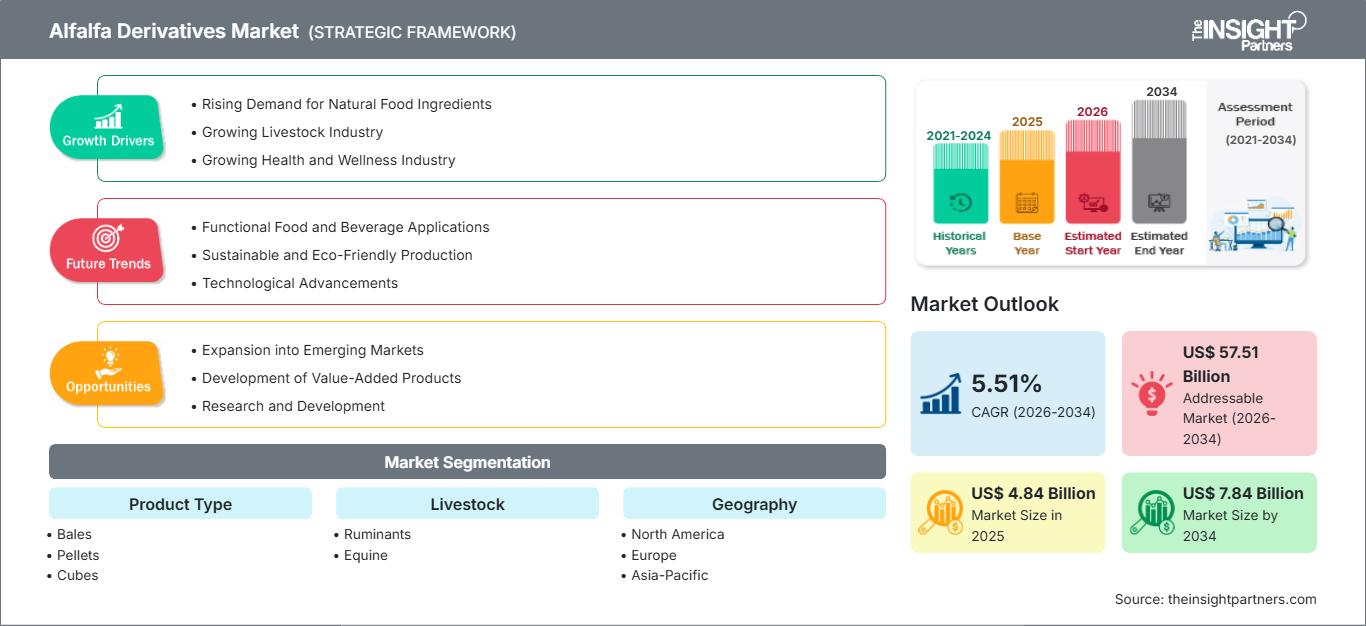
Regional Insights
North America Alfalfa Derivatives Market
North America represents the largest regional contributor, accounting for 36–40% alfalfa derivatives market share in 2025 and expanding at a 4.8–5.6% CAGR through 2034. The region has advantages of cultivation acreages, processing facilities for forage, and application of commercial cattle nutrition programs. The strong presence of the dairy industry in countries like the US and Canada ensures that the consumption of high-quality forage products remains steady.
Further demand from Asia and the Middle East regions adds to the economics of the regional production. An increasing trend towards efficient utilization of feed, precise livestock farming, and controlled nutrition feeding systems also ensures sustained demand in the future. Investments in irrigation management, forage preservation, and quality certification systems will ensure a competitive advantage in the region.
U.S. Alfalfa Derivatives Market
The United States accounts for 78–82% of North American revenue and is projected to grow at a 4.7–5.5% CAGR during the forecast period. Extensive dairy and beef production systems create consistent demand for nutrient-dense forage products. Commercial feed operators increasingly value standardized products capable of supporting herd productivity and operational efficiency.
Major producing states continue benefiting from favorable agricultural ecosystems, advanced harvesting technologies, and well-developed transportation networks. The presence of companies such as Standlee Premium Products LLC, Anderson Hay & Grain Co., and McCracken Hay Company strengthens domestic and export market availability. Premium equine nutrition, specialty livestock feed formulations, and export-focused cultivation remain important growth contributors.
Europe Alfalfa Derivatives Market
Europe accounts for 24–28% of global demand and is expected to expand at a 4.5–5.3% CAGR through 2034. Feed sustainability objectives, traceable livestock production models, and demand for high-quality forage ingredients support market development. Germany remains a leading country due to its advanced dairy sector, feed manufacturing capabilities, and strong focus on livestock productivity.
The UK maintains a stable demand supported by dairy operations and equine nutrition applications, while Germany continues to influence regional procurement trends. France, Italy, and Spain collectively contribute substantial consumption due to established forage cultivation, livestock farming activities, and an increasing focus on premium feed formulations. Regional policies supporting sustainable agriculture and feed quality standards are expected to support long-term growth.
APAC Alfalfa Derivatives Market
Asia Pacific holds 22–26% of global revenue and represents the fastest-expanding major region, advancing at a 6.0–6.8% CAGR. Rising dairy consumption, livestock modernization programs, and increasing emphasis on feed quality contribute to stronger demand across the region.
China remains the leading market, followed by India, Japan, Australia, and South Korea. Expansion of commercial dairy operations, greater feed import activity, and productivity-focused livestock initiatives continue creating opportunities for processed forage providers throughout the forecast period.
Middle East & Africa Alfalfa Derivatives Market
The Middle East and Africa region demonstrates steady expansion with an estimated 5.4–6.2% CAGR through 2034. Demand originates primarily from commercial dairy farms seeking consistent forage quality under challenging climatic conditions.
Saudi Arabia remains the largest regional market, followed by the UAE and South Africa. Investments in food security, agricultural infrastructure, and livestock development programs continue to support imports and utilization of processed alfalfa derivatives across major livestock-producing economies.
Segmentation Analysis
Product Type
The Product Type segment is expected to expand at a 5.5–6.3% CAGR during 2026–2034. The market scope within this segment continues to broaden as livestock producers seek formats that optimize transportation efficiency, storage performance, and nutritional consistency. Product selection often varies according to livestock requirements, handling preferences, feed formulation practices, and supply-chain considerations.
- Bales – Widely utilized across dairy and beef operations due to familiarity, cost-effectiveness, and ease of integration into traditional feeding programs. Strong availability and established distribution networks maintain strategic relevance.
- Pellets – Increasingly preferred in commercial feed systems because of consistent composition, lower wastage, and simplified transportation. Growing use in precision feeding programs supports long-term demand.
- Cubes – Popular among equine operators and specialized livestock managers requiring convenient feeding solutions. Improved handling characteristics and reduced storage challenges strengthen adoption across premium applications.
Livestock
The Livestock segment is projected to record a 5.3–6.1% CAGR through the forecast period. Consumption patterns are influenced by herd size, nutritional requirements, animal productivity goals, and regional livestock economics. Growing focus on animal performance and feed efficiency continues to support demand across major livestock categories.
- Ruminants – Represent the largest consumption category due to significant use in dairy and beef production systems. Nutritional benefits, digestibility characteristics, and protein content support widespread utilization.
- Equine – Demand is supported by premium horse nutrition programs emphasizing quality forage, consistent nutrient profiles, and convenient feeding formats. Specialized product offerings continue to increase market penetration.
Opportunity Snapshot
| Livestock | Revenue Contribution | Trend Tag | Adoption Stage |
| Ruminants | High | Dairy Yield | Mature |
| Equine | Medium | Premium Feed | Scaling |
Alfalfa Derivatives Market Growth Drivers and Impact Analysis
Expansion of Commercial Dairy Production
In commercial dairies, the need for consistent, nutritional quality forage is growing due to its importance in enhancing milk production and overall animal health. Alfalfa-based forage has shown superior properties of protein content, digestibility, and nutrient retention compared to many other traditional forages. Rising consumption of dairy products in developing countries is prompting farmers to consider adopting efficient feeding systems in order to enhance profits. Larger herds and professional management are driving the need for quality feed products. With dairy companies looking to achieve high-quality results, the use of forage-based products is on the rise.
Growing Focus on Feed Conversion Efficiency
Continuous pressures are exerted on livestock farmers to increase productivity levels while controlling the costs of feed. The use of processed alfalfa products helps in improving feed management by providing nutrient levels that are consistent as well as reducing losses from the conventional method of feeding. Cubes and pellets become more favorable since they not only make feed handling and storage easy but also help in the formulation of balanced feeds. Better feed conversion efficiency results in higher profits from dairy cows, beef cattle, and specialty livestock operations. With increasing adoption of data-based feeding strategies, there will be increased demand for forages with consistent quality.
Strengthening Global Forage Trade Networks
International trade has become a critical part of industry growth, linking production sites to livestock that lack sufficient fodder sources. The exporters gain an advantage from rising demand in areas where domestic forage supply is restricted by water deficiency, small acreage for agriculture, or adverse climatic conditions. Better investments have been made in the form of storage, compaction, and logistics that have enhanced export efficiency and stability of goods during transport. Buyers now prefer processed products that can guarantee quality throughout the entire chain. Trade facilities and agreements will promote the growth of the industry.
Alfalfa Derivatives Market Future Trends
Digital Integration Across Forage Supply Chains
The alfalfa derivatives market trends increasingly reflect the adoption of digital technologies across cultivation, harvesting, processing, and distribution activities. Precision agricultural technologies are being adopted by producers in the form of moisture measurement devices and traceability technologies in order to ensure better quality control. Informed decision-making has made it possible for operators to schedule harvest times optimally in order to preserve nutrients. In the coming years, technology integration will help improve transparency and enable premium pricing practices. Increased visibility within the supply chain can assist in responding to changes in export demands.
Rising Adoption of Premium Nutritional Formulations
Specialized nutritional feed formulations will continue to evolve based on animal performance results. High-end feed formulations concentrate on consistency in forage quality and nutrient availability, presenting chances to process alfalfa into value-added products. Increased interest from commercial dairy and equine and niche livestock operations in unique feeding regimens will contribute to growing demand for such products. Collaboration between the feed manufacturers and forage producers may foster innovation and customization of product lineups. As livestock farmers strive to improve animal performance, high-end feed formulations with high-quality forage ingredients will be more commonly accepted.
Alfalfa Derivatives Market Opportunities
Expansion Across Emerging Livestock Economies
The strongest opportunities are emerging in rapidly developing livestock-producing economies where demand for protein-rich animal products continues rising. Increasing urbanization, dietary changes, and commercial farming investments support greater utilization of high-quality feed ingredients. Alfalfa derivatives market Forecasts indicate sustained demand from regions seeking productivity gains in dairy and beef operations. Companies can capitalize through local partnerships, feed-distribution networks, and targeted product portfolios adapted to regional livestock requirements. Strategic investments in warehousing, logistics, and technical support services may further strengthen market penetration. Organizations capable of ensuring supply reliability and nutritional consistency are positioned to benefit from expanding commercial livestock production.
Value-Added Product Development and Branding
Process innovation creates attractive opportunities for manufacturers seeking differentiation. Premium pellets, fortified forage products, and specialized equine nutrition solutions can help suppliers capture higher-margin market segments. Growing producer awareness regarding feed efficiency and animal performance supports willingness to invest in advanced nutritional solutions. Businesses that combine quality assurance programs with traceability capabilities may strengthen customer relationships and brand loyalty. Product development initiatives focused on convenience, storage performance, and nutrient preservation are expected to generate additional revenue streams. Long-term success will increasingly depend on innovation, service quality, and customer-specific nutritional solutions.
Frequently Asked Questions

- Comprehensive Market Sizing and Forecast Analysis
- Detailed Segmentation Analysis
- In-Depth Market Dynamics Assessment
- Regional and Country-Level Insights
- Competitive Landscape and Company Benchmarking
- Strategic Business Intelligence
Recent Reports
Testimonials

The Insight Partners provided valuable market intelligence that supported our global go-to-market strategy. Their team was professional, responsive, and attentive to our feedback, providing thoughtful analysis and helpful methodological clarifications throughout the project.
Junmo Kim Chief Financial Officer (CFO), Enertech Co., Ltd.
The Insight Partners' SCADA System Market report is comprehensive, with valuable insights on current trends and future forecasts. The team was highly professional, responsive, and supportive throughout. We are very satisfied and highly recommend their services.
RAN KEDEM Partner, Reali Technologies LTDs
I requested a report on a very specific software market and the team produced the report in a few days. The information was very relevant and well presented. I then requested some changes and additions to the report. The team was again very responsive and I got the final report in less than a week.
JEAN-HERVE JENN Chairman, Future Analytica
We worked with The Insight Partners for an important market study and forecast. They gave us clear insights into opportunities and risks, which helped shape our plans. Their research was easy to use and based on solid data. It helped us make smart, confident decisions. We highly recommend them.
PIYUSH NAGPAL Sr. Vice President, High Beam Global
The Insight Partners delivered insightful, well-structured market research with strong domain expertise. Their team was professional and responsive throughout. The user-friendly website made accessing industry reports seamless. We highly recommend them for reliable, high-quality research services
YUKIHIKO ADACHI CEO, Deep Blue, LLC.
This is the first time I have purchased a market report from The Insight Partners.While I was unsure at first, I visited their web site and felt more comfortable to take the risk and purchase a market report.I am completely satisfied with the quality of the report and customer service. I had several questions and comments with the initial report, but after a couple of dialogs over email with their analyst I believe I have a report that I can use as input to our strategic planning process.Thank you so much for taking the extra time and making this a positive experience.I will definitely recommend your service to others and you will be my first call when we need further market data.
JOHN SUZUKI President and Chief Executive Officer, Board Director, BK Technologies
I wish to appreciate your support and the professionalism you displayed in the course of attending to my request for information regarding to infectious disease IVD market in Nigeria. I appreciate your patience, your guidance, and the fact that you were willing to offer a discount, which eventually made it possible for us to close a deal. I look forward to engaging The Insight Partners in the future, all thanks to the impression you have created in me as a result of this first encounter.
DR CHIJIOKE ONYIA MANAGING DIRECTOR, PineCrest Healthcare Ltd.Reason to Buy
- Informed Decision-Making
- Understanding Market Dynamics
- Competitive Analysis
- Identifying Emerging Markets
- Customer Insights
- Market Forecasts
- Risk Mitigation
- Boosting Operational Efficiency
- Strategic Planning
- Investment Justification
- Tracking Industry Innovations
- Aligning with Regulatory Trends





 Get Free Sample for