
Algae Oil Market Growth, Share & Trends by 2034
Coverage: By Grade (Fuel, Food, Feed); Application (Biofuel, Dietary Supplement, Food and Beverage, Animal Feed), and Geography (North America, Europe, Asia Pacific, and South and Central America)
- Status : Data Released
- Report Code : TIPRE00018439
- Category : Food and Beverages
- No. of Pages : 150
- Available Report Formats :


- Last update date : August 19, 2026


2025 Market Size
US$ 2.85 Bn
Base year value
2034 Forecast
US$ 4.07 Bn
Projected by 2034
CAGR 2026-2034
4.04 %
Growth rate
Addressable Market
US$ 31.43 Bn
(2026-2034)
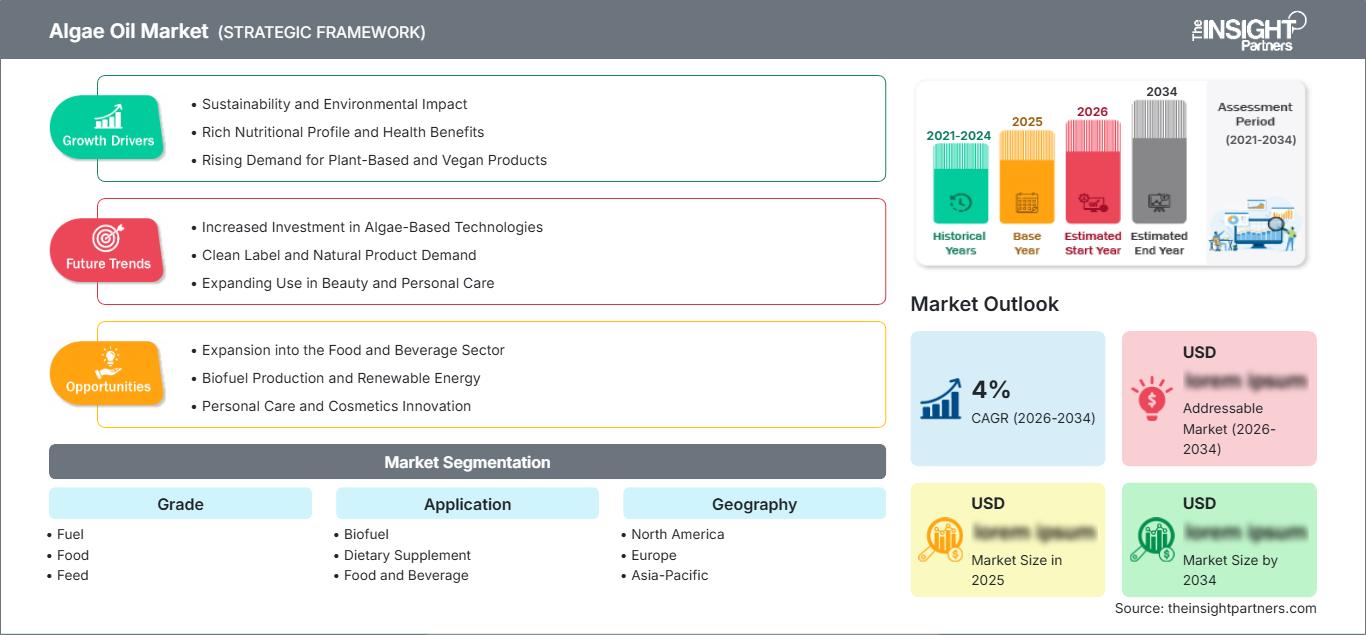
The Algae oil market was valued at US$ 2.85 Billion in 2025 and is projected to reach US$ 4.07 Billion by 2034, advancing at a CAGR of 4.04% during 2026–2034. Expansion is supported by rising demand for sustainable lipid ingredients, wider adoption of algae-derived omega-3 formulations, and increasing commercial use across dietary supplements, food products, biofuels, and animal nutrition applications.
Across North America, commercial microalgae cultivation infrastructure, growing vegan nutrition demand, and investments in low-carbon feedstocks continue to support industry development. The algae oil market size in the region benefits from demand for EPA and DHA alternatives to fish-derived ingredients, while regulatory support for renewable fuels and sustainable nutrition ingredients is expected to sustain regional growth at an estimated CAGR of 3.8–4.4% through 2034.
Algae Oil Market Assessment and Insights
- North America: Share in 2025 estimated at 33–37%, supported by dietary supplement demand, renewable fuel initiatives, and established biotechnology capacity. CAGR between 2026–2034: 3.8–4.4%.
- US: Represents 72–76% of North American demand in 2025, driven by nutraceutical consumption and innovation activity. CAGR between 2026–2034: 3.9–4.5%.
- Europe: Share in 2025 estimated at 28–32%, led by Germany, the UK, France, and the Netherlands. Sustainability regulations and alternative protein strategies support a CAGR of 3.7–4.3%.
- Asia Pacific: Share in 2025 estimated at 24–28%, with China, Japan, South Korea, India, and Australia driving expansion. CAGR between 2026–2034: 4.6–5.2%.
- Largest Segment: Food grade maintains a 52–56% market share in 2025 due to omega-3 enrichment and functional food demand. CAGR between 2026–2034: 3.8–4.4%.
- High Growth Segment: Dietary Supplement application holds 28–32% share in 2025 and records a CAGR of 5.0–5.6% through 2034.
- Key companies analyzed in detail: Alltech, Inc.; Bioprocess Algae LLC; Cargill, Incorporated; Cellana LLC; Cyanotech Corporation; DIC Corporation; Diversified Energy Corporation; DSM-Firmenich (Royal DSM N.V. legacy business); Seaweed Energy Solutions AS; TerraVia Holdings, Inc.
Source: The Insight Partners' analysis based on proprietary research, government publications, company annual reports, investor presentations, industry databases, and expert interviews.
Driven by advances in fermentation platforms and controlled cultivation systems, the algae oil market has evolved from a niche nutritional ingredient segment into a broader commercial ecosystem serving food, feed, and energy industries. Efficiency in extraction, strain improvement, and scaling up has reduced limitations that once impeded growth in this segment. Increasing worries about the burden on marine resources have resulted in a renewed interest in alternative sources of lipids from algae, especially those used for the production of EPA and DHA.
In the future, companies operating in this sector are likely to make investments in regions like Asia Pacific and the Middle East, which are showing an inclination towards bio-production and food security projects. Sustainability, development in renewable biomass feedstock, and acceptance by consumers of plant-based nutrients are likely to provide opportunities for future commercialization.
Algae Oil Market Report Scope
| Report Attribute | Details |
|---|---|
| Market size in 2025 | US$ 2.85 Billion |
| Market Size by 2034 | US$ 4.07 Billion |
| Global CAGR (2026 - 2034) | 4.04% |
| Historical Data | 2021-2024 |
| Forecast period | 2026-2034 |
Algae Oil Market Analysis
The algae oil market is witnessing consistent growth, supported by increasing demand for plant-based omega-3 ingredients and sustainable alternatives to conventional fish-derived oils. There is growing consciousness about health and the environment among consumers, which makes algae-based products even more attractive for manufacturers of dietary supplements and foods. Traceability, purity, and security of the supply chain add to the attractiveness of the product in all sectors of the nutrition, food, and specialty ingredients market.
The value chain of this sector includes microalgae cultivation, harvesting, extraction, purification, and formulation. Recent technological breakthroughs in fermentation techniques, closed system cultivation, and feedstock optimization have enabled higher lipid output and lower production cost.
Despite the increasing competition, the industry is fairly consolidated, with large firms like Cargill, Incorporated, DIC Corporation, Cyanotech Corporation, Cellana LLC, and DSM-Firmenich prioritizing technology advancement, partnerships, and portfolio growth. Numerous players in the market have been developing their businesses by leveraging specialty nutrition, sustainability, and vertical integration.
Investments continue to increase due to the use of scalable fermentation, carbon-efficient manufacturing, and new bio-based components. Companies such as Alltech, Inc., Bioprocess Algae LLC, and Seaweed Energy Solutions AS have been making investments in research and development in order to improve production and application economics. Future competitiveness will largely rely on technology advancement, compliance with regulatory requirements, robustness of the supply chain, and meeting the rising demands for algae-based products.
● REPORT CUSTOMIZATION
Tailor This Report To Align With Your Specific Business Requirements
This report can be customized to align precisely with your business objectives, scope, and target markets. Customization options include tailored segmentation, geography, competitive analysis, and strategic insights to support informed decision-making.
Customize This Report →WHAT YOU CAN ADJUST
- ● Segmentations
- ● Geography
- ● Competitive Analysis
- ● Language Preferences
Algae Oil Market: Strategic Insights
Regional Insights
North America Algae Oil Market
North America accounted for an estimated 33–37% algae oil market share in 2025 and is anticipated to expand at a CAGR of 3.8–4.4% through 2034. The high demand for omega-3 supplements, alternative protein sources, and renewable fuel stock feedstock provides the region with performance opportunities. The presence of biotechnology facilities and commercialization activities continues to bring investments into the region.
The regulatory backing of lower carbon fuels and sustainable food systems makes the prospects for the region even stronger. Increasing consumer acceptance of plant-based nutrition products and rising consciousness about marine ecosystem preservation is also aiding the adoption in the food, dietary supplements, and feed markets.
U.S. Algae Oil Market
The United States represents approximately 72–76% of North American demand in 2025 and is expected to record a CAGR of 3.9–4.5%. The country benefits from advanced biotechnology capabilities, strong nutraceutical consumption patterns, and significant research activity across algae-derived ingredients.
Leading industry participants maintain production, formulation, and commercialization activities within the country. Applications are expanding across dietary supplements, functional beverages, fortified foods, and renewable fuel initiatives. Consumer demand for plant-based omega-3 solutions and sustainable sourcing continues to support long-term development prospects.
Europe Algae Oil Market
Europe held approximately 28–32% share in 2025 and is expected to grow at a CAGR of 3.7–4.3%. Germany remains the leading national market due to strong biotechnology capabilities and growing demand for sustainable nutrition ingredients. The UK benefits from innovation activity focused on alternative food systems and specialty nutrition products.
France, Italy, and Spain increasingly support adoption through food innovation programs, sustainability initiatives, and evolving consumer preferences toward plant-derived ingredients. Regulatory emphasis on environmental performance and circular bioeconomy objectives continues to encourage investment across the regional value chain while supporting commercial uptake.
APAC Algae Oil Market
Asia Pacific accounted for an estimated 24% to 28% share of the global algae oil market in 2025 and is projected to expand at a CAGR of 4.6% to 5.2% through 2034, making it the fastest-growing regional market. China remains the leading contributor due to its strong biotechnology manufacturing base, growing demand for nutritional ingredients, and expanding dietary supplement industry. Countries such as Japan, South Korea, India, and Australia are also increasing investments in sustainable food ingredients, aquaculture nutrition, and bio-based technologies. Government support for food security, industrial biotechnology, and innovation is expected to further accelerate algae oil commercialization across the region.
Middle East & Africa Algae Oil Market
The Middle East & Africa market remains comparatively smaller but is expected to grow steadily at a CAGR of 4.1% to 4.7% during the forecast period. Growth is supported by increasing investments in biotechnology, sustainable agriculture, and food security initiatives across key markets. Saudi Arabia and the UAE are actively promoting alternative food production solutions and resource-efficient technologies, creating opportunities for algae-derived products. Meanwhile, South Africa and other regional economies are witnessing rising interest in sustainable feed ingredients and nutritional products, supporting gradual market expansion and long-term industry development.
Segmentation Analysis
Grade
The Grade segment reflects varying product specifications tailored to food, feed, and fuel applications, with demand patterns influenced by performance requirements, regulatory standards, and end-use industry needs. The segment is projected to register a CAGR of 3.9% to 4.5% from 2026 to 2034. Expanding applications in nutrition, animal feed, and renewable energy continue to broaden the market scope, encouraging manufacturers to develop specialized grades that address sustainability goals, quality expectations, and evolving consumer preferences.
- Food: Largest category, supported by omega-3 fortification trends, vegan product launches, and growing demand for traceable nutritional ingredients across supplements and functional foods. Rising consumer awareness regarding heart, brain, and eye health is further driving adoption. Food-grade algae oil is increasingly utilized in infant formula, nutritional beverages, plant-based products, and dietary supplements due to its purity, sustainability, and consistent omega-3 content.
- Feed: Increasingly utilized in aquaculture and livestock nutrition to improve fatty acid profiles while reducing dependence on marine-sourced alternatives. Feed-grade algae oil supports animal health, growth performance, and nutritional value while helping producers achieve sustainability objectives. Growing pressure to reduce reliance on wild fish resources is encouraging wider adoption across commercial feed formulations.
- Fuel: Strategic segment supported by renewable fuel research, carbon reduction targets, and interest in advanced bio-based feedstocks. Algae oil offers potential advantages as a sustainable raw material for biodiesel and other biofuel applications due to its high lipid content and scalability potential. Continued investments in biofuel technology and decarbonization initiatives are expected to support long-term growth opportunities within this segment.
Application
Application-based demand is projected to advance at a CAGR of 4.2–4.8% through 2034. Adoption patterns vary according to nutritional value, sustainability benefits, and commercial economics, with demand increasingly concentrated around health-focused and environmentally responsible products.
- Biofuel: Utilized in advanced renewable fuel development where algae-derived lipids offer sustainable feedstock potential for long-term decarbonization strategies.
- Dietary Supplement: Fastest-expanding application due to growing consumer awareness of EPA and DHA benefits and demand for plant-based nutrition solutions.
- Food and Beverage: Broadening use in fortified beverages, dairy alternatives, bakery products, and functional nutrition offerings.
- Animal Feed: Gains traction through aquaculture and livestock nutrition programs seeking sustainable lipid enrichment solutions.
Opportunity Snapshot
| Application | Revenue Contribution | Trend Tag | Adoption Stage |
| Biofuel | Medium | Renewable Diesel | Emerging |
| Dietary Supplement | High | Vegan Omega | Mature |
| Food and Beverage | High | Functional Foods | Scaling |
| Animal Feed | Medium | Aquaculture Lipids | Scaling |
Algae Oil Market Growth Drivers and Impact Analysis
Expansion of Plant-Based Omega-3 Consumption
The growing popularity of vegetarian and vegan dietary supplements among consumers has resulted in an increased demand for algae omega-3 oils. This product provides a sustainable source of EPA and DHA fatty acids without the issues of overfishing, pollution of the marine environment, and instability of the fish oil supply chain. In addition, the rising interest in prevention and functional nutrition makes people prefer algae-based supplements in their food and beverages. This leads to an expansion of production capacities and the development of algae-based dietary formulas by food producers.
Advancements in Fermentation and Cultivation Technologies
Through continuous advancement in the technology of fermentation process, strain improvement and cultivation techniques, the economic feasibility of producing algae oil is becoming more attainable. New techniques have been developed that increase lipid productivity, improve the purity of the oil and make production more efficient while at the same time minimizing the reliance on environmental conditions. New techniques of harvesting and extraction have also helped in bringing down the costs of production. This helps in scaling up production more efficiently and competing more effectively with traditional omega-3 oils and other vegetable oils.
Growing Sustainability and Decarbonization Initiatives
The growing importance of sustainability and reduction in carbon emissions is making a favorable environment for market growth. Sustainability and environmentally friendly products have been given priority by the government and organizations, and consumers are being encouraged to use renewable and biological sources of production. Production of algae uses fewer natural resources compared to traditional oils and is beneficial for the environment because of their efficient use of land and water. Being consistent with the philosophy of circular economy and sustainable sourcing practices, algae oil becomes an attractive source for several applications.
Algae Oil Market Future Trends
Integration into Functional Nutrition Platforms
The algae oil market trends are increasingly moving toward functional nutrition solutions that address multiple health objectives within a single product. Algae-based omega-3 components have been included by manufacturers in the form of supplements, nutritionally enhanced foods, beverages, and functional nutrition products that cater to cardiovascular, brain, immunity and healthy aging needs. The rising interest among consumers in preventive healthcare and nutrition is leading to the innovation of unique blends with algae oil, along with other nutritional ingredients such as vitamins, probiotics, proteins, etc.
Commercial Scaling of Precision Fermentation
Precision fermentation is anticipated to have a revolutionary impact on the future development of the market through efficiency and scalability of production. Through developments in bioprocess engineering, strain improvement, and automation of manufacturing systems, producers can produce greater yields of higher quality. Such innovations lower dependency on conventional production processes and increase the efficiency and reliability of production. With continued cost reductions, precision fermentation will likely facilitate increased usage of algae oil in dietary supplements, animal nutrition, food applications, and industry applications.
Algae Oil Market Opportunities
Expansion Across Emerging Asian Markets
Emerging Asian economies are creating significant growth opportunities for the market due to rising disposable incomes, increasing health awareness, and growing demand for sustainable nutritional products. Countries such as China, India, Japan, and South Korea are investing in biotechnology innovation and alternative food ingredient development to enhance food security and reduce reliance on imported raw materials. Expanding urban populations and growing consumption of dietary supplements are further supporting demand for algae-derived omega-3 products. Strategic partnerships, regional production facilities, and distribution network expansion are expected to help market participants strengthen their presence and capture long-term growth opportunities across the region.
Development of Sustainable Feed Solutions
The growing need for sustainable feed ingredients presents a major opportunity for algae oil producers, particularly in aquaculture and livestock nutrition. As the feed industry seeks alternatives to fish oil and other marine-derived ingredients, algae oil offers a renewable and environmentally responsible source of essential fatty acids. Its use can support animal health, growth performance, and nutritional quality while reducing pressure on marine ecosystems. Increasing sustainability commitments among food producers and animal nutrition companies are expected to encourage wider adoption of algae-based feed solutions. Suppliers that can deliver consistent quality, competitive pricing, and reliable large-scale production are likely to gain a strong competitive advantage in this expanding market segment.
Frequently Asked Questions

- Comprehensive Market Sizing and Forecast Analysis
- Detailed Segmentation Analysis
- In-Depth Market Dynamics Assessment
- Regional and Country-Level Insights
- Competitive Landscape and Company Benchmarking
- Strategic Business Intelligence
Recent Reports
Testimonials

The Insight Partners' SCADA System Market report is comprehensive, with valuable insights on current trends and future forecasts. The team was highly professional, responsive, and supportive throughout. We are very satisfied and highly recommend their services.
RAN KEDEM Partner, Reali Technologies LTDs
I requested a report on a very specific software market and the team produced the report in a few days. The information was very relevant and well presented. I then requested some changes and additions to the report. The team was again very responsive and I got the final report in less than a week.
JEAN-HERVE JENN Chairman, Future Analytica
We worked with The Insight Partners for an important market study and forecast. They gave us clear insights into opportunities and risks, which helped shape our plans. Their research was easy to use and based on solid data. It helped us make smart, confident decisions. We highly recommend them.
PIYUSH NAGPAL Sr. Vice President, High Beam Global
The Insight Partners delivered insightful, well-structured market research with strong domain expertise. Their team was professional and responsive throughout. The user-friendly website made accessing industry reports seamless. We highly recommend them for reliable, high-quality research services
YUKIHIKO ADACHI CEO, Deep Blue, LLC.
This is the first time I have purchased a market report from The Insight Partners.While I was unsure at first, I visited their web site and felt more comfortable to take the risk and purchase a market report.I am completely satisfied with the quality of the report and customer service. I had several questions and comments with the initial report, but after a couple of dialogs over email with their analyst I believe I have a report that I can use as input to our strategic planning process.Thank you so much for taking the extra time and making this a positive experience.I will definitely recommend your service to others and you will be my first call when we need further market data.
JOHN SUZUKI President and Chief Executive Officer, Board Director, BK Technologies
I wish to appreciate your support and the professionalism you displayed in the course of attending to my request for information regarding to infectious disease IVD market in Nigeria. I appreciate your patience, your guidance, and the fact that you were willing to offer a discount, which eventually made it possible for us to close a deal. I look forward to engaging The Insight Partners in the future, all thanks to the impression you have created in me as a result of this first encounter.
DR CHIJIOKE ONYIA MANAGING DIRECTOR, PineCrest Healthcare Ltd.Reason to Buy
- Informed Decision-Making
- Understanding Market Dynamics
- Competitive Analysis
- Identifying Emerging Markets
- Customer Insights
- Market Forecasts
- Risk Mitigation
- Boosting Operational Efficiency
- Strategic Planning
- Investment Justification
- Tracking Industry Innovations
- Aligning with Regulatory Trends





 Get Free Sample for