
Algae Omega 3 Market Growth, Trends & Forecast by 2034
Coverage: By Type (ALA, EPA, and DHA); Form (Powder, Capsule, Liquid); Concentration (High Concentrated, and Low Concentrated); Application (Food and Beverages, Dietary Supplements, Pharmaceuticals, and Animal Nutrition, and Others), and Geography (North America, Europe, Asia Pacific, and South and Central America)
- Status : Data Released
- Report Code : TIPRE00020820
- Category : Food and Beverages
- No. of Pages : 150
- Available Report Formats :


- Last update date : August 19, 2026


2025 Market Size
US$ 2.06 Bn
Base year value
2034 Forecast
US$ 4.45 Bn
Projected by 2034
CAGR 2026-2034
8.92 %
Growth rate
Addressable Market
US$ 29.12 Bn
(2026-2034)
The algae omega 3 market was valued at US$ 2.06 Billion in 2025 and is projected to reach US$ 4.45 Billion by 2034, growing at a CAGR of 8.92% during 2026–2034. Demand is supported by plant-based nutrition, clean-label supplementation, sustainable DHA and EPA sourcing, and wider use in food and beverages, dietary supplements, pharmaceuticals, and animal nutrition.
North America remains a priority demand center as supplement penetration, vegan nutrition adoption, infant nutrition standards, and premium pet nutrition continue to support algae omega 3 market size expansion. Regional growth is estimated in the 8.3–9.1% CAGR range through 2034, with the U.S. accounting for the largest share of North American revenue due to established nutraceutical channels and advanced formulation capacity.
Algae Omega 3 Market Assessment and Insights
- North America held an estimated 38–42% share in 2025 and is expected to grow at an 8.3–9.1% CAGR between 2026–2034, supported by supplement maturity and fish-oil substitution.
- U.S. represented 78–82% of North America in 2025 and is projected to grow at an 8.1–8.8% CAGR through 2034, led by dietary supplements and fortified foods.
- Europe accounted for 27–31% share in 2025 and is forecast to grow at an 8.0–8.7% CAGR, led by Germany, the UK, France, Italy, and Spain.
- Asia Pacific held 22–26% share in 2025 and is expected to expand at a 9.6–10.5% CAGR, driven by China, Japan, India, South Korea, and Australia.
- Largest Segment DHA represented 54–59% share in 2025 and is projected to grow at an 8.4–9.2% CAGR, supported by infant nutrition and cognitive health positioning.
- High-Growth Segment animal nutrition represented 13–17% share in 2025 and is projected to grow at a 10.2–11.4% CAGR as aquafeed and premium pet nutrition shift toward sustainable oils.
- Key companies analyzed in detail: Archer Daniels Midland Company, Cellana Inc., Nordic Naturals, AlgiSys LLC, Solarvest BioEnergy Inc., Novotech Nutraceuticals Inc., dsm-firmenich, Corbion N.V., Polaris, BASF SE, Source Omega LLC, Neptune Wellness Solutions Inc., AlgaeCytes Limited, BioProcess Algae LLC, TerraVia Holdings Inc., Qualitas Health, NovoSana, and Photonz Corporation.
Source: The Insight Partners' analysis based on proprietary research, government publications, company annual reports, investor presentations, industry databases, and expert interviews.
Production economics have moved from niche cultivation toward scalable fermentation, improved strain selection, and higher purity extraction. The algae omega 3 market growth profile is increasingly shaped by producers that can deliver consistent DHA and EPA concentration, oxidation stability, traceability, and price discipline. This evolution allows ingredient suppliers to serve infant formula, capsules, powders, beverages, and animal nutrition without relying on marine fishery volatility.
Future momentum is expected to come from Asia Pacific localization, European sustainability regulation, and North American preventive health spending. The algae omega 3 market is also gaining relevance as brands seek alternatives to anchovy-derived oils affected by ocean temperature shifts and fisheries variability. Investment is likely to focus on fermentation yield, encapsulation, powder stability, and application-specific blends.
Algae Omega 3 Market Report Scope
| Report Attribute | Details |
|---|---|
| Market size in 2025 | US$ 2.06 Billion |
| Market Size by 2034 | US$ 4.45 Billion |
| Global CAGR (2026 - 2034) | 8.92% |
| Historical Data | 2021-2024 |
| Forecast period | 2026-2034 |
Algae Omega 3 Market Analysis
Algae omega 3 market growth is supported by consumers seeking vegetarian DHA and EPA without marine contaminants, fish allergens, or sustainability concerns. Supplement manufacturers are utilizing algae oils to market their products for heart health, cognitive support, vision, prenatal care, and aging, while food and beverage product developers are relying on powdered and microencapsulated algae ingredients, which provide better taste masking and stability.
Supply trends are moving towards controlled fermentation due to the consistent quality factor and less reliance on wild fisheries as a raw material source. Buyers are now looking at factors like carbon footprint, non-GMO claims, certifications, sensory evaluation, and regulation in the global marketplace.
Competitive positioning in algae omega 3 market analysis is led by established nutrition companies and specialist algae innovators. dsm-firmenich, Corbion N.V., BASF SE, Archer Daniels Midland Company, Nordic Naturals, Cellana Inc., AlgiSys LLC, and Qualitas Health compete on purity, application breadth, fermentation scale, and branded ingredient credibility rather than volume alone.
The trend in investments is towards heavy oil, EPA, powder technology, and regional manufacturing opportunities. The vertically integrated companies that offer support in cultivation, processing, and formulation are well-positioned to benefit from premium demands. Small specialized firms still have their place when they bring proprietary strains, sustainability, or animal/aquatic nutrition products to the market.
● REPORT CUSTOMIZATION
Tailor This Report To Align With Your Specific Business Requirements
This report can be customized to align precisely with your business objectives, scope, and target markets. Customization options include tailored segmentation, geography, competitive analysis, and strategic insights to support informed decision-making.
Customize This Report →WHAT YOU CAN ADJUST
- ● Segmentations
- ● Geography
- ● Competitive Analysis
- ● Language Preferences
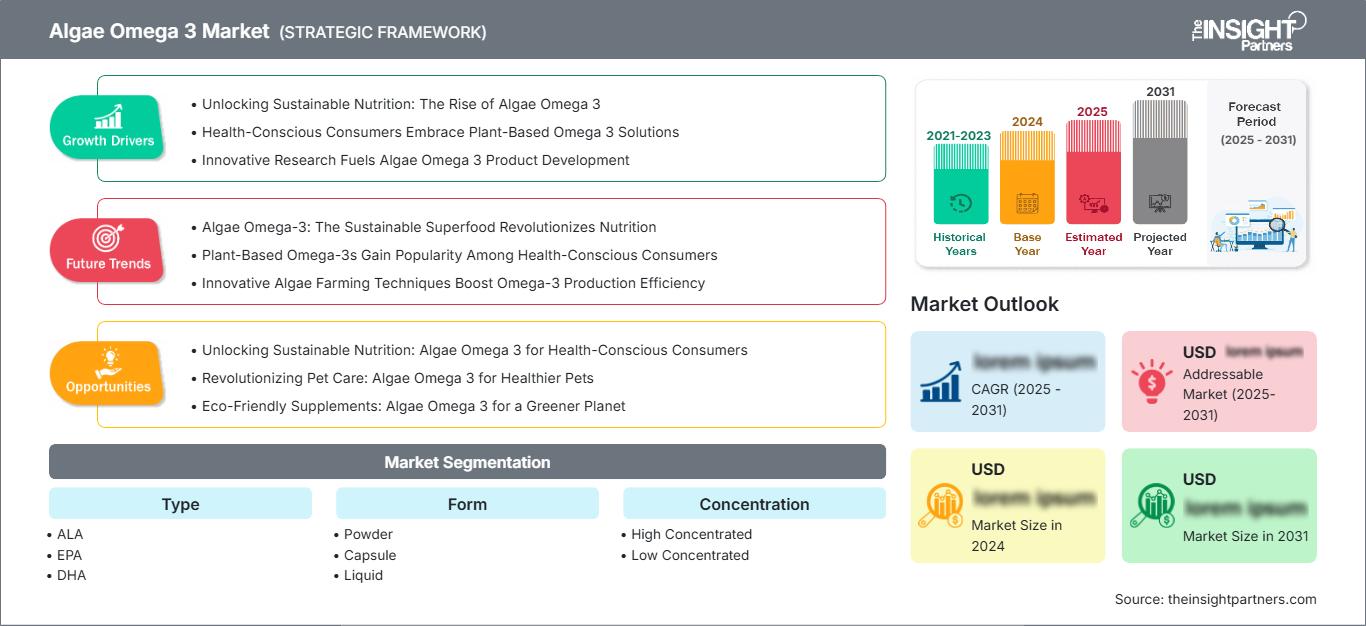
Algae Omega 3 Market: Strategic Insights
Regional Insights
North America algae omega 3 market
North America held an estimated 38–42% algae omega 3 market share in 2025 and is expected to grow at an 8.3–9.1% CAGR during 2026–2034. Dietary supplements, vegan softgels, prenatal nutrition, infant formula, and high-end pet foods drive demand. This region offers advantages through an existing consumer consciousness and well-established sales channels.
There is an increasing interest in traceability of, as well as omega-3, that does not contain any fish. Companies producing ingredients with an existing sales infrastructure in the U.S., along with their regulatory and formulation expertise, will be able to supply these capsules, gummies, powders, and drinks.
U.S. algae omega 3 Market
The U.S. accounted for 78–82% of North America in 2025 and is forecast to expand at an 8.1–8.8% CAGR. High-quality consumption of supplements, adoption of plant-based nutrition, and the high end of wellness are factors that favor acceptance of algae-based DHA and EPA in adult, prenatal, and child nutrition categories.
Demand for algae-based DHA and EPA in the U.S. market is influenced by supplement brands desiring to differentiate themselves based on their claims of being vegan and sustainable. Formulations of capsules, liquids, powders, and functional foods have been identified as future trends.
Europe algae omega 3 Market
Europe represented 27–31% share in 2025 and is expected to grow at an 8.0–8.7% CAGR. Germany and the UK lead demand through supplement retail, clean-label nutrition, and sustainability-led purchasing. France, Italy, and Spain add growth through fortified foods, pediatric nutrition, and pharmacy-led wellness channels.
The region benefits from regulatory focus on nutrition quality and environmental sourcing, which supports algae-derived alternatives to marine oils. European buyers often prioritize traceability, purity, and documented sustainability. DSM-Firmenich, Corbion N.V., BASF SE, and AlgaeCytes Limited strengthen the regional ecosystem through ingredient development and commercialization expertise.
APAC algae omega 3 Market
APAC held 22–26% share in 2025 and is projected to grow at a 9.6–10.5% CAGR. China, Japan, South Korea, India, and Australia support demand through infant nutrition, dietary supplements, functional beverages, and expanding preventive health spending.
China is the leading growth engine because of the infant nutrition scale and rising middle-income demand for premium ingredients. Japan and South Korea favor high-purity functional products, while India and Australia support vegetarian and clean-label supplementation. Local manufacturing and regulatory approvals will influence the speed of adoption.
Middle East & Africa algae omega 3 Market
Middle East & Africa is projected to grow at a 7.2–8.0% CAGR through 2034. Saudi Arabia, the UAE, and South Africa show early adoption in supplements, fortified foods, and premium nutrition, supported by urban wellness spending and pharmacy distribution.
Regional growth remains smaller than other markets but is strategically relevant for imported nutraceutical brands and halal-friendly vegetarian formulations. The UAE is likely to lead premium demand, while South Africa supports broader supplement distribution. Infrastructure and consumer education will determine market depth.
Segmentation Analysis
Type
Type is projected to grow at an 8.7–9.5% CAGR during 2026–2034 as brands differentiate products through DHA, EPA, and ALA positioning. The algae omega 3 market scope is strongest for DHA because of infant, brain, and eye health applications, while EPA demand is rising in cardiovascular and inflammation-related formulations.
- ALA supports plant-based omega positioning but remains less dominant than long-chain DHA and EPA because conversion efficiency limits premium clinical claims.
- EPA is gaining strategic importance as fermentation improvements increase availability for cardiovascular, inflammation, and sports nutrition formulations.
- DHA remains the largest sub-segment due to infant formula, prenatal nutrition, cognitive health supplements, and established consumer awareness.
Form
Form is expected to expand at an 8.5–9.3% CAGR as brands balance dosage precision, sensory performance, and convenience. Capsules dominate supplement usage, liquids support infant and personalized nutrition, and powders are gaining importance in functional foods, beverages, and animal nutrition applications.
- Powder enables use in fortified beverages, sachets, gummies, bakery mixes, and feed premixes where stability and dispersibility are critical.
- Capsule remains the preferred consumer format because it protects oil quality, supports dosage control, and fits established supplement retail channels.
- Liquid is important for infant nutrition, clinical formulations, and customized supplement routines requiring flexible dosing and blendability.
Concentration
Concentration is forecast to grow at an 8.6–9.4% CAGR as customers seek products matched to dosage, claim strength, and price point. High-concentration oils serve premium supplements and pharmaceutical-adjacent nutrition, while low-concentration formats remain important for food enrichment and broader affordability.
- High Concentrated products support smaller serving sizes, stronger label claims, and premium positioning in prenatal, cognitive, and cardiovascular supplements.
- Low Concentrated products address value-focused applications where broader inclusion, cost control, and functional fortification are more important than maximum potency.
Application
Application is projected to grow at an 8.8–9.6% CAGR, led by dietary supplements and expanding animal nutrition use. Dietary supplements provide the largest revenue contribution, while food and beverages increase visibility. Pharmaceuticals and animal nutrition add specialized demand for purity, consistency, and sustainable sourcing.
- Food and Beverages use algae omega-3 in fortified drinks, dairy alternatives, bars, and functional foods, where taste masking and shelf stability determine adoption.
- Dietary Supplements remain the largest application because capsules, gummies, and liquids meet preventive health demand across adult, prenatal, and senior consumers.
- Pharmaceuticals require high purity, documentation, and consistent fatty acid profiles, supporting premium demand but with longer qualification timelines.
- Animal Nutrition is the fastest-growing application as aquafeed, pet food, and livestock nutrition brands reduce reliance on marine oils.
Opportunity Snapshot
| Application | Revenue Contribution | Trend Tag | Adoption Stage |
| Food and Beverages | Medium | Fortified Drinks | Scaling |
| Dietary Supplements | High | Vegan Softgels | Mature |
| Pharmaceuticals | Medium | Clinical Purity | Scaling |
| Animal Nutrition | Medium | Aquafeed Oils | Emerging |
Algae Omega 3 Market Growth Drivers and Impact Analysis
Sustainable Replacement for Marine-Derived Oils
Supply chain pressure on fish oil has made algae-derived DHA and EPA more strategically important for food, supplement, and feed companies. According to the Algae Omega 3 Market Report, algae cultivation provides controlled production, reduced exposure to marine contaminants, and a direct source of omega-3 fatty acids without the need for fish harvesting. This trend is becoming more and more important for purchasing decisions because the companies want to make their product sustainability more legitimate and also need supply chain visibility and ingredient consistency. Moreover, the algae omega-3 sources minimize the impact of the risk related to fisheries fluctuations, anchovy supply shortages and ocean temperature variations.
Expansion of Vegan and Preventive Nutrition Formats
Demand from consumers for products like vegan softgels, gummies, powders, and fortified foods is increasing the market opportunity for omega-3 ingredients derived from algae. This trend is particularly evident amongst those who purchase prenatal supplements, as well as health-conscious adults looking for products containing DHA and EPA that do not have fish-related problems. It opens up avenues for brands marketing algae oils as premium, clean-label, and science-based ingredients.
Fermentation Scale-Up and Formulation Innovation
Improvements in heterotrophic fermentation, strain development, encapsulation, and oxidation control are leading to greater cost effectiveness and greater versatility. This means that suppliers are able to produce high-concentration oils, stable powders, and formulations that are suitable for beverages, capsules, infant formulas, and animal feed. The results can be seen in the form of improved yields, which reduce the risk of manufacturing, and improved sensory quality, which allows the use of omega-3 in regular food items.
Algae Omega 3 Market Future Trends
EPA-Rich Algal Strain Development
Algae omega 3 market trends are moving beyond DHA dominance toward EPA-rich and balanced DHA-EPA ingredient systems. In the past, omega-3 commercialization via algae was focused on DHA due to higher strain yields and infant nutrition needs. However, innovations in fermentation, metabolic engineering, and downstream concentrations have increased the availability of EPA. Such a development will facilitate the development of products for cardiovascular health, sports nutrition, and inflammation with distinct EPA branding. Suppliers who will provide scalable EPA with documentation, sensory stability, and competitive pricing will be well positioned in serving premium consumers.
Microencapsulated Powders for Mainstream Foods
Powdered forms are expected to become more popular among food and beverage companies looking for a neutral-tasting source of omega-3s that will not spoil easily. Microencapsulation protects oils from oxidation, improves dispersibility, and allows the use of oils in drinks, baking mixes, bars, dairy substitutes, and nutritional powders. This may increase consumer usage beyond capsule form consumers and increase household usage. The business challenge will be providing the right taste, dose, affordability, and simple labeling while having verified DHA and EPA levels.
Algae Omega 3 Market Opportunities
Premium Animal Nutrition and Aquafeed Substitution
Algae omega 3 market Forecasts indicate strong upside in aquafeed, pet food, and specialty livestock nutrition as producers reduce dependence on fish oil while maintaining DHA and EPA content. Salmon farming, premium pet diets, and functional feed programs require reliable omega-3 inputs that can support animal health and consumer-facing sustainability claims. Ingredient suppliers can capture value by offering feed-grade oils, premixes, and documentation for traceability. Partnerships with aquaculture and pet nutrition brands may accelerate adoption.
Regional Manufacturing Partnerships in Asia Pacific
There is an interesting business case with Asia Pacific, where there is an increasing need for infant nutrition, functional beverages, and supplements, as well as increased ambition to produce them locally. Companies forming strategic alliances for manufacturing, distribution, or formulation in China, India, Japan, South Korea, and Australia may save on logistical expenses and have increased responsiveness to regulations. Production localized at the destination market makes it possible to quickly develop products of vegetarian, premium and pediatric nutrition segments.
Frequently Asked Questions

- Comprehensive Market Sizing and Forecast Analysis
- Detailed Segmentation Analysis
- In-Depth Market Dynamics Assessment
- Regional and Country-Level Insights
- Competitive Landscape and Company Benchmarking
- Strategic Business Intelligence
Recent Reports
Testimonials

The Insight Partners provided valuable market intelligence that supported our global go-to-market strategy. Their team was professional, responsive, and attentive to our feedback, providing thoughtful analysis and helpful methodological clarifications throughout the project.
Junmo Kim Chief Financial Officer (CFO), Enertech Co., Ltd.
The Insight Partners' SCADA System Market report is comprehensive, with valuable insights on current trends and future forecasts. The team was highly professional, responsive, and supportive throughout. We are very satisfied and highly recommend their services.
RAN KEDEM Partner, Reali Technologies LTDs
I requested a report on a very specific software market and the team produced the report in a few days. The information was very relevant and well presented. I then requested some changes and additions to the report. The team was again very responsive and I got the final report in less than a week.
JEAN-HERVE JENN Chairman, Future Analytica
We worked with The Insight Partners for an important market study and forecast. They gave us clear insights into opportunities and risks, which helped shape our plans. Their research was easy to use and based on solid data. It helped us make smart, confident decisions. We highly recommend them.
PIYUSH NAGPAL Sr. Vice President, High Beam Global
The Insight Partners delivered insightful, well-structured market research with strong domain expertise. Their team was professional and responsive throughout. The user-friendly website made accessing industry reports seamless. We highly recommend them for reliable, high-quality research services
YUKIHIKO ADACHI CEO, Deep Blue, LLC.
This is the first time I have purchased a market report from The Insight Partners.While I was unsure at first, I visited their web site and felt more comfortable to take the risk and purchase a market report.I am completely satisfied with the quality of the report and customer service. I had several questions and comments with the initial report, but after a couple of dialogs over email with their analyst I believe I have a report that I can use as input to our strategic planning process.Thank you so much for taking the extra time and making this a positive experience.I will definitely recommend your service to others and you will be my first call when we need further market data.
JOHN SUZUKI President and Chief Executive Officer, Board Director, BK Technologies
I wish to appreciate your support and the professionalism you displayed in the course of attending to my request for information regarding to infectious disease IVD market in Nigeria. I appreciate your patience, your guidance, and the fact that you were willing to offer a discount, which eventually made it possible for us to close a deal. I look forward to engaging The Insight Partners in the future, all thanks to the impression you have created in me as a result of this first encounter.
DR CHIJIOKE ONYIA MANAGING DIRECTOR, PineCrest Healthcare Ltd.Reason to Buy
- Informed Decision-Making
- Understanding Market Dynamics
- Competitive Analysis
- Identifying Emerging Markets
- Customer Insights
- Market Forecasts
- Risk Mitigation
- Boosting Operational Efficiency
- Strategic Planning
- Investment Justification
- Tracking Industry Innovations
- Aligning with Regulatory Trends





 Get Free Sample for