
Aliphatic Hydrocarbon Solvents & Thinners Market Size, Trends & Growth by 2034
Aliphatic Hydrocarbon Solvents & Thinners Market Size and Forecasts (2021–2034), Global and Regional Share, Trends, and Growth Opportunity Analysis Report Coverage : by Type (Varnish Makers & Painters, Mineral Spirits, Hexane, Heptane); Application (Paints & Coatings, Cleaning & Degreasing, Adhesives, Aerosols, Printing Inks); and Geography (North America, Europe, Asia Pacific, and South and Central America)
- Status : Data Released
- Report Code : TIPRE00040337
- Category : Chemicals and Materials
- No. of Pages : 150
- Available Report Formats :


- Last update date : August 07, 2026


2025 Market Size
US$ 4.1 Bn
Base year value
2034 Forecast
US$ 6.01 Bn
Projected by 2034
CAGR 2026-2034
4.34 %
Growth rate
Addressable Market
US$ 45.91 Bn
(2026-2034)
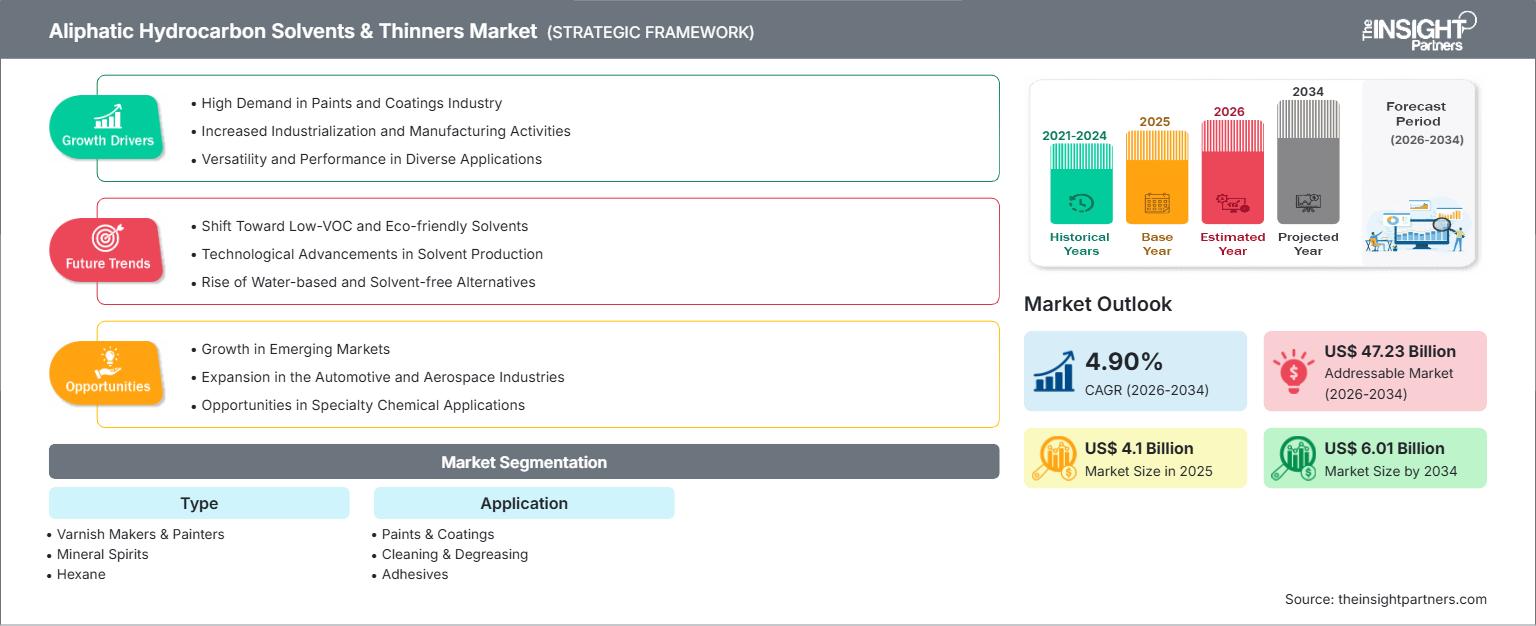
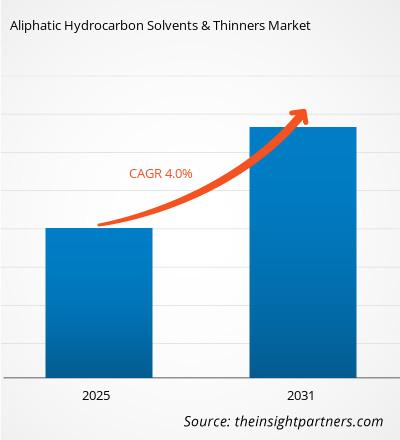
The Aliphatic Hydrocarbon Solvents & Thinners market was valued at US$ 4.1 billion in 2025 and is expected to reach US$ 6.01 billion by 2034; it is estimated to record a CAGR of 4.34% during 2026-2034.
Aliphatic Hydrocarbon Solvents & Thinners Market Assessment and Insights
- North America: Accounted for 31–34% share in 2025 and is projected to expand at a CAGR of 4.1–4.6% during 2026–2034. Strong refining capacity, established coatings manufacturing, and consistent demand from automotive, construction, and industrial maintenance sectors continue supporting market expansion.
- U.S.: Represented 80–84% of the North American market in 2025 and is expected to register a CAGR of 4.2–4.7% during 2026–2034. High industrial solvent consumption, advanced chemical manufacturing, and large-scale infrastructure renovation projects sustain demand.
- Europe: Held 25–28% share in 2025 and is anticipated to grow at a CAGR of 3.8–4.3% during 2026–2034. Germany, France, Italy, and the UK remain key contributors owing to their strong automotive, industrial coatings, and specialty chemicals industries.
- Asia Pacific: Captured 33–36% share in 2025 and is forecast to record the fastest growth at a CAGR of 5.6–6.2% during 2026–2034. China, India, Japan, and South Korea continue expanding petrochemical production and downstream manufacturing capacity.
- Largest Segment: Paints & Coatings accounted for 40–44% market share in 2025 and is expected to grow at a CAGR of 5.0–5.4% during 2026–2034, supported by sustained infrastructure development and industrial coating requirements.
- High Growth Segment: Heptane represented 12–15% market share in 2025 and is anticipated to register a CAGR of 6.0–6.6% during 2026–2034, driven by increasing demand for high-purity solvents in pharmaceutical processing, specialty chemicals, and laboratory applications.
- Key companies analyzed in detail: Exxon Mobil Corporation, BASF SE, dsm-firmenich AG, Shell plc, Chimen S.r.l., INEOS Group Holdings S.A., Brenntag SE, SK Geo Centric Co., Ltd., Saudi Basic Industries Corporation (SABIC), TotalEnergies SE.
Source: The Insight Partners' analysis based on proprietary research, government publications, company annual reports, investor presentations, industry databases, and expert interviews.
The aliphatic hydrocarbon solvents and thinners have developed from general purpose industrial chemicals to become process chemicals that fulfill high standards in terms of their properties, safety, and environmental impact. Solvent refineries have managed to produce solvent chemicals with improved purity, lower aromatic levels, and consistency required for industrial purposes. On the other hand, the producers of such solvents are implementing energy efficient production techniques and efficient logistics solutions to enhance their reliability in addition to the compliance with the changing regulations about the emissions of volatile organic compounds and worker safety.
In the long run, the development of the market will rely increasingly on investments in environmentally friendly refining technology and more sustainable formulas of solvents and regional production facilities. The developing economies are still attracting investments into manufacturing capacity due to the availability of low cost raw material, industrialization and rising demands for downstream chemicals.
Aliphatic Hydrocarbon Solvents & Thinners Market Report Scope
| Report Attribute | Details |
|---|---|
| Market size in 2025 | US$ 4.1 Billion |
| Market Size by 2034 | US$ 6.01 Billion |
| Global CAGR (2026 - 2034) | 4.34% |
| Historical Data | 2021-2024 |
| Forecast period | 2026-2034 |
Aliphatic Hydrocarbon Solvents & Thinners Market Analysis
The growth of the aliphatic hydrocarbon solvents and thinners market is driven by high demand for paints, coatings, adhesives, industrial cleaning solutions, and metal processing chemicals. The industry enjoys a strong value chain from crude oil extraction and refinement to hydrocarbon separation, solvent manufacturing, mixing, distribution, and industrial usage. Feedstock reliability and refineries' ability to increase efficiencies of the processes ensure the availability of high-quality solvents with narrow boiling ranges and specific performance features. Further investments into infrastructure, manufacturing plants and automobile production support solvent consumption across different industries.
Continuous demand for mineral spirits, varnish makers' and painters' naphtha, hexane, and heptane is driven by industrial maintenance, machinery manufacturing, and chemical processing applications. Supply chain efforts target at providing the raw materials within the region and reducing transportation costs and ensuring continuous feedstock supply by refining plants' investments. Solvent differentiation is driven by such parameters as purity, flash point, evaporation rate, and environmental compliance.
The aliphatic hydrocarbon solvents & thinners market report demonstrates that competition will be dominated by refining integration, distribution capacity, quality of products, and technical assistance. Such leading companies as Exxon Mobil Corporation, Shell plc, BASF SE, Saudi Basic Industries Corporation (SABIC), INEOS Group Holdings S.A., dsm-firmenich AG, Brenntag SE, SK Geo Centric Co., Ltd., Chimen S.r.l., and TotalEnergies SE will consistently develop their market positions through optimizing their production, increasing geographical presence, and diversification of their specialty solvents portfolio. Establishing strategic cooperation with coatings, adhesives, and industrial chemicals manufacturers will ensure the competitive advantage for companies in the future.
In terms of investments, companies will increasingly focus on the modernization of their refineries, solvent purification technologies, digital monitoring systems of the production process, and environmentally friendly production methods. At the same time, companies will expand storage facilities, logistics networks, and regional distribution networks. In terms of the solvent formulations, companies will increase their investment in order to produce high-quality solvents with the help of advanced quality control and process automation systems.
● REPORT CUSTOMIZATION
Tailor This Report To Align With Your Specific Business Requirements
This report can be customized to align precisely with your business objectives, scope, and target markets. Customization options include tailored segmentation, geography, competitive analysis, and strategic insights to support informed decision-making.
Customize This Report →WHAT YOU CAN ADJUST
- ● Segmentations
- ● Geography
- ● Competitive Analysis
- ● Language Preferences
Aliphatic Hydrocarbon Solvents & Thinners Market: Strategic Insights
Regional Insights
North America Aliphatic Hydrocarbon Solvents & Thinners Market
North America accounted for 31–34% of the global aliphatic hydrocarbon solvents & thinners market share in 2025 and is projected to expand at a CAGR of 4.1–4.6% during 2026–2034. The region benefits from an integrated refining and petrochemical industry, stable feedstock availability, and sustained demand from paints and coatings, automotive manufacturing, industrial maintenance, and chemical processing sectors. Infrastructure rehabilitation projects and investments in manufacturing facilities continue to support solvent consumption across a broad range of industrial applications requiring high-purity hydrocarbon products.
The United States and Canada will continue to be major contributors to regional demand on account of their highly developed refining processes, chemical manufacturing operations, and supply chain networks. Environmental laws regarding emissions of volatile organic compounds are driving the manufacturers to formulate solvents more efficiently without compromising on performance parameters. Investments in upgrading refineries, logistics, and specialty chemicals will enhance supply security and facilitate market growth.
U.S. Aliphatic Hydrocarbon Solvents & Thinners Market
The U.S. held 80–84% share in North America’s market in 2025, and is expected to grow at a CAGR of 4.2–4.7% from 2026 to 2034. The U.S. continues to be one of the world’s major producers and consumers of hydrocarbon solvents due to its robust infrastructure for refining operations, advanced petrochemical sector, and downstream demand from paints and coatings, adhesives, industrial cleaning, and automobile manufacturing industries.
Major industry players are still focused on modernizing their refineries and production processes in order to increase product quality and efficiency. Growing demand for specialty coatings, industrial maintenance chemicals, and high-performance adhesives has been encouraging companies to offer specialized grades of solvents that are suited for specific applications. Technological advancements along with increasing domestic industrial activities will help maintain country’s dominance in regional market.
Europe Aliphatic Hydrocarbon Solvents & Thinners Market
Europe has been contributing around 25-28% to the total market share in 2025 and is anticipated to witness a growth rate of 3.8-4.3% in the period 2026-2034. The European region has been dominated by Germany due to a significant presence of its automotive, industrial equipment, and specialty chemicals segments, which need large quantities of hydrocarbon solvents for coatings, adhesives, and cleaning purposes. The UK has been consistently generating demand from applications in industrial maintenance, aerospace manufacturing, and protective coatings while focusing on environmentally friendly solvent technologies.
The French, Italian, and Spanish regions constitute another key regional market due to their contributions to construction, industrial manufacturing, packaging, and automotive components manufacturing activities. There have been regulatory measures in favor of environmentally friendly solvent technologies due to initiatives to promote the safety of chemical handling and reduction in emissions. Modernization of manufacturing units and increasing demand for performance coatings are some of the factors supporting Europe as a key consumer of aliphatic hydrocarbon solvents and thinners.
APAC Aliphatic Hydrocarbon Solvents & Thinners Market
Asia Pacific captured 33–36% of the global market in 2025 and is forecast to record the highest CAGR of 5.6–6.2% during 2026–2034. Rapid industrialization, expanding petrochemical production, infrastructure development, and increasing manufacturing output continue supporting regional solvent demand across multiple industrial sectors.
China dominates the region due to its large refining capacity and chemical manufacturing industry, whereas India registers the highest growth rate owing to investments in infrastructure and industrial growth. Japan, South Korea, and Australia are focusing on specialty chemicals and advanced manufacturing along with green solvents.
Middle East & Africa Aliphatic Hydrocarbon Solvents & Thinners Market
The Middle East & Africa market is projected to grow at a CAGR of 4.8–5.3% during 2026–2034, supported by abundant hydrocarbon resources, expanding refining capacity, and downstream petrochemical investments. Growth is further encouraged by increasing industrialization and rising demand for paints, coatings, and construction chemicals across developing economies.
Saudi Arabia is still the largest market due to its integrated refining and petrochemical facilities, while UAE is building up its specialization in specialty chemical manufacturing. South Africa is meeting the demands of the region through its mining and industrial services, as well as manufacturing. Investments in diversification, logistics infrastructure, and high-value chemicals will definitely increase opportunities for solvent suppliers in the region.
Segmentation Analysis
Type
The type segment determines solvent performance based on evaporation rate, solvency power, flash point, and end-use compatibility across industrial applications. The aliphatic hydrocarbon solvents & thinners market scope continues to expand as manufacturers develop application-specific solvent grades with improved purity and reduced aromatic content to comply with environmental and occupational safety regulations. Rising industrial production, coatings demand, and specialty chemical manufacturing are expected to support this segment at a CAGR of 4.8–5.2% during 2026–2034.
- Varnish Makers & Painters: Widely used in paint formulation, coating dilution, and industrial finishing because of balanced evaporation characteristics and compatibility with alkyd resins, making it an essential solvent for architectural and protective coating applications.
- Mineral Spirits: Mineral spirits remain extensively utilized for paint thinning, equipment cleaning, degreasing, and surface preparation owing to their cost-effectiveness, moderate evaporation rate, and broad compatibility with industrial maintenance applications.
- Hexane: Hexane is primarily consumed in vegetable oil extraction, rubber processing, adhesives, and chemical manufacturing where high solvency, rapid evaporation, and consistent product quality are essential for efficient industrial operations.
- Heptane: Heptane is increasingly adopted in pharmaceutical manufacturing, laboratory chemicals, specialty adhesives, and precision cleaning applications because of its high purity, controlled evaporation, and suitability for regulated industrial processes.
Application
Application remains the primary demand driver for hydrocarbon solvents and thinners, reflecting consumption across manufacturing, maintenance, construction, and chemical processing industries. Growing industrialization, infrastructure investments, and increasing production of coatings and adhesives continue strengthening solvent utilization worldwide. The application segment is projected to expand at a CAGR of 5.0–5.4% during 2026–2034, supported by rising demand for high-performance industrial formulations and specialty chemical products.
- Paints & Coatings: Paints and coatings represent the largest application owing to extensive solvent consumption in decorative, automotive, marine, industrial, and protective coatings requiring controlled viscosity, application performance, and drying characteristics.
- Cleaning & Degreasing: Industrial cleaning and degreasing applications rely on hydrocarbon solvents to remove oils, greases, waxes, and production residues from machinery, automotive components, fabricated metals, and precision equipment.
- Adhesives: Solvents improve adhesive viscosity, application consistency, and drying performance across packaging, woodworking, automotive assembly, construction materials, and consumer product manufacturing operations.
- Aerosols: Aerosol formulations utilize aliphatic hydrocarbon solvents as carriers and formulation components in maintenance sprays, lubricants, cleaners, insecticides, and specialty industrial products requiring controlled evaporation properties.
- Printing Inks: Printing ink manufacturers employ hydrocarbon solvents to regulate viscosity, pigment dispersion, drying performance, and print quality across packaging, publication, commercial, and industrial printing applications.
Opportunity Snapshot
| Application | Revenue Contribution | Trend Tag | Adoption Stage |
|---|---|---|---|
| Paints & Coatings | High | Protective Coatings | Mature |
| Cleaning & Degreasing | High | Industrial Cleaning | Mature |
| Adhesives | Medium | Assembly Bonding | Scaling |
| Aerosols | Medium | Specialty Sprays | Scaling |
| Printing Inks | Medium | Flexible Packaging | Mature |
Aliphatic Hydrocarbon Solvents & Thinners Market Growth Drivers and Impact Analysis
Expansion of Global Paints and Coatings Production
Growth in architectural construction, industrial manufacturing, automotive production, and infrastructure modernization continues to increase demand for solvent-based paints and coatings worldwide. Aliphatic hydrocarbon solvents remain essential for controlling viscosity, improving application properties, and ensuring consistent drying performance in coating formulations. Developing economies are investing heavily in residential, commercial, and industrial infrastructure, resulting in sustained coatings consumption. Industrial maintenance requirements across marine, oil and gas, transportation, and manufacturing facilities further strengthen solvent demand. Manufacturers are introducing higher-purity and lower-aromatic formulations that comply with evolving environmental regulations while maintaining performance. These factors collectively support long-term market expansion and encourage investments in refining capacity, specialty solvent production, and downstream coating technologies.
Industrial Cleaning and Metal Processing Requirements
Industrial facilities increasingly require effective cleaning and degreasing solutions to improve equipment reliability, manufacturing efficiency, and product quality. Aliphatic hydrocarbon solvents are widely used for removing oils, greases, waxes, machining fluids, and production residues from metal components and industrial machinery. Growth in automotive manufacturing, aerospace production, fabricated metals, and precision engineering continues to create stable demand for these solvents. Automation across manufacturing plants has further increased the need for fast-drying, low-residue cleaning chemicals that support uninterrupted production processes. Investments in advanced manufacturing and industrial maintenance programs across developed and emerging economies are expected to reinforce solvent consumption while encouraging suppliers to develop safer, higher-performance formulations with improved environmental characteristics.
Expansion of Petrochemical and Chemical Manufacturing Capacity
Rising investments in refinery modernization and integrated petrochemical complexes are strengthening feedstock availability for aliphatic hydrocarbon solvent production. Major refining regions continue expanding capacity to improve supply reliability and reduce dependence on imports while supporting downstream industries such as adhesives, printing inks, agrochemicals, and specialty chemicals. Integrated production facilities enable manufacturers to optimize operating costs, maintain product quality, and improve logistics efficiency. At the same time, increasing industrialization across Asia Pacific and the Middle East is encouraging new solvent production facilities that serve rapidly expanding domestic manufacturing sectors. These developments improve regional supply resilience and create opportunities for companies to introduce specialized solvent grades tailored to industrial performance and regulatory requirements.
Aliphatic Hydrocarbon Solvents & Thinners Market Future Trends
Development of Low-VOC and High-Purity Solvent Formulations
The aliphatic hydrocarbon solvents & thinners market trends increasingly reflect demand for low-VOC, low-odor, and high-purity solvent products that satisfy stricter environmental and occupational safety requirements. Manufacturers are investing in refining technologies that reduce aromatic content while maintaining solvency performance for paints, coatings, adhesives, and industrial cleaning applications. Growing regulatory oversight and customer sustainability objectives are expected to accelerate adoption of environmentally improved solvent formulations. Advanced purification technologies, closed-loop solvent recovery systems, and improved quality monitoring will continue supporting innovation while enabling manufacturers to differentiate products through enhanced performance, compliance, and operational efficiency.
Digital Manufacturing and Intelligent Chemical Management
Digital transformation is expected to reshape solvent manufacturing through process automation, predictive maintenance, advanced quality control, and intelligent inventory management. Producers are increasingly adopting digital monitoring systems that improve production consistency, optimize energy consumption, and enhance supply chain visibility. Industrial customers are simultaneously implementing chemical management software to monitor solvent consumption, workplace exposure, emissions, and regulatory compliance. These technologies improve operational efficiency while supporting more sustainable manufacturing practices. As Industry 4.0 adoption expands across refining and chemical production, digital manufacturing capabilities are expected to become an increasingly important competitive advantage for solvent manufacturers.
Aliphatic Hydrocarbon Solvents & Thinners Market Opportunities
Growing Industrialization Across Emerging Manufacturing Economies
The aliphatic hydrocarbon solvents & thinners market Forecasts indicate significant opportunities across Asia Pacific, the Middle East, Latin America, and selected African countries where manufacturing output, infrastructure investment, and chemical production continue expanding. Rising automotive assembly, industrial equipment manufacturing, construction activity, and downstream petrochemical investments are increasing solvent consumption across multiple industries. Companies establishing regional production facilities and distribution networks can improve supply responsiveness while reducing logistics costs. Strategic partnerships with coatings, adhesives, and specialty chemical manufacturers are expected to strengthen long-term customer relationships and create sustainable competitive advantages in rapidly developing industrial markets.
Innovation in Specialty Solvents for High-Value Applications
Increasing demand for specialty chemicals presents attractive opportunities for manufacturers developing premium aliphatic hydrocarbon solvents with enhanced purity, controlled evaporation rates, and application-specific performance characteristics. Pharmaceutical manufacturing, electronics production, precision cleaning, laboratory chemicals, and advanced coatings require high-quality solvents that meet stringent technical specifications and regulatory requirements. Companies investing in advanced refining, purification technologies, and research capabilities can expand high-margin product portfolios while addressing evolving customer requirements. Development of customized solvent blends and environmentally improved formulations is expected to strengthen differentiation and support long-term growth within value-added industrial applications.
Recent Developments
- May 29, 2025: Advent Chembio Pvt. Ltd. launched its LN and LCN series of ultra-pure solvents designed for analytical, pharmaceutical, and research applications. The new solvent portfolio offers enhanced purity, low residue levels, and consistent performance for high-precision laboratory processes, reflecting the industry's increasing focus on premium hydrocarbon solvent grades that meet stringent quality and regulatory requirements. This launch is expected to strengthen the company's presence in specialty solvent applications and support demand for high-value industrial solvents.
- May 20, 2025: Sulzer Ltd. introduced OptimEXT, a solvent extraction technology that enables solvent recovery rates of up to 99% while reducing energy consumption and operating costs in chemical and petrochemical processing. The solution improves extraction efficiency and solvent utilization across industrial operations, supporting manufacturers in optimizing solvent management, lowering emissions, and improving process sustainability. The launch aligns with the industry's growing emphasis on resource efficiency and circular chemical manufacturing.
Frequently Asked Questions

- Comprehensive Market Sizing and Forecast Analysis
- Detailed Segmentation Analysis
- In-Depth Market Dynamics Assessment
- Regional and Country-Level Insights
- Competitive Landscape and Company Benchmarking
- Strategic Business Intelligence
Recent Reports
Testimonials

The Insight Partners' SCADA System Market report is comprehensive, with valuable insights on current trends and future forecasts. The team was highly professional, responsive, and supportive throughout. We are very satisfied and highly recommend their services.
RAN KEDEM Partner, Reali Technologies LTDs
I requested a report on a very specific software market and the team produced the report in a few days. The information was very relevant and well presented. I then requested some changes and additions to the report. The team was again very responsive and I got the final report in less than a week.
JEAN-HERVE JENN Chairman, Future Analytica
We worked with The Insight Partners for an important market study and forecast. They gave us clear insights into opportunities and risks, which helped shape our plans. Their research was easy to use and based on solid data. It helped us make smart, confident decisions. We highly recommend them.
PIYUSH NAGPAL Sr. Vice President, High Beam Global
The Insight Partners delivered insightful, well-structured market research with strong domain expertise. Their team was professional and responsive throughout. The user-friendly website made accessing industry reports seamless. We highly recommend them for reliable, high-quality research services
YUKIHIKO ADACHI CEO, Deep Blue, LLC.
This is the first time I have purchased a market report from The Insight Partners.While I was unsure at first, I visited their web site and felt more comfortable to take the risk and purchase a market report.I am completely satisfied with the quality of the report and customer service. I had several questions and comments with the initial report, but after a couple of dialogs over email with their analyst I believe I have a report that I can use as input to our strategic planning process.Thank you so much for taking the extra time and making this a positive experience.I will definitely recommend your service to others and you will be my first call when we need further market data.
JOHN SUZUKI President and Chief Executive Officer, Board Director, BK Technologies
I wish to appreciate your support and the professionalism you displayed in the course of attending to my request for information regarding to infectious disease IVD market in Nigeria. I appreciate your patience, your guidance, and the fact that you were willing to offer a discount, which eventually made it possible for us to close a deal. I look forward to engaging The Insight Partners in the future, all thanks to the impression you have created in me as a result of this first encounter.
DR CHIJIOKE ONYIA MANAGING DIRECTOR, PineCrest Healthcare Ltd.Reason to Buy
- Informed Decision-Making
- Understanding Market Dynamics
- Competitive Analysis
- Identifying Emerging Markets
- Customer Insights
- Market Forecasts
- Risk Mitigation
- Boosting Operational Efficiency
- Strategic Planning
- Investment Justification
- Tracking Industry Innovations
- Aligning with Regulatory Trends





 Get Free Sample for