
Alkalinity Control Chemicals Market Size, Growth & Trends by 2034
Coverage: By Product Type (Acids, Bases); Application (Cooling Systems, Boilers, Others), and Geography (North America, Europe, Asia Pacific, and South and Central America)
- Status : Data Released
- Report Code : TIPRE00014337
- Category : Chemicals and Materials
- No. of Pages : 150
- Available Report Formats :


- Last update date : August 07, 2026


2025 Market Size
US$ 2.77 Bn
Base year value
2034 Forecast
US$ 4.37 Bn
Projected by 2034
CAGR 2026-2034
5.21 %
Growth rate
Addressable Market
US$ 32.41 Bn
(2026-2034)
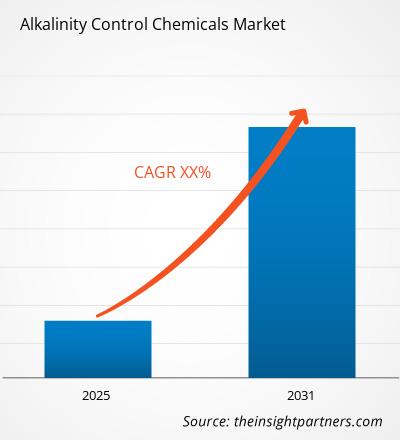
The alkalinity control chemicals market is valued at US$ 2.77 billion in 2025 and will be valued at US$ 4.37 billion in 2034, growing at a CAGR of 5.21%. The market is driven by rising demand for water treatment chemicals in industries such as power generation, oil & gas, marine, chemical processing, and manufacturing industries, where keeping the pH level stable is critical to preventing corrosion and improving performance and longevity of equipment.
In North America, continued industrialization and strict water quality standards continue to drive demand for improved water treatment systems. Alkalinity control chemicals market size in the region will continue to grow, fueled by investments in old boiler plants, district heating, and industrial cooling facilities. Increased automation in the monitoring and predictive maintenance of water treatment facilities is likely to drive a regional CAGR of 4.8-5.3% until 2034.
Alkalinity Control Chemicals Market Assessment and Insights
- North America: North America accounted for 31–35% share in 2025 and is projected to expand at a CAGR of 4.8–5.3% during 2026–2034. Stringent industrial water discharge regulations, widespread boiler treatment programs, and modernization of manufacturing facilities continue to support stable demand.
- US: The US represented 74–78% of the North American market in 2025 and is anticipated to register a CAGR of 4.9–5.4% during 2026–2034, driven by investments in power generation, refining, food processing, and commercial water treatment services.
- Europe: Europe captured 25–29% share in 2025 and is expected to grow at a CAGR of 4.7–5.2% during 2026–2034. Germany, the UK, France, and Italy remain leading markets due to extensive industrial manufacturing, district heating infrastructure, and stringent wastewater regulations.
- Asia Pacific: Asia Pacific held 30–34% share in 2025 and is forecast to record the fastest regional expansion with a CAGR of 5.9–6.4% during 2026–2034. China, India, Japan, and South Korea continue investing heavily in industrial utilities and water reuse infrastructure.
- Largest Segment: Bases accounted for 61–65% market share in 2025 and are anticipated to expand at a CAGR of 5.0–5.5% during 2026–2034, owing to their widespread application in maintaining boiler water alkalinity and minimizing corrosion.
- High Growth Segment: Cooling Systems represented 43–47% market share in 2025 and are projected to grow at a CAGR of 5.8–6.3% during 2026–2034, supported by increasing industrial cooling requirements and stricter water efficiency standards.
- Key companies analyzed in detail: Accepta Ltd., BASF SE, Canada Colors and Chemicals Limited, ChemTreat, Inc., IXOM Operations Pty Ltd, SLB, TECO Alkalinity Control, Wilhelmsen Holding ASA, Zeel Product, Veolia Water Technologies & Solutions.
Source: The Insight Partners' analysis based on proprietary research, government publications, company annual reports, investor presentations, industry databases, and expert interviews.
The methods of water treatment in industries have seen a significant change because of the increasing focus on predictive maintenance, chemical automation, and online monitoring. The chemicals developed in today’s world for alkalinity control help provide stable pH conditions, prevent scale formation, and increase the corrosion resistance properties in closed loop cooling systems and high-pressure boilers. With the help of online monitoring solutions, it has become possible for industries to save water, increase operational reliability, and decrease the cost of maintenance.
In future, the growth of the market can happen owing to the initiatives related to industrial decarbonization, wastewater recycling, and highly efficient steam generating facilities. Industrial complexes in Southeast Asia, the Middle East, and Latin America are still expanding their modern utilities, whereas environmental concerns push manufacturers to install advanced water chemistry programs, thus preventing equipment breakdown and increasing energy efficiency.
Alkalinity Control Chemicals Market Report Scope
| Report Attribute | Details |
|---|---|
| Market size in 2025 | US$ 2.77 Billion |
| Market Size by 2034 | US$ 4.37 Billion |
| Global CAGR (2026 - 2034) | 5.21% |
| Historical Data | 2021-2024 |
| Forecast period | 2026-2034 |
Alkalinity Control Chemicals Market Analysis
The increasing need for effective water treatments in the industry is still driving the market for alkalinity control chemicals in power generation, chemical, food processing, pharmaceuticals, pulp and paper, and maritime industries. Proper regulation of alkalinity helps prevent boilers and cooling systems from corrosion, scaling, and acidity while ensuring high efficiency of heat transfer. Higher investments in industrial water recycling plants, zero liquid discharge solutions, and automatic systems for water chemistry management are reinforcing demand in developed and developing countries.
The supply chain is closely connected to commodity chemical production such as sodium hydroxide, potassium hydroxide, phosphates, carbonates, and mineral acids. Companies are increasingly incorporating digital monitoring systems, dosing equipment, laboratory analysis, and technical services in their water treatment services, which results in higher client retention and increased use of chemicals over time. Sustainability trends are also driving optimized chemical products that are environmentally friendly and more efficient.
The competitive analysis of alkalinity control chemicals market report is characterized by the presence of relatively concentrated competitive structure featuring participation of international water treatment firms, regional chemical compounders and providers of industrial services. The portfolio of BASF SE, ChemTreat, Inc., IXOM Operations Pty Ltd, Accepta Ltd., Wilhelmsen Holding ASA, and SLB is being augmented by development of specialized formulations, innovative digital water treatment systems and provision of integrated industrial services. Regional players strive to distinguish themselves with their customized treatment and technical support services.
More and more investment capital flows into intelligent water treatment systems, which are able to monitor pH, conductivity, alkalinity, and corrosion factors continuously. Operators of industries tend to move towards outcome-oriented services contracts involving special chemicals and remote monitoring, predictive analysis and maintenance optimization services.
● REPORT CUSTOMIZATION
Tailor This Report To Align With Your Specific Business Requirements
This report can be customized to align precisely with your business objectives, scope, and target markets. Customization options include tailored segmentation, geography, competitive analysis, and strategic insights to support informed decision-making.
Customize This Report →WHAT YOU CAN ADJUST
- ● Segmentations
- ● Geography
- ● Competitive Analysis
- ● Language Preferences
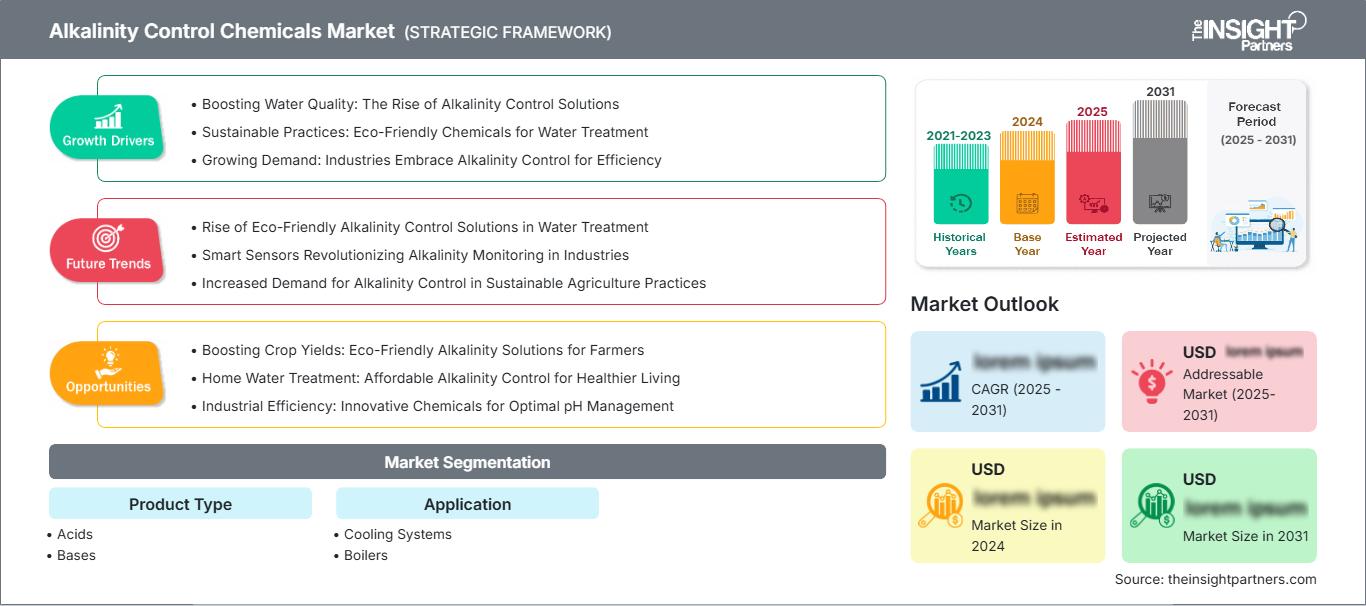
Alkalinity Control Chemicals Market: Strategic Insights
Regional Insights
North America Alkalinity Control Chemicals Market
North America accounted for 31–35% of the alkalinity control chemicals market share in 2025 and is projected to expand at a CAGR of 4.8–5.3% during 2026–2034. Demand is supported by extensive deployment of industrial boilers, cooling towers, combined heat and power plants, and district energy systems. Stringent regulations governing industrial wastewater discharge and asset reliability continue encouraging the use of advanced alkalinity control programs across manufacturing, energy, and institutional facilities.
The United States and Canada continue investing in modernization of aging industrial infrastructure, while industries increasingly implement automated chemical dosing and online water quality monitoring systems. Growing emphasis on reducing downtime, improving energy efficiency, and extending equipment life is accelerating adoption of integrated water treatment programs. Service-based chemical management models offered by leading suppliers are also contributing to long-term market stability across the region.
U.S. Alkalinity Control Chemicals Market
United States occupied 74–78% of North American market in 2025 and will be projected to grow at a CAGR of 4.9-5.4% until 2034. High demand comes from power plants, petrochemical industry, pharmaceutical companies, food processors, pulp and paper industries, and institutional buildings running high pressure boilers. Replacements of old steam infrastructure and increased compliance with environmental regulations are continuously increasing the investments in high-performance chemicals.
Main players of water treatment industry such as ChemTreat, Veolia Water Technologies & Solutions, and Ecolab have an extensive service network in the country that supports industrial water treatment solutions. Advanced digital monitoring systems, predictive maintenance software, and smart dosing systems are being increasingly included in the contracts for chemicals treatments that provide enhanced corrosion protection, efficient use of chemicals, and low operating cost for industrial consumers.
Europe Alkalinity Control Chemicals Market
The Europe region held a market share of 25–29% in 2025 and is expected to register a CAGR of 4.7–5.2% during the period of 2026–2034. Germany is expected to remain the leading region due to the presence of a robust industrial manufacturing base, chemical processing industries, and district heating networks, which need efficient boiler water treatments. Sustained investment in sustainable industries and water recycling will contribute to increased demand for efficient alkalinity control solutions.
United Kingdom continues to promote its industrial water treatment programs in the pharmaceutical, food processing, and commercial utility sectors alongside stringent environmental regulations. The German region is expected to benefit from widespread automation processes in their manufacturing plants, thereby generating a demand for precise chemical dosing systems. The French, Italian, and Spanish regions will help to boost demand within the region through industrial modernization, wastewater reuse programs, and investment in energy-efficient steam production..
APAC Alkalinity Control Chemicals Market
The Asia Pacific region held 30–34% market share in 2025 and is expected to show the highest CAGR in the regions of 5.9–6.4% from 2026 to 2034. Consumption in China was dominated by its large-scale manufacturing, energy production, and chemical processes industries, while India experienced increasing investments in industrial utilities and water treatment.
Countries such as Japan, South Korea, and Australia focus on highly efficient industrial practices, which have advanced water chemistry and automation practices. The rise of industrialization, development of district cooling facilities, and efforts by governments to conserve water and recycle wastewater creates a good market environment for alkalinity control chemicals suppliers.
Middle East & Africa Alkalinity Control Chemicals Market
Middle East & Africa market is anticipated to register a healthy growth rate of CAGR of 5.3-5.8% over 2026-2034 owing to capital investments in desalination plants, oil & gas, power generation, and industrial infrastructure. The rising need for effective boiler and cooling water treatment solutions is fueling market adoption in energy-dependent sectors.
Saudi Arabia holds the leading position within the regional market because of its refinery, petrochemical, and utilities projects; UAE is making investments in district cooling and industrial water reclamation. South Africa is generating demand from mining and manufacturing sectors; while Rest of MEA is growing from the development of industrial sector and advanced water treatment systems.
Segmentation Analysis
Product Type
Acids and bases constitute the primary product categories in the market, collectively supporting pH regulation, corrosion prevention, and scale control across industrial water treatment systems. The alkalinity control chemicals market scope continues to expand as industries adopt integrated water chemistry programs to improve equipment reliability, reduce maintenance costs, and comply with increasingly stringent environmental discharge regulations. The Product Type segment is projected to register a CAGR of 5.0–5.4% during 2026–2034.
- Acids – Acid-based alkalinity control chemicals are widely used to neutralize excess alkalinity and maintain optimum pH in cooling towers, boilers, and process water systems. Demand remains strong in power generation, petrochemical processing, and municipal water treatment facilities requiring precise chemical balance.
- Bases – Base formulations such as sodium hydroxide and related alkaline chemicals are extensively employed to increase water alkalinity, minimize corrosion risks, and stabilize treatment processes. Their adoption continues to grow across industrial utilities, food processing, mining, and refinery operations owing to operational reliability and cost efficiency.
Application
Industrial boiler systems and cooling water networks represent the largest application areas because maintaining optimum alkalinity directly affects heat transfer efficiency, equipment lifespan, and operational safety. Growing industrial automation, stricter water quality regulations, and increasing investments in closed-loop water treatment systems continue to strengthen demand across both applications. The Application segment is anticipated to record a CAGR of 5.3–5.6% during 2026–2034.
- Cooling Systems – Cooling systems account for a significant share of chemical consumption as facilities require continuous pH stabilization and corrosion control to improve thermal efficiency while minimizing scaling and microbiological fouling in recirculating water systems.
- Boilers – Boiler water treatment requires carefully controlled alkalinity to prevent acidic corrosion, tube failures, and scale deposition under high-pressure operating conditions. Rising investments in industrial steam generation and energy infrastructure continue to support long-term demand for specialized treatment chemicals.
Opportunity Snapshot
| Application | Revenue Contribution | Trend Tag | Adoption Stage |
|---|---|---|---|
| Cooling Systems | High | Smart Dosing | Mature |
| Boilers | High | Corrosion Control | Mature |
Alkalinity Control Chemicals Market Growth Drivers and Impact Analysis
Increasing Industrial Water Treatment Requirements
Industrial sectors including power generation, oil and gas, chemicals, mining, food processing, and manufacturing continue to invest heavily in water treatment systems to improve operational efficiency and comply with environmental regulations. Maintaining appropriate alkalinity is essential for preventing corrosion, minimizing scale formation, and ensuring stable boiler and cooling system performance. As industrial facilities modernize aging infrastructure and adopt automated water treatment technologies, demand for specialized alkalinity control chemicals continues to rise. Emerging economies are witnessing rapid industrialization, further increasing chemical consumption for process water management. This driver supports long-term market expansion by reducing maintenance costs, extending equipment life, and improving plant productivity while ensuring compliance with increasingly stringent industrial wastewater and discharge regulations.
Growing Investments in Power Generation Infrastructure
Thermal power plants, combined-cycle gas facilities, biomass plants, and industrial cogeneration units require carefully controlled boiler water chemistry to achieve high operational efficiency and prevent equipment degradation. Governments across Asia Pacific, the Middle East, and parts of Africa continue investing in new electricity generation capacity alongside modernization of existing plants. These developments increase demand for alkalinity control chemicals that stabilize pH, reduce corrosion, and protect high-pressure steam systems. Growing electricity demand, expansion of district heating projects, and industrial steam generation further strengthen consumption. Chemical suppliers are increasingly providing integrated treatment programs combining specialty chemicals, digital monitoring, and technical services to improve plant reliability and reduce unplanned maintenance.
Expansion of Smart Water Management Solutions
Industries are increasingly replacing manual chemical treatment with automated dosing systems integrated with digital sensors, cloud-based monitoring, and predictive analytics. These technologies optimize alkalinity control, reduce chemical wastage, and improve process consistency across complex industrial water systems. Water-intensive sectors are adopting intelligent treatment platforms that continuously monitor pH, conductivity, and corrosion indicators to maximize operational efficiency. Suppliers are responding by developing performance-based service contracts that combine chemicals, monitoring equipment, and technical support. This transformation strengthens long-term customer relationships while creating additional value beyond chemical sales, supporting premium product adoption and encouraging innovation throughout the market.
Alkalinity Control Chemicals Market Future Trends
Integration of Digital Water Chemistry Management
Digitalization is becoming a defining trend in industrial water treatment as facilities increasingly deploy IoT-enabled sensors, automated dosing equipment, artificial intelligence, and cloud-based monitoring platforms. These technologies provide continuous visibility into water chemistry, enabling predictive maintenance and optimized chemical consumption. Alkalinity control chemicals market trends increasingly reflect the shift toward intelligent treatment solutions that reduce operational costs while improving regulatory compliance. Vendors are expanding digital service offerings alongside chemical portfolios, creating integrated solutions that improve customer retention and generate recurring service revenues. The convergence of specialty chemicals and industrial digitalization is expected to reshape competitive strategies throughout the forecast period.
Development of Sustainable Water Treatment Chemicals
Industrial customers are increasingly seeking environmentally responsible chemical formulations that deliver high treatment efficiency while minimizing environmental impact. Manufacturers are investing in low-toxicity additives, biodegradable formulations, and products compatible with stricter wastewater discharge regulations. Sustainability initiatives are also encouraging reduced chemical consumption through optimized dosing technologies and circular water management practices. As environmental regulations continue tightening worldwide, suppliers capable of delivering sustainable treatment programs supported by technical expertise and digital monitoring are expected to gain competitive advantages across industrial water treatment applications.
Alkalinity Control Chemicals Market Opportunities
Expansion Across Emerging Industrial Economies
Rapid industrialization across Southeast Asia, the Middle East, Latin America, and Africa presents substantial opportunities for manufacturers of alkalinity control chemicals. Investments in petrochemicals, refining, power generation, mining, food processing, and industrial manufacturing are creating sustained demand for advanced water treatment solutions. Alkalinity control chemicals market Forecasts indicate that localized manufacturing, regional distribution partnerships, and technical service capabilities will become increasingly important for capturing these expanding opportunities. Companies that establish strong regional support networks and customized treatment programs are likely to strengthen customer relationships while benefiting from long-term industrial infrastructure development.
Performance-Based Water Treatment Service Models
Chemical suppliers have opportunities to move beyond conventional product sales by offering integrated service models combining specialty chemicals, digital monitoring platforms, laboratory analysis, predictive maintenance, and engineering support. Industrial customers increasingly value measurable operational improvements rather than standalone chemical purchases. Performance-based contracts improve equipment reliability, reduce water consumption, optimize chemical usage, and lower maintenance costs while creating recurring revenue streams for suppliers. This transition toward solution-oriented business models is expected to enhance customer loyalty, differentiate suppliers in competitive markets, and generate higher long-term profitability.
Recent Developments
- March 17, 2026: Hampton Roads Sanitation District (HRSD) partnered with CREW Carbon to deploy wastewater alkalinity enhancement technology at scale. The collaboration combines CREW Carbon’s patented process intensification technology with HRSD’s inDENSE wastewater treatment technology to optimize biological treatment performance, reduce chemical consumption, and improve carbon removal efficiency. The initiative highlights growing adoption of alkalinity management solutions in wastewater facilities seeking operational efficiency and lower environmental impact.
- August 12, 2025: Buckman Laboratories and Atul Ltd announced a strategic joint venture to manufacture, market, and deliver advanced water treatment solutions across India and Sri Lanka. The partnership combines Buckman’s water treatment chemistry portfolio with Atul’s manufacturing capabilities to support industrial applications including chemical processing, power generation, food processing, textiles, and utilities, where alkalinity control and chemical water balancing are critical operational requirements.
Frequently Asked Questions

- Comprehensive Market Sizing and Forecast Analysis
- Detailed Segmentation Analysis
- In-Depth Market Dynamics Assessment
- Regional and Country-Level Insights
- Competitive Landscape and Company Benchmarking
- Strategic Business Intelligence
Recent Reports
Testimonials

The Insight Partners' SCADA System Market report is comprehensive, with valuable insights on current trends and future forecasts. The team was highly professional, responsive, and supportive throughout. We are very satisfied and highly recommend their services.
RAN KEDEM Partner, Reali Technologies LTDs
I requested a report on a very specific software market and the team produced the report in a few days. The information was very relevant and well presented. I then requested some changes and additions to the report. The team was again very responsive and I got the final report in less than a week.
JEAN-HERVE JENN Chairman, Future Analytica
We worked with The Insight Partners for an important market study and forecast. They gave us clear insights into opportunities and risks, which helped shape our plans. Their research was easy to use and based on solid data. It helped us make smart, confident decisions. We highly recommend them.
PIYUSH NAGPAL Sr. Vice President, High Beam Global
The Insight Partners delivered insightful, well-structured market research with strong domain expertise. Their team was professional and responsive throughout. The user-friendly website made accessing industry reports seamless. We highly recommend them for reliable, high-quality research services
YUKIHIKO ADACHI CEO, Deep Blue, LLC.
This is the first time I have purchased a market report from The Insight Partners.While I was unsure at first, I visited their web site and felt more comfortable to take the risk and purchase a market report.I am completely satisfied with the quality of the report and customer service. I had several questions and comments with the initial report, but after a couple of dialogs over email with their analyst I believe I have a report that I can use as input to our strategic planning process.Thank you so much for taking the extra time and making this a positive experience.I will definitely recommend your service to others and you will be my first call when we need further market data.
JOHN SUZUKI President and Chief Executive Officer, Board Director, BK Technologies
I wish to appreciate your support and the professionalism you displayed in the course of attending to my request for information regarding to infectious disease IVD market in Nigeria. I appreciate your patience, your guidance, and the fact that you were willing to offer a discount, which eventually made it possible for us to close a deal. I look forward to engaging The Insight Partners in the future, all thanks to the impression you have created in me as a result of this first encounter.
DR CHIJIOKE ONYIA MANAGING DIRECTOR, PineCrest Healthcare Ltd.Reason to Buy
- Informed Decision-Making
- Understanding Market Dynamics
- Competitive Analysis
- Identifying Emerging Markets
- Customer Insights
- Market Forecasts
- Risk Mitigation
- Boosting Operational Efficiency
- Strategic Planning
- Investment Justification
- Tracking Industry Innovations
- Aligning with Regulatory Trends





 Get Free Sample for