
Almond Milk Market Demand, Share & Growth by 2034
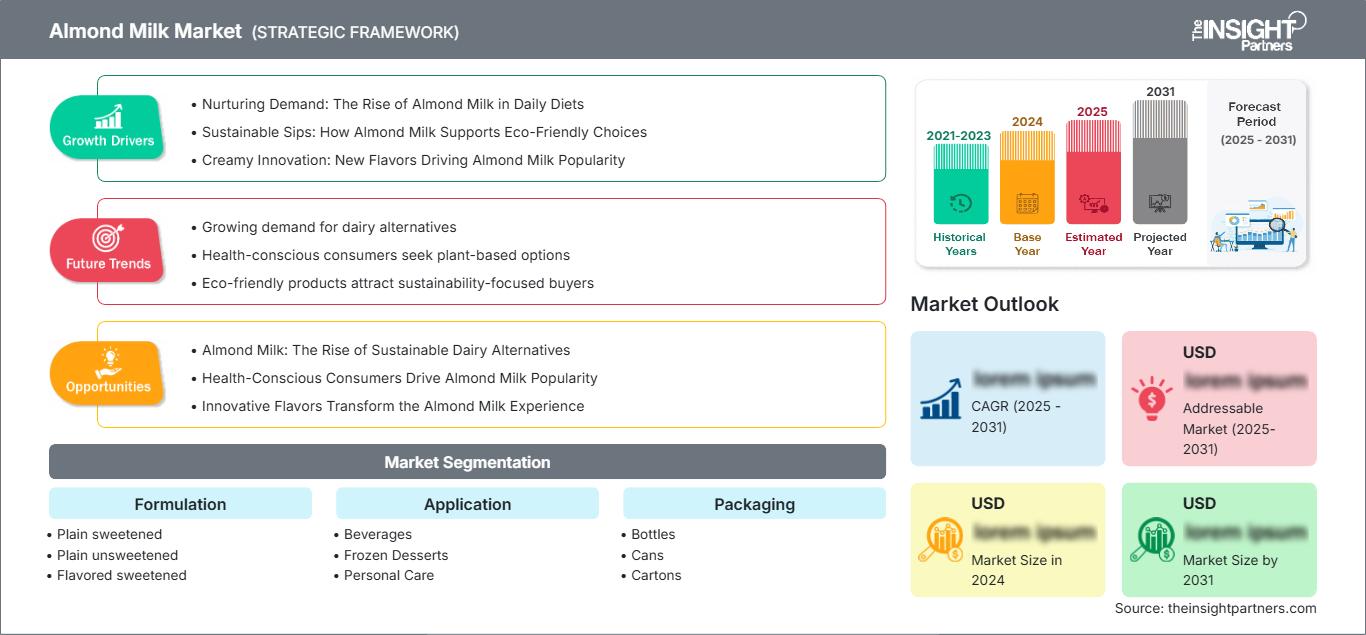
Coverage: By Formulation (Plain sweetened, Plain unsweetened, Flavored sweetened, Flavored unsweetened); Application (Beverages, Frozen Desserts, Personal Care, Others); Packaging (Bottles, Cans, Cartons); Distribution Channel (Hypermarkets and Supermarkets, Convenience Stores, Online, Others) , and Geography (North America, Europe, Asia Pacific, and South and Central America)
- Status : Data Released
- Report Code : TIPRE00011266
- Category : Food and Beverages
- No. of Pages : 150
- Available Report Formats :


- Last update date : August 19, 2026


2025 Market Size
US$ 12.21 Bn
Base year value
2034 Forecast
US$ 25.29 Bn
Projected by 2034
CAGR 2026-2034
8.4 %
Growth rate
Addressable Market
US$ 168.07 Bn
(2026-2034)
The Almond milk market was valued at US$ 12.21 billion in 2025 and is projected to reach US$ 25.29 billion by 2034, expanding at a CAGR of 8.4% during 2026–2034. Rising consumer preference for dairy alternatives, wider availability across retail formats, and growing adoption in foodservice applications continue to strengthen demand. Product innovation focused on clean-label formulations, fortified offerings, and flavor diversification is supporting sustained expansion across developed and emerging economies.
Across North America, demand remains supported by high awareness of plant-based nutrition, lactose intolerance prevalence, and mature retail infrastructure. The almond milk market size in the region benefits from extensive product penetration in supermarkets and online channels. Regional growth is expected to remain in the 7.5–8.5% range through 2034, aided by premiumization strategies and continued investment in sustainable packaging solutions.
Almond Milk Market Assessment and Insights
- North America: Share in 2025 estimated at 36–40%, supported by strong consumer awareness and extensive retail availability. Expected CAGR between 7.5–8.5% during 2026–2034.
- US: Accounts for 78–82% of North American demand in 2025, supported by product innovation and foodservice adoption. Expected CAGR between 7.8–8.8% during 2026–2034.
- Europe: Share in 2025 estimated at 27–31%. Germany, the UK, France, Italy, and Spain remain leading markets. Expected CAGR between 8.0–9.0% during 2026–2034.
- Asia Pacific: Share in 2025 estimated at 20–24%. China, Japan, India, South Korea, and Australia drive expansion. Expected CAGR between 9.0–10.0% during 2026–2034.
- Largest Segment: Beverages application segment holds approximately 68–72% market share in 2025 and is projected to expand at 8.2–9.0% CAGR through 2034.
- High Growth Segment: Online distribution represents roughly 13–17% share in 2025 and is expected to grow at 10.5–11.5% CAGR through 2034.
- Key companies analyzed in detail: Daiya Foods Inc.; The Hain Celestial Group, Inc.; Pureharvest; SunOpta Inc.; WhiteWave Foods Company; Blue Diamond Growers; Sanitarium Health Food Company; Califia Farms, LLC; Tofutti Brands Inc.; Fine Japan Co., Ltd.
Source: The Insight Partners' analysis based on proprietary research, government publications, company annual reports, investor presentations, industry databases, and expert interviews.
Evolving consumer priorities are reshaping production and commercialization strategies within the almond milk market. Companies are making progress through improvements in flavors, protein fortification, and efficiencies in the processing process by reducing the intensity of water and energy. The supply chain includes the use of traceability and sustainability certifications, while aseptic packaging enables extended shelf life and distribution over longer distances geographically. All these trends have helped in making products more accessible and resilient.
In the coming years, there will be significant investments in the regions of Asia Pacific, the Middle East, and some countries of Latin America. Favorable conditions are being created because of regulatory incentives for innovations in the plant-based foods industry, along with health awareness among consumers.
Almond Milk Market Report Scope
| Report Attribute | Details |
|---|---|
| Market size in 2025 | US$ 12.21 billion |
| Market Size by 2034 | US$ 25.29 billion |
| Global CAGR (2026 - 2034) | 8.4% |
| Historical Data | 2021-2024 |
| Forecast period | 2026-2034 |
Almond Milk Market Analysis
Growing consumer interest in plant-based nutrition remains a primary factor behind almond milk market growth. The demand for almond milk is driven by the rise of lactose intolerance among people, preference for vegan diets, and the sustainability of non-dairy beverages. Consumers today are looking for low-calorie drinks without cholesterol and in line with health-conscious goals. The shelves of retailers are getting more allocated to plant-based beverages, while restaurants are offering non-dairy beverages as an alternative on their regular menus. The development of new flavors, fortified drinks, and ingredients makes almond milk even more appealing to a wider variety of consumers.
The entire value chain involves almond cultivation, processing, formulation, packing, distribution, and commercialization at retail stores. California is still the largest supplier of almonds on the planet; however, there is a trend to increase sourcing and production in other regions. Water-efficient agriculture, sustainable practices, and technological innovations in the processing industry provide increased productivity of manufacturers and reduce the volatility of raw materials.
A detailed almond milk market analysis indicates that competition is increasingly centered on brand differentiation, premium ingredient positioning, and expanded distribution networks. Major corporations are concentrating on the formulation of clean labels, the fortification of products with vitamins and minerals, and customized products that cater to special consumer demands like products with less sugar or more protein content. Market strategies now incorporate sustainability features, transparency in terms of ingredients, and nutrient benefits. Moreover, collaborative efforts with retailers, coffee shops, and foodservice chains help companies increase brand awareness and consumer channel penetration.
The competition intensity in the industry is moderately to highly intense with established companies and new market entrants fighting to capture market share via innovation and portfolio expansion. Blue Diamond Growers and Califia Farms have maintained a good level of brand recognition in important markets due to their broad range of products and distribution network, while SunOpta Inc. uses its manufacturing competencies to offer its branded products and private-label products. The Hain Celestial Group, WhiteWave Foods Company, Daiya Foods Inc., and regional players keep on improving packaging and investing in innovations and expansions.
● REPORT CUSTOMIZATION
Tailor This Report To Align With Your Specific Business Requirements
This report can be customized to align precisely with your business objectives, scope, and target markets. Customization options include tailored segmentation, geography, competitive analysis, and strategic insights to support informed decision-making.
Customize This Report →WHAT YOU CAN ADJUST
- ● Segmentations
- ● Geography
- ● Competitive Analysis
- ● Language Preferences
Almond Milk Market: Strategic Insights
Regional Insights
North America Almond Milk Market
North America accounted for approximately 36–40% almond milk market share in 2025 and remains the leading regional market. Consumption is supported by widespread acceptance of plant-based diets, strong retail penetration, and continuous product innovation. Regional demand is expected to expand at a 7.5–8.5% CAGR during the forecast period as consumers increasingly seek dairy-free beverage alternatives.
The United States and Canada are principal contributors to regional performance. Growth is supported by premium product launches, fortified ingredient adoption, and strong participation from foodservice channels. E-commerce expansion and subscription-based grocery models are further improving access to specialty plant-based products across urban and suburban markets.
U.S. Almond Milk Market
The United States represents approximately 78–82% of North American demand in 2025 and is projected to grow at a 7.8–8.8% CAGR through 2034. Market maturity is supported by consumer awareness, product availability, and distribution network, but there is still room for growth in the industry.
Some of the leading players in the industry include Blue Diamond Growers, Califia Farms, and SunOpta. The consumption of almond milk is growing not only in beverages but also in coffee preparations, smoothies, frozen products, and food preparations. Innovation in terms of organic and unsweetened products will be an important competitive advantage in the market.
Europe Almond Milk Market
Europe accounted for an estimated 27–31% share in 2025 and is forecast to expand at an 8.0–9.0% CAGR through 2034. Sustainability choices, vegan diets, and regulatory backing of alternative foods are factors that help drive geographical expansion.
In the United Kingdom, there is an indication of strong demand from the existing plant-based customer base and wider availability in supermarkets. Germany stays at the forefront due to higher acceptance levels of alternative dairy foods and greater product diversity.
In France, Italy, and Spain, there are indications of continued robust growth driven by the premiumization trends and growing health consciousness. This is reinforced by enhanced availability of flavors and fortified varieties, coupled with expansion in retail channels.
APAC Almond Milk Market
Asia Pacific accounted for approximately 20–24% share in 2025 and represents the fastest-expanding major region. The market is projected to record a 9.0–10.0% CAGR through 2034 as awareness of plant-based nutrition increases.
China remains the leading regional contributor, while Japan, South Korea, India, and Australia demonstrate growing demand. Rising disposable income, modern retail development, and supportive food innovation ecosystems continue to attract investment and accelerate category adoption.
Middle East & Africa Almond Milk Market
The Middle East & Africa region remains comparatively smaller but exhibits increasing potential. Growth is expected at a 7.0–8.0% CAGR during 2026–2034, supported by diversification of food consumption patterns and increasing retail modernization.
Saudi Arabia and the UAE lead regional demand, while South Africa remains a significant African market. Infrastructure development, premium grocery expansion, and rising interest in wellness-focused products contribute to long-term market opportunities.
Segmentation Analysis
Formulation
The formulation segment is projected to expand at a 8.3–9.1% CAGR during 2026–2034. Consumer demand increasingly favors clean-label products, reduced sugar content, and differentiated taste profiles. The almond milk market scope within formulation categories continues to broaden as manufacturers launch products tailored to health-conscious and flavor-seeking consumers.
- Plain sweetened – Maintains steady demand among consumers preferring traditional taste profiles. Strong retail visibility and broad demographic appeal support continued importance within mainstream consumption patterns.
- Plain unsweetened – Benefits from growing interest in calorie-conscious nutrition and clean-label positioning. Frequently selected for smoothies, coffee applications, and dietary management purposes.
- Flavored sweetened – Supports premiumization through vanilla, chocolate, and specialty flavor offerings. Often targets younger consumers and convenience-oriented purchasing behaviors.
- Flavored unsweetened – Combines flavor differentiation with reduced sugar positioning. Increasingly relevant among health-focused consumers seeking balanced nutritional attributes.
Application
The application segment is forecast to grow at a 8.5–9.3% CAGR through 2034. Expanding usage across beverages, desserts, and personal care products continues to diversify revenue generation opportunities. Functional ingredient compatibility supports broader commercialization potential.
- Beverages – Represents the dominant market category due to daily consumption patterns, coffee integration, and broad retail penetration. Innovation in fortification and flavoring strengthens long-term relevance.
- Frozen Desserts – Gains traction from demand for dairy-free indulgent products. Manufacturers increasingly utilize almond-based formulations to target vegan and lactose-intolerant consumers.
- Personal Care – Emerging usage includes skin-care and cosmetic formulations emphasizing natural ingredients and plant-based positioning. Premium product development supports segment visibility.
Packaging
The packaging segment is expected to record a 7.8–8.6% CAGR during the forecast period. Packaging innovation remains closely linked to sustainability objectives, convenience requirements, and shelf-life optimization.
- Bottles – Widely used across premium and refrigerated product categories. Convenience, portability, and brand differentiation support continued adoption.
- Cans – Increasingly utilized for ready-to-drink formulations. Durability and efficient logistics enhance commercial attractiveness in selected applications.
- Cartons – Common in shelf-stable products due to storage efficiency and established consumer familiarity. Sustainability initiatives further support adoption.
Distribution Channel
The distribution channel segment is projected to expand at a 9.0–10.0% CAGR through 2034. Omnichannel retail strategies continue enhancing product accessibility and consumer engagement.
- Hypermarkets – Important volume-driving channel offering extensive product assortments and promotional activity that supports mainstream market penetration.
- Supermarkets – Remain critical for recurring consumer purchases because of strong accessibility and wide availability of branded product portfolios.
- Convenience Stores – Support impulse purchases and ready-to-consume formats, particularly within urban markets and transportation hubs.
- Online – Fastest-growing channel benefiting from digital grocery adoption, subscription services, and broader access to specialty formulations.
Opportunity Snapshot
| Application | Revenue Contribution | Trend Tag | Adoption Stage |
| Beverages | High | Functional Drinks | Mature |
| Frozen Desserts | Medium | Dairy-Free Treats | Scaling |
| Personal Care | Low | Botanical Beauty | Emerging |
Almond Milk Market Growth Drivers and Impact Analysis
Expansion of Plant-Based Dietary Preferences
Plant-based food choices have continued to grow in developed and developing markets. There is increased recognition of lactose intolerance, non-dairy diets, and environmental concerns, which have resulted in an increased demand for non-dairy beverages. Retailers are increasing shelf space and offering high-quality branded alternatives. Dairy-free menu items have started to appear more often on menus in foodservice settings.
Product Innovation and Functional Fortification
There is considerable focus on making products containing vitamins, minerals, and proteins to make them better nutritionally positioned. Functional claims that help in promoting wellness, immunity and balanced nutrition have made consumers more interested. There is innovation when it comes to flavors, clean label ingredients, and reduced sugars. Such innovations differentiate the products and make it possible for them to command premium prices.
Growth of Organized Retail and Digital Commerce
Current retail models, as well as e-commerce platforms, are increasing market reach. Online grocery shopping enables consumers to access unique offerings and make comparisons easily. Subscription and direct-to-consumer models help improve ease of purchase. With a wider reach, companies get exposed to new customer bases, leading to continual growth in categories.
Almond Milk Market Future Trends
Acceleration of Sustainable Sourcing Initiatives
Future product development will increasingly emphasize transparent sourcing, water-efficient cultivation practices, and verified sustainability credentials. These initiatives align with consumer expectations regarding environmental responsibility. Almond milk market trends indicate growing interest in traceable ingredient supply chains and packaging solutions with reduced environmental impact. Companies capable of demonstrating measurable sustainability progress are likely to gain competitive advantages.
Rising Demand for Personalized Nutrition Products
Future product lines could be affected by consumer demand for personalized wellness products. There is bound to be production of products catering to specific aspects such as protein consumption, digestion problems, and specific dietary needs. The use of data on consumer preferences and marketing campaigns will result in innovative products.
Almond Milk Market Opportunities
Expansion into Emerging Urban Markets
Rapid urbanization and retail modernization across Asia, the Middle East, and selected African countries create notable investment opportunities. Increasing disposable income and broader exposure to plant-based consumption support category development. Almond milk market Forecasts suggest that early investment in localized production, distribution partnerships, and consumer education initiatives may generate long-term competitive benefits in underpenetrated markets.
Premium Functional Product Development
There are high-growth prospects in fortified, organic, and clean-label products aimed at health-conscious consumers. Companies can improve their bottom lines by developing unique formulations based on targeted nutritional goals. Development of research, new ingredients, and premium packaging is projected to drive revenues while reinforcing brands' positioning.
Frequently Asked Questions

- Comprehensive Market Sizing and Forecast Analysis
- Detailed Segmentation Analysis
- In-Depth Market Dynamics Assessment
- Regional and Country-Level Insights
- Competitive Landscape and Company Benchmarking
- Strategic Business Intelligence
Recent Reports
Testimonials

The Insight Partners' SCADA System Market report is comprehensive, with valuable insights on current trends and future forecasts. The team was highly professional, responsive, and supportive throughout. We are very satisfied and highly recommend their services.
RAN KEDEM Partner, Reali Technologies LTDs
I requested a report on a very specific software market and the team produced the report in a few days. The information was very relevant and well presented. I then requested some changes and additions to the report. The team was again very responsive and I got the final report in less than a week.
JEAN-HERVE JENN Chairman, Future Analytica
We worked with The Insight Partners for an important market study and forecast. They gave us clear insights into opportunities and risks, which helped shape our plans. Their research was easy to use and based on solid data. It helped us make smart, confident decisions. We highly recommend them.
PIYUSH NAGPAL Sr. Vice President, High Beam Global
The Insight Partners delivered insightful, well-structured market research with strong domain expertise. Their team was professional and responsive throughout. The user-friendly website made accessing industry reports seamless. We highly recommend them for reliable, high-quality research services
YUKIHIKO ADACHI CEO, Deep Blue, LLC.
This is the first time I have purchased a market report from The Insight Partners.While I was unsure at first, I visited their web site and felt more comfortable to take the risk and purchase a market report.I am completely satisfied with the quality of the report and customer service. I had several questions and comments with the initial report, but after a couple of dialogs over email with their analyst I believe I have a report that I can use as input to our strategic planning process.Thank you so much for taking the extra time and making this a positive experience.I will definitely recommend your service to others and you will be my first call when we need further market data.
JOHN SUZUKI President and Chief Executive Officer, Board Director, BK Technologies
I wish to appreciate your support and the professionalism you displayed in the course of attending to my request for information regarding to infectious disease IVD market in Nigeria. I appreciate your patience, your guidance, and the fact that you were willing to offer a discount, which eventually made it possible for us to close a deal. I look forward to engaging The Insight Partners in the future, all thanks to the impression you have created in me as a result of this first encounter.
DR CHIJIOKE ONYIA MANAGING DIRECTOR, PineCrest Healthcare Ltd.Reason to Buy
- Informed Decision-Making
- Understanding Market Dynamics
- Competitive Analysis
- Identifying Emerging Markets
- Customer Insights
- Market Forecasts
- Risk Mitigation
- Boosting Operational Efficiency
- Strategic Planning
- Investment Justification
- Tracking Industry Innovations
- Aligning with Regulatory Trends





 Get Free Sample for