
Alpha Lactalbumin Market Trends, Share & Demand by 2034
Alpha Lactalbumin Market Size and Forecasts (2021 - 2034), Global and Regional Share, Trends, and Growth Opportunity Analysis Report Coverage : by Product (Bovine Milk Alpha-Lactalbumin, Human Milk Alpha-Lactalbumin, Other Types); Applications (Clinical Nutrition, Infant Formula, Sports Nutrition, Healthy Foods); and Geography (North America, Europe, Asia Pacific, and South and Central America)
- Status : Data Released
- Report Code : TIPRE00040622
- Category : Life Sciences
- No. of Pages : 150
- Available Report Formats :


- Last update date : July 10, 2026


2025 Market Size
US$ 1.33 Bn
Base year value
2034 Forecast
US$ 2.13 Bn
Projected by 2034
CAGR 2026-2034
5.36 %
Growth rate
Addressable Market
US$ 15.68 Bn
(2026-2034)
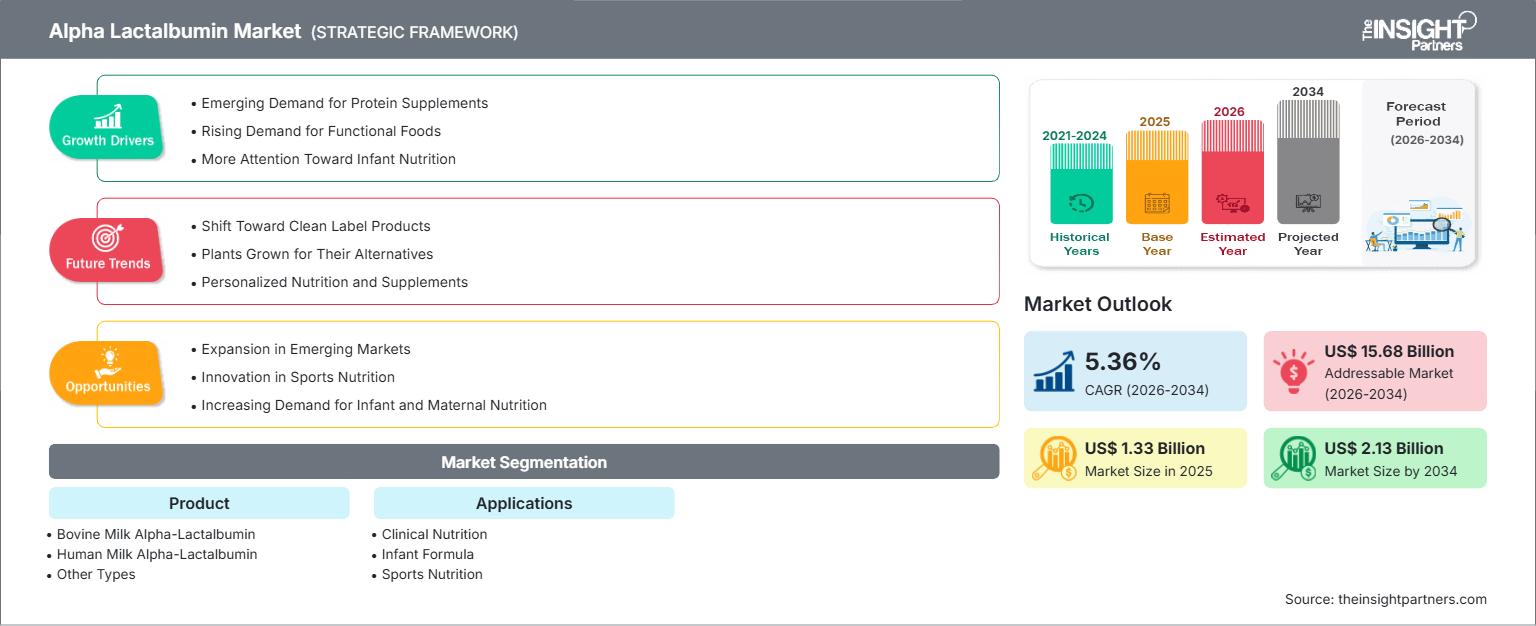
The alpha lactalbumin market size was valued at US$ 1.33 Billion in 2025 and is projected to reach US$ 2.13 Billion by 2034, expanding at a CAGR of 5.36% during 2026–2034. Growing demand for infant nutritional products, clinical nutritional products, and high-grade dairy proteins has contributed to the growth of the market. Increased investments in dairy ingredient production as well as improvements in protein separation technology have further contributed to the market’s commercial attractiveness.
North America is likely to continue its leadership as one of the key regions of the alpha lactalbumin market due to the increasing consumption of protein-enriched products, increasing use of alpha-lactalbumin in clinical nutrition applications, as well as innovations in the infant formula ingredients market. North America is projected to record a CAGR ranging from 5.0% to 5.6% between 2026 and 2034.
Alpha Lactalbumin Market Assessment and Insights
- North America: North America accounted for 34–38% share in 2025 and is projected to expand at a CAGR of 5.0–5.6% during 2026–2034, driven by premium infant nutrition demand, established dairy processing infrastructure, and increasing use of functional proteins in medical nutrition formulations.
- U.S.: The U.S. represented 76–80% of North America's market in 2025 and is forecast to register a CAGR of 5.1–5.7% during 2026–2034, supported by innovation in specialized dairy ingredients and expanding clinical nutrition applications.
- Europe: Europe held 29–33% share in 2025 and is expected to grow at a CAGR of 5.2–5.8% during 2026–2034, led by Denmark, Germany, France, and the Netherlands owing to strong dairy processing capabilities and premium infant formula manufacturing.
- Asia Pacific: Asia Pacific captured 22–26% alpha lactalbumin market share in 2025 and is anticipated to record the fastest regional CAGR of 5.9–6.5% during 2026–2034, supported by rising birth rates in selected economies, growing middle-class spending, and expanding clinical nutrition demand across China, India, Japan, and Australia.
- Largest Segment: Infant Formula accounted for 44–48% market share in 2025 and is projected to grow at a CAGR of 5.5–6.1% during 2026–2034, supported by increasing preference for human milk-inspired nutritional ingredients.
- High Growth Segment: Clinical Nutrition represented 20–24% market share in 2025 and is forecast to expand at a CAGR of 6.3–6.9% during 2026–2034, driven by increasing elderly populations and demand for medical nutrition products.
- Key companies analyzed in detail: Arla Foods Ingredients Group P/S, Hilmar Ingredients, Milk Specialties Global, Merck KGaA, Agropur, Inc., Fonterra Co-operative Group Limited, FrieslandCampina Ingredients, Kerry Group plc, Glanbia plc, Lactalis Ingredients.
Source: The Insight Partners' analysis based on proprietary research, government publications, company annual reports, investor presentations, industry databases, and expert interviews.
Advancements in dairy protein fractionation technologies have significantly improved the commercial viability of high-purity alpha lactalbumin production. Manufacturers are increasingly adopting precision membrane filtration, chromatography, and sustainable processing techniques to enhance protein recovery while maintaining nutritional integrity. These technological improvements have expanded product applications beyond infant formula into clinical nutrition, sports nutrition, and functional food categories, strengthening the overall Alpha Lactalbumin Market growth across global value chains.
Future market development will increasingly depend on expanding production capacity in Asia Pacific, investments in premium dairy ingredients, and evolving regulatory standards for infant and medical nutrition products. Companies are expected to prioritize sustainable manufacturing, traceable dairy sourcing, and research collaborations to improve product functionality while addressing growing consumer demand for scientifically validated nutritional ingredients across diverse healthcare and wellness applications.
Alpha Lactalbumin Market Report Scope
| Report Attribute | Details |
|---|---|
| Market size in 2025 | US$ 1.33 Billion |
| Market Size by 2034 | US$ 2.13 Billion |
| Global CAGR (2026 - 2034) | 5.36% |
| Historical Data | 2021-2024 |
| Forecast period | 2026-2034 |
Alpha Lactalbumin Market Analysis
Growing consumer awareness regarding the nutritional importance of whey proteins continues to accelerate demand for alpha lactalbumin across specialized nutrition applications. The excellent amino acid profile, digestion capabilities, and functional bioactivity of alpha lactalbumin have made it an important ingredient in infant formula, clinical nutrition, and sports nutrition applications. Higher spending on healthcare and aging populations are additional drivers of demand for high-quality nutritional ingredients.
The alpha lactalbumin market report highlights that the value chain is made up of integrated dairy cooperatives, protein processing companies, ingredient manufacturers, food formulators, and pharmaceutical nutrition firms. Advanced milk protein fractionation processes have resulted in increased production efficiencies and quality products. Improved cold-chain logistics and dairy products trade across the globe have contributed to supply.
The alpha lactalbumin market forecast indicates that competition will remain moderately consolidated, with leading dairy ingredient manufacturers emphasizing product innovation, production capacity expansion, and strategic collaborations. Companies such as Arla Foods Ingredients Group P/S, Hilmar Ingredients, FrieslandCampina Ingredients, Fonterra Co-operative Group Limited, and Kerry Group plc are strengthening their competitive positions through investments in advanced dairy protein processing technologies and the expansion of premium nutrition portfolios.
Research and development of application-specific formulations for infant formula, medical nutrition, and healthy foods is expected to gain popularity among leading suppliers. Sustainable operations, efficient milk utilization, and modern protein extraction technology are still expected to be dominant competitive factors. Strategic partnership with infant formula suppliers and healthcare nutrition companies is expected to drive their future competitiveness.
● REPORT CUSTOMIZATION
Tailor This Report To Align With Your Specific Business Requirements
This report can be customized to align precisely with your business objectives, scope, and target markets. Customization options include tailored segmentation, geography, competitive analysis, and strategic insights to support informed decision-making.
Customize This Report →WHAT YOU CAN ADJUST
- ● Segmentations
- ● Geography
- ● Competitive Analysis
- ● Language Preferences
Alpha Lactalbumin Market: Strategic Insights
Regional Insights
North America Alpha Lactalbumin Market
North America accounted for 34–38% of the global market in 2025 and is projected to register a CAGR of 5.0–5.6% during 2026–2034. The region benefits from well-established dairy processing industries, increasing demand for premium infant formula, and expanding clinical nutrition applications. Strong investments in membrane filtration technologies and sustainable dairy ingredient manufacturing continue to strengthen regional competitiveness.
Rise in consumer preferences for high-protein nutritional products along with rising use of specialized nutrition for medical conditions will ensure continued growth in the market. Regulations focused on quality and safety of food products and traceability of ingredients will motivate companies to manufacture high purity alpha lactalbumin products.
U.S. Alpha Lactalbumin Market
The U.S. represented 76–80% of North America's market in 2025 and is anticipated to expand at a CAGR of 5.1–5.7% during 2026–2034. The country's advanced dairy processing capabilities, strong healthcare nutrition sector, and growing functional food industry continue to drive demand for premium protein ingredients across multiple applications.
Ingredient manufacturers are still pouring their resources into the science behind protein separation, collaborative research efforts, and unique nutrition formulation. Consumer demands for protein-rich drinks, clinical nutrition formulas, and baby formula innovation are driving the market development for the future.
Europe Alpha Lactalbumin Market
Europe accounted for 29–33% of the global market in 2025 and is projected to grow at a CAGR of 5.2–5.8% during 2026–2034. Denmark remains the regional leader due to its advanced dairy processing infrastructure and globally recognized infant nutrition ingredient manufacturers.
Germany is continuing to grow the sectors of clinical nutrition and functional foods, leading to ongoing demand for high-quality proteins. The country is investing in food innovations and nutritional research, thereby providing strong markets for specific proteins.
France, Italy, and the Netherlands are all growing steadily through high-end dairy production, food processing, and exporting of special nutritional proteins. Regular investments in sustainable dairy production ensure continued competitive advantages in the region.
APAC Alpha Lactalbumin Market
Asia Pacific captured 22–26% share in 2025 and is forecast to register a CAGR of 5.9–6.5% during 2026–2034. China remains the largest regional market owing to sustained demand for premium infant formula.
Japan and Australia continue their development in advanced clinical nutrition and functional dairy products. India is proving to be an interesting prospect due to the rise in expenditure on health care and dairy processing capacity.
Government support in food safety, domestic dairy modernization, and nutritional security continues to strengthen regional production capacity while promoting the use of premium whey proteins.
Middle East & Africa Alpha Lactalbumin Market
The Middle East & Africa market is projected to expand at a CAGR of 4.8–5.4% during 2026–2034. Saudi Arabia and the UAE continue investing in food security initiatives and premium nutritional product imports.
South Africa remains the leading African market through growing healthcare nutrition awareness and expanding retail distribution for specialized nutritional products.
Improving dairy processing infrastructure, increasing healthcare investments, and greater consumer awareness regarding protein-rich nutrition are expected to create sustainable long-term opportunities across the Rest of the Middle East & Africa.
Segmentation Analysis
Product
The Product segment in the alpha lactalbumin market is projected to grow at a CAGR of 5.2–5.7% during 2026–2034, supported by rising demand for high-purity dairy proteins in infant formula and clinical nutrition. Product differentiation based on protein source and functional purity is becoming increasingly important for manufacturers targeting premium nutrition applications.
The bovine milk alpha-lactalbumin continues to hold dominance in the sub-segment due to its high availability and economical use in mass production of dairy products. On the other hand, the Human Milk Alpha-Lactalbumin has attracted more interest lately because of its similarity to the breast milk composition.
- Bovine Milk Alpha-Lactalbumin: This sub-segment dominates due to extensive dairy supply chains and established extraction infrastructure, making it highly suitable for infant formula and sports nutrition formulations requiring scalable protein sourcing.
- Human Milk Alpha-Lactalbumin: This sub-segment is gaining traction in premium infant nutrition applications due to its structural similarity to human breast milk, supporting improved digestion, immune development, and neonatal health outcomes.
- Other Types: Includes emerging protein variants used in specialized nutritional research and experimental formulations, primarily targeted at niche clinical nutrition and advanced biomedical applications.
Applications
The Applications segment is anticipated to grow at a CAGR of 5.4-5.9% from 2026 to 2034, on account of the growing demand for personalized nutrition products in the healthcare and wellness sectors. Increasing awareness regarding the quality of proteins and their amino acid profile will further boost their acceptance in both infant and clinical nutrition segments.
Increasing incorporation of alpha lactalbumin in functional foods and sports nutrition will further contribute towards boosting its commercial value. Growing aging population and prevalence of lifestyle diseases are some other factors fueling demand for protein-based nutritional solutions.
- Clinical Nutrition: Strong adoption in hospital-based nutrition therapies due to its high digestibility and essential amino acid profile, supporting recovery in critically ill and elderly patients.
- Infant Formula: Largest application area, driven by demand for breast milk-resembling protein composition that supports infant growth, immunity, and cognitive development.
- Sports Nutrition: Increasing usage among athletes and fitness consumers seeking high-quality whey proteins for muscle recovery and performance enhancement.
- Healthy Foods: Expanding integration into functional foods and beverages aimed at general wellness, weight management, and daily protein enrichment.
Opportunity Snapshot
| Segment Name | Revenue Contribution | Trend Tag | Adoption Stage |
| Clinical Nutrition | Medium | Medical Protein | Scaling |
| Infant Formula | High | Premium Infant | Mature |
| Sports Nutrition | Medium | Performance Protein | Scaling |
| Healthy Foods | Low | Functional Foods | Emerging |
Alpha Lactalbumin Market Growth Drivers and Impact Analysis
Rising demand for premium infant nutrition formulations
The growing concern about infant well-being and nutrition around the world has been fueling the demand for alpha lactalbumin. The increasing importance attached to the quality of infant nutrition products by government bodies and health agencies such as WHO has led to the addition of high-grade whey proteins to make infant formula more similar to breast milk. Alpha lactalbumin is an ingredient that is used in several infant formulas owing to its easy digestibility and essential amino acid content. Higher rates of childbirth in emerging economies along with higher levels of women participation in the workforce have further increased the usage of fortified infant nutrition products. Parents' growing knowledge about protein quality and immunity boosting nutrients is another factor that has led to the consumption of premium products.
Expansion of clinical and medical nutrition applications
Rising utilization of protein nutrition therapies is another key factor driving market growth of alpha lactalbumin. The increasing use of nutritional formulas for older patients, patients recovering from surgery, and patients with chronic ailments by hospitals and other healthcare establishments is driving the market of alpha lactalbumin. The biological quality and easy digestibility of alpha lactalbumin makes it an ideal ingredient for clinical nutrition formula used in patients who have poor digestion or higher protein needs. Rising aging population in Europe, Japan, and North America is driving demand for therapeutic nutrition formula. Furthermore, the rising incidence of diseases linked to changes in lifestyle such as cancer and metabolic diseases is driving demand for hospital nutritional interventions.
Advancements in dairy protein processing technologies
Technological improvements in dairy processing techniques like membrane filtration, chromatography, and enzymatic fractionation have improved the efficiency and purity of alpha lactalbumin production considerably. This has resulted in reduced costs and higher yields of high-quality protein, thus facilitating its use in a wide range of applications. There is a rising trend among dairy processors to set up processing plants that guarantee the quality and scalability of protein production. Moreover, sustainable processing techniques have become increasingly important for the reduction of water and energy costs of protein extraction from dairies. Furthermore, regulatory authorities have started encouraging safety and transparency in food production systems, leading dairy processors towards using advanced purification techniques. All of this has expanded the scope of alpha lactalbumin utilization in various applications.
Alpha Lactalbumin Market Future Trends
Shift toward human milk–based protein optimization
A key alpha lactalbumin market trend is the increasing shift toward human milk–optimized protein formulations, particularly in infant nutrition. Manufacturers are focusing on replicating the nutritional profile of breast milk more accurately by enhancing the protein ratio and amino acid composition in infant formula products. This trend is driven by growing scientific research highlighting the importance of early-life nutrition in long-term health outcomes. Companies are investing in bioengineering and precision dairy fractionation technologies to produce proteins with higher structural similarity to human milk. Regulatory agencies are also encouraging improved nutritional standards in infant food products. As a result, demand for high-purity alpha lactalbumin is expected to grow steadily across premium infant nutrition segments globally.
Integration of functional proteins into personalized nutrition systems
Personalized nutrition is emerging as a transformative trend influencing demand for alpha lactalbumin across healthcare and wellness applications. Increasing consumer awareness of protein quality and individualized dietary needs is encouraging manufacturers to develop tailored nutritional solutions based on age, health status, and activity levels. Digital health platforms and nutrigenomics are supporting this shift by enabling more precise dietary recommendations. Alpha lactalbumin is gaining importance due to its high bioavailability and adaptability across multiple formulations, including beverages, supplements, and medical nutrition products. Companies are exploring AI-driven formulation technologies to optimize protein blends for specific health outcomes. This trend is expected to significantly expand the market scope, particularly in developed economies with advanced healthcare infrastructure.
Alpha Lactalbumin Market Opportunities
Expansion in emerging dairy protein manufacturing hubs
Emerging economies in Asia Pacific and Latin America present significant opportunities for alpha lactalbumin production and consumption. Countries such as India and China are investing heavily in dairy modernization, cold chain infrastructure, and nutritional security programs. These developments are creating favorable conditions for large-scale production of high-value dairy proteins. Local manufacturing reduces import dependency while improving cost competitiveness in regional markets. Additionally, rising disposable incomes and urbanization are driving demand for premium infant formula and functional foods. Governments are also supporting domestic dairy industries through subsidies and technology transfer initiatives. This creates strong opportunities for global ingredient manufacturers to establish joint ventures, local processing facilities, and distribution partnerships to capture long-term growth potential.
Growth in sports nutrition and wellness applications
The increasing global focus on fitness, preventive healthcare, and protein-rich diets is driving opportunities in sports nutrition and wellness applications. Consumers are increasingly adopting high-protein dietary regimes, particularly in urban and developed markets. Alpha lactalbumin’s superior amino acid profile and digestibility make it an attractive ingredient for sports recovery drinks, protein powders, and functional beverages. Fitness industry expansion, coupled with rising gym memberships and athleisure trends, is supporting sustained demand growth. Additionally, e-commerce platforms are improving accessibility to specialized nutrition products, enabling wider consumer penetration. Manufacturers are investing in innovative formulations combining alpha lactalbumin with other bioactive ingredients to enhance performance and recovery benefits, strengthening long-term market expansion opportunities.
Recent Developments
- September 2025: Arla Foods Ingredients Group P/S expanded its production capacity for specialized whey protein fractions, including alpha-lactalbumin, at its Denmark facility to meet rising global demand for infant formula and clinical nutrition ingredients. The expansion focuses on improving membrane filtration efficiency and sustainability performance across dairy protein production systems.
- June 2025: Hilmar Ingredients announced investments in advanced protein separation technologies in its U.S. facilities to enhance production of high-purity whey proteins, including alpha-lactalbumin. The initiative aims to support growing demand in sports nutrition and medical nutrition markets.
- March 2025: Agropur, Inc. launched upgraded dairy protein processing lines designed to improve yield and purity of specialty milk proteins, strengthening its portfolio for infant formula and functional food applications across North America and global export markets.
Frequently Asked Questions

- Comprehensive Market Sizing and Forecast Analysis
- Detailed Segmentation Analysis
- In-Depth Market Dynamics Assessment
- Regional and Country-Level Insights
- Competitive Landscape and Company Benchmarking
- Strategic Business Intelligence
Recent Reports
Testimonials

The Insight Partners provided valuable market intelligence that supported our global go-to-market strategy. Their team was professional, responsive, and attentive to our feedback, providing thoughtful analysis and helpful methodological clarifications throughout the project.
Junmo Kim Chief Financial Officer (CFO), Enertech Co., Ltd.
The Insight Partners' SCADA System Market report is comprehensive, with valuable insights on current trends and future forecasts. The team was highly professional, responsive, and supportive throughout. We are very satisfied and highly recommend their services.
RAN KEDEM Partner, Reali Technologies LTDs
I requested a report on a very specific software market and the team produced the report in a few days. The information was very relevant and well presented. I then requested some changes and additions to the report. The team was again very responsive and I got the final report in less than a week.
JEAN-HERVE JENN Chairman, Future Analytica
We worked with The Insight Partners for an important market study and forecast. They gave us clear insights into opportunities and risks, which helped shape our plans. Their research was easy to use and based on solid data. It helped us make smart, confident decisions. We highly recommend them.
PIYUSH NAGPAL Sr. Vice President, High Beam Global
The Insight Partners delivered insightful, well-structured market research with strong domain expertise. Their team was professional and responsive throughout. The user-friendly website made accessing industry reports seamless. We highly recommend them for reliable, high-quality research services
YUKIHIKO ADACHI CEO, Deep Blue, LLC.
This is the first time I have purchased a market report from The Insight Partners.While I was unsure at first, I visited their web site and felt more comfortable to take the risk and purchase a market report.I am completely satisfied with the quality of the report and customer service. I had several questions and comments with the initial report, but after a couple of dialogs over email with their analyst I believe I have a report that I can use as input to our strategic planning process.Thank you so much for taking the extra time and making this a positive experience.I will definitely recommend your service to others and you will be my first call when we need further market data.
JOHN SUZUKI President and Chief Executive Officer, Board Director, BK Technologies
I wish to appreciate your support and the professionalism you displayed in the course of attending to my request for information regarding to infectious disease IVD market in Nigeria. I appreciate your patience, your guidance, and the fact that you were willing to offer a discount, which eventually made it possible for us to close a deal. I look forward to engaging The Insight Partners in the future, all thanks to the impression you have created in me as a result of this first encounter.
DR CHIJIOKE ONYIA MANAGING DIRECTOR, PineCrest Healthcare Ltd.Reason to Buy
- Informed Decision-Making
- Understanding Market Dynamics
- Competitive Analysis
- Identifying Emerging Markets
- Customer Insights
- Market Forecasts
- Risk Mitigation
- Boosting Operational Efficiency
- Strategic Planning
- Investment Justification
- Tracking Industry Innovations
- Aligning with Regulatory Trends





 Get Free Sample for