
Aluminum Curtain Wall Market Trends, Size & Growth by 2034
Coverage: By Type (Stick-built, Semi-Unitized, Unitized); Application (Commercial, Residential), and Geography (North America, Europe, Asia Pacific, and South and Central America)
- Status : Data Released
- Report Code : TIPRE00016129
- Category : Manufacturing and Construction
- No. of Pages : 150
- Available Report Formats :


- Last update date : July 13, 2026


2025 Market Size
US$ 45.60 Mn
Base year value
2034 Forecast
US$ 75.70 Mn
Projected by 2034
CAGR 2026-2034
5.80 %
Growth rate
Addressable Market
US$ 549.83 Mn
(2026-2034)
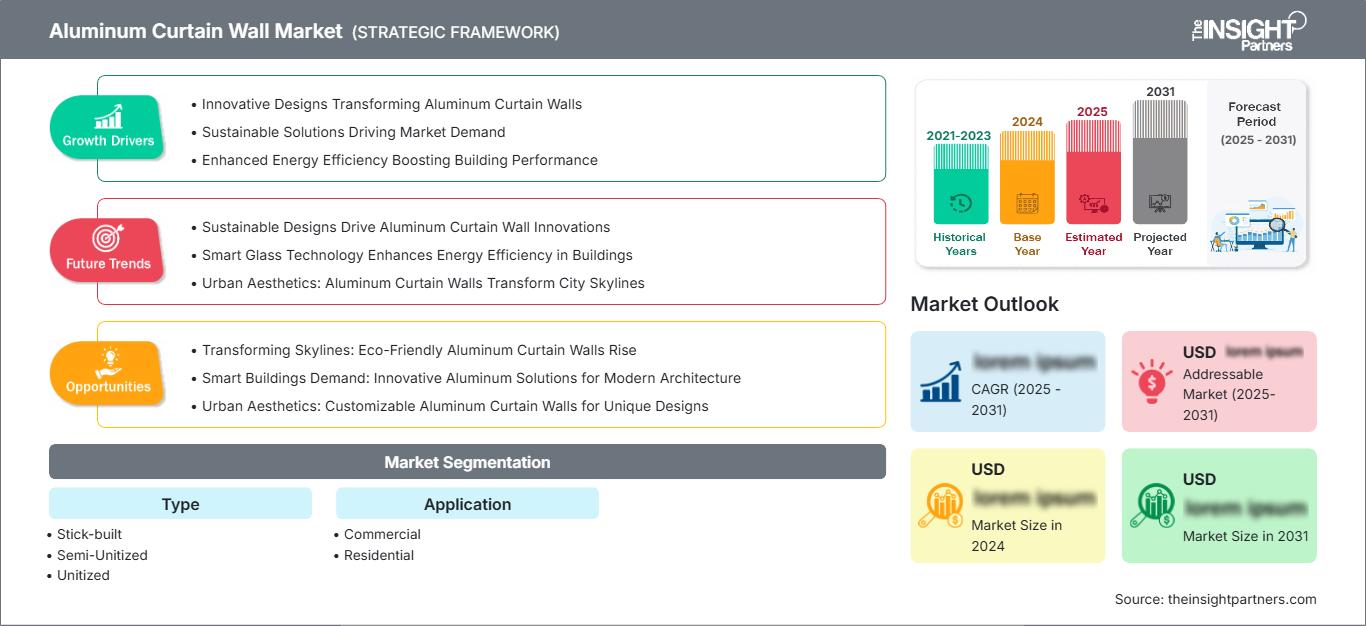
The aluminum curtain wall market size is expected to grow from US$ 45.60 Million in 2025 to US$ 75.70 Million by 2034. It is projected to register a CAGR of 5.80% from 2026 to 2034. Demand is supported by wider use of lightweight facade systems, energy-conscious commercial architecture, and preference for visually open building envelopes across urban construction projects.
Across North America, the aluminum curtain wall market size is supported by office modernization, mixed-use towers, and retrofit programs that prioritize lower envelope heat transfer. The region is estimated to expand at a 5.4–5.9% CAGR during 2026–2034, helped by stricter energy codes and demand for unitized systems that reduce site labor while improving installation consistency.
Aluminum Curtain Wall Market Assessment and Insights
- North America: The region represented 28–32% share in 2025 and is expected to grow at a 5.4–5.9% CAGR between 2026–2034, led by commercial retrofits, institutional projects, and higher envelope performance requirements.
- US: The U.S. accounted for 76–80% of North America in 2025 and is forecast to grow at a 5.3–5.8% CAGR between 2026–2034.
- Europe: Europe held 22–26% share in 2025 and is projected to grow at a 4.9–5.4% CAGR between 2026–2034, with Germany, the UK, France, Italy, and Spain leading demand.
- Asia Pacific: Asia Pacific captured 30–34% share in 2025 and is set to grow at a 6.3–6.8% CAGR between 2026–2034, driven by China, India, Japan, South Korea, and Australia.
- Largest Segment: Unitized systems held 41–45% market share in 2025 and are expected to grow at a 6.0–6.5% CAGR between 2026–2034.
- High Growth Segment: Residential applications held 24–28% market share in 2025 and are forecast to grow at a 6.1–6.6% CAGR between 2026–2034.
- Key companies analyzed in detail: ALUMIL Aluminium Industry S.A., ARCAT, Inc., Capitol Aluminum and Glass Corporation, EFCO, LLC, EXTECH/Exterior Technologies, Inc., GUTMANN AG, HansenGroup Ltd., Kawneer Company, Inc., Sapa Building Systems Ltd., and YKK AP America Inc.
Source: The Insight Partners' analysis based on proprietary research, government publications, company annual reports, investor presentations, industry databases, and expert interviews.
Engineering of facades has evolved from on-site fabricated systems to pre-assembled systems with testing performance for risk reduction in construction. The aluminum system profiles have evolved to incorporate better thermal breaks, larger glazing spans, and tighter tolerances. Furthermore, the fabrication plants utilize computer-aided design models in fabrication for repeatability. Dynamic production processes involve coordination between extruders and facade fabricators early in the design process to cater for wind pressure, acoustic, condensation control, and carbon accounting.
Demand within the forecast period is likely to diversify from exclusive high-end office buildings to include health care facilities, educational buildings, transportation, and residential developments. New geographies will likely expand capacities in the unitized facade while mature geographies will focus on the energy upgrade of existing building structures. Favorable tailwinds through building energy code, green building certification, and urban heat management are likely to shift the specification towards more performing assemblies that drive the aluminum curtain wall market growth.
Aluminum Curtain Wall Market Report Scope
| Report Attribute | Details |
|---|---|
| Market size in 2025 | US$ 45.60 Million |
| Market Size by 2034 | US$ 75.70 Million |
| Global CAGR (2026 - 2034) | 5.80% |
| Historical Data | 2021-2024 |
| Forecast period | 2026-2034 |
Aluminum Curtain Wall Market Analysis
The forecast for the aluminum curtain wall market is based on the demand created from commercial building sectors that need a quick envelope, better daylight, and reduced energy consumption. Contractors are opting for glazed units when schedule pressure is a concern whereas the stick-built curtain walls are applicable for smaller projects or those with unique designs. These value chain processes include aluminum extrusion, glass fabrication, gasket, anchoring, sealing compounds, engineering, and specialized curtain wall installers.
The supply conditions are determined by fluctuations in aluminum costs, extrusion capabilities, and availability of skilled installers of facades. Purchasing departments are increasingly assessing the lifecycle value and not just the cost of installations as poor air tightness, thermal bridging, and poor installation can impose maintenance costs and higher energy consumption over time.
The aluminum curtain wall market report reveals the fragmented nature of the competition landscape between global system houses, regional fabricators, and specification platforms using engineering assistance, project references, and building code compliance. Companies like Kawneer Company, Inc., YKK AP America Inc., EFCO, LLC, and ALUMIL Aluminium Industry S.A. have their strengths in proven systems, whereas EXTECH/Exterior Technologies, Inc. and GUTMANN AG are geared towards specialty architecture.
The aluminum curtain wall market trends for investments revolve around digital estimating, pre-BIM libraries, automated cutting technology, and fabrication lines with minimized reworking opportunities. Capitol Aluminum and Glass Corporation, HansenGroup Ltd., Sapa Building Systems Ltd., ARCAT, Inc., and other members of the ecosystem contribute to specifying projects. Strategic positioning relates more and more to validated thermal performance and regional availability.
● REPORT CUSTOMIZATION
Tailor This Report To Align With Your Specific Business Requirements
This report can be customized to align precisely with your business objectives, scope, and target markets. Customization options include tailored segmentation, geography, competitive analysis, and strategic insights to support informed decision-making.
Customize This Report →WHAT YOU CAN ADJUST
- ● Segmentations
- ● Geography
- ● Competitive Analysis
- ● Language Preferences
Aluminum Curtain Wall Market: Strategic Insights
Regional Insights
North America Aluminum Curtain Wall Market
North America accounted for 28–32% share in 2025, and the aluminum curtain wall market share is supported by commercial renovation, healthcare construction, airports, and higher-performance institutional buildings. The region is projected to expand at a 5.4–5.9% CAGR, with demand tied to tighter envelope codes, LEED-oriented projects, and replacement of older facade systems.
Unitized systems are gaining ground because they reduce field labor and improve quality control in dense urban projects. Canada and the U.S. both emphasize thermal performance, condensation resistance, and acoustic control. Building owners are also linking facade decisions to operating cost reduction, resilience against severe weather, and compliance with local carbon-reduction policies.
U.S. Aluminum Curtain Wall Market
The U.S. represented 76–80% of North America in 2025 and is expected to grow at a 5.3–5.8% CAGR through 2034. Demand is concentrated in office repositioning, universities, healthcare campuses, logistics-adjacent offices, and mixed-use towers where facade upgrades improve leasing appeal and energy performance.
Company presence is broad, with Kawneer Company, Inc., YKK AP America Inc., EFCO, LLC, ARCAT, Inc., and EXTECH/Exterior Technologies, Inc. supporting specifications and project execution. Commercial applications dominate, but residential towers in major cities increasingly use aluminum curtain wall systems to deliver larger glazed areas, slimmer sightlines, and improved wind-load performance.
Europe Aluminum Curtain Wall Market
Europe held 22–26% share in 2025 and is forecast to record a 4.9–5.4% CAGR. Germany is the leading country because energy renovation, technical building standards, and industrialized facade manufacturing are well established. The UK is driven by office refurbishment, mixed-use redevelopment, and stricter post-occupancy performance expectations.
France, Italy, and Spain contribute through public infrastructure, hospitality refurbishments, and urban residential projects that require visually efficient envelopes. European specifications often emphasize low-emissivity glazing, thermal breaks, fire safety, and recyclability. Suppliers such as ALUMIL Aluminium Industry S.A., GUTMANN AG, HansenGroup Ltd., and Sapa Building Systems Ltd. benefit from regional engineering depth.
APAC Aluminum Curtain Wall Market
APAC accounted for 30–34% share in 2025 and is projected to grow at a 6.3–6.8% CAGR, making it the fastest regional growth area. China remains the leading country, supported by high-rise construction, urban redevelopment, and domestic facade manufacturing scale.
Japan and South Korea prioritize seismic detailing, precision installation, and premium commercial envelopes. India and Australia add growth through metro developments, technology parks, hospitals, and green building programs. Policy emphasis on energy-efficient buildings and industrialized construction favors semi-unitized and unitized aluminum curtain wall adoption across dense cities.
Middle East & Africa Aluminum Curtain Wall Market
Middle East & Africa is expected to grow at a 5.6–6.1% CAGR, led by the UAE and Saudi Arabia. Demand is linked to hospitality, commercial towers, airports, and government-backed infrastructure where facade aesthetics must align with heat control and sand-resistant performance.
South Africa and the Rest of MEA provide selective opportunities through office upgrades, retail centers, and public projects. Energy-intensive climates place emphasis on solar control glazing, shading integration, and durable finishes. Project selection is increasingly shaped by lifecycle maintenance costs and availability of experienced facade contractors.
Segmentation Analysis
Type
The Type segment in the Aluminum Curtain Wall Market forecast is expected to grow at a 5.7–6.2% CAGR during 2026–2034. The aluminum curtain wall market scope across system types reflects project scale, installation method, labor availability, and performance requirements. Unitized systems lead large towers, semi-unitized solutions balance prefabrication and flexibility, and stick-built systems remain useful for customized or lower-rise applications.
- Stick-built: Stick-built systems remain important for low-rise buildings, complex geometries, and projects requiring on-site adjustment. Their strategic value lies in design flexibility and suitability for smaller commercial facades.
- Semi-Unitized: Semi-unitized systems serve mid-scale developments where partial prefabrication improves speed without sacrificing field adaptability. Demand is strongest in offices, hospitals, and education buildings with controlled budgets.
- Unitized: Unitized systems dominate large projects because factory assembly improves quality, water control, and schedule certainty. Their importance increases where labor shortages and urban site constraints affect installation.
Application
The Application segment is expected to grow at a 5.8–6.3% CAGR during 2026–2034. Commercial buildings remain the core demand base because offices, hotels, airports, hospitals, and retail assets require durable, transparent envelopes. Residential adoption is rising in premium towers where developers use aluminum curtain wall systems to improve daylight, views, and exterior differentiation.
- Commercial: Commercial applications account for the strongest revenue contribution because large floorplates, brand-sensitive architecture, and energy codes favor tested facade systems across offices, healthcare, hospitality, and transport assets.
- Residential: Residential applications are scaling in high-density cities where premium apartments require daylight, view corridors, and slim profiles. Developers value differentiated exteriors and improved envelope performance.
Opportunity Snapshot
| Application | Revenue Contribution | Trend Tag | Adoption Stage |
| Commercial | High | Office Retrofit | Mature |
| Residential | Medium | Urban Towers | Scaling |
Aluminum Curtain Wall Market Growth Drivers and Impact Analysis
Energy Codes Push Higher-Performance Facades
The built environment consumes a large amount of final energy, and the efficiency of the envelope plays a critical role in determining the energy needs for heating, cooling, and lighting. This makes the use of the aluminum curtain wall system highly significant if the system is used together with thermal breaks, insulated glass units, and low emissivity coatings. In light of the stricter local building codes on energy consumption, developers are utilizing the performance tested facade systems to help meet the requirements without sacrificing design transparency.
Prefabrication Reduces Schedule and Quality Risk
The constraints on construction labor and shortened timelines for completion are making the use of factory-produced facade modules more attractive. Unitized aluminum curtain walls move the activities of glazing, sealing, and testing of panels to more predictable production sites, minimizing weather interference and mistakes that could happen in the field. In the case of high-rise buildings, the speed of enclosure allows work on the inside by other contractors to be started sooner, thus improving the sequencing of activities in the whole project. The effect becomes especially pronounced in crowded urban areas with limited availability of crane lifts, street access, and storage facilities.
Urban Redevelopment Expands Retrofit Demand
A large number of buildings that were previously constructed prior to today’s energy codes must upgrade their facades in order to stay relevant. Upgrading aluminum curtain walls will provide better daylighting, reduced air infiltration and aesthetic updates without the need for structural renovations of the building. Investors in real estate are focusing on retrofitting efforts which help tenants stay in place, cut costs and comply with local carbon regulations. This effect of demand on the market is long-lasting since the process of renovation continues even if there is no new construction activity.
Aluminum Curtain Wall Market Future Trends
Smart Glass and Adaptive Envelope Integration
Current trends within the aluminum curtain wall sector are shifting towards intelligent management of light, heat, and glare through dynamic building facades. With the advent of smart glass and automated shading systems, building envelopes could be made to automatically adapt to varying environmental and occupancy conditions. Future standards would probably include linking building envelope performance with building management systems for easier management of comfort and energy consumption. These systems would initially gain acceptance within high-value environments such as premium office buildings, airports, hospitals, and technology parks.
Lower-Carbon Aluminum and Circular Facade Design
The procurement process in the future is likely to put more weight on the recycled content of aluminum, environmental declarations, and building facades that are easily dismantled. Aluminum is very easy to recycle; however, the demand for recycled content that has documentation, less carbon emissions during production, and products that can be fixed or reused is rising. The issue is likely to affect the requirements, particularly in Europe and North America, where embodied carbon declaration is becoming common.
Aluminum Curtain Wall Market Opportunities
Retrofit Packages for Occupied Commercial Buildings
Suppliers may develop distinctive retrofit systems incorporating surveys, engineering, mock-up tests, staged installation and tenant disruption management. Predictions for the aluminum curtain wall industry show an ongoing stream of aged commercial property requiring better-performing envelope systems without total demolition. Businesses able to provide flexible anchorage, fast panel replacement and payback data would be ideal for owners looking to reduce operating costs and improve property value. Ideal applications would occur in office conversions, hospitals, educational facilities, and hotel retrofits where façade work needs to be done while operations continue.
Localized Fabrication in High-Growth Cities
Cities experiencing growth in APAC and the Middle East have the potential to provide opportunities for localized manufacturing collaborations, reducing lead times and increasing responsiveness in projects. Façade providers can utilize local capabilities in fabrication, installer training, and localized engineering services related to the codes to take on larger commercial and mixed-use projects. This will help to reduce the costs associated with transportation and importation. In the case of developers, the availability of localized fabrication makes it easier to collaborate during changes in design or sequencing of the site.
Recent Developments
- June 2026: Kawneer Company, Inc. — highlighted its 2500 UT Plus Unitwall system, emphasizing ultra-thermal efficiency, performance testing, and support for resilient commercial building envelopes in North America. The launch reinforces demand for unitized facade systems that combine factory quality control with improved energy performance.
- March 2026: Linetec provided architectural finishing services for the new Pine Rest Pediatric Center of Behavioral Health in Michigan, supporting the project’s aluminum curtain wall and window systems. The facility features Tubelite 400T Series Curtain Wall systems and Wausau behavioral care windows, with Linetec delivering high-performance fluoropolymer paint finishes designed to enhance durability, appearance, and long-term performance.
Frequently Asked Questions

- Comprehensive Market Sizing and Forecast Analysis
- Detailed Segmentation Analysis
- In-Depth Market Dynamics Assessment
- Regional and Country-Level Insights
- Competitive Landscape and Company Benchmarking
- Strategic Business Intelligence
Recent Reports
Testimonials

The Insight Partners' SCADA System Market report is comprehensive, with valuable insights on current trends and future forecasts. The team was highly professional, responsive, and supportive throughout. We are very satisfied and highly recommend their services.
RAN KEDEM Partner, Reali Technologies LTDs
I requested a report on a very specific software market and the team produced the report in a few days. The information was very relevant and well presented. I then requested some changes and additions to the report. The team was again very responsive and I got the final report in less than a week.
JEAN-HERVE JENN Chairman, Future Analytica
We worked with The Insight Partners for an important market study and forecast. They gave us clear insights into opportunities and risks, which helped shape our plans. Their research was easy to use and based on solid data. It helped us make smart, confident decisions. We highly recommend them.
PIYUSH NAGPAL Sr. Vice President, High Beam Global
The Insight Partners delivered insightful, well-structured market research with strong domain expertise. Their team was professional and responsive throughout. The user-friendly website made accessing industry reports seamless. We highly recommend them for reliable, high-quality research services
YUKIHIKO ADACHI CEO, Deep Blue, LLC.
This is the first time I have purchased a market report from The Insight Partners.While I was unsure at first, I visited their web site and felt more comfortable to take the risk and purchase a market report.I am completely satisfied with the quality of the report and customer service. I had several questions and comments with the initial report, but after a couple of dialogs over email with their analyst I believe I have a report that I can use as input to our strategic planning process.Thank you so much for taking the extra time and making this a positive experience.I will definitely recommend your service to others and you will be my first call when we need further market data.
JOHN SUZUKI President and Chief Executive Officer, Board Director, BK Technologies
I wish to appreciate your support and the professionalism you displayed in the course of attending to my request for information regarding to infectious disease IVD market in Nigeria. I appreciate your patience, your guidance, and the fact that you were willing to offer a discount, which eventually made it possible for us to close a deal. I look forward to engaging The Insight Partners in the future, all thanks to the impression you have created in me as a result of this first encounter.
DR CHIJIOKE ONYIA MANAGING DIRECTOR, PineCrest Healthcare Ltd.Reason to Buy
- Informed Decision-Making
- Understanding Market Dynamics
- Competitive Analysis
- Identifying Emerging Markets
- Customer Insights
- Market Forecasts
- Risk Mitigation
- Boosting Operational Efficiency
- Strategic Planning
- Investment Justification
- Tracking Industry Innovations
- Aligning with Regulatory Trends





 Get Free Sample for