
Aluminum-extruded Products Market Growth, Trends & Forecast by 2034
Aluminum-extruded Products Market Size and Forecasts (2021 - 2034), Global and Regional Share, Trends, and Growth Opportunity Analysis Report Coverage : by Product Type (Mill-finished, Powder-coated, Anodized); End-Use Industry (Construction, Automotive, Electrical and Electronics, Machinery and Equipment); and Geography (North America, Europe, Asia Pacific, and South and Central America)
- Status : Data Released
- Report Code : TIPRE00040390
- Category : Chemicals and Materials
- No. of Pages : 150
- Available Report Formats :


- Last update date : August 17, 2026


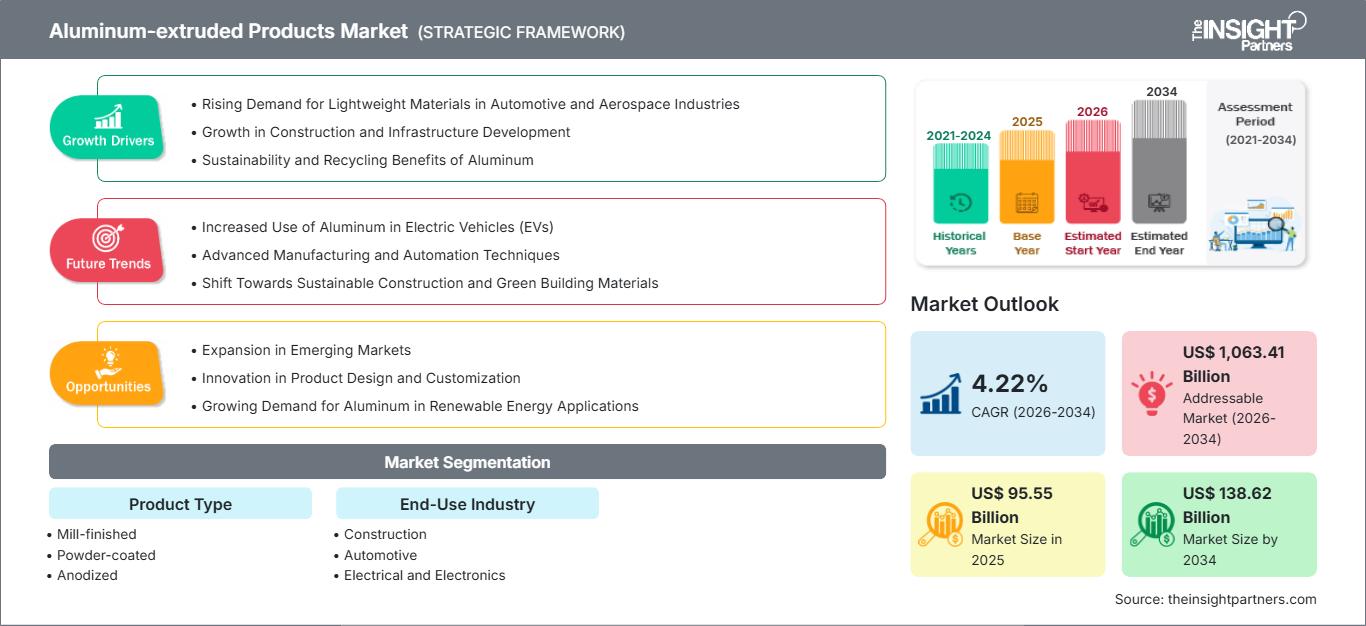
2025 Market Size
US$ 95.55 Bn
Base year value
2034 Forecast
US$ 138.62 Bn
Projected by 2034
CAGR 2026-2034
4.22 %
Growth rate
Addressable Market
US$ 1,063.41 Bn
(2026-2034)
The aluminum-extruded products market is witnessing steady expansion, supported by rising demand across construction, transportation, electrical, and industrial applications. The market was valued at US$ 95.55 Billion in 2025 and is projected to reach US$ 138.62 Billion by 2034, growing at a CAGR of 4.22% during 2026–2034. Increasing preference for lightweight, corrosion-resistant, recyclable materials and the adoption of aluminum profiles in energy-efficient infrastructure are shaping long-term market development.
North America represents a mature but innovation-driven landscape, with the aluminum-extruded products market size expanding through infrastructure refurbishment, electric vehicle manufacturing, and advanced industrial applications. The region is expected to register growth at approximately 3.8–4.3% CAGR between 2026 and 2034. Demand is supported by government-led infrastructure investments, increasing adoption of sustainable building materials, and rising utilization of extruded aluminum components in automotive structures, renewable energy systems, and electrical equipment.
Aluminum-extruded Products Market Assessment and Insights
- North America: North America held a 24–28% share in 2025 and is projected to grow at a CAGR of 3.8–4.3% between 2026–2034. The region benefits from construction renovation activities, automotive lightweighting, renewable energy installations, and domestic manufacturing investments.
- US: The US accounted for 78–82% share of North America in 2025 and is expected to grow at a CAGR of 3.9–4.4% between 2026–2034. Automotive electrification, infrastructure upgrades, and industrial modernization are strengthening extrusion demand.
- Europe: Europe represented a 21–25% share in 2025 and is anticipated to expand at a CAGR of 3.7–4.2% between 2026–2034. Germany, Italy, France, and the UK remain important markets due to automotive production, sustainable construction, and energy-efficient building regulations.
- Asia Pacific: Asia Pacific captured a 42–46% share in 2025 and is estimated to grow at a CAGR of 4.8–5.3% between 2026–2034. China dominates regional consumption, while India, Japan, and South Korea support growth through industrial expansion and electric mobility adoption.
- Largest Segment: Construction held a 39–43% market share in 2025 and is forecast to grow at a CAGR of 3.9–4.4% between 2026–2034. Aluminum profiles remain widely used in façades, windows, doors, and structural systems.
- High Growth Segment: Electrical and Electronics accounted for 14–18% market share in 2025 and is projected to achieve a CAGR of 5.3–5.8% between 2026–2034. Growth is driven by electrification, thermal management solutions, and renewable energy infrastructure.
- Key companies analyzed in detail: United Company RUSAL, Alcoa Corporation, Aluminum Corporation of China Limited (CHALCO), Rio Tinto plc, BHP Group Limited, Norsk Hydro ASA, Century Aluminum Company, China Hongqiao Group Limited, Aluminum Bahrain B.S.C. (Alba), Hindalco Industries Limited.
Source: The Insight Partners' analysis based on proprietary research, government publications, company annual reports, investor presentations, industry databases, and expert interviews.
Market growth for aluminum-extrusion products has evolved from developments within alloy design, automation in extrusion machines, and improved manufacturing techniques. Manufacturers are now favoring recycled aluminum feedstock, energy-saving processes, and online measurement systems that optimize efficiency and minimize environmental damage. The use of cutting-edge surface treatments such as anodizing and powder coating has broadened applicability into areas of architecture, automotive, and industrial engineering, where strength and performance are key.
Industry prospects continue to be buoyed by infrastructure projects, renewable energy growth, and the desire for lighter materials. Growing nations are ramping up their extrusion facilities to meet the needs of urban and industrial development, while established economies seek applications that can generate value and operate sustainably. Increasing regulatory pressure towards recyclability and low emission levels is driving aluminum innovation.
Aluminum-extruded Products Market Report Scope
| Report Attribute | Details |
|---|---|
| Market size in 2025 | US$ 95.55 Billion |
| Market Size by 2034 | US$ 138.62 Billion |
| Global CAGR (2026 - 2034) | 4.22% |
| Historical Data | 2021-2024 |
| Forecast period | 2026-2034 |
Aluminum-extruded Products Market Analysis
The aluminum-extruded products market growth is influenced by expanding construction activities, increasing vehicle lightweighting requirements, and rising demand for energy-efficient materials. The value chain includes alumina producers, aluminum smelters, billet manufacturers, extrusion companies, finishing service providers, and end-use industries. Supply dynamics are shaped by bauxite availability, energy costs, recycling rates, and regional production capacities. Construction remains the largest demand contributor, while automotive and electrical applications are creating additional opportunities for specialized profiles.
The availability of raw materials and energy efficiency still play a crucial role in the economics of extrusion. Companies have invested in recycling systems and production of aluminum using lower carbon emissions in order to cut down the reliance on primary metals. The supply chain within a specific region is transforming through vertical integration, whereby the producer controls all processes.
The aluminum-extruded products market analysis indicates increasing competition among integrated aluminum producers and specialized extrusion manufacturers. Companies such as United Company RUSAL, Alcoa Corporation, Aluminum Corporation of China Limited (CHALCO), Rio Tinto plc, and Norsk Hydro ASA are strengthening their positions through capacity optimization, sustainability initiatives, and technology investments. Hindalco Industries Limited and China Hongqiao Group Limited are expanding their downstream capabilities to address growing regional demand.
These strategic investments have been made in automatic extrusion plants, recycling of aluminum and application-specific solutions for automotive, construction, and electrical applications. Century Aluminum Company and Aluminium Bahrain B.S.C. (Alba) are still contributing towards the local supply capacity, whereas BHP Group Limited has also contributed by participating in the aluminum value chain. Competitiveness now relies on carbon efficiency, customizability of products, geographical coverage, and customer relationships.
● REPORT CUSTOMIZATION
Tailor This Report To Align With Your Specific Business Requirements
This report can be customized to align precisely with your business objectives, scope, and target markets. Customization options include tailored segmentation, geography, competitive analysis, and strategic insights to support informed decision-making.
Customize This Report →WHAT YOU CAN ADJUST
- ● Segmentations
- ● Geography
- ● Competitive Analysis
- ● Language Preferences
Aluminum-extruded Products Market: Strategic Insights
Regional Insights
North America Aluminum-extruded products market
North America accounted for a 24–28% of the aluminum-extruded products market share in 2025 and is projected to expand at a CAGR of 3.8–4.3% during 2026–2034. The market is driven by replacement demand arising from aging infrastructure, upgrading of commercial construction, energy generation from renewable sources, and increased use of aluminum in lighter transportation solutions. The USA continues to be the key source, facilitated by investments in manufacturing and infrastructure development.
The supply chain comprises companies that produce primary aluminum, extrusion companies, and further processing companies for applications in construction, automotive, aircraft, electrical, and industrial machinery industries. Canada supplies aluminum production capacities and lower carbon energy sources, whereas Mexico is becoming increasingly significant in the automotive manufacturing industry.
U.S. Aluminum-extruded products market
The U.S. represented approximately 78–82% of North America’s aluminum-extruded products market in 2025 and is estimated to grow at a CAGR of 3.9–4.4% during 2026–2034. The demand is driven by construction modernization, production of electric vehicles, and the growing application of aluminum profiles in the renewable energy sector. Investments from the government in infrastructure are promoting the shift to lighter and more eco-friendly materials from traditional heavy materials.
The major producers and processors of aluminum include Alcoa Corporation, Norsk Hydro ASA, and Hindalco Industries Limited. The automotive companies are making use of aluminum in their cars due to its strength and lightness. It finds application in frames, batteries, and cooling systems of the automobiles. There is an increased demand for aluminum extrusion in the data center, solar power, and electrical infrastructure projects.
Europe Aluminum-extruded products market
Europe held a 21–25% share of the aluminum-extruded products market in 2025 and is expected to register a CAGR of 3.7–4.2% during 2026–2034. Germany still takes precedence as the leading regional market because of the presence of automotive manufacturing facilities in the country, along with the engineering industry, and high demand for energy-efficient building materials. The UK and France also account for a significant share of extrusions consumed within the region due to the renovation projects and investments into renewable energy.
Extrusion demand in Germany depends on the automotive lightweighting industry, industrial machinery, and sustainable building products. German concerns about carbon dioxide emissions make the country interested in using recycled and low-carbon extrusion products. In the UK, the market growth is fueled by the redevelopment of infrastructure, along with aluminum windows, facades, and transport applications.
Contribution is made by Italy and Spain in terms of architecture, machinery manufacturing, and construction. Italy is well-known for its contribution in aluminum processing and design-based applications, while Spain enjoys the advantage of renewable energy and industrial upgrading. The manufacturers in Europe are becoming more involved in circular aluminum systems, advanced finish techniques, and energy-efficient production processes.
APAC Aluminum-extruded products market
Asia Pacific accounted for a 42–46% share in 2025 and is projected to grow at a CAGR of 4.8–5.3% during 2026–2034. China remains the dominant market due to large-scale construction activity, automotive production, and extensive aluminum processing capacity. India, Japan, and South Korea are expanding demand through industrial development and electric mobility adoption.
China Hongqiao Group Limited, Aluminum Corporation of China Limited (CHALCO), and other regional producers support extensive extrusion supply networks. India’s infrastructure expansion and manufacturing policies are encouraging aluminum usage, while Japan and South Korea focus on advanced automotive and electronics applications. Australia contributes through upstream aluminum resources and renewable energy initiatives, supporting regional supply chains.
Middle East & Africa Aluminum-extruded products market
The Middle East & Africa region is estimated to account for 8–12% share of the market in 2025 and is expected to grow at a CAGR of 4.0–4.5% during 2026–2034. Factors that favor growth include the development of infrastructure, the urbanization process, the development of renewable energy sources, and industrial diversification. Gulf nations are significant because of their capability in aluminum production processes.
The leading markets in the region include Saudi Arabia and the United Arab Emirates because of investments in construction projects and commercial infrastructure, as well as aluminum production facilities. Alba in Bahrain B.S.C. enhances the supply capabilities in the region, while South Africa adds to the region’s capabilities through industrial uses and construction projects.
Segmentation Analysis
Product Type
The product type segment of the market scope includes mill-finished, powder-coated, and anodized products, each serving different application requirements based on surface characteristics, durability, and aesthetic performance. This segment is expected to expand at a CAGR of 4.0–4.5% during 2026–2034. Increasing demand for customized profiles, corrosion-resistant surfaces, and lightweight structural components is encouraging manufacturers to enhance finishing capabilities and develop application-specific extrusion solutions.
- Mill-finished: Mill-finished aluminum extrusions represent a widely adopted product category due to their cost efficiency, versatility, and suitability for further processing. These products are commonly used in industrial equipment, fabrication applications, and components where surface finishing is performed after extrusion.
- Powder-coated: Powder-coated aluminum extrusions are gaining importance in architectural and construction applications due to their improved weather resistance, color flexibility, and durability. These products are preferred for façades, windows, doors, and decorative building elements requiring long service life.
- Anodized: Anodized aluminum extrusions are valued for enhanced corrosion resistance, surface hardness, and premium appearance. They are increasingly utilized in architectural structures, electronics housings, and transportation applications where aesthetic quality and performance reliability are important.
End-Use Industry
The end-use industry segment represents a critical component of the aluminum-extruded products market, covering construction, automotive, electrical and electronics, and machinery and equipment applications. This segment is expected to grow at a CAGR of 4.1–4.6% during 2026–2034. Rising infrastructure investments, vehicle electrification, industrial automation, and demand for lightweight materials continue to expand aluminum extrusion adoption across diverse industries.
- Construction: Construction remains the largest application area, driven by extensive use of aluminum profiles in windows, doors, façades, curtain walls, roofing systems, and structural components. Growing emphasis on energy-efficient buildings and recyclable construction materials supports sustained demand.
- Automotive: Automotive applications are increasing as manufacturers adopt aluminum extrusions for lightweight structures, battery enclosures, crash management systems, and vehicle components. Electric vehicle production is accelerating demand due to the need for weight reduction and improved energy efficiency.
- Electrical and Electronics: Electrical and electronics applications are expanding through demand for heat sinks, frames, electrical housings, and renewable energy components. Aluminum extrusion provides thermal conductivity, corrosion resistance, and design flexibility for advanced electronic and power infrastructure systems.
- Machinery and Equipment: Machinery and equipment manufacturers use aluminum extrusions for frames, automation systems, assembly lines, and industrial structures. The segment benefits from increasing factory automation, modular equipment designs, and demand for lightweight yet durable engineering materials.
Opportunity Snapshot
| End-Use Industry | Revenue Contribution | Trend Tag | Adoption Stage |
|---|---|---|---|
| Construction | High | Green Buildings | Mature |
| Automotive | Medium | EV Lightweighting | Scaling |
| Electrical and Electronics | Medium | Thermal Management | Scaling |
| Machinery and Equipment | Medium | Industrial Automation | Mature |
Aluminum-extruded Products Market Growth Drivers and Impact Analysis
Rising Adoption of Lightweight Materials in Transportation
Growing demand for light transport applications is driving the increased usage of aluminum extrusions in the automotive and mobility sectors. Automotive manufacturers are using aluminum extrusions in structural parts, battery units, and bodies to increase fuel efficiency and extend the driving distance of electric vehicles. The shift to electric mobility is generating more demand for corrosion-resistant and weight-efficient materials. The usage of aluminum extrusion allows manufacturers to create intricate designs, retain strength, and ensure the recyclability of the products. This is prompting the extrusion industry to focus on developing advanced alloying, precision processing techniques, and customized products.
Expansion of Sustainable Construction Infrastructure
Increasing focus on sustainable buildings and efficient energy systems has resulted in an increased use of aluminum extrusions in the construction industry. This has happened due to the strength, recyclability, and longevity of aluminum which makes it more desirable for façade, window, door, and other structural parts in buildings. Due to green building codes and regulations that reduce the emission levels during the lifecycle of structures, architects and builders have started using recyclable materials in their designs. The growing trend of urbanization in emerging economies is increasing the need for lightweight and strong materials in modern construction techniques.
Growth of Renewable Energy and Electrical Infrastructure
The growth of renewable energy generation systems and electricity infrastructure presents new possibilities for the application of aluminum extrusions. Components that make up the mounting system for solar panels, power transmission parts, batteries, and enclosures that contain electricity components are being made of aluminum due to its conductive, anti-corrosive, and lightweight properties. Growth of the solar energy capacity and the modernization of grids is prompting companies producing aluminum extrusions to focus on designing new types of extrusions for energy applications. Growth of charging stations and energy storage systems for electric vehicles is driving demand for aluminum extrusions used for thermal management of energy.
Aluminum-extruded Products Market Future Trends
Increasing Integration of Recycled and Low-Carbon Aluminum
Future development of the aluminum-extruded products market trends will increasingly focus on recycled aluminum usage and low-carbon production methods. Circular systems for materials, better scrap collection, and processes powered by renewable energy sources are some ways manufacturers are lowering their environmental impact. Buyers from the construction, automobile, and electronic industries are giving more consideration to lowering carbon footprints and sustainability in sourcing materials. Innovative recycling techniques are anticipated to be used to increase efficiency without compromising the quality of the products. Green aluminum product lines are predicted to increase by extrusion firms to meet regulatory and customer sustainability demands.
Digitalization of Extrusion Manufacturing Processes
Digital transformation will be a decisive aspect that will affect extrusion processes because of automation, predictive maintenance, and real-time production monitoring. Companies have started to use advanced sensors, AI-assisted quality control methods, and digital simulation software to fine-tune extrusion process parameters and reduce production defects. Such innovations help to achieve better uniformity, rapid prototyping, and cost reduction. In the future, plants will have to install smart manufacturing systems to increase the flexibility of customized aluminum profiles. Moreover, digital systems will provide the means to improve energy management and resource utilization for efficiency gains under more demanding applications.
Aluminum-extruded Products Market Opportunities
Expansion of Electric Vehicle Component Applications
The aluminum-extruded products market Forecasts indicate significant opportunities through increasing integration of extruded components in electric vehicles. EVs can be used to create battery casings, structural reinforcements, thermal management systems, and chassis parts made using the extrusion process. Extrusion companies can invest in extrusion processes and high-strength alloy materials in order to capture the growing needs of the automotive sector. Collaborations between aluminum producers and automobile OEMs are going to increase in order to ensure low-carbon material sourcing channels. There are many emerging markets in APAC and NA that can be utilized by the extrusion companies.
Development of Advanced Architectural Aluminum Solutions
Increasing demand for modern buildings creates opportunities for manufacturers to develop advanced architectural extrusion systems with enhanced performance and design flexibility. Companies can expand into premium powder-coated and anodized profiles for commercial buildings, residential projects, and smart infrastructure developments. The adoption of energy-efficient façades, modular construction methods, and recyclable building materials is expected to support future market expansion. Investment in surface treatment technologies, digital design capabilities, and regional fabrication networks can improve competitiveness. These opportunities are particularly relevant in urbanizing economies where construction activity and sustainability regulations are driving demand for durable aluminum-based building solutions.
Recent Developments
- June 2026: Zahit Aluminium confirmed the successful commissioning and commercial operation of a new 12-inch, 47-MN extrusion press supplied by Danieli Breda at its manufacturing facility in Turkey. The advanced extrusion line incorporates isothermal extrusion technology, ESED 4.0 energy-saving systems, and automation capabilities to improve operational efficiency while producing structural, architectural, framing, and photovoltaic aluminum profiles. As part of its ongoing capacity expansion strategy, the company has also ordered a second extrusion press to further strengthen production capabilities.
- April 2025: Taber Extrusions officially broke ground on its US$70 million expansion in Russellville, Arkansas. The project includes a 125,000 sq. ft. facility expansion and installation of the largest direct aluminum extrusion press in North America, significantly increasing capacity for aerospace, defense, transportation, and industrial extrusions.
Frequently Asked Questions

- Comprehensive Market Sizing and Forecast Analysis
- Detailed Segmentation Analysis
- In-Depth Market Dynamics Assessment
- Regional and Country-Level Insights
- Competitive Landscape and Company Benchmarking
- Strategic Business Intelligence
Recent Reports
Testimonials

The Insight Partners provided valuable market intelligence that supported our global go-to-market strategy. Their team was professional, responsive, and attentive to our feedback, providing thoughtful analysis and helpful methodological clarifications throughout the project.
Junmo Kim Chief Financial Officer (CFO), Enertech Co., Ltd.
The Insight Partners' SCADA System Market report is comprehensive, with valuable insights on current trends and future forecasts. The team was highly professional, responsive, and supportive throughout. We are very satisfied and highly recommend their services.
RAN KEDEM Partner, Reali Technologies LTDs
I requested a report on a very specific software market and the team produced the report in a few days. The information was very relevant and well presented. I then requested some changes and additions to the report. The team was again very responsive and I got the final report in less than a week.
JEAN-HERVE JENN Chairman, Future Analytica
We worked with The Insight Partners for an important market study and forecast. They gave us clear insights into opportunities and risks, which helped shape our plans. Their research was easy to use and based on solid data. It helped us make smart, confident decisions. We highly recommend them.
PIYUSH NAGPAL Sr. Vice President, High Beam Global
The Insight Partners delivered insightful, well-structured market research with strong domain expertise. Their team was professional and responsive throughout. The user-friendly website made accessing industry reports seamless. We highly recommend them for reliable, high-quality research services
YUKIHIKO ADACHI CEO, Deep Blue, LLC.
This is the first time I have purchased a market report from The Insight Partners.While I was unsure at first, I visited their web site and felt more comfortable to take the risk and purchase a market report.I am completely satisfied with the quality of the report and customer service. I had several questions and comments with the initial report, but after a couple of dialogs over email with their analyst I believe I have a report that I can use as input to our strategic planning process.Thank you so much for taking the extra time and making this a positive experience.I will definitely recommend your service to others and you will be my first call when we need further market data.
JOHN SUZUKI President and Chief Executive Officer, Board Director, BK Technologies
I wish to appreciate your support and the professionalism you displayed in the course of attending to my request for information regarding to infectious disease IVD market in Nigeria. I appreciate your patience, your guidance, and the fact that you were willing to offer a discount, which eventually made it possible for us to close a deal. I look forward to engaging The Insight Partners in the future, all thanks to the impression you have created in me as a result of this first encounter.
DR CHIJIOKE ONYIA MANAGING DIRECTOR, PineCrest Healthcare Ltd.Reason to Buy
- Informed Decision-Making
- Understanding Market Dynamics
- Competitive Analysis
- Identifying Emerging Markets
- Customer Insights
- Market Forecasts
- Risk Mitigation
- Boosting Operational Efficiency
- Strategic Planning
- Investment Justification
- Tracking Industry Innovations
- Aligning with Regulatory Trends





 Get Free Sample for