
Ambient Lighting Market Trends, Demand & Growth by 2034
Coverage: By Offering (Hardware and Software & Service); Types (Suspended Lights, Track Lights, Strip Lights, Surface Mounted Lights, and Recessed Lights); and End-user (Hospitality & Retail, Office Buildings, Automotive, Healthcare, Residential, and Industrial), and Geography (North America, Europe, Asia Pacific, and South and Central America)
- Status : Data Released
- Report Code : TIPTE100001008
- Category : Electronics and Semiconductor
- No. of Pages : 150
- Available Report Formats :


- Last update date : July 20, 2026


2025 Market Size
US$ 80.57 Bn
Base year value
2034 Forecast
US$ 187.80 Bn
Projected by 2034
CAGR 2026-2034
9.86 %
Growth rate
Addressable Market
US$ 1,194.92 Bn
(2026-2034)
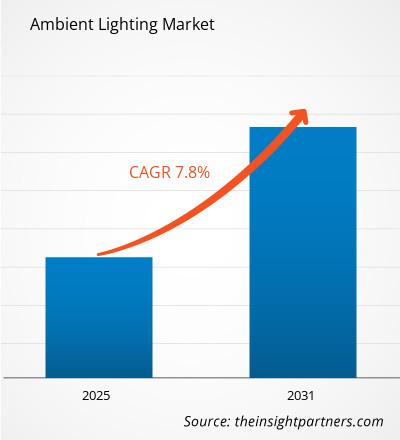
The Ambient Lighting Market is valued at US$ 80.57 billion in 2025 and is projected to reach US$ 187.80 billion by 2034, advancing at a CAGR of 9.86% during the 2026–2034 forecast period. This is indicative of a fundamental shift in the paradigm of lighting solutions conception, design, and implementation within the residential, commercial, and industrial spheres across the world. The synergy between the demand for energy efficiency, smart building technology, and the philosophy of human-centric design will continue to change user priorities.
North America has structural strengths that are well-suited for continuous market expansion and the projected compound annual growth rate of between 8.5% and 9.5% for the period up to 2034. This region enjoys the advantage of high penetration of smart homes over 40%, together with highly active retrofits of commercial buildings because of ASHRAE 90.1 and Title 24 compliance.
Ambient Lighting Market Assessment and Insights
- North America holds an estimated 28–32% share of the global market in 2025 and is growing at a CAGR ranging between 8.5% and 9.5% during 2026–2034, supported by rigorous building energy codes and widespread adoption of connected lighting platforms.
- US commands approximately 78–82% of the North American market in 2025 and is expanding at a CAGR between 8.0% and 9.0% through 2034, driven by large scale hospitality renovation cycles and smart city infrastructure investments.
- Europe accounts for an estimated 24–28% share of the global market in 2025 with a CAGR ranging from 8.0% to 9.0% during 2026–2034, led by Germany, the United Kingdom, and France, where EU Ecodesign regulations and WELL Building Standard adoption accelerate specification-grade fixture demand.
- Asia Pacific captures an estimated 32–36% share of the market in 2025 and is growing at a CAGR between 10.0% and 11.5% through 2034, with China, Japan, India, and South Korea representing primary demand centers fueled by urbanization and manufacturing expansion.
- The largest segment by end user is the residential sector, holding an estimated 30–35% market share in 2025 and growing at a CAGR between 9.5% and 10.5% during the forecast period, driven by smart home penetration and premiumization trends in emerging economies.
- High Growth Segment by offering is software and services, capturing an estimated 18–22% share in 2025 and growing at a CAGR between 12.0% and 14.0% through 2034, propelled by lighting as a service models.
- Key companies analyzed in detail: Signify N.V. (formerly Philips Lighting Holding B.V.), Wolfspeed, Inc. (formerly Cree, Inc.), OSRAM Licht GmbH, General Electric Company, Wipro Lighting, DRAXLMAIER Group, Thorn Lighting, Hubbell Lighting, Eaton Corporation plc, and Häfele America Co.
Source: The Insight Partners' analysis based on proprietary research, government publications, company annual reports, investor presentations, industry databases, and expert interviews.
The ambient lighting space has moved beyond single fixture manufacturing to integrate system solutions which involve LED engines, optic systems, sensor systems and wireless connectivity. Production processes have changed as the proportion of semiconductor elements per luminaire has grown due to the use of mid-power and chip-scale LED packages, which allow for thin profiles and better optical control. Modern surface-mount assembly production lines can handle both rigid and flexible substrates, making it possible for strip and linear luminaires to emerge.
In terms of future trends, the current market finds itself at an inflection point in which regulations in Southeast Asia and the Middle East require certain minimal efficacy levels, forcing LED use in new building installations. Development and investment in tunable spectrum technology, which will allow correlation of the color temperature between 2700K and 6500K, is growing at 15 percent annually in terms of patent registrations.
Ambient Lighting Market Report Scope
| Report Attribute | Details |
|---|---|
| Market size in 2025 | US$ 80.57 Billion |
| Market Size by 2034 | US$ 187.80 Billion |
| Global CAGR (2026 - 2034) | 9.86% |
| Historical Data | 2021-2024 |
| Forecast period | 2026-2034 |
Ambient Lighting Market Analysis
Market demand is driven by changes in the paradigm of construction, where the focus on the well-being of occupants has been added to the energy efficiency of the buildings. Value chains have changed to include foundries of application-specific LED drivers, optical designers who specialize in micro prismatic diffusers, systems integrators who work on firmware for mesh networks, and cloud platform providers for analytics dashboards.
Changes in supply are driven by the trend of vertical integration amongst the leading firms that wish to benefit from margins in hardware, connectivity, and analytics layers. Availability of Zhaga-compliant modular interfaces allows component interoperability, which lowers vendor lock-in and hastens the development of specialized luminaire products for healthcare, hospitality, and luxury housing.
Competitive dynamics in the market are portrayed by the rivalry that exists between conventional lighting firms as well as new native technology firms hailing from the consumer electronics and building automation industries. Signify N.V. has strengthened its standing in the market due to the expansion of the Interact IoT platform, while OSRAM Licht GmbH is making use of its opto semiconductor background to offer unique spectral quality products. Eaton Corporation plc has been investing in connected emergency lighting solutions, which meet safety codes while being part of building intelligence systems.
Current investment patterns show an increase in the number of venture investments in human-centric lighting ventures, which have applied their knowledge of circadian rhythms. Since 2022, deal volumes have grown about 20% annually. Strategic positioning requires ecosystem interoperability, which includes Matter protocol compatibility.
● REPORT CUSTOMIZATION
Tailor This Report To Align With Your Specific Business Requirements
This report can be customized to align precisely with your business objectives, scope, and target markets. Customization options include tailored segmentation, geography, competitive analysis, and strategic insights to support informed decision-making.
Customize This Report →WHAT YOU CAN ADJUST
- ● Segmentations
- ● Geography
- ● Competitive Analysis
- ● Language Preferences
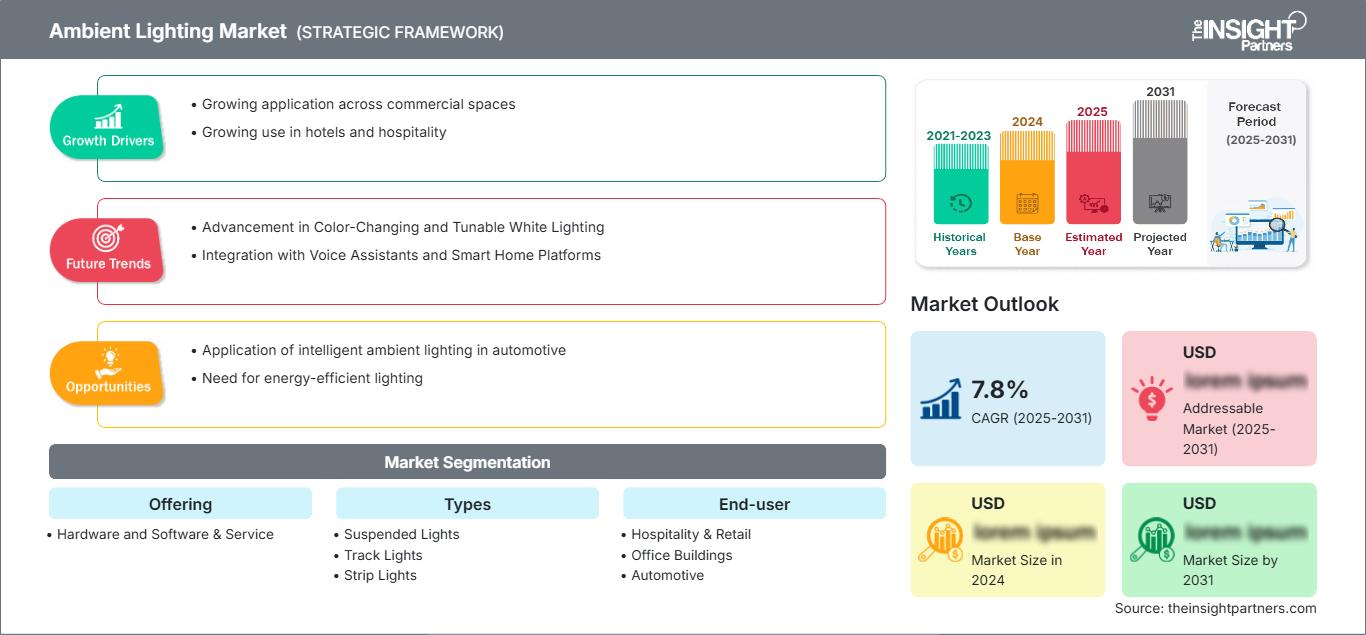
Ambient Lighting Market: Strategic Insights
Regional Insights
North America Ambient Lighting Market
The market in North America commands an estimated 28–32% share of global revenue in 2025, underpinned by an extensive installed base of commercial real estate undergoing technological refresh cycles. Building energy codes across the United States and Canada have progressively tightened lighting power density allowances, with ASHRAE 90.1 2022 mandating reductions of approximately 5% below previous standards in most space types. This regulatory environment compels building owners to evaluate ambient lighting system upgrades during tenant improvement projects, creating recurring demand streams that are partially decoupled from new construction cyclicality. As a result, the ambient lighting market size continues to benefit from retrofit activity, energy-efficiency initiatives, and the growing adoption of intelligent lighting controls across commercial and institutional buildings.
The competitive landscape features strong representation from domestically headquartered manufacturers, including General Electric Company and Hubbell Lighting, complemented by substantial market presence from global players such as Signify N.V. and OSRAM Licht GmbH. The CAGR for North America ranges between 8.5% and 9.5% through 2034, reflecting mature market dynamics where value growth outpaces volume expansion due to increasing system complexity and software attachment rates.
U.S. Ambient Lighting Market Market
The United States market represents an estimated 78–82% of North American regional revenue in 2025, accounting for the largest ambient lighting market share in the region, supported by the largest commercial real estate inventory globally, exceeding 100 billion square feet. Application trends demonstrate accelerating adoption of tunable white lighting systems in healthcare environments, where research from the Lighting Research Center at Rensselaer Polytechnic Institute has documented measurable improvements in patient recovery metrics and staff alertness under circadian supportive illumination protocols. Hospitality renovation cycles spanning major hotel flags in Las Vegas, Orlando, and New York incorporate elaborate ambient lighting scenes as central elements of guest experience differentiation, with typical property-wide LED retrofits encompassing between 5,000 and 15,000 luminaires. The CAGR for the U.S. ambient lighting market is projected at 8.0–9.0% during the 2026–2034 forecast period.
Europe Ambient Lighting Market Market
The European market captures an estimated 24–28% of global revenue in 2025, according to the ambient lighting market report, anchored by stringent regulatory frameworks and deep-rooted design sensibilities that elevate lighting from a utilitarian function to an element of architectural expression. The United Kingdom commands approximately 22–28% of the European market, driven by office refurbishment activity in London and regional technology hubs where hybrid work models have prompted workspace redesigns emphasizing hospitality-inspired ambient lighting schemes that support video conferencing, employee comfort, and workplace well-being.
Germany accounts for approximately 20–25% of the European ambient lighting market revenue, with demand concentrated in industrial and automotive manufacturing facilities where high bay ambient systems incorporating daylight harvesting and presence detection deliver documented energy savings exceeding 60% compared to legacy fluorescent installations. France, Italy, and Spain collectively represent approximately 30–35% of the European market, with hospitality and luxury residential segments demonstrating particular strength. The overall European CAGR is estimated at 8.0–9.0% through 2034.
APAC Ambient Lighting Market Market
The Asia Pacific ambient lighting market forecast indicates that the region commands an estimated 32–36% of global revenue in 2025, representing the largest regional share, and is projected to advance at a CAGR between 10.0% and 11.5% through 2034. China dominates regional demand, accounting for approximately 45–55% of APAC consumption, driven by urbanization rates exceeding 65% and ongoing residential construction delivering between 10 and 14 million new housing units annually.
Japan and South Korea collectively represent substantial demand for premium ambient lighting solutions, with Japan's market characterized by advanced adoption of human-centric lighting in eldercare facilities responding to demographic aging trends. South Korea's technology-forward residential market demonstrates among the highest smart lighting penetration rates globally, exceeding 25% of urban households. India exhibits the highest growth trajectory within APAC, supported by the Smart Cities Mission encompassing 100 urban centers and the Ujala scheme that has distributed over 360 million LED bulbs since inception, conditioning mass market acceptance of solid state lighting technology.
Middle East & Africa Ambient Lighting Market Market
The Middle East and Africa ambient lighting market trends indicate that the region accounts for an estimated 6–9% of global revenue in 2025, with growth closely linked to large-scale infrastructure development and urban transformation initiatives across Gulf Cooperation Council economies. Saudi Arabia represents the leading regional market, where Vision 2030 giga-projects, including NEOM, the Red Sea Project, and Diriyah Gate, incorporate advanced ambient lighting strategies that integrate landscape illumination, architectural façade lighting, and interior hospitality environments within cohesive design frameworks. Regional trends also highlight increasing adoption of energy-efficient LED technologies, smart lighting controls, and experience-driven lighting solutions that enhance aesthetics, sustainability, and visitor engagement across commercial, residential, hospitality, and public infrastructure projects.
South Africa serves as the primary market in Sub Saharan Africa, where commercial office modernization in Johannesburg and Cape Town drives ambient lighting upgrades aligned with Green Star certification requirements. The regional CAGR is projected at 7.5–9.0% during the forecast period, with growth concentrated in urban centers undergoing infrastructure modernization and tourism-related hospitality development.
Segmentation Analysis
Offering
The offering segment is bifurcated into hardware and software and services. Hardware continues to represent the dominant revenue category. At the same time, software and services are the high growth segment advancing at a CAGR between 12.0% and 14.0% through 2034, driven by lighting as a service commercial models and analytics platform deployments in enterprise facilities.
- Hardware encompasses LED luminaires, drivers, sensors, and control interfaces that constitute the physical infrastructure layer of ambient lighting systems.
- Software and Services covers lighting management platforms, commissioning services, energy analytics dashboards, and ongoing maintenance contracts that generate recurring revenue.
Types
The types segment encompasses suspended lights, track lights, strip lights, surface mounted lights, and recessed lights. The segment is advancing at a CAGR between 9.0% and 10.5% through 2034, reflecting broad based demand across form factors as designers specify layered illumination schemes that combine multiple luminaire types within cohesive spatial concepts.
- Suspended Lights maintain strong positioning in commercial office and hospitality applications where ceiling heights permit linear or decorative pendant configurations that deliver both ambient illumination and visual identity.
- Track Lights serve flexible retail and gallery environments where reconfigurable accent and ambient illumination support changing merchandise layouts and exhibition programming.
- Strip Lights represent the fastest growing type subsegment, driven by architectural cove, under cabinet, and furniture integrated applications where compact form factors enable discreet ambient illumination in residential and hospitality settings.
- Surface-mounted lights address installation scenarios where recessed ceiling configurations are impractical, including concrete ceiling structures prevalent in multifamily residential and institutional construction.
- Recessed Lights maintain dominance in new residential and commercial construction where clean ceiling aesthetics are prioritized, with standard aperture sizes between 2 and 6 inches accommodating downlight, wall wash, and adjustable directional configurations.
End user
The end user segment spans hospitality and retail, office buildings, automotive, healthcare, residential, and industrial applications, with the residential sector representing the largest end user category in the ambient lighting market. This segment holds an estimated 30–35% share in 2025 and is growing at a CAGR between 9.5% and 10.5% through 2034, driven by smart home proliferation and premiumization trends across developed and emerging economies.
- Hospitality and retail depend on ambient lighting to establish brand identity, influence customer dwell time, and enhance the perceived value of merchandise and interior environments.
- Office Buildings prioritize ambient lighting systems supporting visual comfort during extended screen based work, with tunable white technology adoption accelerating as research from organizations, including the International WELL
- Automotive incorporates ambient lighting as a critical interior differentiation element, with premium vehicle segments deploying between 15 and 40 individually addressable LED zones for dashboard, door panel, footwell, and headliner illumination.
- Healthcare facilities deploy ambient lighting systems calibrated to support patient recovery, staff alertness during night shifts, and wayfinding in complex hospital environments.
- Residential represents the largest installed base for ambient lighting, with connected lamp shipments exceeding 100 million units annually as consumers adopt voice-controlled and app-managed systems.
- Industrial facilities deploy high bay ambient lighting systems in manufacturing, warehousing, and logistics environments where illumination uniformity and glare control directly impact worker safety and operational accuracy.
Opportunity Snapshot
| End User | Revenue Contribution | Trend Tag | Adoption Stage |
| Residential | High | Smart Home | Scaling |
| Hospitality & Retail | High | Experience Design | Mature |
| Office Buildings | Medium | Hybrid Workplace | Scaling |
| Healthcare | Medium | Circadian Support | Emerging |
| Automotive | Medium | EV Interior | Scaling |
| Industrial | Medium | IIoT Integration | Emerging |
Ambient Lighting Market Growth Drivers and Impact Analysis
Energy Efficiency Regulatory Frameworks Mandating Solid State Lighting Conversion
The regulatory agencies from various nations have enforced increasingly stringent regulations regarding lighting efficiency standards, which have resulted in the mandatory adoption of LEDs for ambient lighting systems in new constructions and large scale replacement projects. The combination of EU Ecodesign Directive, appliance standards by US Department of Energy and the Green Building Evaluation Standard in China all set minimum luminous efficacy requirements of greater than 80 lumens per watt for illumination purposes, which cannot be achieved by conventional fluorescent and halogen lighting systems. Lighting is responsible for about 15 percent of the total energy consumption worldwide.
Human Centric Lighting Adoption Driven by Workplace Wellness Standards
Certification systems such as WELL, LEED v5, and Fitwel have included lighting metrics for circadian rhythm support, glare reduction, and light spectrum in their certification rating systems, changing the approach to specifying ambient lighting in commercial construction. Several research publications from the Lighting Research Center, as well as peer-reviewed articles in the Journal of Clinical Sleep Medicine, have established the link between lighting during the day and alertness and cognitive function in the evening.
Smart Building Integration Creating Recurring Revenue Models
The fusion of ambient lighting technology and IoT systems creates luminaire-based sensors capable of producing occupancy insights, space usage metrics, and environment telemetry information, highly sought after by building management and corporate real estate executives. The use of PoE lighting technology makes it possible for each luminaire to become an endpoint on a network, complete with a unique IP address, thereby providing remote monitoring and data collection capabilities without extra low-voltage wiring. This innovation helps pave the way for lighting-as-a-service business models where users make recurring payments for lighting performance metrics without purchasing the equipment.
Ambient Lighting Market Future Trends
Spectral Engineering for Agricultural and Therapeutic Applications
The ambient lighting market is witnessing accelerated research and commercialization activity around precisely engineered light spectra targeting specific biological responses beyond general illumination. Horticultural ambient lighting systems with programmable red to far red ratios enable indoor vertical farming operations to optimize plant morphology, nutritional content, and flowering cycles without chemical growth regulators. Therapeutic applications include ambient lighting protocols for dementia care facilities, where specific spectral compositions and temporal patterns have demonstrated measurable reductions in agitation and sleep disturbance among Alzheimer's patients according to studies published in the Journal of Alzheimer's Disease.
Matter Protocol Standardization Enabling Cross Ecosystem Interoperability
The adoption of the Matter connectivity standard by leading smart home platforms, including Apple HomeKit, Google Home, Amazon Alexa, and Samsung SmartThings will fundamentally reshape residential ambient lighting market dynamics by eliminating ecosystem lock in barriers that have fragmented consumer adoption. Matter certification ensures that compliant ambient lighting products operate seamlessly across all major smart home controllers without requiring proprietary hubs or manufacturer specific applications, reducing integration complexity for consumers and installers. This standardization is expected to accelerate smart ambient lighting penetration from current levels around 15% of connected households toward 35% by 2030, expanding the addressable market for luminaires with integrated wireless connectivity.
Ambient Lighting Market Opportunities
Healthcare Facility Modernization Programs in Aging Populations
Developed economies facing demographic aging trends are allocating substantial public and private capital toward healthcare infrastructure modernization, creating a significant addressable market for specialized ambient lighting systems. The World Health Organization projects that the global population aged 60 years and older will double from approximately 1 billion in 2020 to 2.1 billion by 2050, driving hospital bed capacity expansion and eldercare facility construction across Japan, Western Europe, and North America. Healthcare ambient lighting specifications increasingly mandate tunable white systems with documented circadian efficacy, representing a premium product category with ASPs three to five times higher than standard commercial luminaires.
Automotive Ambient Lighting Content Expansion in Electric Vehicle Platforms
Electric vehicle platform architectures, which typically feature flat floor designs, expansive interior volumes, and reduced mechanical component footprints, enable more extensive ambient lighting integration than internal combustion vehicle platforms constrained by transmission tunnels and exhaust routing. Leading EV manufacturers, including Tesla, BYD, and legacy automakers transitioning their portfolios are increasing ambient lighting content per vehicle from approximately 15–25 LED zones in premium internal combustion models to 30–50 zones in comparable EVs, according to teardown analysis. The elimination of engine noise in EVs elevates interior ambiance as a critical sensory experience differentiator, with ambient lighting contributing to perceived quality and brand identity. Automotive ambient lighting specifications demand exceptional reliability across temperature extremes from 40°C to +85°C, vibration resistance, and 15 plus year operational lifetimes, creating barriers to entry that favor established automotive lighting suppliers such as OSRAM Licht GmbH and DRAXLMAIER Group.
Recent Developments
- March 2026: Signify (Euronext: LIGHT), the world leader in lighting, introduced four additions to its Interact platform at Light + Building in Frankfurt. These new solutions can help businesses and municipalities make buildings smarter and cities more responsive and sustainable, driven by data.
- May 2026: Signify has expanded its Philips Smart Lighting portfolio with new Wi-Fi-based smart lighting solutions designed to transform home lighting from simple illumination into personalized and immersive experiences. The latest products enable users to create customized environments based on mood, lifestyle, and entertainment preferences through connected lighting technologies.
- January 2026: ams OSRAM (SIX: AMS), a global leader in innovative light and sensor solutions, will showcase how its latest solutions are powering game-changing applications in nearly every industry at CES 2026 in an invite-only meeting room at the Venetian Expo.
Frequently Asked Questions

- Comprehensive Market Sizing and Forecast Analysis
- Detailed Segmentation Analysis
- In-Depth Market Dynamics Assessment
- Regional and Country-Level Insights
- Competitive Landscape and Company Benchmarking
- Strategic Business Intelligence
Recent Reports
Testimonials

The Insight Partners' SCADA System Market report is comprehensive, with valuable insights on current trends and future forecasts. The team was highly professional, responsive, and supportive throughout. We are very satisfied and highly recommend their services.
RAN KEDEM Partner, Reali Technologies LTDs
I requested a report on a very specific software market and the team produced the report in a few days. The information was very relevant and well presented. I then requested some changes and additions to the report. The team was again very responsive and I got the final report in less than a week.
JEAN-HERVE JENN Chairman, Future Analytica
We worked with The Insight Partners for an important market study and forecast. They gave us clear insights into opportunities and risks, which helped shape our plans. Their research was easy to use and based on solid data. It helped us make smart, confident decisions. We highly recommend them.
PIYUSH NAGPAL Sr. Vice President, High Beam Global
The Insight Partners delivered insightful, well-structured market research with strong domain expertise. Their team was professional and responsive throughout. The user-friendly website made accessing industry reports seamless. We highly recommend them for reliable, high-quality research services
YUKIHIKO ADACHI CEO, Deep Blue, LLC.
This is the first time I have purchased a market report from The Insight Partners.While I was unsure at first, I visited their web site and felt more comfortable to take the risk and purchase a market report.I am completely satisfied with the quality of the report and customer service. I had several questions and comments with the initial report, but after a couple of dialogs over email with their analyst I believe I have a report that I can use as input to our strategic planning process.Thank you so much for taking the extra time and making this a positive experience.I will definitely recommend your service to others and you will be my first call when we need further market data.
JOHN SUZUKI President and Chief Executive Officer, Board Director, BK Technologies
I wish to appreciate your support and the professionalism you displayed in the course of attending to my request for information regarding to infectious disease IVD market in Nigeria. I appreciate your patience, your guidance, and the fact that you were willing to offer a discount, which eventually made it possible for us to close a deal. I look forward to engaging The Insight Partners in the future, all thanks to the impression you have created in me as a result of this first encounter.
DR CHIJIOKE ONYIA MANAGING DIRECTOR, PineCrest Healthcare Ltd.Reason to Buy
- Informed Decision-Making
- Understanding Market Dynamics
- Competitive Analysis
- Identifying Emerging Markets
- Customer Insights
- Market Forecasts
- Risk Mitigation
- Boosting Operational Efficiency
- Strategic Planning
- Investment Justification
- Tracking Industry Innovations
- Aligning with Regulatory Trends





 Get Free Sample for