
Amblyopia Market Demand, Share & Growth by 2034
Coverage: By Type (Strabismus Amblyopia, Refractive Amblyopia, Deprivation Amblyopia, Reverse Amblyopia); Diagnosis (Visual Acuity Tests, Photo Screening, Bruckner Test, Others); End User (Hospitals, Ophthalmic Clinics, Others), and Geography (North America, Europe, Asia Pacific, and South and Central America)
- Status : Data Released
- Report Code : TIPRE00017636
- Category : Life Sciences
- No. of Pages : 150
- Available Report Formats :


- Last update date : July 14, 2026


2025 Market Size
US$ 5.57 Bn
Base year value
2034 Forecast
US$ 7.88 Bn
Projected by 2034
CAGR 2026-2034
3.92 %
Growth rate
Addressable Market
US$ 61.06 Bn
(2026-2034)
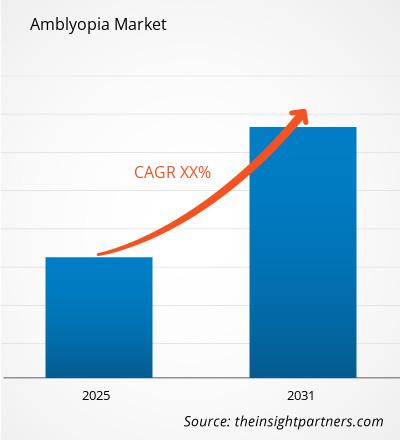
The Amblyopia Market size was valued at US$ 5.57 Billion in 2025 and is projected to reach US$ 7.88 Billion by 2034, growing at a CAGR of 3.92% from 2026 to 2034. These factors include the implementation of pediatric vision screening, early detection of refractive errors, and increasing prevalence of use of digital therapy options, correction lenses, and the provision of ophthalmology services.
The North American market is anticipated to grow at a CAGR of 3.6% to 4.1% between 2026 and 2034. The factors driving the growth of the market include structured school screening programs, pediatric referrals for ophthalmology, the presence of diagnostic pathways supported by reimbursement, and the use of instruments for binocular vision therapy.
Amblyopia Market Assessment and Insights
- North America accounted for 36–39% share in 2025 and is expected to grow at a CAGR between 2026 – 2034 of 3.6–4.1%, supported by paediatric screening, digital vision therapy adoption, and specialist clinic access.
- US represented 78–82% of North America in 2025 and is projected to grow at a CAGR between 2026 – 2034 of 3.7–4.2%, driven by school screening follow-up and device-enabled diagnosis.
- Europe held 26–29% share in 2025 and may grow at a CAGR between 2026 – 2034 of 3.3–3.8%, led by Germany, the UK, France, Italy, and Spain through structured paediatric eye care pathways.
- Asia Pacific captured 22–25% share in 2025 and is forecast to grow at a CAGR between 2026 – 2034 of 4.3–4.9%, with China, Japan, India, South Korea, and Australia expanding paediatric optometry capacity.
- Largest Segment: Refractive Amblyopia held 47–51% market share in 2025 and is expected to grow at a CAGR of 3.8–4.3% during 2026–2034 due to rising refractive-error detection.
- High Growth Segment: Photo Screening held 32–36% market share in 2025 and is projected to grow at a CAGR of 4.6–5.2% during 2026–2034 as primary-care screening expands.
- Key companies analyzed in detail: Amblyoptica Holding Pty Ltd, Vivid Vision, Inc., CooperVision, Inc., Carl Zeiss Meditec AG, HOYA Vision Care, Fresnel Prism & Lens Co., Novartis AG, Bausch + Lomb Corporation, REBIScan, Inc., Johnson & Johnson Vision Care, Inc.
Source: The Insight Partners' analysis based on proprietary research, government publications, company annual reports, investor presentations, industry databases, and expert interviews.
There has been a change in the way technology has developed from the patch-only treatment approach to the use of corrective glasses, binocular treatment, therapeutic technology and screening devices, which help in more accurate patient referral. There have also been changes in the production dynamics of amblyopia products, as lens manufacturers, ophthalmic device companies and software developers have come together in partnership with pediatric clinics.
In the coming years, growth in the Amblyopia Market is expected to occur in those nations that spend on school health programs, optometry education, and early childhood screening. Software-based treatment methods gaining regulatory approval, increased reimbursement for pediatric vision treatment services and hospital partnerships with eye care companies would help boost access. Geographies, where new growth will occur, are expected to start with cost-effective screening devices and then proceed to specialists' treatment for complicated conditions like strabismus and deprivation amblyopia.
Amblyopia Market Report Scope
| Report Attribute | Details |
|---|---|
| Market size in 2025 | US$ 5.57 Billion |
| Market Size by 2034 | US$ 7.88 Billion |
| Global CAGR (2026 - 2034) | 3.92% |
| Historical Data | 2021-2024 |
| Forecast period | 2026-2034 |
Amblyopia Market Analysis
Demand in the Amblyopia Market growth pathway is closely linked to early detection because treatment outcomes decline when intervention is delayed beyond childhood visual development windows. Hospitals, paediatric ophthalmologists, optometrists, and manufacturers form the core value chain, while schools and primary-care providers create important referral channels. Supply dynamics remain balanced, with corrective lenses and diagnostic devices widely available, but digital therapies still scaling through clinical validation and physician adoption.
The second level of demand originates from parents opting for less intrusive alternatives to patching. Tools for binocularity, vision acuity assessment and photo-screening are some of the means through which missed diagnoses can be reduced and compliance enhanced. In procurement decisions, workflow compatibility, training and documentation of visual acuity, binocularity and/or treatment compliance are key considerations.
Competitive positioning in the Amblyopia Market analysis is an amalgamation of optics strength, software specialization and diagnostic innovations. CooperVision, Inc., Johnson & Johnson Vision Care, Inc., Bausch + Lomb Corporation, HOYA Vision Care and Carl Zeiss Meditec AG possess established networks of distribution channels while Vivid Vision, Inc., Amblyoptica Holding Pty Ltd and REBIScan, Inc. focus on technology-oriented diagnostics or treatments.
Attention is being paid to innovations in pediatric-friendly screenings, home-based therapy solutions and lenses that work seamlessly within the field of optometry. Novartis AG and Fresnel Prism & Lens Co. still play a part due to their wide presence in ophthalmology and prism correction marketplaces. Companies capable of offering clinical evidence, physician education and software/optics platforms have an edge in defending their market share.
● REPORT CUSTOMIZATION
Tailor This Report To Align With Your Specific Business Requirements
This report can be customized to align precisely with your business objectives, scope, and target markets. Customization options include tailored segmentation, geography, competitive analysis, and strategic insights to support informed decision-making.
Customize This Report →WHAT YOU CAN ADJUST
- ● Segmentations
- ● Geography
- ● Competitive Analysis
- ● Language Preferences
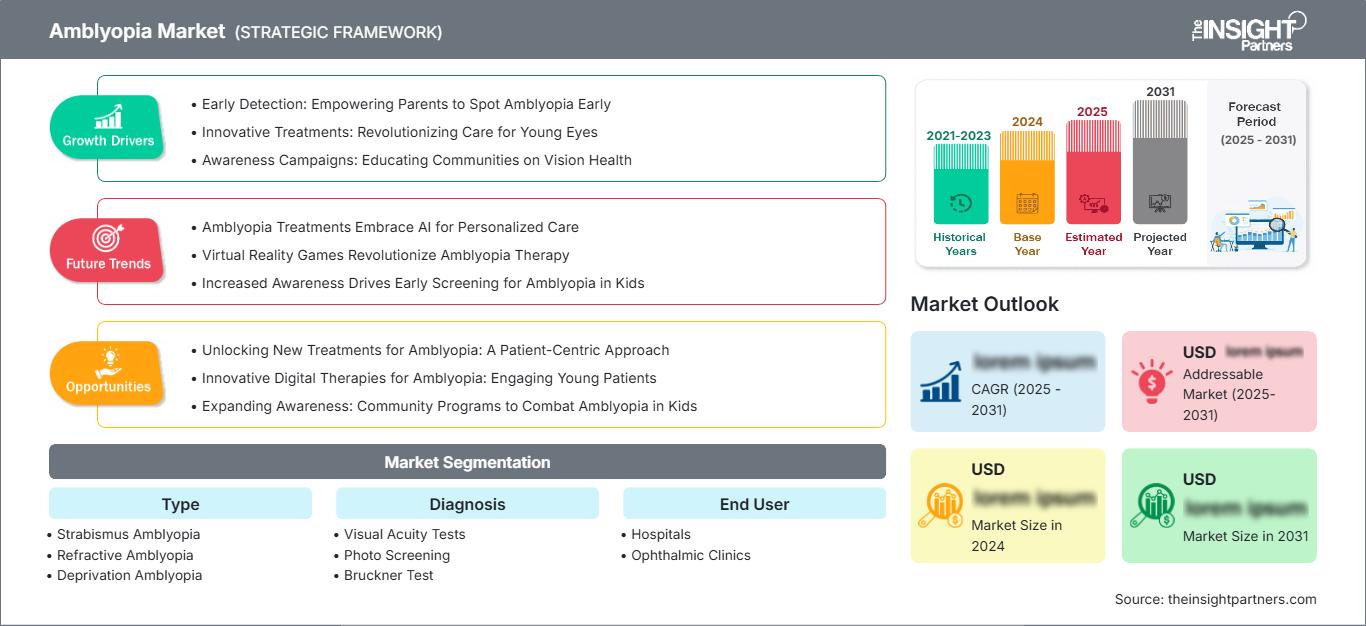
Amblyopia Market: Strategic Insights
Regional Insights
North America Amblyopia Market
North America accounted for 36–39% Amblyopia Market share in 2025 and is expected to grow at a CAGR of 3.6–4.1% during 2026–2034. The region benefits from structured paediatric wellness visits, wider optometric coverage, and stronger referral linkages between schools, paediatricians, ophthalmic clinics, and children’s hospitals. Demand is concentrated in optical correction, visual acuity testing, and emerging binocular therapy solutions.
Another way that market development is facilitated by clinical research on dichoptic devices and advanced vision screening processes. While compliance for screenings has been inconsistent, involvement from insurance companies and focus on child development from a public health perspective has made pediatric eyecare services an important market. Infrastructure developed for device purchase in North America facilitates photo screenings and digitized follow-up processes.
U.S. Amblyopia Market
The U.S. represented 78–82% of North America in 2025 and is forecast to grow at a CAGR of 3.7–4.2% from 2026 to 2034. The demand will be boosted by preschool eye exams, pediatric optometry practices, and software-assisted exercise. Vivid Vision, Inc., CooperVision, Inc., Johnson & Johnson Vision Care, Inc., Bausch + Lomb Corporation, and REBIScan, Inc. keep their presence in eye health communities.
Current applications move to early detection rather than to late specialty referral through the pediatric, school, and community settings. The follow-up problem in case of failed testing generates a demand for referral mechanisms and parent-friendly services. Hospitals deal with complicated cases, and eye clinics build up their abilities for refractive treatment and vision therapy.
Europe Amblyopia Market
Europe held 26–29% share in 2025 and is expected to grow at a CAGR of 3.3–3.8% through 2034, with Germany leading regional demand. Screening at school entry and availability of optometrists is a feature of the UK market, but long waiting periods for pediatric ophthalmology services favor private clinics' referrals. Germany's organized healthcare system enables diagnosis and correction of patients suffering from refractive and strabismic disorders.
In France, Italy, and Spain, a gradual uptake is evident, which is due to development of the eye-health pathway for children and an increased presence of optical retail outlets. Early detection of issues prevails in Western Europe, while Southern Europe is characterized by opportunities arising through upgrading clinics and using a public-private referral scheme.
APAC Amblyopia Market
The APAC region has been valued at 22-25% share in 2025 and is anticipated to witness a CAGR of 4.3-4.9% during 2026-2034, which makes it the fastest growing region. The dominance of the region is due to China, because of large pediatric population base, myopia-related policies and ophthalmic hospitals.
Japan and South Korea use advanced diagnostic equipment, while India uses large-scale initiatives with screening programs. Australia offers an optometrist-based framework, while countries in Southeast Asia provide increased accessibility through eye care chains. Some of the industrial factors include homegrown optics industry, screening through smartphones, and affordable devices availability.
Middle East & Africa Amblyopia Market
The Middle East & Africa market is expected to grow at a CAGR of 3.5–4.0% during 2026–2034. Saudi Arabia leads through healthcare infrastructure investment, paediatric specialty expansion, and hospital modernization. The UAE supports private ophthalmology growth and medical tourism, while South Africa anchors specialist services in sub-Saharan Africa.
MEA's remaining parts are still underpenetrated since there is inadequate screening, inadequate pediatric ophthalmologists and inadequate follow-up infrastructure. Economies that are energy exporters are improving their health care infrastructure indirectly helping in procuring diagnostic tools. The growth will depend on school screening, availability of cheap spectacles and tele-ophthalmology among other things.
Segmentation Analysis
Type
Type is expected to grow at a CAGR of 3.7–4.2% during 2026–2034 as clinical pathways increasingly differentiate amblyopia by cause. The Amblyopia Market scope across type reflects the need for tailored treatment, since refractive, strabismic, deprivation, and reverse forms require different combinations of correction, monitoring, therapy, and specialist management.
- Strabismus Amblyopia remains clinically important because eye misalignment often requires coordinated ophthalmology, prism correction, patching, or surgical evaluation, making early detection vital for binocular vision development.
- Refractive Amblyopia is the largest type because anisometropia and uncorrected refractive errors are frequently identified through screening, creating sustained demand for spectacles, contact lenses, and follow-up assessments.
- Deprivation Amblyopia represents a smaller but high-acuity category, as cataract, ptosis, or media opacity can rapidly impair visual development and usually requires urgent specialist intervention.
- Reverse Amblyopia is associated with overtreatment or excessive penalization of the stronger eye, making careful monitoring, dosage adjustment, and clinical supervision strategically important.
Diagnosis
Diagnosis is projected to grow at a CAGR of 4.1–4.7% from 2026 to 2034, supported by higher screening volumes and demand for objective paediatric assessment. Diagnostic adoption is moving beyond specialist offices as paediatrician’s, schools, and primary eye-care providers integrate faster tools that identify children needing confirmatory examination.
- Visual Acuity Tests remain the foundation of diagnosis because they are low cost, clinically familiar, and essential for measuring treatment response across hospital and clinic settings.
- Photo Screening is gaining importance in younger children and nonverbal populations because portable systems improve detection of amblyogenic risk factors before conventional acuity testing becomes reliable.
- Bruckner Test remains useful in paediatric and primary-care settings because it offers a rapid red-reflex assessment for asymmetry, media opacity, and possible ocular alignment issues.
End User
End User is expected to grow at a CAGR of 3.8–4.4% during 2026–2034 as care delivery shifts toward combined hospital and outpatient clinic pathways. Hospitals manage complex deprivation and surgical cases, while ophthalmic clinics increasingly handle refractive correction, monitoring, and therapy adherence with shorter visit cycles.
- Hospitals contribute high-acuity demand because they manage congenital cataract, severe strabismus, complex diagnostic workups, and cases requiring multidisciplinary paediatric ophthalmology intervention.
- Ophthalmic Clinics account for recurring treatment volume, including refraction, visual acuity monitoring, photo screening, binocular therapy supervision, and follow-up care for school-aged children.
Opportunity Snapshot
| Segment Name | Revenue Contribution (High/Medium/Low) | Trend Tag | Adoption Stage |
| Hospitals | High | Complex Care | Mature |
| Ophthalmic Clinics | High | Therapy Follow-up | Scaling |
Amblyopia Market Growth Drivers and Impact Analysis
Expansion of paediatric vision screening programs
Vision screening in children is among the top drivers since amblyopia is curable if detected early but becomes refractory otherwise. Vision screening in school programs, pediatrician checkups, and community screening increases the pool of patients who require a diagnostic test of their visual acuity, refraction testing, photo screening, and specialist referral. The commercial relevance of this driver is wide since every negative result of vision screening creates subsequent demand for eye correction, further monitoring, treatment, and parent counseling. In mature markets, the driver consists of increased follow-up rate after negative results of screening. In emerging markets, the driver consists of developing affordable ways of linking vision screening with provision of glasses or further eye exam.
Shift toward binocular and digital therapy models
Therapy innovation is improving the value proposition for children and caregivers by reducing dependence on patching alone. Binocular platforms, game-based exercises, and supervised home therapy can improve engagement, track usage, and give providers measurable adherence data. This matters commercially because poor compliance has historically limited treatment outcomes and repeat therapy effectiveness. Digital models also allow clinics to extend care beyond physical visits, creating service revenue opportunities and differentiated offerings. Adoption will still depend on evidence quality, clinician confidence, regulatory clarity, and reimbursement, but the direction is clear. Providers favor tools that fit workflows and demonstrate improvement in acuity or binocular function without increasing visit burden.
Rising refractive-error awareness among children
Growing awareness of childhood refractive error is increasing diagnosis of anisometropia and other amblyogenic risk factors. Parents, schools, and pediatricians are more likely to link poor vision with reading difficulty, learning performance, and reduced participation in daily activities. This expands demand for eye examinations, spectacles, contact lenses in selected patients, and long-term monitoring. Optical companies benefit because refractive Amblyopia Market cases often require repeated prescriptions and adherence support over several years. The driver is especially important in Asia Pacific, where myopia-focused public-health discussion has raised broader attention to paediatric vision. As more children enter care pathways earlier, providers can manage amblyopia before visual development opportunities narrow.
Amblyopia Market Future Trends
Integration of AI-supported Paediatric Screening
Amblyopia Market trends point toward AI-supported screening tools that help non-specialist settings identify children needing professional eye examinations. Algorithms may assist with image interpretation, risk stratification, documentation, and referral prioritization, especially where paediatric ophthalmologists are limited. These systems will not replace clinical diagnosis, but they can reduce missed cases and standardize early detection. Vendors are likely to focus on portable devices, cloud dashboards, and integration with electronic health records. Adoption will depend on validation across age groups, ethnicities, and ocular conditions, as well as data privacy compliance. The strongest use case will be high-volume screening programs that need speed, consistency, and actionable referral outputs.
Personalized Therapy Intensity and Monitoring
Future care will increasingly tailor treatment intensity to age, baseline acuity, amblyopia cause, adherence, and binocular status. Instead of uniform patching schedules or generic follow-up intervals, clinicians may use digital adherence data, refraction changes, and acuity response patterns to adjust treatment. This trend improves outcomes while reducing caregiver fatigue and unnecessary visits. Companies developing therapies, diagnostics, and optical products can create stronger value by supporting decision-making rather than selling standalone products. Personalized monitoring also supports payer discussions because it links intervention to documented progress. Over time, therapy protocols may become more data-driven, especially in clinics managing large paediatric populations.
Amblyopia Market Opportunities
Clinic-centered Digital Therapy Partnerships
A significant investment opportunity lies in partnerships between ophthalmic clinics and digital therapy developers. Clinics need tools that improve adherence, reduce manual supervision, and offer measurable progress between appointments. Developers need clinical credibility, patient access, and feedback loops for evidence generation. A structured model can combine in-office onboarding, supervised home use, periodic acuity checks, and provider dashboards. Amblyopia Market Forecasts indicate that scalable outpatient models will gain importance as clinics handle larger screening-driven caseloads. Companies that provide training, technical support, and reimbursement documentation can improve adoption. The best opportunities will come from solutions designed around paediatric engagement and clinician workflow rather than technology novelty alone.
Emerging-market School Referral Ecosystems
Emerging markets offer an opportunity to build complete school-to-clinic referral ecosystems rather than isolated screening programs. Many children fail screenings but do not receive confirmatory examination or corrective treatment because parents lack information, access, or affordability. Companies can partner with schools, nongovernmental organizations, optical retailers, and local hospitals to provide screening, referral scheduling, low-cost spectacles, and escalation for complex cases. This approach creates volume while addressing public-health gaps. The model is particularly relevant in India, parts of Southeast Asia, the Middle East, and Africa. Success requires pricing discipline, local-language education materials, and reliable follow-up mechanisms that convert screening into completed care.
Recent Developments
- May 2026: CooperVision, Inc. company announced completion of enrolment for what it described as the world’s largest paediatric myopia control clinical study, strengthening its paediatric eye-care research infrastructure and supporting broader evidence generation relevant to childhood vision management and optometry-led intervention pathways
- June 2025: Johnson & Johnson Vision Care, Inc. and the American Optometric Association Foundation launched the See It Through initiative to improve follow-up care for children who fail vision screening, addressing a critical access gap in paediatric eye health and referral completion
- May 2025: HOYA Vision Care company presented paediatric vision research at EAOO 2025 and introduced the visuReal MoveAI Kids Module, an AI-powered video centration tool for children’s eyewear fitting, supporting more precise paediatric optical dispensing and myopia-related care workflows
Frequently Asked Questions

- Comprehensive Market Sizing and Forecast Analysis
- Detailed Segmentation Analysis
- In-Depth Market Dynamics Assessment
- Regional and Country-Level Insights
- Competitive Landscape and Company Benchmarking
- Strategic Business Intelligence
Recent Reports
Testimonials

The Insight Partners provided valuable market intelligence that supported our global go-to-market strategy. Their team was professional, responsive, and attentive to our feedback, providing thoughtful analysis and helpful methodological clarifications throughout the project.
Junmo Kim Chief Financial Officer (CFO), Enertech Co., Ltd.
The Insight Partners' SCADA System Market report is comprehensive, with valuable insights on current trends and future forecasts. The team was highly professional, responsive, and supportive throughout. We are very satisfied and highly recommend their services.
RAN KEDEM Partner, Reali Technologies LTDs
I requested a report on a very specific software market and the team produced the report in a few days. The information was very relevant and well presented. I then requested some changes and additions to the report. The team was again very responsive and I got the final report in less than a week.
JEAN-HERVE JENN Chairman, Future Analytica
We worked with The Insight Partners for an important market study and forecast. They gave us clear insights into opportunities and risks, which helped shape our plans. Their research was easy to use and based on solid data. It helped us make smart, confident decisions. We highly recommend them.
PIYUSH NAGPAL Sr. Vice President, High Beam Global
The Insight Partners delivered insightful, well-structured market research with strong domain expertise. Their team was professional and responsive throughout. The user-friendly website made accessing industry reports seamless. We highly recommend them for reliable, high-quality research services
YUKIHIKO ADACHI CEO, Deep Blue, LLC.
This is the first time I have purchased a market report from The Insight Partners.While I was unsure at first, I visited their web site and felt more comfortable to take the risk and purchase a market report.I am completely satisfied with the quality of the report and customer service. I had several questions and comments with the initial report, but after a couple of dialogs over email with their analyst I believe I have a report that I can use as input to our strategic planning process.Thank you so much for taking the extra time and making this a positive experience.I will definitely recommend your service to others and you will be my first call when we need further market data.
JOHN SUZUKI President and Chief Executive Officer, Board Director, BK Technologies
I wish to appreciate your support and the professionalism you displayed in the course of attending to my request for information regarding to infectious disease IVD market in Nigeria. I appreciate your patience, your guidance, and the fact that you were willing to offer a discount, which eventually made it possible for us to close a deal. I look forward to engaging The Insight Partners in the future, all thanks to the impression you have created in me as a result of this first encounter.
DR CHIJIOKE ONYIA MANAGING DIRECTOR, PineCrest Healthcare Ltd.Reason to Buy
- Informed Decision-Making
- Understanding Market Dynamics
- Competitive Analysis
- Identifying Emerging Markets
- Customer Insights
- Market Forecasts
- Risk Mitigation
- Boosting Operational Efficiency
- Strategic Planning
- Investment Justification
- Tracking Industry Innovations
- Aligning with Regulatory Trends





 Get Free Sample for