
Ambulance Services Market Growth, Demand & Size by 2034
Coverage: by Mode of Transport ( Ground Ambulance Services, Water Ambulance Services, Air Ambulance Services ); Emergency Type ( Emergency Ambulance Services, Non-Emergency Ambulance Services ); Equipment Type ( Advance Life Support (ALS) Ambulance, Basic Life Support (BLS) Ambulance ), and Geography (North America, Europe, Asia Pacific, and South and Central America)
- Status : Data Released
- Report Code : TIPRE00006967
- Category : Life Sciences
- No. of Pages : 150
- Available Report Formats :


- Last update date : July 15, 2026


2025 Market Size
US$ 51.24 Bn
Base year value
2034 Forecast
US$ 81.99 Bn
Projected by 2034
CAGR 2026-2034
5.36 %
Growth rate
Addressable Market
US$ 604.18 Bn
(2026-2034)
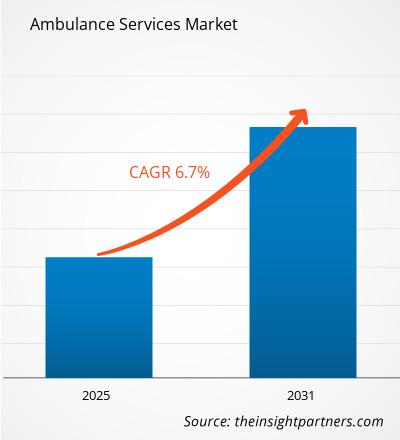
The global Ambulance Services market was valued at US$ 51.24 billion in 2025 and is expected to reach US$ 81.99 billion by 2034; it is estimated to record a CAGR of 5.36% during 2026-2034.
Ambulance Services Market Assessment and Insights
- North America accounted for 38–40% share in 2025 and is growing at a CAGR of 5.4–5.8% between 2026–2034, driven by structured EMS reimbursement, high emergency call volumes, and fleet modernization.
- US represented 78–82% of North America in 2025 and is growing at a CAGR of 5.3–5.7% between 2026–2034 due to advanced 911 networks and private EMS participation.
- Europe held 26–28% share in 2025 and is growing at a CAGR of 5.2–5.6% between 2026–2034, led by the UK, Germany, France, Italy, and Spain through public-private EMS contracts.
- Asia Pacific captured 22–24% share in 2025 and is growing at a CAGR of 7.3–7.8% between 2026–2034, with China, Japan, India, South Korea, and Australia expanding organized emergency access.
- Largest Segment Ground Ambulance Services held 66–69% market share in 2025, growing at a CAGR of 5.6–6.0% during 2026–2034 because road-based EMS remains the primary response mode.
- High Growth Segment Air Ambulance Services held 18–21% market share in 2025, growing at a CAGR of 7.2–7.7% during 2026–2034 due to critical care transfers and remote-area coverage.
- Key companies analyzed in detail: Envision Healthcare Corporation, Falck A/S, Acadian Ambulance Service, Inc., BVG India Limited, America Ambulance Services, Inc., Air Medical Group Holdings, Inc., Air Methods Corporation, Ziqitza Healthcare Limited, Medivic Aviation Air Ambulance Services Pvt. Ltd., Babcock International Group PLC.
Source: The Insight Partners' analysis based on proprietary research, government publications, company annual reports, investor presentations, industry databases, and expert interviews.
Digitized dispatch systems, telemedicine-based triaging, GPS routing, patient record keeping electronically, and heart monitoring through connectivity technologies have brought about changes in the way that operators manage the quality of response in their operations. The Ambulance Services Market production dynamics are being influenced by chassis availability, medical equipment supply chains, oxygen systems, and safety regulations concerning patient compartments in ambulances.
The demand for ambulances is projected to grow in new urban zones due to high rates of road accidents, cardiovascular emergencies, and maternity transportations. Emergency medical response has been prioritized by governments in health access initiatives whereas the private sector is looking for corporate, events, hospital, and home healthcare arrangements. The tailwinds in regulatory dynamics include standardization of ambulance classification, licensing, crew qualification, and response times and quality tracking.
Ambulance Services Market Report Scope
| Report Attribute | Details |
|---|---|
| Market size in 2025 | US$ 51.24 Billion |
| Market Size by 2034 | US$ 81.99 Billion |
| Global CAGR (2026 - 2034) | 5.36% |
| Historical Data | 2021-2024 |
| Forecast period | 2026-2034 |
Ambulance Services Market Analysis
The Ambulance Services Market growth depends on emergency utilization, interfacility transfers, and the development of home-based care. The ecosystem involves dispatchers, operators of ambulance fleets, hospitals, insurers, leasing companies for aircraft, suppliers of medical devices, and emergency authorities in the government. The demand is not driven only by emergencies, since there are routine transfers for dialysis, oncology treatment, rehabilitation, and long-term care.
Supply is dependent on the availability of labor force, fleet availability, purchase cycles, and reimbursement security. WHO guidance on the prehospital emergency systems emphasizes dispatch standards, clinical protocols, infection control, and ambulance equipment list. IATA data on full recovery of passenger and aviation capacity recovery suggests the role of air medical logistics, which is dependent on availability of special-purpose aircraft and flight clinicians.
Positioning of competitors in the Ambulance Services Market depends on the geographic region. Falck A/S has an amalgamation of publicly held EMS contracts and international presence, whereas Acadian Ambulance Service, Inc. and Air Methods Corporation focus on geographic density and critical care expertise. BVG India Limited and Ziqitza Healthcare Limited are notable names for outsourced emergency services in India.
The current trend of investments in the industry includes the replacement of aging fleets, rotor-wing operations, digitization of command centers, and contract-oriented payers’ services. Air Medical Group Holdings, Inc., Babcock International Group PLC, Medivic Aviation Air Ambulance Services Pvt. Ltd., and America Ambulance Services, Inc. position themselves by geography, aircraft availability, specialized crews, and hospitals.
● REPORT CUSTOMIZATION
Tailor This Report To Align With Your Specific Business Requirements
This report can be customized to align precisely with your business objectives, scope, and target markets. Customization options include tailored segmentation, geography, competitive analysis, and strategic insights to support informed decision-making.
Customize This Report →WHAT YOU CAN ADJUST
- ● Segmentations
- ● Geography
- ● Competitive Analysis
- ● Language Preferences
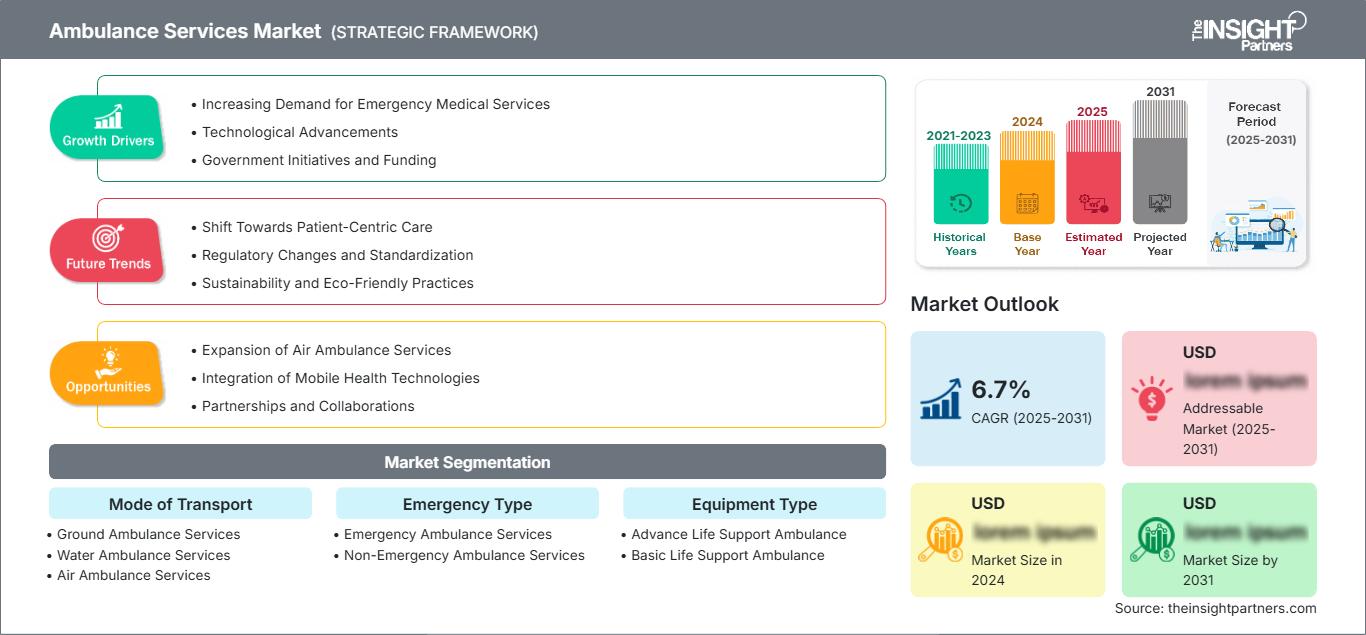
Ambulance Services Market: Strategic Insights
Regional Insights
North America Ambulance Services Market
North America represented 38–40% share in 2025 and is expected to post a CAGR of 5.4–5.8% during 2026–2034. The Ambulance Services Market share is anchored by mature 911 systems, dense hospital networks, private EMS participation, and high adoption of advanced life support vehicles. Demand remains resilient because emergency departments, trauma centers, skilled nursing facilities, and specialty hospitals rely on scheduled and unscheduled transport capacity.
Drivers that have an impact on the organization structure include age distribution, increased prevalence of chronic illnesses, and mobile integrated healthcare utilization. Organizations are making investments in electronic records, connection to defibrillators, work schedules, and replacement of vehicles. There is pressure on costs, but there are performance-driven contracts between the municipality and hospitals.
U.S. Ambulance Services Market
The U.S. comprised between 78% and 82% share of North America in 2025, and is expected to expand at a compound annual growth rate of 5.3% and 5.7% during the forecast period 2026-2034. Major cities have a combination of fire-based EMS, private ambulance companies, hospitals owning their own ambulances, and aerial medical service providers.
Geographic presence includes Envision Healthcare Corporation, Acadian Ambulance Service, Inc., Falck A/S, Air Methods Corporation, and Air Medical Group Holdings, Inc., serving in various segments within ground and air medical transportation services. The trends in applications include critical care transportation, neonatal transportation, dialysis transportation, events standby, and rural flights due to inefficiency of ground transportation over distances.
Europe Ambulance Services Market
Europe held 26–28% share in 2025 and is expected to advance at a CAGR of 5.2–5.6% during 2026–2034. The UK remains a leading country because NHS ambulance trusts, air ambulance charities, and national urgent care reforms are pushing fleet expansion and handover improvement.
Germany has advantages of structured rescue operations, sound medical supervision, and regional purchase of modern ambulances. France, Italy, and Spain contribute through public emergency numbers, international demand for healthcare, tourist medical transfers, and private companies filling the gaps in public systems that are overloaded.
Babcock International Group PLC is one of the leading players in helicopter medical aviation industry. Falck A/S keeps growing its ambulance business across Europe. Requirements regarding competencies of crew members, dispatch procedures, and response time measurement promote technology adoption and transparency.
APAC Ambulance Services Market
Share in APAC was 22-24% in 2025 and expected to witness a CAGR of 7.3-7.8% from 2026 to 2034. The main country with the largest market share is China, whereas Japan, South Korea, India, and Australia are contributing by providing well-organized hospital infrastructure and emergency services in urban areas.
Industrialization, road safety issues, and increased insurance coverage are favoring organized medical transportation. India is of utmost importance due to the presence of outsourced emergency response solutions which are creating scope for BVG India Limited, Ziqitza Healthcare Limited, and Medivic Aviation Air Ambulance Services Pvt. Ltd.
Middle East & Africa Ambulance Services Market
Middle East & Africa is projected to grow at a CAGR of 6.4–6.9% during 2026–2034, led by the UAE and Saudi Arabia. Hospital construction, medical tourism, large events, and highway infrastructure expansion are increasing the need for advanced ground and air response.
Demand in sub-Saharan Africa is led by South African private hospitals, trauma transport, and mining emergency preparedness. Adoption in the remainder of MEA is inconsistent; however, investments in energy highways, airports, and smart cities are generating demand for professional ambulances.
Segmentation Analysis
Mode of Transport
The Mode of Transport segment is expected to grow at a CAGR of 6.0–6.4% during 2026–2034. Ambulance Services Market scope across this segment reflects how geography, urgency, infrastructure, and clinical need determine transport selection. Ground services dominate routine response, air services support time-critical transfers, and water services remain essential for islands, flood-prone areas, and offshore operations.
- Ground Ambulance Services remain the core delivery mode, supported by lower operating cost, dense urban deployment, scheduled patient transport, and integration with emergency dispatch and hospital transfer networks.
- Water Ambulance Services serve coastal, island, riverine, and disaster-prone regions where road access is limited, making them strategically important for tourism zones and remote community healthcare.
- Air Ambulance Services address high-acuity transfers, rural emergencies, organ transport, and trauma evacuation, with adoption linked to aircraft availability, reimbursement, aviation regulation, and clinical crew specialization.
Emergency Type
The Emergency Type segment is projected to register a CAGR of 5.8–6.2% during 2026–2034. Demand is balanced between life-threatening incidents and planned medical mobility. Emergency services require rapid dispatch, trained responders, and clinical readiness, while non-emergency services depend on scheduling efficiency, payer authorization, and reliable transport for patients unable to use conventional mobility.
- Emergency Ambulance Services are central to trauma, cardiac arrest, stroke, obstetric, and respiratory cases, with performance measured through response time, triage accuracy, clinical protocols, and hospital handover efficiency.
- Non-Emergency Ambulance Services support dialysis, rehabilitation, hospital discharge, outpatient procedures, and long-term care transfers, creating recurring demand and improving patient flow across healthcare systems.
Equipment Type
The Equipment Type segment is anticipated to expand at a CAGR of 6.1–6.5% during 2026–2034. Adoption depends on patient acuity, reimbursement, crew training, and regulatory classification. Advanced life support vehicles require higher investment but enable critical interventions, while basic life support vehicles provide cost-effective transport for stable patients and routine mobility needs.
- Advance Life Support Ambulance vehicles are used for high-acuity response and critical care transfers, requiring cardiac monitors, ventilators, infusion pumps, medication kits, and paramedics trained for complex procedures.
- Basic Life Support Ambulance vehicles provide essential transport, oxygen support, immobilization, and first-response capability, making them important for community coverage, non-emergency transfers, and lower-acuity incidents.
Opportunity Snapshot
| Segment Name | Revenue Contribution | Trend Tag | Adoption Stage |
| Ground Ambulance Services | High | Fleet Digitalization | Mature |
| Water Ambulance Services | Low | Island Access | Emerging |
| Air Ambulance Services | Medium | Critical Transfer | Scaling |
Ambulance Services Market Growth Drivers and Impact Analysis
Rising Burden of Time-Sensitive Medical Emergencies
The growing number of heart diseases, strokes, traumatic conditions, sepsis, emergencies associated with delivery, and respiratory problems further contribute to the need for an effective system of the prehospital response. The highest impact on the market comes from regions where the government and hospitals assess the results by time-related parameters such as door to balloon and stroke time frames. Ambulance providers are evaluated not only in terms of transport effectiveness but also concerning triage, skills, and coordination with the receiving unit. The demand factor is important for cities with the need for GPS routing, dispatching, and base location.
Expansion of Hospital Networks and Interfacility Transfers
The consolidation of healthcare services is leading to more hub and spoke models of healthcare delivery, in which people are transported from community hospitals, trauma centers, heart centers, rehabilitation centers, and extended care facilities. This kind of structural change contributes to increased ambulance usage even as the number of emergencies remains constant. Hospitals need transport companies who will ensure bed management and discharge planning among other aspects of operations. The economic effects are seen in the increased need for non-emergency and critical care transport under contract, especially in markets where there is a growing elderly population and prevalent chronic conditions.
Standardization of Prehospital Care and Dispatch Systems
The national and international policies are pushing emergency services systems to evolve away from fragmented vehicle dispatching to a system where the process is guided by clinical governance in the pre-hospital phase. Dispatch center requirements, crew training, inventory of medical equipment, infection control procedures, handovers and patient documentation create a higher operating floor for providers. There are two effects on the market – one is that it becomes harder for non-professionals to be in business due to regulation and auditing requirements, whereas professional providers see new openings via public tenders and hospital cooperation. The significance of digital dispatch and electronic patient documentation increases due to regulatory and payment requirements of auditable operational performance.
Ambulance Services Market Future Trends
AI-Enabled Dispatch and Predictive Fleet Positioning
Ambulance Services Market trends are expected to be increasingly shaped by artificial intelligence tools that forecast emergency demand by location, time, weather, traffic, event schedules, and historical call patterns. Predictive positioning can reduce idle mileage, improve response reliability, and help managers balance coverage across high-risk corridors. The most valuable applications will integrate emergency call data, hospital capacity signals, and crew availability into one operational view. Adoption will be gradual because data quality, cybersecurity, and public-sector procurement cycles remain barriers. However, providers with mature command centers can use AI to improve utilization without proportionally increasing fleet size, making dispatch intelligence a margin and service-quality lever.
Hybrid Emergency and Community Paramedicine Models
The future operating model will be one that integrates emergency response with community paramedicine, remote evaluation, and hospital at home support. It may be the case where the ambulances attend to patients in their residences, conduct point-of-care evaluations or refer patients to virtual clinicians instead of taking all cases to the emergency room. Such an operating model will be significant in cases where the systems are characterized by hospital congestion and high non-emergency calls. There will be a transition from charging based on the transportation model to charging based on availability, performance and population health contracts.
Ambulance Services Market Opportunities
Scaling Air Medical Networks in Underserved Geographies
Ambulance Services Market Forecasts indicate that air medical transport can capture higher-value opportunities where distance, terrain, and specialist care concentration limit ground response. Investors can target regions with expanding trauma systems, remote industrial sites, tourism corridors, and island populations. The opportunity requires disciplined capital planning because aircraft acquisition, maintenance, pilots, clinical crews, and regulatory compliance create high fixed costs. Partnerships with hospitals, insurers, mining companies, energy operators, and governments can improve utilization reliability. Successful providers will combine rotorcraft or fixed-wing access with transparent pricing, medical oversight, and reliable landing infrastructure. This makes air ambulance expansion attractive but operationally demanding.
Building Contracted Non-Emergency Transport Platforms
An attractive opportunity for scaling lies in non-emergency transportation services because of the aging population and increased use of outpatient services creating multiple requirements for mobility. Route density can be gained at dialysis facilities, rehab centers, cancer treatment centers, nursing homes, and discharge departments of hospitals. There is a good business case if operators leverage scheduling tools, payers’ records, patient management system, and adequate fleet. In contrast to the ambulance industry, such service allows for optimization via long-term agreements and consistent utilization. It additionally allows hospitals to shorten patients' discharges and make beds available. New entrants should focus on compliance, comfort, punctuality, and coordination with care coordinators.
Recent Developments
- September 2025: Babcock International Group PLC — The company secured a four-year contract extension with Hampshire and Isle of Wight Air Ambulance, continuing provision of an Airbus H135 helicopter with Night Vision Imaging System technology, maintenance, safety compliance, and aviation personnel. The arrangement supports a 19-hour daily operating model and relocation near Southampton Airport.
- June 2025: Falck A/S — Falck USA launched ambulance operations in the Dallas/Fort Worth Metroplex, marking a strategic expansion into the Southwest. The service provides advanced life support, critical care transport, and 911 emergency response, with management indicating plans to expand across the broader DFW area and strengthen community-centered EMS coverage.
- March 2025: Air Methods Corporation — Air Methods announced fleet expansion plans involving nearly 50 new aircraft through agreements with Bell Textron Inc. and Airbus Helicopters. The program included up to 27 Bell helicopters and 21 Airbus helicopters, supporting nationwide emergency medical transport capacity across its extensive U.S. base network.
Frequently Asked Questions

- Comprehensive Market Sizing and Forecast Analysis
- Detailed Segmentation Analysis
- In-Depth Market Dynamics Assessment
- Regional and Country-Level Insights
- Competitive Landscape and Company Benchmarking
- Strategic Business Intelligence
Recent Reports
Testimonials

The Insight Partners' SCADA System Market report is comprehensive, with valuable insights on current trends and future forecasts. The team was highly professional, responsive, and supportive throughout. We are very satisfied and highly recommend their services.
RAN KEDEM Partner, Reali Technologies LTDs
I requested a report on a very specific software market and the team produced the report in a few days. The information was very relevant and well presented. I then requested some changes and additions to the report. The team was again very responsive and I got the final report in less than a week.
JEAN-HERVE JENN Chairman, Future Analytica
We worked with The Insight Partners for an important market study and forecast. They gave us clear insights into opportunities and risks, which helped shape our plans. Their research was easy to use and based on solid data. It helped us make smart, confident decisions. We highly recommend them.
PIYUSH NAGPAL Sr. Vice President, High Beam Global
The Insight Partners delivered insightful, well-structured market research with strong domain expertise. Their team was professional and responsive throughout. The user-friendly website made accessing industry reports seamless. We highly recommend them for reliable, high-quality research services
YUKIHIKO ADACHI CEO, Deep Blue, LLC.
This is the first time I have purchased a market report from The Insight Partners.While I was unsure at first, I visited their web site and felt more comfortable to take the risk and purchase a market report.I am completely satisfied with the quality of the report and customer service. I had several questions and comments with the initial report, but after a couple of dialogs over email with their analyst I believe I have a report that I can use as input to our strategic planning process.Thank you so much for taking the extra time and making this a positive experience.I will definitely recommend your service to others and you will be my first call when we need further market data.
JOHN SUZUKI President and Chief Executive Officer, Board Director, BK Technologies
I wish to appreciate your support and the professionalism you displayed in the course of attending to my request for information regarding to infectious disease IVD market in Nigeria. I appreciate your patience, your guidance, and the fact that you were willing to offer a discount, which eventually made it possible for us to close a deal. I look forward to engaging The Insight Partners in the future, all thanks to the impression you have created in me as a result of this first encounter.
DR CHIJIOKE ONYIA MANAGING DIRECTOR, PineCrest Healthcare Ltd.Reason to Buy
- Informed Decision-Making
- Understanding Market Dynamics
- Competitive Analysis
- Identifying Emerging Markets
- Customer Insights
- Market Forecasts
- Risk Mitigation
- Boosting Operational Efficiency
- Strategic Planning
- Investment Justification
- Tracking Industry Innovations
- Aligning with Regulatory Trends





 Get Free Sample for