
Ambulatory Healthcare Service Market Size, Trends & Demand by 2034
Ambulatory Healthcare Service Market Size and Forecasts (2021–2034), Global and Regional Share, Trends, and Growth Opportunity Analysis Report Coverage : by Type (Primary Care Office, Surgical Specialty Office, Emergency Department, Medical Specialty Office); Application (Ophthalmology, Orthopedics, Gastroenterology, Pain Management, Other Applications); and Geography (North America, Europe, Asia Pacific, and South and Central America)
- Status : Data Released
- Report Code : TIPRE00040159
- Category : Life Sciences
- No. of Pages : 150
- Available Report Formats :


- Last update date : July 15, 2026


2025 Market Size
US$ 938.98 Bn
Base year value
2034 Forecast
US$ 1,430.79 Bn
Projected by 2034
CAGR 2026-2034
4.79 %
Growth rate
Addressable Market
US$ 10,756.29 Bn
(2026-2034)
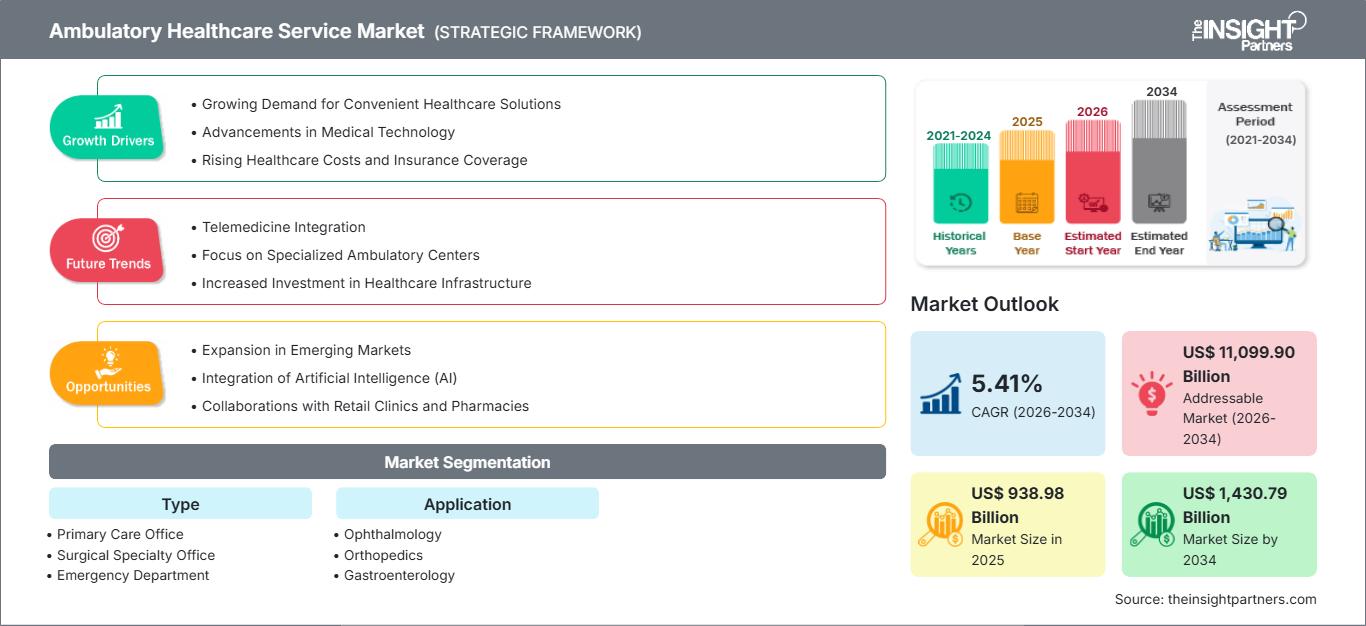
The Ambulatory Healthcare Service market was valued at US$ 938.98 billion in 2025 and is expected to reach US$ 1430.79 billion by 2034; it is estimated to record a CAGR of 4.79% during 2026-2034.
Ambulatory Healthcare Service Market Assessment and Insights
- North America accounted for 39–42% share in 2025 and is expected to grow at a CAGR between 2026–2034 of 4.9–5.4%, driven by ASC expansion, payer steering, and higher outpatient procedure readiness.
- US represented 83–86% share of North America in 2025 and is projected to grow at a CAGR between 2026–2034 of 4.8–5.3%, supported by large integrated operators and specialty migration.
- Europe held 24–27% share in 2025 and is expected to grow at a CAGR between 2026–2034 of 4.4–4.9%, led by Germany, the UK, France, Italy, and Spain through outpatient reform and elective backlog reduction.
- Asia Pacific captured 20–23% share in 2025 and is forecast to grow at a CAGR between 2026–2034 of 6.1–6.8%, with China, Japan, India, South Korea, and Australia expanding day-care surgery and medical specialty clinics.
- Largest Segment: Primary Care Office held 34–37% market share in 2025 and is expected to grow at a CAGR range of 4.7–5.2% during 2026–2034 due to chronic disease management needs.
- High Growth Segment: Surgical Specialty Office held 25–28% market share in 2025 and is expected to grow at a CAGR range of 6.0–6.6% during 2026–2034 as procedures shift to ASCs.
- Key companies analyzed in detail: HCA Healthcare, Inc.; Tenet Healthcare Corporation; Kaiser Foundation Health Plan, Inc.; UnitedHealth Group Incorporated; CVS Health Corporation; Fresenius Medical Care AG; Rite Aid Corporation; Pediatrix Medical Group, Inc.; Amedisys, Inc.; LifePoint Health, Inc.
Source: The Insight Partners' analysis based on proprietary research, government publications, company annual reports, investor presentations, industry databases, and expert interviews.
The care delivery model has changed from hospital-based capacity management to decentralized outpatient delivery enabled through online scheduling, remote monitoring, referral analysis, and standard clinical pathways. The providers are revamping their facilities based on shorter stays, less staffing intensity, and more procedure volume. The production process in this particular service industry is dependent on physician availability, specialty equipment utilization, authorization processes, and patient navigation system apart from just bed capacity.
The growth in the future would depend on favorable policies towards lower-acuity outpatient care, investment in specialty centers, and referral network development in the new geographical regions. There are expectations that Asia Pacific and some parts of the Middle East would become important owing to government investments in community clinics and private investments in day care surgery services. Tailwinds in the form of digital health care, bundled payment, and chronic care management would further aid the process.
Ambulatory Healthcare Service Market Report Scope
| Report Attribute | Details |
|---|---|
| Market size in 2025 | US$ 938.98 Billion |
| Market Size by 2034 | US$ 1,430.79 Billion |
| Global CAGR (2026 - 2034) | 4.79% |
| Historical Data | 2021-2024 |
| Forecast period | 2026-2034 |
Ambulatory Healthcare Service Market Analysis
Rising chronic disease prevalence, aging populations, and payer interest in lower-cost settings are reinforcing Ambulatory Healthcare Service Market growth. According to WHO, NCDs contribute to most deaths worldwide, which results in the repetition of patient visits for diabetes, heart ailments, kidney diseases, eye problems, and musculoskeletal problems. The ecosystem consists of doctor practices, ASCs, diagnostic companies, home healthcare organizations, pharmacies, insurers, health systems, and tech companies, which collaborate to perform pre-visit triaging, provision of care, billing, and post-visit management.
The dynamics of the supply side are hampered by lack of doctors and unequal distribution of specialists, and thus productivity is an essential component of the model. Healthcare providers are trying to increase productivity through automating scheduling, use of care coordinators, centralized revenue cycle processes, and standardized procedure rooms. Supply dynamics are also affected by payer contracts, certificate of need regulations, pharmaceutical dispensing laws, and capital access for setting up new facilities.
Ambulatory Healthcare Service Market report shows that this market is competitive in nature and is dominated by integrated health organizations, payer owned care organizations, kidney care networks, primary care groups, and home health organizations. HCA Healthcare, Inc. and Tenet Healthcare Corporation specialize in ambulatory surgery centers while UnitedHealth Group Incorporated and CVS Health Corporation combine healthcare services with insurance, pharmacies and data analytics. Kaiser Foundation Health Plan, Inc. focuses on integrated group model healthcare services while Fresenius Medical Care AG specializes in outpatient renal services.
The strategic investments focus on deepening expertise, physician alignments and geographical presence instead of facility count. Pediatrix Medical Group, Inc. is relevant in the market due to its physician aligned specialized services whereas Amedisys, Inc. and LifePoint Health, Inc. bring outpatient access with home and community based services. However, the strategy for Rite Aid Corporation revolves around retail healthcare access although its strategy still depends upon stable geographic presence and pharmacy based service integrations.
● REPORT CUSTOMIZATION
Tailor This Report To Align With Your Specific Business Requirements
This report can be customized to align precisely with your business objectives, scope, and target markets. Customization options include tailored segmentation, geography, competitive analysis, and strategic insights to support informed decision-making.
Customize This Report →WHAT YOU CAN ADJUST
- ● Segmentations
- ● Geography
- ● Competitive Analysis
- ● Language Preferences
Ambulatory Healthcare Service Market: Strategic Insights
Regional Insights
North America Ambulatory Healthcare Service Market
North America holds a 39–42% share in 2025 and is expected to grow with a CAGR of 4.9–5.4% for the forecast period 2026–2034. This region enjoys the advantage of high penetration in terms of insurance coverage, established ambulatory surgery regulations, and payer-driven site-of-care management. Medicare and commercial payers prefer outpatient facilities over inpatient ones in cases where both have similar clinical safety standards.
The North America Ambulatory Healthcare Service Market share is driven by integrated delivery networks, physician consolidation, and technology-enabled access. HCA Healthcare, Inc., Tenet Healthcare Corporation, UnitedHealth Group Incorporated, CVS Health Corporation, and Kaiser Foundation Health Plan, Inc. are building their referral strategy through primary care, specialty practices, urgent care centers, ASCs, and technology-enabled navigation. Orthopedics, ophthalmology, gastroenterology, and pain procedures form the foundation of these applications.
U.S. Ambulatory Healthcare Service Market
U.S. accounts for 83-86% share of North American market in 2025 and forecasted to increase with the CAGR growth rate range of 4.8-5.3% in 2026-2034. The region will be driven by large ASC players, specialty physicians' collaborations, employer plan steering and data-driven reimbursement models. Application areas include outpatient surgery, primary care, dialysis, urgent care and value-based senior care.
There is significant presence of players within the U.S. Tenet Healthcare Corporation's USPI platform, UnitedHealth Group Incorporated's Optum and SCA Health business units and HCA Healthcare, Inc.'s outpatient division boost procedural capabilities. CVS Health Corporation provides services related to primary care of seniors and pharmacy access, whereas Fresenius Medical Care AG focuses on chronic kidney disease patients. The demand for the region is highest for orthopaedics, gastroenterology, ophthalmology and pain management.
Europe Ambulatory Healthcare Service Market
Europe’s market had a 24-27% share in 2025 and is expected to experience a CAGR of 4.4-4.9% between 2026-2034. There is an ongoing development of an outpatient approach in the UK to deal with electively scheduled patient backlog, which includes the reformation of the NHS with an emphasis on community diagnostic centers, urgent one-day emergency treatment, and day case procedures increase. The demand comes from ophthalmology, orthopedic specialties, gastroenterology, and chronic diseases follow-up.
The leading country is Germany due to well-developed specialist network, the presence of statutory insurance system, and reforms that promote the use of outpatient treatment for procedures that were provided on the inpatient level previously. There is good access to specialists on an ambulatory basis, although the labor market situation and reimbursement issues influence the rate of growth.
France, Italy, and Spain move towards more frequent day surgeries and outpatient consultations of medical specialties due to dealing with budget restrictions and capacity issues. France has a strong insurance system, Italy takes advantage of its regional investment into outpatient care within its recovery plans, while Spain can benefit from development of outpatient departments by private hospital groups.
APAC Ambulatory Healthcare Service Market
The market share of APAC was 20-23% in 2025 and is expected to grow at a CAGR of 6.1-6.8% from 2026 to 2034. The key driver for China will be its specialty clinics in urban areas, hospital networks, and favorable policies for tiered diagnosis. Mature outpatient consumption and aged care system of Japan and South Korea are adding to the growth of the market.
The unique growth factors of India and Australia are also highlighted in the research. India will see growth owing to private day-care surgery services, ophthalmology chain and increased gastroenterology procedures, whereas Australia will benefit from its community care facilities and efficient electives. Medical device localization, appointment booking software, and insurance involvement are some industrial driving factors.
Middle East & Africa Ambulatory Healthcare Service Market
The Middle East & Africa market is expected to grow at a CAGR range of 5.6–6.2% during 2026–2034. Saudi Arabia is the leading country, supported by Vision 2030 healthcare privatization, hospital network modernization, and investment in ambulatory clinics. The UAE is adding premium outpatient centers linked to medical tourism and chronic care management.
The best example of a well-established system of private care facilities in the sub-Sahara is South Africa, even though limited affordability restricts its wider use. Markets in the rest of MEA are enhancing access to healthcare facilities via primary care clinics, dialysis clinics, and special outreach programs. Government expenditure related to energy in Gulf countries facilitates clinic building.
Segmentation Analysis
Type
Type of market is forecasted to expand at a CAGR of 5.0-5.6% between 2026 and 2034 owing to a well-balanced demand for services from primary care, specialty care, emergency departments, and surgery centers. The Ambulatory Healthcare Service Market is increasing in scope due to integration of prevention, diagnosis, procedures, and follow-up services by healthcare providers in ambulatory care facilities. Growth is high where payment incentives drive access and performance.
- Primary Care Office remains the access gateway for chronic disease monitoring, preventive screening, referrals, and medication management. Its strategic value lies in patient retention, risk stratification, and early intervention before specialist or emergency utilization.
- Surgical Specialty Office is gaining importance as anesthesia, devices, imaging, and recovery protocols enable same-day procedures. Providers use these sites to improve throughput, physician productivity, and payer acceptance for lower-cost surgery.
- Emergency Department continues to serve urgent non-admitted cases, especially where freestanding and hospital-linked facilities support triage. Demand is shaped by convenience, payer policies, after-hours access, and shortages in primary care availability.
- Medical Specialty Office supports cardiology, nephrology, gastroenterology, endocrinology, and pain-related consultations. These sites are strategically important because aging populations require repeat specialist visits, diagnostic coordination, and long-term disease management.
Application
CAGR is estimated to be between 5.2-5.8% from 2026 to 2034 due to procedure-oriented and specialty-driven nature of outpatient care. Applications will be driven by prevalence of disease, development of devices, safety of anesthesia, insurance approvals, and patient desire for faster recovery. The most successful applications have predictable patients, repeatable care, and cost benefit compared to inpatient and hospital outpatient care.
- Ophthalmology has a mature outpatient model supported by cataract surgery, retinal procedures, diagnostics, and high elderly demand. Its strategic relevance comes from predictable volumes, efficient rooms, and strong patient acceptance.
- Orthopedics is moving rapidly toward ASCs for joints, sports medicine, spine-adjacent procedures, and pain-linked care. Growth depends on implant protocols, rehabilitation coordination, payer approval, and surgeon alignment.
- Gastroenterology remains central because colonoscopy, endoscopy, and digestive disease monitoring fit outpatient workflows. Screening programs, aging demographics, and anesthesia-supported procedure rooms sustain consistent procedure volumes.
- Pain Management demand is supported by chronic back pain, musculoskeletal disorders, and interventional procedures. Providers prioritize these services because they generate repeat visits, imaging coordination, and referral relationships with orthopedics and neurology.
Opportunity Snapshot
| Segment Name | Revenue Contribution | Trend Tag | Adoption Stage |
| Ophthalmology | High | Cataract Hubs | Mature |
| Orthopedics | High | Joint Migration | Scaling |
| Gastroenterology | High | Screening Access | Mature |
| Pain Management | Medium | Spine Pathways | Scaling |
| Other Applications | Low | Niche Clinics | Emerging |
Ambulatory Healthcare Service Market Growth Drivers and Impact Analysis
Shift of Procedures from Inpatient Sites to Outpatient Centers
The procedure migration is the most powerful structuring force due to its direct impact on where healthcare expenditures take place. Anesthesia advances, less-invasive surgical tools, imaging guidance, and post-procedure recovery methods make numerous procedures for orthopedic, ophthalmic, gastrointestinal and pain management fields possible without the need of overnight hospital stay. Payors are supportive of procedure migration as similar procedures can be performed at a lower expense to facility, while patients get the benefit of shorter visit and quicker discharge. The reaction of health system is that it starts building ASCs and specialty offices in proximity of referral base, instead of depending only on hospital sites.
Aging Population and Chronic Disease Visit Intensity
Populations with older ages continue to create constant needs for primary care visits, specialist visits, dialysis, ophthalmic services, musculoskeletal health care, and pharmacy. Aging patients will need to be screened for various health issues like diabetes, cardiovascular problems, renal conditions, eye problems, gastrointestinal diseases, and musculoskeletal pain. Outpatient facilities are thus an important source of longitudinal care. The need for lower acuity services in order to prevent admissions from being necessitated, as pointed out by WHO, is an important aspect to note when looking at population aging as one of the drivers of ambulatory care delivery.
Payer and Employer Focus on Lower-Cost Care Settings
Commercial health insurers, Medicare Advantage plans, and self-insured companies are employing benefit design, preauthorization, network tiers, and bundled payments to drive eligible patients to seek treatment in an outpatient setting. This force acts on both supply and demand sides since healthcare organizations must prove safety, quality, and cost effectiveness to continue being preferred providers. Outpatient facilities able to perform predictable treatments and manage chronic illness cases can achieve transparent pricing and scheduling, thus gaining more trust from payers. Companies prefer such models if they increase employee attendance at work and lower total costs of the episode.
Ambulatory Healthcare Service Market Future Trends
AI-Enabled Navigation and Predictive Outpatient Scheduling
AI-fueled navigation is expected to emerge as one of the leading Ambulatory Healthcare Service Market trends, enabling healthcare facilities to match their patients with the appropriate facility, provider, and appointment. Predictive tools will assist in finding missed screenings, no-shows, readiness for procedures, and risks associated with the follow-up visit. Within the forecast period, AI-fueled navigation solutions will minimize empty capacity, facilitate referrals, and provide payer reporting. The greatest success will be achieved by integrated practices that have large volumes of data from primary care, specialty visits, pharmacy, and claims.
Expansion of Hybrid Ambulatory and Home-Based Care Models
Hybrid approaches will combine outpatient facilities with home monitoring, remote follow-up, pharmacy services, and home health. Such a shift is particularly applicable to kidney conditions, postoperative care, pain management programs, and geriatric primary care, where there is a need for monitoring following the outpatient facility visit. It is expected that providers will have to re-engineer their processes such that the physical visit will revolve around diagnostic and intervention processes, while education and compliance monitoring and monitoring symptoms can be done remotely. This will result in a wider service offering by ambulatory organizations.
Ambulatory Healthcare Service Market Opportunities
Specialty ASC Partnerships in Underserved Metropolitan Areas
Investors can target specialty ASC partnerships in underserved metropolitan catchments where hospital outpatient departments remain congested and physician groups lack capital for expansion. Orthopedics, gastroenterology, ophthalmology, and pain management offer attractive Ambulatory Healthcare Service Market Forecasts because they combine high case volume with defined clinical protocols. The opportunity is not limited to facility ownership; management services, equipment leasing, anesthesia partnerships, and revenue-cycle support can also capture value. Operators should prioritize markets with favourable payer mix, measurable referral leakage, and surgeons seeking succession pathways. Execution requires physician alignment, payer contracting, quality reporting, and disciplined site selection near population growth corridors.
Integrated Primary Care and Pharmacy-Led Access Models
Primary care and pharmacy-linked outpatient models offer an opportunity to manage patients earlier, particularly in neighbourhoods with limited specialist access. Retail pharmacies, senior clinics, and physician groups can coordinate vaccinations, medication adherence, chronic disease checks, lab referrals, and telehealth triage. This model is attractive because it expands access without immediately requiring hospital-scale infrastructure. Payers may support it when it reduces emergency utilization and improves quality metrics. Strategic action should focus on connecting pharmacists, nurse practitioners, primary care physicians, and care managers through shared data platforms. The most viable investments will combine local convenience with referral pathways into specialty and surgical networks.
Recent Developments
- July 2026: Kaiser Foundation Health Plan, Inc. opened its first two northern Nevada medical offices in Reno and Sparks through its joint venture with Renown Health, creating a new outpatient care delivery base. The sites initially provide primary care and laboratory services, with pharmacy and imaging planned for 2027.
- June 2026: Fresenius Medical Care AG launched kinexus worldwide, a unified digital platform designed to support home dialysis. The development strengthens outpatient kidney care by connecting treatment data, patient support, and clinical workflows, aligning with the company’s strategy to expand digital care delivery beyond traditional dialysis clinic infrastructure.
- October 2025: Tenet Healthcare Corporation reported continued investment in its United Surgical Partners International platform, including 11 ASC acquisitions and two de novo openings in the third quarter of 2025. The company also indicated nearly US$ 300 million in ambulatory care M&A spending year to date.
Frequently Asked Questions

- Comprehensive Market Sizing and Forecast Analysis
- Detailed Segmentation Analysis
- In-Depth Market Dynamics Assessment
- Regional and Country-Level Insights
- Competitive Landscape and Company Benchmarking
- Strategic Business Intelligence
Recent Reports
Testimonials

The Insight Partners' SCADA System Market report is comprehensive, with valuable insights on current trends and future forecasts. The team was highly professional, responsive, and supportive throughout. We are very satisfied and highly recommend their services.
RAN KEDEM Partner, Reali Technologies LTDs
I requested a report on a very specific software market and the team produced the report in a few days. The information was very relevant and well presented. I then requested some changes and additions to the report. The team was again very responsive and I got the final report in less than a week.
JEAN-HERVE JENN Chairman, Future Analytica
We worked with The Insight Partners for an important market study and forecast. They gave us clear insights into opportunities and risks, which helped shape our plans. Their research was easy to use and based on solid data. It helped us make smart, confident decisions. We highly recommend them.
PIYUSH NAGPAL Sr. Vice President, High Beam Global
The Insight Partners delivered insightful, well-structured market research with strong domain expertise. Their team was professional and responsive throughout. The user-friendly website made accessing industry reports seamless. We highly recommend them for reliable, high-quality research services
YUKIHIKO ADACHI CEO, Deep Blue, LLC.
This is the first time I have purchased a market report from The Insight Partners.While I was unsure at first, I visited their web site and felt more comfortable to take the risk and purchase a market report.I am completely satisfied with the quality of the report and customer service. I had several questions and comments with the initial report, but after a couple of dialogs over email with their analyst I believe I have a report that I can use as input to our strategic planning process.Thank you so much for taking the extra time and making this a positive experience.I will definitely recommend your service to others and you will be my first call when we need further market data.
JOHN SUZUKI President and Chief Executive Officer, Board Director, BK Technologies
I wish to appreciate your support and the professionalism you displayed in the course of attending to my request for information regarding to infectious disease IVD market in Nigeria. I appreciate your patience, your guidance, and the fact that you were willing to offer a discount, which eventually made it possible for us to close a deal. I look forward to engaging The Insight Partners in the future, all thanks to the impression you have created in me as a result of this first encounter.
DR CHIJIOKE ONYIA MANAGING DIRECTOR, PineCrest Healthcare Ltd.Reason to Buy
- Informed Decision-Making
- Understanding Market Dynamics
- Competitive Analysis
- Identifying Emerging Markets
- Customer Insights
- Market Forecasts
- Risk Mitigation
- Boosting Operational Efficiency
- Strategic Planning
- Investment Justification
- Tracking Industry Innovations
- Aligning with Regulatory Trends





 Get Free Sample for