
Ambulatory Infusion Therapy Services Market Size, Share & Demand by 2034
Coverage: by Type ( Hospital-Based Ambulatory Surgery Centers, Free-Standing Ambulatory Surgery Centers ); Specialty ( Single- Specialty Centers, Multi-Specialty Centers ); Treatment ( Cataract Surgery, Orthopaedic Surgery, Endoscopic Procedure, Gastroenterology, Others ), and Geography (North America, Europe, Asia Pacific, and South and Central America)
- Status : Data Released
- Report Code : TIPRE00012481
- Category : Life Sciences
- No. of Pages : 150
- Available Report Formats :


- Last update date : July 15, 2026


2025 Market Size
US$ 30.31 Bn
Base year value
2034 Forecast
US$ 54.73 Bn
Projected by 2034
CAGR 2026-2034
7.66 %
Growth rate
Addressable Market
US$ 401.75 Bn
(2026-2034)
The Ambulatory Infusion Therapy Services Market was valued at US$ 30.31 Billion in 2025 and is projected to reach US$ 54.73 Billion by 2034, growing at a CAGR of 7.66% during 2026–2034. It represents the rise of alternate care delivery methods, the preference of payers for more cost-effective care sites, and the acceptance of ambulatory infusions as part of the medical community.
North America is still the most advanced region, thanks to its specialized medication usage, care site optimization by payers, and extensive provider networks. The Ambulatory Infusion Therapy Services Market size in the region is expected to expand at a CAGR of 7.3–7.8% during 2026–2034, with growth anchored by chronic disease prevalence, biosimilar adoption, oncology supportive care, immunology therapies, and operational investment in outpatient access points.
Ambulatory Infusion Therapy Services Market Assessment and Insights
- North America: The region accounted for 47–49% share in 2025 and is growing at a CAGR of 7.3–7.8% during 2026–2034, supported by payer steering, specialist referral networks, accreditation standards, and strong specialty pharmacy integration.
- US: The US represented 82–85% of North America in 2025 and is growing at a CAGR of 7.2–7.7% during 2026–2034, driven by commercial payer site-neutrality programs and provider-owned infusion suites.
- Europe: Europe held 24–26% share in 2025 and is growing at a CAGR of 6.8–7.3% during 2026–2034, with Germany, the UK, and France leading due to integrated outpatient pathways and biosimilar prescribing.
- Asia Pacific: Asia Pacific represented 17–19% share in 2025 and is growing at a CAGR of 8.6–9.2% during 2026–2034, led by China, Japan, India, South Korea, and Australia as specialty care capacity widens.
- Largest Segment: Hospital-Based Ambulatory Surgery Centers held 58–62% market share in 2025, growing at a CAGR of 7.2–7.7% during 2026–2034 because hospitals retain complex case referrals and pharmacy governance.
- High Growth Segment: Free-Standing Ambulatory Surgery Centers held 38–42% market share in 2025, growing at a CAGR of 8.0–8.6% during 2026–2034 as payers encourage lower-cost community-based care.
- Key companies analyzed in detail: Accredo Health Group Inc., CHI Health, Cleveland Clinic Foundation, Coram LLC, HCA Healthcare Inc., McLaren Health Care Corporation, Option Care Health Inc., PharMerica Corporation, UnitedHealth Group Incorporated, KabaFusion Holdings LLC, Soleo Health Inc.
Source: The Insight Partners' analysis based on proprietary research, government publications, company annual reports, investor presentations, industry databases, and expert interviews.
Scheduling, prior authorization electronically, cold chain, and remote nurse documentation are some ways that infusion capacity planning is being revolutionized by technology. Providers have changed their focus from episodic chair utilization to disease-based programs including immunology, neurology, gastroenterology, oncology support services, and nutrition therapies. This is due to production issues, which are related to biologics, requiring compounding, skilled nurses, adverse event policies, and payer validation. This operational complexity strengthens established networks within Ambulatory Infusion Therapy Services Market.
Future demand is likely to expand to suburban cluster areas, secondary markets, and specialty pharmacies' neighboring clinics. Outpatient regulation, biosimilar substitution policy, and hospitals’ lack of space are driving the business case for decentralized infusion suites. Future markets will probably focus on oncology, immunology, gastroenterology, and post-acute antibiotics programs. The Ambulatory Infusion Therapy Services Market will more and more reward providers that can integrate clinical safety, payer contracts, patient intake digitally, and nurse supply reliably.
Ambulatory Infusion Therapy Services Market Report Scope
| Report Attribute | Details |
|---|---|
| Market size in 2025 | US$ 30.31 Billion |
| Market Size by 2034 | US$ 54.73 Billion |
| Global CAGR (2026 - 2034) | 7.66% |
| Historical Data | 2021-2024 |
| Forecast period | 2026-2034 |
Ambulatory Infusion Therapy Services Market Analysis
Demand has been increasing due to the need for repeated biologics and immune globulins administration because of the prevalence of auto-immune, neurological, gastroenterological, and immunodeficiency diseases. Ambulatory Infusion Therapy Services Market is also influenced by the preference of payers for low-acuity, observed environments rather than hospital outpatient clinics. The ecosystem connects drug manufacturers, specialty pharmacies, prescribers, payers, nurses, accreditation agencies, and logistics providers to form a service chain.
Supply is limited by the number of available infusion nurses, reimbursement policies, and needs for the drugs handling. Companies having standardized protocols will be able to increase chair turnaround, cancel fewer visits, and avoid emergency situations. Hospitals will have advantages of clinical governance whereas free-standing sites – due to their convenience and reduced costs. Such equilibrium will promote the creation of hybrid models having centralized pharmacy and decentralized access points.
The competition in this market is fractured yet more strategic. The Ambulatory Infusion Therapy Services Market analysis reveals national-level companies such as Option Care Health Inc., UnitedHealth Group Incorporated via its Optum business line, Coram LLC, Accredo Health Group Inc., KabaFusion Holdings LLC, and Soleo Health Inc. in competition with hospitals like Cleveland Clinic Foundation, HCA Healthcare Inc., CHI Health, and McLaren Health Care Corporation.
Money is being invested in areas of referral automation, payer contracting, reporting, and specialization rather than merely expanding site locations. PharMerica Corporation continues to play a role in situations that involve the intersection between long-term care pharmacy services and infusion care. Competitive advantage in the market is based on treatment breadth, geographical presence, nurse staffing flexibility, and capability in proving results to payers.
● REPORT CUSTOMIZATION
Tailor This Report To Align With Your Specific Business Requirements
This report can be customized to align precisely with your business objectives, scope, and target markets. Customization options include tailored segmentation, geography, competitive analysis, and strategic insights to support informed decision-making.
Customize This Report →WHAT YOU CAN ADJUST
- ● Segmentations
- ● Geography
- ● Competitive Analysis
- ● Language Preferences
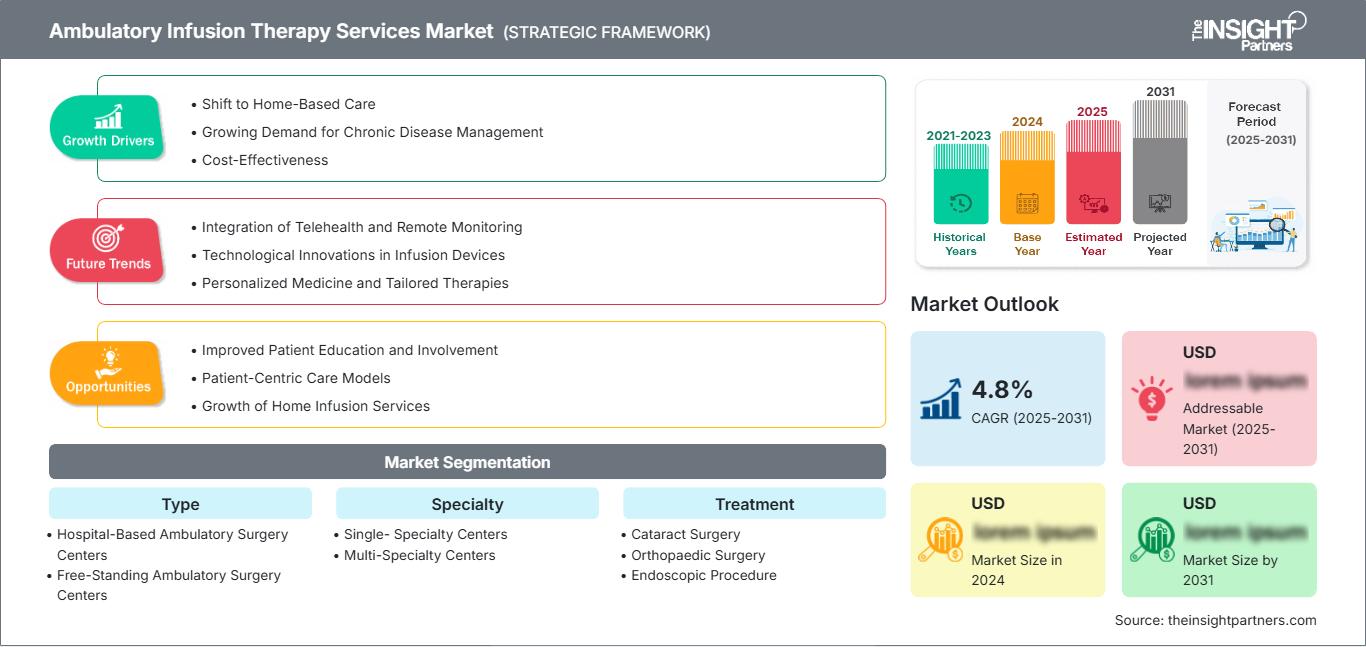
Ambulatory Infusion Therapy Services Market: Strategic Insights
Regional Insights
North America Ambulatory Infusion Therapy Services Market
North America held 47–49% share in 2025 and is projected to expand at a CAGR of 7.3–7.8% during 2026–2034. The Ambulatory Infusion Therapy Services Market share is supported by mature specialty pharmacy networks, broad biologics utilization, and reimbursement models that encourage site-of-care migration. Accreditation standards, analytics by payers, and manufacturers who desire reliable delivery mechanisms for their premium products are advantages for this region.
There are structural demands resulting from aging population, high number of treatments available for autoimmune diseases, oncology support care requirements, and high use of biosimilars. Although the US dominates volumes in the region, Canada is known to contribute through the outpatient care offered by hospitals and province level care redesign. The providers are working on integrating patient intake, solutions for nurse productivity, and adverse events preparation because the payer now assesses total episode costs, compliance, and adherence.
U.S. Ambulatory Infusion Therapy Services Market
The US held the share of 82-85% in North America in 2025 and is anticipated to register a growth rate of 7.2-7.7% in terms of CAGR during 2026-2034. Some commercial payers are moving some of the biologic infusions from the hospital outpatient department settings, where possible, and when the patient acuity can support that.
Companies have more presence in the metropolitan locations of large or mid-size. These are companies such as Option Care Health Inc., Coram LLC, Accredo Health Group Inc., UnitedHealth Group Incorporated, KabaFusion Holdings LLC, and Soleo Health Inc., which work in conjunction with hospitals. There are many applications, and some of them are immunoglobulin, inflammatory bowel disease, multiple sclerosis, rheumatoid arthritis, parenteral nutrition, and anti-infective.
Europe Ambulatory Infusion Therapy Services Market
Europe held 24%–26% market share in 2025 and is anticipated to grow at a CAGR of 6.8%–7.3% between 2026 and 2034. Germany is the market leader due to good match of prescription practice, biologic access, and outpatient care infrastructure with infusions. The UK is increasing community infusion capacity in response to pressures on hospitals from the NHS to relieve their backlog. Private sector facilities provide rapid access to certain treatments.
Germany has good hospital infrastructure, specialty doctor availability, and experience with biosimilars in immuno-oncology support. France, Italy, and Spain are developing their market through regional outpatient care programs. However, the reimbursement process varies. Infusion suite adoption occurs where public health authorities see it as a solution to increase capacity. Growth is stable but not disruptive as it depends on governance, nursing, and purchasing policies.
APAC Ambulatory Infusion Therapy Services Market
The APAC region has a market share ranging between 17-19% and has the highest rate of expansion, growing at a CAGR of 8.6-9.2% in 2026-2034 owing to its fast-pace development. China dominates the market by volume due to the decentralization of certain recurring treatments by tertiary hospitals, while Japan and South Korea have outpatient systems that offer quality services and are regulated.
India and Australia are developing ambulatory infrastructure in terms of private hospitals, health insurance, and specialty clinics. The policy focus on congestion in hospitals, production of local biologics, access to oncology, and health records digitization favors uptake. The industrial factors driving growth in the market include cold chain investments and clinic networks as well as physicians’ involvement in the management of chronic conditions.
Middle East & Africa Ambulatory Infusion Therapy Services Market
The Middle East & Africa is projected to grow at a CAGR of 7.9–8.5% during 2026–2034. Saudi Arabia is the leading country because healthcare transformation programs are expanding outpatient infrastructure, specialty hospitals, and private-sector participation. The UAE follows with medical tourism, premium clinics, and payer interest in efficient day-care delivery.
The South African contribution is seen in terms of private hospitals and oncology infusions while the Rest of MEA continues to have mixed results owing to staffing and compensation issues. Public investments in energy-based health infrastructure development in the Gulf region makes the region more prepared for the infusion suites and specialist drug distribution.
Segmentation Analysis
Type
The Type segment is projected to grow at a CAGR of 7.4–7.9% during 2026–2034. The Ambulatory Infusion Therapy Services Market scope across type is shaped by clinical acuity, payer steering, patient convenience, and provider ownership models. Hospital-based centers remain important for complex patients, while free-standing centers are gaining traction where predictable therapies can be administered safely in lower-cost, accessible environments.
- Hospital-Based Ambulatory Surgery Centers: These centers retain a leading position because hospitals control referrals, pharmacy oversight, emergency escalation, and specialist coordination for higher-risk cases requiring closer supervision.
- Free-Standing Ambulatory Surgery Centers: These centers are strategically important for community access, payer-preferred care pathways, lower facility costs, and recurring therapies suited to standardized monitoring outside hospital campuses.
Specialty
The Specialty segment is projected to expand at a CAGR of 7.1–7.6% during 2026–2034. Specialty configuration influences referral capture, staff utilization, and therapy breadth. Single-specialty models deliver disease-program depth, while multi-specialty centers improve chair utilization across immunology, gastroenterology, neurology, orthopedic supportive care, ophthalmology-related procedures, and endoscopic care pathways supported by outpatient medication administration.
- Single- Specialty Centers: These centers are positioned around focused disease expertise, physician trust, protocol consistency, and improved patient education for therapies requiring frequent monitoring or complex adherence support.
- Multi-Specialty Centers: These centers support higher operating flexibility by combining several referral streams, reducing idle capacity, and enabling broader payer contracting across multiple recurring therapy categories.
Treatment
The Treatment segment is forecast to grow at a CAGR of 7.5–8.0% during 2026–2034. Treatment demand is shaped by procedure volumes, chronic disease prevalence, recovery protocols, and outpatient suitability. Cataract, orthopedic, endoscopic, and gastroenterology-related services benefit from shorter treatment cycles, better scheduling systems, and physician comfort with structured ambulatory pathways that reduce inpatient dependence.
- Cataract Surgery: Cataract procedures maintain strong ambulatory relevance because they are high-volume, protocol-driven, lower-acuity services suited to efficient scheduling and predictable post-procedure monitoring.
- Orthopaedic Surgery: Orthopedic pathways are important as joint, sports injury, and pain-related procedures shift toward day-care models supported by anesthesia advances and recovery protocols.
- Endoscopic Procedure: Endoscopic procedures support consistent outpatient throughput because they require defined preparation, short recovery windows, and specialist-led workflows that fit ambulatory capacity planning.
- Gastroenterology: Gastroenterology is strategically significant due to inflammatory bowel disease biologics, recurring monitoring needs, and growing physician preference for controlled outpatient administration settings.
Opportunity Snapshot
| Segment Name | Revenue Contribution | Trend Tag | Adoption Stage |
| Cataract Surgery | Medium | Day Care | Mature |
| Orthopaedic Surgery | High | Joint Pathways | Scaling |
| Endoscopic Procedure | Medium | Procedure Suites | Mature |
| Gastroenterology | High | IBD Biologics | Scaling |
| Others | Low | Niche Therapies | Emerging |
Ambulatory Infusion Therapy Services Market Growth Drivers and Impact Analysis
Shift from Hospital Outpatient Departments to Lower-Cost Sites
The payer's push towards the examination of sites-of-care regarding biologics, immunoglobulins, and other repeat infusions stems from the high associated costs of facilities at the hospital's outpatient department. This is a significant market driver since it leads to the channeling of eligible patients to ambulatory suites, specialty pharmacies, and adjacent-to-home care options where safety standards are met. Providers who are quick in gaining approval, have proper reimbursement documentation, and adverse event process are capable of attracting greater referrals. The market driver is not just about cutting down on costs but making hospital chairs available for complex cases.
Rising Specialty Drug Utilization Across Chronic Diseases
The increase in infused and injectable specialty drug therapies is creating increased needs for recurrent administrations in immunology, neurology, oncology supportive care, gastroenterology, and orphan diseases. Such therapies often need to be refrigerated, doses validated, monitored, and administered by a nurse practitioner, which makes an organized ambulatory environment preferable to scattered office administration. This effect is evident in the growth in need for disease-specific guidelines, pharmacy integration, and assistance from manufacturers. Those who are able to handle complicated onboarding, benefit research, and patient education shorten the delay in starting the therapies. The rise of biologics and biosimilars provides volume growth for the Ambulatory Infusion Therapy Services Market through patients who require scheduled therapy.
Digital Intake and Clinical Workflow Standardization
Efficiency in operations is increasing within infusion networks through such innovations as digital scheduling, integration with the EMR, automated prior authorization, and remote clinical documentation. They help to avoid administrative leakage, cancellations, and treatment delays, and this translates to increased efficiency in chair utilization and improved payer relationships. The benefits of workflow automation include enabling multi-site operations, which is a requirement when expanding provider networks and when introducing specialty drugs by manufacturers. The effect of these innovations on the market includes better margin management, as nursing, compounding, and inventory management can be optimized. Those who will manage to translate operational data into payer evidence will benefit from the evolving contracts.
Ambulatory Infusion Therapy Services Market Future Trends
Outcome-Linked Infusion Network Contracting
Contracting in the future would progress from merely the use of reimbursement rates to a more sophisticated network selection process, driven by the evidence gathered on factors such as adherence, adverse events handling, therapy completion, satisfaction and avoidable hospitalization. The Ambulatory Infusion Therapy Services market trends suggest that payers and manufacturers will be increasingly interested in these factors. The ability of infusion companies to collect more evidence at the point of care will be critical for future contracting and analysis of these events would be needed to convert them into actionable insights.
Expansion of Hybrid Infusion and Home-Adjacent Models
The hybrid models incorporating ambulatory suites, home infusion, telephone pharmacy services, and remote monitoring are likely to gain traction in the coming years. New patients who are going to receive high-risk medications could get the first doses in the monitored suites and then move to home or less intensive environments. Such an approach strikes a balance between convenience and safety while allowing healthcare professionals to manage their nursing staff better. Moreover, such models would be beneficial for providing access to healthcare services in rural and suburban areas where it might be impossible to establish fully-fledged specialty centers.
Ambulatory Infusion Therapy Services Market Opportunities
Specialty Pharmacy and Ambulatory Suite Integration
A major opportunity lies in tighter integration between specialty pharmacy operations and ambulatory administration sites. Coordinated models can reduce therapy-start delays, improve inventory accuracy, support manufacturer requirements, and create a single accountability point for patients and prescribers. Ambulatory Infusion Therapy Services Market Forecasts indicate that operators investing in centralized intake, benefits verification, and suite scheduling will be better positioned to serve complex biologic launches. The opportunity is particularly attractive where immunology, gastroenterology, neurology, and rare disease therapies require recurring administration. Investors should prioritize platforms with proven payer relationships, scalable pharmacy infrastructure, and documented nursing governance.
Capacity Development in Secondary Urban Markets
Expanding into secondary urban markets represents an opportunity to capitalize on long-distance traveling times for recurring infusions among non-academic patients. The key lies in establishing smaller protocol suites located closer to specialist hubs, which would not only increase accessibility but also reduce unnecessary utilization of hospital outpatients. The best opportunity exists in the regions where commercial insurance, private hospital chains, and specialists of chronic conditions converge. The strategy includes designing a facility that is modular in nature, nursing hiring arrangements, and signing referral agreements with gastroenterologists, rheumatologists, neurologists, and oncologists.
Recent Developments
- September 2025: CVS Health Corporation launched CVS Infusion Care locations within selected retail stores, creating private infusion suites for eligible patients and expanding access to specialty infusion and injectable therapies. The company stated that seven locations opened in the first quarter of 2025 and reported 100% patient satisfaction for clinical nursing support in those suites
- August 2025: Option Care Health Inc. selected Option Care Health as specialty infusion therapy provider for administration of its lead asset eDSP, subject to clinical success and regulatory approval. The agreement leverages more than 90 full-service pharmacies and over 180 ambulatory infusion suites across the US to support rare disease commercialization and patient access
- August 2025: Nutrishare Inc. acquired select Coram pharmacy home infusion assets from CVS Health, supporting nationwide home total parenteral nutrition services and adding a new Arizona pharmacy. The transaction followed Coram’s move to close local pharmacies and establish three national hubs, reflecting ongoing restructuring in infusion service delivery
Frequently Asked Questions

- Comprehensive Market Sizing and Forecast Analysis
- Detailed Segmentation Analysis
- In-Depth Market Dynamics Assessment
- Regional and Country-Level Insights
- Competitive Landscape and Company Benchmarking
- Strategic Business Intelligence
Recent Reports
Testimonials

The Insight Partners' SCADA System Market report is comprehensive, with valuable insights on current trends and future forecasts. The team was highly professional, responsive, and supportive throughout. We are very satisfied and highly recommend their services.
RAN KEDEM Partner, Reali Technologies LTDs
I requested a report on a very specific software market and the team produced the report in a few days. The information was very relevant and well presented. I then requested some changes and additions to the report. The team was again very responsive and I got the final report in less than a week.
JEAN-HERVE JENN Chairman, Future Analytica
We worked with The Insight Partners for an important market study and forecast. They gave us clear insights into opportunities and risks, which helped shape our plans. Their research was easy to use and based on solid data. It helped us make smart, confident decisions. We highly recommend them.
PIYUSH NAGPAL Sr. Vice President, High Beam Global
The Insight Partners delivered insightful, well-structured market research with strong domain expertise. Their team was professional and responsive throughout. The user-friendly website made accessing industry reports seamless. We highly recommend them for reliable, high-quality research services
YUKIHIKO ADACHI CEO, Deep Blue, LLC.
This is the first time I have purchased a market report from The Insight Partners.While I was unsure at first, I visited their web site and felt more comfortable to take the risk and purchase a market report.I am completely satisfied with the quality of the report and customer service. I had several questions and comments with the initial report, but after a couple of dialogs over email with their analyst I believe I have a report that I can use as input to our strategic planning process.Thank you so much for taking the extra time and making this a positive experience.I will definitely recommend your service to others and you will be my first call when we need further market data.
JOHN SUZUKI President and Chief Executive Officer, Board Director, BK Technologies
I wish to appreciate your support and the professionalism you displayed in the course of attending to my request for information regarding to infectious disease IVD market in Nigeria. I appreciate your patience, your guidance, and the fact that you were willing to offer a discount, which eventually made it possible for us to close a deal. I look forward to engaging The Insight Partners in the future, all thanks to the impression you have created in me as a result of this first encounter.
DR CHIJIOKE ONYIA MANAGING DIRECTOR, PineCrest Healthcare Ltd.Reason to Buy
- Informed Decision-Making
- Understanding Market Dynamics
- Competitive Analysis
- Identifying Emerging Markets
- Customer Insights
- Market Forecasts
- Risk Mitigation
- Boosting Operational Efficiency
- Strategic Planning
- Investment Justification
- Tracking Industry Innovations
- Aligning with Regulatory Trends





 Get Free Sample for