
Ambulatory Surgery Center Services Market Growth, Size & Forecast by 2034
Coverage: By Type (Hospital Based Ambulatory Surgical Centers, Free Standing Ambulatory Surgical Centers, and Others); Specialty (Single Specialty Centers, and Multi Specialty Centers); Treatment (Laceration Treatment, Bone Fracture Treatment, Emergency Care Service, Trauma or Accident Treatment, and Others), and Geography (North America, Europe, Asia Pacific, and South and Central America)
- Status : Data Released
- Report Code : TIPRE00013448
- Category : Life Sciences
- No. of Pages : 150
- Available Report Formats :


- Last update date : July 16, 2026


2025 Market Size
US$ 156.15 Bn
Base year value
2034 Forecast
US$ 265.06 Bn
Projected by 2034
CAGR 2026-2034
6.06 %
Growth rate
Addressable Market
US$ 1,907.84 Bn
(2026-2034)
The global Ambulatory Surgery Center Services market is expected to register a value of US$ 156.15 Billion in 2025 and is predicted to grow to US$ 265.06 Billion by 2034, growing at a CAGR of 6.06% between 2026 and 2034. Growth drivers for the market include shifting procedures from hospitals to outpatient surgical settings driven by cost savings, developments in minimally invasive surgeries, and physicians aligning themselves with outpatient services delivery models.
Across North America, the Ambulatory Surgery Center Services Market size reflects a mature but still expanding care model, with regional growth estimated at a 5.7–6.2% CAGR through 2034. Expansion is driven by Medicare payment adjustments, preferred choice of less costly locations by private payers, and investments by healthcare systems in their freestanding facilities. The orthopedics, gastroenterology, ophthalmology, and pain management areas still prove to be the most expandable service lines.
Ambulatory Surgery Center Services Market Assessment and Insights
- North America maintained an estimated 44–46% share in 2025 and is expected to grow at a 5.7–6.2% CAGR between 2026–2034, supported by payer steering, physician ownership, and outpatient reimbursement expansion.
- US represented 82–85% of North America in 2025 and is projected to grow at a 5.8–6.3% CAGR between 2026–2034, driven by scale operators and multispecialty ASC networks.
- Europe held an estimated 24–27% share in 2025 and is set to grow at a 5.2–5.8% CAGR between 2026–2034, led by the UK, Germany, France, Italy, and Spain.
- Asia Pacific accounted for 21–24% share in 2025 and is forecast to grow at a 7.1–7.8% CAGR between 2026–2034, with China, Japan, India, South Korea, and Australia leading adoption.
- Largest Segment Free Standing Ambulatory Surgical Centers captured 68–72% market share in 2025 and is expected to grow at a 6.3–6.8% CAGR between 2026–2034.
- High Growth Segment Emergency Care Service held 16–19% market share in 2025 and is projected to grow at a 7.4–8.1% CAGR between 2026–2034.
- Key companies analyzed in detail: Oracle Cerner, eClinicalWorks, McKesson Corporation, Medical Information Technology, Inc., Surgical Information Systems, LLC, NextGen Healthcare, Inc., Veradigm LLC, HST Pathways, CureMD Healthcare, Epic Systems Corporation, athenahealth, Inc., Optum, Inc., Quatris Healthco, AMSURG Corporation, Surgical Care Affiliates, LLC, Surgery Partners, Inc., HCA Healthcare, Inc., Healthway Medical Corporation Limited, SurgCenter Development, Trillium Health Partners.
Source: The Insight Partners' analysis based on proprietary research, government publications, company annual reports, investor presentations, industry databases, and expert interviews.
Adoption of technology innovations has transformed the Ambulatory Surgery Center Services market from merely being capable of providing outpatient surgical procedures to digitally enabled surgical ecosystems. Electronic medical record system interoperability, automated revenue cycle processes, anesthesia documentation management systems, supply chain visibility software and patient engagement technologies increasingly define efficiency and financial sustainability. Procedure shifting occurs primarily when surgeons are able to develop standardized procedures, shorten length of stay and control post-operative complications by means of remote follow-ups and discharge procedures.
In the future, the development of outpatient surgical care will be contingent on regulatory issues, financing and clinicians' comfort with performing high-risk surgeries in non-hospital settings. Asian emerging economies are developing private facilities for outpatient surgery, whereas European healthcare systems are utilizing outpatient pathways in order to alleviate elective backlog. De novo ambulatory surgical center developments, physician-owned models and specialty-specific networks become prevalent in North America.
Ambulatory Surgery Center Services Market Report Scope
| Report Attribute | Details |
|---|---|
| Market size in 2025 | US$ 156.15 Billion |
| Market Size by 2034 | US$ 265.06 Billion |
| Global CAGR (2026 - 2034) | 6.06% |
| Historical Data | 2021-2024 |
| Forecast period | 2026-2034 |
Ambulatory Surgery Center Services Market Analysis
The Ambulatory Surgery Center Services Market growth is fueled by an economic rationale, which is that many procedures that are eligible can be conducted in an ambulatory surgery center for less facility expense while retaining clinical quality standards. Increasing demand is a result of aging populations requiring cataract, orthopedic, gastrointestinal, urological, and pain procedures. Value Chain participants include surgeons, anesthesiologists, payers, device manufacturers, EHR providers, sterile processing companies, and post-acute coordination services.
There continues to be a trend of increased investments in OR space, robot readiness, and infection control abilities. In addition, the CMS payment rules for 6,000 ASCs and the 2.6% ASC payment increase by 2026 encourage the procedure transfer if the clinical conditions have been met. Thus, the Ambulatory Surgery Center Services Market becomes more procedure-oriented, credentialing-driven, and evidence-based.
AMSURG Corporation, Surgical Care Affiliates, LLC, Surgery Partners, Inc., HCA Healthcare, Inc., and Optum, Inc. are growing through partnership, acquisitions, and integration of their specialty networks, thus raising competitive intensity. According to the report on Ambulatory Surgery Center Services Market analysis, the advantages of the scale include contract negotiation power, optimized case mix, payer analysis, and clinical playbook standardization at multiple centers.
Software providers such as Oracle Cerner, Epic Systems Corporation, athenahealth Inc., Surgical Information Systems, LLC, HST Pathways, NextGen Healthcare, Inc., Medical Information Technology Inc., CureMD Healthcare, Veradigm LLC, and Quatris Healthco help with scheduling, charting, billing, and tracking performance metrics. The importance of their role is increasing due to the dependence of ASCs' financial performance on clean claims, case cost transparency, preference cards, and quick turnover of patients.
● REPORT CUSTOMIZATION
Tailor This Report To Align With Your Specific Business Requirements
This report can be customized to align precisely with your business objectives, scope, and target markets. Customization options include tailored segmentation, geography, competitive analysis, and strategic insights to support informed decision-making.
Customize This Report →WHAT YOU CAN ADJUST
- ● Segmentations
- ● Geography
- ● Competitive Analysis
- ● Language Preferences
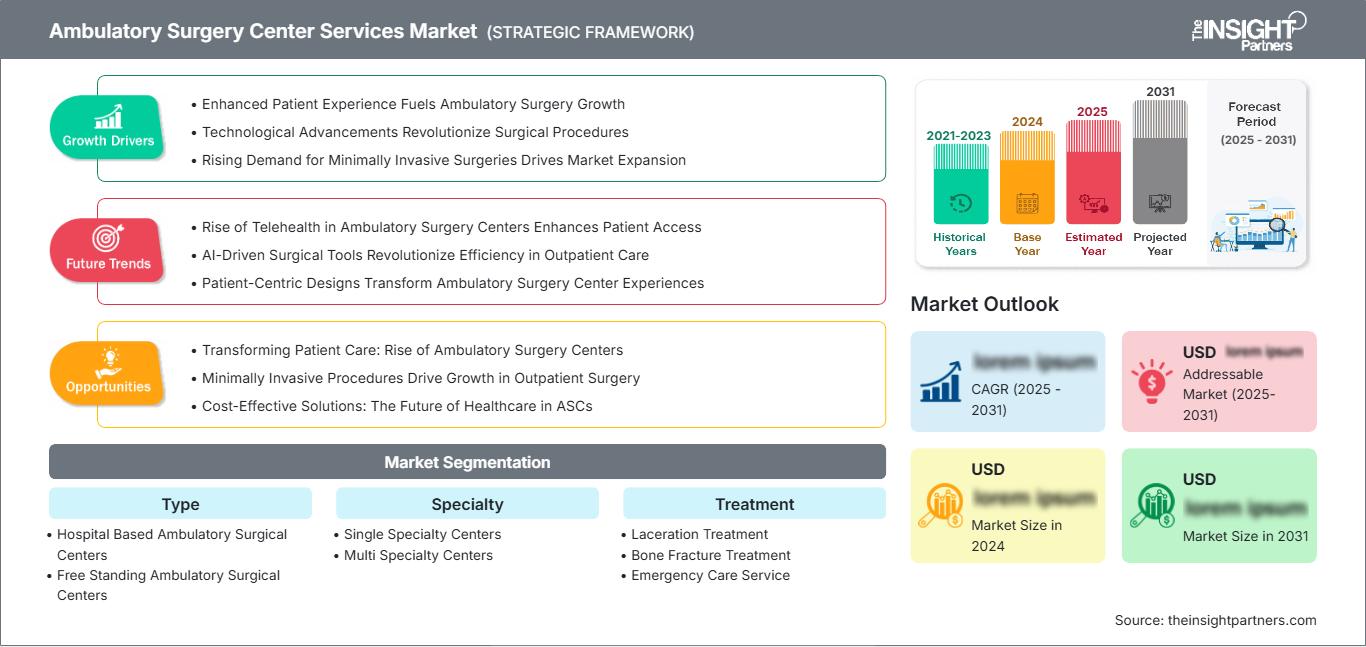
Ambulatory Surgery Center Services Market: Strategic Insights
Regional Insights
North America Ambulatory Surgery Center Services Market
North America led with 44–46% share in 2025 and is forecast to grow at a 5.7–6.2% CAGR through 2034. The Ambulatory Surgery Center Services Market share is anchored by the US, where payer policies and employer benefit designs increasingly favor lower-cost surgical sites. Canada contributes through day-surgery programs designed to ease hospital pressure and reduce elective backlogs.
Structural factors include a huge base of people who are privately insured, strong presence of physicians in the ownership models, and increasing eligibility of ASC for performing musculoskeletal and cardiovascular surgeries. Health information technology adoption is well matured in the region, with various platforms like Epic Systems Corporation, Oracle Cerner, athenahealth, Inc., and Surgical Information Systems, LLC providing support for documentation and utilization.
U.S. Ambulatory Surgery Center Services Market
North America includes the US which comprised of 82-85% in 2025, with an estimated 5.8-6.3% CAGR from 2026-2034. The key areas that will experience growth include orthopedics, gastroenterology, ophthalmology, and pain management with an increasing role played by cardiovascular procedures depending on how payers and regulators develop their rules. The operators have a wide range and the leading ones include Surgical Care Affiliates, LLC, AMSURG Corporation, Surgery Partners, Inc., HCA Healthcare, Inc., and Optum, Inc.
The application trends revolve around high acuity outpatient surgeries, digital pre-admission screening, and post-discharge monitoring. The two most important aspects of this procedure include physician recruitment and payer contracting since those ambulatory care centers with predictable surgical volumes and anesthesia coverage have greater operating room efficiency.
Europe Ambulatory Surgery Center Services Market
Europe had 24-27% market share in 2025, and the region is expected to grow at 5.2-5.8% CAGR until 2034. The key driver in the UK is NHS waiting list pressures that have led to an increase in use of independent sector capacity, day case surgery and outsourcing of elective pathways in orthopedics, ophthalmology and endoscopy.
Growth in Germany is driven by ongoing hospital reforms, development of highly developed specialist networks and payers' interest in moving appropriate patients to outpatient settings. Day surgery is supported in France via reimbursements and national ambulatory targets. Italy and Spain are developing regional outpatient surgery programs to address capacity pressures in the public systems and increasing demand for procedures due to aging population.
Technology adoption is increasing in Europe; however, fragmentation of reimbursement systems slows down consistent expansion of ASCs. Multispecialty ASCs are becoming popular where there are clear requirements for accreditation, anesthesia staffing and post-surgery governance. Healthway Medical Corporation Limited and Trillium Health Partners serve as good examples for the comparison of integrated ASC models in neighboring markets.
APAC Ambulatory Surgery Center Services Market
APAC had a market share of 21-24% in 2025 and will register a CAGR of 7.1-7.8% for the period between 2026-2034, being the fastest-growing regional cluster. China takes the lead with regard to potential volumes, while Japan capitalizes on age-related surgeries (ophthalmology and orthopedics). India is developing private ASCs in its metropolitan and tier-two cities.
The development of ASC in South Korea and Australia is driven by high rates of digitization and the presence of specialized networks of doctors. De-congestion of hospitals, medical tourism, and growth of private insurance coverage make the region strong. Investments in infrastructure, accessibility of surgical equipment, and scheduling systems increase the attractiveness of ASC in urban environments.
Middle East & Africa Ambulatory Surgery Center Services Market
Middle East & Africa is projected to grow at a 5.5–6.1% CAGR through 2034, with Saudi Arabia leading due to healthcare transformation programs and private-sector participation. The UAE is expanding premium outpatient surgical capacity, while South Africa remains the most structured market in Africa for private day surgery.
Gulf countries’ energy-driven fiscal capacity helps in the improvement of hospital infrastructures, hiring specialists, and promoting medical tourism. Rest of MEA growth is uneven because there are variations in the depths of reimbursement, anesthesiologist personnel, and the system of accreditation. Nevertheless, investments in urban outpatient services could decongest tertiary hospitals.
Segmentation Analysis
Type
This type is anticipated to have a CAGR of 6.0-6.5% from 2026-2034. The Ambulatory Surgery Center Services Market Scope for this particular category includes the trend that occurs between the hospital-based outpatient facility and freestanding outpatient facilities. The need for this product will be determined by financing, payor network, physician alignment, and ability to handle workflow without inpatient costs.
- Hospital Based Ambulatory Surgical Centers support integrated referral pathways, emergency backup, and brand credibility. They remain strategically important for health systems transitioning appropriate elective procedures away from high-cost inpatient assets.
- Free Standing Ambulatory Surgical Centers lead adoption because they offer focused operations, faster scheduling, lower facility costs, and stronger physician ownership economics. They dominate routine elective and increasingly higher-acuity outpatient procedures.
Specialty
Specialty is expected to grow at a CAGR of 5.8% to 6.4% from 2026 to 2034. The specialty set-up affects the attractiveness for payers, staffing requirements, equipment requirements, and financial viability of the case mix. Specialty-focused centers are able to streamline their operations, and diversified centers are less dependent on a single specialty cycle.
- Single Specialty Centers are strong in gastroenterology, ophthalmology, and pain management. They benefit from repeatable procedure protocols, focused equipment purchasing, and high-throughput scheduling for predictable patient categories.
- Multi-Specialty Centers provide broader revenue resilience by combining orthopedics, urology, ENT, spine, and general surgery. Their strategic value rises where payers prefer consolidated outpatient networks.
Treatment
Treatments will witness growth in a range of 6.2-6.9% CAGR through 2026-2034. The demand for treatment is correlated with trauma preparedness, urgent surgery triage, and rise in same-day procedures. Facilities are increasingly collaborating with urgent care and physician facilities to identify patients at the right time.
- Laceration Treatment supports walk-in and scheduled minor procedural demand. It is important for centers positioned near urgent care networks, occupational health programs, and community-based clinical pathways.
- Bone Fracture Treatment benefits from outpatient orthopedic protocols, imaging access, and growing acceptance of same-day fracture stabilization. Strategic importance increases where sports injury and aging populations overlap.
- Emergency Care Service is expanding as centers integrate urgent assessment, rapid referral, and short-stay surgical capability. It supports faster care access and reduces pressure on hospital emergency departments.
- Trauma or Accident Treatment remains selective but valuable in markets with strong orthopedic and imaging partnerships. It requires triage discipline, anesthesia readiness, and referral agreements for complex cases.
Opportunity Snapshot
| Segment Name | Revenue Contribution | Trend Tag | Adoption Stage |
| Laceration Treatment | Medium | Minor Repair | Mature |
| Bone Fracture Treatment | High | Ortho Shift | Scaling |
| Emergency Care Service | High | Urgent Surgery | Scaling |
| Trauma or Accident Treatment | Medium | Trauma Triage | Emerging |
Ambulatory Surgery Center Services Market Growth Drivers and Impact Analysis
Payer Preference for Lower-Cost Surgical Sites
More payers are directing patients with eligible procedures to ASCs due to reduced facility charges and cost sharing as compared to hospital outpatient departments offering similar services. Such a driver influences patient referrals, preauthorization guidelines, insurance plans offered by employers, and networks. Insurance companies are applying site-of-service policies for orthopedic, endoscopy, ophthalmology, and pain procedures. Medicare updates will keep extending the list of eligible procedures. For ASC operators, such a trend creates more visibility of demand but also greater accountability for patient outcomes, complications, and readmissions. Those ASCs that have good documentation and are proficient at managing implants and claims will succeed in benefiting from such payer preferences.
Higher-Acuity Procedures Moving Outpatient
The market has shifted from offering less complex surgeries like cataracts and endoscopies to total joint surgeries, spinal procedures, cardiovascular surgeries, and more complex orthopedics. This offers a better case revenue while also making sure that anesthesia services, imaging facilities, emergency response plans, and surgeon credentialing are improved. The effect can be seen in terms of investments made in bigger operating theaters, robots, surgical implants, and recovery facilities. Facilities that do not meet all safety and accreditation standards might find themselves restricted to offering only the less profitable services. On the other hand, scaled providers with physician partners will benefit from being able to selectively accept the more complicated cases.
Digital Operations and Revenue Cycle Discipline
Workflow maturity in digital technology is becoming a critical performance discriminator. ASCs rely on precision in scheduling, patient eligibility verification, case costing, implant management, anesthesia management, and claims management to safeguard their bottom line. Solutions from companies like Epic Systems Corporation, Oracle Cerner, Surgical Information Systems, LLC, HST Pathways, athenahealth, Inc., and NextGen Healthcare, Inc. assist centers to minimize administrative leakages and optimize OR utilization. The influence of these solutions is particularly high within multi-site organizations that are able to track through standardized dashboards such parameters as cancellations, denials, supply costs, and case time.
Ambulatory Surgery Center Services Market Future Trends
Specialty-Focused Networks Will Replace Standalone Expansion
Ambulatory Surgery Center Services Market trends indicate that operators will prioritize specialty-dense networks rather than isolated facility additions. In orthopedic surgery, gastroenterology, ophthalmology, urology, and cardiovascular specialties, there should be surgeon alignment, payor alignment, and standardization in their facilities. In this regard, future expansion will be facilitated through the establishment of centers around physicians’ associations, equipment used in imaging, and post-acute facilities. Such organizations will be capable of bargaining better prices for implants, sharing anesthesia professionals, and directing patients to the right center. There will be consolidation of small centers in addition to partnership possibilities for health care systems.
AI-Enabled Scheduling and Case Mix Optimization
The adoption of AI-based administrative solutions will have an increasing influence on capacity planning, referral management, denial avoidance, and patient-mix optimization. Instead of substituting the decision-making process of healthcare professionals, these solutions will enable the management team to foresee no-shows, discover at-risk patients, allocate procedures within the capabilities of a facility, and find discrepancies between the billing codes before sending them to payers. This will work best for multispecialty ASCs due to the need to organize surgery blocks, preferences of surgeons, the supply of implants, and payer authorization processes daily.
Ambulatory Surgery Center Services Market Opportunities
Partnership Models with Health Systems and Physician Groups
Joint ventures between health systems, physicians, and ASC operators offer a practical route to expand capacity without duplicating hospital infrastructure. The Ambulatory Surgery Center Services Market Forecasts point to strong investment interest in models that preserve physician economics while giving hospitals access to lower-cost outpatient channels. Investors should focus on geographies with elective backlogs, payer support, and underpenetrated specialty capacity. Opportunity quality depends on governance, referral transparency, and clear rules for case selection. Well-designed partnerships can reduce hospital congestion, improve patient convenience, and create defensible regional networks with balanced clinical and financial incentives.
Emerging Market Day-Surgery Platforms
Emerging economies offer opportunity for purpose-built day-surgery platforms targeting insured urban patients, medical tourists, and self-pay procedure categories. India, Southeast Asia, Gulf markets, and selected African cities have rising specialist availability, private insurance growth, and demand for faster elective access. Investors can create differentiated platforms by combining accredited facilities, transparent pricing, digital scheduling, and specialty partnerships. The strongest opportunities will be in orthopedics, ophthalmology, ENT, gastroenterology, and minor trauma pathways. Execution risk remains tied to clinician recruitment, reimbursement reliability, and patient trust, but early movers can define outpatient surgical standards before markets become crowded.
Recent Developments
- June 2026: Ascension and AMSURG announced completion of their transaction, significantly expanding Ascension’s outpatient surgical footprint and adding AMSURG’s national ASC platform to a broader faith-based healthcare delivery network. The deal strengthens scale in gastroenterology, ophthalmology, orthopedics, and other community-based surgical specialties.
- March 2026: Surgery Partners, Inc. reported full-year 2025 revenue growth of 6.2% and issued 2026 guidance of US$ 3.35–3.45 billion in revenue, excluding M&A. Management highlighted continued focus on higher-acuity procedures, strategic acquisitions, organic growth, and portfolio optimization across its short-stay surgical facility network.
- November 2025: SCA Health published an industry update emphasizing ASCs as licensed outpatient surgical facilities that support same-day procedures within a 23-hour care window. The company highlighted expansion into higher-acuity procedures, including total joints, spine, and cardiovascular cases, supported by technology and value-based care alignment.
Frequently Asked Questions

- Comprehensive Market Sizing and Forecast Analysis
- Detailed Segmentation Analysis
- In-Depth Market Dynamics Assessment
- Regional and Country-Level Insights
- Competitive Landscape and Company Benchmarking
- Strategic Business Intelligence
Recent Reports
Testimonials

The Insight Partners' SCADA System Market report is comprehensive, with valuable insights on current trends and future forecasts. The team was highly professional, responsive, and supportive throughout. We are very satisfied and highly recommend their services.
RAN KEDEM Partner, Reali Technologies LTDs
I requested a report on a very specific software market and the team produced the report in a few days. The information was very relevant and well presented. I then requested some changes and additions to the report. The team was again very responsive and I got the final report in less than a week.
JEAN-HERVE JENN Chairman, Future Analytica
We worked with The Insight Partners for an important market study and forecast. They gave us clear insights into opportunities and risks, which helped shape our plans. Their research was easy to use and based on solid data. It helped us make smart, confident decisions. We highly recommend them.
PIYUSH NAGPAL Sr. Vice President, High Beam Global
The Insight Partners delivered insightful, well-structured market research with strong domain expertise. Their team was professional and responsive throughout. The user-friendly website made accessing industry reports seamless. We highly recommend them for reliable, high-quality research services
YUKIHIKO ADACHI CEO, Deep Blue, LLC.
This is the first time I have purchased a market report from The Insight Partners.While I was unsure at first, I visited their web site and felt more comfortable to take the risk and purchase a market report.I am completely satisfied with the quality of the report and customer service. I had several questions and comments with the initial report, but after a couple of dialogs over email with their analyst I believe I have a report that I can use as input to our strategic planning process.Thank you so much for taking the extra time and making this a positive experience.I will definitely recommend your service to others and you will be my first call when we need further market data.
JOHN SUZUKI President and Chief Executive Officer, Board Director, BK Technologies
I wish to appreciate your support and the professionalism you displayed in the course of attending to my request for information regarding to infectious disease IVD market in Nigeria. I appreciate your patience, your guidance, and the fact that you were willing to offer a discount, which eventually made it possible for us to close a deal. I look forward to engaging The Insight Partners in the future, all thanks to the impression you have created in me as a result of this first encounter.
DR CHIJIOKE ONYIA MANAGING DIRECTOR, PineCrest Healthcare Ltd.Reason to Buy
- Informed Decision-Making
- Understanding Market Dynamics
- Competitive Analysis
- Identifying Emerging Markets
- Customer Insights
- Market Forecasts
- Risk Mitigation
- Boosting Operational Efficiency
- Strategic Planning
- Investment Justification
- Tracking Industry Innovations
- Aligning with Regulatory Trends





 Get Free Sample for