
Ammonia Market Growth, Size & Forecast by 2034
Coverage: by Fiber Type (Liquid, Gas, Powder); Application (Fertilizer, Refrigerants, Pharmaceuticals, Textile, Others) , and Geography (North America, Europe, Asia Pacific, and South and Central America)
- Status : Data Released
- Report Code : TIPRE00012618
- Category : Chemicals and Materials
- No. of Pages : 150
- Available Report Formats :


- Last update date : August 17, 2026


2025 Market Size
US$ 85.93 Bn
Base year value
2034 Forecast
US$ 108.07 Bn
Projected by 2034
CAGR 2026-2034
2.58 %
Growth rate
Addressable Market
US$ 880.32 Bn
(2026-2034)
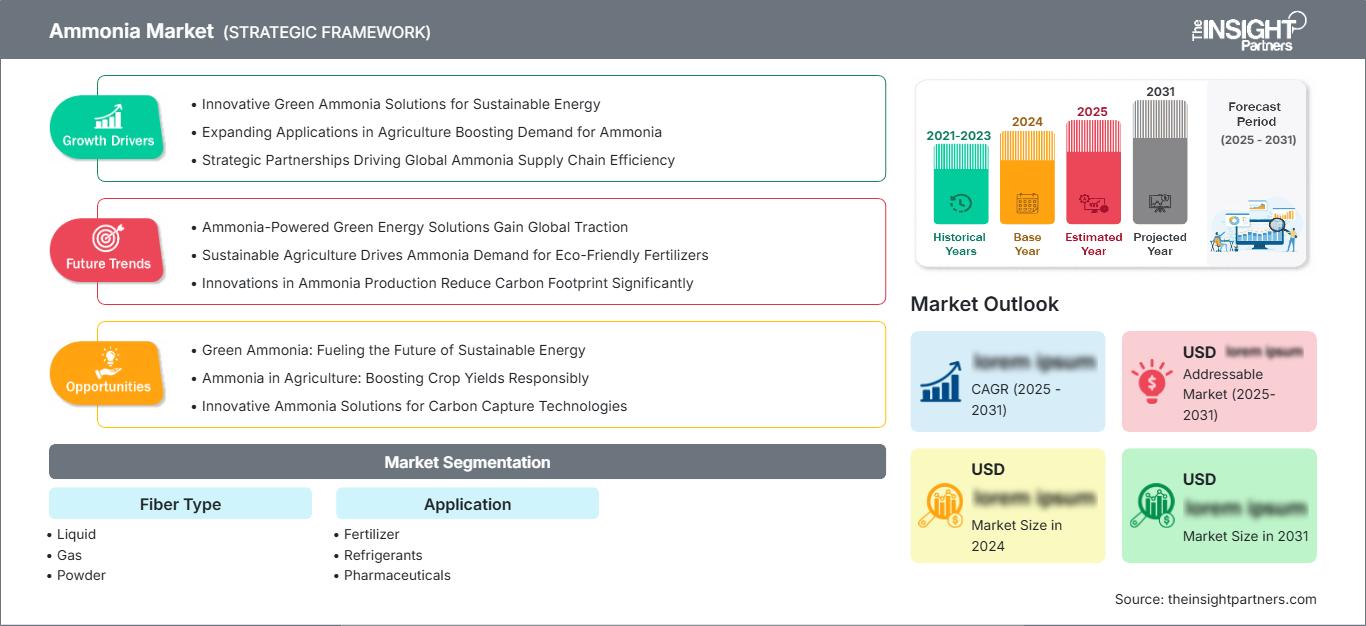
The Ammonia Market was valued at US$ 85.93 billion in 2025 and is projected to reach US$ 108.07 billion by 2034, registering a CAGR of 2.58% during 2026–2034. The market remains fundamental to global agriculture and industrial manufacturing, supported by stable fertilizer consumption, expanding chemical production, and increasing investments in low-carbon ammonia technologies. Continuous modernization of production facilities and growing adoption across energy-related applications are expected to sustain long-term demand despite fluctuations in natural gas prices.
North America continues to represent a technologically advanced production hub supported by abundant natural gas resources, integrated fertilizer manufacturing, and investments in carbon capture technologies. The ammonia market size in the region is supported by increasing production efficiency, export-oriented capacity additions, and emerging blue ammonia projects serving industrial decarbonization initiatives. Stable agricultural demand and expanding clean-energy investments are expected to support regional growth at a CAGR of 2.3–2.8% through 2034.
Ammonia Market Assessment and Insights
- North America: North America accounted for 24–28% share in 2025 and is expected to expand at a CAGR of 2.3–2.8% during 2026–2034. Large-scale fertilizer production, abundant shale gas resources, and growing investments in blue ammonia projects continue strengthening regional competitiveness.
- US: The US represented 78–82% of North America’s market in 2025 and is anticipated to grow at a CAGR of 2.4–2.9%. Expanding fertilizer demand, hydrogen initiatives, and modern ammonia production infrastructure continue supporting market development.
- Europe: Europe held 18–22% share in 2025 and is projected to grow at a CAGR of 2.0–2.5%. Germany, the Netherlands, Norway, and France remain key production and consumption centers supported by decarbonization investments and low-carbon ammonia initiatives.
- Asia Pacific: Asia Pacific accounted for 40–44% share in 2025 and is anticipated to register a CAGR of 2.9–3.4%. China, India, Japan, and South Korea continue driving regional demand through fertilizer production, industrial expansion, and growing energy-transition investments.
- Largest Segment: Application – Fertilizer represented 68–72% market share in 2025 and is projected to expand at a CAGR of 2.5–3.0%. Strong agricultural demand and food security initiatives continue supporting its dominant position.
- High Growth Segment: Application – Pharmaceuticals accounted for 5–8% market share in 2025 and is expected to grow at a CAGR of 3.8–4.4%. Expanding pharmaceutical manufacturing and increasing chemical synthesis activities continue to support above-average growth.
- Key companies analyzed in detail: Achema AB, BASF SE, CF Industries Holdings, Inc., Dow Inc., Jiangsu Huachang Chemical Co., Ltd., Koch Fertilizer, LLC, Linde plc, OCI N.V., SABIC, Yara International ASA.
Source: The Insight Partners' analysis based on proprietary research, government publications, company annual reports, investor presentations, industry databases, and expert interviews.
Ammonia production keeps developing by increasing energy efficiency, improving catalysts, and combining it with carbon capture technology. Manufacturers are updating the existing Haber-Bosch plants, at the same time building blue and green ammonia production to minimize emissions. New capacity growth in the Middle East, North America, and Asia ensures global supply security, while digital optimization of the plants improves their performance and cuts down maintenance expenses of the integrated plants.
The future of the industry will be based on the development of clean energy, international hydrogen trade, and decarbonization policy promoting low-carbon ammonia. Export-oriented projects in Australia, the Middle East, and South America will complement existing production, and growing demand for shipping, power generation, and industrial hydrogen use will provide new revenue streams other than fertilizer use.
Ammonia Market Report Scope
| Report Attribute | Details |
|---|---|
| Market size in 2025 | US$ 85.93 Billion |
| Market Size by 2034 | US$ 108.07 Billion |
| Global CAGR (2026 - 2034) | 2.58% |
| Historical Data | 2021-2024 |
| Forecast period | 2026-2034 |
Ammonia Market Analysis
Rising agricultural productivity requirements remain the primary factor supporting ammonia market growth, as nitrogen fertilizers continue playing an indispensable role in global crop production. Demand is bolstered by population growth, decreasing arable land per person, and government initiatives for food security. The industry value chain includes natural gas producers, hydrogen production, ammonia production, storage, transportation, fertilizer companies, chemical processing companies, and industrial consumers, and this makes for a seamless value chain despite price volatility due to cyclical commodities.
Supply is becoming more sensitive to feedstocks, energy prices, and environmental policies. Natural gas continues to play a significant role in the economics of conventional ammonia production, while renewable hydrogen production initiatives continue to provide feedstock alternatives. Capacity expansion in resource-abundant areas makes for increased export capacity, while blue and green ammonia production reduces reliance on conventional ammonia production.
Competitive intensity within the ammonia market analysis reflects a combination of vertically integrated fertilizer producers, diversified chemical manufacturers, and industrial gas companies. BASF SE, CF Industries Holdings, Inc., Yara International ASA, OCI N.V., Linde plc, and SABIC continue investing in production optimization, carbon capture technologies, and strategic partnerships to strengthen operational efficiency. Meanwhile, regional producers such as Jiangsu Huachang Chemical Co., Ltd. and Achema AB focus on improving production flexibility and expanding downstream integration.
The investment focus is shifting toward the production of ammonia using low carbon techniques, digital manufacturing methods, and export infrastructure for hydrogen globally. Businesses are upgrading their current facilities as they consider integrating renewable hydrogen, advanced catalysts, and process automation in order to increase energy efficiency. Partnerships between energy firms, technology firms, and government are likely to expedite sustainable ammonia production processes.
● REPORT CUSTOMIZATION
Tailor This Report To Align With Your Specific Business Requirements
This report can be customized to align precisely with your business objectives, scope, and target markets. Customization options include tailored segmentation, geography, competitive analysis, and strategic insights to support informed decision-making.
Customize This Report →WHAT YOU CAN ADJUST
- ● Segmentations
- ● Geography
- ● Competitive Analysis
- ● Language Preferences
Ammonia Market: Strategic Insights
Regional Insights
North America Ammonia Market
North America accounted for 24–28% of the ammonia market share in 2025 and is projected to expand at a CAGR of 2.3–2.8% during 2026–2034. This area enjoys access to rich natural gas resources, a well-developed fertilizer industry, and modern logistics systems that link the plants with agricultural markets. Investments in blue ammonia technology that include carbon capture and storage systems increase the competitive advantage of regional players and facilitate the implementation of industrial decarbonization projects.
The United States and Canada maintain their investments in hydrogen and ammonia technologies via public and private sector measures. Rising demand for fertilizers, industrial refrigeration, chemical products, and new uses in hydrogen transportation drives the growth of the market. Major producers improve the efficiency of production processes via digital technologies and innovative catalysts. Export opportunities to Europe and Asia ensure North America's role as a key ammonia producer on the global market.
U.S. Ammonia Market
The United States represented 78–82% of North America's market in 2025 and is anticipated to register a CAGR of 2.4–2.9% through 2034. The country benefits from low-cost shale gas resources, world-scale production facilities, and a highly developed fertilizer distribution network. Large integrated manufacturers continue expanding operational efficiency through modernization projects while increasing investments in carbon capture to produce lower-emission ammonia for domestic and export markets.
Federal incentives supporting hydrogen production and carbon management are encouraging new investments in blue ammonia facilities. Fertilizer remains the dominant application, although demand from industrial refrigeration, chemicals, and clean energy initiatives is expanding steadily. Leading companies, including CF Industries Holdings, Inc., Koch Fertilizer, LLC, and Linde plc, continue strengthening production capabilities through strategic partnerships and technology upgrades that improve operational efficiency while reducing greenhouse gas emissions.
Europe Ammonia Market
Europe accounted for 18–22% of the global market in 2025 and is expected to grow at a CAGR of 2.0–2.5% during the forecast period. Strict environmental regulations, industrial decarbonization strategies, and investments in renewable hydrogen continue shaping regional demand. Although energy costs remain comparatively high, the transition toward low-carbon ammonia production is attracting significant public and private investments across multiple European countries.
Germany remains the region's leading market because of its extensive chemical manufacturing base, advanced engineering capabilities, and growing hydrogen economy. The country continues investing in ammonia import terminals, green hydrogen infrastructure, and industrial decarbonization projects that support long-term consumption across chemicals and energy applications.
The Netherlands, France, Italy, Spain, and Norway collectively strengthen regional competitiveness through fertilizer production, chemical manufacturing, and expanding clean-energy infrastructure. Rotterdam is emerging as a strategic ammonia import and distribution hub, while France and Spain continue investing in renewable hydrogen integration to support future industrial demand and international energy trade.
APAC Ammonia Market
Asia Pacific represented 40–44% of the global market in 2025 and is forecast to register the fastest regional expansion with a CAGR of 2.9–3.4%. China and India dominate regional consumption because of extensive fertilizer production and large agricultural sectors, while Japan and South Korea are investing aggressively in ammonia-based hydrogen supply chains for future energy security.
Industrial expansion, government fertilizer subsidy programs, and increasing investments in low-carbon energy continue supporting regional growth. Australia is also emerging as a significant producer of export-oriented green ammonia, leveraging abundant renewable energy resources to supply Asian and European markets.
Middle East & Africa Ammonia Market
The Middle East & Africa is projected to expand at a CAGR of 2.8–3.3% through 2034. Saudi Arabia and the United Arab Emirates continue investing in blue and green ammonia production using abundant natural gas resources and rapidly expanding renewable energy capacity. Export-oriented projects are strengthening the region's strategic position within the global hydrogen economy.
South Africa remains an important consumer for industrial and mining applications, while other African countries continue expanding fertilizer demand to improve agricultural productivity. Infrastructure development, international energy partnerships, and investments in ammonia export terminals are expected to strengthen regional competitiveness over the coming decade.
Segmentation Analysis
Fiber Type
The Fiber Type segment is expected to grow at a CAGR of 2.3–2.8% during 2026–2034. The ammonia market scope continues expanding through diversified physical forms serving fertilizer production, refrigeration systems, and industrial processing. Product selection depends primarily on transportation efficiency, storage requirements, downstream manufacturing processes, and safety regulations governing industrial handling.
- Liquid – The largest sub-segment because liquid ammonia offers efficient bulk transportation, economical storage, and extensive utilization in fertilizer manufacturing, refrigeration systems, and numerous industrial chemical processes.
- Gas – Widely utilized in industrial refrigeration, emission control systems, and specialty manufacturing where direct gaseous application improves operational efficiency and supports continuous processing requirements.
- Powder – Maintains niche demand across specialized laboratory applications and selected industrial formulations requiring controlled material handling, packaging convenience, and extended storage stability.
Application
The Application segment is projected to register a CAGR of 2.6–3.1% during the forecast period. Fertilizer manufacturing continues accounting for the largest proportion of demand, while industrial refrigeration, pharmaceutical synthesis, and textile processing provide diversified growth opportunities that improve overall market resilience against agricultural demand fluctuations.
- Fertilizer – Represents the dominant application because ammonia serves as the essential feedstock for urea, ammonium nitrate, and other nitrogen fertilizers supporting global agricultural productivity.
- Refrigerants – Growing adoption across food processing, cold storage, and beverage manufacturing reflects ammonia's high energy efficiency and comparatively low environmental impact relative to synthetic refrigerants.
- Pharmaceuticals – Increasing pharmaceutical manufacturing and specialty chemical synthesis continue supporting higher-value ammonia consumption across active pharmaceutical ingredient production and intermediate manufacturing.
- Textile – Demand remains supported by textile finishing and specialty chemical processing, particularly across the Asia Pacific, where textile manufacturing continues expanding alongside industrial development.
Opportunity Snapshot
| Application | Revenue Contribution | Trend Tag | Adoption Stage |
|---|---|---|---|
| Fertilizer | High | Food Security | Mature |
| Refrigerants | Medium | Cold Chain | Scaling |
| Pharmaceuticals | Medium | API Expansion | Scaling |
| Textile | Low | Process Efficiency | Mature |
Ammonia Market Growth Drivers and Impact Analysis
Expanding Global Fertilizer Consumption Supports Stable Demand
Despite the continuous increase in other sectors’ share of ammonia usage, agriculture will continue leading the market due to the necessity of nitrogen-based fertilizers in raising the level of crop yield. With an increasing need for food supplies as a result of growing populations, diminishing amounts of available land for cultivation, and intensification of agricultural activity, there is a need to ensure a higher level of local production of fertilizers by governments. Nations in the Asia Pacific region, Africa, and Latin America continue to raise their capacity of fertilizer manufacturing to ensure more stable food supplies and independence from imports. Major manufacturers, such as Yara International ASA, CF Industries Holdings, Inc., Koch Fertilizer, LLC, and OCI N.V., continue increasing efficiency in production and distribution.
Energy Transition Accelerates Investments in Blue and Green Ammonia
The trend towards more sustainable industrial sectors has contributed greatly to increased research into uses for ammonia outside the fertilizer industry. There has been an increase in the use of blue ammonia plants that incorporate carbon capture methods, in addition to green ammonia plants that run on renewable energy. Ammonia is gaining recognition as an alternative hydrogen carrier due to the existing transport networks and high hydrogen content in ammonia. Countries such as Japan, South Korea, Saudi Arabia, Australia, and the Netherlands have continued to invest in large-scale import/export infrastructure for clean energy trading between countries.
Industrial Refrigeration and Chemical Manufacturing Expand Consumption
The growth of industries in developing countries is still driving demand for ammonia in various sectors, including refrigeration, chemicals, pharmaceuticals, and textiles. Ammonia-based refrigeration plants continue to be popular for use in large storage buildings, food processing industries, dairies, and beverage plants due to better thermodynamic performance and low global warming impact. On the other hand, growing production in the pharmaceutical and specialty chemicals sector is also demanding ammonia as an important intermediate in various reactions. The development of industrial infrastructure in countries like China, India, Southeast Asian countries, and certain Middle Eastern countries is further driving demand beyond agriculture.
Ammonia Market Future Trends
Commercial Scale Green Ammonia Production Continues Expanding
Renewable electricity costs continue declining across several regions, making green ammonia production increasingly competitive for industrial and export applications. These ammonia market trends are encouraging manufacturers to integrate electrolyzers with ammonia synthesis facilities powered by solar and wind energy. Export-oriented projects in Australia, Saudi Arabia, Oman, and Chile are targeting international demand from Europe and Northeast Asia, where governments continue supporting imported low-carbon fuels for industrial decarbonization and hydrogen transportation.
Digital Manufacturing Improves Plant Efficiency and Reliability
The use of artificial intelligence, predictive maintenance systems, sensor technology, and digital twin technology is becoming more common in ammonia manufacturing plants. Process monitoring in real time is being used to boost catalyst efficiency, decrease maintenance expenses, conserve energy, and decrease unscheduled plant downtimes. Automation also leads to increased safety while at the same time optimizing manufacturing logistics. Digital technology is likely to improve cost competitiveness by boosting manufacturing efficiency and decreasing costs.
Ammonia Market Opportunities
Export-Oriented Green Ammonia Infrastructure Creates Long-Term Growth
Large renewable energy resources across Australia, the Middle East, and South America create favorable conditions for export-focused green ammonia production. Ammonia Market Forecasts indicate increasing international demand from Europe, Japan, and South Korea as governments seek low-carbon hydrogen carriers supporting industrial decarbonization. Investments in renewable electricity, electrolyzers, export terminals, and integrated logistics networks provide attractive opportunities for producers capable of establishing reliable long-term international supply chains.
Marine Fuel Adoption Opens High-Value Industrial Applications
Global shipping companies continue evaluating ammonia as an alternative marine fuel capable of reducing carbon emissions from long-distance maritime transport. Engine manufacturers, classification societies, and shipbuilders are investing in ammonia-compatible propulsion technologies while ports evaluate bunkering infrastructure. Producers capable of supplying certified low-carbon ammonia can establish strategic partnerships with shipping operators and energy companies, creating new revenue streams beyond conventional fertilizer and industrial chemical applications.
Recent Developments
- May 2025: BASF SE – BASF inaugurated a new hexamethylenediamine (HMD) production plant at its Chalampé site in France, increasing the company's global HMD manufacturing capacity by approximately 50%. The expansion strengthens BASF's integrated polyamide value chain and enhances the supply of key intermediates used in engineering plastics and specialty chemical applications, supporting long-term growth across automotive, industrial, and consumer markets.
- December 2025: Air Products & Chemicals, Inc. and Yara International ASA entered advanced negotiations to jointly develop low-emission ammonia projects by combining Air Products' low-carbon hydrogen production capabilities with Yara's global ammonia production and distribution network. The collaboration covers the Louisiana Clean Energy Complex and the NEOM Green Hydrogen Project, aiming to accelerate global availability of low-emission ammonia for fertilizer, industrial, and clean energy applications.
Frequently Asked Questions

- Comprehensive Market Sizing and Forecast Analysis
- Detailed Segmentation Analysis
- In-Depth Market Dynamics Assessment
- Regional and Country-Level Insights
- Competitive Landscape and Company Benchmarking
- Strategic Business Intelligence
Recent Reports
Testimonials

The Insight Partners' SCADA System Market report is comprehensive, with valuable insights on current trends and future forecasts. The team was highly professional, responsive, and supportive throughout. We are very satisfied and highly recommend their services.
RAN KEDEM Partner, Reali Technologies LTDs
I requested a report on a very specific software market and the team produced the report in a few days. The information was very relevant and well presented. I then requested some changes and additions to the report. The team was again very responsive and I got the final report in less than a week.
JEAN-HERVE JENN Chairman, Future Analytica
We worked with The Insight Partners for an important market study and forecast. They gave us clear insights into opportunities and risks, which helped shape our plans. Their research was easy to use and based on solid data. It helped us make smart, confident decisions. We highly recommend them.
PIYUSH NAGPAL Sr. Vice President, High Beam Global
The Insight Partners delivered insightful, well-structured market research with strong domain expertise. Their team was professional and responsive throughout. The user-friendly website made accessing industry reports seamless. We highly recommend them for reliable, high-quality research services
YUKIHIKO ADACHI CEO, Deep Blue, LLC.
This is the first time I have purchased a market report from The Insight Partners.While I was unsure at first, I visited their web site and felt more comfortable to take the risk and purchase a market report.I am completely satisfied with the quality of the report and customer service. I had several questions and comments with the initial report, but after a couple of dialogs over email with their analyst I believe I have a report that I can use as input to our strategic planning process.Thank you so much for taking the extra time and making this a positive experience.I will definitely recommend your service to others and you will be my first call when we need further market data.
JOHN SUZUKI President and Chief Executive Officer, Board Director, BK Technologies
I wish to appreciate your support and the professionalism you displayed in the course of attending to my request for information regarding to infectious disease IVD market in Nigeria. I appreciate your patience, your guidance, and the fact that you were willing to offer a discount, which eventually made it possible for us to close a deal. I look forward to engaging The Insight Partners in the future, all thanks to the impression you have created in me as a result of this first encounter.
DR CHIJIOKE ONYIA MANAGING DIRECTOR, PineCrest Healthcare Ltd.Reason to Buy
- Informed Decision-Making
- Understanding Market Dynamics
- Competitive Analysis
- Identifying Emerging Markets
- Customer Insights
- Market Forecasts
- Risk Mitigation
- Boosting Operational Efficiency
- Strategic Planning
- Investment Justification
- Tracking Industry Innovations
- Aligning with Regulatory Trends





 Get Free Sample for