
Ammonium Chloride Market Growth, Share & Trends by 2034
Coverage: By Product Type (Agriculture Grade, Industrial Grade, Food Grade, Others); Application (Agriculture, Metalwork, Food, Pharmaceutical, Others) , and Geography (North America, Europe, Asia Pacific, and South and Central America)
- Status : Data Released
- Report Code : TIPRE00008717
- Category : Chemicals and Materials
- No. of Pages : 150
- Available Report Formats :


- Last update date : August 19, 2026


2025 Market Size
US$ 1.70 Bn
Base year value
2034 Forecast
US$ 2.36 Bn
Projected by 2034
CAGR 2026-2034
3.77 %
Growth rate
Addressable Market
US$ 18.49 Bn
(2026-2034)
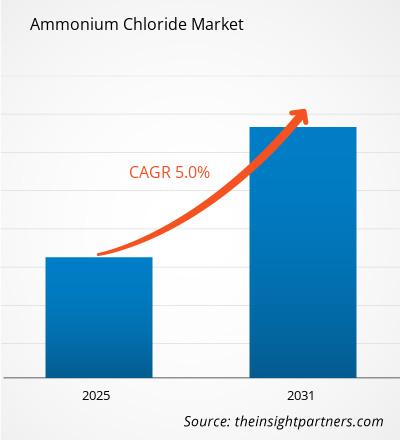
The ammonium chloride market in 2025 reached US$ 1.70 Billion and is forecasted to grow to US$ 2.36 Billion by 2034 with the expansion rate of 3.77% CAGR between 2026 and 2034. The growth will be driven by the stable consumption of the compound in agriculture, metal processing, pharmaceuticals, food processing, and other industrial uses. The growth in the production of fertilizers, increase in galvanizing processes, usage in dry cell batteries and specialty chemicals further contributes to long-term stability.
North America continues to be the technologically mature market with its highly developed chemical production facilities, regulated food processing standards, and stable demand for metal fabrication industries. The estimated CAGR for the ammonium chloride market size within this region will be of 3.1–3.6% during 2026–2034. Growth in the pharmaceutical industry, investments in specialty chemicals and upgrading of steel production facilities continues to drive regional demand, especially in the United States and Canada.
Ammonium Chloride Market Assessment and Insights
- North America: Accounted for 24–27% Ammonium Chloride Market share in 2025 and is expected to register a CAGR of 3.1–3.6% during 2026–2034. Strong demand from pharmaceutical manufacturing, metal treatment, and industrial processing, combined with advanced production technologies, continues to support regional expansion.
- U.S.: Represented 74–78% of the North American market in 2025 and is projected to expand at a CAGR of 3.2–3.7% during 2026–2034. Stable domestic manufacturing, food-grade chemical demand, and investments in specialty chemical production remain key contributors.
- Europe: Held 20–23% share in 2025 and is anticipated to grow at a CAGR of 2.8–3.3% during 2026–2034. Germany, France, Italy, and the UK continue leading consumption through advanced pharmaceutical production, specialty chemicals, and metal processing industries.
- Asia Pacific: Captured 42–45% share in 2025 and is forecast to register the fastest regional expansion with a CAGR of 4.3–4.8% during 2026–2034. China, India, Japan, and South Korea remain major production and consumption centers owing to large fertilizer industries and expanding industrial manufacturing.
- Largest Segment: Agriculture Grade accounted for 47–50% market share in 2025 and is projected to grow at a CAGR of 3.5–4.0% during 2026–2034, supported by fertilizer applications and sustained agricultural productivity initiatives.
- High Growth Segment: Pharmaceutical Application represented 14–17% market share in 2025 and is anticipated to expand at a CAGR of 4.8–5.3% during 2026–2034, driven by increasing pharmaceutical formulations and expanding healthcare manufacturing capacity.
- Key companies analyzed in detail: BASF SE, Benco Chemicals LTD LLC, Central Glass Co., Ltd., Hangzhou Longshan Chemical, Haohua Chemical Group Co., Ltd., ProChem, Inc., RBP Chemical Technology, Inc., The Dallas Group of America, Tuticorin Alkali Chemicals and Fertilizers Limited, Zaclon LLC.
Source: The Insight Partners' analysis based on proprietary research, government publications, company annual reports, investor presentations, industry databases, and expert interviews.
Improvements in the manufacturing of ammonium chloride have been witnessed due to advances in chlor-alkali integration, by-product recovery, process automation, and quality assurance systems. Manufacturers are increasingly adopting circular chemistry in production processes that make efficient use of the input materials, besides minimizing emission and waste output. Development of high purity products for the pharmaceutical and food industries has widened the product range of ammonium chloride, while stringent environmental requirements have facilitated modernization of the existing manufacturing facilities. In addition, industrialization in Asia Pacific has expanded the production capacity of the region to make the global supply chain more balanced for the agriculture, metallurgy, pharmaceuticals, and specialty chemicals sectors.
Investment in the emerging markets is likely to drive industry dynamics through additions in production capacity and integration in the downstream chemical manufacturing and infrastructure improvement. Stringent regulations on product quality, food safety, and pharmaceutical requirements will further drive producers to produce higher value-added products with improved standards of purity. Modernization of agriculture in developing countries, combined with industrialization in Southeast Asia, India, and some Middle East nations, will offer new investment prospects for the industry.
Ammonium Chloride Market Report Scope
| Report Attribute | Details |
|---|---|
| Market size in 2025 | US$ 1.70 Billion |
| Market Size by 2034 | US$ 2.36 Billion |
| Global CAGR (2026 - 2034) | 3.77% |
| Historical Data | 2021-2024 |
| Forecast period | 2026-2034 |
Ammonium Chloride Market Analysis
Ammonium Chloride Market Expansion is being driven by increasing agricultural operations, growth in industrial manufacturing and constant pharmaceutical production across the globe. Agricultural sector represents the major demand generator and here ammonium chloride finds usage as nitrogen fertilizer especially for rice, wheat and other cereals that are grown in soils tolerant to chloride ions. At the same time, there is the consistent use of industrial grade material for galvanizing, metal coating, soldering fluxes, textile industry and production of dry cell batteries. The rising investments into food and pharmaceutical industry widen the demand base and reduce its reliance on one sector.
As for the value chain analysis, the industry starts with the purchase of ammonia, hydrochloric acid and other chlor-alkali raw materials, followed by synthesis, purification, crystallization, drying, packaging and delivery of the end product to the downstream industry. Integrated chemical manufacturers have access to their own raw materials, while specialty manufacturers pay attention to the purity of the products they produce. The supply chain is evolving through the establishment of regional warehouses and long-term supply agreements.
The ammonium chloride market forecast reveals that this industry is moderately consolidated with major global chemical companies competing along with regional manufacturers focusing on industrial and specialty grade products. BASF SE continues utilizing its fully integrated network of chemical products production and wide customer base, while Central Glass Co., Ltd. maintains its strong position in manufacturing high purity chemicals for pharmaceutical and industrial purposes. Further expansion of production capacity is undertaken by Haohua Chemical Group Co., Ltd. and Hangzhou Longshan Chemical to support increasing demand both domestically and in exports in the Asian market. In addition, Tuticorin Alkali Chemicals and Fertilizers Limited profits from its established fertilizer manufacturing plant serving the agricultural industry in India.
The current strategic decisions of companies in this industry become more and more focused on process efficiency and product diversification along with environmental standards and certifications. ProChem, Inc., RBP Chemical Technology, Inc., Zaclon LLC, Benco Chemicals LTD LLC, and The Dallas Group of America continue enhancing their specialty chemicals product line with customized products for laboratories, food, pharmaceutical, and industrial customers.
● REPORT CUSTOMIZATION
Tailor This Report To Align With Your Specific Business Requirements
This report can be customized to align precisely with your business objectives, scope, and target markets. Customization options include tailored segmentation, geography, competitive analysis, and strategic insights to support informed decision-making.
Customize This Report →WHAT YOU CAN ADJUST
- ● Segmentations
- ● Geography
- ● Competitive Analysis
- ● Language Preferences
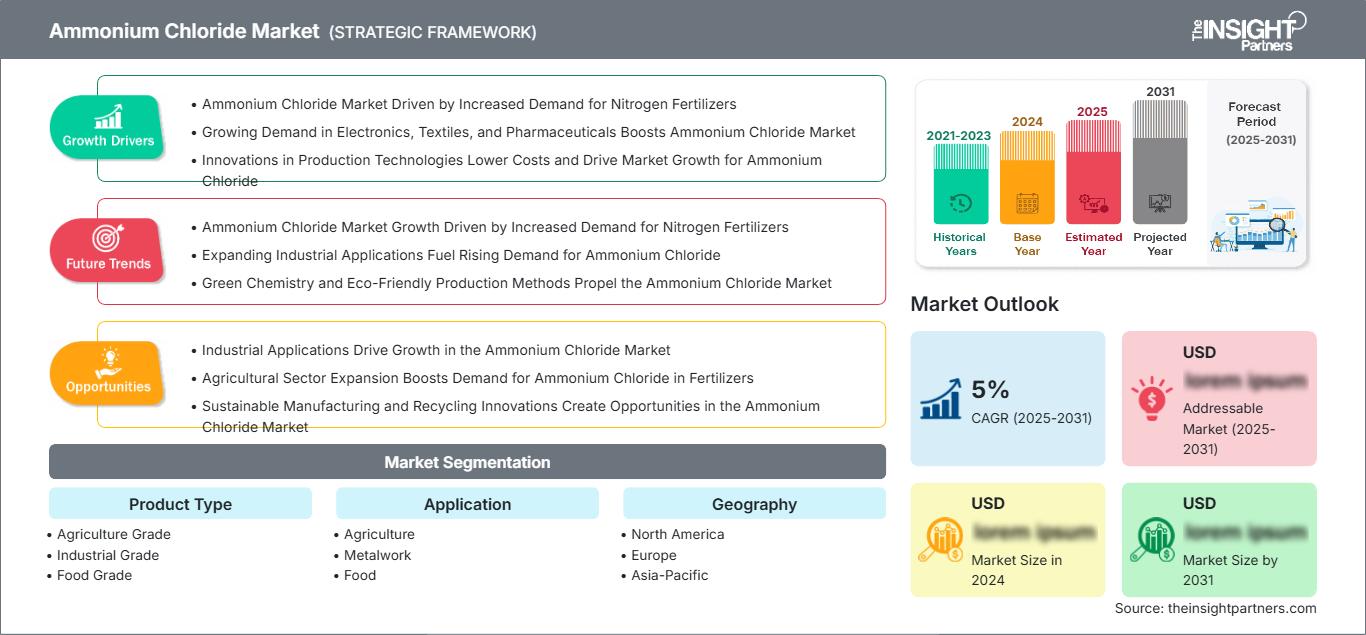
Ammonium Chloride Market: Strategic Insights
Regional Insights
North America Ammonium Chloride Market
North America captured a share of 24% to 27% in the ammonium chloride market in 2025 and is forecasted to grow at a rate of CAGR of 3.1% to 3.6% between 2026 and 2034. Demand in the region is driven by the presence of strong sectors of pharmaceutical manufacturing, specialty chemical manufacturing, food processing, and metal fabrication. Quality control measures imposed by organizations such as the U.S. Food and Drug Administration and Health Canada drive the consumption of high-grade products.
Well-developed chemical supply chain, integration of chlor-alkali manufacturing and sophisticated logistics infrastructure are among other contributing factors. Reliability of demand in the form of consistent investments in sectors like steel fabrication, electronics manufacturing, and lab chemicals is another key factor driving the regional market. Increasing pharmaceutical manufacturing and rising consumption of pharmaceutical excipients in North America will further aid consistent market growth.
U.S. Ammonium Chloride Market
In 2025, the US made up 74–78% of the market in North America and is predicted to exhibit a CAGR of 3.2–3.7% from 2026 to 2034. The United States boasts an industrial structure that is diversified and includes pharmaceutical manufacturing, food ingredients, specialty chemicals, metal processing, and reagents. Efficient domestic production of the chemicals and existing import mechanisms guarantee steady supply of chemicals.
Several top manufacturers and specialty chemical distributors have their production and distribution networks in the country, allowing the efficient supply of chemicals to the industries. Increasing investments in pharmaceutical manufacturing, growing demand for analytical grade chemicals, and ongoing metal fabrications drive the growth of the market. Growing focus on high-quality industrial chemicals and sustainable manufacturing processes will solidify its position in the North American region.
Europe Ammonium Chloride Market
Europe accounted for 20–23% of the worldwide market share in 2025 and is expected to have a CAGR of 2.8–3.3% over the period of 2026-2034. Germany holds the position of the largest regional market due to the developed chemical manufacturing industry, robust pharmaceutical industry, and extensive metal processing activities. The consistent development of the manufacturing industry has ensured stable consumption in various end-use sectors.
Consistent demand has been seen in the UK from the pharmaceutical manufacturing, specialty chemicals, and food processing industries. Compliance with strict quality standards in Europe has led to the adoption of high purity ammonium chloride in various regulated uses.
France, Italy, and Spain collectively contribute significant regional demand through food manufacturing, pharmaceutical production, and industrial processing. Investments in specialty chemicals, modernization of manufacturing infrastructure, and expanding industrial exports continue supporting long-term consumption. Increasing adoption of environmentally responsible production technologies further strengthens the competitiveness of European manufacturers within international markets.
APAC Ammonium Chloride Market
Asia Pacific accounted for 42–45% of the global market in 2025 and is forecast to expand at a CAGR of 4.3–4.8% during 2026–2034, making it the fastest-growing regional market. China leads regional production and consumption owing to its extensive fertilizer manufacturing capacity, while India continues expanding demand through agriculture and industrial development.
Japan and South Korea maintain stable consumption through pharmaceutical, electronics, and specialty chemical industries, whereas Australia supports demand through mining and industrial applications. Government initiatives promoting agricultural productivity, expanding domestic manufacturing, and chemical industry modernization continue supporting long-term regional growth.
Middle East & Africa Ammonium Chloride Market
The Middle East & Africa is expected to register a CAGR of 3.5–4.0% during 2026–2034. Saudi Arabia leads regional production through its integrated petrochemical industry, while the UAE continues investing in downstream chemical manufacturing and industrial diversification. South Africa remains an important consumer driven by mining, metallurgy, and industrial chemical applications.
Growing investments in industrial infrastructure, fertilizer manufacturing, and energy diversification programs continue creating opportunities across the region. Expansion of chemical processing facilities, improving logistics infrastructure, and increasing industrial exports are expected to strengthen regional competitiveness and support sustained demand over the forecast period.
Segmentation Analysis
Product Type
The Product Type segment is projected to expand at a CAGR of 3.6–4.1% during 2026–2034. Product innovation continues to focus on improving purity, consistency, and regulatory compliance to address diverse end-use requirements. While agriculture-grade material accounts for the largest volume owing to fertilizer applications, industrial and food grades are gaining traction as manufacturers invest in value-added production technologies. The ammonium chloride market scope continues to widen as demand increases for high-purity products across regulated industries, encouraging producers to diversify product portfolios and enhance quality assurance systems.
- Agriculture Grade – Represents the largest product category, supported by widespread use as a nitrogen fertilizer for chloride-tolerant crops. Stable agricultural production and government initiatives promoting crop productivity continue to sustain long-term consumption across major farming economies.
- Industrial Grade – Widely utilized in galvanizing, soldering fluxes, dry-cell batteries, textile processing, and metal treatment. Growing industrialization and manufacturing expansion across developing economies continue supporting consistent demand for industrial-grade material.
- Food Grade – Demand remains driven by food processing applications where the compound functions as a processing aid and ingredient under regulated quality standards. Increasing food safety requirements continue encouraging adoption of certified high-purity grades.
Application
The Application segment is anticipated to register a CAGR of 3.8–4.3% during 2026–2034. Expanding industrial diversification has broadened consumption beyond traditional fertilizer applications into pharmaceuticals, food manufacturing, and metal processing. Continuous investment in specialty chemicals, healthcare production, and advanced manufacturing is expected to support balanced demand growth while reducing dependence on any single end-use industry.
- Agriculture – Continues generating the highest consumption through fertilizer production that improves nitrogen availability for chloride-tolerant crops. Population growth and increasing pressure on agricultural productivity remain important demand-supporting factors.
- Metalwork – Maintains stable demand through galvanizing, tinning, soldering, and metal finishing operations where ammonium chloride functions as an effective flux. Expanding infrastructure development and manufacturing activities continue supporting industrial consumption.
- Food – Used in bakery products, confectionery, yeast production, and food processing applications requiring regulated food-grade materials. Rising processed food production and stringent quality standards continue supporting market demand.
- Pharmaceutical – The fastest-growing application, supported by increasing production of cough formulations, expectorants, and laboratory reagents. Growing healthcare expenditure, expanding pharmaceutical manufacturing capacity, and stronger regulatory compliance continue driving higher adoption of pharmaceutical-grade ammonium chloride.
Opportunity Snapshot
| Application | Revenue Contribution | Trend Tag | Adoption Stage |
|---|---|---|---|
| Agriculture | High | Crop Nutrition | Mature |
| Metalwork | Medium | Surface Treatment | Mature |
| Food | Medium | Process Ingredients | Scaling |
| Pharmaceutical | High | Drug Formulation | Scaling |
Ammonium Chloride Market Growth Drivers and Impact Analysis
Expansion of Global Fertilizer Consumption and Crop Yield Improvement
Growing food demand resulting from population growth and shrinking arable land continues to increase fertilizer consumption worldwide. Ammonium chloride remains an important nitrogen source for chloride-tolerant crops such as rice, wheat, barley, and sugar beet, particularly across Asia Pacific. Government initiatives supporting agricultural productivity, balanced nutrient application, and soil fertility management are encouraging stable fertilizer demand despite fluctuations in commodity prices. Farmers are increasingly adopting efficient nutrient management practices that improve crop yields while optimizing fertilizer utilization. At the same time, expanding agricultural production in India, China, Indonesia, and Southeast Asia continues creating long-term opportunities for manufacturers. Investments in domestic fertilizer production and improvements in agricultural supply chains are expected to sustain consumption while strengthening the role of ammonium chloride within integrated crop nutrition strategies over the forecast period.
Increasing Industrial Manufacturing and Metal Processing Activities
Industrial expansion across emerging economies continues to strengthen demand for ammonium chloride in galvanizing, soldering, tinning, metal finishing, and dry-cell battery manufacturing. Rapid urbanization and infrastructure investments are driving steel fabrication and metal component production, increasing the need for effective flux materials that improve surface preparation and bonding performance. Simultaneously, electronics manufacturing and precision engineering industries require reliable industrial chemicals that meet consistent quality specifications. Manufacturers are responding by upgrading production facilities with automated process controls and energy-efficient technologies that improve product consistency while lowering operating costs. Long-term investments in manufacturing capacity, industrial parks, and export-oriented production across Asia Pacific and the Middle East are expected to provide a stable demand base for industrial-grade ammonium chloride throughout the forecast period.
Growing Pharmaceutical and Food Processing Applications
The expansion of pharmaceutical manufacturing and processed food production is creating new opportunities for high-purity ammonium chloride products. Pharmaceutical-grade material is increasingly utilized in expectorants, laboratory reagents, and formulation processes requiring stringent quality standards. Rising healthcare expenditure, expanding generic drug production, and increasing investments in pharmaceutical manufacturing facilities continue supporting demand across developed and emerging economies. Food-grade ammonium chloride also maintains steady demand in bakery products, confectionery, and food processing applications where regulatory compliance and product purity are critical. As manufacturers continue investing in advanced purification technologies and internationally recognized quality certifications, premium-grade products are expected to contribute a larger share of industry revenues while improving profitability across the value chain.
Ammonium Chloride Market Future Trends
Growing Shift Toward High-Purity Specialty Grades
Manufacturers are increasingly investing in purification technologies to produce pharmaceutical-grade and food-grade ammonium chloride with higher consistency and lower impurity levels. This transition reflects rising regulatory requirements and customer expectations regarding product quality, traceability, and manufacturing compliance. The ammonium chloride market trends indicate that specialty applications are expected to account for a progressively larger share of industry value as healthcare, food processing, and laboratory chemical sectors expand globally. Companies are also implementing advanced analytical testing, automated quality control systems, and digital manufacturing platforms to improve operational efficiency and strengthen competitiveness in premium product categories.
Integration of Sustainable and Energy-Efficient Manufacturing
Environmental regulations and corporate sustainability objectives are encouraging manufacturers to modernize production facilities through energy-efficient technologies and improved resource utilization. Greater adoption of process automation, waste minimization practices, and by-product recovery systems is reducing production costs while supporting environmental compliance. Integrated chlor-alkali operations are expected to improve raw material efficiency and strengthen supply reliability. Over the coming years, companies that invest in cleaner manufacturing technologies, lower emissions, and circular production models are likely to gain competitive advantages while meeting evolving customer and regulatory expectations across global markets.
Ammonium Chloride Market Opportunities
Expansion of Pharmaceutical Manufacturing Across Emerging Economies
Increasing investments in pharmaceutical manufacturing across India, China, Southeast Asia, Latin America, and selected Middle Eastern countries are creating attractive growth avenues for producers of high-purity ammonium chloride. Rising healthcare expenditure, supportive government incentives for domestic drug manufacturing, and expanding exports of generic medicines are strengthening long-term demand for pharmaceutical-grade materials. Ammonium chloride Forecasts indicate that companies capable of supplying pharmacopeia-compliant products with consistent quality, traceability, and regulatory documentation will be well positioned to secure long-term contracts. Investment in dedicated purification facilities, GMP-compliant production, and advanced quality assurance systems can enable manufacturers to strengthen margins while expanding their presence in high-value healthcare applications.
Development of Value-Added Industrial and Specialty Chemical Solutions
Manufacturers have an opportunity to diversify beyond commodity-grade products by developing customized formulations for metal finishing, electronics, laboratory chemicals, and specialty industrial applications. Demand is increasingly shifting toward products offering higher purity, improved handling characteristics, and application-specific performance. Investments in research and development, strategic collaborations with downstream manufacturers, and expansion of regional distribution networks can improve market penetration and customer retention. Companies that integrate digital quality monitoring, sustainable production technologies, and localized technical support are expected to strengthen their competitive positioning while capturing additional value from specialized industrial applications with relatively higher profitability.
Recent Developments
- October 30, 2025: BASF SE announced the construction of a new electronic-grade ammonium hydroxide plant in Ludwigshafen, Germany. The investment expands BASF's ultra-high-purity ammonia chemical portfolio for semiconductor manufacturing and strengthens its integrated ammonia-based chemical value chain in Europe.
- April 24, 2025: BASF SE launched Ampliqan, a new nitrification inhibitor designed to improve nitrogen-use efficiency across ammonium-containing fertilizers. The innovation supports climate-smart agriculture and is expected to be commercialized globally beginning in 2026.
Frequently Asked Questions

- Comprehensive Market Sizing and Forecast Analysis
- Detailed Segmentation Analysis
- In-Depth Market Dynamics Assessment
- Regional and Country-Level Insights
- Competitive Landscape and Company Benchmarking
- Strategic Business Intelligence
Recent Reports
Testimonials

The Insight Partners' SCADA System Market report is comprehensive, with valuable insights on current trends and future forecasts. The team was highly professional, responsive, and supportive throughout. We are very satisfied and highly recommend their services.
RAN KEDEM Partner, Reali Technologies LTDs
I requested a report on a very specific software market and the team produced the report in a few days. The information was very relevant and well presented. I then requested some changes and additions to the report. The team was again very responsive and I got the final report in less than a week.
JEAN-HERVE JENN Chairman, Future Analytica
We worked with The Insight Partners for an important market study and forecast. They gave us clear insights into opportunities and risks, which helped shape our plans. Their research was easy to use and based on solid data. It helped us make smart, confident decisions. We highly recommend them.
PIYUSH NAGPAL Sr. Vice President, High Beam Global
The Insight Partners delivered insightful, well-structured market research with strong domain expertise. Their team was professional and responsive throughout. The user-friendly website made accessing industry reports seamless. We highly recommend them for reliable, high-quality research services
YUKIHIKO ADACHI CEO, Deep Blue, LLC.
This is the first time I have purchased a market report from The Insight Partners.While I was unsure at first, I visited their web site and felt more comfortable to take the risk and purchase a market report.I am completely satisfied with the quality of the report and customer service. I had several questions and comments with the initial report, but after a couple of dialogs over email with their analyst I believe I have a report that I can use as input to our strategic planning process.Thank you so much for taking the extra time and making this a positive experience.I will definitely recommend your service to others and you will be my first call when we need further market data.
JOHN SUZUKI President and Chief Executive Officer, Board Director, BK Technologies
I wish to appreciate your support and the professionalism you displayed in the course of attending to my request for information regarding to infectious disease IVD market in Nigeria. I appreciate your patience, your guidance, and the fact that you were willing to offer a discount, which eventually made it possible for us to close a deal. I look forward to engaging The Insight Partners in the future, all thanks to the impression you have created in me as a result of this first encounter.
DR CHIJIOKE ONYIA MANAGING DIRECTOR, PineCrest Healthcare Ltd.Reason to Buy
- Informed Decision-Making
- Understanding Market Dynamics
- Competitive Analysis
- Identifying Emerging Markets
- Customer Insights
- Market Forecasts
- Risk Mitigation
- Boosting Operational Efficiency
- Strategic Planning
- Investment Justification
- Tracking Industry Innovations
- Aligning with Regulatory Trends





 Get Free Sample for