
Amyotrophic Lateral Sclerosis Market Size, Growth & Trends by 2034
Amyotrophic Lateral Sclerosis Market Size and Forecasts (2021 - 2034), Global and Regional Share, Trends, and Growth Opportunity Analysis Report Coverage : by Diagnosis Type (Clinical Examination, Electromyography, Magnetic Resonance Imaging, Genetic Testing); Treatment Type (Medication, Therapy, Supportive Care); Route of Administration (Oral, Intravenous, Subcutaneous); End User (Hospitals, Homecare Settings, Specialty Clinics); and Geography (North America, Europe, Asia Pacific, and South and Central America)
- Status : Data Released
- Report Code : TIPRE00040190
- Category : Life Sciences
- No. of Pages : 150
- Available Report Formats :


- Last update date : July 28, 2026


2025 Market Size
US$ 741.38 Mn
Base year value
2034 Forecast
US$ 1,256.55 Mn
Projected by 2034
CAGR 2026-2034
6.04 %
Growth rate
Addressable Market
US$ 9,048.97 Mn
(2026-2034)
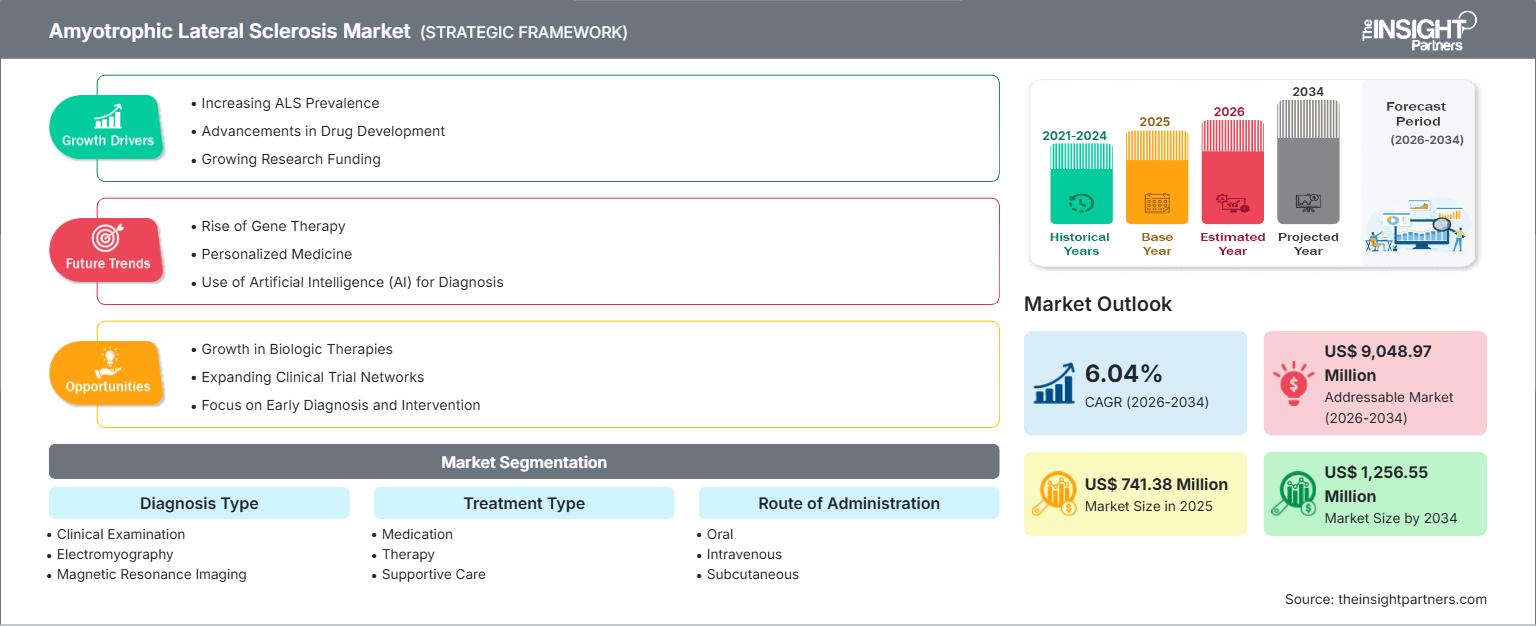
The amyotrophic lateral sclerosis market size stood at US$ 741.38 million in 2025 and is estimated to reach US$ 1,256.55 million by 2034, growing at a CAGR of 6.04%. Drivers of the market include increasing motor neuron disease diagnoses, genetic testing expansion, specialty clinics, disease-modifying drugs, respiratory interventions, nutritional interventions, and multi-disciplinary approach for progressive neurodegeneration.
Adoption is expected to expand at a CAGR of 5.7-6.7% in North America throughout 2034 due to rare disease insurance coverage, neuromuscular centers, registries and research, and early genetic counseling adoption. Size of ALS market is driven by specialty drug prescriptions, home-based care, and biological and antisense therapy availability for certain patients' populations.
Amyotrophic Lateral Sclerosis Market Assessment and Insights
- North America held 42–45% share in 2025 and is projected to grow at a CAGR between 5.7–6.7% during 2026–2034, supported by neuromuscular centers, rare disease reimbursement, clinical trial networks, and access to advanced diagnostics.
- US accounted for 86–90% of North America in 2025 and is forecast to grow at a CAGR between 5.8–6.8% during 2026–2034, driven by specialty care and genetic testing.
- Europe represented 28–31% share in 2025 and is projected to grow at a CAGR between 5.2–6.2% during 2026–2034, led by Germany, the UK, France, Italy, and Spain.
- Asia Pacific captured 18–21% share in 2025 and is expected to grow at a CAGR between 6.8–7.8% during 2026–2034, led by Japan, China, South Korea, India, and Australia.
- Largest Segment Medication held 47–50% market share in 2025 and is projected to grow at a CAGR between 5.8–6.8% during 2026–2034.
- High Growth Segment Genetic Testing held 9–12% market share in 2025 and is projected to grow at a CAGR between 8.0–9.5% during 2026–2034.
- Key companies analyzed in detail: Sanofi S.A., Orphazyme A/S, Bristol Myers Squibb Company, AbbVie Inc., Teva Pharmaceutical Industries Ltd., Eisai Co., Ltd., Sarepta Therapeutics, Inc., Amgen Inc., Viatris Inc., Vertex Pharmaceuticals Incorporated, UCB S.A., Roche Holding AG, Biogen Inc., Alector, Inc., Novartis AG.
Source: The Insight Partners' analysis based on proprietary research, government publications, company annual reports, investor presentations, industry databases, and expert interviews.
Care for ALS patients has progressed from symptom-based therapy alone to biomarker-driven diagnosis, genetic sub-classification, and multi-disciplinary treatment. The combination of EMG, MRI, clinical observation and genetic screening is now employed to reduce diagnostic times. Modes of administration have become increasingly varied with oral, intravenous and investigational subcutaneous agents being used to ensure future compatibility with home-based care and reduced caregiver involvement.
Future prospects include early diagnosis, genotype-directed treatments, respiratory care and multi-disciplinary specialty care. Developing countries are improving their access to neurology care, while mature markets are working on building registries, decentralized trials and reimbursement for orphan diseases. Regulatory support is likely to be strongest in cases where the presence of biomarkers allows accelerated or conditional approvals, especially for genetically defined patient groups with large unmet needs.
Amyotrophic Lateral Sclerosis Market Report Scope
| Report Attribute | Details |
|---|---|
| Market size in 2025 | US$ 741.38 Million |
| Market Size by 2034 | US$ 1,256.55 Million |
| Global CAGR (2026 - 2034) | 6.04% |
| Historical Data | 2021-2024 |
| Forecast period | 2026-2034 |
Amyotrophic Lateral Sclerosis Market Analysis
The demand for the product is driven by the increasing prevalence of diseases, growing neurological awareness, and increasing use of genetic testing in familial and seemingly sporadic cases. The reason why the amyotrophic lateral sclerosis market growth is boosted by the fact that CDC projections have shown that the number of patients with ALS will increase by over 10% between 2022 and 2030 in the US.
The ecosystem consists of neurology practices, diagnostic facilities, genetic counselors, specialty pharmacies, infusion centers, home care, respiratory equipment suppliers, pharmaceuticals companies, patient registries, and clinical trials. Supply dynamics depend on rare disease supply chain management, payer authorization, biomarkers testing, and caregiver support services. The market is further strengthened by the fact that WHO acknowledges that neurological disorders affect more than 3 billion people in the world.
Market competition is increasingly driven by focused science, clinical data, delivery convenience, and payer outcomes. In the ALS market assessment, Biogen Inc. has improved precision treatment positioning in SOD1-ALS, while Roche Holding AG, Alector, Inc., Sanofi S.A., UCB S.A., Novartis AG, and Vertex Pharmaceuticals Incorporated remain relevant in terms of neuroscience, immunology, genetics, or translational research potential.
Other existing pharma players, namely AbbVie Inc., Teva Pharmaceutical Industries Ltd., Eisai Co., Ltd., Amgen Inc., Viatris Inc., and Bristol Myers Squibb Company, provide support to the general neurology and specialty drugs landscape via production, marketing, and therapy know-how. Investment focus is now shifting towards antisense platform technologies, neurofilament endpoint, biomarker-powered clinical trials, and a patient care-at-home strategy.
● REPORT CUSTOMIZATION
Tailor This Report To Align With Your Specific Business Requirements
This report can be customized to align precisely with your business objectives, scope, and target markets. Customization options include tailored segmentation, geography, competitive analysis, and strategic insights to support informed decision-making.
Customize This Report →WHAT YOU CAN ADJUST
- ● Segmentations
- ● Geography
- ● Competitive Analysis
- ● Language Preferences
Amyotrophic Lateral Sclerosis Market: Strategic Insights
Regional Insights
North America amyotrophic lateral sclerosis market
North America held 42–45% share in 2025 and is projected to grow at a CAGR between 5.7–6.7% during 2026–2034. The region benefits from rare disease reimbursement, ALS registries, specialty neuromuscular centers, and broader use of genetic testing. The amyotrophic lateral sclerosis market share is concentrated in medication, clinical examination, electromyography, supportive care, and home respiratory support. The region’s structural advantage comes from clinical trial density, patient advocacy, specialty pharmacy distribution, and biomarker adoption. CDC’s National ALS Registry dashboard projected 34,720 adults living with ALS in the US in 2026, supporting resource planning for treatment, homecare, and specialty services. Demand is strongest where multidisciplinary clinics coordinate neurologists, pulmonologists, nutritionists, therapists, and social support.
U.S. amyotrophic lateral sclerosis Market
America is the predominant player in North America market with 86-90% share in 2025 and expected to grow at a CAGR of 5.8-6.8% in 2026-2034. Market strength is derived from the accessibility of therapies, excellent diagnosis capability, insurance cover of certain rare disease medications and clinical research networks within the academic neuromuscular centers. Corporate presence is evident in the form of Biogen Inc.'s ALS product line, neuroscience research center of Roche Holding AG, Alector, Inc.'s neurodegeneration pipeline, and neurology generics by Teva Pharmaceutical Industries Ltd. and Viatris Inc. Trends in application include early genetic screening, specialty drugs treatment, respiratory assistance, dietary supplement and home care.
Europe amyotrophic lateral sclerosis Market
Europe had a 28–31% market share in 2025, and its market will continue to grow at a CAGR ranging from 5.2–6.2% for 2026–2034. The UK is working on the development of genetic medicine approaches and services for motor neuron disease, aided by national neurology networks and rare disease assessment processes. Reimbursements are based on evidence and may differ from country to country. Germany has the highest growth because of advanced neurological facilities, diagnostics, and good coordination of hospital care. France, Italy, and Spain have organized ALS clinics and participation in trials with supportive care programs. Europe is affected by regulatory acknowledgment of biomarker-based therapy and the impact of cost-effectiveness analyses on market introduction sequence.
APAC amyotrophic lateral sclerosis Market
APAC captured 18–21% share in 2025 and is forecast to grow at a CAGR between 6.8–7.8% during 2026–2034. Japan is the leading country, followed by China, South Korea, India, and Australia, supported by aging populations, improving neurology access, and growing molecular diagnostics. Japan and South Korea show stronger specialty therapy access, while China is expanding hospital neurology capacity and rare disease policy attention. India’s growth is linked to urban specialty clinics, private diagnostics, and gradual awareness improvements. Australia benefits from registries, homecare models, and structured multidisciplinary support.
Middle East & Africa amyotrophic lateral sclerosis Market
The Middle East & Africa market will have a CAGR of 4.5–5.5% from 2026 to 2034. Saudi Arabia and the UAE take the lead in terms of adoption via tertiary hospitals, infrastructure for medical tourism, and the development of specialty neurology and rehabilitation services. South Africa is the most advanced market in Africa owing to the presence of private networks of neurologists and university hospitals. The RoMEA market will grow slowly since diagnosis delays, lack of specialists, and reimbursement constraints affect access. Nevertheless, supportive care, nutritional support, and respiration assistance provide opportunities.
Segmentation Analysis
Diagnosis Type
Diagnosis Type is projected to grow at a CAGR between 6.2–7.2% during 2026–2034. Diagnostic pathways are becoming more structured as neurologists combine clinical findings with electrophysiology, imaging, and molecular testing. The amyotrophic lateral sclerosis market scope is widening because earlier differential diagnosis can improve trial eligibility, guide genetic counseling, and support faster initiation of appropriate medication, therapy, and supportive care.
- Clinical Examination remains the diagnostic foundation because neurologists assess upper and lower motor neuron signs, disease progression, bulbar symptoms, respiratory status, and functional decline across repeated visits.
- Electromyography is strategically important because it detects denervation and reinnervation patterns, helping differentiate ALS from neuropathies, myopathies, radiculopathies, and other neuromuscular mimics.
- Magnetic Resonance Imaging supports exclusion of structural, inflammatory, compressive, or vascular conditions that can resemble motor neuron disease and complicate diagnosis.
- Genetic Testing is gaining importance as SOD1, C9orf72, FUS, TARDBP, and other variants influence counseling, family risk assessment, trial selection, and precision treatment access.
Treatment Type
Treatment Type is projected to grow at a CAGR between 5.7–6.7% during 2026–2034. Treatment demand is shifting from generalized symptom management toward combined disease-modifying, rehabilitative, and supportive care pathways. Medication remains commercially significant, but therapy and supportive care are essential because ALS progressively affects mobility, communication, swallowing, breathing, sleep, nutrition, and caregiver workload.
- Medication leads revenue contribution because approved products, specialty therapies, and investigational disease-modifying approaches are priced above routine supportive interventions and require specialist prescribing.
- Therapy includes physical, occupational, speech, and respiratory interventions that help maintain function, manage swallowing and communication, reduce complications, and extend independence.
- Supportive Care is critical because ventilatory support, nutrition planning, mobility aids, communication devices, and caregiver services directly influence quality of life and healthcare utilization.
Route of Administration
Route of Administration is expected to grow at a CAGR between 5.9–6.9% during 2026–2034. Route selection reflects drug mechanism, patient function, access setting, caregiver involvement, and payer rules. Oral therapies support convenience for early and moderate disease, intravenous treatment requires infusion capacity, and subcutaneous approaches could gain preference if future products combine efficacy with home administration potential.
- Oral administration remains important because convenience, outpatient prescribing, and easier continuation support routine use in patients who can swallow safely or manage assisted dosing.
- Intravenous delivery supports therapies requiring controlled administration, infusion monitoring, or rapid systemic exposure, but it also increases dependence on infusion centers and caregiver logistics.
- Subcutaneous delivery is strategically attractive for future access because it can support home-based care, reduce infusion burden, and improve continuity where motor decline limits travel.
End User
End User is projected to grow at a CAGR between 5.6–6.6% during 2026–2034. Care delivery increasingly depends on coordinated settings rather than single-site treatment. Hospitals remain essential for diagnosis and acute complications, specialty clinics manage longitudinal neurological care, and homecare settings become more important as patients require ventilation support, nutrition assistance, mobility equipment, and caregiver coordination.
- Hospitals manage diagnosis, acute respiratory issues, gastrostomy placement, complex medication initiation, and specialist referrals, especially for patients with rapid decline or severe complications.
- Homecare Settings are expanding because ALS progression increases demand for noninvasive ventilation, mobility support, nutrition assistance, communication tools, and caregiver-led daily management.
- Specialty Clinics coordinate neurologists, therapists, dietitians, respiratory specialists, genetic counselors, and social workers, making them central to standardized care and trial access.
Opportunity Snapshot
| Segment Name | Revenue Contribution | Trend Tag | Adoption Stage |
|---|---|---|---|
| Hospitals | High | Acute Neurology | Mature |
| Homecare Settings | Medium | Assisted Living | Scaling |
| Specialty Clinics | High | Multidisciplinary Care | Scaling |
Amyotrophic Lateral Sclerosis Market Growth Drivers and Impact Analysis
Earlier Genetic Stratification Changes Treatment Pathways
Genetic stratification will play an increasingly important part as ALS is now not considered a syndrome anymore. Genetic testing of variants, such as SOD1 and C9orf72, helps in family counseling, patient recruitment for trials, risk assessment, and treatment in specific subgroups. The practical significance of genetic stratification includes the increased importance of genetic counselors, molecular labs, and specialty neurology practices. From a research perspective, early testing makes clinical trials more efficient due to the biological fit of recruited patients instead of heterogeneous samples. From a commercial point of view, genetic stratification provides opportunities for premium drugs, biomarkers, and payer discussions based on rationale of the treatment.
Multidisciplinary Clinics Improve Care Continuity
Multidisciplinary ALS clinics are driving market development because patients require coordinated neurological, respiratory, nutritional, rehabilitative, and psychosocial support. Disease progression often affects swallowing, walking, speaking, and breathing within a short clinical window, making fragmented care inefficient and burdensome. Integrated centers can standardize monitoring, identify ventilation needs earlier, coordinate gastrostomy timing, and connect patients with assistive technologies. This improves demand for therapy services, supportive devices, specialty medications, and homecare partnerships. For manufacturers and service providers, these clinics are strategically important because they concentrate eligible patients, support clinical trial recruitment, and create structured pathways for payer documentation and treatment follow-up.
Biomarker Evidence Supports Targeted Drug Development
Neurofilament and other biomarkers are reshaping ALS drug development by offering measurable signals of neurodegeneration and treatment response. This is especially important because functional decline can vary widely across patients, making traditional endpoints difficult in small, rare disease cohorts. Biomarker-supported evidence can help de-risk trials, guide dose selection, identify responsive populations, and support regulatory discussions where unmet need is high. Commercial impact is strongest for therapies targeting defined mechanisms, including antisense, gene-targeted, immunomodulatory, and neuroprotective approaches. As biomarker testing becomes more routine, sponsors with strong translational science may accelerate development and improve payer confidence in clinical value.
Amyotrophic Lateral Sclerosis Market Future Trends
Precision Therapy Expansion Beyond SOD1-ALS
The most important amyotrophic lateral sclerosis market trends will involve expanding precision therapy from rare SOD1-linked disease into broader genetic and biomarker-defined groups. Future pipelines are expected to prioritize mechanisms tied to RNA processing, protein aggregation, neuroinflammation, mitochondrial dysfunction, and axonal degeneration. This will require larger genetic screening programs, richer natural history datasets, and trial designs that can evaluate small patient subsets without losing statistical rigor. Companies that combine therapy development with diagnostics, registries, and real-world evidence will be better positioned. The trend will also increase the commercial relevance of specialty clinics capable of identifying and monitoring molecularly defined patients.
Home-Based Monitoring and Decentralized Trial Models
Home-based monitoring will become more important as ALS progression makes frequent site visits difficult. Digital respiratory measures, speech tracking, wearable mobility data, caregiver-reported outcomes, and tele-neurology can help clinicians observe decline more continuously. Decentralized trials may reduce participation burden, improve retention, and broaden recruitment beyond major academic centers. This trend creates opportunities for connected devices, home nursing, specialty pharmacies, and data platforms that integrate patient-reported and clinician-verified endpoints. Adoption will depend on validation, privacy safeguards, payer acceptance, and clinician workflow integration. Over time, home-generated evidence may support treatment optimization and more practical post-approval surveillance.
Amyotrophic Lateral Sclerosis Market Opportunities
Integrated Genetic Testing and Treatment Access Programs
A strong opportunity exists in linking genetic testing, counseling, treatment initiation, and long-term monitoring into integrated access programs. The amyotrophic lateral sclerosis market Forecasts indicate that growth will increasingly depend on identifying eligible patients earlier, especially for therapies tied to specific mutations or biomarker profiles. Companies can invest in sponsored testing, clinician education, registry partnerships, and navigation services that reduce diagnostic delays without compromising ethical counseling. Health systems benefit when genetic results guide trial referral, family risk discussions, and precision prescribing. The strongest programs will combine rapid testing, reimbursement support, and follow-up pathways across hospitals and specialty clinics.
Homecare Solutions for Respiratory and Functional Decline
Homecare presents an actionable opportunity because ALS progressively shifts care needs from hospitals to the patient’s living environment. Investment should focus on noninvasive ventilation support, nutrition assistance, mobility equipment, communication technologies, remote monitoring, and trained caregiver services. Providers that coordinate with neurologists and specialty pharmacies can reduce avoidable admissions while improving continuity. This opportunity is particularly relevant in aging societies where caregiver strain and hospital capacity pressures are rising. Commercial models should combine equipment, clinical support, data capture, and service reliability. Differentiation will come from responsiveness, patient training, and integration with multidisciplinary clinic care plans.
Recent Developments
- December 2025: Biogen Inc. announced that JAMA Neurology published long-term results from the Phase 3 VALOR study and open-label extension for QALSODY in SOD1-ALS. The company reported more than 3.5 years of follow-up, sustained neurofilament reductions, and observed benefits across function, strength, breathing, and survival-related measures.
- July 2025: Medicines and Healthcare products Regulatory Agency approved Biogen Netherlands B.V.’s tofersen for adults with ALS caused by SOD1 mutations in the UK. The approval, granted on July 22, 2025, through the International Recognition Procedure, expanded targeted treatment availability for a rare inherited form of motor neuron disease.
- March 2025: Sanofi S.A.’s Phase 2 HIMALAYA study of oral SAR443820 in ALS was updated on ClinicalTrials.gov as terminated after Part A did not meet the primary endpoint. The record described a randomized, double-blind study assessing efficacy, safety, tolerability, pharmacokinetics, and pharmacodynamics in adults with ALS.
Frequently Asked Questions

- Comprehensive Market Sizing and Forecast Analysis
- Detailed Segmentation Analysis
- In-Depth Market Dynamics Assessment
- Regional and Country-Level Insights
- Competitive Landscape and Company Benchmarking
- Strategic Business Intelligence
Recent Reports
Testimonials

The Insight Partners' SCADA System Market report is comprehensive, with valuable insights on current trends and future forecasts. The team was highly professional, responsive, and supportive throughout. We are very satisfied and highly recommend their services.
RAN KEDEM Partner, Reali Technologies LTDs
I requested a report on a very specific software market and the team produced the report in a few days. The information was very relevant and well presented. I then requested some changes and additions to the report. The team was again very responsive and I got the final report in less than a week.
JEAN-HERVE JENN Chairman, Future Analytica
We worked with The Insight Partners for an important market study and forecast. They gave us clear insights into opportunities and risks, which helped shape our plans. Their research was easy to use and based on solid data. It helped us make smart, confident decisions. We highly recommend them.
PIYUSH NAGPAL Sr. Vice President, High Beam Global
The Insight Partners delivered insightful, well-structured market research with strong domain expertise. Their team was professional and responsive throughout. The user-friendly website made accessing industry reports seamless. We highly recommend them for reliable, high-quality research services
YUKIHIKO ADACHI CEO, Deep Blue, LLC.
This is the first time I have purchased a market report from The Insight Partners.While I was unsure at first, I visited their web site and felt more comfortable to take the risk and purchase a market report.I am completely satisfied with the quality of the report and customer service. I had several questions and comments with the initial report, but after a couple of dialogs over email with their analyst I believe I have a report that I can use as input to our strategic planning process.Thank you so much for taking the extra time and making this a positive experience.I will definitely recommend your service to others and you will be my first call when we need further market data.
JOHN SUZUKI President and Chief Executive Officer, Board Director, BK Technologies
I wish to appreciate your support and the professionalism you displayed in the course of attending to my request for information regarding to infectious disease IVD market in Nigeria. I appreciate your patience, your guidance, and the fact that you were willing to offer a discount, which eventually made it possible for us to close a deal. I look forward to engaging The Insight Partners in the future, all thanks to the impression you have created in me as a result of this first encounter.
DR CHIJIOKE ONYIA MANAGING DIRECTOR, PineCrest Healthcare Ltd.Reason to Buy
- Informed Decision-Making
- Understanding Market Dynamics
- Competitive Analysis
- Identifying Emerging Markets
- Customer Insights
- Market Forecasts
- Risk Mitigation
- Boosting Operational Efficiency
- Strategic Planning
- Investment Justification
- Tracking Industry Innovations
- Aligning with Regulatory Trends





 Get Free Sample for