
Anhydrous Denatured Ethyl Alcohol Market Size, Share & Trends by 2034
Coverage: By Type (High Purity, Middle Purity, Low Purity); Application (Paint Thinners, Lacquers, Varnishes, Paints), and Geography (North America, Europe, Asia Pacific, and South and Central America)
- Status : Data Released
- Report Code : TIPRE00016160
- Category : Chemicals and Materials
- No. of Pages : 150
- Available Report Formats :


- Last update date : August 19, 2026


2025 Market Size
US$ 15.73 Bn
Base year value
2034 Forecast
US$ 32.39 Bn
Projected by 2034
CAGR 2026-2034
8.36 %
Growth rate
Addressable Market
US$ 216.08 Bn
(2026-2034)
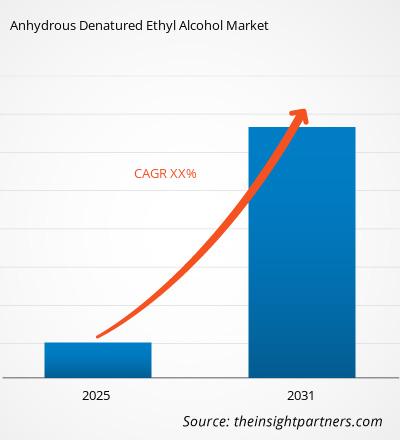
The anhydrous denatured ethyl alcohol market was valued at US$ 15.73 Billion in 2025 and is projected to reach US$ 32.39 Billion by 2034, expanding at a CAGR of 8.36% during 2026–2034. Demand is driven by high-purity industrial ethanol usage as a solvent and an ingredient in paint formulations. Expansion will be further driven by the replacement of industrial solvents, expansion in regional chemical manufacturing operations, and stringent demands for uniform product purity.
North America is a structurally significant market, aided by existing coatings manufacturing, specialty chemicals production, and distribution facilities for industrial alcohols. The regional market is expected to grow with a CAGR of 7.2–8.0% for 2026-2034. Growth is supported by demands for reliable solvent grade products, regulatory distinction between denatured and beverage alcohol, and increased bio-ethanol raw materials.
Anhydrous Denatured Ethyl Alcohol Market Assessment and Insights
- North America: North America accounted for an estimated 27–31% share in 2025 and is projected to grow at a 7.2–8.0% CAGR between 2026–2034, supported by coatings, specialty chemicals, industrial solvents, and established ethanol supply chains.
- US: The US represented approximately 23–26% of global demand in 2025 and is expected to grow at a 7.1–7.9% CAGR during 2026–2034, supported by industrial ethanol production and coatings applications.
- Europe: Europe held an estimated 20–24% share in 2025 and is projected to register a 7.7–8.5% CAGR through 2034. Germany, France, Italy, the UK, and Spain provide substantial coatings, chemical manufacturing, and industrial solvent demand.
- Asia Pacific: Asia Pacific represented approximately 29–33% of the market in 2025 and is forecast to expand at an 8.7–9.6% CAGR. China, India, Japan, South Korea, and Australia benefit from manufacturing growth and expanding coatings production.
- Largest Segment: High Purity represented an estimated 42–47% market share in 2025 and is projected to grow at an 8.4–9.1% CAGR through 2034, supported by formulation-sensitive industrial applications.
- High Growth Segment: Paints represented approximately 25–29% market share in 2025 and is projected to expand at a 9.0–9.8% CAGR, reflecting coatings production and solvent-performance requirements.
- Key companies analyzed in detail: Agro Ind, Science Company, SUAZ and CO, Sucroal, Thinh Cuong, Archer Daniels Midland Company, Cargill, Incorporated, Greenfield Global Inc., POET, LLC, and Valero Energy Corporation.
Source: The Insight Partners' analysis based on proprietary research, government publications, company annual reports, investor presentations, industry databases, and expert interviews.
The anhydrous denatured ethyl alcohol industry has moved from traditional bulk solvent sourcing into the provision of increasingly distinct types of alcohol based on the type of purity, denatured formula, origin of feedstock and application requirements. Manufacturers now possess capabilities in fermentation, dehydration, purification, storage and distribution. In the coatings sector, anhydrous ethanol allows quick evaporation and compatibility with particular resin systems, whereas the denaturation process makes the use of the product in industry possible without taxes that apply to beverage alcohol in appropriate jurisdictions.
Over the forecast period, manufacturers are expected to concentrate on regional inventories, low carbon footprint feedstock, modern dehydration methods and application-oriented formulae. The importance of the Asia-Pacific region will increase due to the development of the coatings industry and chemical manufacturing industry, whereas North America and Europe will continue to be of significance owing to the presence of advanced industrial solvent network.
Anhydrous Denatured Ethyl Alcohol Market Report Scope
| Report Attribute | Details |
|---|---|
| Market size in 2025 | US$ 15.73 Billion |
| Market Size by 2034 | US$ 32.39 Billion |
| Global CAGR (2026 - 2034) | 8.36% |
| Historical Data | 2021-2024 |
| Forecast period | 2026-2034 |
Anhydrous Denatured Ethyl Alcohol Market Analysis
Consumption for the anhydrous denatured ethyl alcohol market comes from the coatings industry, chemical formulators, solvent users, and distributors. The supply chain starts from corn, sugar cane, grains or any other fermentable feedstock and then through fermentation, distillation, dehydration, denaturation, quality check, storage, and finally bulk distribution. Suppliers with their own feedstock sources can control any price fluctuations in raw materials.
Anhydrous denatured ethyl alcohol market report highlights the growth due to the known properties of ethanol as a solvent which include fast evaporation and ability to fit into various formulation systems. Factors affecting the supply include feedstock availability, energy prices, dehydration costs, freight rates, and local alcohol regulations. Local producers will have the advantage of low industrial ethanol availability, whereas importers will be exposed to fluctuations in transportation and currency.
Competitive structure is fragmented among integrated ethanol producers, specialty industrial-alcohol providers, and regional distributors. Archer Daniels Midland Company and Cargill, Incorporated have an advantage due to wide infrastructure of agriculture and industries, whereas Greenfield Global Inc. operates both ethanol production and specialty alcohol delivery. POET, LLC and Valero Energy Corporation have good production capacities, even though they have diversified product range in fuel and industrial ethanol.
Specialized providers like Agro Ind, Science Company, SUAZ and CO, Sucroal, and Thinh Cuong could use competition due to regional availability, ability to formulate products according to customer needs, and specific specifications. Investment trends include increasing investment into dehydration technology, storage capacity, low-carbon feedstocks, and distribution centers. Competitive strategy is determined by ethanol production capacity as well as purity, denaturant usage, documentation, and distribution to industrial consumers.
● REPORT CUSTOMIZATION
Tailor This Report To Align With Your Specific Business Requirements
This report can be customized to align precisely with your business objectives, scope, and target markets. Customization options include tailored segmentation, geography, competitive analysis, and strategic insights to support informed decision-making.
Customize This Report →WHAT YOU CAN ADJUST
- ● Segmentations
- ● Geography
- ● Competitive Analysis
- ● Language Preferences
Anhydrous Denatured Ethyl Alcohol Market: Strategic Insights

Regional Insights
North America anhydrous denatured ethyl alcohol market
North America is estimated to hold a 27–31% Anhydrous Denatured Ethyl Alcohol Market share of the global market in 2025 and is projected to expand at a 7.2–8.0% CAGR through 2034. The region benefits from large ethanol production capacity, sophisticated coatings manufacturing, and established industrial alcohol distribution networks. The US remains the dominant national market, while Canada provides additional demand from coatings, chemicals, and manufacturing.
Factors affecting the regional demand for the product include the availability of the raw material, the facilities required to dehydrate ethanol, and the alcohol laws within industry. There has been more differentiation of materials on the basis of purity, composition of denaturant, and paperwork. High levels of production of ethanol domestically decrease reliance on imports for many industries, although prices are still dependent on corn and energy prices.
US anhydrous denatured ethyl alcohol market
The US is estimated to hold about 82-85% of the 2025 North American market, with growth projected at a rate of 7.1-7.9% CAGR until 2034. The US presence is driven by abundant ethanol production, established coatings industry, and wide-reaching industrial solvents distribution network. Major manufacturers and suppliers are Archer Daniels Midland Company, Cargill, Incorporated, POET, LLC, Greenfield Global Inc., and Valero Energy Corporation.
Paints, varnishes, lacquers, and thinner formulas constitute significant industrial demand for ethanol when fast evaporation and proper formulation are required. Also, legislation makes it possible to differentiate between denatured and beverage alcohol and use of ethanol for industrial purposes under certain circumstances. Growing consumer preference for sustainable materials could become an added reason for differentiation between traditional and biological industrial ethanol. Supply agreements, purity standards, denaturants quality, and regional stock are likely to be among main purchasing criteria.
Europe anhydrous denatured ethyl alcohol market
Europe had around 20–24% share in 2025 and will be growing at a CAGR of 7.7–8.5% until 2034. In the region, Germany holds the first position, followed by France, Italy, the United Kingdom, and Spain. There is an already established chemical and coating industry in the region that acts as a stable consumer of industrial solvents, while regulations guide denaturing process, traceability, and excisable status.
There is also established demand for coating and industrial chemicals from the United Kingdom owing to an established alcohol distribution network and stringent control over production and utilization. The demand from Germany is driven by its large chemical and coatings industry in the automotive segment, where consistency of solvents is critical. France, Italy, and Spain provide demand due to their decorative coatings, industrial paints, and adhesives manufacturing.
APAC anhydrous denatured ethyl alcohol market
APAC accounted for approximately 29–33% of the market in 2025 and is expected to grow at an 8.7–9.6% CAGR through 2034. China is the leading national market, followed by India, Japan, South Korea, and Australia. Expanding manufacturing, coatings production, construction activity, and chemical processing underpin regional consumption.
China and India provide considerable volume potential due to growing industrial capacity and sizeable manufacturing base. Industrial solvents of higher quality are being pursued by Japan and South Korea due to the advanced level of manufacturing, whereas Australia is offering a smaller but established market for industrial products. Policies on biofuels and ethanol production will help increase the availability of feedstocks in the region.
Middle East and Africa anhydrous denatured ethyl alcohol market
Middle East and Africa is expected to record a 6.8–7.6% CAGR through 2034. Saudi Arabia and the UAE are important regional chemical and manufacturing centers, while South Africa represents a significant industrial market. Demand is supported by coatings, construction materials, chemical processing, and industrial maintenance activities.
Middle East: advantages of infrastructure spending and development in downstream chemicals, and Africa: potential for longer term due to increasing industrialization. UAE acts as a logistics center for chemical products in the region, while solvent use in Saudi Arabia is based on industrial diversification in the country. South Africa: demand created in the area of coatings and manufacturing. More reliant on imports compared to North America.
Segmentation Analysis
Type
The type segment is expected to expand at an 8.1–8.8% CAGR during 2026–2034. Purity requirements determine suitability for different formulations, with higher-purity grades generally preferred where solvent behavior, residue control, odor characteristics, and formulation stability are critical. Middle- and low-purity materials remain relevant in cost-sensitive industrial applications where ultra-high purity is unnecessary.
- High Purity: High-purity material serves formulation-sensitive coatings, specialty solvents, and chemical applications where low water content and consistent composition are important. Its strategic value is strengthened by tighter process-control requirements.
- Middle Purity: Middle-purity grades address applications balancing solvent performance and cost. Demand is supported by mainstream industrial coatings, thinners, and manufacturing processes where moderate impurity tolerance is acceptable.
- Low Purity: Low-purity grades compete primarily on economics and availability. Their use is concentrated in less formulation-sensitive applications where performance requirements permit greater variation in water and trace-component levels.
Application
The application segment is projected to grow at an 8.5–9.2% CAGR from 2026 to 2034. Paints, thinners, lacquers, and varnishes collectively provide a broad customer base because ethanol can function as a solvent or formulation aid. Growth depends on coatings output, resin technologies, VOC requirements, and the compatibility of ethanol with individual formulation systems. This application structure defines the anhydrous denatured ethyl alcohol market scope.
- Paint Thinners: Paint thinners use ethanol where rapid evaporation and compatibility with selected coating formulations are required. Demand follows industrial and decorative coatings production and varies according to resin chemistry and formulation requirements.
- Lacquers: Lacquer formulations can use ethanol as a solvent component because of its volatility and compatibility with selected resin systems. Consumption is linked to furniture, industrial finishing, specialty coatings, and formulation practices.
- Varnishes: Varnish manufacturers use alcohol-based solvents in selected formulations requiring controlled evaporation and film formation. Demand is influenced by furniture finishing, wood coatings, specialty formulations, and shifts toward lower-impact solvent systems.
- Paints: Paint applications represent a major demand outlet because ethanol can contribute to solvent balance and processing characteristics in selected formulations. Expansion in construction and industrial coatings supports long-term consumption.
Opportunity Snapshot
| Application | Revenue Contribution (High/Medium/Low) | Trend Tag | Adoption Stage |
|---|---|---|---|
| Paint Thinners | High | Fast Evaporation | Mature |
| Lacquers | Medium | Resin Compatibility | Mature |
| Varnishes | Medium | Film Control | Scaling |
| Paints | High | Coating Output | Scaling |
Anhydrous Denatured Ethyl Alcohol Market Growth Drivers and Impact Analysis
Expansion of industrial coatings and solvent-intensive manufacturing
Growth in industrial coatings production directly expands the addressable customer base for ethanol-based solvent systems. Construction, machinery, transportation equipment, furniture, and general manufacturing require paints, lacquers, varnishes, and related formulations, creating recurring demand for solvent inputs. The impact is strongest where manufacturers maintain high production throughput and require consistent solvent specifications across batches. Regionalization of manufacturing can further increase demand in Asia Pacific and selected emerging economies as new coating plants and downstream production facilities are established. For suppliers, this driver increases the importance of local inventories, technical documentation, and application support. Producers able to maintain consistent water content, purity, and denaturant composition can capture customers whose formulations are sensitive to solvent variability.
Increasing preference for renewable industrial solvent feedstocks
Bio-based ethanol offers producers an opportunity to differentiate industrial solvent supply according to feedstock origin and carbon intensity. Although denaturing remains necessary for many industrial applications, the underlying ethanol can originate from agricultural fermentation, creating opportunities to connect solvent supply with renewable feedstock strategies. Customers with sustainability targets may increasingly request information about agricultural inputs, energy consumption, carbon intensity, and production pathways. This trend can influence procurement decisions even when conventional ethanol remains technically suitable. Suppliers that integrate feedstock sourcing, production, dehydration, and distribution can improve traceability and potentially reduce exposure to external ethanol shortages. Over time, carbon accounting requirements may become an additional specification alongside purity and denaturant composition.
Regulatory differentiation between industrial and beverage alcohol
Regulatory frameworks governing denatured alcohol influence product formulation, distribution, documentation, and purchasing practices. In the US, completely and specially denatured alcohol are subject to defined requirements, while European rules establish conditions under which denatured alcohol can qualify for excise-duty exemptions. These frameworks make denaturant selection a commercially significant issue rather than a simple formulation decision. Producers serving multiple countries must manage differences in approved denaturants, concentration requirements, labeling, storage, and record keeping. Regulatory complexity can therefore favor suppliers with established compliance systems and regional expertise. It also creates opportunities for specialty distributors that can manage documentation and deliver formulations tailored to local requirements without disrupting customer manufacturing processes.
Anhydrous Denatured Ethyl Alcohol Market Future Trends
Application-specific denaturant and purity optimization
Future product development is likely to move toward more application-specific industrial alcohol grades rather than standardized bulk ethanol alone. Coatings manufacturers increasingly optimize solvent packages according to resin chemistry, drying behavior, film appearance, odor, and regulatory requirements. This creates room for suppliers to offer denaturant systems and purity specifications tailored to individual applications. Digital quality systems may improve batch traceability, while analytical testing can provide tighter control of water, aldehydes, higher alcohols, and other trace components. Customers could increasingly evaluate industrial alcohol using total formulation performance rather than price per unit alone. Suppliers with flexible dehydration and blending infrastructure will be positioned to support smaller formulation-specific orders alongside large-volume contracts.
Regionalized supply networks and lower-carbon ethanol sourcing
The market is likely to experience continued regionalization as industrial customers seek shorter supply chains and greater resilience. Local or regional storage facilities can reduce lead times and protect customers from temporary disruptions in international freight. At the same time, demand for lower-carbon feedstocks may encourage ethanol suppliers to disclose production pathways and environmental characteristics. Producers could increasingly differentiate conventional, advanced, and waste-derived ethanol streams according to customer sustainability requirements. The Anhydrous Denatured Ethyl Alcohol Market trend will not eliminate price sensitivity, but it can create segmented value propositions in which premium customers pay for traceability, reliability, and environmental performance. Distribution partnerships are therefore likely to become more strategically important alongside production capacity.
Anhydrous Denatured Ethyl Alcohol Market Opportunities
Expansion of industrial alcohol distribution in emerging Asia
Emerging Asian markets provide an opportunity for suppliers to establish local distribution, storage, and technical service capabilities alongside growing coatings production. India, Southeast Asia, and selected secondary Chinese manufacturing centers can generate demand from paints, varnishes, lacquers, and industrial maintenance products as manufacturing capacity expands. Rather than relying exclusively on bulk exports, producers can develop regional hubs that maintain multiple purity grades and approved denaturant formulations. Such networks can reduce delivery times and improve supply continuity for medium-sized coating manufacturers. Investment decisions should prioritize industrial clusters with concentrated coatings demand, reliable transport infrastructure, and access to ethanol feedstocks. Local partnerships can further reduce regulatory and distribution barriers.
Premium low-carbon industrial ethanol portfolios
Suppliers can develop differentiated product portfolios around lower-carbon feedstocks, verified production pathways, and consistent application performance. Such products may command greater value where coatings producers have corporate emissions targets or customer requirements for lower-impact materials. The opportunity in the anhydrous denatured ethyl alcohol market forecast extends beyond ethanol production to certification, traceability, lifecycle assessment, and customer-specific documentation. Integrated producers can potentially combine agricultural sourcing with efficient fermentation and dehydration to reduce production emissions while maintaining required purity. Specialty distributors could complement this approach by providing application-specific grades and inventory. The strongest commercial opportunity is likely to emerge where sustainability requirements coincide with high-purity specifications, allowing suppliers to compete on technical and environmental attributes rather than commodity price alone.
Recent Developments
- September 19, 2025: Greenfield Global Inc. launched Greenfield Global UK Limited and established local distribution hubs for high-purity and industrial-grade alcohol. The initiative expanded local inventory and shortened supply lead times for UK customers across life sciences, flavor and fragrance, and industrial markets. The move strengthens Greenfield's regional distribution capabilities and demonstrates increasing emphasis on localized industrial ethanol supply.
- August 15, 2025: Cargill, Incorporated announced plans for a new corn ethanol plant in Goiás, Brazil, through Cargill Bioenergia. The facility will be located next to an existing sugarcane ethanol operation, expanding Cargill's ethanol production footprint in a major agricultural region. The project strengthens feedstock integration and production capacity that can support broader industrial ethanol supply chains.
Frequently Asked Questions

- Comprehensive Market Sizing and Forecast Analysis
- Detailed Segmentation Analysis
- In-Depth Market Dynamics Assessment
- Regional and Country-Level Insights
- Competitive Landscape and Company Benchmarking
- Strategic Business Intelligence
Recent Reports
Testimonials

The Insight Partners provided valuable market intelligence that supported our global go-to-market strategy. Their team was professional, responsive, and attentive to our feedback, providing thoughtful analysis and helpful methodological clarifications throughout the project.
Junmo Kim Chief Financial Officer (CFO), Enertech Co., Ltd.
The Insight Partners' SCADA System Market report is comprehensive, with valuable insights on current trends and future forecasts. The team was highly professional, responsive, and supportive throughout. We are very satisfied and highly recommend their services.
RAN KEDEM Partner, Reali Technologies LTDs
I requested a report on a very specific software market and the team produced the report in a few days. The information was very relevant and well presented. I then requested some changes and additions to the report. The team was again very responsive and I got the final report in less than a week.
JEAN-HERVE JENN Chairman, Future Analytica
We worked with The Insight Partners for an important market study and forecast. They gave us clear insights into opportunities and risks, which helped shape our plans. Their research was easy to use and based on solid data. It helped us make smart, confident decisions. We highly recommend them.
PIYUSH NAGPAL Sr. Vice President, High Beam Global
The Insight Partners delivered insightful, well-structured market research with strong domain expertise. Their team was professional and responsive throughout. The user-friendly website made accessing industry reports seamless. We highly recommend them for reliable, high-quality research services
YUKIHIKO ADACHI CEO, Deep Blue, LLC.
This is the first time I have purchased a market report from The Insight Partners.While I was unsure at first, I visited their web site and felt more comfortable to take the risk and purchase a market report.I am completely satisfied with the quality of the report and customer service. I had several questions and comments with the initial report, but after a couple of dialogs over email with their analyst I believe I have a report that I can use as input to our strategic planning process.Thank you so much for taking the extra time and making this a positive experience.I will definitely recommend your service to others and you will be my first call when we need further market data.
JOHN SUZUKI President and Chief Executive Officer, Board Director, BK Technologies
I wish to appreciate your support and the professionalism you displayed in the course of attending to my request for information regarding to infectious disease IVD market in Nigeria. I appreciate your patience, your guidance, and the fact that you were willing to offer a discount, which eventually made it possible for us to close a deal. I look forward to engaging The Insight Partners in the future, all thanks to the impression you have created in me as a result of this first encounter.
DR CHIJIOKE ONYIA MANAGING DIRECTOR, PineCrest Healthcare Ltd.Reason to Buy
- Informed Decision-Making
- Understanding Market Dynamics
- Competitive Analysis
- Identifying Emerging Markets
- Customer Insights
- Market Forecasts
- Risk Mitigation
- Boosting Operational Efficiency
- Strategic Planning
- Investment Justification
- Tracking Industry Innovations
- Aligning with Regulatory Trends





 Get Free Sample for