
Animal Feed Antioxidants Market Growth, Share & Trends by 2034
Coverage: By Product (Natural, Synthetic); Livestock (Swine, Poultry, Cattle, Aquaculture, Others), and Geography (North America, Europe, Asia Pacific, and South and Central America)
- Status : Data Released
- Report Code : TIPRE00016500
- Category : Food and Beverages
- No. of Pages : 150
- Available Report Formats :


- Last update date : August 25, 2026


2025 Market Size
US$ 393.2 Mn
Base year value
2034 Forecast
US$ 557.09 Mn
Projected by 2034
CAGR 2026-2034
3.95 %
Growth rate
Addressable Market
US$ 4,316.67 Mn
(2026-2034)
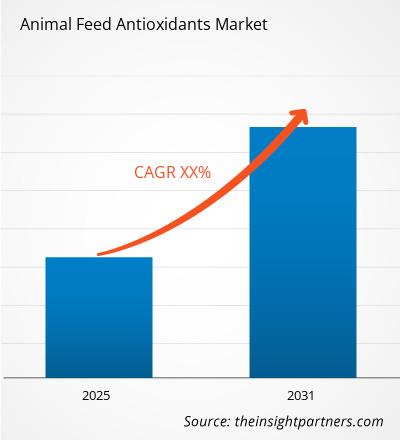
The animal feed antioxidants market was valued at US$ 393.2 million in 2025 and is projected to reach US$ 557.09 million by 2034, growing at a CAGR of 3.95% during 2026–2034. Demand is supported by the need to protect fats, oils, vitamins, and pigment systems in compound feed from oxidation while maintaining feed efficiency across swine, poultry, cattle, and aquaculture production systems.
North America remains a quality-driven market where feed mills emphasize ingredient stability, traceability, and performance consistency. The animal feed antioxidants market size in the region is expected to benefit from poultry integration, dairy productivity programs, pet food crossover technologies, and tighter feed safety expectations. Regional growth is likely to remain moderate, supported by demand for both cost-effective synthetic additives and cleaner-label natural antioxidant blends.
Animal Feed Antioxidants Market Assessment and Insights
- North America accounted for an estimated 22–25% share in 2025 and is projected to grow at a CAGR of 3.6–4.1% during 2026–2034, supported by integrated poultry operations, dairy feed fortification, and stronger quality-control protocols.
- US represented nearly 76–80% of North America demand in 2025 and is expected to grow at a CAGR of 3.7–4.2% through 2034.
- Europe held an estimated 24–27% share in 2025 and is forecast to grow at a CAGR of 3.4–3.9%, led by Germany, France, Spain, the UK, and Italy.
- Asia Pacific represented about 38–42% of 2025 revenue and is expected to grow at a CAGR of 4.2–4.8%, led by China, India, Japan, South Korea, and Australia.
- Largest Segment: Synthetic antioxidants held a 58–62% market share in 2025 and are expected to grow at a CAGR of 3.3–3.8% during 2026–2034.
- High Growth Segment: Natural antioxidants held a 38–42% share in 2025 and are projected to grow at a CAGR of 4.6–5.2% through 2034 as feed producers seek label-friendly stabilization options.
- Key companies analyzed in detail: BASF SE, Adisseo France SAS, Archer Daniels Midland Company, Cargill, Incorporated, Chr. Hansen Holding A/S, DSM-Firmenich AG, DuPont de Nemours, Inc., Evonik Industries AG, Kemin Industries, Inc., and Novus International, Inc.
Source: The Insight Partners' analysis based on proprietary research, government publications, company annual reports, investor presentations, industry databases, and expert interviews.
Feed antioxidant use has evolved from basic protection against rancidity to a targeted quality-management tool. The animal feed antioxidants market growth reflects wider use of stabilized fats, vitamin premixes, pigment systems, and oil-rich ingredients in poultry, swine, aquaculture, and dairy diets. The blending of feeds with high levels of accuracy, the use of coated feed components, and testing for risks of oxidation have become key strategies that modern-day feed mills apply in order to minimize nutrient losses when the feed is stored, transported, or pelletized.
Future demand is influenced by increases in livestock populations across regions, feed regulations, and the emphasis on uniform animal performance. The new feed systems in Asia and Latin America are increasingly including antioxidants, while the established markets are refining dosing and formulation strategies.
Animal Feed Antioxidants Market Report Scope
| Report Attribute | Details |
|---|---|
| Market size in 2025 | US$ 393.2 Million |
| Market Size by 2034 | US$ 557.09 Million |
| Global CAGR (2026 - 2034) | 3.95% |
| Historical Data | 2021-2024 |
| Forecast period | 2026-2034 |
Animal Feed Antioxidants Market Analysis
Rising feed ingredient costs are encouraging nutritionists to prevent avoidable nutrient deterioration. Oils, rendered fats, fishmeal, vitamins, and carotenoids are vulnerable to oxidation, especially in humid climates and long supply chains. This supports animal feed antioxidants market growth because additives help reduce rancidity, maintain palatability, and protect the performance value embedded in compound feed formulations.
Antioxidant suppliers, premix suppliers, feed mills, integrators, livestock farmers, and aqua feed manufacturers constitute the ecosystem. While synthetic antioxidants like BHT, BHA, ethoxyquin, and propyl gallate will continue to play an important role in large-scale applications, natural antioxidants like tocopherols, rosemary extract, ascorbic acid, carotenoids, and plant extracts are getting increased acceptance among consumers who are looking for cleaner label solutions.
Market positioning factors include formulation efficacy, regulatory approval, and application knowledge. Companies like BASF SE, DSM-Firmenich AG, Kemin Industries, Inc., Adisseo France SAS, and Novus International, Inc. focus on the technical approach towards feed preservation, while Cargill, Incorporated and Archer Daniels Midland Company associate the use of antioxidants with feed ingredients and nutrition solutions.
The animal feed antioxidants market analysis also points to rising interest in customized blends. Producers want additive systems matched to feed fat content, species, processing temperature, storage time, and regional climate. This shifts competition from commodity pricing toward technical service, stability testing, and integrated feed quality programs that support measurable shelf-life and animal productivity outcomes.
● REPORT CUSTOMIZATION
Tailor This Report To Align With Your Specific Business Requirements
This report can be customized to align precisely with your business objectives, scope, and target markets. Customization options include tailored segmentation, geography, competitive analysis, and strategic insights to support informed decision-making.
Customize This Report →WHAT YOU CAN ADJUST
- ● Segmentations
- ● Geography
- ● Competitive Analysis
- ● Language Preferences
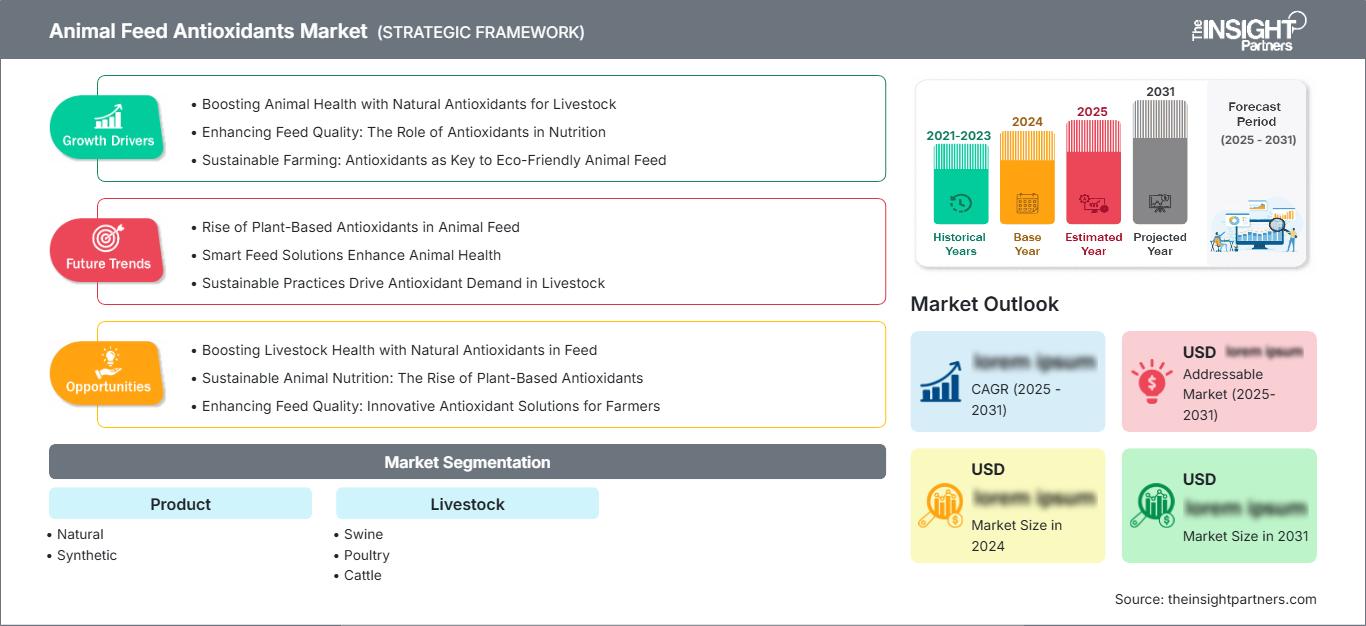
Animal Feed Antioxidants Market: Strategic Insights
Regional Insights
North America animal feed antioxidants market
North America is expected to hold 22–25% of global revenue in 2025 and grow at a CAGR of 3.6–4.1% during 2026–2034. Demand is anchored in large poultry complexes, swine feed systems, dairy productivity programs, and pet food formulation practices that emphasize ingredient preservation. The animal feed antioxidants market share in the region reflects a preference for proven synthetic stabilizers and growing use of natural blends in premium feed lines.
Usage is the most common, where the feedstock is composed of fats, oils, pigments, and vitamins, which have to stay stable through the process and storage. Integrated feed companies depend on an antioxidant program to secure their feed conversion efficiency and quality variation. The need for logistics, seasonality, and feed safety further drives the use of antioxidants.
U.S. animal feed antioxidants Market
The U.S. accounted for an estimated 76–80% of North America's demand in 2025 and is projected to grow at a CAGR of 3.7–4.2% through 2034, according to the Animal Feed Antioxidants Market Report. The poultry and swine industries fuel demand due to the strong relationship between feed efficiency, meat quality, and the management of costs in relation to ingredient stability. Antioxidants are also used by large feed mills for vitamin premixes and high-fat feeds.
Firms such as Cargill, Incorporated; Archer Daniels Midland Company; Kemin Industries, Inc.; and Novus International, Inc. have a substantial presence within the industry and actively promote additives through technical service and regional distribution capabilities. Premium pet foods and specialty feed formulations that utilize antioxidants are additional drivers of demand.
Europe animal feed antioxidants Market
Europe held an estimated 24–27% share in 2025 and is forecast to grow at a CAGR of 3.4–3.9% during 2026–2034. Germany, France, Spain, the UK, and Italy are major demand centers due to advanced feed manufacturing, high livestock productivity standards, and regulatory attention to feed additives. The region shows stronger momentum for natural antioxidant systems than many cost-sensitive markets.
Germany benefits from technical feed formulations and high-quality compound feed production. The UK and France emphasize traceability and animal welfare-linked nutrition programs. Spain and Italy support demand through poultry, swine, and specialty feed operations. Europe’s growth profile is stable rather than rapid, with innovation focused on plant-derived stabilizers, dosage optimization, and regulatory-compliant antioxidant systems.
APAC animal feed antioxidants Market
Asia Pacific represented about 38–42% of 2025 revenue and is projected to grow at a CAGR of 4.2–4.8% through 2034. China remains the leading country due to large-scale swine, poultry, and aquaculture feed production. India is expanding commercial feed penetration, while Japan, South Korea, and Australia support demand through quality-focused feed systems.
Growth is supported by rising animal protein consumption, industrial feed production, and higher use of oil-rich feed ingredients. Aquaculture feed is particularly important because fish oils and marine meals require strong oxidative protection. Regional producers balance synthetic antioxidant affordability with increasing interest in natural options for export-oriented and premium livestock products.
Middle East & Africa animal feed antioxidants Market
The Middle East and Africa are projected to grow at a CAGR of 3.9–4.5% during 2026–2034. Saudi Arabia, the UAE, South Africa, and the Rest of MEA show demand tied to poultry expansion, imported feed ingredients, and hot-climate storage challenges. Antioxidants are important when feed ingredients travel long distances before use.
Regional adoption is uneven, with modern feed mills using structured quality-control programs while smaller producers rely on basic preservation systems. In Gulf markets, poultry and dairy investments increase the need for stable compound feed. South Africa remains the most developed feed additive market in the region, supported by commercial livestock production and established distribution networks.
Segmentation Analysis
Product
Product segmentation defines the animal feed antioxidants market scope through natural and synthetic solutions. The product segment is expected to grow at a CAGR of 3.8–4.3% during 2026–2034, with adoption determined by feed cost, regulatory preference, oxidative risk, and animal species. Synthetic antioxidants dominate high-volume applications, while natural options gain traction in premium, export-oriented, and cleaner-label feed formulations.
- Natural antioxidants include tocopherols, ascorbic acid, carotenoids, rosemary extract, and botanical compounds used when producers seek label-friendly feed preservation and added nutritional positioning.
- Synthetic antioxidants such as BHT, BHA, ethoxyquin, and propyl gallate remain widely used because they provide consistent oxidative protection, cost efficiency, and suitability for large compound feed volumes.
Livestock
Livestock applications are projected to grow at a CAGR of 3.9–4.5% during 2026–2034. Poultry remains the largest use area due to high feed throughput, cost sensitivity, and rapid production cycles. Swine, cattle, and aquaculture demand is linked to protein production, feed energy density, and the need to maintain nutrient integrity in specialized diets.
- Swine feed uses antioxidants to protect fats and vitamins in starter, grower, and finisher diets, supporting feed palatability and performance consistency in intensive systems.
- Poultry is the leading livestock category because high-volume broiler and layer feed requires stable oils, pigments, vitamin premixes, and consistent feed conversion performance.
- Cattle diets incorporate antioxidants in dairy and beef feed where fat supplementation, vitamin stability, immune support, and storage reliability are important for productivity.
- Aquaculture feed needs strong oxidative protection because fish oils, marine meals, and high-energy formulations are vulnerable to rancidity during processing, shipping, and storage.
Opportunity Snapshot
Market Opportunity Snapshot
| Livestock | Revenue Contribution | Trend Tag | Adoption Stage |
| Swine | Medium | Fat Stability | Scaling |
| Poultry | High | Feed Conversion | Mature |
| Cattle | Medium | Dairy Fortification | Scaling |
| Aquaculture | Medium | Oil Protection | Scaling |
Animal Feed Antioxidants Market Growth Drivers and Impact Analysis
Rising Use of High-Fat and Vitamin-Rich Feed Formulations
Today, animal feeds contain oils, rendered fats, vitamins, pigments, amino acids, and other special additives that enhance feed efficiency. This improves their nutritional quality but also enhances their susceptibility to oxidation during storage and processing. Antioxidants help to preserve the value of such feed components by delaying their spoilage and stabilizing sensitive components. This effect becomes more evident in poultry, swine, and aquatic livestock, as the cost of feed forms a significant proportion of the cost of production.
Expansion of Industrial Livestock and Aquaculture Production
Predictability of feed quality is critical in the commercial livestock system when feeding large quantities of livestock at a time. As feed production increases, there will be an increased chain of supplies, bulk storage, and increased temperatures during the processing of the feeds. The use of antioxidants becomes imperative to avoid the spoilage of the quality. Aquaculture becomes very important because fish oils and marine meals are highly susceptible to oxidation.
Greater Attention to Feed Safety and Shelf-Life Management
Oxidation control has been recognized by feed manufacturers as an integral component of quality assurance and not just another ingredient option. Rancidity of feeds will decrease palatability, destroy nutrients like vitamins, and cause inconsistent performance of animals. Antioxidants have been used to increase the storage time of the feed and maintain its nutritional value. It can be seen in places that have hot climatic conditions, where raw materials are imported, and there are long distances from the point of manufacture to consumption.
Animal Feed Antioxidants Market Future Trends
Shift Toward Natural and Blended Antioxidant Systems
Animal feed antioxidants market trends are increasingly shaped by demand for natural tocopherols, rosemary extract, ascorbic acid, carotenoids, and botanical blends. These systems appeal to producers serving premium meat, egg, dairy, aquaculture, and pet food channels. Synthetic antioxidants will remain important for cost control, but blended products are expected to gain share because they combine performance reliability with cleaner-label positioning. Suppliers that prove stability, dosage efficiency, and regulatory compliance will be better positioned in high-value feed programs.
Precision Testing and Species-Specific Formulation
Adoption in the future will depend largely on diagnostic testing, oxidative risk assessment, and formulation according to species requirements. The feed millers will make their antioxidant choices based on the nature of ingredients used, type of fats included, duration of storage, environmental conditions, and the process involved. This will lead to a shift from generic inclusion levels to value-based procurement systems. Digital traceability and lab tests on the degree of oxidation can assist suppliers to prove their worth in aquaculture, poultry, and dairy feeds.
Animal Feed Antioxidants Market Opportunities
Premium Natural Antioxidant Platforms for Export-Oriented Feed
Growth opportunities are emerging in natural antioxidant platforms designed for premium livestock, aquaculture, and pet nutrition. Export-oriented producers often face stricter buyer expectations for additive transparency, residue control, and feed quality documentation. Botanical extracts, tocopherols, and mixed antioxidant systems can help suppliers serve these customers while maintaining shelf-life performance. The opportunity is strongest where producers want to differentiate animal-derived products by quality, sustainability, and cleaner-label feeding practices without compromising feed stability during storage.
Technical Service Models Linked to Feed Quality Assurance
The animal feed antioxidants market Forecasts point to expanding opportunities for suppliers that combine products with testing, formulation advice, and performance documentation. Feed mills need support in selecting antioxidant types, optimizing dosages, and validating protection under real processing conditions. Service-led models can create stronger customer retention than additive sales alone. Companies offering oxidative stability testing, premix compatibility guidance, and climate-specific storage recommendations can capture value from both mature markets and rapidly industrializing feed sectors.
Frequently Asked Questions

- Comprehensive Market Sizing and Forecast Analysis
- Detailed Segmentation Analysis
- In-Depth Market Dynamics Assessment
- Regional and Country-Level Insights
- Competitive Landscape and Company Benchmarking
- Strategic Business Intelligence
Recent Reports
Testimonials

The Insight Partners' SCADA System Market report is comprehensive, with valuable insights on current trends and future forecasts. The team was highly professional, responsive, and supportive throughout. We are very satisfied and highly recommend their services.
RAN KEDEM Partner, Reali Technologies LTDs
I requested a report on a very specific software market and the team produced the report in a few days. The information was very relevant and well presented. I then requested some changes and additions to the report. The team was again very responsive and I got the final report in less than a week.
JEAN-HERVE JENN Chairman, Future Analytica
We worked with The Insight Partners for an important market study and forecast. They gave us clear insights into opportunities and risks, which helped shape our plans. Their research was easy to use and based on solid data. It helped us make smart, confident decisions. We highly recommend them.
PIYUSH NAGPAL Sr. Vice President, High Beam Global
The Insight Partners delivered insightful, well-structured market research with strong domain expertise. Their team was professional and responsive throughout. The user-friendly website made accessing industry reports seamless. We highly recommend them for reliable, high-quality research services
YUKIHIKO ADACHI CEO, Deep Blue, LLC.
This is the first time I have purchased a market report from The Insight Partners.While I was unsure at first, I visited their web site and felt more comfortable to take the risk and purchase a market report.I am completely satisfied with the quality of the report and customer service. I had several questions and comments with the initial report, but after a couple of dialogs over email with their analyst I believe I have a report that I can use as input to our strategic planning process.Thank you so much for taking the extra time and making this a positive experience.I will definitely recommend your service to others and you will be my first call when we need further market data.
JOHN SUZUKI President and Chief Executive Officer, Board Director, BK Technologies
I wish to appreciate your support and the professionalism you displayed in the course of attending to my request for information regarding to infectious disease IVD market in Nigeria. I appreciate your patience, your guidance, and the fact that you were willing to offer a discount, which eventually made it possible for us to close a deal. I look forward to engaging The Insight Partners in the future, all thanks to the impression you have created in me as a result of this first encounter.
DR CHIJIOKE ONYIA MANAGING DIRECTOR, PineCrest Healthcare Ltd.Reason to Buy
- Informed Decision-Making
- Understanding Market Dynamics
- Competitive Analysis
- Identifying Emerging Markets
- Customer Insights
- Market Forecasts
- Risk Mitigation
- Boosting Operational Efficiency
- Strategic Planning
- Investment Justification
- Tracking Industry Innovations
- Aligning with Regulatory Trends





 Get Free Sample for