
Animal feed enzymes Market Growth, Demand & Size by 2034
Coverage: By Type (Phytase, Carbohydrase, Protease, Others); Livestock (Poultry, Swine, Ruminant, Aquatic animals, Others); Source (Microorganism, Plant, Animal); Form (Dry, Liquid), and Geography (North America, Europe, Asia Pacific, and South and Central America)
- Status : Data Released
- Report Code : TIPRE00016575
- Category : Food and Beverages
- No. of Pages : 150
- Available Report Formats :


- Last update date : August 25, 2026


2025 Market Size
US$ 1.28 Bn
Base year value
2034 Forecast
US$ 2.13 Bn
Projected by 2034
CAGR 2026-2034
5.79 %
Growth rate
Addressable Market
US$ 15.43 Bn
(2026-2034)
The animal feed enzymes market is projected to grow from US$ 1.28 billion in 2025 to US$ 2.13 billion by 2034, registering a CAGR of 5.79% from 2026 to 2034. Demand is being shaped by the need to improve feed conversion, reduce nutrient loss, and support healthier livestock production across poultry, swine, ruminant, and aquaculture systems.
North America remains a structurally important region as integrated feed producers, poultry processors, and swine operations adopt enzyme solutions to manage feed cost volatility and sustainability targets. The animal feed enzymes market size in the region is supported by established regulatory frameworks, advanced nutrition practices, and the adoption of phytase, carbohydrase, and protease blends in commercial diets.
Animal feed enzymes Market Assessment and Insights
- North America: The region accounted for an estimated 24–28% share in 2025 and is expected to grow at a CAGR of 5.1–5.7% during 2026–2034, supported by poultry integration and precision feeding.
- US: The US represented nearly 74–78% of North America's revenue in 2025, growing at a CAGR of 5.0–5.6% as producers prioritize feed efficiency and phosphorus reduction.
- Europe: Europe held an estimated 20–24% share in 2025 and is projected to expand at 4.8–5.4% CAGR, with Germany, France, Spain, and the UK leading adoption.
- Asia Pacific: Asia Pacific accounted for 34–38% share in 2025 and is expected to record a 6.2–7.0% CAGR, driven by China, India, Japan, and Southeast Asian poultry and aquaculture demand.
- Largest Segment: Phytase held the leading type share at 36–42% in 2025, with a CAGR of 5.3–6.0%, due to its role in phosphorus availability and feed cost control.
- High Growth Segment: Protease represented 18–23% share in 2025 and is expected to grow at 6.4–7.2% CAGR as high-protein diets and aquafeed formulations expand.
- Key companies analyzed in detail: Adisseo, Advanced Enzyme Technologies Limited, BASF SE, BioResource International, Inc., Cargill, Incorporated, DSM-Firmenich, IFF, Elanco Animal Health Incorporated, ENMEX, and Novonesis A/S.
Source: The Insight Partners' analysis based on proprietary research, government publications, company annual reports, investor presentations, industry databases, and expert interviews.
The animal feed enzyme market has shifted its focus from a single enzyme additive system to the precision nutrition strategy, whereby the choice of phytase, carbohydrase, and protease is dictated by the quality of the grains, the needs of the species, and the processing conditions of the feed.
Capital investment has turned towards thermostable enzymes, microbial fermentation capacity, and custom blends that can withstand the pelleting process. New regions are driving the use of the technology by producers of poultry and aquaculture, who are turning to plant-based raw materials as a cheaper alternative to more expensive raw materials, which necessitate better digestibility.
Animal feed enzymes Market Report Scope
| Report Attribute | Details |
|---|---|
| Market size in 2025 | US$ 1.28 Billion |
| Market Size by 2034 | US$ 2.13 Billion |
| Global CAGR (2026 - 2034) | 5.79% |
| Historical Data | 2021-2024 |
| Forecast period | 2026-2034 |
Animal feed enzymes Market Analysis
The animal feed enzymes market growth is tied closely to feed cost optimization, since feed commonly represents the largest expense in livestock production. Phytase lowers the need for inorganic phosphates, carbohydrases release energy from grain and fiber sources, and proteases enhance the digestion of proteins. These effects are significant since feed integrators face the challenges of fluctuating corn and soybean meal prices, as well as alternative ingredients.
Another factor that affects the dynamics of supply is related to the investment of enzyme manufacturers in new strains of microbes, fermentation process and equipment, and post-pelleting applications of enzymes. More and more feed mills require enzymes that resist temperature changes, humidity, and storage conditions.
The animal feed enzymes market analysis shows a moderately consolidated competitive landscape led by companies with biotechnology, feed formulation, and distribution capabilities. Novonesis A/S, DSM-Firmenich, BASF SE, Adisseo, Cargill, Incorporated, IFF, Elanco Animal Health Incorporated, and specialist firms compete through species-specific products, technical service, and evidence-backed performance claims.
Strategic positioning is shifting from product sales to nutrition platforms, a trend highlighted in the Animal Feed Enzymes Market Report. Suppliers are combining enzymes with organic acids, probiotics, amino acids, and digital formulation tools to deliver broader nutritional solutions. This approach helps customers quantify savings from lower nutrient over-formulation, reduced mineral supplementation, and improved feed conversion ratios across poultry, swine, and aquaculture operations.
● REPORT CUSTOMIZATION
Tailor This Report To Align With Your Specific Business Requirements
This report can be customized to align precisely with your business objectives, scope, and target markets. Customization options include tailored segmentation, geography, competitive analysis, and strategic insights to support informed decision-making.
Customize This Report →WHAT YOU CAN ADJUST
- ● Segmentations
- ● Geography
- ● Competitive Analysis
- ● Language Preferences
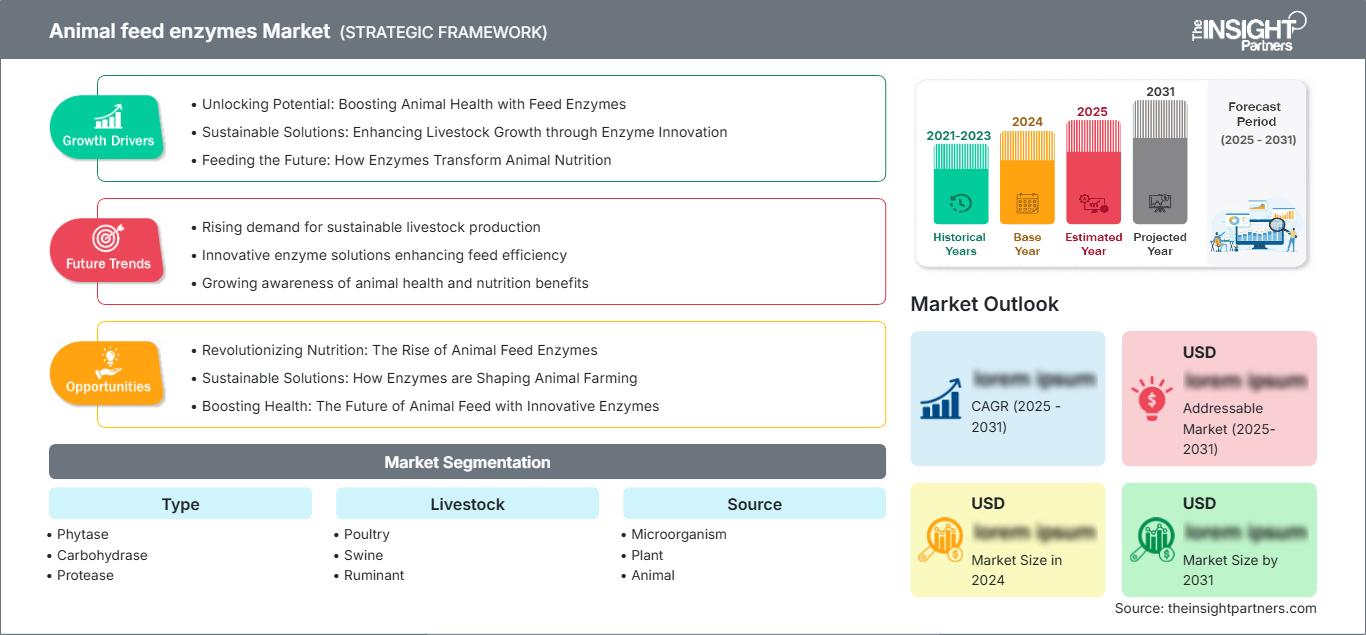
Animal feed enzymes Market: Strategic Insights
Regional Insights
North America animal feed enzymes market
North America is expected to hold a 24–28% animal feed enzymes market share in 2025, with a CAGR of 5.1–5.7% through 2034. The area enjoys the presence of big poultry and pork integrators, state-of-the-art feed milling facilities, and extensive nutrition consulting networks. Enzyme utilization is now increasingly linked to sustainability reporting, manure nutrient management, and cost savings in corn-soybean diets.
Another source of increased demand is the increasing use of multi-enzyme blends in poultry and swine feeds. Phytase enzymes are used to minimize phosphorus release, while carbohydrate enzymes are utilized for enhanced energy recovery from different grains. Development of aqua feeds creates another small but growing demand base, especially as plant proteins replace fish meal in some products.
U.S. animal feed enzymes market
The US accounted for roughly 74–78% of North America's revenue in 2025 and is projected to grow at a 5.0–5.6% CAGR during 2026–2034. Adoption is strongest in vertically integrated poultry and swine systems where feed conversion, nutrient density, and production consistency directly influence margins.
Company presence is extensive, with major enzyme and feed additive suppliers operating technical, distribution, and formulation support networks. Poultry applications lead demand because enzymes improve phosphorus release and fiber digestion in high-volume broiler diets. Swine producers also use enzyme blends to manage soybean meal variability, gut function, and nitrogen utilization.
Europe animal feed enzymes market
Europe represented an estimated 20–24% share in 2025 and is expected to advance at a 4.8–5.4% CAGR. The area has been influenced by environmental legislation, lower usage of antibiotics, and high-quality feed standards. Enzyme utilization in Germany and France has been driven by their large feed industries, whereas Spain and Italy have enjoyed favorable conditions due to their swine and poultry industries.
The market in the UK is fueled by poultry integration and formulation through sustainability. Nutrient efficiency and phosphorus are the two factors that drive Germany, while poultry, swine, and ruminant nutrition are factors in France. The Netherlands, along with Spain and Italy, utilizes a combination of phytase and carbohydrase enzymes.
APAC animal feed enzymes market
APAC held an estimated 34–38% share in 2025 and is projected to grow at a 6.2–7.0% CAGR. China continues to be the biggest regional demand market due to its industrial feed production and pig herd modernization. India and Southeast Asia increase enzyme usage in poultry production and compound feeds.
Quality, traceability, and formulation are key factors for Japan and South Korea, whereas Australia focuses on ruminants and poultry applications. Aquaculture is a vital aspect for the region since plant aquafeed uses enzymes to boost protein digestion. The government’s interest in efficient livestock production leads to more adoption in big and medium-sized feed mills.
Middle East & Africa animal feed enzymes market
The Middle East & Africa region is expected to register a 5.5–6.2% CAGR during 2026–2034. Saudi Arabia and the UAE are adopting feed additives in poultry and dairy systems to improve productivity under high-cost import conditions. South Africa remains a key market due to its feed manufacturing base.
Growth is linked to food security programs, expansion of poultry production, and demand for more efficient feed conversion in variable climatic conditions. The region has lower penetration than North America, Europe, and APAC, but imported raw material dependence increases the value of enzymes that improve nutrient release and reduce formulation waste.
Segmentation Analysis
Type
Type segmentation defines the animal feed enzymes market scope because each enzyme class addresses a specific nutritional constraint. The type segment is projected to grow at a CAGR of 5.5–6.2% during 2026–2034 as producers use enzyme combinations to improve energy, protein, and mineral availability across species.
- Phytase leads adoption by releasing phosphorus from phytate in plant-based ingredients, helping reduce inorganic phosphate use, lower feed costs, and support environmental compliance in poultry and swine production.
- Carbohydrases support energy utilization by breaking down non-starch polysaccharides in grains and by-products, making it valuable where wheat, barley, corn, and alternative ingredients vary in digestibility.
- Protease improves protein utilization and amino acid availability, gaining importance in high-protein poultry, swine, and aquaculture diets where soybean meal variability and fishmeal replacement create formulation challenges.
Livestock
Livestock demand is expected to grow at a CAGR of 5.7–6.4% through 2034, reflecting higher use across monogastric and aquaculture diets. Poultry remains the largest livestock application because small feed conversion gains can materially affect production economics in broilers and layers.
- Poultry is the largest user category, supported by high compound feed output, broad phytase penetration, and rising use of carbohydrase and protease blends in broiler and layer diets.
- Swine adoption is driven by soybean meal optimization, phosphorus management, and the need to maintain growth performance while reducing nutrient excretion in intensive production systems.
- Ruminant demand is comparatively selective, with enzymes used to improve fiber degradation, support milk yield, and improve feed efficiency in dairy and beef nutrition programs.
- Aquatic animals represent a high-potential application as aquafeed producers use enzymes to improve plant protein digestibility and reduce dependence on fishmeal and fish oil inputs.
Source
Source segmentation is projected to expand at a CAGR of 5.4–6.1% as microbial fermentation becomes the preferred production route. Microorganism-derived enzymes dominate because they offer scalable output, consistent activity, and engineering flexibility for thermostability and species-specific performance.
- Microorganism sources dominate commercial production due to fermentation scalability, consistent enzyme activity, and the ability to optimize strains for phytase, xylanase, amylase, and protease applications.
- Plant sources remain niche but strategically relevant where natural positioning, label preferences, or specific enzyme profiles can support differentiated feed additive formulations.
- Animal sources have limited use because of cost, scalability, and consistency challenges that favor microbial alternatives, although selected applications may persist in specialized feed formulations.
Form
Form segmentation is expected to grow at a CAGR of 5.6–6.3%. Dry products remain widely used because they integrate easily into premixes and tolerate storage, while liquid enzymes are gaining value in post-pelleting systems where heat exposure would otherwise reduce activity.
- Dry forms are preferred in premix and compound feed manufacturing because they offer handling convenience, broad compatibility, and better storage stability in conventional distribution channels.
- Liquid forms are used in post-pelleting application systems, enabling feed mills to protect enzyme activity from heat and customize dosing for specific production batches.
Opportunity Snapshot
| Livestock | Revenue Contribution | Trend Tag | Adoption Stage |
| Poultry | High | Feed Conversion | Mature |
| Swine | Medium | Nutrient Control | Scaling |
| Ruminant | Medium | Fiber Efficiency | Scaling |
| Aquatic animals | Medium | Aquafeed Shift | Emerging |
Animal feed enzymes Market Growth Drivers and Impact Analysis
Rising Feed Cost Pressure Across Intensive Livestock Systems
The cost of feed accounts for the biggest portion of the production costs for poultry, swine, and aquaculture. Enzymes would therefore be a viable means of dealing with such challenges. The phytase, carbohydrase, and protease enzymes enable producers to get more usable nutrients from cereals, oilseed meal, and other feedstuffs. This enables diet formulation with reduced inorganic phosphates, better use of amino acids, and enhanced metabolizable energy. These benefits are experienced greatly in integrated companies, whereby any minor gains in feed conversion are multiplied over millions of animals and huge amounts of feed.
Sustainability and Nutrient Excretion Reduction Requirements
Environmental pressures have led to the adoption of enzymes because livestock farms have to minimize phosphorus and nitrogen runoff while sustaining their production levels. The use of phytase increases phosphorus utilization, reducing undigested phosphorus in the manure, while protease helps in protein utilization and can help in minimizing nitrogen loss. This is especially critical in areas with nutrient management regulations and environmental quality issues. The pressure has an effect on purchases because the value of enzymes is now being assessed not just in terms of costs but also in relation to the environment.
Growth of Plant-Based Feed Ingredients and Aquaculture Diet Reformulation
Increased use of plant-based raw materials results in a need for enzymes to increase the digestibility of food and mitigate any anti-nutrition factors. In the case of aquaculture, feed formulators replace a certain percentage of fishmeal with soybean meal, canola meal, among others, in the feed, where proteases and carbohydrases are required. Poultry and swine diets are fed depending on the prices and availability of the grains. Enzymes play an important role in handling the variability of the raw materials without impacting the growth performances and digestion.
Animal feed enzymes Market Future Trends
Expansion of Precision Enzyme Blends
Animal feed enzymes market trends indicate a shift from single active ingredients toward customized blends designed for species, feed composition, processing method, and regional raw material patterns. The suppliers are using fermentation optimization, enzyme engineering, and feed analysis in an effort to align their products to particular nutritional objectives. The blending of phytase, xylanase, amylase, beta-glucanase, and protease is likely to become more common in feed milling industries where there is a desire to measure the release of nutrients instead of simply adding additives to the feed.
Thermostable and Post-Pelleting Delivery Systems
Future product development will focus on enzyme stability during pelleting, storage, and transport. High pelleting temperatures can reduce enzyme recovery, particularly in regions where feed sanitation and processing intensity are increasing. Thermostable coatings, improved microbial strains, and liquid post-pelleting systems are likely to expand as producers demand predictable activity at the point of feeding. This trend supports premium products because reliability becomes more valuable when feed mills operate at high throughput volumes and cannot risk nutrient release variability across batches.
Animal feed enzymes Market Opportunities
Aquaculture Feed Reformulation in Asia Pacific
Animal feed enzymes market Forecasts point to a significant opportunity in aquaculture, especially across the Asia Pacific, where shrimp, tilapia, carp, and marine fish production rely increasingly on formulated feeds. As fishmeal costs and sustainability concerns push producers toward plant proteins, enzymes can improve protein digestibility and reduce waste output in water systems. Suppliers that develop aquaculture-specific protease and carbohydrase blends can capture value by helping feed mills maintain growth rates, feed conversion, and water quality while using more flexible ingredient baskets.
Integrated Sustainability Programs for Poultry and Swine Producers
Large poultry and swine producers are building sustainability programs that quantify emissions, nutrient loss, and resource efficiency. Enzyme suppliers can position products within these programs by documenting phosphorus reduction, lower nitrogen excretion, and improved feed conversion. The opportunity is strongest where integrators control feed formulation, production data, and procurement decisions. Vendors that combine enzymes with technical services, lifecycle metrics, and formulation software can move beyond commodity pricing and become strategic partners in cost reduction and environmental performance.
Frequently Asked Questions

- Comprehensive Market Sizing and Forecast Analysis
- Detailed Segmentation Analysis
- In-Depth Market Dynamics Assessment
- Regional and Country-Level Insights
- Competitive Landscape and Company Benchmarking
- Strategic Business Intelligence
Recent Reports
Testimonials

The Insight Partners provided valuable market intelligence that supported our global go-to-market strategy. Their team was professional, responsive, and attentive to our feedback, providing thoughtful analysis and helpful methodological clarifications throughout the project.
Junmo Kim Chief Financial Officer (CFO), Enertech Co., Ltd.
The Insight Partners' SCADA System Market report is comprehensive, with valuable insights on current trends and future forecasts. The team was highly professional, responsive, and supportive throughout. We are very satisfied and highly recommend their services.
RAN KEDEM Partner, Reali Technologies LTDs
I requested a report on a very specific software market and the team produced the report in a few days. The information was very relevant and well presented. I then requested some changes and additions to the report. The team was again very responsive and I got the final report in less than a week.
JEAN-HERVE JENN Chairman, Future Analytica
We worked with The Insight Partners for an important market study and forecast. They gave us clear insights into opportunities and risks, which helped shape our plans. Their research was easy to use and based on solid data. It helped us make smart, confident decisions. We highly recommend them.
PIYUSH NAGPAL Sr. Vice President, High Beam Global
The Insight Partners delivered insightful, well-structured market research with strong domain expertise. Their team was professional and responsive throughout. The user-friendly website made accessing industry reports seamless. We highly recommend them for reliable, high-quality research services
YUKIHIKO ADACHI CEO, Deep Blue, LLC.
This is the first time I have purchased a market report from The Insight Partners.While I was unsure at first, I visited their web site and felt more comfortable to take the risk and purchase a market report.I am completely satisfied with the quality of the report and customer service. I had several questions and comments with the initial report, but after a couple of dialogs over email with their analyst I believe I have a report that I can use as input to our strategic planning process.Thank you so much for taking the extra time and making this a positive experience.I will definitely recommend your service to others and you will be my first call when we need further market data.
JOHN SUZUKI President and Chief Executive Officer, Board Director, BK Technologies
I wish to appreciate your support and the professionalism you displayed in the course of attending to my request for information regarding to infectious disease IVD market in Nigeria. I appreciate your patience, your guidance, and the fact that you were willing to offer a discount, which eventually made it possible for us to close a deal. I look forward to engaging The Insight Partners in the future, all thanks to the impression you have created in me as a result of this first encounter.
DR CHIJIOKE ONYIA MANAGING DIRECTOR, PineCrest Healthcare Ltd.Reason to Buy
- Informed Decision-Making
- Understanding Market Dynamics
- Competitive Analysis
- Identifying Emerging Markets
- Customer Insights
- Market Forecasts
- Risk Mitigation
- Boosting Operational Efficiency
- Strategic Planning
- Investment Justification
- Tracking Industry Innovations
- Aligning with Regulatory Trends





 Get Free Sample for