
Animal Identification Tags Market Growth, Size & Forecast by 2034
Coverage: By Type (Radiofrequency Identification Devices (RID), Near Field Communication (NFC), 2-Dimensional Codes) ; Product (Tags, Reader) , and Geography (North America, Europe, Asia Pacific, and South and Central America)
- Status : Data Released
- Report Code : TIPRE00008609
- Category : Life Sciences
- No. of Pages : 150
- Available Report Formats :


- Last update date : August 05, 2026


2025 Market Size
US$ 1.72 Bn
Base year value
2034 Forecast
US$ 3.54 Bn
Projected by 2034
CAGR 2026-2034
8.37 %
Growth rate
Addressable Market
US$ 23.64 Bn
(2026-2034)
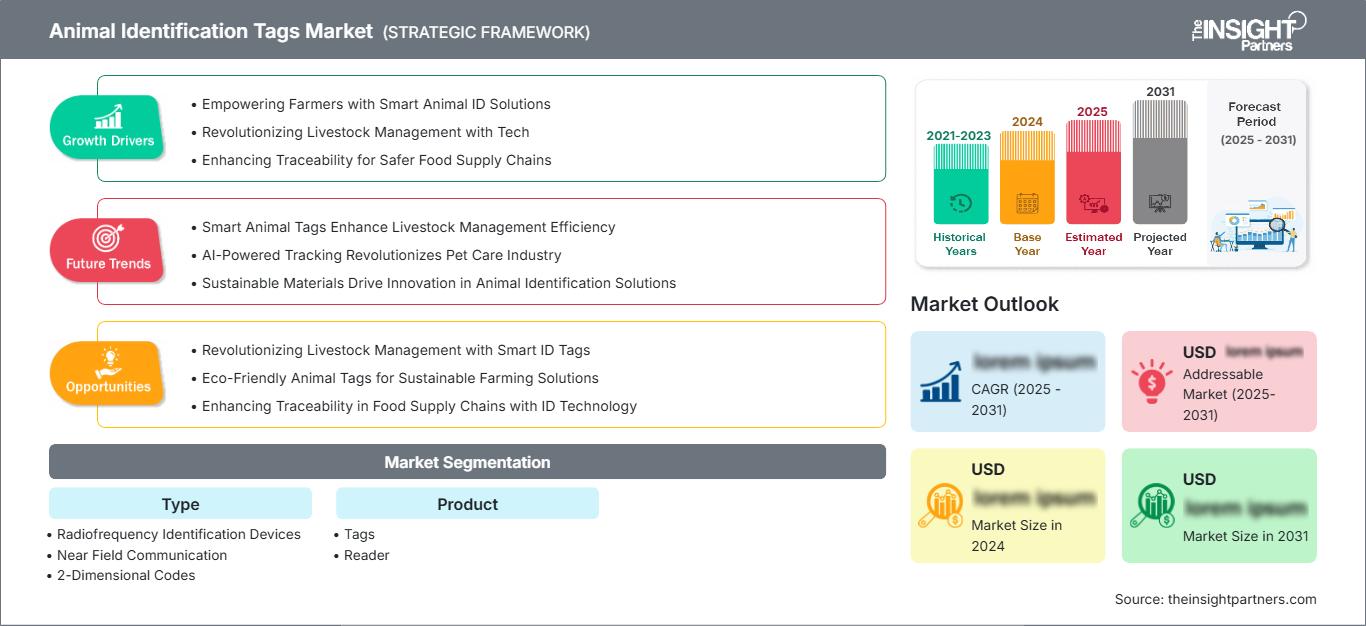
The animal identification tags market size is projected to grow from US$ 1.72 Billion in 2025 to US$ 3.54 Billion by 2034; it is expected to register a CAGR of 8.37% during 2026–2034. Adoption is being supported by livestock traceability mandates, digitized farm records, food safety controls, pet recovery systems, and increased use of RFID-enabled animal health monitoring across commercial, companion, and research animal settings.
North America is expected to maintain its status as one of the valuable markets for the animal identification tags market with CAGR of 7.8-8.4% during the forecast period of 2026-2034. The reason behind growth will be the presence of electronic animal identification regulations for cattle movement, robust veterinary service industry, and large scale dairies and beef herds integrating readers with farm management systems and animal performance databases.
Animal Identification Tags Market Assessment and Insights
- North America held 34–36% share in 2025 and is projected to grow at a CAGR between 2026–2034 of 7.8–8.4%, supported by cattle traceability rules, organized dairy farms, and reader adoption across auction markets.
- US accounted for 78–82% of North America in 2025 and is projected to grow at a CAGR between 2026–2034 of 7.9–8.5%, driven by official electronic ear tag adoption and swine traceability funding.
- Europe represented 25–27% share in 2025 and is projected to grow at a CAGR between 2026–2034 of 7.2–7.8%, with Germany, France, the UK, Italy, and Spain leading traceability-linked adoption.
- Asia Pacific captured 24–26% share in 2025 and is projected to grow at a CAGR between 2026–2034 of 9.1–9.8%, led by China, India, Australia, Japan, and South Korea.
- Largest Segment Tags held 68–72% market share in 2025 and is projected to grow at a CAGR between 2026–2034 of 8.1–8.7%, reflecting recurring replacement and livestock volume demand.
- High Growth Segment Reader held 28–32% market share in 2025 and is projected to grow at a CAGR between 2026–2034 of 8.8–9.5%, supported by digital herd platforms and automation.
- Key companies analyzed in detail: ams-OSRAM AG, Microchip Technology Incorporated, Impinj, Inc., Alien Technology, LLC, Confidex Ltd., HID Global Corporation, Invengo Technology Pte. Ltd., Omni-ID Ltd., NXP Semiconductors N.V., RF Code, Inc.
Source: The Insight Partners' analysis based on proprietary research, government publications, company annual reports, investor presentations, industry databases, and expert interviews.
Adoption of technology has advanced from visual enumeration and bar code identification to use of RFID, NFC, and 2D code systems that integrate animals with health, ownership, movement, and production records. Production trends have seen tag manufacturers struggle with balancing chip supplies, durability of polymer used, tampering and low cost scalability. In the market for animal identification tags, RFID ear tags and transponders are now forming the major backbone for tracking livestock, while codes on printouts serve cheap solutions.
Future demand will be driven by development of new livestock economies, disease surveillance projects and cross border food safety regulations. Asia Pacific and some regions of Middle East will see more purchases as national herd improvement programs take off. The tailwind will be greatest where movement of animals, certifications for exports and vaccinations histories need electronic verification. This creates an opportunity for bundled tag reader software products instead of just hardware sales.
Animal Identification Tags Market Report Scope
| Report Attribute | Details |
|---|---|
| Market size in 2025 | US$ 1.72 Billion |
| Market Size by 2034 | US$ 3.54 Billion |
| Global CAGR (2026 - 2034) | 8.37% |
| Historical Data | 2021-2024 |
| Forecast period | 2026-2034 |
Animal Identification Tags Market Analysis
The basis of demand lies in the need for every animal to be assigned an identifiable identity record. The growth in the animal identification tag market has been further strengthened by disease traceability, premium meat certification, pet identification services, and dairy efficiency monitoring. Farmers are making use of animal identification tags in order to minimize the errors of manual recording, whereas veterinarians and regulators depend upon unique identification in order to validate data on movement, treatments, and ownership.
The value chain includes chip manufacturers, tag manufacturers, polymer molders, readers, software developers, distribution agencies, veterinarians, and farmer cooperatives. The supply is becoming favorable owing to standardization of low frequency and ultra-high frequency components by chip manufacturers as well as optimization of the retention ability, readability, and weather-resistance of the tags.
Competition in the animal identification tags market report is measured on the basis of component performance, inter-readability by the reader, product longevity, and channel connectivity rather than on the basis of price alone. The analysis of the market for animal identification tags reveals that Microchip Technology Incorporated and NXP Semiconductors N.V. offer chip capabilities, whereas HID Global Corporation, Confidex Ltd., Alien Technology, LLC, and Invengo Technology Pte. Ltd. offer tag-reader capabilities.
Investments are moving towards readers with higher field connectivity, anti-collision capability, and compatibility with livestock platforms. Impinj, Inc. improves its capabilities in UHF RAIN RFID in order to enhance high volume identification, whereas ams-OSRAM AG enhances sensing technologies which are applicable in monitoring systems. RF Code, Inc. and Omni-ID Ltd. will be important players wherever asset visibility, ruggedized tags, and identification come in contact with animal applications.
● REPORT CUSTOMIZATION
Tailor This Report To Align With Your Specific Business Requirements
This report can be customized to align precisely with your business objectives, scope, and target markets. Customization options include tailored segmentation, geography, competitive analysis, and strategic insights to support informed decision-making.
Customize This Report →WHAT YOU CAN ADJUST
- ● Segmentations
- ● Geography
- ● Competitive Analysis
- ● Language Preferences
Animal Identification Tags Market: Strategic Insights
Regional Insights
North America animal identification tags market
North America held a 34–36% share in 2025 and is anticipated to witness a 7.8–8.4% CAGR over 2026–2034. North America holds its position due to the presence of electronic animal identification schemes, extensive reach of veterinary services, and advanced dairy/beef chains. The animal identification tags market share is dominated by the US since cattle movements, auction scanning, and companion animal microchipping are well-organized.
The support for the adoption of the technology in Canada comes from animal health traceability schemes and export livestock farming. In addition, Mexico is expanding the use of digital identification technologies in commercial beef production. The demand for the technology is growing in sale barns, veterinary clinics, and large farms because of the transition from manual record keeping to scanning.
U.S. animal identification tags Market
The United States accounted for 78–82% of North America in 2025 and is expected to post 7.9–8.5% CAGR during 2026-2034. Usage is boosted by the requirement of electronic identification of covered cattle and bison when moving between states and the government incentives for RFID tags in swine. Dairy farms with large herds and beef cattle feedlots utilize identification for linking movement, breeding, vaccination, and performance records.
There is a wide range of companies that include Microchip Technology Incorporated, HID Global Corporation, Impinj, Inc., Alien Technology, LLC, and RF Code, Inc. providing chip, tag, reader, and tracking functionalities. The demand for applications is growing from tagging compliance purposes to operational analytics. Veterinarians, shelters, livestock markets, and meat processing facilities are using readers to avoid documentation errors.
Europe animal identification tags Market
Share of Europe stood at 25–27% in 2025 and expected to experience 7.2–7.8% CAGR during 2026–2034 period. Germany will continue to be the market leader owing to high density of dairy farming, strong measures of animal health control and digitalization of agriculture. UK puts an emphasis on cattle movement tracking and sheep identification hence the procurement of the solution should include reader compatibility and database integration.
The demand will be dominated by Germany and France as herd traceability is strongly linked with food safety, veterinary surveillance, and export certificates. Germany has well-developed animal health system which provides better reader penetration rate, France has integrated livestock registries and strong meat and dairy products certification systems. Both markets need compliant, durable, and interoperable tag format.
Italy, Spain, and Northern Europe will drive the demand via cattle, sheep, goat, and companion animals applications. Italy and Spain use animal identification in order to implement origin labeling and cattle movement control system, whereas the Nordic markets value animal welfare and traceability transparency. Vendor opportunities will focus on NFC data access, tamper proof tags and readers integration with government/corporative databases.
APAC animal identification tags Market
The Asia Pacific region made up 24-26% share in 2025 and will grow at 9.1-9.8% CAGR from 2026 to 2034. The reason behind China being the leading country in this region is that there is a need for scalable identification systems because of modernization of livestock, food safety, and animal disease monitoring.
Japan and South Korea, on the other hand, have their interests in food provenance and authentication of livestock. India and Australia form two other growth drivers. While India is increasing its efforts in terms of organized dairy and animal health programs, Australia’s export-oriented beef and sheep industry relies on traceability credibility.
Middle East & Africa animal identification tags Market
Middle East & Africa is estimated to achieve a CAGR of 8.0-8.7% during 2026-2034, led by Saudi Arabia. Application demand will be influenced by food security initiatives, imports of live animals, camel and small ruminant identification, and veterinary border inspections. Programs in the UAE will include high-end animal identification while in South Africa there will be traceability initiatives for commercial cattle and wildlife.
Infrastructural spending is slowly helping in creating connectivity between databases, mobile veterinary reports, and the deployment of readers. Adoption by Rest of MEA is somewhat mixed due to cost issues in adopting affordable smallholders and low levels of digital infrastructure. The disease-animal identification tags market is set to experience growth from US$ 1.72 Billion in 2025 to US$ 3.54 Billion in 2034, achieving a CAGR of 8.37% during 2026-2034. Market growth will be influenced by the adoption of electronic identification technology in livestock, companion animals, and regulated movement systems.
Segmentation Analysis
Type
The Type segment is expected to grow at a CAGR range of 8.2–8.8% during 2026–2034. The animal identification tags market scope across type categories is shaped by compliance intensity, reading distance, cost per animal, and data capture requirements. RFID remains the core technology for regulated livestock movement, while NFC and 2-dimensional codes support mobile interaction, low-cost verification, and consumer-facing traceability use cases.
- Radiofrequency Identification Devices dominate adoption because they enable automated reading, unique electronic numbers, and integration with official databases, making them strategically important for cattle, dairy, swine, equine, and high-value pet identification.
- Near Field Communication is gaining relevance where smartphone-readable tags can improve veterinary access, pet owner engagement, and small-farm recordkeeping, particularly in companion animals and premium livestock identification programs.
- 2-Dimensional Codes remain important for cost-sensitive tagging, visual verification, and supply-chain documentation, especially where producers need printed identity backup alongside electronic or database-linked animal records.
Product
The Product segment is expected to grow at a CAGR range of 8.0–8.6% during 2026–2034. Tags account for recurring volume because animal populations require initial tagging, replacement, and movement-linked identification. Readers represent a smaller but strategically important investment layer, as adoption scales only when farms, veterinary inspectors, markets, and processors can capture tag data reliably in real operating environments.
- Tags remain the principal revenue contributor because each animal requires a durable identity device, with demand influenced by retention rates, chip quality, tamper resistance, animal species, and national numbering systems.
- Reader demand rises as electronic identification matures, with handheld, fixed, and chute-mounted devices supporting batch scanning, veterinary inspections, auction workflows, slaughterhouse intake, and automated herd management.
Opportunity Snapshot
| Product | Revenue Contribution | Trend Tag | Adoption Stage |
|---|---|---|---|
| Radiofrequency Identification Devices | High | Traceability Mandates | Mature |
| Near Field Communication | Medium | Mobile Verification | Scaling |
| 2-Dimensional Codes | Medium | Low-Cost ID | Mature |
| Tags | High | Recurring Devices | Mature |
| Reader | Medium | Field Scanning | Scaling |
Animal Identification Tags Market Growth Drivers and Impact Analysis
Mandatory Electronic Traceability for Regulated Livestock Movement
Electronic traceability rules are a central driver because they convert animal identification from a voluntary farm management tool into a compliance requirement. In the U.S., covered cattle and bison moving interstate must use official eartags that are both visually and electronically readable when applied from November 2024, creating direct demand for RFID tags and compatible readers. Similar policy logic is visible in Europe, Australia, and export-focused livestock systems where traceability supports disease containment and trade access. The market impact is practical: farms, auctions, veterinarians, and processors must invest in standardized identification infrastructure. This raises recurring tag volume and accelerates reader installation across points where animal movement data must be captured accurately.
Rising Biosecurity Pressure Across Animal Protein Supply Chains
Disease preparedness is increasing the strategic value of reliable identity systems. Outbreaks can disrupt meat, dairy, and live animal trade, while investigation speed depends on knowing where animals originated, moved, and interacted. Electronic tags reduce manual errors during traceback and allow faster linkage between animal records, premises data, veterinary certificates, and laboratory results. The benefit is not limited to emergency response; routine health programs, vaccination tracking, breeding records, and residue control also improve when identity data is consistent. As animal protein supply chains become more integrated, producers and authorities are prioritizing tags that support verifiable records across farms, transporters, markets, and processing facilities.
Digital Farm Management and Productivity-Based Tag Adoption
Producers increasingly view identification tags as data gateways rather than simple numbering devices. RFID and NFC-enabled systems can support feed monitoring, milk yield association, breeding performance, veterinary treatment records, and culling decisions when linked with farm software. This creates operational value beyond regulatory compliance, especially in dairy, high-value cattle, equine management, and organized swine production. Reader-enabled workflows reduce labor during weighing, vaccination, sorting, and movement documentation, while more accurate records support herd profitability analysis. Vendors that combine durable tags with readers, software integrations, and technical support can capture higher customer loyalty as farms move toward precision livestock management.
Animal Identification Tags Market Future Trends
Sensor-Enabled Identity Tags
The next phase of animal identification tags market trends will involve identity devices that also capture condition-related data. Temperature-sensing microchips, activity-linked collars, and tag-reader systems connected to farm analytics will allow producers to detect health events earlier and reduce manual observation gaps. Adoption will be strongest in companion animals, equine applications, dairy operations, and high-value breeding herds where welfare monitoring justifies premium hardware. Over time, buyers will compare tags on sensing reliability, battery requirements, data ownership, and software compatibility, not only price. This trend will gradually shift competition from basic identification hardware toward connected animal intelligence systems.
Interoperable Databases and Cross-Border Traceability
Interoperability will become a defining trend as livestock trade, veterinary inspection, and disease response increasingly require data exchange across jurisdictions. Tags and readers will need to support standardized numbering, conformance testing, and database compatibility to avoid fragmented systems. Governments and industry bodies are likely to prioritize platforms that can connect farm records, movement permits, slaughterhouse intake, and export documentation. This will favor suppliers that provide transparent technical specifications and work with national registries. Cross-border traceability will be especially relevant for cattle, sheep, goats, and animals moving through regional trade corridors.
Animal Identification Tags Market Opportunities
Digitizing Smallholder and Cooperative Livestock Systems
Smallholder livestock systems represent a substantial opportunity because many animals remain outside formal digital traceability. Cooperative-led tagging programs can improve access to veterinary services, insurance, breeding support, productivity benchmarking, and market premiums. The strongest near-term potential is in India, Southeast Asia, parts of Africa, and Latin America, where dairy and small ruminant networks are formalizing. animal identification tags market Forecasts indicate that vendors can expand faster by offering low-cost tags, rugged readers, multilingual mobile tools, and training models suited to field agents. Financing partnerships with cooperatives, governments, and animal health organizations can reduce upfront adoption barriers.
Reader Infrastructure at Livestock Transaction Points
Reader deployment at auctions, collection centers, veterinary checkpoints, and processing plants is a high-impact opportunity because it determines whether electronic tags generate usable data. Many producers will tag animals for compliance, but market value rises when scanning becomes routine during movement and sale. Suppliers can target transaction points with fixed readers, handheld devices, middleware, and support services that reduce bottlenecks. This approach creates pull-through demand for compatible tags and improves system-level traceability. Investment priorities should emphasize read accuracy in noisy environments, simple user interfaces, offline data capture, and integration with government or private livestock databases.
Recent Developments
- November 2025: Impinj, Inc. expanded Gen2X with new RAIN RFID capabilities designed to improve read-zone focus, reduce stray tag reads, and support endpoint IC verification. Although launched for broader enterprise RFID use, these performance improvements are relevant to livestock and animal asset environments where reliable scanning, authentication, and dense tag populations affect operational accuracy.
- October 2025: AKC Reunite launched a temperature-sensing ISO 134.2 kHz pet microchip for nationwide availability in the U.S. The device identifies pets through a unique microchip number and can read temperature when scanned with compatible equipment, supporting less invasive wellness checks in veterinary clinics, shelters, breeder facilities, and animal recovery workflows.
- August 2025: Merck Animal Health was awarded a USDA APHIS contract to supply no-cost RFID eartags for sow and exhibition swine producers over five years. The program supports direct-from-manufacturer distribution and strengthens U.S. swine disease traceability, creating a broader electronic identification pathway beyond cattle and bison programs.
Frequently Asked Questions

- Comprehensive Market Sizing and Forecast Analysis
- Detailed Segmentation Analysis
- In-Depth Market Dynamics Assessment
- Regional and Country-Level Insights
- Competitive Landscape and Company Benchmarking
- Strategic Business Intelligence
Recent Reports
Testimonials

The Insight Partners provided valuable market intelligence that supported our global go-to-market strategy. Their team was professional, responsive, and attentive to our feedback, providing thoughtful analysis and helpful methodological clarifications throughout the project.
Junmo Kim Chief Financial Officer (CFO), Enertech Co., Ltd.
The Insight Partners' SCADA System Market report is comprehensive, with valuable insights on current trends and future forecasts. The team was highly professional, responsive, and supportive throughout. We are very satisfied and highly recommend their services.
RAN KEDEM Partner, Reali Technologies LTDs
I requested a report on a very specific software market and the team produced the report in a few days. The information was very relevant and well presented. I then requested some changes and additions to the report. The team was again very responsive and I got the final report in less than a week.
JEAN-HERVE JENN Chairman, Future Analytica
We worked with The Insight Partners for an important market study and forecast. They gave us clear insights into opportunities and risks, which helped shape our plans. Their research was easy to use and based on solid data. It helped us make smart, confident decisions. We highly recommend them.
PIYUSH NAGPAL Sr. Vice President, High Beam Global
The Insight Partners delivered insightful, well-structured market research with strong domain expertise. Their team was professional and responsive throughout. The user-friendly website made accessing industry reports seamless. We highly recommend them for reliable, high-quality research services
YUKIHIKO ADACHI CEO, Deep Blue, LLC.
This is the first time I have purchased a market report from The Insight Partners.While I was unsure at first, I visited their web site and felt more comfortable to take the risk and purchase a market report.I am completely satisfied with the quality of the report and customer service. I had several questions and comments with the initial report, but after a couple of dialogs over email with their analyst I believe I have a report that I can use as input to our strategic planning process.Thank you so much for taking the extra time and making this a positive experience.I will definitely recommend your service to others and you will be my first call when we need further market data.
JOHN SUZUKI President and Chief Executive Officer, Board Director, BK Technologies
I wish to appreciate your support and the professionalism you displayed in the course of attending to my request for information regarding to infectious disease IVD market in Nigeria. I appreciate your patience, your guidance, and the fact that you were willing to offer a discount, which eventually made it possible for us to close a deal. I look forward to engaging The Insight Partners in the future, all thanks to the impression you have created in me as a result of this first encounter.
DR CHIJIOKE ONYIA MANAGING DIRECTOR, PineCrest Healthcare Ltd.Reason to Buy
- Informed Decision-Making
- Understanding Market Dynamics
- Competitive Analysis
- Identifying Emerging Markets
- Customer Insights
- Market Forecasts
- Risk Mitigation
- Boosting Operational Efficiency
- Strategic Planning
- Investment Justification
- Tracking Industry Innovations
- Aligning with Regulatory Trends





 Get Free Sample for