
Anionic Surfactants Market Growth, Trends & Forecast by 2034
Coverage: By Type (Linear Alkylbenzene Sulfonate (LAS), Lignosulfonates, Alcohol Ether Sulfates/Fatty Alcohol Sulfates (AES/FAS), Alkyl Sulfates/Ether Sulfates, Sarcosinates, Alpha Olefin Sulfonates (AOS), Phosphate Esters, Alkyl Naphthalene Sulfonates, Others); Applications (Home Care, Personal Care, Oil and Gas, Construction, Others) , and Geography (North America, Europe, Asia Pacific, and South and Central America)
- Status : Data Released
- Report Code : TIPRE00005061
- Category : Chemicals and Materials
- No. of Pages : 150
- Available Report Formats :


- Last update date : October 26, 2026


2025 Market Size
US$ 13.93 Bn
Base year value
2034 Forecast
US$ 22.63 Bn
Projected by 2034
CAGR 2026-2034
5.54 %
Growth rate
Addressable Market
US$ 165.76 Bn
(2026-2034)
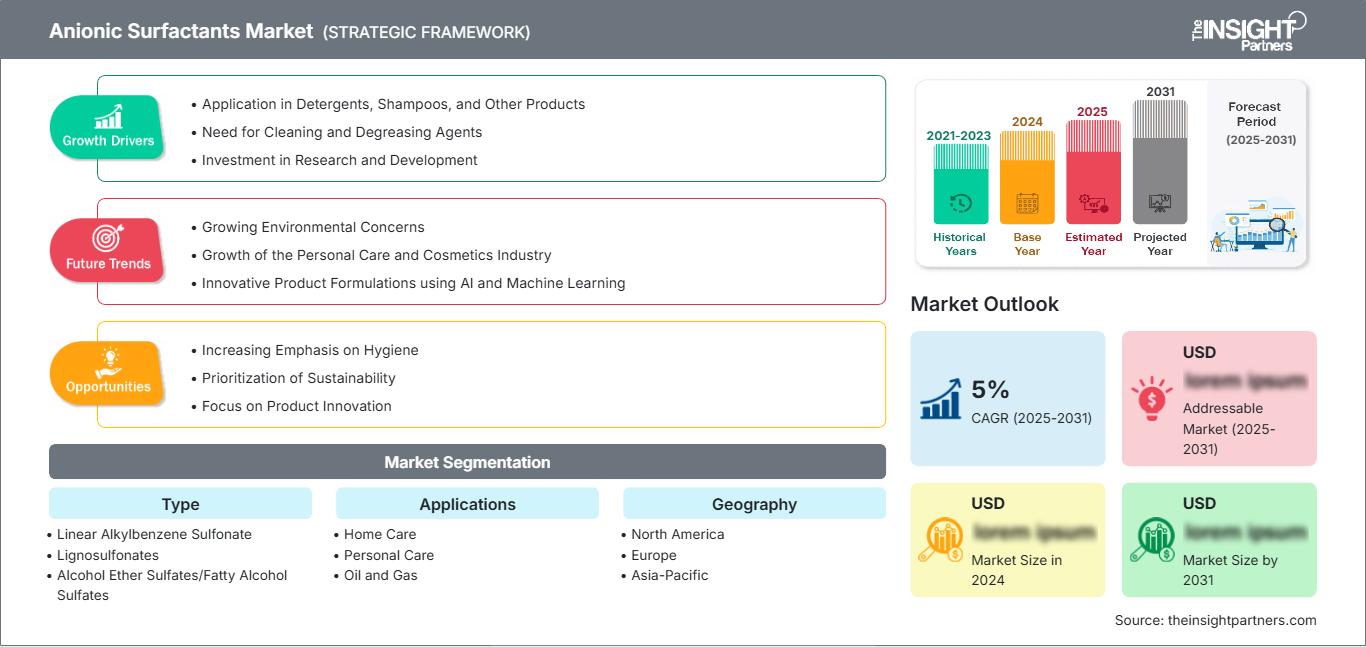
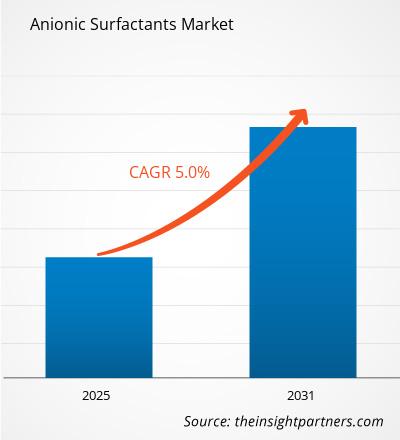
The anionic surfactants market size was valued at US$ 13.93 Billion in 2025 and is projected to reach US$ 22.63 Billion by 2034, registering a CAGR of 5.54% during 2026–2034. The market is supported by widespread use of negatively charged surface-active materials in detergents, personal care formulations, industrial cleaning, oilfield chemicals, construction additives, and specialty formulations where wetting, foaming, emulsification, and detergency are required.
North America remains an important specialty formulation hub, with the anionic surfactants market expected to expand at an estimated 4.3–5.1% CAGR through 2034. Growth is supported by premium home and personal care formulations, demand for concentrated cleaning products, and continued development of sulfate-reduced and biodegradable ingredient systems.
Anionic Surfactants Market Assessment and Insights
- North America: The region is estimated to represent 17–21% Anionic Surfactants Market share in 2025 and expand at a 4.3–5.1% CAGR between 2026–2034, supported by household cleaning, personal care, industrial formulations, and specialty surfactant innovation.
- US: The US accounts for approximately 14–17% share in 2025 and is expected to grow at a 4.2–5.0% CAGR between 2026–2034, led by home care and personal care applications.
- Europe: Europe is estimated at 20–24% share in 2025 and projected to grow at a 4.0–4.8% CAGR between 2026–2034, with Germany, France, the UK, Italy, and Spain supporting established formulation demand.
- Asia Pacific: Asia Pacific is estimated to command 39–44% share in 2025 and expand at a 6.0–6.8% CAGR between 2026–2034, led by China, India, Japan, South Korea, and Southeast Asian manufacturing centers.
- Largest Segment: Linear Alkylbenzene Sulfonate is estimated at 23–27% market share in 2025, with a 5.1–5.8% CAGR during 2026–2034, reflecting its scale in detergent formulations.
- High Growth Segment: Alpha Olefin Sulfonates is estimated at 7–10% market share in 2025, expanding at a 6.5–7.3% CAGR during 2026–2034, supported by mild and sulfate-conscious formulations.
- Key companies analyzed in detail: Akzo Nobel N.V., BASF SE, Clariant AG, Croda International Plc, Dow Inc., Evonik Industries AG, Galaxy Surfactants Limited, Huntsman Corporation, Kao Corporation, and Stepan Company.
Source: The Insight Partners' analysis based on proprietary research, government publications, company annual reports, investor presentations, industry databases, and expert interviews.
The Anionic Surfactants Market has grown from one that was mainly driven by volume-based detergent chemistry to a market where formulations focus on biodegradability, concentrate products, mildness, renewable carbon feedstocks, and reduced impurities. Linear alkyl benzene sulfonates continue to play an important role in high volume cleaning while alcohol ether sulfates, alpha olefin sulfonates, sarcosinates, and other specialty sulfonates enable formulation diversity.
In the future, the Anionic Surfactants Market is set to gain from increasing formulation needs in countries like India, Southeast Asia, Latin America, and some Middle Eastern nations. The areas expected to receive more investment will be specialty surfactants, renewable carbon sources, flexible capacity and local technical centers. Increasing need for formulating because of regulatory concerns over biodegradability, impurities, microplastics, and hazardous ingredients will lead to reformulation efforts.
Anionic Surfactants Market Report Scope
| Report Attribute | Details |
|---|---|
| Market size in 2025 | US$ 13.93 Billion |
| Market Size by 2034 | US$ 22.63 Billion |
| Global CAGR (2026 - 2034) | 5.54% |
| Historical Data | 2021-2024 |
| Forecast period | 2026-2034 |
Anionic Surfactants Market Analysis
The anionic surfactants market development is driven by detergency-demanding uses, as negative ions ensure high soil removal properties, wetting power, foamability, and emulsifying abilities. Production starts from raw materials such as olefins, fatty alcohols, natural oils, sulfur compounds, ethylene oxide, among others. It includes the processes of sulfonation, sulfation, ethoxylation, neutralization, mixing, drying, and packaging of the product. Ingredients are included in consumer goods and industries by formulators.
The economic fundamentals of the supply of the commodity include feedstock supplies, energy prices, sulfur chemistry, fatty alcohol pricing, and ethylene oxide supplies. An integrated manufacturer can increase control of expenses through integration of raw materials with production of surfactants. Regional production plays an important role, since there may be high expenses connected to transportation of concentrated liquid surfactants. Increasingly, customers require reliable suppliers with stable properties.
According to the Anionic Surfactants Market report, differentiation is becoming more dependent on formulating prowess, renewable sources of feedstock, and formulation for application specific requirements. BASF SE, Clariant AG, Croda International Plc, Evonik Industries AG, Galaxy Surfactants Limited, Kao Corporation, and Stepan Company all have extensive specialty product lines including personal care, home care, industrial, and others. Akzo Nobel N.V. and Dow Inc. provide complementing capabilities in formulating and specialty chemicals, while Huntsman Corporation is participating through high-performance surfactant and formulating technology.
Strategic investments are becoming more oriented toward optimizing capacity rather than growth of capacity at any cost. Stepan Company invested in 75,000 metric ton per year alkoxylation facility in Texas in 2025, thus providing better access to surfactant related technologies in the region. Companies are also working on bio based and biodegradable options, enhancing their application labs, and growing their regional technical services capability.
● REPORT CUSTOMIZATION
Tailor This Report To Align With Your Specific Business Requirements
This report can be customized to align precisely with your business objectives, scope, and target markets. Customization options include tailored segmentation, geography, competitive analysis, and strategic insights to support informed decision-making.
Customize This Report →WHAT YOU CAN ADJUST
- ● Segmentations
- ● Geography
- ● Competitive Analysis
- ● Language Preferences
Anionic Surfactants Market: Strategic Insights
Regional Insights
North America Anionic Surfactants Market
North America is estimated to hold 17–21% share in 2025 and is projected to expand at a 4.3–5.1% CAGR through 2034. The USA serves as the primary regional market, based on the development of detergent, personal care, institutional cleaning, oilfield, construction, and specialty chemical industries. Canada and Mexico play their part through manufacturing networks of industrial and consumer goods.
Regional market trends show an increased preference for concentrated detergents, low-sulfate personal care products, and specialty chemicals with high efficacy and minimal amounts. Producers also face shifting regulatory requirements with regard to 1,4-dioxane and renewable sourcing. The need for stringent qualifications will favor companies that possess formulation labs, reliable domestic inventory, and technical assistance. Local production will help avoid risks associated with changes in freight rates.
U.S. Anionic Surfactants Market
The US is estimated to account for 80–83% of North America's 2025 share, with a projected 4.2–5.0% CAGR through 2034. These products are used for household detergents, personal cleaning, institutional cleaning, oilfield applications, and construction chemicals. In addition, this nation features strong manufacturing and technical expertise among surfactants manufacturers around the world.
The demand trend is moving towards concentrated products, impurities, sulfate awareness, and renewable content products. Stepan Company, BASF SE, Dow Inc., Huntsman Corporation, and many other chemical companies provide products for various applications. The domestic production is critical for the customers because they need to deliver sulfonates and sulfates on time despite changes in the price of raw materials and logistics.
Europe Anionic Surfactants Market
Europe is estimated to account for 20–24% share in 2025 and expand at a 4.0–4.8% CAGR, with Germany representing the leading country. Germany is characterized by a large chemical industry together with good capabilities in detergents, cosmetic formulation, industrial formulation, and specialty materials, which enables stable demand from several categories of surfactants.
The UK plays a significant role in the field of specialty chemicals, home care, and personal care formulation. The French and Italian countries have developed cosmetics, detergents, and consumer goods industries, while Spain makes its contribution via household care, industrial cleaning and personal care formulation. The buying behavior in Europe becomes more focused on renewable raw materials, traceability, biodegradability and legislation.
Asia Pacific Anionic Surfactants Market
APAC is estimated to represent 39–44% share in 2025 and grow at a 6.0–6.8% CAGR, making it the leading regional market. China remains the largest country, supported by detergent, personal care, textile, industrial, and chemical manufacturing. Japan and South Korea contribute through sophisticated specialty formulation industries.
India offers significant growth prospects, but Australia is relatively small in comparison. The regional development, increase in the consumption of household products, increased production of cosmetics, and investments in specialty chemicals drive demand. While China gets an advantage out of its manufacturing prowess, India is becoming an attractive destination for downstream investments in the chemical sector.
Middle East and Africa Anionic Surfactants Market
Middle East & Africa is expected to expand at a 4.1–4.9% CAGR through 2034, with Saudi Arabia representing a leading regional market. UAE contributes through distribution and specialty chemical trade, while South Africa provides demand from household products, industrial cleaning, mining-related formulations, and construction.
The region benefits from petrochemical integration, infrastructure development, and diversification away from basic hydrocarbon exports. Access to feedstocks can support competitive surfactant manufacturing, particularly where downstream detergent and personal care production develops alongside chemical investments. Rest of MEA remains more import dependent, creating opportunities for regional distributors and producers offering shorter lead times and application support.
Segmentation Analysis
Type
Type represents the principal technology segmentation, with the segment expected to expand at a 5.5–6.2% CAGR during 2026–2034. Demand varies according to detergency, foam profile, mildness, biodegradability, formulation compatibility, and raw-material economics. Commodity sulfonates retain scale advantages, while specialty sulfate and sulfonate chemistries benefit from formulation innovation.
- Linear Alkylbenzene Sulfonate: LAS remains the largest type because of strong detergency, cost efficiency, foam performance, and established detergent manufacturing infrastructure. Its compatibility with powder and liquid formulations supports broad global utilization.
- Lignosulfonates: Lignosulfonates serve as dispersants and water-reducing agents across construction, agrochemical, and industrial formulations. Their renewable origin and multifunctionality support applications where dispersion and formulation economics are important.
- Alcohol Ether Sulfates/Fatty Alcohol Sulfates: These materials provide strong cleansing and foaming and are widely used in household and personal care formulations. Demand increasingly favors grades balancing foam, mildness, sulfate content, and renewable sourcing.
- Alkyl Sulfates/Ether Sulfates: Alkyl sulfates and ether sulfates remain established cleansing ingredients. Their formulation flexibility and broad availability support shampoos, body washes, detergents, and industrial cleaning products, although reformulation pressures encourage lower-impurity grades.
- Sarcosinates: Sarcosinates occupy a specialty position in personal care because they combine cleansing performance with comparatively mild sensory characteristics. Demand is linked to premium facial cleansing, shampoos, body care, and sulfate-conscious formulations.
- Alpha Olefin Sulfonates: AOS benefits from strong foaming, biodegradability, and formulation versatility. Its strategic importance is increasing in personal care and household products seeking sulfate-free positioning while maintaining cleansing performance.
- Phosphate Esters: Phosphate esters provide wetting, emulsification, and surface-modification properties across industrial and specialty formulations. Demand is concentrated in applications requiring performance under demanding chemical or processing conditions.
- Alkyl Naphthalene Sulfonates: These specialty sulfonates are valued for dispersing and wetting performance in industrial formulations. Their smaller volume base is supported by applications where high-performance dispersion justifies specialized chemistry.
- Others: Other anionic chemistries address niche requirements across cleaning, personal care, agriculture, and industrial formulations. Their strategic role is increasing as formulators seek tailored performance and alternatives to conventional sulfate systems.
Applications
Applications determine the final performance requirements and purchasing specifications, with the segment projected to grow at a 5.7–6.4% CAGR during 2026–2034. Home care remains the largest demand center, while personal care and specialty industrial uses increasingly favor differentiated surfactant technologies.
- Home Care: Home care represents the largest application base, driven by laundry detergents, dishwashing products, surface cleaners, and concentrated formulations. Demand emphasizes detergency, foam control, cold-water performance, and compatibility with sustainable formulations.
- Personal Care: Personal care demand is supported by shampoos, body washes, facial cleansers, and specialty cleansing products. Formulators increasingly prioritize mildness, sensory performance, sulfate-free positioning, renewable content, and compatibility with sensitive-skin claims.
- Oil and Gas: Oil and gas applications use surfactants for wetting, emulsification, stimulation, and specialty formulation functions. Demand is influenced by drilling activity, enhanced recovery requirements, production chemistry, and performance requirements under challenging field conditions.
- Construction: Construction applications include concrete additives, dispersants, admixtures, coatings, and specialty formulation systems. Demand benefits from infrastructure investment and the increasing use of performance-enhancing chemical additives in modern construction materials.
- Others: Other applications include agriculture, textiles, pulp and paper, industrial processing, and institutional formulations. These uses diversify demand and provide opportunities for specialized surfactants with application-specific wetting or dispersing performance.
Opportunity Snapshot
| Applications | Revenue Contribution (High/Medium/Low) | Trend Tag (MAX 2 words) | Adoption Stage (Emerging/Scaling/Mature) |
|---|---|---|---|
| Home Care | High | Concentrated Cleaning | Mature |
| Personal Care | High | Mild Cleansing | Scaling |
| Oil and Gas | Medium | Field Chemistry | Mature |
| Construction | Medium | Admixture Performance | Scaling |
| Others | Low | Specialty Formulation | Emerging |
Anionic Surfactants Market Growth Drivers and Impact Analysis
Growing Demand for Concentrated and High-Performance Household Cleaning Formulations
Cleaning products are moving to concentrate form in liquid form, powder form, pod form, and compact form, which means that there is a need for efficient surfactants with dosage control. This move will favor the need for surfactants that provide high detergency and viscosity, foam formation, stability, and compatibility with enzymes or other components. Formulation companies will find it easy when their surfactants increase functional efficiency without adding formulation complexity. This development also brings change in buying criteria since brand owners will be evaluating active content, formulation cost, water content, transportation, and cold water performance. Companies that will be able to provide formulations with sulfonates, sulfates, hydrotropes, and other additives will have opportunity for formulation.
Rising Demand for Mild and Specialty Surfactants in Personal Care Products
Increasingly, formulators are trying to find balance between cleansing performance and mildness, as well as sensory attributes and ingredient concerns. This represents a window of opportunity for alpha olefin sulfonates, sarcosinates, specific ether sulfates, and certain anionic formulations that can offer the benefits of cleansing and foaming with a mildness claim or a sulfate-free benefit. The market implications include facial cleansers, shampoos, body washes, and premium bath products. Formulators with expertise in surfactants can distinguish themselves through tailored surfactant combinations rather than just by ingredients and offer skin feel and foam performance advantages while still maintaining cost-effective manufacturing. Demand is especially compelling in the Asia-Pacific region, where personal care products are produced and consumed on the rise.
Increasing Adoption of Sustainable and Bio-Based Surfactant Ingredients
Sustainability considerations are increasingly dictating raw material decisions in consumer and industrial formulations. The desire is for renewable carbon, biodegradability, traceability, low-carbon production, and certification without compromising on performance. In this respect, there will be an opportunity for manufacturers who can integrate their feedstocks of renewable materials into the existing surfactant chemistries or come up with new molecular chemistries that have favorable sustainability characteristics. The effects of such market dynamics are more pronounced in cases where multinational customers make sustainability considerations of their suppliers within their global procurement processes. The mass balance approach is a way forward since it makes it possible to incorporate renewable or bio-circular feedstocks into the existing production assets without altering formulation properties.
Anionic Surfactants Market Future Trends
Wider Adoption of Mass-Balance Feedstocks for Sustainable Surfactant Production
Mass-balance approaches are likely to gain wider adoption because they enable manufacturers to introduce renewable or bio-circular feedstocks without redesigning established formulations or completely rebuilding production infrastructure. This model can accelerate lower-carbon product development while preserving performance characteristics, supply reliability, and existing processing conditions. Certification systems such as ISCC PLUS will increasingly support traceability from feedstock through finished ingredient, allowing brand owners to document renewable-carbon claims more credibly. Suppliers may consequently expand certified production across fatty alcohols, ethoxylates, sulfates, and related intermediates. The trend will also encourage longer-term procurement agreements between chemical producers and consumer-product companies. Over time, mass-balance materials could become a practical bridge between conventional petrochemical surfactants and fully bio-derived technologies.
Integration of Digital Formulation and Computational Chemistry Technologies
The Anionic Surfactants Market trends show that digital formulation tools and computational chemistry are expected to reduce development cycles by helping formulators predict foam, wetting, interfacial behavior, compatibility, and sensory characteristics before extensive laboratory testing. Data-driven systems can combine molecular descriptors with formulation variables, enabling more systematic selection of surfactant combinations for targeted applications. For suppliers, this creates an opportunity to build proprietary formulation databases that support customer development and improve technical-service productivity. Artificial intelligence can also help identify promising molecules and blends that balance performance with biodegradability or renewable-carbon content. Commercial adoption will initially focus on large producers and multinational formulators with substantial formulation datasets. As software becomes easier to deploy, smaller specialty chemical companies may increasingly use digital tools to compete in application-specific niches.
Anionic Surfactants Market Opportunities
Expansion of Anionic Surfactant Manufacturing Capacity in Emerging Asian Markets
The anionic surfactants market Forecasts indicate attractive investment potential in India and Southeast Asia as detergent, personal care, textile, and industrial formulation capacity expands. Producers can establish regional manufacturing, finishing, or blending operations to reduce logistics exposure and improve service to rapidly growing downstream customers. India offers particular advantages through its chemical manufacturing ecosystem, while Southeast Asia provides access to expanding consumer-product production networks. Investment priorities should include flexible reactors, sulfonation and sulfation capability, analytical laboratories, and application-development centers. Partnerships with local formulators can shorten qualification cycles and reveal product-specific requirements. Regional production can also support customized active matter and packaging formats, allowing suppliers to compete on responsiveness and technical value rather than relying exclusively on commodity pricing.
Development of Specialty Anionic Surfactants for Industrial Applications
Industrial applications offer a route toward higher-value growth because customers often require specific wetting, dispersion, emulsification, or interfacial properties that cannot be achieved through standardized detergent grades. Producers can target construction additives, oilfield chemicals, agricultural formulations, coatings, and industrial processing with tailored anionic chemistries. Investment should focus on application laboratories, pilot-scale formulation capability, and customer-specific testing rather than simply adding bulk production capacity. Suppliers with expertise in phosphate esters, lignosulfonates, alkyl naphthalene sulfonates, and specialty sulfonates can build differentiated portfolios around difficult processing conditions. The opportunity is particularly relevant for companies seeking to reduce exposure to commodity detergent cycles. Technical qualification can also increase switching costs and support longer-term customer relationships.
Recent Developments
- April 14, 2026: Clariant AG launched Hostapon CT solid, a salt-free taurate surfactant designed for mild cleansing applications. The ingredient contains 90% active content and is positioned around foam performance, lubricity, oil resistance, and formulation flexibility for sensitive and dry skin products. The launch expands Clariant's mild surfactant portfolio as personal care formulators increasingly seek high-performance cleansing ingredients.
- December 16, 2025: Syensqo announced ISCC PLUS mass-balance certification for its Moerdijk, Netherlands site covering a Rhodasurf laundry-care surfactant. The certification enables bio-circular feedstocks to be used in production of certified laureth-7, with commercial supply of Rhodasurf B7 UP planned from January 2026. The development supports lower-carbon laundry formulations without requiring customers to modify existing supply chains.
Frequently Asked Questions

- Comprehensive Market Sizing and Forecast Analysis
- Detailed Segmentation Analysis
- In-Depth Market Dynamics Assessment
- Regional and Country-Level Insights
- Competitive Landscape and Company Benchmarking
- Strategic Business Intelligence
Recent Reports
Testimonials

The Insight Partners provided valuable market intelligence that supported our global go-to-market strategy. Their team was professional, responsive, and attentive to our feedback, providing thoughtful analysis and helpful methodological clarifications throughout the project.
Junmo Kim Chief Financial Officer (CFO), Enertech Co., Ltd.
The Insight Partners' SCADA System Market report is comprehensive, with valuable insights on current trends and future forecasts. The team was highly professional, responsive, and supportive throughout. We are very satisfied and highly recommend their services.
RAN KEDEM Partner, Reali Technologies LTDs
I requested a report on a very specific software market and the team produced the report in a few days. The information was very relevant and well presented. I then requested some changes and additions to the report. The team was again very responsive and I got the final report in less than a week.
JEAN-HERVE JENN Chairman, Future Analytica
We worked with The Insight Partners for an important market study and forecast. They gave us clear insights into opportunities and risks, which helped shape our plans. Their research was easy to use and based on solid data. It helped us make smart, confident decisions. We highly recommend them.
PIYUSH NAGPAL Sr. Vice President, High Beam Global
The Insight Partners delivered insightful, well-structured market research with strong domain expertise. Their team was professional and responsive throughout. The user-friendly website made accessing industry reports seamless. We highly recommend them for reliable, high-quality research services
YUKIHIKO ADACHI CEO, Deep Blue, LLC.
This is the first time I have purchased a market report from The Insight Partners.While I was unsure at first, I visited their web site and felt more comfortable to take the risk and purchase a market report.I am completely satisfied with the quality of the report and customer service. I had several questions and comments with the initial report, but after a couple of dialogs over email with their analyst I believe I have a report that I can use as input to our strategic planning process.Thank you so much for taking the extra time and making this a positive experience.I will definitely recommend your service to others and you will be my first call when we need further market data.
JOHN SUZUKI President and Chief Executive Officer, Board Director, BK Technologies
I wish to appreciate your support and the professionalism you displayed in the course of attending to my request for information regarding to infectious disease IVD market in Nigeria. I appreciate your patience, your guidance, and the fact that you were willing to offer a discount, which eventually made it possible for us to close a deal. I look forward to engaging The Insight Partners in the future, all thanks to the impression you have created in me as a result of this first encounter.
DR CHIJIOKE ONYIA MANAGING DIRECTOR, PineCrest Healthcare Ltd.Reason to Buy
- Informed Decision-Making
- Understanding Market Dynamics
- Competitive Analysis
- Identifying Emerging Markets
- Customer Insights
- Market Forecasts
- Risk Mitigation
- Boosting Operational Efficiency
- Strategic Planning
- Investment Justification
- Tracking Industry Innovations
- Aligning with Regulatory Trends





 Get Free Sample for