
Anti-Counterfeit Packaging Market Growth, Share & Trends by 2034
Coverage: By Technology [Security Inks and Coatings, Radio Frequency Identification (RFID), Forensic Markers, Tamper Evident, Holograms, Barcode, and Others] and Application (Food and Beverage, Pharmaceutical, Personal Care and Cosmetics, Electrical and Electronics, Textile and Apparel, Automotive, and Others)
- Status : Data Released
- Report Code : TIPRE00029001
- Category : Chemicals and Materials
- No. of Pages : 150
- Available Report Formats :


- Last update date : August 27, 2026


2025 Market Size
US$ 229.20 Mn
Base year value
2034 Forecast
US$ 723.58 Mn
Projected by 2034
CAGR 2026-2034
13.6 %
Growth rate
Addressable Market
US$ 4,117.47 Mn
(2026-2034)
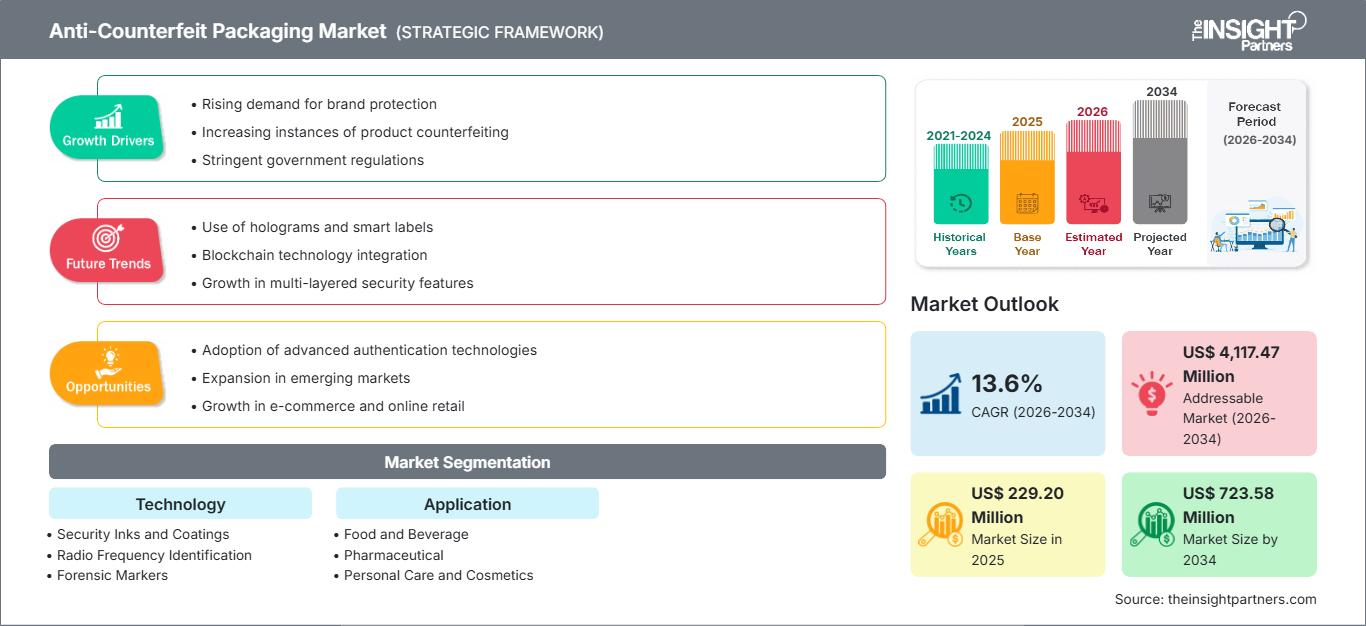
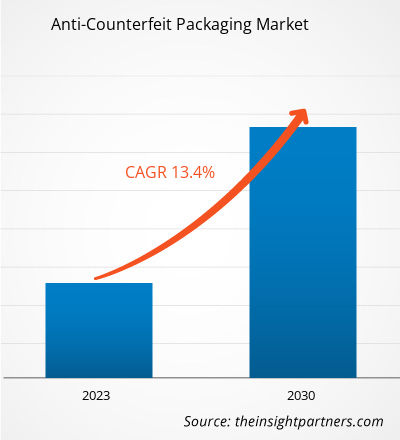
The anti-counterfeit packaging market was valued at US$ 229.20 Million in 2025 and is projected to reach US$ 723.58 Million by 2034, registering a CAGR of 13.6% during 2026–2034. Expansion is supported by increasing brand-protection requirements, digitized supply chains, regulatory traceability, and adoption of layered authentication technologies across pharmaceuticals, consumer products, electronics, and automotive applications.
North America is positioned as a high-value market, supported by sophisticated brand-protection programs, strong pharmaceutical and electronics manufacturing, and established digital identification infrastructure. The anti-counterfeit packaging market size in the region is expected to expand at an estimated 11.8–12.6% CAGR during 2026–2034 as companies combine physical security features with serialization, data analytics, and consumer authentication.
Anti-Counterfeit Packaging Market Assessment and Insights
- North America: The region represented an estimated 31–35% share in 2025 and is expected to grow at 11.8–12.6% CAGR between 2026–2034, supported by pharmaceutical serialization, electronics protection, and mature brand-security programs.
- US: The US accounted for approximately 70–74% of North America's 2025 value and is projected to grow at 12.0–12.8% CAGR during 2026–2034, led by pharmaceutical, food, electronics, and premium consumer-product protection.
- Europe: Europe held an estimated 26–30% share in 2025 and is forecast to grow at 12.2–13.0% CAGR between 2026–2034, with Germany, France, Italy, the UK, and Spain benefiting from traceability and digital product requirements.
- Asia Pacific: Asia Pacific represented about 28–32% share in 2025 and is anticipated to expand at 14.2–15.2% CAGR between 2026–2034, with China, Japan, South Korea, and India driving adoption across pharmaceuticals, electronics, apparel, and packaged foods.
- Largest Segment: Security Inks and Coatings held an estimated 24–28% market share in 2025 and is expected to grow at 12.0–12.8% CAGR during 2026–2034, reflecting broad compatibility with printed packaging.
- High Growth Segment: Radio Frequency Identification represented about 14–18% share in 2025 and is projected to grow at 15.0–16.0% CAGR during 2026–2034 as item-level tracking gains importance.
- Key companies analyzed in detail: Arjo AB, Octane5 International LLC, Antares Vision S.p.A., CCL Industries Inc., Avery Dennison Corporation, The Label Printers, KURZ Transfer Products LP, Gestion Groupe Optel Inc., Brady Corporation, Constantia Flexibles Group GmbH.
Source: The Insight Partners' analysis based on proprietary research, government publications, company annual reports, investor presentations, industry databases, and expert interviews.
The anti-counterfeit packaging market has shifted from stand-alone visual devices toward layered systems combining covert inks, tamper evidence, serialized codes, RFID, and digital authentication. Label and package conversion processes are incorporating security elements within the standard process, thus making additional production steps unnecessary. Digital printing allows variable identification, while inspection through cameras allows fast identification. These developments are impacting the capabilities of suppliers, especially those that provide authentication services and tracking information at the same time from one package to another.
During the coming years, investment is expected to be made in authentication platforms that are interoperable, machine-readable identifiers, and packaging systems that fit digital product information demands. The emerging demand from India, Southeast Asia, China, and Latin America will increase the customer base beyond the existing pharma industry. Traceability, product origin and consumer safety regulations will favor the acceptance of these solutions, while sustainability will drive thinner labels, recyclable substrate materials, water-based products, and unnecessary material security features. The Anti-Counterfeit Packaging Market report examines these trends and their impact on future market development, technology adoption, and competitive positioning.
Anti-Counterfeit Packaging Market Report Scope
| Report Attribute | Details |
|---|---|
| Market size in 2025 | US$ 229.20 Million |
| Market Size by 2034 | US$ 723.58 Million |
| Global CAGR (2026 - 2034) | 13.6% |
| Historical Data | 2021-2024 |
| Forecast period | 2026-2034 |
Anti-Counterfeit Packaging Market Analysis
Counterfeit risk is increasingly influencing packaging procurement because brand owners need authentication at production, distribution, retail, and consumer touchpoints. This is a central factor behind anti-counterfeit packaging market growth. These include security material suppliers, ink suppliers, label converters, RFID and identification suppliers, package manufacturers, software platforms, inspection equipment suppliers, distributors, and brand owners. The supply base is thus diverse, with more value going to those suppliers that are able to provide both physical and digital security.
High demand arises where the possibility of substitution can cause loss of safety, loss of income, or loss of reputation. Pharmaceuticals need to have controlled identification and tampering-proof, whereas electronics and automotive components need individualized tracking and verification. Foods, cosmetics, and clothing are increasingly making use of authentication as a way of protecting their premium position and distribution channels.
The competitive landscape includes diversified label and materials companies alongside specialist authentication providers. CCL Industries Inc. and Avery Dennison Corporation have broad label and identification capabilities, while KURZ Transfer Products LP emphasizes security effects and decorative transfer technologies. Antares Vision S.p.A. and Gestion Groupe Optel Inc. are positioned around traceability and digital authentication, while Brady Corporation and The Label Printers support specialized identification requirements. The anti-counterfeit packaging market analysis therefore, points toward convergence between packaging security and digital identity.
In today's world, investments have become more for platform technology that integrates various layers of authentication than for single features. Octane5 International LLC has an orientation towards brand protection technologies, whereas Constantia Flexibles Group GmbH has an advantage by virtue of its experience in flexible packaging. Arjo AB stands for applications in the healthcare industry where the concept of product identity is vital. Differentiation through technology now has more to do with customization, integration into existing production processes, data security, and global brand protection without adding packaging complexity.
● REPORT CUSTOMIZATION
Tailor This Report To Align With Your Specific Business Requirements
This report can be customized to align precisely with your business objectives, scope, and target markets. Customization options include tailored segmentation, geography, competitive analysis, and strategic insights to support informed decision-making.
Customize This Report →WHAT YOU CAN ADJUST
- ● Segmentations
- ● Geography
- ● Competitive Analysis
- ● Language Preferences
Anti-Counterfeit Packaging Market: Strategic Insights
Regional Insights
North America anti-counterfeit packaging market
North America accounted for an estimated 31–35% of the Anti-Counterfeit Packaging Market share in 2025 and is projected to expand at 11.8–12.6% CAGR through 2034. North America continues to be the primary driver since pharmaceutical companies, consumer goods companies, electronics makers, and their distributors need serialization and other technologies at the package level. Regulations, as well as complex supply chain infrastructures, have created the demand for serialization, tamper evidence, RFID tags, and covert technologies.
Demand for security is increased by Canada and Mexico due to food and beverage products, healthcare applications, automobiles, and manufacturing across borders. The regional ecosystem is helped by the presence of advanced printing capabilities as well as high adoption rates of the technology, allowing security functions to be integrated into the package converting process. Companies are increasingly assessing authentication solutions based on lifecycle value, which includes diversion prevention, returns management, consumer engagement, and enforcement.
U.S. anti-counterfeit packaging Market
The US represented approximately 70–74% of North America's 2025 Anti-Counterfeit Packaging Market value and is expected to grow at 12.0–12.8% CAGR through 2034. Demand is concentrated in pharmaceuticals, electronics, food, cosmetics, and automotive components, where counterfeit exposure can create safety liabilities and direct revenue losses. Major suppliers, including Avery Dennison Corporation, Brady Corporation, and CCL Industries Inc., serve a broad base of brand owners and converters.
Pharmaceutical serialization, digital traceability, and consumer verification are strengthening the role of packaging as a data carrier. Electronics manufacturers increasingly require component and accessory authentication, while automotive companies are expanding identification for replacement parts. Retail and e-commerce also increase the need to validate products after distribution. The market therefore favors solutions that combine tamper evidence, machine-readable identifiers, and cloud-linked authentication while maintaining high-speed printing and converting economics.
Europe anti-counterfeit packaging Market
Europe held an estimated 26–30% share of the Anti-Counterfeit Packaging Market in 2025 and is projected to grow at 12.2–13.0% CAGR through 2034, with Germany serving as the leading market. Regulatory emphasis on traceability, sustainability, and product information is encouraging integration of authentication with broader digital packaging systems.
The UK is an important market for pharmaceuticals, food, cosmetics, and premium consumer products. Brand owners increasingly use serialized labels and digital verification to manage online distribution and protect premium goods. Germany combines advanced manufacturing with strong industrial identification demand, particularly across pharmaceuticals, automotive components, machinery, and electronics. France, Italy, and Spain contribute through pharmaceuticals, luxury goods, food, cosmetics, and apparel, where product provenance and brand integrity support investment in authentication technologies.
APAC anti-counterfeit packaging Market
APAC accounted for approximately 28–32% share of the Anti-Counterfeit Packaging Market in 2025 and is expected to grow at 14.2–15.2% CAGR through 2034, with China leading. China and Japan have strong electronics, automotive, pharmaceutical, and consumer-goods manufacturing bases, while South Korea adds electronics and cosmetics demand.
India and Australia provide additional growth through pharmaceuticals, packaged foods, healthcare, and regulated consumer products. Increasing digitization, organized retail, e-commerce, and traceability initiatives are encouraging manufacturers to adopt QR-based identification, RFID, tamper evidence, and security printing. China remains the leading regional market because of its manufacturing scale and broad exposure to brand-protection requirements.
Middle East & Africa anti-counterfeit packaging Market
The Middle East and Africa Anti-Counterfeit Packaging Market is developing from a smaller base, with Saudi Arabia and the UAE representing important demand centers. Pharmaceutical traceability, imported consumer products, food safety, and luxury goods protection support authentication investment. South Africa remains a major African market due to its developed retail and manufacturing ecosystem.
Saudi Arabia's healthcare and industrial diversification programs, together with UAE logistics and re-export activity, increase the need for reliable product identification. Energy-related equipment, automotive parts, pharmaceuticals, and premium consumer products are relevant application areas. The region is expected to expand at 10.5–11.5% CAGR through 2034, with infrastructure modernization and cross-border trade supporting demand.
Segmentation Analysis
Technology
Technology selection is increasingly determined by threat level, packaging format, verification environment, and required data connectivity. Security Inks and Coatings remain widely deployable because covert pigments, color-shifting effects, and machine-readable properties can be integrated into conventional printing, while digital identification methods support traceability. The technology segment is expected to grow at 13.1–14.0% CAGR during 2026–2034. The anti-counterfeit packaging market scope increasingly includes layered combinations rather than single-feature protection.
- Security Inks and Coatings: Widely used across labels and printed packaging because covert pigments, color-shifting effects, and machine-readable properties can be integrated without major package redesign.
- Radio Frequency Identification: Enables automated item-level identification and supply-chain visibility, making it strategically important for pharmaceuticals, electronics, apparel, and high-value goods requiring rapid scanning.
- Forensic Markers: Provide specialized authentication through chemical or molecular signatures, supporting high-risk products where conventional visual security features can be copied or reproduced.
- Tamper Evident: Creates visible evidence of unauthorized opening or interference and remains important in pharmaceuticals, food, healthcare products, and premium consumer packaging.
- Holograms: Combine visual recognition with optical complexity and remain useful for brand protection, particularly where consumer-facing authentication and premium appearance are required.
- Barcode: Supports low-cost identification and broad compatibility with existing scanners, especially when serialized or enhanced with additional authentication data.
Application
Application demand varies according to counterfeit exposure, regulatory oversight, product value, and consumer verification needs in the Anti-Counterfeit Packaging Market. Pharmaceuticals and personal care products place greater emphasis on authentication and tamper resistance, while electronics and automotive components increasingly require item-level traceability. The application segment is estimated to grow at 13.4–14.2% CAGR during 2026–2034 as brand owners expand packaging security beyond traditional pharmaceutical uses.
- Food and Beverage: Authentication helps protect branded foods, beverages, and ingredients while supporting traceability, diversion detection, and consumer confidence across complex retail and distribution channels.
- Pharmaceutical: High-value and safety-critical medicines require strong serialization, tamper evidence, and authentication, making this application central to investment in connected packaging security.
- Personal Care and Cosmetics: Premium cosmetics, fragrances, and skincare products face brand imitation and diversion, encouraging holograms, covert features, QR verification, and serialized labels.
- Electrical and Electronics: Counterfeit components and accessories can create performance and safety risks, increasing demand for item-level identification, tamper evidence, and authentication throughout distribution.
- Textile and Apparel: Brand owners use authentication to protect premium products, manage online resale, and prepare for product-level traceability requirements affecting provenance and product information.
- Automotive: Replacement parts and components require reliable identification because counterfeit parts can affect vehicle performance, safety, and warranty economics across global aftermarket channels.
Opportunity Snapshot
| Application | Revenue Contribution | Trend Tag | Adoption Stage |
| Food and Beverage | Medium | Traceable Packs | Scaling |
| Pharmaceutical | High | Digital Identity | Mature |
| Personal Care and Cosmetics | High | Smart Labels | Scaling |
| Electrical and Electronics | High | Item Authentication | Scaling |
| Textile and Apparel | Medium | Product Passport | Emerging |
| Automotive | Medium | Part Traceability | Scaling |
Anti-Counterfeit Packaging Market Growth Drivers and Impact Analysis
Expansion of serialized and connected product identification
The move from fixed security labels to serialized, interconnected labels is affecting how packages are sourced. The ability of brand owners to tie individual packaging to records of production, distribution, and results of verification efforts provides a more solid foundation for detecting any duplication or diversion efforts. This is particularly true in the case of pharmaceuticals and electronics because such goods can be distributed via several intermediaries before reaching customers. Interconnectedness will help in recall activities and investigations since suspicious units can be tied to particular production/distribution records. For converters, the effect is the need to be equipped with the capability to perform variable data printing, camera inspection, database connection, and secure data handling. Those who can provide these services while operating at standard production speeds will benefit from valuable projects and improved customer relations.
Increasing regulatory pressure on traceability and product authenticity
Regulatory changes are enabling packaging to move beyond just being a means of containment into something that will help prove the identity of a product. Regulations related to serialization, labeling, traceability, and digital record-keeping motivate manufacturers to encode products using machine-readable codes on their packages. The regulation of pharmaceuticals continues to remain a major motivator, but the same concepts are now appearing in apparel, electronic products, foods and many other kinds of products in which provenance and product information have become increasingly relevant. The commercial benefit goes well beyond mere compliance since a system capable of meeting regulatory requirements can also be used for anti-diversion, consumer validation, inventory management, and product recalls. This means that the systems used by packaging providers must be able to adjust to changing requirements without having to alter the entire design of the package.
Rising economic and safety losses from sophisticated counterfeiting
There is an increasing trend towards the reproduction of visual elements on packages, labeling, serial numbers, and security features that people are used to, making single-tier protection less effective. Therefore, it makes more sense for brands to use several tiers of protection, including overt, covert, forensic, and digital protection. It is felt particularly strongly in the case of medicines, auto parts, electronics, cosmetics, and luxury goods, where counterfeits can not only be a potential danger to health but also inflict significant damage to brands. Layered protection is also more advantageous when it comes to enforcement, since inspectors will be able to use different tiers of verification in order to differentiate real items from very elaborate fakes. In response, packaging vendors are beginning to offer several features in one small label and package.
Anti-Counterfeit Packaging Market Future Trends
Integration of physical fingerprints with digital product identities
The anti-counterfeit packaging market trends are moving toward authentication systems that connect physical characteristics with digital identities. Instead of depending solely on printed codes, future packages can use naturally occurring material structures, microfeatures, or covert signatures as additional verification factors. This reduces the usefulness of copied identifiers because a counterfeit package may reproduce the visible code without reproducing the underlying physical fingerprint. Integration with digital product passports can also allow one identifier to support authenticity, product information, traceability, and lifecycle records. Adoption will depend on scalable camera systems, secure databases, low-cost verification workflows, and compatibility with existing printing equipment. Packaging converters that build authentication into standard production processes should be better positioned to support high-volume deployment across multiple end-use industries. Smartphone-based verification can further extend authentication from factories and warehouses to consumers.
Convergence of authentication, sustainability, and smart packaging
Future generations of packaging technology are expected to incorporate security performance with minimal material consumption, recycled substrates, and consumer engagement via digital means. Security solutions involving the use of extra films, foils, adhesives, or laminate structures will come under intense scrutiny as brand owners attempt to meet packaging sustainability goals. As a result, there will be innovations in thinner material structures, recyclable security labels, water-based systems, and printable security features that enhance security performance with less material usage. On the other hand, QR codes, NFC, RFID, and mobile security will provide digital access to packaging without the need for extra material parts. Such advances will enable the incorporation of authentication technology in consumer packaging, which is more sensitive to cost than pharmaceuticals. The competitive edge in such cases will have to be achieved through balancing security, environmental performance, consumer engagement, and economics of conversion.
Anti-Counterfeit Packaging Market Opportunities
Developing integrated authentication platforms for emerging markets
Companies can capture new demand by creating modular authentication platforms designed for manufacturers that lack sophisticated internal security infrastructure. Such systems can combine serialized codes, tamper evidence, covert markings, and cloud-based verification while allowing customers to select features according to product risk. India, Southeast Asia, Latin America, and selected Middle Eastern markets provide opportunities because organized retail and e-commerce are expanding while counterfeit exposure remains significant. Local language interfaces, mobile-first authentication, regional printing partnerships, and simple implementation models can lower adoption barriers. Suppliers should prioritize technologies that work with existing packaging equipment rather than requiring complete production-line replacement. A scalable platform can also create recurring software and verification revenue alongside physical security materials. Integration with distributors and marketplaces can further improve visibility beyond the manufacturing site.
Targeting high-risk aftermarket and premium product categories
The anti-counterfeit packaging market Forecasts indicate attractive opportunities where counterfeit products create disproportionate financial or safety consequences. Automotive replacement parts, electronic accessories, premium cosmetics, specialty pharmaceuticals, and branded apparel can justify higher security expenditure because authentication protects both revenue and product integrity. Suppliers can develop category-specific packages that combine visible trust signals with covert or digital verification. Automotive applications, for example, can connect component identifiers with warranty and service records, while premium consumer products can combine QR or NFC interaction with tamper evidence. Strategic partnerships with distributors, marketplaces, repair networks, and brand-protection teams can extend authentication beyond the package itself. This broader ecosystem approach can improve detection rates and generate stronger customer retention. Vendors should prioritize applications where verification data can generate measurable commercial or operational value.
Recent Developments
- May 18, 2026: Annora Pharma expanded its collaboration with AltiusHub to deploy an AI-native serialization, track-and-trace, and regulatory compliance platform across its export operations. The system is designed to improve serialization efficiency by up to 45% and provide real-time visibility of serialized drug products from packaging through export dispatch.
- September 17, 2025: Digimarc Corporation launched digitally watermarked security labels designed for machine-verifiable product authentication. The labels use encrypted, covert watermarks and can be combined with QR codes, providing brands with single- or two-factor verification options across different label substrates.
Frequently Asked Questions

- Comprehensive Market Sizing and Forecast Analysis
- Detailed Segmentation Analysis
- In-Depth Market Dynamics Assessment
- Regional and Country-Level Insights
- Competitive Landscape and Company Benchmarking
- Strategic Business Intelligence
Recent Reports
Testimonials

The Insight Partners' SCADA System Market report is comprehensive, with valuable insights on current trends and future forecasts. The team was highly professional, responsive, and supportive throughout. We are very satisfied and highly recommend their services.
RAN KEDEM Partner, Reali Technologies LTDs
I requested a report on a very specific software market and the team produced the report in a few days. The information was very relevant and well presented. I then requested some changes and additions to the report. The team was again very responsive and I got the final report in less than a week.
JEAN-HERVE JENN Chairman, Future Analytica
We worked with The Insight Partners for an important market study and forecast. They gave us clear insights into opportunities and risks, which helped shape our plans. Their research was easy to use and based on solid data. It helped us make smart, confident decisions. We highly recommend them.
PIYUSH NAGPAL Sr. Vice President, High Beam Global
The Insight Partners delivered insightful, well-structured market research with strong domain expertise. Their team was professional and responsive throughout. The user-friendly website made accessing industry reports seamless. We highly recommend them for reliable, high-quality research services
YUKIHIKO ADACHI CEO, Deep Blue, LLC.
This is the first time I have purchased a market report from The Insight Partners.While I was unsure at first, I visited their web site and felt more comfortable to take the risk and purchase a market report.I am completely satisfied with the quality of the report and customer service. I had several questions and comments with the initial report, but after a couple of dialogs over email with their analyst I believe I have a report that I can use as input to our strategic planning process.Thank you so much for taking the extra time and making this a positive experience.I will definitely recommend your service to others and you will be my first call when we need further market data.
JOHN SUZUKI President and Chief Executive Officer, Board Director, BK Technologies
I wish to appreciate your support and the professionalism you displayed in the course of attending to my request for information regarding to infectious disease IVD market in Nigeria. I appreciate your patience, your guidance, and the fact that you were willing to offer a discount, which eventually made it possible for us to close a deal. I look forward to engaging The Insight Partners in the future, all thanks to the impression you have created in me as a result of this first encounter.
DR CHIJIOKE ONYIA MANAGING DIRECTOR, PineCrest Healthcare Ltd.Reason to Buy
- Informed Decision-Making
- Understanding Market Dynamics
- Competitive Analysis
- Identifying Emerging Markets
- Customer Insights
- Market Forecasts
- Risk Mitigation
- Boosting Operational Efficiency
- Strategic Planning
- Investment Justification
- Tracking Industry Innovations
- Aligning with Regulatory Trends





 Get Free Sample for