
Anti-Migrating Agent Market Size, Growth & Trends by 2034
Anti-Migrating Agent Market Size and Forecasts (2021–2034), Global and Regional Share, Trends, and Growth Opportunity Analysis Report Coverage : by Type (Non-ionic, Anionic, Cationic, Amphoteric); Grades (Technical, Food, Pharmaceutical); Chemistry (Organic, Inorganic); End-Use Industry (Textile, Plastics, Paper); and Geography (North America, Europe, Asia Pacific, and South and Central America)
- Status : Data Released
- Report Code : TIPRE00040499
- Category : Chemicals and Materials
- No. of Pages : 150
- Available Report Formats :


- Last update date : September 15, 2026


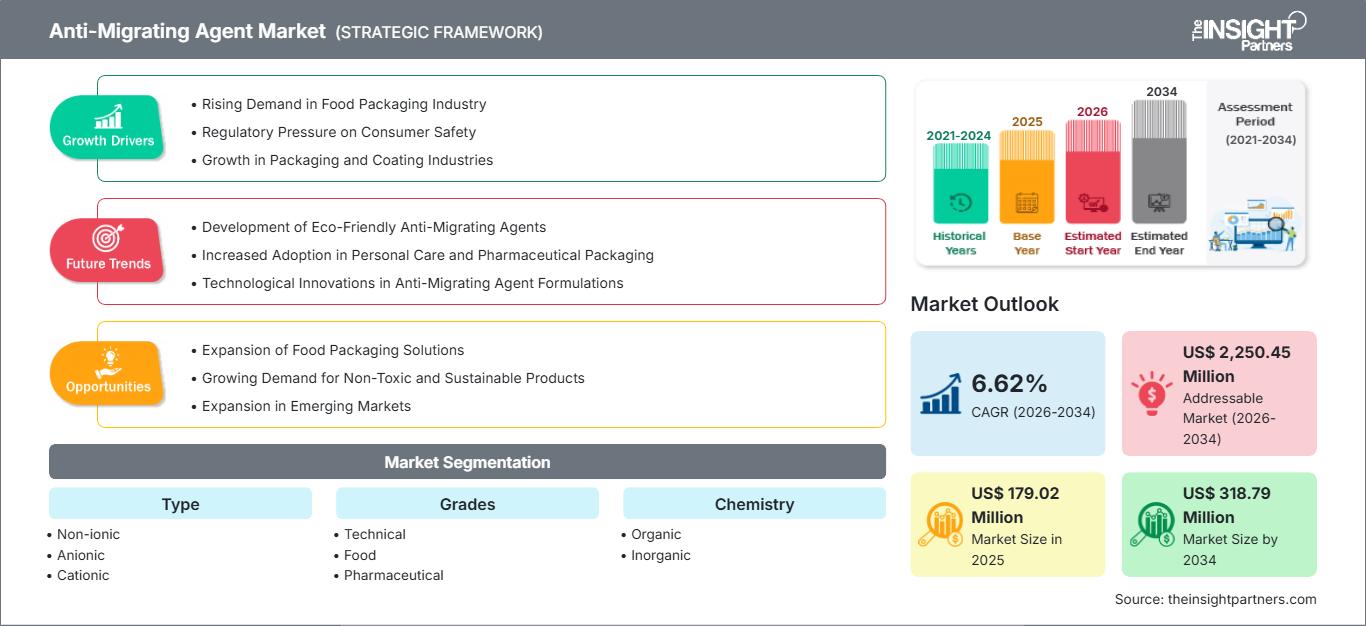
2025 Market Size
US$ 179.02 Mn
Base year value
2034 Forecast
US$ 318.79 Mn
Projected by 2034
CAGR 2026-2034
6.62 %
Growth rate
Addressable Market
US$ 2,250.45 Mn
(2026-2034)
The Anti-Migrating Agent market was valued at US$ 179.02 million in 2025 and is expected to reach US$ 318.79 million by 2034; it is estimated to record a CAGR of 6.62% during 2026-2034.
Anti-Migrating Agent Market Assessment and Insights
- North America commands a modeled 24–28% anti-migrating agent market share in 2025 and is expected to grow at a 6.8–7.3% CAGR during 2026–2034, supported by specialty textile finishing, plastics processing, and regulatory attention to chemical performance.
- US accounts for 70–75% of North American demand in 2025, with a 6.6–7.1% CAGR through 2034, reflecting advanced converting, specialty chemicals, and high-value textile applications.
- Europe holds a 26–30% share in 2025 and is projected to expand at a 7.0–7.5% CAGR, led by Germany, Italy, France, Spain, and the UK, where sustainable chemistry and process efficiency remain central.
- Asia Pacific represents 36–40% of 2025 demand and is expected to record an 8.0–8.5% CAGR through 2034, led by China, India, Japan, and South Korea across textile and polymer processing.
- Largest Segment is Textile, with a 55–60% market share in 2025 and a 7.6–8.1% CAGR during 2026–2034, reflecting broad continuous dyeing and finishing requirements.
- High Growth Segment is Organic chemistry, representing a 62–66% share in 2025 and a 7.8–8.4% CAGR, supported by formulation versatility and compatibility across substrates.
- Key companies analyzed in detail: Solvay S.A., BASF SE, Ashland Inc., Eastman Chemical Company, LANXESS AG, Air Products and Chemicals, Inc., Evonik Industries AG, Momentive Performance Materials Inc., Huntsman Corporation, Prince International Corporation.
Source: The Insight Partners' analysis based on proprietary research, government publications, company annual reports, investor presentations, industry databases, and expert interviews.
anti-migrating agent market trends are moving from traditional formulations focused on migration control and viscosity adjustment into more complex systems incorporating dye control, compatibility, wash-off properties, and decreased processing burden. Fabric manufacturers are increasingly developing auxiliary chemicals to be used on polyester, cotton mixes, reactive and disperse dyes, and in continuous pad-dry processes, whereas plastic and paper producers are looking for additives whose behavior can be controlled while maintaining recyclability and printability.
Growth opportunities in the anti-migrating agent market will be expanding geographically as textile production is increasing in South and Southeast Asia and specialty packaging products are being produced in developing regions. Regulatory pressure on chemical inventory management, water pollution, fluorochemicals, and food contact substances is also pushing formulating. Companies with application labs, regional production facilities, and technical services will be well positioned going forward due to customer demands.
Anti-Migrating Agent Market Report Scope
| Report Attribute | Details |
|---|---|
| Market size in 2025 | US$ 179.02 Million |
| Market Size by 2034 | US$ 318.79 Million |
| Global CAGR (2026 - 2034) | 6.62% |
| Historical Data | 2021-2024 |
| Forecast period | 2026-2034 |
Anti-Migrating Agent Market Analysis
Demand creation in the anti-migrating agent market is mainly from textile dyeing and finishing, since migration in between drying stages could cause issues related to centre to selvedge, face to back, and shade uniformity. Value chain for the market for anti-migration additives includes specialty chemical raw materials, formulation and compounding, quality control, distributors, dye houses, polymer processing, paper converting, and brand customers. Competition is based on factors such as viscosity control, compatibility, efficiency in dosage, wash off, and compliance.
Supply considerations in the anti-migrating agent market continue to be driven by the cost of raw material, formulation difficulty, and geographical locations of manufacture. Applications in the textile sector require performance on several variables including fiber type, dye type, liquor, and drying characteristics. Plastics and paper applications include factors related to thermal stability, migration, appearance, and further converting processes.
The competitive environment is divided between diversified chemical companies and specialized textile-chemical suppliers. Formulation and specialized additive technologies are offered by Solvay S.A., BASF SE, Ashland Inc., Eastman Chemical Company, and Evonik Industries AG, while performance chemistry services are offered by Huntsman Corporation and Momentive Performance Materials Inc. LANXESS AG, Air Products and Chemicals, Inc., and Prince International Corporation also contribute with specialty materials technology.
The investment strategy is shifting toward sustainable auxiliaries, applications testing, and regional technical support. The positioning of the products is based on reduced water and energy usage, restriction-free substance compliance, and repeatability of the process. The differentiation strategy is based on formulation technology, fast qualification, and adaptation to fiber/polymer/coating/paper substrate specifications.
● REPORT CUSTOMIZATION
Tailor This Report To Align With Your Specific Business Requirements
This report can be customized to align precisely with your business objectives, scope, and target markets. Customization options include tailored segmentation, geography, competitive analysis, and strategic insights to support informed decision-making.
Customize This Report →WHAT YOU CAN ADJUST
- ● Segmentations
- ● Geography
- ● Competitive Analysis
- ● Language Preferences
Anti-Migrating Agent Market: Strategic Insights
Regional Insights
North America anti-migrating agent market
North America is modeled at 24–28% of global demand in 2025, with a 6.8–7.3% CAGR through 2034. The US represents the dominant regional market because specialty textile finishing, packaging conversion, and high-performance plastics require tight control of additive and colorant movement.
Canada and Mexico complement demand through textile, packaging, and industrial manufacturing networks. Chemical stewardship and food-contact requirements support adoption of better-characterized formulations.
U.S. anti-migrating agent market
The US contributes 70–75% of North American demand in 2025 and is expected to expand at a 6.6–7.1% CAGR. High-value textile finishing, specialty plastics, and paper packaging applications sustain consumption, particularly where appearance, barrier performance, and chemical compliance are tightly specified.
Company presence spans diversified specialty chemical suppliers and application-focused formulators. Growth is supported by domestic packaging conversion, technical textiles, and demand for higher-performance polymer systems. Customers increasingly evaluate migration control alongside recyclability, low-VOC processing, food-contact suitability, and consistent production performance.
Europe anti-migrating agent market
Europe accounts for 26–30% of global demand in 2025 and is projected to grow at 7.0–7.5% through 2034. Germany is the leading country, supported by specialty chemicals, textile machinery, industrial coatings, and packaging technologies. Sustainability-oriented procurement and chemical stewardship reinforce demand for precisely formulated auxiliaries.
The anti-migrating agent market report shows that the UK is supported by specialty textile processing and packaging development. Germany maintains the strongest industrial base, with established producers and application laboratories. France, Italy, and Spain contribute through apparel, luxury textiles, packaging, and converting, while Italy has particular relevance in high-value textile processing.
APAC anti-migrating agent market
APAC holds a modeled 36–40% share in 2025 and is expected to record an 8.0–8.5% CAGR through 2034, making it the leading regional growth center. China remains the largest market, followed by India, Japan, and South Korea.
Australia contributes a smaller but technically advanced demand base. Growth is supported by textile manufacturing, polymer conversion, paper packaging, export-oriented dyeing, and industrial policy supporting higher-value manufacturing.
Middle East & Africa anti-migrating agent market
Middle East and Africa demand is smaller but structurally expanding, with a modeled 6.0–6.5% CAGR through 2034. Saudi Arabia and the UAE benefit from industrial diversification, packaging investment, and downstream materials development, while South Africa anchors regional specialty chemical consumption.
Rest of MEA demand is linked to textile processing, paper conversion, packaging, and infrastructure-related materials. Saudi Arabia is the leading growth market, supported by manufacturing diversification and chemical-industry capabilities. Water availability and energy efficiency also influence formulation choices.
Segmentation Analysis
Type
Type remains fundamental because ionic character influences compatibility with dyes, fibers, polymers, and processing baths. The segment is expected to expand at a 7.2–7.8% CAGR during 2026–2034 as formulators optimize migration control without disrupting shade development or downstream finishing.
- Non-ionic products provide broad compatibility and are relevant where formulation stability across mixed chemistries is required. Their flexibility supports use in textile auxiliaries and selected plastics applications.
- Anionic products are important in continuous textile dyeing because they can increase liquor viscosity and help retain dyes during intermediate drying while maintaining process compatibility.
- Cationic products serve specialized formulations where positive charge improves interaction with negatively charged substrates or components. Demand remains application-specific and qualification-intensive.
- Amphoteric products offer balanced ionic behavior and formulation flexibility, making them useful where bath stability, compatibility, and performance across changing processing conditions are required.
Grades
Grades are projected to grow at a 7.1–7.7% CAGR through 2034, reflecting differentiated purity, performance, and compliance requirements. Technical formulations dominate industrial use, while food and pharmaceutical grades require tighter impurity control and regulatory documentation.
- Technical grade products address high-volume textile, plastics, and paper processing where cost-performance balance, consistency, and process compatibility determine purchasing decisions.
- Food grade products require controlled composition and migration characteristics suitable for applications involving food-contact materials, increasing the importance of documentation, purity, and regulatory qualification.
- Pharmaceutical grade products serve highly controlled applications requiring stringent specifications and traceability. Their smaller volume base is offset by higher qualification barriers and product-value requirements.
Chemistry
Chemistry is expected to advance at a 7.5–8.2% CAGR during 2026–2034. Organic systems remain commercially prominent because they can be tailored for substrate compatibility, rheology, and processing requirements across textile and polymer applications.
- Organic chemistry holds the strongest position because polymeric, surfactant, and functional organic systems can be engineered for targeted migration control, wash-off behavior, and compatibility with complex formulations.
- Inorganic chemistry is strategically important where thermal stability, chemical resistance, and cost efficiency are priorities, particularly in selected paper and plastics applications.
End-Use Industry
End-Use Industry is projected to grow at a 7.6–8.1% CAGR through 2034, with textile applications maintaining the largest demand base. Plastics and paper broaden the market by introducing migration-control requirements beyond dyeing.
- Textile applications lead because continuous dyeing and finishing require control of dye movement during drying, helping preserve shade uniformity and reduce reprocessing.
- Plastics demand is linked to additive and pigment behavior during processing and service, especially where appearance, surface quality, and regulatory migration limits matter.
- Paper applications increasingly use functional additives and barrier systems to control penetration and improve print, coating, and packaging performance.
Opportunity Snapshot
| End-Use Industry | Revenue Contribution | Trend Tag | Adoption Stage |
|---|---|---|---|
| Textile | High | Dye Control | Mature |
| Plastics | Medium | Additive Control | Scaling |
| Paper | Medium | Barrier Performance | Scaling |
Anti-Migrating Agent Market Growth Drivers and Impact Analysis
Expansion of Continuous Textile Dyeing
The anti-migrating agent market forecast shows that continued dyeing is also an important consumption driver since there could be visible shade variations and extra processing because of migration during the drying phase. Hence, suppliers are constantly developing agents with properties that allow for increased liquor viscosity and retention of dyes in designated locations and are also compatible with reactive, disperse, vat, and pigment dyeing systems. The influence is not just about the quantity of products sold but also due to the increasing criteria used by textile mills, such as dosage efficiency and wash-off and process stability properties. More textiles being manufactured at high throughput rates in Asian textile mills would lead to increased sales of auxiliaries.
Migration Control Requirements in Plastics and Paper
Migration control is no longer limited to dyeing textiles as plastic compounders and paper converters are now looking at issues around migration of additives, colorant bleed-through, coating penetration, and surface defects. For plastics, stability in formulation is becoming more critical in light of the increasing usage of recycled resins and complex additive blends. Similarly, for paper converters, there are similar problems with coatings, inks, barriers, and functional additives being applied on porous substrates. Such demands open up a broader market for specialty formulations where suppliers must develop formulations that work in harsher environments like high temperatures and stringent regulations.
Stronger Chemical Stewardship Requirements
Chemical Stewardship is Driving Formulation Choices Throughout the Value Chains of Textiles, Plastics, and Paper. Chemical prohibitions, wastewater monitoring efforts, and chemical management responsibilities are making manufacturers formulate their goods to lower harmful chemicals and be able to prove their chemical content better. There is greater emphasis on chemical transparency in the form of the ZDHC programs among other textile initiatives, as well as some food contact and packaging initiatives. The business implications are two-fold – it may become necessary to reformulate existing products, and for those who have compliance documents already, it is easier to qualify with customers.
Anti-Migrating Agent Market Future Trends
Shift Toward Lower-Impact and Bio-Based Formulations
Future innovation in the anti-migration agent space will likely focus on bio-based polymers, biodegradable functional additives, and more sustainable surfactant systems without compromising on migration control efficacy. The textile market will consider auxiliary chemistry alongside other aspects like wastewater quality and end-of-life issues. For the plastic and paper sectors, the transition will be driven by the need for recyclability and food contact. Suppliers are anticipated to utilize renewable raw materials combined with molecular engineering to ensure the predictable nature of viscosity, substrate adhesion, thermal stability, and wash off.
Application-Specific and Digitally Optimized Formulations
Formulations in future systems would be increasingly made application specific based on the nature of fiber, dye type, polymer type, coating construction, drying characteristics, and water process characteristics. In this way, overdosing is minimized and repeatability is increased by ensuring that the auxiliary characteristics correspond to the actual process parameters. Formulation science would increasingly be coupled with process control data, lab simulation, and customer technical service from the supplier. This would be especially true for continuous textile operations and high speed converting, in which slight variations in viscosity, temperature, and drying have a big effect on end result quality.
Anti-Migrating Agent Market Opportunities
Localized Technical Services in Asian Textile Manufacturing
India, Bangladesh, Vietnam, and nearby textile manufacturing facilities provide prospects for localized production, technical services, and application labs. Mills are demanding quick problem solving for continuous dyeing, color matching, water management, and chemical regulations. Local technical teams will enable fast formulation testing and customer loyalty maintenance especially for competing against foreign auxiliaries. Investment opportunities can also include smaller application centers that duplicate customer drying and dyeing conditions prior to manufacturing. Localized manufacturing will not only allow faster production and better supply security but also will provide flexibility in product formulation due to local water composition, fiber blends, and machinery.
Migration-Control Solutions for Sustainable Packaging
Within the anti-migrating agent market, packaging offers a separate opportunity as brands move toward recycled plastics, fiber-based structures, water-based coatings, and lighter multilayer designs. These changes can create new interactions among pigments, additives, adhesives, coatings, and substrates, increasing the importance of controlled migration and surface performance. Suppliers can target formulations that support recyclability, low odor, food-contact compliance, and barrier performance simultaneously. Paper-based packaging is particularly relevant because coatings must provide functional protection without creating unacceptable recycling challenges. Investment in application testing, food-contact documentation, and compatibility studies can help chemical suppliers enter this segment with lower qualification risk.
This opportunity is further strengthened by the increasing technical complexity of modern packaging value chains. As converters incorporate higher recycled content and replace conventional materials with alternative substrates, interactions between formulation components can become less predictable and require more rigorous migration management. Anti-migrating agents can therefore create value by improving formulation stability during processing while supporting consistent surface appearance and functional performance in finished packaging. Suppliers can differentiate their offerings through products designed for specific combinations of recycled polymers, coatings, inks, adhesives, and fiber-based substrates. Collaboration with packaging converters, material producers, and brand owners can also accelerate qualification and identify application-specific performance requirements at an earlier stage. In addition, regulatory scrutiny of food-contact materials is increasing the importance of testing and technical documentation. Companies that establish strong capabilities in analytical validation, migration testing, and application development can reduce commercialization timelines and strengthen their position in higher-value packaging applications.
Recent Developments
- April 14, 2026: Archroma Management LLC showcased a portfolio of technical-textile solutions at Techtextil 2026, emphasizing performance, productivity, and sustainability across advanced textile applications. Its portfolio includes THERMACOL anti-migration auxiliaries for synthetic fibers and SOLIDOKOL anti-migration agents for cellulosic systems.
- February 25, 2026: CHT Group presented sustainable textile technologies at PERFORMANCE DAYS Spring, highlighting dyeing and functional-finishing solutions. The company reported that its PIGMENTURA process can reduce water consumption in dyeing by up to 96%, reinforcing the shift toward lower-resource textile chemistry.
Frequently Asked Questions

- Comprehensive Market Sizing and Forecast Analysis
- Detailed Segmentation Analysis
- In-Depth Market Dynamics Assessment
- Regional and Country-Level Insights
- Competitive Landscape and Company Benchmarking
- Strategic Business Intelligence
Recent Reports
Testimonials

The Insight Partners' SCADA System Market report is comprehensive, with valuable insights on current trends and future forecasts. The team was highly professional, responsive, and supportive throughout. We are very satisfied and highly recommend their services.
RAN KEDEM Partner, Reali Technologies LTDs
I requested a report on a very specific software market and the team produced the report in a few days. The information was very relevant and well presented. I then requested some changes and additions to the report. The team was again very responsive and I got the final report in less than a week.
JEAN-HERVE JENN Chairman, Future Analytica
We worked with The Insight Partners for an important market study and forecast. They gave us clear insights into opportunities and risks, which helped shape our plans. Their research was easy to use and based on solid data. It helped us make smart, confident decisions. We highly recommend them.
PIYUSH NAGPAL Sr. Vice President, High Beam Global
The Insight Partners delivered insightful, well-structured market research with strong domain expertise. Their team was professional and responsive throughout. The user-friendly website made accessing industry reports seamless. We highly recommend them for reliable, high-quality research services
YUKIHIKO ADACHI CEO, Deep Blue, LLC.
This is the first time I have purchased a market report from The Insight Partners.While I was unsure at first, I visited their web site and felt more comfortable to take the risk and purchase a market report.I am completely satisfied with the quality of the report and customer service. I had several questions and comments with the initial report, but after a couple of dialogs over email with their analyst I believe I have a report that I can use as input to our strategic planning process.Thank you so much for taking the extra time and making this a positive experience.I will definitely recommend your service to others and you will be my first call when we need further market data.
JOHN SUZUKI President and Chief Executive Officer, Board Director, BK Technologies
I wish to appreciate your support and the professionalism you displayed in the course of attending to my request for information regarding to infectious disease IVD market in Nigeria. I appreciate your patience, your guidance, and the fact that you were willing to offer a discount, which eventually made it possible for us to close a deal. I look forward to engaging The Insight Partners in the future, all thanks to the impression you have created in me as a result of this first encounter.
DR CHIJIOKE ONYIA MANAGING DIRECTOR, PineCrest Healthcare Ltd.Reason to Buy
- Informed Decision-Making
- Understanding Market Dynamics
- Competitive Analysis
- Identifying Emerging Markets
- Customer Insights
- Market Forecasts
- Risk Mitigation
- Boosting Operational Efficiency
- Strategic Planning
- Investment Justification
- Tracking Industry Innovations
- Aligning with Regulatory Trends





 Get Free Sample for