
Anti-PD-1 Antibody Market Size, Demand & Growth by 2034
Coverage: by Type (Monoclonal, Polyclonal); Application (Immunohistochemistry-Paraffin (IHC-P), Immunocytochemistry (ICC), Western Blotting, Flow Cytometry, ELISA) , and Geography (North America, Europe, Asia Pacific, and South and Central America)
- Status : Data Released
- Report Code : TIPRE00008159
- Category : Life Sciences
- No. of Pages : 150
- Available Report Formats :


- Last update date : August 21, 2026


2025 Market Size
US$ 32.56 Bn
Base year value
2034 Forecast
US$ 85.65 Bn
Projected by 2034
CAGR 2026-2034
11.34 %
Growth rate
Addressable Market
US$ 520.90 Bn
(2026-2034)
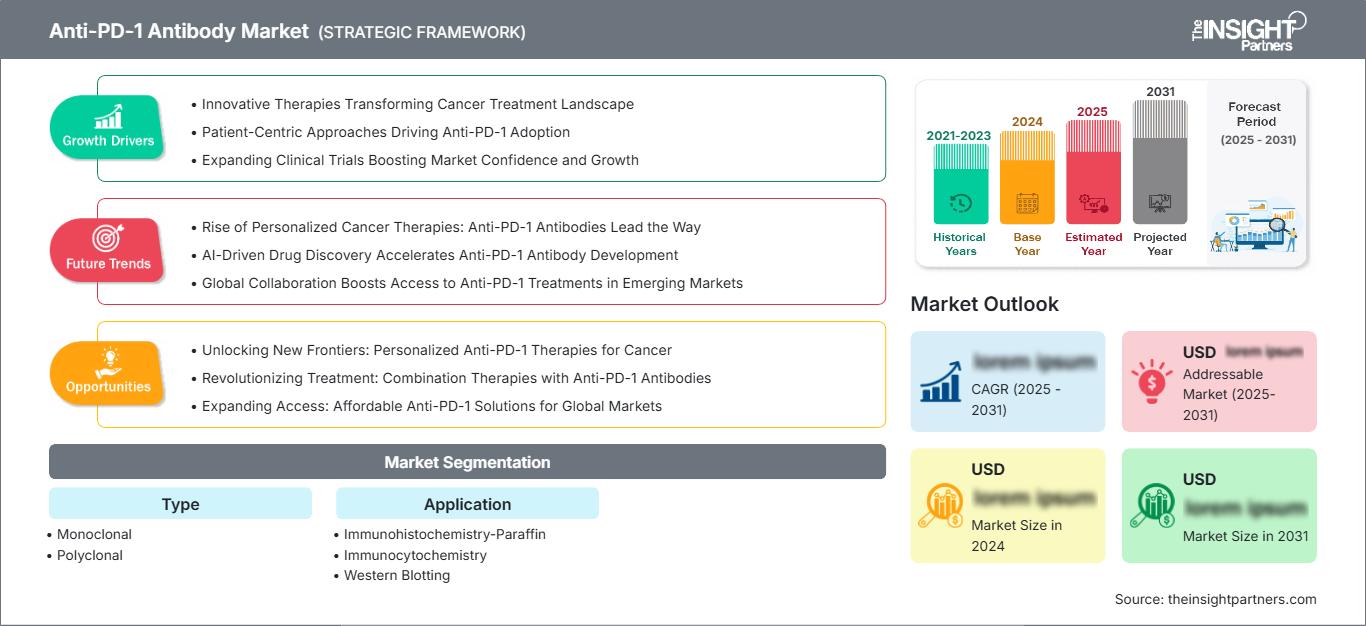
The global anti-PD-1 antibody market size held value of US$ 32.56 Billion in 2025 and is expected to reach US$ 85.65 Billion by 2034, growing at a CAGR of 11.34% from 2026 to 2034. The market represents growing demand for antibodies against programmed cell death protein 1 in translational research, immuno-oncology studies, biomarker identification, and laboratory applications.
North America anti-PD-1 antibody market share will be driven by well-developed life sciences infrastructure, high oncology research activity, and growing demand for validated research reagents. North America is expected to grow at a CAGR of 10.2–11.0% from 2026 to 2034 owing to pharmaceutical R&D activities and academic research funding.
Anti-PD-1 Antibody Market Assessment and Insights
- North America: North America represented a 38–42% share in 2025 and is expected to grow at a 10.2–11.0% CAGR between 2026–2034. The US remains the principal contributor, supported by advanced oncology research, biopharmaceutical development, and extensive antibody validation infrastructure.
- US: The US accounted for 72–76% of North American revenue in 2025 and is projected to grow at a 10.4–11.2% CAGR during 2026–2034, driven by research intensity and commercial antibody availability.
- Europe: Europe held a 28–32% share in 2025 and is forecast to expand at a 9.6–10.5% CAGR between 2026–2034. Germany, the UK, France, Italy, and Spain support demand through biomedical research, cancer studies, and established laboratory networks.
- Asia Pacific: Asia Pacific represented a 24–28% share in 2025 and is projected to record an 11.8–12.8% CAGR during 2026–2034. China, Japan, South Korea, India, and Australia are strengthening research capacity and expanding immunology and oncology programs.
- Largest Segment: Monoclonal antibodies represented a 70–75% market share in 2025 and are expected to grow at a 10.8–11.7% CAGR during 2026–2034, reflecting strong specificity and assay adoption.
- High Growth Segment: Flow Cytometry is estimated to hold a 17–21% share in 2025 and is projected to grow at a 12.2–13.2% CAGR during 2026–2034, supported by cellular immune profiling.
- Key companies analyzed in detail: Bio X Cell, Ono Pharmaceutical Co., Ltd., BioVision Inc., Thermo Fisher Scientific, Inc., Merck KGaA, InvivoGen, Chugai Pharmaceutical Co., Ltd., Bristol-Myers Squibb Company, Abcam plc, Arcus Biosciences, Cell Signaling Technology, Inc., and Proteintech Group, Inc.
Source: The Insight Partners' analysis based on proprietary research, government publications, company annual reports, investor presentations, industry databases, and expert interviews.
According to the anti-PD-1 antibody market report, the market has developed alongside improvements in monoclonal antibody technology, recombinant expression, affinity improvement, and assay-specific validation. The commercial portfolio is expanding to include monoclonal and polyclonal antibodies that are applicable to immunohistochemistry, immunocytochemistry, western blotting, and flow cytometry. This is exemplified by Thermo Fisher Scientific’s broad portfolio of PD-1 antibodies that are available in different assay formats and species, with validation data for research reproducibility.
Future trends will be centered on recombinant antibodies, increased specificity, multiplex-compatible conjugates, and assay-specific validation. Increased research into cancer immunology in the Asia Pacific region, together with increased biomarker characterization, will drive additional demand. There will also be indirect support from regulatory developments in immuno-oncology since the expansion of therapeutic programs necessitates translational research, target expression analysis, and immune cell characterization.
Anti-PD-1 Antibody Market Report Scope
| Report Attribute | Details |
|---|---|
| Market size in 2025 | US$ 32.56 Billion |
| Market Size by 2034 | US$ 85.65 Billion |
| Global CAGR (2026 - 2034) | 11.34% |
| Historical Data | 2021-2024 |
| Forecast period | 2026-2034 |
Anti-PD-1 Antibody Market Analysis
Market growth is driven by immuno-oncology research, exploration of immune checkpoint pathways, and the need to ensure reproducible detection of targets. Market growth of anti-PD-1 antibodies is tied to pharmaceutical discovery projects, academic labs, CROs, and pathology labs. PD-1 antibodies are applied in flow cytometry, immunohistochemistry, immunocytochemistry, and Western blot, thus generating several sources of income in the research process.
The supply chain starts from antibody discovery, antigen synthesis, host immunization or recombinant production, purification, conjugation, validation, packaging, and distribution. Competitors provide their products by specificity, lot-to-lot consistency, cross-species reactivity, validation for application, and documentation. Researchers are increasingly interested in products that have proven their value in scientific literature because reproducibility of the assay is essential for further translational research.
Competitive positioning involves comprehensive catalog of antibodies and specialized PD-1 expertise. Thermo Fisher Scientific offers wide application coverage, whereas Bio X Cell, BioVision, InvivoGen, Abcam plc, and Cell Signaling Technology cater to research-oriented applications. Anti-PD-1 antibody market analysis also takes into account the contribution of pharmaceutical firms such as Bristol-Myers Squibb, Ono Pharmaceutical, Chugai Pharmaceutical, and Arcus Biosciences in the field of PD-1 immuno-oncology research.
Investment is increasingly being made in recombinant antibody formats, validated clones, conjugated antibodies, and multiplex-ready reagents. Suppliers with wide distribution networks and application-specific validation can attract laboratories that require standardized procedures. Pharmaceutical developers make indirect contributions through ongoing checkpoint-inhibitors research, whereas reagent suppliers gain through rising demand for target identification and immune response studies.
● REPORT CUSTOMIZATION
Tailor This Report To Align With Your Specific Business Requirements
This report can be customized to align precisely with your business objectives, scope, and target markets. Customization options include tailored segmentation, geography, competitive analysis, and strategic insights to support informed decision-making.
Customize This Report →WHAT YOU CAN ADJUST
- ● Segmentations
- ● Geography
- ● Competitive Analysis
- ● Language Preferences
Anti-PD-1 Antibody Market: Strategic Insights
Regional Insights
North America anti-pd-1 antibody market
North America occupied a 38–42% market share in 2025 and is projected to grow at a 10.2–11.0% CAGR between 2026 and 2034. North America is dominated by the US owing to the prevalence of immunology and oncology programs amongst biotech firms, academia, cancer institutions, and contract research organizations. Demand is driven by advanced lab facilities and widespread availability of antibody databases.
Contributions to the region from Canada come from university research, translational medicine, and government cancer research. Application validation, lot-to-lot consistency, and species suitability have become key purchase criteria in the region instead of merely having access to antibodies. PD-1 antibodies are used in pharmaceutical and biotechnology labs to study immune cell phenotypes, tumor microenvironment, and biomarkers. Cold-chain logistics and investments in immuno-oncology research are some other factors adding to reagents' accessibility in the region.
U.S. anti-pd-1 antibody Market
The US held a market share of 72–76% in North America in 2025 and is expected to register a CAGR of 10.4–11.2% until 2034. Leadership in the country is due to high availability of pharmaceutical R&D, academic medical centers, cancer institutes, and biotech companies. Research uses range from discovery biology to translational research including immune checkpoint expression and characterization of cellular responses.
Thermo Fisher Scientific, Bio X Cell, BioVision, Abcam plc, and Cell Signaling Technology are suppliers to research laboratories, while Bristol-Myers Squibb and other drug manufacturers are supportive of the overall PD-1 research environment. Flow cytometry and tissue staining are major applications as researchers tend to merge phenotypic immune profiling with tumor biomarkers. Procurement processes, laboratory standards, and research funding make the usage of PD-1 reagents more common in universities, hospitals, biotechnology companies, and contract research organizations.
Europe anti-pd-1 antibody Market
Europe had a 28-32% share in 2025 and will have a CAGR of 9.6-10.5% through 2034. The UK and Germany are key research hubs, driven by pharmaceuticals development, university labs, pathology services, and cancer research organizations. France, Italy, and Spain are contributing through the development of translational research and biomedical research in hospitals.
The UK is benefiting from its life science ecosystem and high-level academic research activities, while Germany is leveraging its capabilities in pharmaceuticals manufacturing, diagnostics, and university research. France is having high oncology research capabilities, while Italy and Spain are contributing through clinical research networks and academic laboratories. The demand is increasingly favoring validated antibodies that can be used in multiple experimental formats, especially immunohistochemistry and flow cytometry. Germany continues to be the key European contributor due to its wide biotech and lab facilities.
APAC anti-pd-1 antibody Market
The APAC region accounted for a 24% to 28% market share in 2025 and is expected to witness growth at a CAGR of 11.8% to 12.8% till 2034. The China region will dominate the expansion of the regional market, followed by Japan and South Korea, while India and Australia will offer further demand from research.
The China region will enhance its biotechnology infrastructure, Japan will continue with its well-established pharmaceutical research, while South Korea will continue its focus on biologics research. India will increase its laboratory and clinical research capacity, while Australia will gain from its advanced university and cancer research networks. The growing demand for immune profiling, biomarkers, and translational oncology is expected to drive demand.
Middle East & Africa anti-pd-1 antibody Market
MEA (Middle East and Africa) provides a smaller yet developing market, wherein Saudi Arabia and the UAE lead demand due to healthcare advancement and research infrastructure. South Africa continues to be a major source of research, while the other MEA markets develop slowly from a small laboratory base. The expected regional growth is between 8.0% to 9.0% from 2026 to 2034.
Saudi Arabia and the UAE are developing advanced healthcare and biomedical facilities, while South Africa fosters university research and oncology research programs. Wealth generated from the energy sector in the Gulf region provides the necessary infrastructure investment, albeit reagents, specialized knowledge, and procurement practices make the difference. Hence, local distribution collaborations are essential.
Segmentation Analysis
Type
Type segmentation is characterized by differentiated use cases between monoclonal and polyclonal antibodies. Monoclonal products remain preferred where target specificity and reproducibility are critical, while polyclonal products retain utility in applications requiring broader epitope recognition. The segment is projected to expand at a 10.7–11.6% CAGR during 2026–2034. The anti-pd-1 antibody market scope therefore includes both standardized research products and specialized antibodies selected according to experimental requirements.
- Monoclonal: Monoclonal antibodies provide high target specificity and consistent binding characteristics, supporting reproducible immunohistochemistry, flow cytometry, and cellular assays where defined clone performance is important.
- Polyclonal: Polyclonal antibodies provide broader epitope recognition and remain useful for Western blotting and exploratory research where signal sensitivity and recognition of target variants influence assay selection.
Application
Application segmentation covers immunohistochemistry-paraffin, immunocytochemistry, Western blotting, and flow cytometry. The segment is expected to grow at a 11.8–12.7% CAGR during 2026–2034 as researchers combine tissue, cellular, and protein-level methods. PD-1 expression is investigated across tumor biology and immune-cell studies, supporting multi-application purchasing and broader laboratory utilization.
- Immunohistochemistry-Paraffin: Paraffin-based staining supports tissue-level localization of PD-1 and is strategically important for oncology research involving formalin-fixed specimens and tumor microenvironment characterization.
- Immunocytochemistry: Immunocytochemistry enables cellular localization studies and complements tissue-based approaches, particularly where researchers need spatial information from cultured or isolated cells.
- Western Blotting: Western blotting supports protein-expression analysis and target confirmation, remaining valuable in molecular biology workflows where quantitative or comparative protein assessment is required.
- Flow Cytometry: Flow cytometry enables multiparametric immune-cell profiling and is increasingly important for studying PD-1 expression alongside other immune markers in complex cellular populations.
Opportunity Snapshot
| Application | Revenue Contribution | Trend Tag | Adoption Stage |
|---|---|---|---|
| Immunohistochemistry-Paraffin | High | Tissue Profiling | Mature |
| Immunocytochemistry | Medium | Cell Localization | Scaling |
| Western Blotting | Medium | Protein Validation | Mature |
| Flow Cytometry | High | Immune Profiling | Scaling |
Anti-PD-1 Antibody Market Growth Drivers and Impact Analysis
Expansion of Immuno-Oncology Research Programs
The expansion of immuno-oncology research is increasing demand for reagents that characterize checkpoint proteins across tumor and immune-cell models. PD-1 remains a central target for investigating T-cell exhaustion, tumor immune evasion, and treatment response. As pharmaceutical developers broaden checkpoint combinations and investigate new cancer indications, research laboratories require antibodies for preclinical target validation and translational biomarker work. This creates demand across multiple formats rather than a single assay category. The commercial impact is strongest for suppliers able to provide validated clones, multiple species reactivity, and compatibility with established laboratory workflows. Continued investment in oncology research should therefore support recurring antibody purchases, particularly where experiments require repeated validation across tissue, cellular, and protein-analysis platforms.
Greater Requirement for Validated and Reproducible Antibodies
Laboratory reproducibility is becoming a stronger purchasing criterion as research organizations seek to reduce experimental variability. Antibodies used in PD-1 studies must demonstrate appropriate specificity, sensitivity, species compatibility, and application performance. Suppliers that provide validation datasets, publication references, knockout evidence, or application-specific protocols can differentiate their products from generic catalog offerings. Thermo Fisher Scientific, for example, presents PD-1 antibodies across flow cytometry, immunohistochemistry, immunocytochemistry, and Western blotting applications. This validation-oriented purchasing behavior can increase customer retention because researchers are less likely to switch products once a reliable antibody has been incorporated into an established experimental protocol. The impact is particularly relevant to regulated or publication-sensitive research environments.
Increasing Adoption of Multiparametric Immune Profiling
Multiparametric immune profiling is expanding the role of PD-1 antibodies beyond single-marker experiments. Flow cytometry enables simultaneous assessment of PD-1 with additional immune markers, allowing researchers to distinguish cellular subsets and investigate functional states. Conjugated antibodies and fluorophore-compatible formats can simplify multiplex workflows while reducing experimental steps. The commercial implication is a shift toward application-specific products rather than undifferentiated antibody supply. Suppliers that support multiple fluorophores, species, clones, and validated protocols can capture broader laboratory spending. This driver also increases the strategic importance of technical support because complex panels require researchers to manage antibody compatibility, spectral overlap, staining conditions, and controls. As immune profiling becomes more sophisticated, demand should increasingly favor comprehensive product portfolios.
Anti-PD-1 Antibody Market Future Trends
Growth of Recombinant and Application-Validated Antibodies
Recombinant antibody technologies are expected to gain importance as laboratories seek consistent lot-to-lot performance and more predictable binding characteristics. Recombinant formats can provide defined sequences and facilitate controlled production, supporting applications where reproducibility is critical. Future product development is likely to combine recombinant expression with application-specific validation, fluorophore conjugation, and improved documentation. This approach can reduce uncertainty during assay development and shorten optimization cycles for researchers. Suppliers may increasingly differentiate through verified performance rather than antibody availability alone. The anti-pd-1 antibody market trends are therefore likely to favor products supported by strong validation evidence, standardized manufacturing processes, and compatibility with multiple research platforms. Such characteristics should become particularly important for translational laboratories conducting repeat studies.
Integration of PD-1 Detection into Multiplex Workflows
Multiplex analysis is expected to influence future product design as researchers increasingly examine PD-1 alongside broader immune-marker panels. In flow cytometry, compatible fluorophores and validated clones can support simultaneous analysis of several cellular markers. Tissue-based research may similarly integrate PD-1 with other checkpoint and tumor-associated markers. Future suppliers are likely to develop more conjugated formats, optimized staining protocols, and application-specific combinations. This trend can increase the value of each customer relationship because researchers may purchase multiple reagents from a single supplier to maintain workflow consistency. Integration with automated analysis and digital pathology could further strengthen demand for validated antibodies capable of generating consistent signals across large sample sets and repeated experiments.
Anti-PD-1 Antibody Market Opportunities
Expansion of Localized Supply in Emerging Research Markets
Emerging research markets provide opportunities for suppliers to establish localized distribution, technical support, and inventory programs. China, India, South Korea, and selected Middle Eastern markets are expanding biomedical research capacity, but access to specialized antibodies can remain dependent on international supply chains. Local stockholding can reduce procurement delays and improve product availability for laboratories conducting time-sensitive experiments. Companies can also create region-specific technical support teams that assist with application selection, validation, and protocol optimization. The anti-pd-1 antibody market Forecasts indicate that faster-growing regions could become increasingly important contributors to incremental demand. Strategic partnerships with distributors, universities, biotechnology companies, and contract research organizations can provide efficient routes into fragmented laboratory markets while reducing customer acquisition costs.
Development of Integrated Antibody and Assay Solutions
An additional opportunity lies in combining antibodies with broader assay solutions rather than selling individual reagents. Researchers increasingly require complete workflows covering sample preparation, staining, detection, controls, and interpretation. Suppliers can respond through validated antibody panels, conjugated reagent sets, application-specific protocols, and technical documentation. Such offerings can simplify purchasing and reduce optimization time for laboratories. The opportunity is particularly relevant to flow cytometry and tissue profiling, where multiple antibodies may be required within one experiment. Vendors that integrate complementary products can strengthen recurring demand and improve customer retention. Commercial strategies should prioritize workflow compatibility, application validation, and technical support rather than relying exclusively on catalog breadth or price-based differentiation.
Recent Developments
- June 2026: Bristol-Myers Squibb Company announced European Commission approval of Opdivo in combination with doxorubicin, vinblastine, and dacarbazine for previously untreated Stage III or IV classical Hodgkin lymphoma in adults and adolescents aged 12 years and older. The decision expanded the use of a PD-1-directed therapy into frontline hematologic oncology.
- March 2026: Bristol-Myers Squibb Company received US FDA approval for Opdivo combined with doxorubicin, vinblastine, and dacarbazine for previously untreated Stage III or IV classical Hodgkin lymphoma in adults and pediatric patients aged 12 years and older. The approval was based on Phase 3 SWOG 1826 results.
- 2026: Thermo Fisher Scientific, Inc. continued offering an extensive PD-1 antibody portfolio spanning flow cytometry, immunohistochemistry, immunocytochemistry, and Western blotting, including monoclonal, recombinant monoclonal, and polyclonal formats. The portfolio illustrates continuing expansion of application-validated PD-1 research tools across experimental workflows.
Frequently Asked Questions

- Comprehensive Market Sizing and Forecast Analysis
- Detailed Segmentation Analysis
- In-Depth Market Dynamics Assessment
- Regional and Country-Level Insights
- Competitive Landscape and Company Benchmarking
- Strategic Business Intelligence
Recent Reports
Testimonials

The Insight Partners' SCADA System Market report is comprehensive, with valuable insights on current trends and future forecasts. The team was highly professional, responsive, and supportive throughout. We are very satisfied and highly recommend their services.
RAN KEDEM Partner, Reali Technologies LTDs
I requested a report on a very specific software market and the team produced the report in a few days. The information was very relevant and well presented. I then requested some changes and additions to the report. The team was again very responsive and I got the final report in less than a week.
JEAN-HERVE JENN Chairman, Future Analytica
We worked with The Insight Partners for an important market study and forecast. They gave us clear insights into opportunities and risks, which helped shape our plans. Their research was easy to use and based on solid data. It helped us make smart, confident decisions. We highly recommend them.
PIYUSH NAGPAL Sr. Vice President, High Beam Global
The Insight Partners delivered insightful, well-structured market research with strong domain expertise. Their team was professional and responsive throughout. The user-friendly website made accessing industry reports seamless. We highly recommend them for reliable, high-quality research services
YUKIHIKO ADACHI CEO, Deep Blue, LLC.
This is the first time I have purchased a market report from The Insight Partners.While I was unsure at first, I visited their web site and felt more comfortable to take the risk and purchase a market report.I am completely satisfied with the quality of the report and customer service. I had several questions and comments with the initial report, but after a couple of dialogs over email with their analyst I believe I have a report that I can use as input to our strategic planning process.Thank you so much for taking the extra time and making this a positive experience.I will definitely recommend your service to others and you will be my first call when we need further market data.
JOHN SUZUKI President and Chief Executive Officer, Board Director, BK Technologies
I wish to appreciate your support and the professionalism you displayed in the course of attending to my request for information regarding to infectious disease IVD market in Nigeria. I appreciate your patience, your guidance, and the fact that you were willing to offer a discount, which eventually made it possible for us to close a deal. I look forward to engaging The Insight Partners in the future, all thanks to the impression you have created in me as a result of this first encounter.
DR CHIJIOKE ONYIA MANAGING DIRECTOR, PineCrest Healthcare Ltd.Reason to Buy
- Informed Decision-Making
- Understanding Market Dynamics
- Competitive Analysis
- Identifying Emerging Markets
- Customer Insights
- Market Forecasts
- Risk Mitigation
- Boosting Operational Efficiency
- Strategic Planning
- Investment Justification
- Tracking Industry Innovations
- Aligning with Regulatory Trends





 Get Free Sample for