
Anti-PD-1 MAb Market Growth, Demand & Size by 2034
Coverage: By Product (40mg, 100mg, 200mg, Others); Application (Melanoma Patients, Lung Cancer Patients, Lymphoma Patients, Other) , and Geography (North America, Europe, Asia Pacific, and South and Central America)
- Status : Data Released
- Report Code : TIPRE00023269
- Category : Life Sciences
- No. of Pages : 150
- Available Report Formats :


- Last update date : August 21, 2026


2025 Market Size
US$ 75.85 Mn
Base year value
2034 Forecast
US$ 102.64 Mn
Projected by 2034
CAGR 2026-2034
3.42 %
Growth rate
Addressable Market
US$ 810.69 Mn
(2026-2034)
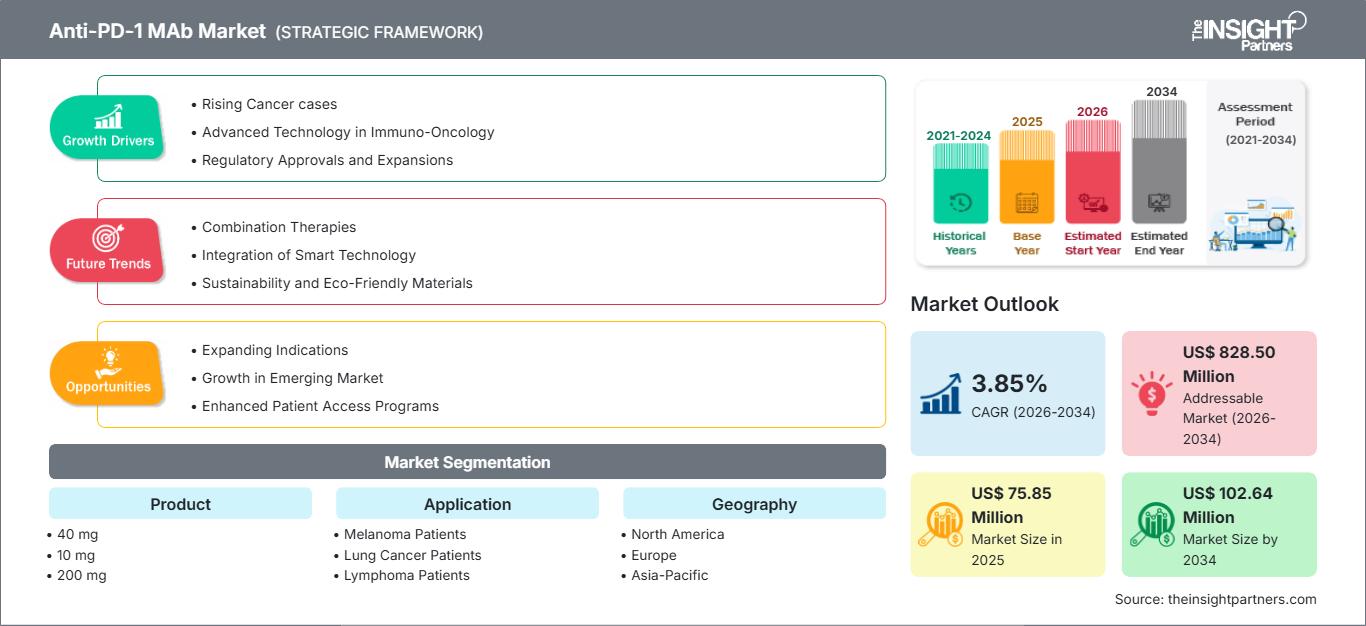
The Anti-PD-1 MAb market was valued at US$ 75.85 million in 2025 and is expected to reach US$ 102.64 million by 2034; it is estimated to record a CAGR of 3.42% during 2026-2034.
Anti-PD-1 MAb Market Assessment and Insights
- North America: North America is estimated to hold a 42–46% anti-pd-1 mab market share in 2025 and grow at a CAGR of 3.4–3.9% between 2026–2034, supported by established immuno-oncology treatment pathways and premium product adoption.
- US: The US is estimated to represent 82–86% of North American revenue in 2025 and expand at a CAGR of 3.3–3.8% during 2026–2034, supported by broad clinical utilization.
- Europe: Europe is estimated to account for 25–29% share in 2025 and grow at a CAGR of 3.6–4.1%, with Germany, the UK, France, Italy, and Spain contributing through established oncology systems and reimbursement.
- Asia Pacific: Asia Pacific is estimated to represent 19–23% share in 2025 and grow at a CAGR of 4.5–5.1%, led by China, Japan, South Korea, India, and Australia through expanding oncology access.
- Largest Segment: The 200 mg product segment is estimated to hold a 48–53% market share in 2025 and grow at a CAGR of 3.8–4.3%, reflecting utilization in established dosing protocols.
- High Growth Segment: The 40 mg product segment is estimated to account for 18–23% share in 2025 and grow at a CAGR of 4.4–5.0%, supported by dosing flexibility.
- Key companies analyzed in detail: Merck, Shanghai Junshi Biosciences Co., Ltd., Coherus BioSciences, Inc., Aditya Pharma, Genentech, Inc., Bristol Myers Squibb Company, TopAlliance Biosciences, Inc., Innovent Biologics, Inc., BeiGene, Ltd., and AstraZeneca PLC.
Source: The Insight Partners' analysis based on proprietary research, government publications, company annual reports, investor presentations, industry databases, and expert interviews.
From being a small cohort of innovative checkpoint inhibitors, the anti-pd-1 mab market is growing to become an intense oncology class across several cancers and lines of therapy. Distinguishing factors now include indication diversity, ease of use, possibility of combination, efficiencies in production process, and mode of delivery. Changes are occurring in terms of production as well, as Chinese manufacturers and specialist producers build global commercial and supply capabilities.
The anti-pd-1 mab market report indicates that future development will focus on the following: differentiating delivery, geographic reach, and lifecycle management. The developing Asian markets represent the opportunity for more volume of treatments as oncology infrastructure develops, while the established markets present an opportunity in the form of formulating innovations and indication expansions. Subcutaneous administration regulatory pathway allows chair time efficiency and affects the positioning of the product, especially in health systems valuing outpatient oncology capability and less infusional burden.
Anti-PD-1 MAb Market Report Scope
| Report Attribute | Details |
|---|---|
| Market size in 2025 | US$ 75.85 Million |
| Market Size by 2034 | US$ 102.64 Million |
| Global CAGR (2026 - 2034) | 3.42% |
| Historical Data | 2021-2024 |
| Forecast period | 2026-2034 |
Anti-PD-1 MAb Market Analysis
Anti-PD-1 mAb market growth is driven by increasing importance of immune checkpoint inhibition in cancer treatments and by ongoing clinical studies across cancers. The value chain includes antibody discovery, development of cell lines, production of biologicals, quality controls, approvals, purchasing from hospitals, specialty distribution, and administration in oncology. Hence, demand for the products is impacted by patient eligibility and logistics capabilities of health care providers to manage biological products effectively.
Cost structure for biological drugs includes factors such as manufacturing yield, dosing regimen, treatment period, indication mix, and purchasing terms. Originator drugs usually enjoy premium prices owing to strong clinical evidence and well-defined indications, whereas regional players fight for their positions via cost-effectiveness and geographical expansion. Biomarker testing, which affects patient eligibility for particular treatments, is becoming increasingly important as well.
The competitive environment includes the giants of the pharmaceutical industry as well as specialists in immuno-oncology. The first company is Merck with pembrolizumab, while the second company is Bristol Myers Squibb Company with nivolumab. The contribution of Genentech, Inc. lies in its oncology products and development skills, while Shanghai Junshi Biosciences Co., Ltd. and Coherus BioSciences, Inc. offer toripalimab using cross-border commercialization approach. TopAlliance Biosciences, Inc. is still closely associated with toripalimab development and commercialization.
Innovent Biologics, Inc. and BeiGene, Ltd. contribute to the Chinese-origin competitive set, while Aditya Pharma offers a regional competitive market presence. AstraZeneca PLC becomes a competitor due to its oncology knowledge base, despite the fact that the checkpoint product portfolio of the company is mainly focused on PD-L1, not PD-1 targeting. The strategic position is increasingly built upon formulation differences, manufacturing scale, geography licensing, and clinical data.
● REPORT CUSTOMIZATION
Tailor This Report To Align With Your Specific Business Requirements
This report can be customized to align precisely with your business objectives, scope, and target markets. Customization options include tailored segmentation, geography, competitive analysis, and strategic insights to support informed decision-making.
Customize This Report →WHAT YOU CAN ADJUST
- ● Segmentations
- ● Geography
- ● Competitive Analysis
- ● Language Preferences
Anti-PD-1 MAb Market: Strategic Insights
Regional Insights
North America Anti-PD-1 mAb Market
North America is projected to contribute between 42% and 46% of worldwide revenues in 2025 and grow at a CAGR of 3.4% to 3.9% until 2034. The region is characterized by the availability of sophisticated oncology facilities, biomarker testing, specialist prescribers, and immune checkpoint therapy experience. The US is the leading contributor, whereas Canada is the secondary contributor, which is bolstered by the presence of public health systems and province-based reimbursement system.
The demand for treatments is driven by lung cancer, melanoma, lymphoma, and other solid tumor indications. Increasing product lifecycle management will be critical because of competition to existing intravenous treatments due to unique modes of administration. The subcutaneous formulation is favorable in terms of throughput improvement; however, the success of its implementation depends on approval, reimbursement, prescriber preferences, and clinical equivalence.
U.S. Anti-PD-1 mAb Market
The US is estimated to represent 82–86% of North American revenue in 2025 and grow at a CAGR of 3.3–3.8% during 2026–2034. The country's position is supported by specialized cancer centers, broad clinical adoption of checkpoint inhibitors, established reimbursement pathways, and extensive pharmaceutical development activity. Merck and Bristol Myers Squibb Company maintain substantial competitive visibility.
Demand for applications spans melanoma and lung cancer, while lymphoma and other tumor indications provide portfolio diversification. There is growing emphasis on treatment duration, combination therapy, and ease of administration that affects purchasing decisions. Subcutaneous drug delivery may lower infusion time and make process more efficient in an ambulatory setting, thus providing lifecycle management for existing products. However, payer negotiations, site-of-care economics, and competition by other immuno-oncology approaches will limit price growth.
Europe Anti-PD-1 mAb Market
In Europe, the market is expected to have a market share of 25–29%, with a compound annual growth rate (CAGR) of 3.6–4.1%. Germany will continue to dominate, as it has an extensive oncology patient pool and well-defined reimbursement mechanisms. The UK, France, Italy, and Spain also make notable contributions via their national cancer programs, specialty centers, and adoption of checkpoint inhibitors.
In the UK, there exist defined oncology pathways and HTA process which makes clinical and economic data relevant for uptake. Germany is a good market for specialty capacity and pharmaceutical access but assessment and reimbursement affect product positioning. France, Italy, and Spain have a good base of immuno-oncology usage and increased focus on healthcare efficiency. In Europe, differentiation and expanded indications may create incremental value, and pricing and tendering will limit growth.
APAC Anti-PD-1 mAb Market
In 2025, APAC region is projected to have a 19-23% share and grow at a CAGR of 4.5-5.1%. China is the key country in the region, followed by Japan, South Korea, India, and Australia. Local biologic development, growing infrastructure for oncology, and wider availability of immune checkpoint therapy drives demand in the region.
China is especially significant since local biologic manufacturers compete along with multinationals, while Japan and South Korea already have oncology system in place. India is expected to provide volume opportunities in the long term due to growth in cancer diagnosis and biologics availability. Australia has reimbursement mechanisms and specialist practices. Investment in biologics manufacturing and domestic pharma capabilities would drive supply in the region.
Middle East & Africa Anti-PD-1 mAb Market
MEA is forecast to achieve CAGR growth of 4.0–4.6% until 2034. Saudi Arabia and UAE are higher-value markets due to modern oncology infrastructure and investment in health care, whereas South Africa is a bigger market due to its population. Rest of MEA will continue to be limited by affordability and accessibility constraints.
The leading regional value will belong to Saudi Arabia owing to healthcare modernization and development of specialized oncology services. UAE profits from modern infrastructure and healthcare tourism. South Africa offers bigger population-based potential for treatment, however, affordability plays an important role. Infrastructure investments due to Gulf diversification will enhance the ability to provide specialty services, whereas public procurement and collaboration with foreign partners will still be important in lower-access African countries.
Segmentation Analysis
Product
The Product segment is projected to grow at a CAGR of 3.7–4.2% during 2026–2034. Product demand is shaped by approved dosing protocols, patient weight or clinical requirements, treatment duration, vial utilization, wastage management, and administration setting. The anti-pd-1 mab market scope increasingly includes formulation and dose optimization as manufacturers seek to improve treatment economics and convenience.
- 40 mg: The 40 mg presentation provides dosing flexibility and can support patient-specific treatment calculations. Its strategic importance increases where healthcare providers seek to optimize vial utilization and minimize unnecessary biologic wastage.
- 10 mg: The 10 mg presentation serves lower-dose requirements and can provide additional flexibility for selected treatment protocols. Its role is comparatively specialized, with utilization influenced by prescribing and procurement practices.
- 200 mg: The 200 mg presentation represents the principal commercial format for many established treatment protocols. Its importance reflects standardized dosing, simplified procurement, and widespread use across major oncology treatment settings.
Application
The Application segment is expected to grow at a CAGR of 3.9–4.4% during 2026–2034. Demand varies according to cancer incidence, biomarker eligibility, treatment guidelines, line of therapy, and clinical adoption. Lung cancer represents a major utilization pool, while melanoma and lymphoma provide additional demand and diversification opportunities.
- Melanoma Patients: Melanoma remains an established immunotherapy application where checkpoint inhibition has reshaped systemic treatment. Continued use depends on treatment-line positioning, combination strategies, patient eligibility, and long-term clinical outcomes.
- Lung Cancer Patients: Lung cancer represents a major application because checkpoint inhibitors are incorporated into multiple treatment pathways. Large patient volumes, biomarker-guided selection, and combination therapy support substantial commercial relevance.
- Lymphoma Patients: Lymphoma applications provide targeted opportunities where PD-1 inhibition is clinically appropriate. Adoption is influenced by disease subtype, prior therapy, treatment guidelines, and competition from alternative immunotherapies.
Opportunity Snapshot
| Application | Revenue Contribution | Trend Tag | Adoption Stage |
| Melanoma Patients | Medium | Durable response | Mature |
| Lung Cancer Patients | High | Broad adoption | Mature |
| Lymphoma Patients | Medium | Targeted use | Scaling |
Anti-PD-1 MAb Market Growth Drivers and Impact Analysis
Expansion of Immunotherapy Across Earlier Treatment Settings
Evaluation and use of checkpoint inhibition is not confined to advanced/metastatic cases anymore, providing room for longer therapy cycles and a larger pool of candidates eligible for treatment. Early-stage therapy may result in more patients getting treated with immunotherapy prior to or in combination with surgery, but it remains to be seen how successful its commercial application will be depending on trial results and guidelines adoption. However, this shift also implies changes in the economic aspect of treatment because the therapy can be started with different patient profiles and treatment goals in mind. Companies with wide clinical data will be able to expand the use of their products in a range of treatment scenarios, while the competition will target particular tumor types. The demand dynamics will thus be based not on one particular indication, but on growing the scope of treatment paths overall.
Increasing Focus on Administration Efficiency
Healthcare systems are increasingly examining treatment administration time, infusion-center capacity, staffing requirements, and patient convenience. Subcutaneous delivery offers a potential way to reduce administration time compared with conventional intravenous infusion, although economic benefits depend on product preparation, monitoring, reimbursement, and site-of-care arrangements. The commercial effect can extend beyond the medicine itself because more efficient administration may allow oncology centers to manage higher patient volumes without proportional increases in chair capacity. Manufacturers developing differentiated formulations can therefore compete on healthcare-system value rather than clinical efficacy alone. Adoption will remain dependent on regulatory approval, comparative evidence, provider familiarity, and payer recognition of operational savings. This driver is particularly relevant in mature markets where treatment infrastructure is established but oncology capacity remains under pressure.
Expansion of Local Biologics Manufacturing
Domestic biologics development and manufacturing are strengthening competition, particularly in China and selected emerging pharmaceutical markets. Local production can improve supply resilience, reduce dependence on imported finished products, and support pricing strategies aligned with national healthcare priorities. For checkpoint inhibitors, manufacturing capability also provides a platform for additional indications, formulation development, and combination research. Regional companies can use local clinical expertise and regulatory familiarity to accelerate market access, while multinational companies may rely on licensing or partnership structures to extend geographic reach. The resulting competitive effect can increase product availability and encourage differentiation through price, indication breadth, and formulation. However, biologic manufacturing requires stringent quality systems, validated processes, and consistent regulatory compliance, limiting the number of companies capable of competing effectively at scale.
Anti-PD-1 MAb Market Future Trends
Subcutaneous Checkpoint Inhibitors and Shorter Administration
The anti-pd-1 mab market trends are moving toward subcutaneous delivery as established intravenous products approach lifecycle-management milestones. Merck's subcutaneous pembrolizumab formulation demonstrates how a mature PD-1 product can be repositioned around administration convenience rather than a new mechanism. Bristol Myers Squibb Company has also advanced subcutaneous nivolumab, indicating that administration route is becoming a competitive dimension across major checkpoint franchises. Future adoption will depend on comparative efficacy, safety, reimbursement, healthcare workflow, and patient preference. Shorter administration can potentially increase treatment-center capacity and reduce time spent in oncology units. As more products adopt differentiated delivery, competition may shift toward convenience, preparation requirements, total treatment cost, and site-of-care economics rather than solely molecule-level clinical differentiation.
Cross-Border Expansion of Chinese PD-1 Therapies
Chinese-developed PD-1 antibodies are likely to expand their international presence through licensing, regulatory approvals, and commercial partnerships. Toripalimab provides a prominent example, with approvals extending across multiple markets and additional indications under development. The strategy can allow Chinese developers to combine domestic manufacturing and clinical capabilities with international commercialization expertise. Competitive expansion will depend on local regulatory requirements, pricing, reimbursement, physician familiarity, and clinical differentiation against established multinational products. Emerging markets may be particularly receptive where affordability and access are significant considerations. Over time, broader geographic commercialization could create a more fragmented competitive structure, with regional developers competing directly with multinational checkpoint franchises in selected tumor types and treatment settings.
Anti-PD-1 MAb Market Opportunities
Regional Partnerships for Emerging Oncology Markets
The anti-pd-1 mab market Forecasts indicate meaningful opportunity for companies that establish regional commercialization partnerships rather than relying solely on direct market entry. Emerging oncology markets often require local regulatory expertise, distributor relationships, reimbursement navigation, pharmacovigilance infrastructure, and specialist education. Partnerships can reduce entry costs while accelerating access to established treatment centers. Chinese developers may particularly benefit from alliances that translate domestic clinical and manufacturing strengths into international approvals and sales. Multinational companies can also use regional partners to expand established products into countries where direct infrastructure would be inefficient. Investment should prioritize markets with growing oncology capacity, improving biologic reimbursement, and identifiable specialist networks. Successful strategies will need to balance affordability with sustainable margins, while ensuring product quality and reliable supply throughout the commercialization period.
Lifecycle Management Through Formulation and Indication Expansion
A second opportunity involves extending established products through new formulations, administration routes, and additional indications. Subcutaneous delivery can create a differentiated product proposition without requiring discovery of a completely new antibody, while indication expansion can increase the number of eligible patients and extend commercial relevance. Manufacturers should prioritize tumor types where clinical evidence can support meaningful treatment adoption and where healthcare systems have sufficient capacity to deliver therapy. Formulation investment can be especially valuable when intravenous administration creates operational constraints or when competing products introduce convenience advantages. Companies can combine formulation changes with real-world evidence, health-economic studies, and provider education to strengthen adoption. Such lifecycle strategies may preserve product value as competitive intensity increases and established molecules encounter pricing and patent pressures.
Recent Developments
- May 2026: Shanghai Junshi Biosciences Co., Ltd. announced that the final analysis of the Phase 3 NEOTORCH study of toripalimab plus chemotherapy in resectable stage II–III non-small cell lung cancer met predefined efficacy boundaries for event-free survival and major pathological response, supporting continued development in perioperative treatment.
- February 2026: Merck announced US FDA approval of KEYTRUDA and KEYTRUDA QLEX with chemotherapy, with or without bevacizumab, for certain adults with PD-L1-positive platinum-resistant ovarian, fallopian tube, or primary peritoneal carcinoma, expanding use of its anti-PD-1 therapy.
- May 2025: Bristol Myers Squibb Company announced European Commission approval of subcutaneous Opdivo across multiple solid-tumor indications, introducing a 600 mg/vial formulation and a new administration route supported by Phase 3 CheckMate-67T results.
Frequently Asked Questions

- Comprehensive Market Sizing and Forecast Analysis
- Detailed Segmentation Analysis
- In-Depth Market Dynamics Assessment
- Regional and Country-Level Insights
- Competitive Landscape and Company Benchmarking
- Strategic Business Intelligence
Recent Reports
Testimonials

The Insight Partners provided valuable market intelligence that supported our global go-to-market strategy. Their team was professional, responsive, and attentive to our feedback, providing thoughtful analysis and helpful methodological clarifications throughout the project.
Junmo Kim Chief Financial Officer (CFO), Enertech Co., Ltd.
The Insight Partners' SCADA System Market report is comprehensive, with valuable insights on current trends and future forecasts. The team was highly professional, responsive, and supportive throughout. We are very satisfied and highly recommend their services.
RAN KEDEM Partner, Reali Technologies LTDs
I requested a report on a very specific software market and the team produced the report in a few days. The information was very relevant and well presented. I then requested some changes and additions to the report. The team was again very responsive and I got the final report in less than a week.
JEAN-HERVE JENN Chairman, Future Analytica
We worked with The Insight Partners for an important market study and forecast. They gave us clear insights into opportunities and risks, which helped shape our plans. Their research was easy to use and based on solid data. It helped us make smart, confident decisions. We highly recommend them.
PIYUSH NAGPAL Sr. Vice President, High Beam Global
The Insight Partners delivered insightful, well-structured market research with strong domain expertise. Their team was professional and responsive throughout. The user-friendly website made accessing industry reports seamless. We highly recommend them for reliable, high-quality research services
YUKIHIKO ADACHI CEO, Deep Blue, LLC.
This is the first time I have purchased a market report from The Insight Partners.While I was unsure at first, I visited their web site and felt more comfortable to take the risk and purchase a market report.I am completely satisfied with the quality of the report and customer service. I had several questions and comments with the initial report, but after a couple of dialogs over email with their analyst I believe I have a report that I can use as input to our strategic planning process.Thank you so much for taking the extra time and making this a positive experience.I will definitely recommend your service to others and you will be my first call when we need further market data.
JOHN SUZUKI President and Chief Executive Officer, Board Director, BK Technologies
I wish to appreciate your support and the professionalism you displayed in the course of attending to my request for information regarding to infectious disease IVD market in Nigeria. I appreciate your patience, your guidance, and the fact that you were willing to offer a discount, which eventually made it possible for us to close a deal. I look forward to engaging The Insight Partners in the future, all thanks to the impression you have created in me as a result of this first encounter.
DR CHIJIOKE ONYIA MANAGING DIRECTOR, PineCrest Healthcare Ltd.Reason to Buy
- Informed Decision-Making
- Understanding Market Dynamics
- Competitive Analysis
- Identifying Emerging Markets
- Customer Insights
- Market Forecasts
- Risk Mitigation
- Boosting Operational Efficiency
- Strategic Planning
- Investment Justification
- Tracking Industry Innovations
- Aligning with Regulatory Trends





 Get Free Sample for