
Anti-static Packaging Film Market Demand, Trends & Forecast by 2034
Coverage: By Product Type (Polyethylene (PE), Polyethylene Terephthalate (PET), Polyvinyl Chloride (PVC), Others); End User (Electrical and Electronics, Pharmaceutical and Medical Devices, Automotive Parts, Food and Beverages, Others), and Geography (North America, Europe, Asia Pacific, and South and Central America)
- Status : Data Released
- Report Code : TIPRE00018860
- Category : Chemicals and Materials
- No. of Pages : 150
- Available Report Formats :


- Last update date : August 28, 2026


2025 Market Size
US$ 873.12 Mn
Base year value
2034 Forecast
US$ 1,474.40 Mn
Projected by 2034
CAGR 2026-2034
5.99 %
Growth rate
Addressable Market
US$ 10,629.89 Mn
(2026-2034)
The anti-static packaging film market is valued at US$ 873.12 Million in 2025 and is projected to reach US$ 1,474.40 Million by 2034, expanding at a CAGR of 5.99% from 2026 to 2034. The growing demand will be driven by rising protection needs of electrostatic discharge sensitive parts, rise in electronics manufacturing, and increased application of specialized packaging films in various pharmaceutical, medical, automotive, and industrial logistics.
The North American Anti-Static Packaging Film Market Size is projected to continue playing a structurally significant role due to advanced electronics manufacturing and assembly, semiconductor packaging, manufacture of medical devices, and existing electrostatic discharge control standards. The region's market is forecast to grow at about 5.4%–5.9% CAGR between 2026 and 2034 due to material traceability, consistent surface resistance, and established electrostatic control standards.
Anti-static Packaging Film Market Assessment and Insights
- North America: The region is estimated to account for 27–31% share in 2025, supported by electronics, medical devices, and automotive component packaging, with growth of 5.4–5.9% CAGR between 2026–2034 as ESD control becomes increasingly integrated into logistics specifications.
- US: The US represents approximately 79–83% of North America's 2025 market, with demand concentrated in semiconductor, electronics, healthcare, aerospace, and automotive supply chains and growth of 5.5–6.0% CAGR between 2026–2034.
- Europe: Europe is estimated at 23–27% share in 2025, led by Germany, France, Italy, and the UK, with 4.9–5.5% CAGR between 2026–2034, supported by industrial automation, electronics, medical technology, and sustainability-led material selection.
- Asia Pacific: Asia Pacific holds approximately 35–39% share in 2025, led by China, Japan, South Korea, and Taiwan, and is projected to grow at 6.4–7.0% CAGR between 2026–2034 amid semiconductor, consumer electronics, and battery manufacturing expansion.
- Largest Segment: Polyethylene is estimated to hold 43–47% market share in 2025, with 5.8–6.3% CAGR from 2026–2034, reflecting flexibility, processability, and broad conversion compatibility.
- High Growth Segment: Electrical and Electronics is estimated at 39–43% market share in 2025, advancing at 6.5–7.1% CAGR from 2026–2034 as component sensitivity and automated handling increase ESD-protection requirements.
- Key companies analyzed in detail: Achilles Corporation, Kolon Industries, Inc., Mitsubishi Polyester Film, Inc., Nan Ya Plastics Corporation, Klöckner Pentaplast Europe GmbH & Co. KG, Saint-Gobain Corporation, Sekisui Film Co., Ltd., Toray Plastics (America), Inc., Toyobo Co., Ltd., and Wiman Corporation.
Source: The Insight Partners' analysis based on proprietary research, government publications, company annual reports, investor presentations, industry databases, and expert interviews.
Development has been seen from basic static control films into more advanced materials which combine electrostatic dissipative properties with mechanical strength, transparency, barrier, sealability, and low contamination. For flexible protection purposes, polyethylene will remain significant; however, for dimensional stability and improved mechanical performance, PET will be preferred. Increasingly, film producers will be competing on additive systems, multilayer construction, surface treatment, and engineered electrical properties suitable for electronics and automated packaging environments.
In the coming years, investments will be made in specialty film capacities, high-performance multilayer constructions, and recycling-oriented materials. Incremental production and consumption importance will also accrue to Asia Pacific, owing to developments in semiconductors, electronics, electric vehicles, and batteries. At the same time, increasing government concern over plastic waste and extended producer responsibility will lead to suppliers reducing material intensity, improving recyclability, and developing antistatic properties without undermining ESD protection.
Anti-static Packaging Film Market Report Scope
| Report Attribute | Details |
|---|---|
| Market size in 2025 | US$ 873.12 Million |
| Market Size by 2034 | US$ 1,474.40 Million |
| Global CAGR (2026 - 2034) | 5.99% |
| Historical Data | 2021-2024 |
| Forecast period | 2026-2034 |
Anti-static Packaging Film Market Analysis
The Anti-Static Packaging Film Market Growth for antistatic packaging film is directly correlated with the growing transportation of electrostatic-sensitive components in manufacturing and logistics networks. Resin makers provide PE, PET, and PVC base resins to film makers, who add antistatic compounds, conductive or dissipative technology, and surface modification before extrusion, casting, or orientation. Film makers convert the films to bags, liners, wraps, interleaves, pouches, and protective packaging that cater to specialty users.
The market is especially responsive to electronics manufacturing volumes since package requirements have to ensure charge management without affecting component visibility and physical protection. The market is dependent on additive supplies, resin prices, film line capacity, and conversion qualification cycles. Polymer and film makers that are vertically integrated have better capability for controlling the formulation consistency, whereas specialized converters have to differentiate themselves through customization, lead-time, and electrical performance.
Antistatic capability together with precise control of thickness, optical clarity, puncture resistance, clean room compatibility, and recyclability is becoming a key competitive positioning factor. In the anti-static packaging film market report, the analysis shows that the market has a fragmented nature, where big film manufacturers are competing with ESD materials' specialists. The product range of Achilles Corporation concentrates on electronics and semiconductors packaging. Toray Plastics (America), Inc. and Mitsubishi Polyester Film, Inc. offer their specialty polyester and polyolefin films.
The diversity of polymer films allows Kolon Industries, Inc., Nan Ya Plastics Corporation, Toyobo Co., Ltd. and Sekisui Film Co., Ltd. to be competitive on the market. Besides, the capabilities of Klöckner Pentaplast Europe GmbH & Co. KG, Saint-Gobain Corporation, Wiman Corporation and specialty materials offered by PPG Industries can be noted. Higher value films are becoming the subject of investment, not the bulk one.
● REPORT CUSTOMIZATION
Tailor This Report To Align With Your Specific Business Requirements
This report can be customized to align precisely with your business objectives, scope, and target markets. Customization options include tailored segmentation, geography, competitive analysis, and strategic insights to support informed decision-making.
Customize This Report →WHAT YOU CAN ADJUST
- ● Segmentations
- ● Geography
- ● Competitive Analysis
- ● Language Preferences
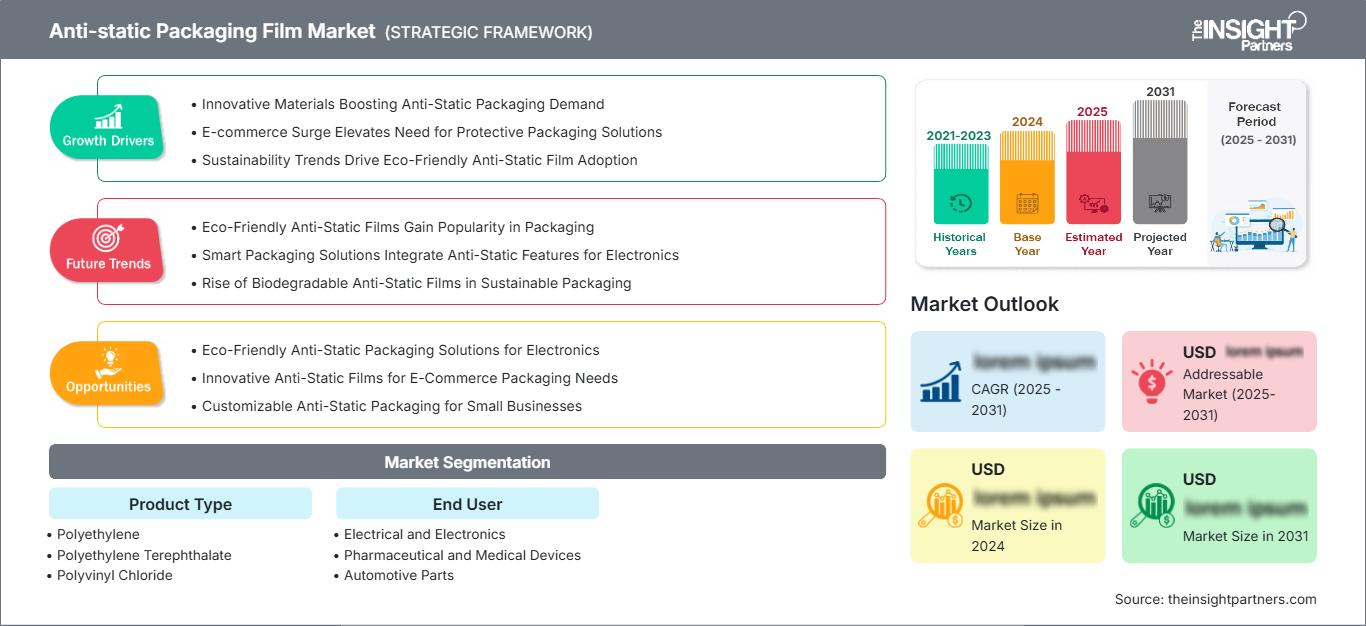
Anti-static Packaging Film Market: Strategic Insights
Regional Insights
North America anti-static packaging film market
North America is estimated to represent 27–31% of the anti-static packaging film market share in 2025, with regional growth of 5.4–5.9% CAGR during 2026–2034. The US dominates regional consumption because semiconductor, aerospace, medical-device, automotive-electronics, and industrial manufacturing facilities require controlled packaging for ESD-sensitive components. Canada contributes through electronics, automotive, and healthcare manufacturing.
There is value in the existence of ESD management systems and procurement guidelines which now more often than not require a quantifiable measure of electrical properties over generic antistatic characteristics. Packaging for semiconductors and automated handling of components drive the need for low particle generation films with stable resistivity. Producers are addressing sustainability concerns through gauge reduction, recycling content where practical, and developing recyclable film structures.
U.S. anti-static packaging film Market
The United States constitutes about 79–83% of the total North American anti-static packaging films market by 2025, which has an estimated CAGR of 5.5-6.0% during 2034. The demand is mainly centered on semiconductor manufacture, electronics assembly, medical devices, automotive electronics, aerospace systems, and expensive industrial parts. Key players have their competition in terms of technical qualification and distribution services.
Moreover, the market is driven by ESD control requirements for packaging, transport, and handling. In this regard, the property and requirements for anti-static packaging that protect electrostatic discharge-sensitive items are provided by the IEC 61340-5-3 standard. Furthermore, the IEC 61340-5-1 standard provides the ESD control requirements for organizations that handle electrical and electronic products.
Europe anti-static packaging film Market
Europe is estimated to be a market share of 23% to 27% in 2025 and will see growth of 4.9% to 5.5% CAGR from 2026 to 2034. Germany is expected to lead the pack in Europe, followed by the UK, France, Italy, and Spain, driven by electronics, automotive, industrial machinery, and pharma manufacturing needs for protected packaging films.
The UK is driven by electronics logistics, medtech, aerospace, and industrial supply chain. Germany has the most structurally driven demand due to automotive and industrial electronics industry, where sensitive modules need controlled environment to be handled. France has combination of aerospace, healthcare, electronics, and industrial applications, and Italy and Spain provide demand via automotive, machinery, pharmaceuticals, and electronics industries. Sustainability drivers have become more prominent in film specification choices across Europe in recent years.
APAC anti-static packaging film Market
APAC holds 35-39% market share in 2025 and sees the most robust regional expansion of 6.4-7.0% CAGR till 2034. China takes the lead in the region, followed by Japan and South Korea, while there is further demand from India and Australia. Applications such as semiconductor packaging, consumer electronics, automotive electronics, and battery production drive regional consumption.
China has an established electronics ecosystem, Japan has semiconductor packaging and other precision manufacturing applications, and South Korea has memory, display, and batteries production applications. India sees growth in electronics assembly and component manufacture, whereas Australia continues to remain relatively niche in electronics production. Domestic electronics manufacturing and semiconductor investments could drive demand for ESD protection packaging in the region.
Middle East & Africa anti-static packaging film Market
Middle East and Africa is a developing market segment, with high demand in Saudi Arabia, UAE, South Africa, and other industrializing countries. The regional growth rate is forecast to be in the range of 4.5–5.1% CAGR from 2026 to 2034, driven by diversification of manufacturing operations and upgrades in logistics facilities.
Developing countries like Saudi Arabia and UAE are upgrading their industrial facilities, thereby providing an opportunity for specialized packaging solutions. South Africa continues to lead the sub-region in terms of industrial, automotive, healthcare, and electronic applications. The region is progressively transitioning from being a commodities-based economy to that of localized manufacturing operations, with increasing investment in energy and infrastructure leading to transportation of sensitive electrical equipment.

Segmentation Analysis
Product Type
Polyethylene, polyethylene terephthalate, and polyvinyl chloride serve different performance requirements across the packaging ecosystem. The segment is projected to expand at 5.7–6.2% CAGR from 2026–2034. Material selection depends on flexibility, dimensional stability, transparency, electrical properties, sealing behavior, and compatibility with downstream converting processes. The anti-static packaging film market scope therefore spans both commodity-oriented protective films and specialized structures designed for sensitive components.
- Polyethylene: Widely used where flexibility, toughness, heat sealing, and cost efficiency are priorities. PE supports bags, liners, wraps, and protective films and is compatible with high-volume conversion processes.
- Polyethylene Terephthalate: Selected for dimensional stability, strength, clarity, and thermal performance. PET is strategically important for demanding electronics and industrial packaging applications requiring consistent film geometry.
- Polyvinyl Chloride: Used where controlled flexibility, clarity, durability, and specialized formulation characteristics are required. PVC remains relevant in industrial and electronics-related protective-film applications.
End User
End-user demand is shaped by the sensitivity, value, handling frequency, and regulatory requirements of packaged products. The segment is expected to grow at 5.9–6.4% CAGR from 2026–2034. Electronics remains the principal demand center, while pharmaceutical, automotive, and food-related applications provide diversification. The anti-static packaging film market trends increasingly favor films capable of combining static control with cleanliness, transparency, mechanical protection, and material-efficiency objectives.
- Electrical and Electronics: The leading application area, requiring controlled charge generation for semiconductors, circuit boards, displays, sensors, modules, and other sensitive components during manufacturing and transportation.
- Pharmaceutical and Medical Devices: Uses antistatic films where sensitive devices, sterile products, and controlled logistics require protection from static-related handling risks without compromising packaging cleanliness.
- Automotive Parts: Demand is expanding for electronic control units, sensors, connectors, battery-related components, and other modules requiring protection during tiered automotive supply-chain transportation.
- Food and Beverages: Represents a smaller specialized opportunity where static control can support film handling, automated packaging, and particulate-management requirements, particularly for specialized industrial packaging environments.
Opportunity Snapshot
| End User | Revenue Contribution | Trend Tag | Adoption Stage |
|---|---|---|---|
| Electrical and Electronics | High | ESD Protection | Mature |
| Pharmaceutical and Medical Devices | Medium | Clean Packaging | Scaling |
| Automotive Parts | Medium | EV Electronics | Scaling |
| Food and Beverages | Low | Automated Handling | Emerging |
Anti-static Packaging Film Market Growth Drivers and Impact Analysis
Increasing Semiconductor and Electronics Manufacturing
Expansion of semiconductor, PCB, sensor, display, and electronic-module production directly increases the number of components requiring controlled handling. As device architectures become more compact and electrically sensitive, packaging failures caused by uncontrolled electrostatic events can create disproportionately high quality and yield consequences. This makes antistatic films an increasingly important component of the broader ESD-control system rather than simply a protective wrapping material. Manufacturers supplying electronics packaging therefore have opportunities to differentiate through stable electrical characteristics, low contamination, and compatibility with automated handling. The impact extends across upstream resin formulation, film extrusion, conversion, testing, and distribution. Suppliers with validated electrical performance can secure longer qualification cycles and stronger customer retention because packaging materials become embedded within controlled production procedures.
Growth of Automated Component Handling and Logistics
Automation is changing how sensitive components are transferred between production stations, warehouses, and assembly facilities. Robotic gripping, conveyor movement, automated storage, and high-speed sorting create repeated contact and separation events that can generate electrostatic charge. Packaging materials must therefore maintain predictable electrical performance during rapid mechanical handling rather than only under static warehouse conditions. This favors films with durable antistatic characteristics, controlled surface resistivity, and adequate puncture and tear resistance. The impact is particularly relevant for semiconductor and automotive-electronics supply chains, where components can pass through multiple suppliers before final assembly. Film manufacturers can benefit by designing products around automated handling specifications, including consistent thickness, surface characteristics, sealing performance, and compatibility with machine-readable packaging formats.
Expansion of High-Value Medical and Automotive Electronics
Medical devices and automotive systems are becoming more electronics-intensive, increasing the number of components that require specialized transportation protection. Sensors, control modules, diagnostic equipment, power-management electronics, and battery-related components can carry high replacement or failure costs, strengthening the economic rationale for controlled packaging. Automotive electrification further expands the number of electronic modules moving through multi-tier supply chains. Medical-device manufacturers similarly require packaging that combines protection with cleanliness and traceability. This creates opportunities for higher-performance films rather than purely price-driven materials. Suppliers can capture value through customized thicknesses, controlled electrical properties, clean manufacturing conditions, and documentation that supports customer qualification. The resulting demand is less dependent on packaging volume alone and increasingly influenced by the criticality and value of the packaged component.
Anti-static Packaging Film Market Future Trends
Shift Toward Recyclable Antistatic Film Structures
Sustainability considerations are expected to increasingly influence the formulation and construction of antistatic films. Future products will move toward mono-material structures, reduced gauge, recyclable substrates, and additive systems that minimize interference with recycling processes. PE-based structures are particularly positioned for development because they can support flexible packaging configurations while maintaining processability. PET films will continue serving applications where performance requirements outweigh material simplification. Manufacturers are likely to invest in additive technologies that deliver static dissipation at lower concentrations, reducing the material burden associated with functional performance. Film producers will also increasingly provide customers with recyclability information, recycled-content options, and lifecycle-related technical documentation. The competitive advantage will shift toward balancing ESD performance, durability, recyclability, and processing efficiency within one packaging structure.
Integration of Functional Performance Beyond Static Control
Future product development will increasingly combine antistatic performance with barrier, moisture resistance, low particle generation, optical clarity, heat resistance, and mechanical protection. This reflects the changing requirements of electronics and high-value industrial supply chains, where one packaging layer is expected to perform several functions. Multilayer films can provide differentiated surface properties while preserving a strong mechanical core, allowing manufacturers to tailor electrical performance to the packaged component. Greater integration with automated packaging equipment will also encourage precise dimensional control and improved seal consistency. The anti-static packaging film market trends will therefore move toward application-engineered materials rather than generic antistatic grades. Suppliers capable of jointly optimizing electrical, mechanical, optical, and environmental properties should be better positioned for demanding qualification programs.
Anti-static Packaging Film Market Opportunities
Specialized Packaging for Semiconductor and Battery Supply Chains
Semiconductor and battery manufacturing provide attractive opportunities for specialized antistatic film suppliers because both industries involve high-value components and tightly controlled handling environments. Packaging developers can target wafer-related materials, electronic modules, battery-management systems, connectors, sensors, and intermediate components requiring controlled charge behavior. The opportunity extends beyond basic film supply toward engineered structures with low contamination, controlled surface resistance, dimensional stability, and compatibility with automated equipment. The anti-static packaging film market Forecasts indicate that customers will increasingly evaluate total protection performance rather than film price alone. Producers can therefore invest in application laboratories, electrical testing, clean manufacturing capabilities, and customer qualification programs. Strategic partnerships with electronics and battery manufacturers can also shorten product-development cycles and establish recurring demand for customized film grades.
Localized Specialty Film Production in Emerging Manufacturing Hubs
Electronics and automotive supply chains are increasingly diversifying manufacturing locations, creating opportunities for regional film production closer to customers. India, Southeast Asia, Mexico, and selected Eastern European economies can support specialty-film capacity as manufacturers seek shorter lead times and reduced supply-chain dependence. Local production can also improve customization, technical support, and inventory management for converters and component manufacturers. Investors should prioritize facilities capable of producing multiple polymer substrates and specialty electrical grades rather than commodity films alone. Integrating extrusion, coating, slitting, testing, and conversion can improve responsiveness to customer specifications. The market size opportunity in emerging manufacturing hubs is therefore linked not only to volume growth but also to localization of technically demanding packaging materials.
Recent Developments
- December 23, 2025: Cosmo First Limited expanded its flexible packaging portfolio with new BOPP, CPP, and BOPET films for pet food applications, including a high-heat-resistant transparent BOPP film. The development illustrates continued investment in specialty film structures combining performance and packaging functionality.
- November 10, 2025: TOPPAN Holdings Inc. announced a hybrid manufacturing line in India capable of producing both BOPP and BOPE films. The line is designed to increase film production capacity by approximately 40% and support recyclable mono-material packaging structures.
Frequently Asked Questions

- Comprehensive Market Sizing and Forecast Analysis
- Detailed Segmentation Analysis
- In-Depth Market Dynamics Assessment
- Regional and Country-Level Insights
- Competitive Landscape and Company Benchmarking
- Strategic Business Intelligence
Recent Reports
Testimonials

The Insight Partners provided valuable market intelligence that supported our global go-to-market strategy. Their team was professional, responsive, and attentive to our feedback, providing thoughtful analysis and helpful methodological clarifications throughout the project.
Junmo Kim Chief Financial Officer (CFO), Enertech Co., Ltd.
The Insight Partners' SCADA System Market report is comprehensive, with valuable insights on current trends and future forecasts. The team was highly professional, responsive, and supportive throughout. We are very satisfied and highly recommend their services.
RAN KEDEM Partner, Reali Technologies LTDs
I requested a report on a very specific software market and the team produced the report in a few days. The information was very relevant and well presented. I then requested some changes and additions to the report. The team was again very responsive and I got the final report in less than a week.
JEAN-HERVE JENN Chairman, Future Analytica
We worked with The Insight Partners for an important market study and forecast. They gave us clear insights into opportunities and risks, which helped shape our plans. Their research was easy to use and based on solid data. It helped us make smart, confident decisions. We highly recommend them.
PIYUSH NAGPAL Sr. Vice President, High Beam Global
The Insight Partners delivered insightful, well-structured market research with strong domain expertise. Their team was professional and responsive throughout. The user-friendly website made accessing industry reports seamless. We highly recommend them for reliable, high-quality research services
YUKIHIKO ADACHI CEO, Deep Blue, LLC.
This is the first time I have purchased a market report from The Insight Partners.While I was unsure at first, I visited their web site and felt more comfortable to take the risk and purchase a market report.I am completely satisfied with the quality of the report and customer service. I had several questions and comments with the initial report, but after a couple of dialogs over email with their analyst I believe I have a report that I can use as input to our strategic planning process.Thank you so much for taking the extra time and making this a positive experience.I will definitely recommend your service to others and you will be my first call when we need further market data.
JOHN SUZUKI President and Chief Executive Officer, Board Director, BK Technologies
I wish to appreciate your support and the professionalism you displayed in the course of attending to my request for information regarding to infectious disease IVD market in Nigeria. I appreciate your patience, your guidance, and the fact that you were willing to offer a discount, which eventually made it possible for us to close a deal. I look forward to engaging The Insight Partners in the future, all thanks to the impression you have created in me as a result of this first encounter.
DR CHIJIOKE ONYIA MANAGING DIRECTOR, PineCrest Healthcare Ltd.Reason to Buy
- Informed Decision-Making
- Understanding Market Dynamics
- Competitive Analysis
- Identifying Emerging Markets
- Customer Insights
- Market Forecasts
- Risk Mitigation
- Boosting Operational Efficiency
- Strategic Planning
- Investment Justification
- Tracking Industry Innovations
- Aligning with Regulatory Trends





 Get Free Sample for