
Antiblock Additive Market Size, Share & Forecast by 2034
Antiblock Additive Market Size and Forecasts (2021 - 2034), Global and Regional Share, Trends, and Growth Opportunity Analysis Report Coverage : by Product Type (Organic and Inorganic); Polymer Type (LLDPE, LDPE, HDPE, BOPP, PVC); Application (Food and Beverages, Pharmaceuticals, Agriculture); and Geography (North America, Europe, Asia Pacific, and South and Central America)
- Status : Data Released
- Report Code : TIPRE00040343
- Category : Chemicals and Materials
- No. of Pages : 150
- Available Report Formats :


- Last update date : October 26, 2026


2025 Market Size
US$ 1.34 Bn
Base year value
2034 Forecast
US$ 2.26 Bn
Projected by 2034
CAGR 2026-2034
6.00 %
Growth rate
Addressable Market
US$ 16.32 Bn
(2026-2034)
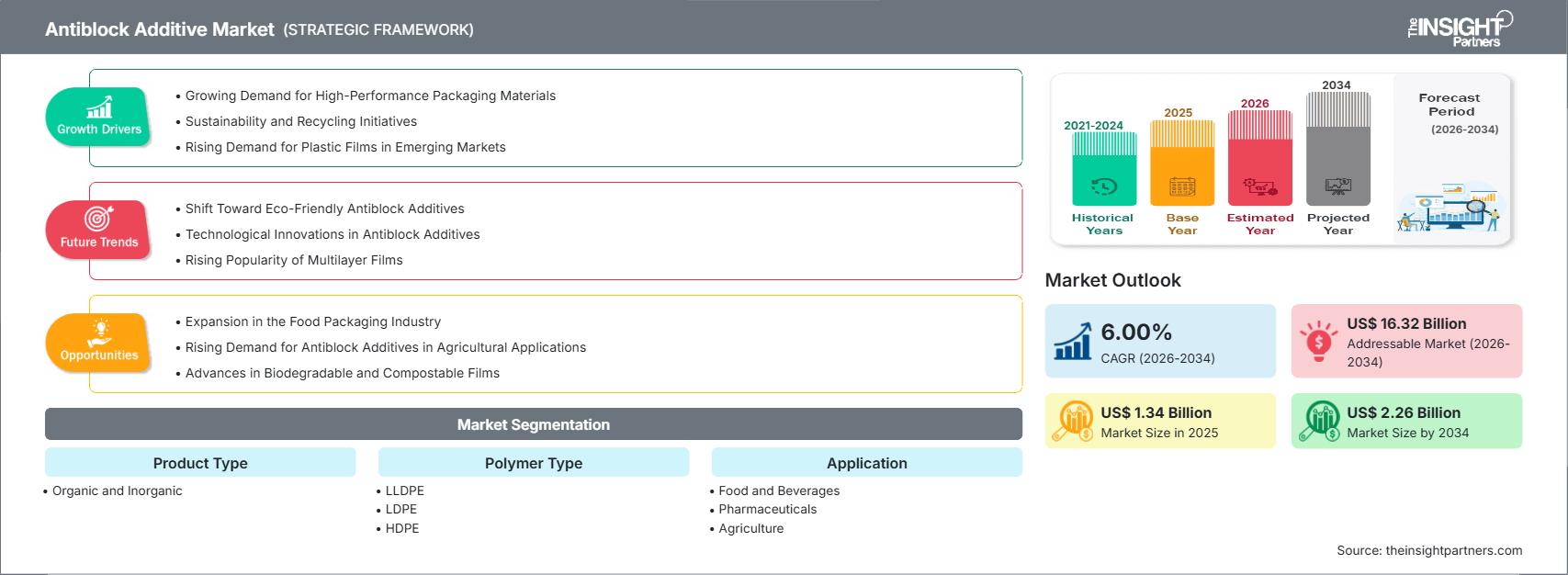
The antiblock additive market was valued at US$ 1.34 Billion in 2025 and is projected to reach US$ 2.26 Billion by 2034, expanding at a 6.00% CAGR from 2026 to 2034. Demand is supported by increasing use of flexible polymer films, higher film-line productivity requirements, and growing emphasis on surface performance, transparency, machinability, and packaging efficiency across food, pharmaceutical, and agricultural applications.
North America represents a technologically mature market, supported by sophisticated flexible-film conversion, established food and pharmaceutical packaging industries, and continuous development of high-clarity additive formulations. The antiblock additive market size in the region is expected to expand at approximately 5.0–5.8% CAGR during 2026–2034, with demand increasingly shifting toward engineered, low-dosage, and regulatory-compliant formulations.
Antiblock Additive Market Assessment and Insights
- North America: North America accounted for approximately 24–28% Antiblock Additive Market share in 2025 and is projected to grow at 5.0–5.8% CAGR between 2026–2034, supported by advanced film conversion, food packaging, and specialty polymer processing.
- US: The US represented approximately 78–82% of North America's 2025 demand and is expected to grow at 4.9–5.7% CAGR during 2026–2034, led by flexible packaging and pharmaceutical films.
- Europe: Europe held approximately 21–25% share in 2025 and is projected to register 5.2–6.0% CAGR during 2026–2034. Germany, Italy, France, Spain, and the UK remain important markets because of established film-converting and packaging industries.
- Asia Pacific: Asia Pacific represented approximately 43–47% share in 2025 and is expected to expand at 6.5–7.3% CAGR during 2026–2034, with China, Japan, South Korea, and India providing the strongest demand base.
- Largest Segment: Inorganic products represented approximately 65–70% market share in 2025 and are projected to grow at 5.6–6.4% CAGR during 2026–2034, supported by silica and mineral-based solutions.
- High Growth Segment: BOPP represented approximately 15–19% market share in 2025 and is expected to expand at 6.8–7.6% CAGR during 2026–2034, supported by high-speed packaging-film conversion.
- Key companies analyzed in detail: W. R. Grace & Co., Specialty Minerals Inc., Honeywell International Inc., Fine Organics, Ampacet Corporation, LyondellBasell Industries N.V., Avient Corporation, Wells Plastics Limited, Elementis plc, Imerys S.A., Tosaf Group Ltd., and Evonik Operations GmbH.
Source: The Insight Partners' analysis based on proprietary research, government publications, company annual reports, investor presentations, industry databases, and expert interviews.
The Antiblock Additive Market has evolved from conventional mineral-based antiblocking toward engineered particle systems, optimized masterbatch dispersion, and formulations designed to balance blocking force, coefficient of friction, haze, transparency, and processability. Film producers increasingly require additives that operate at lower loading while maintaining consistent performance across thinner structures, multilayer films, and high-throughput extrusion lines.
Looking ahead, investment in the Antiblock Additive Market is likely to concentrate on Asia Pacific film capacity, recyclable mono-material structures, high-clarity packaging, and additive systems compatible with recycled polymers. Regulatory pressure surrounding packaging recyclability and food-contact compliance should favor suppliers capable of providing controlled particle morphology, predictable migration behavior, and documentation across multiple polymer systems and end-use applications.
Antiblock Additive Market Report Scope
| Report Attribute | Details |
|---|---|
| Market size in 2025 | US$ 1.34 Billion |
| Market Size by 2034 | US$ 2.26 Billion |
| Global CAGR (2026 - 2034) | 6.00% |
| Historical Data | 2021-2024 |
| Forecast period | 2026-2034 |
Antiblock Additive Market Analysis
The antiblock additive market growth is closely connected with polymer-film output because blocking can disrupt winding, storage, converting, and bag-opening operations. The value chain begins with silica, talc, diatomaceous earth, organic additives, and specialty mineral inputs, followed by particle treatment or formulation, masterbatch production, film extrusion, conversion, and packaging. Suppliers compete on dispersion, optical performance, dosage efficiency, and polymer compatibility.
Supply dynamics in the Antiblock Additive Market differ by product category. Inorganic products benefit from established mineral-processing infrastructure, while engineered and organic formulations depend more heavily on formulation expertise and additive chemistry. Film producers typically qualify grades through application testing, making consistency and technical support important purchasing criteria. Food-contact requirements further influence supplier selection because additive purity, migration behavior, and regulatory documentation can affect customer approval cycles.
The competitive landscape in the Antiblock Additive Market is moderately consolidated, with established additive suppliers competing alongside masterbatch producers and specialty mineral companies. W. R. Grace & Co. emphasizes synthetic silica for polymer films, while Specialty Minerals Inc. and Imerys S.A. participate through mineral-based solutions. Ampacet Corporation combines antiblocking technologies with broader additive masterbatch capabilities, strengthening its position with film converters requiring integrated formulations.
Avient Corporation, Tosaf Group Ltd., and Evonik Operations GmbH reinforce competition through specialized polymer-additive technologies, including solutions for flexible packaging and high-clarity films. Strategic positioning increasingly depends on low-dosage performance, compatibility with recycled resins, and solutions supporting mono-material packaging. Investment is therefore moving toward product development and application engineering rather than relying solely on commodity-volume expansion.
● REPORT CUSTOMIZATION
Tailor This Report To Align With Your Specific Business Requirements
This report can be customized to align precisely with your business objectives, scope, and target markets. Customization options include tailored segmentation, geography, competitive analysis, and strategic insights to support informed decision-making.
Customize This Report →WHAT YOU CAN ADJUST
- ● Segmentations
- ● Geography
- ● Competitive Analysis
- ● Language Preferences
Antiblock Additive Market: Strategic Insights
Regional Insights
North America Antiblock Additive Market
North America accounted for 24–28% Antiblock Additive Market in 2025 and is projected to grow at 5.0–5.8% CAGR during 2026–2034. The USA continues to be the leading regional market on the back of its sizeable capacity of flexible packaging converting, well-developed food industry, pharmaceuticals manufacturing, and polyethylene and polypropylene films. Increasingly, the demand trend is moving towards high clarity and low dosage compositions which retain optical qualities while improving film processing.
Canadian and Mexican markets support regional demand through food packaging applications, agricultural films, industrial packaging applications, and inter-regional polymer conversion. Growth opportunities are associated with investments in recyclable packages and films, light-weight films, and faster extrusion. Suppliers with well-established technology centers and full documentation are set to profit from this trend as the converters are qualifying additives for recyclable and downgauged products. Growth of the regional market should be moderate rather than high as additive penetration is relatively advanced in the region.
United States Antiblock Additive Market
The US represented 78–82% of North America's 2025 demand and is projected to grow at 4.9–5.7% CAGR during 2026–2034. Flexible food packaging continues to be an important end use, while pharmaceutical films, agricultural films, and industrial packaging increase end-use scope. US domestic additive producers will benefit from existing customer qualification processes and nearness to large film converting operations.
Increasingly, growth will be tied to advanced polyethylene and polypropylene films where control of haze levels, surface friction, and winding performance is needed. Producers like W. R. Grace & Co., Ampacet Corporation, Avient Corporation, and Honeywell International Inc. have related technology and polymer additive offerings for US converters. Demand for mechanically recycled polyolefin-based formulations may result from content recycled needs and monomaterial packaging trends.
Europe Antiblock Additive Market
Europe accounted for 21–25% share in 2025 and is expected to expand at 5.2–6.0% CAGR during 2026–2034. Germany takes the lead in this region, followed by Italy, France, Spain, and the UK. Sustainability of packaging policies in Europe is motivating film manufacturers to enhance the recyclability of their films without impacting their processability or surface quality.
Germany and Italy have a high level of film extrusion and converting capacities, while France and Spain have a high level of demands for food and consumer packaging. The UK has importance for flexible packaging and pharmaceuticals. European film manufacturers are focusing on evaluation of additives based on recyclability, food contact suitability, downgauging performance, and monomaterial compatibility. This has a positive impact on antiblock systems.
Asia Pacific Antiblock Additive Market
APAC represented 43–47% share in 2025 and is projected to grow at 6.5–7.3% CAGR during 2026–2034, making it the leading regional market. The major source of demand comes from China, with Japan, South Korea, India, and Australia making up the demand through packaging, agriculture, and polymerization activities.
With China having high film-making capabilities, it provides regional volumes of demand, while India has the potential for high incremental demand from food packages, agriculture, and consumer goods. Japan and South Korea focus on high performance films and converting activities, while Australia helps through packaging and agriculture applications.
Middle East & Africa Antiblock Additive Market
The Middle East and Africa market is supported by polyethylene production, packaging conversion, agriculture, and infrastructure-linked polymer consumption. Saudi Arabia and the UAE are important regional hubs because of petrochemical integration and growing downstream plastics capacity, while South Africa provides a significant packaging-conversion base.
Demand in the Antiblock Additive Market is expected to expand at approximately 5.4–6.2% CAGR during 2026–2034, with Saudi Arabia leading the regional market. Integrated petrochemical operations can improve access to polymer feedstocks, while investments in downstream manufacturing support film production. Agricultural films and food packaging provide additional demand in markets where controlled film handling is increasingly important.
Segmentation Analysis
Type
Inorganic products remain the leading category because mineral and silica-based systems provide reliable antiblocking performance, broad polymer compatibility, and established commercial availability. The segment is projected to grow at 5.6–6.4% CAGR during 2026–2034, while organic products gain attention where transparency and low interaction with migratory additives are prioritized.
- Organic: Organic antiblocks are increasingly selected for high-clarity films and applications where optical performance, low additive interaction, and controlled surface properties are critical, particularly in premium packaging structures.
- Inorganic: Inorganic grades remain widely used because silica, talc, and diatomaceous-earth systems combine cost efficiency, reliable surface texturing, and compatibility with high-volume polyolefin film manufacturing.
Polymer
The polymer segment is driven primarily by flexible-film production, with performance requirements varying according to polymer crystallinity, extrusion temperature, film thickness, and conversion speed. This segment is projected to expand at 6.1–6.9% CAGR during 2026–2034, supported by polyolefin packaging demand.
- LLDPE: LLDPE films require antiblocking systems that balance surface separation with clarity and seal performance, making the polymer important for bags, stretch structures, food packaging, and agricultural films.
- LDPE: LDPE remains important in blown-film applications where softness and surface contact can increase blocking, creating sustained demand for compatible silica and engineered particle formulations.
- HDPE: HDPE applications emphasize machinability and easy opening, particularly in bags and industrial films, creating demand for additives that provide surface separation without adversely affecting film strength.
- BOPP: BOPP films require high optical quality and controlled friction during rapid conversion, increasing demand for engineered antiblocks that minimize scuffing, haze, and processing variability.
- PVC: PVC applications require formulation compatibility and controlled surface behavior, particularly in sheets, films, and specialty packaging structures where additive interaction can influence appearance and processing.
Application
Application demand is concentrated in packaging-related films because film blocking directly affects winding, storage, conversion, and end-use handling. The segment is projected to grow at 5.9–6.7% CAGR during 2026–2034, with food and beverages remaining the largest application.
- Food and Beverages: Food packaging represents the principal demand center because high-volume film production requires reliable unwinding, sealing, bag opening, and optical performance across flexible packaging formats.
- Pharmaceuticals: Pharmaceutical applications prioritize regulatory compliance, cleanliness, consistency, and controlled film handling, creating opportunities for specialized antiblocks with documented composition and predictable performance.
- Agriculture: Agricultural films require dependable separation and processing performance across greenhouse, mulch, and protective-film applications, particularly where large film surfaces are exposed to heat and storage pressure.
Opportunity Snapshot
| Application | Revenue Contribution | Trend Tag | Adoption Stage |
|---|---|---|---|
| Food and Beverages | High | Flexible Packaging | Mature |
| Pharmaceuticals | Medium | Clean Films | Scaling |
| Agriculture | Medium | Greenhouse Films | Scaling |
Antiblock Additive Market Growth Drivers and Impact Analysis
Higher Extrusion and Converting Speeds
The Antiblock Additive Market forecast shows that higher extrusion and converting speeds increase the economic consequences of film blocking because even small surface-contact problems can create winding instability, production interruptions, scrap, and additional labor. The effect that antiblock agents give is quite minor from a formulation point of view; however, it could significantly enhance separation and processing. This applies especially to polyethylene and polypropylene films employed in packaging applications, in which case converters always look for increased speeds and thinner gauge rates. As the film gets thinner, the task of retaining proper surface separation while minimizing haze gets increasingly difficult. In this context, there is a preference for suppliers who can provide consistent particle size, dispersion capability, and coefficient of friction characteristics.
Transition Toward Mono-Material Packaging
The transition toward mono-material packaging is creating a distinct formulation requirement because recyclable structures must maintain processing and functional performance while reducing incompatible material layers. Mono-material films made from polyethylene are becoming more and more competitive versus the conventional multilayer films in some packaging applications, thus increasing the need for additives which would be suitable for oriented and advanced PE films. The antiblock agents should enable surface separation without affecting such characteristics as transparency, ability to seal, recyclability, and others. That means that in the case of the development of the antiblock system, the choice of suppliers will be based not on the price but on application engineering and compatibility with materials.
Stricter Food and Pharmaceutical Packaging Requirements
Greater control is now being exercised regarding the composition, migration, purity, and documentation associated with packaging of foodstuffs and pharmaceuticals. Antiblock formulations employed in these segments must retain their functionality while avoiding the creation of undesirable reactions with the goods to be packaged or other additives. In addition to the traditional performance criteria, such trends make the importance of regulatory knowledge significant. Companies that have comprehensive documentation and traceability, as well as reliable production processes, may save their customers’ qualification time, and also help multi-national converters that operate in multiple regulatory environments. This is especially valid for high-end packaging films, where a formulation change entails considerable validation effort. As a result, the market begins to divide itself between minerals for commodities and technically specialized products.
Antiblock Additive Market Future Trends
Engineered Particle Morphology and Lower Additive Loading
The Antiblock Additive Market trends show that future product development will increasingly focus on controlling particle morphology, size distribution, surface chemistry, and dispersion to obtain higher antiblocking efficiency at lower loading levels. Conventional mineral additives can provide reliable performance but may influence haze, gloss, or additive adsorption when formulations are pushed toward demanding optical specifications. Engineered spherical or narrowly distributed particles can address some of these trade-offs. Development programs are therefore likely to emphasize the simultaneous optimization of blocking force, transparency, coefficient of friction, and processing behavior. Lower dosage can also reduce formulation costs and minimize the influence of additives on recycling streams. This direction should strengthen the position of specialty silica and engineered mineral technologies in premium packaging films.
Antiblock Systems for Recycled and Multifunctional Films
As recycled polyolefin content increases, additive developers will need to account for greater variability in polymer molecular weight, contamination, additive history, and processing stability. Antiblock systems developed for virgin resin cannot automatically deliver identical results in recycled feedstocks because changes in surface chemistry and contaminant levels can influence dispersion and film behavior. Future formulations are therefore likely to emphasize robust performance across wider resin variability. Suppliers may increasingly develop application-specific masterbatches that combine antiblocking with slip, antistatic, or processing functionality. Such multifunctional formulations can simplify dosing and reduce the number of additives introduced into recycled film structures, supporting converters seeking stable performance while increasing recycled content.
Antiblock Additive Market Opportunities
Premium High-Performance Packaging Films
The antiblock Additive Market report indicates that premium food, personal-care, and pharmaceutical packaging offers suppliers an opportunity to move beyond commodity antiblocking based primarily on cost. These applications place greater emphasis on transparency, low haze, controlled coefficient of friction, seal performance, and consistent appearance. Producers can differentiate through engineered particle systems that maintain antiblocking efficiency without creating visible surface defects. The opportunity is particularly attractive in multilayer and downgauged films, where small changes in additive performance can have a pronounced optical impact. Investment in application laboratories, film-testing capabilities, and customer-specific formulation development can strengthen supplier relationships with converters. Companies that demonstrate measurable improvements in clarity, processing stability, and additive efficiency can potentially secure longer qualification cycles and higher-value product positions.
Localized Masterbatch Development in Emerging Markets
Emerging film-producing markets provide opportunities for localized masterbatch development because polymer grades, processing equipment, additive preferences, and regulatory requirements differ across regions. India, Southeast Asia, the Middle East, and selected Latin American markets are expanding flexible packaging and agricultural-film capacity, creating demand for technically supported additive solutions. Localized production can shorten delivery times, reduce inventory requirements, and enable formulations to reflect regional resin and processing conditions. Suppliers can also use regional technical centers to conduct film trials with converters before commercial qualification. This approach may be particularly valuable for medium-sized film producers that require formulation assistance but do not maintain extensive internal research capabilities. Regional partnerships therefore represent a practical route to market penetration.
Recent Developments
- March 01, 2026: Cosmo Speciality Chemicals, a subsidiary of Cosmo First Limited, launched an expanded portfolio of high-performance masterbatches, including its CosmoAdd additive range for BOPP, CPP, and blown-film applications. The portfolio specifically includes antiblock, antistatic, slip, cavitating, antioxidant, and clarifier additives, strengthening the company's position in value-added film-processing solutions.
- February 10, 2026: Ampacet Corporation showcased application-focused masterbatch and additive technologies at Plastindia 2026 in New Delhi, including slip and antiblock additives for plastics processing. Its portfolio addresses pharmaceutical packaging, agricultural films, consumer products, and industrial applications, highlighting increasing demand for multifunctional additive solutions in film manufacturing.
Frequently Asked Questions

- Comprehensive Market Sizing and Forecast Analysis
- Detailed Segmentation Analysis
- In-Depth Market Dynamics Assessment
- Regional and Country-Level Insights
- Competitive Landscape and Company Benchmarking
- Strategic Business Intelligence
Recent Reports
Testimonials

The Insight Partners provided valuable market intelligence that supported our global go-to-market strategy. Their team was professional, responsive, and attentive to our feedback, providing thoughtful analysis and helpful methodological clarifications throughout the project.
Junmo Kim Chief Financial Officer (CFO), Enertech Co., Ltd.
The Insight Partners' SCADA System Market report is comprehensive, with valuable insights on current trends and future forecasts. The team was highly professional, responsive, and supportive throughout. We are very satisfied and highly recommend their services.
RAN KEDEM Partner, Reali Technologies LTDs
I requested a report on a very specific software market and the team produced the report in a few days. The information was very relevant and well presented. I then requested some changes and additions to the report. The team was again very responsive and I got the final report in less than a week.
JEAN-HERVE JENN Chairman, Future Analytica
We worked with The Insight Partners for an important market study and forecast. They gave us clear insights into opportunities and risks, which helped shape our plans. Their research was easy to use and based on solid data. It helped us make smart, confident decisions. We highly recommend them.
PIYUSH NAGPAL Sr. Vice President, High Beam Global
The Insight Partners delivered insightful, well-structured market research with strong domain expertise. Their team was professional and responsive throughout. The user-friendly website made accessing industry reports seamless. We highly recommend them for reliable, high-quality research services
YUKIHIKO ADACHI CEO, Deep Blue, LLC.
This is the first time I have purchased a market report from The Insight Partners.While I was unsure at first, I visited their web site and felt more comfortable to take the risk and purchase a market report.I am completely satisfied with the quality of the report and customer service. I had several questions and comments with the initial report, but after a couple of dialogs over email with their analyst I believe I have a report that I can use as input to our strategic planning process.Thank you so much for taking the extra time and making this a positive experience.I will definitely recommend your service to others and you will be my first call when we need further market data.
JOHN SUZUKI President and Chief Executive Officer, Board Director, BK Technologies
I wish to appreciate your support and the professionalism you displayed in the course of attending to my request for information regarding to infectious disease IVD market in Nigeria. I appreciate your patience, your guidance, and the fact that you were willing to offer a discount, which eventually made it possible for us to close a deal. I look forward to engaging The Insight Partners in the future, all thanks to the impression you have created in me as a result of this first encounter.
DR CHIJIOKE ONYIA MANAGING DIRECTOR, PineCrest Healthcare Ltd.Reason to Buy
- Informed Decision-Making
- Understanding Market Dynamics
- Competitive Analysis
- Identifying Emerging Markets
- Customer Insights
- Market Forecasts
- Risk Mitigation
- Boosting Operational Efficiency
- Strategic Planning
- Investment Justification
- Tracking Industry Innovations
- Aligning with Regulatory Trends





 Get Free Sample for