
Antidegradants Market Size, Trends & Growth by 2034
Coverage: By Category (Primary, Secondary); Type (Antioixdants, Antiozonants); Application (Tire, Non-Tire) , and Geography (North America, Europe, Asia Pacific, and South and Central America)
- Status : Data Released
- Report Code : TIPRE00021784
- Category : Chemicals and Materials
- No. of Pages : 150
- Available Report Formats :


- Last update date : August 27, 2026


2025 Market Size
US$ 3.4 Bn
Base year value
2034 Forecast
US$ 4.71 Bn
Projected by 2034
CAGR 2026-2034
3.69 %
Growth rate
Addressable Market
US$ 36.84 Bn
(2026-2034)
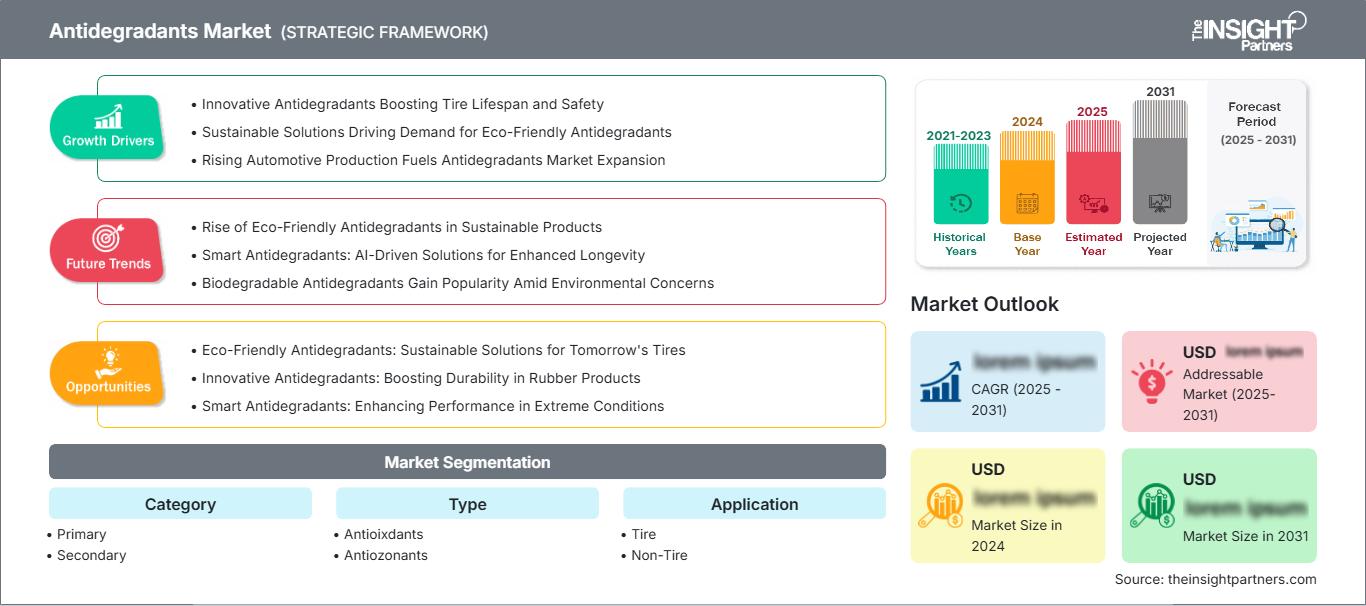
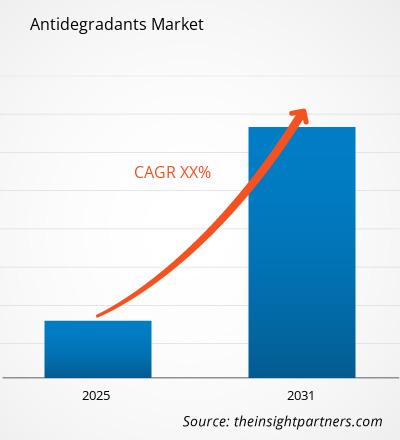
The Antidegradants market was valued at US$ 3.4 billion in 2025 and is expected to reach US$ 4.71 billion by 2034; it is estimated to record a CAGR of 3.69% during 2026-2034.
Antidegradants Market Assessment and Insights
- North America: The region represented an estimated 28–32% share in 2025 and is projected to grow at 4.5–5.0% CAGR between 2026–2034, supported by mature tire manufacturing, replacement demand, and environmental scrutiny of conventional tire chemicals.
- US: The US accounted for approximately 78–82% of North America in 2025 and is expected to grow at 4.4–4.9% CAGR during 2026–2034, led by tire production and regulatory-driven formulation changes.
- Europe: Europe held approximately 24–28% share in 2025 and is forecast to expand at 3.8–4.3% CAGR, with Germany, France, Italy, and the UK supporting demand through automotive manufacturing and chemical regulation.
- Asia Pacific: Asia Pacific represented approximately 35–39% share in 2025 and is anticipated to register 5.4–6.0% CAGR, led by China, India, Japan, and South Korea through tire production, industrial rubber consumption, and capacity expansion.
- Largest Segment: Antioxidants held approximately 68–72% market share in 2025, reflecting broad tire applications, and are expected to grow at 4.0–4.5% CAGR during 2026–2034.
- High Growth Segment: Antiozonants represented approximately 38–42% market share in 2025 and are projected to grow at 5.0–5.5% CAGR during 2026–2034, supported by increasing cracking resistance requirements.
- Key companies analyzed in detail: Acme Chem Limited; Akrochem Corporation; Akzo Nobel N.V.; Arkema S.A.; Behn Meyer Holding AG; Eastman Chemical Company; Kumho Petrochemical Co., Ltd.; LANXESS AG; NOCIL Limited; Struktol Company of America, LLC.
Source: The Insight Partners' analysis based on proprietary research, government publications, company annual reports, investor presentations, industry databases, and expert interviews.
The antidegradants market has evolved from conventional antioxidant supply toward application-specific rubber protection systems. Aromatic amines remain important because of their effectiveness against oxidative and ozone-induced degradation, particularly in tires. Production firms are now paying attention to cleaner production, controlled impurities, formulating compatibility, and uniform particle structure. Expansion of capacities will be much more coordinated, enabling production firms to secure their intermediates and ensure that they are efficient and reliable.
Future expansion will depend on the regional tire industry, regulation of rubber chemicals, and exploration of alternate chemistries. The Asia Pacific region will continue to dominate the production and consumption market, but the North America and Europe regions will continue to have disproportionate demand for reformulated products. Successful commercialization of alternate products like 6PPD would mean the start of a new product cycle, although this would depend on performance validation, registration, and compatibility with tire formulations.
Antidegradants Market Report Scope
| Report Attribute | Details |
|---|---|
| Market size in 2025 | US$ 3.4 Billion |
| Market Size by 2034 | US$ 4.71 Billion |
| Global CAGR (2026 - 2034) | 3.69% |
| Historical Data | 2021-2024 |
| Forecast period | 2026-2034 |
Antidegradants Market Analysis
Demand for the antidegradants market growth is closely connected with tire replacement volumes, vehicle parc expansion, industrial rubber production, and durability requirements. Aromatics intermediates, amines, phenols, and speciality feedstock lead to the value chain of synthesis, purification, granulation or pelletization, packaging, transportation, and rubber compounding. Feedstock security is crucial when integrated into production and allows producers to cope with the volatility of raw material, whereas compounders need technical assistance in dosage and compatibility issues.
Factors that affect the supply chain include petrochemical feedstock prices, plant utilization rate, energy prices, environmental restrictions, and regional transportation issues. Tire producers usually prefer suppliers who can provide stable quality because differences in antidegradants may have an impact on vulcanization properties, blooming process, aging properties, and tire performance. Asian production capacities are developing in this industry, and European and North American producers are focusing on specialty grades, technical services, sustainability, and documentation.
Competitive positioning in the antidegradants market analysis increasingly combines scale with chemistry development. Lanxess offers a diverse range of rubber chemicals, whereas Kumho Petrochemical offers both rubber and specialty chemicals. NOCIL is building up capacity for its TDQ antioxidants, and Akrochem Corporation provides rubber compounders with a range of chemicals. Eastman Chemical Company and Arkema provide specialty chemistry and intermediates, which are needed for formulation.
Investment priorities have changed from just capacity to security and environmentally friendlier products. The companies are looking at their bio-based feedstock, mass balanced materials, efficiency of their process, and technology to replace capacity instead of depending only on capacity expansion. Flexsys is coming up with a PPD-free version of 6PPD, and Lanxess has developed Vulkanox 4060. This proves that environmental consideration has become a competitive parameter.
● REPORT CUSTOMIZATION
Tailor This Report To Align With Your Specific Business Requirements
This report can be customized to align precisely with your business objectives, scope, and target markets. Customization options include tailored segmentation, geography, competitive analysis, and strategic insights to support informed decision-making.
Customize This Report →WHAT YOU CAN ADJUST
- ● Segmentations
- ● Geography
- ● Competitive Analysis
- ● Language Preferences
Antidegradants Market: Strategic Insights
Regional Insights
North America Antidegradants market
North America accounted for approximately 28–32% share of the Antidegradants Market in 2025, with the US representing the dominant portion of regional demand. The regional market is projected to expand at 4.5–5.0% CAGR through 2034. Mature tire replacement activity, vehicle ownership, industrial rubber production, and stringent product-performance expectations provide a stable consumption base for antioxidants and antiozonants.
Environmental scrutiny is reshaping purchasing priorities, particularly around 6PPD and its transformation product 6PPD-quinone. Tire producers, chemical suppliers, and regulators are therefore evaluating alternative protection systems alongside conventional grades. Canada contributes through automotive and industrial applications, while Mexico provides manufacturing support through its growing automotive supply chain. Regional demand should increasingly favor products combining established performance with improved environmental profiles.
U.S. Antidegradants Market
The US represented approximately 78–82% of North America's 2025 share and is expected to grow at 4.4–4.9% CAGR through 2034. Domestic tire manufacturing, replacement demand, industrial rubber products, and automotive production sustain consumption. Regulatory attention toward 6PPD transformation products is also increasing interest in alternative antidegradant technologies.
The competitive environment includes multinational chemical suppliers and specialist rubber-chemical producers. Applications extend from passenger and commercial tires to belts, hoses, seals, footwear, and other non-tire products. Formulators increasingly evaluate migration, toxicity, processing compatibility, and aging performance alongside price. The US therefore, represents an important early-adoption market for next-generation chemistries that can meet established tire durability requirements.
Europe Antidegradants Market
Europe held approximately 24–28% share of the Antidegradants Market in 2025 and is forecast to grow at 3.8–4.3% CAGR, with Germany remaining the leading national market. The region combines major automotive manufacturing, established tire producers, industrial rubber demand, and stringent chemical-management requirements, creating demand for technically qualified and well-documented formulations.
The UK maintains demand through automotive components, industrial rubber goods, and aftermarket tires, while Germany benefits from its large automotive and tire-manufacturing ecosystem. France, Italy, and Spain contribute through vehicle production, tire manufacturing, industrial components, and transportation infrastructure. Across Europe, regulatory evaluation and sustainability requirements are encouraging suppliers to improve feedstock traceability, product safety documentation, and environmental performance without compromising rubber durability.
APAC Antidegradants Market
APAC represented approximately 35–39% of the Antidegradants Market share in 2025 and is expected to register 5.4–6.0% CAGR, making it the fastest-growing major regional market. China leads consumption, followed by Japan, South Korea, India, and Australia. Large tire manufacturing bases and expanding automotive production underpin regional demand.
China combines scale with integrated chemical production, while India is increasing domestic rubber-chemical capacity. Japan and South Korea emphasize advanced formulations and quality consistency, whereas Australia remains smaller and application-oriented. Industrial expansion, automotive localization, and manufacturing investments should support consumption. Regional producers also benefit from proximity to petrochemical feedstocks and export infrastructure, strengthening the Asia Pacific's role in global supply.
Middle East & Africa Antidegradants Market
The Middle East and Africa Antidegradants Market represents smaller consumption centers, with Saudi Arabia and the UAE supported by petrochemical integration, industrial development, and infrastructure investment. South Africa remains the leading African market because of its automotive and industrial rubber base. Regional demand is expected to grow at 4.8–5.3% CAGR through 2034.
Saudi Arabia benefits from downstream chemical development, while the UAE provides logistics and trading advantages. South Africa supports tire, mining, conveyor, and industrial applications. The Rest of MEA remains fragmented, with consumption concentrated around construction, transportation, energy, and general industrial activities. Greater local manufacturing and distribution capabilities could reduce import dependence and improve the availability of specialized rubber chemicals.
Segmentation Analysis
Category
The Antidegradants Market Report indicates that category demand is shaped by the distinction between primary protection during processing and secondary stabilization during service. The category segment is projected to grow at approximately 4.1–4.6% CAGR during 2026–2034. Primary products remain essential for tire durability, while secondary products gain relevance where compound stability, heat exposure, and formulation longevity require complementary protection.
- Primary: Primary antidegradants directly interrupt oxidation or ozone-related degradation mechanisms and remain central to tire formulations. Their established performance, broad formulation compatibility, and long-standing technical acceptance support recurring demand from major compounders.
- Secondary: Secondary antidegradants complement primary systems by improving resistance under specific thermal, oxidative, or processing conditions. Their strategic importance increases in demanding industrial applications requiring extended service life and controlled degradation.
Type
The type segment of the Antidegradants Market is characterized by established antioxidant consumption alongside growing demand for antiozonant functionality. It is expected to register approximately 4.2–4.7% CAGR during 2026–2034. Product selection depends on polymer type, operating environment, required protection duration, staining tolerance, and the intended balance between performance and environmental profile.
- Antioixdants: Antioxidants constitute the largest functional group because they protect rubber from oxygen-driven aging and thermal degradation. Demand remains particularly strong in tires, hoses, belts, seals, and other components exposed to heat and prolonged service conditions.
- Antiozonants: Antiozonants protect elastomers from ozone attack and surface cracking, making them strategically important in dynamically flexed rubber products. Tire sidewalls and exposed components remain key applications where ozone resistance directly affects service reliability.
Application
The Antidegradants Market Forecast indicates that application demand is dominated by tires because antidegradants are integral to protecting rubber compounds during long service cycles. The application segment is projected to expand at approximately 4.3–4.8% CAGR during 2026–2034, while non-tire uses provide diversification through industrial rubber components and specialized elastomers.
- Tire: Tires represent the principal consumption outlet because antioxidants and antiozonants protect tread, sidewall, and internal rubber compounds from oxidation, ozone cracking, fatigue, and environmental aging. Replacement demand and vehicle production sustain recurring consumption.
- Non-Tire: Non-tire applications include hoses, belts, seals, footwear, cables, vibration components, and industrial rubber goods. Demand is supported by requirements for durability under heat, mechanical stress, chemicals, and outdoor exposure.
Opportunity Snapshot
| Application | Revenue Contribution (High/Medium/Low) | Trend Tag | Adoption Stage |
| Tire | High | 6PPD Reformulation | Scaling |
| Non-Tire | Medium | Durable Elastomers | Mature |
Antidegradants Market Growth Drivers and Impact Analysis
Expansion of global tire production and replacement demand
The Antidegradants Market Trends indicate that rising vehicle ownership and increasing mobility sustain long-term tire consumption, directly supporting demand for rubber-protection chemicals. Replacement tires play a crucial role due to the fact that the growth of the car parc results in a cycle of consumption irrespective of the production of new cars. Formulations resistant to fatigue, heat, ozone, and oxidation are required in commercial vehicles, buses, trucks, and off-road equipment as well. The result is an increased volume available for chemical manufacturers due to the growth of tire production and an opportunity to improve dosing and process control in compounds by compounders. The effect will be most pronounced in the Asia Pacific, where automotive production and tire capacities are growing. Mature markets can rely on replacement tires and high-end tires.
Increasing regulatory scrutiny of conventional tire antidegradants
6PPD and 6PPD-quinone environmental assessment has become a strategically significant issue for the tire industry and manufacturers of rubber chemicals. Regulatory requirements create pressure to find potential substitutes that can offer similar ozone protection and anti-aging benefits while not generating any additional side products. Thus, competitiveness criteria change from being merely associated with cost and performance aspects to also include toxicity, environmental impact, regulatory registration, and lifecycle considerations. Chemical producers that would be able to combine high performance in tires and environmental solutions will have applications in global tire companies. However, such reformulation requires a great deal of validation due to the crucial importance of antidegradants for cracking resistance, fatigue, processing, and compound stability.
Greater emphasis on tire durability and lifecycle efficiency
Durability is one of the growing trends for tire manufacturers due to its capacity to decrease the need for replacements, the amount of materials used, and environmental effects. Antidegradants can play an important role in increasing tire durability as their action helps to decrease the degradation of the rubber through oxidation and ozone attacks, which ensures the maintenance of rubber properties. In this case, the trend is not related only to passenger tires but may be relevant for other types of tires, such as commercial, industrial, mining, agriculture, and others, when downtime and replacing components can bring economic losses. Therefore, high-quality rubber compounds can allow for justifying antidegradants despite their low percentage in the cost of the compound.
Antidegradants Market Future Trends
Development of lower-impact replacement chemistries
The next stage of antidegradant technology advancement will focus on new antidegradants that will have the same durability as tires but will not have a negative impact on the environment. Antidegradants based on non-PPD compounds, modified aromatic molecules, biomass-based resources, and functional materials that would inhibit degradation in a different way will become preferable choices for suppliers. Apart from the antioxidant properties of a new product, its commercial success will also depend on such characteristics as ozone resistance, fatigue, processability, storage stability, compliance with regulations, and economic efficiency of production. Drop-in and near-drop-in antidegradants will be preferred, since tire manufacturers will have fewer complications with their formulation and approval processes. During the forecasted period, collaboration between all stakeholders, including tire producers, chemical producers, laboratories and regulatory bodies, will grow.
Greater adoption of sustainable feedstocks and mass-balanced production
Increasingly, the element of sustainability will affect antidegradant procurement in terms of feedstock choice, energy used in manufacture, traceability, and carbon calculation. Manufacturers of chemicals will be encouraged to adopt mass balance systems, renewable feedstock, biocircular intermediates, and less energy-intensive synthesis, provided the performance of the product is maintained. To the tire industry, such a strategy provides a means of reducing the footprint of their formulations without having to alter any of their manufacturing processes. Purchasing departments can increasingly assess additives based on lifecycle documentation and not just price. Such suppliers with sustainable feedstock chains would benefit from stronger ties with tire companies worldwide, who are seeking to make environmentally positive changes.
Antidegradants Market Opportunities
Commercialization partnerships for 6PPD replacement technologies
The development of 6PPD alternatives creates an opportunity for chemical producers to establish joint-development agreements with tire manufacturers before competing technologies become standardized. Investors and suppliers can focus on molecules that offer comparable ozone protection, aging resistance, and fatigue performance while minimizing regulatory concerns. Partnerships can reduce commercialization risk by sharing laboratory testing, tire validation, environmental assessment, and scale-up costs. Companies with existing aromatic-intermediate infrastructure may possess an additional advantage when replacement chemistry can use related feedstocks or manufacturing assets. Market participants should prioritize applications where environmental exposure is most scrutinized and where tire manufacturers have strong incentives to demonstrate reformulation progress. Early collaboration can also generate proprietary formulation knowledge and accelerate customer qualification.
Regional capacity expansion and integrated rubber-chemical supply
Asia Pacific provides an attractive investment environment for additional antidegradant capacity because of its concentration of tire manufacturing, synthetic rubber production, petrochemical infrastructure, and export logistics. Producers can improve competitiveness by integrating intermediate production, automating handling systems, and locating facilities near major tire clusters. India offers particular potential because domestic tire manufacturing and rubber-chemical production are expanding simultaneously. China and South Korea remain important for scale, while Southeast Asian markets can provide proximity to natural-rubber and tire supply chains. Investment strategies should emphasize flexible production lines capable of serving multiple grades rather than single-product capacity. Integrated operations can reduce exposure to intermediate shortages, improve consistency, and support exports to Europe, North America, and emerging markets.
Recent Developments
- March 16, 2026: NOCIL Limited disclosed a proposed INR 130 crore brownfield expansion at Dahej for peak-utilization rubber-chemical products, including backward integration, with completion targeted for H1 FY28. The investment is intended to strengthen manufacturing capacity, operational efficiency, and global market presence, while its broader expansion program supports the company's TDQ antioxidant portfolio.
- March 3, 2026: LANXESS AG - LANXESS presented Vulkanox 4060 at Tire Technology Expo 2026 as an alternative to 6PPD. The company reported comparable oxidative-aging protection in laboratory and application tests and stated that commercial production was scheduled for mid-2026, subject to regulatory registration. The development directly addresses increasing environmental and regulatory scrutiny of conventional tire antidegradants.
Frequently Asked Questions

- Comprehensive Market Sizing and Forecast Analysis
- Detailed Segmentation Analysis
- In-Depth Market Dynamics Assessment
- Regional and Country-Level Insights
- Competitive Landscape and Company Benchmarking
- Strategic Business Intelligence
Recent Reports
Testimonials

The Insight Partners provided valuable market intelligence that supported our global go-to-market strategy. Their team was professional, responsive, and attentive to our feedback, providing thoughtful analysis and helpful methodological clarifications throughout the project.
Junmo Kim Chief Financial Officer (CFO), Enertech Co., Ltd.
The Insight Partners' SCADA System Market report is comprehensive, with valuable insights on current trends and future forecasts. The team was highly professional, responsive, and supportive throughout. We are very satisfied and highly recommend their services.
RAN KEDEM Partner, Reali Technologies LTDs
I requested a report on a very specific software market and the team produced the report in a few days. The information was very relevant and well presented. I then requested some changes and additions to the report. The team was again very responsive and I got the final report in less than a week.
JEAN-HERVE JENN Chairman, Future Analytica
We worked with The Insight Partners for an important market study and forecast. They gave us clear insights into opportunities and risks, which helped shape our plans. Their research was easy to use and based on solid data. It helped us make smart, confident decisions. We highly recommend them.
PIYUSH NAGPAL Sr. Vice President, High Beam Global
The Insight Partners delivered insightful, well-structured market research with strong domain expertise. Their team was professional and responsive throughout. The user-friendly website made accessing industry reports seamless. We highly recommend them for reliable, high-quality research services
YUKIHIKO ADACHI CEO, Deep Blue, LLC.
This is the first time I have purchased a market report from The Insight Partners.While I was unsure at first, I visited their web site and felt more comfortable to take the risk and purchase a market report.I am completely satisfied with the quality of the report and customer service. I had several questions and comments with the initial report, but after a couple of dialogs over email with their analyst I believe I have a report that I can use as input to our strategic planning process.Thank you so much for taking the extra time and making this a positive experience.I will definitely recommend your service to others and you will be my first call when we need further market data.
JOHN SUZUKI President and Chief Executive Officer, Board Director, BK Technologies
I wish to appreciate your support and the professionalism you displayed in the course of attending to my request for information regarding to infectious disease IVD market in Nigeria. I appreciate your patience, your guidance, and the fact that you were willing to offer a discount, which eventually made it possible for us to close a deal. I look forward to engaging The Insight Partners in the future, all thanks to the impression you have created in me as a result of this first encounter.
DR CHIJIOKE ONYIA MANAGING DIRECTOR, PineCrest Healthcare Ltd.Reason to Buy
- Informed Decision-Making
- Understanding Market Dynamics
- Competitive Analysis
- Identifying Emerging Markets
- Customer Insights
- Market Forecasts
- Risk Mitigation
- Boosting Operational Efficiency
- Strategic Planning
- Investment Justification
- Tracking Industry Innovations
- Aligning with Regulatory Trends





 Get Free Sample for