
Antifouling Agents Market Growth, Trends & Forecast by 2034
Coverage: By Type (Copper-Based, Self-Polishing, Others); Application (Shipping Vessels, Drilling Rigs and Production Platforms, Others), and Geography (North America, Europe, Asia Pacific, and South and Central America)
- Status : Data Released
- Report Code : TIPRE00013905
- Category : Chemicals and Materials
- No. of Pages : 150
- Available Report Formats :


- Last update date : August 27, 2026


2025 Market Size
US$ 6.48 Bn
Base year value
2034 Forecast
US$ 8.32 Bn
Projected by 2034
CAGR 2026-2034
2.82 %
Growth rate
Addressable Market
US$ 67.19 Bn
(2026-2034)
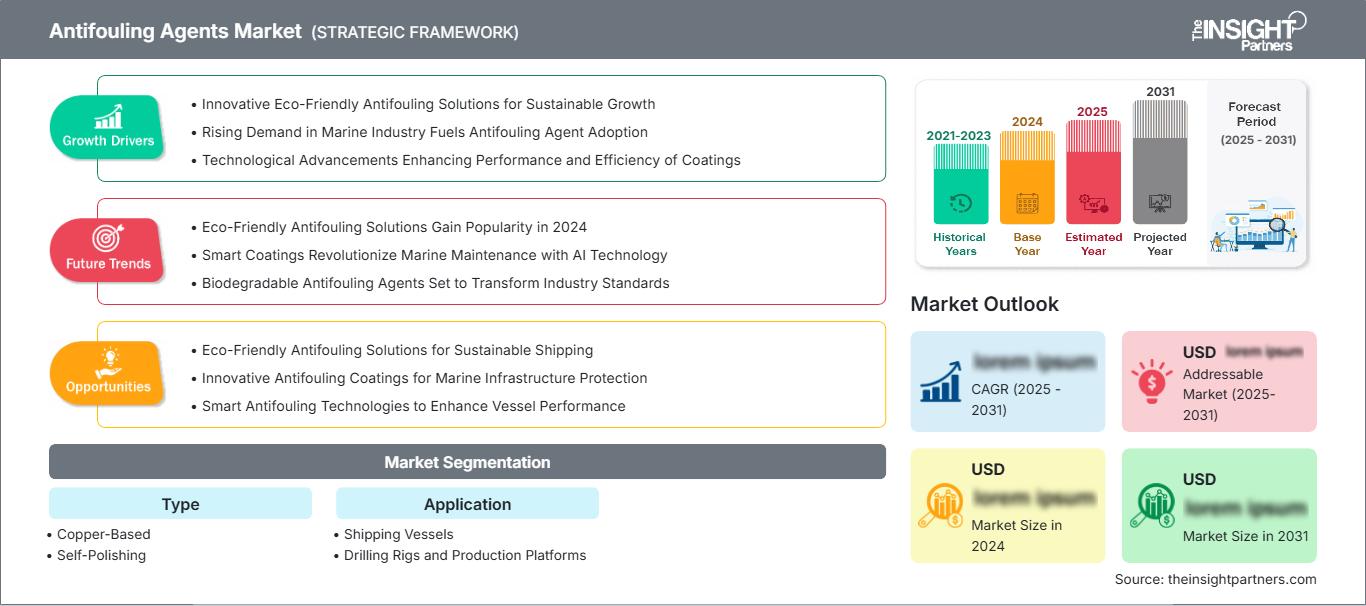
The antifouling agents market is positioned at the intersection of marine asset protection, fuel-efficiency management, and environmental compliance. The market is valued at US$ 6.48 Billion in 2025 and is projected to reach US$ 8.32 Billion by 2034, expanding at a 2.82% CAGR during 2026–2034. Demand is increasingly influenced by vessel efficiency requirements, stricter biofouling controls, and development of coatings that reduce hull resistance while limiting environmental impact.
North America is expected to remain a technologically advanced market, with an estimated 2.6–3.0% CAGR during 2026–2034. The regional outlook is supported by continued fleet maintenance, offshore energy activity, and shipowners' focus on reducing fuel consumption and emissions. The antifouling agents market size in the region is also influenced by the increasing adoption of low-biocide and biocide-free fouling-control technologies.
Antifouling Agents Market Assessment and Insights
- North America: North America is estimated to account for 24–28% share in 2025, growing at a 2.6–3.0% CAGR between 2026–2034. Fleet maintenance, offshore operations, environmental requirements, and premium hull-performance technologies support demand.
- US: The US represents approximately 78–82% of North America's share in 2025 and is projected to expand at a 2.7–3.1% CAGR between 2026–2034, supported by commercial shipping and offshore applications.
- Europe: Europe is estimated to hold 22–26% share in 2025, expanding at a 2.5–2.9% CAGR between 2026–2034. Norway, Germany, the Netherlands, Greece, Italy, and the UK remain important maritime markets with strong sustainability requirements.
- Asia Pacific: Asia Pacific is estimated at 38–42% share in 2025, growing at a 3.0–3.5% CAGR between 2026–2034. China, Japan, South Korea, and Singapore benefit from shipbuilding concentration, fleet activity, and marine-coating innovation.
- Largest Segment: Copper-Based products represent approximately 68–72% market share in 2025, with a 2.5–2.9% CAGR during 2026–2034, reflecting broad commercial-vessel applicability.
- High Growth Segment: Self-Polishing products hold approximately 28–32% market share in 2025 and are expected to grow at a 3.2–3.7% CAGR during 2026–2034, driven by controlled biocide release and smoother hull surfaces.
- Key companies analyzed in detail: Akzo Nobel N.V.; ChemPoint Inc.; Foshan Boer Ceramic Technique Co., Ltd.; Hempel Group; Huisins New Material Technology Co., Ltd.; Kansai Paint Co., Ltd.; KCC Marine Coatings; Nippon Paint Holdings Co., Ltd.; PPG Industries, Inc.; The Sherwin-Williams Company.
Source: The Insight Partners' analysis based on proprietary research, government publications, company annual reports, investor presentations, industry databases, and expert interviews.
From traditional anti-fouling paints using biocides, marine coating technology has advanced to controlled-release, low-friction, self-polishing, and foul-release coatings. Today, polymer chemistry determines polishing rate, biocide release, surface roughness, and service life. Production, therefore, will move towards binders and formulations that are tailor-made to particular vessel performance profiles, low-emission formulations and digital hull monitoring linked to coating choice and maintenance.
In the coming years, biocide improvement, silicone-based foul release coatings, and drag reduction surface technologies without the trade-off of fouling control are anticipated to gain greater investments by suppliers. The emerging shipbuilding centers in Asia will still be critical production and application centers while the environmental regulations in Europe will fast-track product reformulations. There will also be increased integration of coatings with hull monitoring and vessel performance analysis.
Antifouling Agents Market Report Scope
| Report Attribute | Details |
|---|---|
| Market size in 2025 | US$ 6.48 Billion |
| Market Size by 2034 | US$ 8.32 Billion |
| Global CAGR (2026 - 2034) | 2.82% |
| Historical Data | 2021-2024 |
| Forecast period | 2026-2034 |
Antifouling Agents Market Analysis
Demand is increasingly shaped by the economic cost of hull fouling because biological growth raises hydrodynamic resistance, fuel consumption, and emissions. The antifouling agents market growth therefore, extends beyond vessel protection and increasingly relates to operational efficiency. The value chain begins with resins, pigments, biocides, solvents, and specialty additives, followed by formulation, coating manufacture, distribution, shipyard application, inspection, and lifecycle maintenance.
Supply chain dynamics involve access to specialty polymers, copper compounds, biocides, silicone technology, and formulation know-how. The producers need to achieve a balance between anti-fouling properties and regulations that involves the handling of hazardous substances and marine discharge. Big coating firms can use their global network of technical services and contacts in shipyards, whereas smaller firms can fight back by relying on new active ingredients, reduced friction, and extended servicing periods.
The competition nowadays involves measured ship performance as opposed to just volume. There are some leading marine coating firms including Akzo Nobel N.V., Hempel Group, Kansai Paint Co., Ltd., Nippon Paint Holdings Co., Ltd., PPG Industries, Inc., and The Sherwin-Williams Company whereas KCC Marine Coatings and other specialty firms take care of niche requirements. ChemPoint Inc. is involved in the distribution of specialty products.
Strategic investment is moving toward premium coatings capable of demonstrating fuel, carbon, and maintenance benefits. Companies are also combining coatings with digital monitoring, hull inspection, and cleaning solutions. This creates a competitive environment in which formulation performance, application support, regulatory readiness, and lifecycle economics increasingly matter alongside purchase price. Partnerships with shipowners and shipyards can accelerate validation because coating performance is strongly dependent on vessel speed, route, docking cycle, and environmental conditions.
● REPORT CUSTOMIZATION
Tailor This Report To Align With Your Specific Business Requirements
This report can be customized to align precisely with your business objectives, scope, and target markets. Customization options include tailored segmentation, geography, competitive analysis, and strategic insights to support informed decision-making.
Customize This Report →WHAT YOU CAN ADJUST
- ● Segmentations
- ● Geography
- ● Competitive Analysis
- ● Language Preferences
Antifouling Agents Market: Strategic Insights
Regional Insights
North America antifouling agents market
North America antifouling agents market is estimated to represent 24–28% share in 2025, with a 2.6–3.0% CAGR during 2026–2034. The US dominates regional consumption because of its large commercial fleet, naval infrastructure, offshore energy assets, and extensive repair network. This includes commercial transport, offshore operations, and coastal facilities. In terms of product choice, there is now more focus on prolonged docking times and lower hull resistance.
In addition to this, there is another factor driving regional demand in the form of environmental consideration in connection with biocides and marine pollution. Ship operators are looking at copper-lowering, copper-free, and foul-release systems wherever feasible. This provides an advantage to coatings companies that have a good technical service facility in place, since the quality of application plays a vital role.
U.S. antifouling agents Market
The US accounts for approximately 78–82% of North America's 2025 share and is expected to grow at a 2.7–3.1% CAGR during 2026–2034. Demand for coatings results from merchant vessels, naval vessels, offshore installations, workboats, and shipyard repairs. Marine-coatings expertise exists at PPG Industries, Inc. and The Sherwin-Williams Company, whereas other international firms cater to large shipyards.
Coating application is shifting towards the use of coatings that provide solutions to both biofouling and vessel efficiency problems. There is interest on the part of commercial carriers in applying low-friction coatings because of the high cost of fuel. Offshore facilities must be durable enough to withstand immersion and physical wear. Thus, US buyers are now taking into consideration total costs rather than only the cost of coatings.
Europe antifouling agents Market
Europe is estimated to hold 22–26% share of the antifouling agents market in 2025, expanding at a 2.5–2.9% CAGR during 2026–2034. The UK, Germany, Norway, Italy, Spain, Greece, and the Netherlands form important demand centers, with Norway representing a particularly influential maritime market because of its shipping, offshore, and technology ecosystem.
The UK and Germany emphasize fleet efficiency, environmental management, and advanced marine engineering. Norway combines shipping decarbonization with strong adoption of performance-monitoring technologies. France, Italy, and Spain maintain substantial commercial, cruise, naval, and ship-repair activity. Across the region, regulations and sustainability commitments encourage reduced-biocide systems, foul-release coatings, improved hull cleaning practices, and longer coating service intervals.
APAC antifouling agents Market
APAC is estimated at 38–42% of the antifouling agents market share in 2025 and is expected to grow at a 3.0–3.5% CAGR during 2026–2034. China leads regional consumption, followed by Japan and South Korea. India and Australia provide additional demand through fleet expansion, coastal shipping, offshore assets, and maintenance activity.
The region benefits from concentrated shipbuilding capacity and large commercial fleets. Chinese, Japanese, and Korean shipyards provide direct channels for coating suppliers, while government decarbonization programs encourage efficient hull technologies. Japan also has a strong marine-coating research base, supporting development of self-polishing and biocide-free solutions.
Middle East & Africa antifouling agents Market
The Middle East and Africa antifouling agents market demand is concentrated around Gulf shipping, offshore energy, ports, and South African maritime infrastructure. Saudi Arabia and the UAE lead regional demand, while South Africa provides an important southern African repair and commercial shipping center. The region is estimated to expand at a 2.4–2.9% CAGR during 2026–2034.
Energy infrastructure creates recurring requirements for submerged assets and offshore structures, while port development supports vessel maintenance. High seawater temperatures and intense biological activity can increase fouling pressure, making coating selection highly dependent on route and operating conditions. Suppliers with local application expertise can therefore capture demand through tailored coating specifications and technical support.
Segmentation Analysis
Type
The Type segment of the antifouling agents market comprises Copper-Based and Self-Polishing formulations. Copper-based systems remain dominant because of established efficacy and broad commercial-vessel acceptance, while self-polishing systems are gaining importance through controlled surface renewal and improved coating smoothness. The Type segment is expected to expand at approximately 2.8–3.2% CAGR during 2026–2034. Product development increasingly focuses on optimizing active-ingredient release, reducing environmental burden, and maintaining performance during variable vessel speeds.
- Copper-Based: Copper-based formulations retain a strong position in commercial marine applications because copper compounds provide established fouling protection across diverse operating conditions. Their extensive application history supports broad shipyard acceptance.
- Self-Polishing: Self-polishing systems continuously renew the coating surface during immersion, supporting controlled biocide release and smoother hull profiles. They are strategically important for long docking intervals and fuel-efficiency objectives.
Applications
The Applications segment of the antifouling agents market includes Shipping Vessels and Drilling Rigs and Production Platforms. Shipping vessels account for the larger demand base because hull fouling directly affects propulsion efficiency, fuel consumption, and emissions. The segment is expected to grow at approximately 2.7–3.1% CAGR during 2026–2034. Offshore applications remain technically important because coatings must withstand prolonged immersion and challenging environmental conditions.
- Shipping Vessels: Shipping vessels represent the principal application because fouling directly affects resistance, propulsion demand, fuel consumption, and voyage economics. Container ships, tankers, bulk carriers, car carriers, and cruise vessels require differentiated coating specifications.
- Drilling Rigs and Production Platforms: Offshore platforms require durable fouling protection across submerged structural surfaces exposed to continuous marine immersion. Coating selection emphasizes durability, mechanical resistance, maintenance intervals, and environmental compatibility.
Opportunity Snapshot
| Application | Revenue Contribution | Trend Tag | Adoption Stage |
| Shipping Vessels | High | Hull Efficiency | Mature |
| Drilling Rigs and Production Platforms | Medium | Offshore Protection | Scaling |
Antifouling Agents Market Growth Drivers and Impact Analysis
Stricter vessel efficiency and carbon-intensity requirements
Marine operators are increasingly looking at hull coatings as a means of enhancing operational efficiency rather than just for their protective value. Factors such as carbon intensity and vessel efficiency lead to a need to keep hull resistance to a minimum, and even slight changes in resistance translate into greater needs for power to propel the ship during extended trips. This makes the performance of hull coatings economically significant and leads to the evaluation of various coating systems on the basis of factors such as fuel consumption, reduction in speed, docking periods, and lifecycle costs. Hull coatings manufacturers who can offer performance advantages stand to gain an edge over those whose products are merely priced differently from their competitors.
Expansion of commercial shipping and marine infrastructure
An increase in fleet size, port facilities, offshore constructions, and marine shipping requires regular surface protection of the underwater surfaces. While new-build ships need painting before their launch into operation, older fleets need regular docking for renovation work. As a result, there will be a relatively stable cycle of renewal since the demand is associated with asset maintenance rather than consumption. Moreover, the localization of shipbuilding in Asia Pacific region provides additional advantages for the companies dealing with coating providers. Offshore drilling platforms create an additional source of demand since the submerged parts are exposed for a long period of time and need durable coatings.
Environmental restrictions accelerating formulation innovation
Environmental regulation of biocides, solvents, and marine discharge is shifting the direction of product development. Companies are increasingly exploring biocide-reduced products, biocide-free foul-release coatings, and polymers that will offer controlled release of their active ingredients. Regulatory compliance has now become a prerequisite for commercialization instead of being just a product characteristic. This will increase research and formulation costs for manufacturers since they will have to prove efficacy alongside meeting increasing environmental regulations. On the positive side, it offers scope for differentiation through the use of silicone coatings, advanced polymers, and low-emission formulations. Product certification and its environmental efficacy could be a key competitive advantage, especially in Europe and other highly regulated maritime regions. Formulation ranges will in the long run become increasingly specialized based on vessel characteristics, environmental regulations, and geographic location.
Antifouling Agents Market Future Trends
Digital hull-performance optimization will reshape coating selection
Future coating decisions will increasingly use vessel-specific operating information rather than generic product specifications. AIS data, speed profiles, route conditions, water temperature, docking history, and underwater inspection results can be combined to determine fouling risk and expected coating performance. The antifouling agents market trends will consequently shift toward digitally supported product selection, where coating suppliers provide recommendations linked to measurable vessel outcomes. Digital monitoring can also identify abnormal hull deterioration before it produces significant fuel penalties. Integration with fleet-management platforms should enable shipowners to compare performance across vessels and voyages. Over time, coating suppliers may increasingly monetize technical services alongside physical products, strengthening customer relationships while generating proprietary performance datasets that support formulation development and targeted maintenance planning.
Biocide-free and low-impact foul-release technologies will gain attention
The rising expectation from the environment is likely to drive the development of surfaces that have an inherent ability to resist the attachment of organisms via surface chemistry and structure, as opposed to the traditional use of biocides. Some of the strategies that are currently gaining industry focus include silicone coatings, graphene surfaces, hybrid polymers, and textured surfaces. Biocidal products will not fall out of favor since the operational conditions in terms of vessel speed, downtime, water temperatures, and fouling loads differ significantly. Instead, the market is likely to be segmented with products for general protection and premium products that offer low impact to the environment.
Antifouling Agents Market Opportunities
Premium coatings for high-value commercial fleets
Premium commercial vessels provide an attractive opportunity because fuel consumption and schedule reliability have a direct influence on operating economics. Container carriers, tankers, car carriers, and cruise vessels can justify higher coating expenditure when measurable reductions in resistance, fuel use, or maintenance frequency are demonstrated. Suppliers can target this opportunity by developing vessel-specific systems that combine antifouling protection with low-friction performance. Commercial models may increasingly include performance monitoring, inspection support, and lifecycle optimization rather than one-time coating sales. The antifouling agents market Forecasts indicate that value creation should increasingly concentrate around measurable operating outcomes. Partnerships with shipowners, fleet managers, shipyards, and classification organizations can provide the real-world evidence needed to accelerate the adoption of premium systems.
Regional manufacturing and technical-service expansion
Expansion of shipbuilding and repair capacity in the Asia Pacific creates opportunities for manufacturers to localize production, inventory, application support, and technical laboratories. China, South Korea, Japan, India, and Southeast Asian maritime centers offer access to large shipbuilding and maintenance ecosystems. Local production can reduce logistics costs and shorten delivery times, while regional technical centers can adapt formulations to water chemistry, fouling intensity, vessel speed, and local regulatory requirements. Companies can also develop partnerships with shipyards and applicators to secure specification positions during newbuild projects. The antifouling agents market scope, therefore, extends beyond chemical formulation into regional service infrastructure, technical qualification, application training, inspection, and lifecycle support. Such capabilities can create durable competitive advantages.
Recent Developments
- March 10, 2026: Nippon Paint Holdings Co., Ltd. introduced its FASTAR next-generation antifouling technology, highlighting new approaches to suppress marine biofouling through advanced marine-coating development. The technology reflects continued movement toward coatings that improve hull performance while addressing environmental considerations and evolving maritime requirements.
- February 24, 2026: GIT Coatings launched XGIT-FORCE, a graphene-based hard foul-release coating designed to move hull protection toward biocide-free performance management. The company states that initial applications are underway across a global fleet and positions the technology around fuel savings, mechanical durability, and reduced environmental impact.
Frequently Asked Questions

- Comprehensive Market Sizing and Forecast Analysis
- Detailed Segmentation Analysis
- In-Depth Market Dynamics Assessment
- Regional and Country-Level Insights
- Competitive Landscape and Company Benchmarking
- Strategic Business Intelligence
Recent Reports
Testimonials

The Insight Partners provided valuable market intelligence that supported our global go-to-market strategy. Their team was professional, responsive, and attentive to our feedback, providing thoughtful analysis and helpful methodological clarifications throughout the project.
Junmo Kim Chief Financial Officer (CFO), Enertech Co., Ltd.
The Insight Partners' SCADA System Market report is comprehensive, with valuable insights on current trends and future forecasts. The team was highly professional, responsive, and supportive throughout. We are very satisfied and highly recommend their services.
RAN KEDEM Partner, Reali Technologies LTDs
I requested a report on a very specific software market and the team produced the report in a few days. The information was very relevant and well presented. I then requested some changes and additions to the report. The team was again very responsive and I got the final report in less than a week.
JEAN-HERVE JENN Chairman, Future Analytica
We worked with The Insight Partners for an important market study and forecast. They gave us clear insights into opportunities and risks, which helped shape our plans. Their research was easy to use and based on solid data. It helped us make smart, confident decisions. We highly recommend them.
PIYUSH NAGPAL Sr. Vice President, High Beam Global
The Insight Partners delivered insightful, well-structured market research with strong domain expertise. Their team was professional and responsive throughout. The user-friendly website made accessing industry reports seamless. We highly recommend them for reliable, high-quality research services
YUKIHIKO ADACHI CEO, Deep Blue, LLC.
This is the first time I have purchased a market report from The Insight Partners.While I was unsure at first, I visited their web site and felt more comfortable to take the risk and purchase a market report.I am completely satisfied with the quality of the report and customer service. I had several questions and comments with the initial report, but after a couple of dialogs over email with their analyst I believe I have a report that I can use as input to our strategic planning process.Thank you so much for taking the extra time and making this a positive experience.I will definitely recommend your service to others and you will be my first call when we need further market data.
JOHN SUZUKI President and Chief Executive Officer, Board Director, BK Technologies
I wish to appreciate your support and the professionalism you displayed in the course of attending to my request for information regarding to infectious disease IVD market in Nigeria. I appreciate your patience, your guidance, and the fact that you were willing to offer a discount, which eventually made it possible for us to close a deal. I look forward to engaging The Insight Partners in the future, all thanks to the impression you have created in me as a result of this first encounter.
DR CHIJIOKE ONYIA MANAGING DIRECTOR, PineCrest Healthcare Ltd.Reason to Buy
- Informed Decision-Making
- Understanding Market Dynamics
- Competitive Analysis
- Identifying Emerging Markets
- Customer Insights
- Market Forecasts
- Risk Mitigation
- Boosting Operational Efficiency
- Strategic Planning
- Investment Justification
- Tracking Industry Innovations
- Aligning with Regulatory Trends





 Get Free Sample for