
Antithrombotic Drugs Market Trends, Size & Forecast by 2034
Antithrombotic Drugs Market Size and Forecasts (2021–2034), Global and Regional Share, Trends, and Growth Opportunity Analysis Report Coverage : by Drug Class (Thrombolytic Drugs, Anti-platelet Drugs, Anticoagulants); Route of Administration (Oral, Parenteral); Application (Pulmonary Embolism, Deep Vein Thrombosis, Atrial Fibrillation); and Geography (North America, Europe, Asia Pacific, and South and Central America)
- Status : Data Released
- Report Code : TIPRE00039903
- Category : Life Sciences
- No. of Pages : 150
- Available Report Formats :


- Last update date : August 21, 2026


2025 Market Size
US$ 40.73 Bn
Base year value
2034 Forecast
US$ 67.39 Bn
Projected by 2034
CAGR 2026-2034
5.75 %
Growth rate
Addressable Market
US$ 489.86 Bn
(2026-2034)
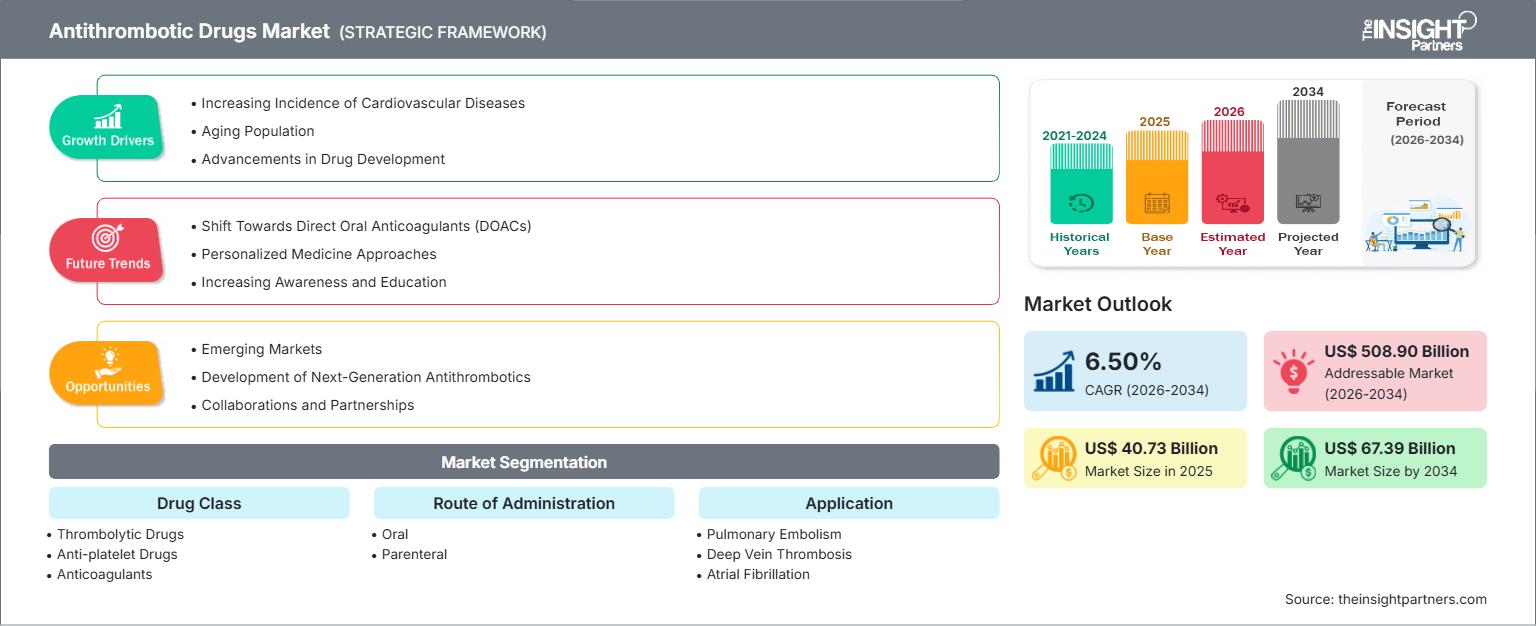
The Antithrombotic Drugs market was valued at US$ 40.73 billion in 2025 and is expected to reach US$ 67.39 billion by 2034; it is estimated to record a CAGR of 5.75% during 2026-2034.
Antithrombotic Drugs Market Assessment and Insights
- North America: North America represented an estimated 35–39% antithrombotic drugs Market share in 2025 and is expected to expand at a 5.8–6.8% CAGR between 2026–2034, supported by established cardiovascular treatment pathways, strong anticoagulant utilization, and sophisticated reimbursement infrastructure.
- US: The US accounted for approximately 82–87% of North America's 2025 revenue, with growth projected at 5.7–6.7% CAGR during 2026–2034, reflecting broad adoption of oral anticoagulants and advanced thrombosis care.
- Europe: Europe held approximately 27–31% share in 2025 and is projected to grow at 5.9–6.9% CAGR through 2034. Germany, the UK, France, Italy, and Spain remain important markets because of mature healthcare systems and established anticoagulation protocols.
- Asia Pacific: Asia Pacific represented approximately 20–24% share in 2025 and is expected to grow at 7.1–8.1% CAGR. China, Japan, India, and South Korea are leading contributors as diagnosis, healthcare access, and cardiovascular treatment capacity expand.
- Largest Segment: Anticoagulants represented approximately 58–63% market share in 2025 and are projected to grow at 6.2–7.2% CAGR during 2026–2034, supported by broad use across atrial fibrillation and venous thromboembolism.
- High Growth Segment: Oral administration represented approximately 68–73% market share in 2025 and is projected to expand at 6.6–7.6% CAGR, supported by convenience, adherence advantages, and expanding direct oral anticoagulant use.
- Key companies analyzed in detail: Boehringer Ingelheim, Bristol Myers Squibb, Johnson & Johnson, Sanofi, Pfizer Inc., AstraZeneca, Roche, Novartis, GSK (GlaxoSmithKline), Daiichi Sankyo Company, Limited.
Source: The Insight Partners' analysis based on proprietary research, government publications, company annual reports, investor presentations, industry databases, and expert interviews.
Therapeutic development has progressed from conventional anticoagulation to more focused approaches such as direct factor Xa inhibition and new factors XIa targets. Competition has increased based on predictable dosage schedules, decreased testing needs, and convenience of administration in an outpatient setting. Production also became more sophisticated, as the sourcing of the active pharmaceutical ingredient, its formulating, quality assurance and regional distribution affect supply reliability. Thus, the antithrombotics market includes high-volume marketed treatments and novel mechanisms in search of better benefit-risk balance.
The antithrombotic drugs Market report indicates that prospects for the future will extend beyond the well-established markets in North America and Europe, as China, India, Japan and certain Southeast Asian countries develop their ability to diagnose and treat cardiovascular disease, as well as to prevent stroke and venous thromboembolism. In addition, regulatory authorities require rigorous data about bleeding complications, efficacy, drug interactions and patient selection. The demands support those firms that can provide real-world evidence in addition to traditional data from randomized trials.
Antithrombotic Drugs Market Report Scope
| Report Attribute | Details |
|---|---|
| Market size in 2025 | US$ 40.73 Billion |
| Market Size by 2034 | US$ 67.39 Billion |
| Global CAGR (2026 - 2034) | 5.75% |
| Historical Data | 2021-2024 |
| Forecast period | 2026-2034 |
Antithrombotic Drugs Market Analysis
Factors fueling the antithrombotics drugs market include growing cases of atrial fibrillation, deep vein thrombosis, pulmonary embolism, and other diseases of similar nature. Demand for such medications arises from diagnosis and risk stratification and involves prescribers, hospitals, pharmacies, payers, and consumers. The WHO guidelines on the essential medicines emphasize that choices should be evidence-based, safe, and affordable, hence stressing the significance of availability and proper prescription practices.
Players in the supply chain include research organizations, pharmaceutical companies, makers of APIs, formulation facilities, contract manufacturing organizations, regulatory agencies, wholesalers, and healthcare professionals. Different types of antithrombotic medications have different dynamics since generic medications will experience competition in prices while innovations require patents and specialized manufacturing capabilities. More and more organizations are balancing their global production capabilities with regional stockpiling efforts.
Competitive landscape, investment, and positioning
Antithrombotics Market Overview Analysis highlights competitive dynamics featuring established cardiovascular franchises with innovation focused on pipeline development. The Eliquis franchise is a significant advantage for Bristol Myers Squibb and Pfizer; however, Boehringer Ingelheim retains a large presence because of Pradaxa. Daiichi Sankyo has increased their presence by means of edoxaban, while Sanofi remains engaged in special thrombotic disorders. Meanwhile, AstraZeneca, Roche, Novartis, and GSK participate through cardiovascular and hospital portfolios.
Johnson & Johnson and Bristol Myers Squibb have made strategic investments into Factor XIa inhibition through milvexian, highlighting the effort in development of anticoagulation that could possess better bleeding profile. Increasing priority includes investment into biomarker-driven patient selection, oral administration, life cycle management, and evidence building. Companies with robust commercial capability could develop established brands through geographic expansion; on the other hand, innovators are utilizing mechanism and clinical differentiation to serve unmet needs of patients currently not adequately addressed by anticoagulants.
● REPORT CUSTOMIZATION
Tailor This Report To Align With Your Specific Business Requirements
This report can be customized to align precisely with your business objectives, scope, and target markets. Customization options include tailored segmentation, geography, competitive analysis, and strategic insights to support informed decision-making.
Customize This Report →WHAT YOU CAN ADJUST
- ● Segmentations
- ● Geography
- ● Competitive Analysis
- ● Language Preferences
Antithrombotic Drugs Market: Strategic Insights
Regional Insights
North America antithrombotic drugs market
In 2025, North America was responsible for 35% - 39% of global sales and will grow at CAGR of 5.8% - 6.8% up to 2034. It has been favored by high disease awareness, easy access to diagnostics, existence of anticoagulation clinics and high use of oral anticoagulants. United States is still the leader in terms of sales and has good hospital infrastructure and numerous specialists.
Canada brings its contribution due to its publicly financed healthcare system and thrombosis management paths. The regional market trend is shifting in favor of convenient oral regimens for stroke and venous thromboembolism prevention. Clinical practice is still highly dependent on kidney health, patient age, bleeding tendency, interaction with other drugs and cost. So, companies have to compete not on molecule but on evidence, support, affordability and supply.
U.S. antithrombotic drugs Market
The US accounted for roughly 82-87% of North American revenue in 2025 and is anticipated to experience growth at 5.7-6.7% CAGR during the period from 2026 to 2034. The reason for such dominance includes high rates of prescriptions, specialist availability, modern diagnostic capabilities, and the high application rate of direct oral anticoagulants. Several multinational pharmaceutical firms include Bristol Myers Squibb, Pfizer Inc., Boehringer Ingelheim, Johnson & Johnson, Sanofi, etc.
Demand for the use of drugs is mainly connected to atrial fibrillation, pulmonary embolism, and deep vein thrombosis, with an increasing tendency towards using outpatient treatment when applicable. Hospitals still play their role in thrombolytic treatment and acute anticoagulation treatment while pharmacies specialize in chronic cases of treatment.
Europe antithrombotic drugs Market
Europe accounted for roughly 27-31% antithrombotic drugs market share in 2025 and is anticipated to witness growth at CAGR 5.9-6.9%. Germany holds the dominant position in the region owing to good coverage of cardiovascular care and drug supply. The UK, France, Italy, and Spain also make their notable contribution via advanced healthcare infrastructure, guidelines-based prescribing practices, and oral anticoagulant availability.
The UK is well-known for its influence of national guidelines in treating atrial fibrillation and venous thromboembolism. Germany features high prescription volumes and good hospital and specialists' infrastructure. France, Italy, and Spain further develop prevention-oriented cardiovascular care while keeping pharmaceutical budgets in check. Thus, evidence of effectiveness and health technology assessment, as well as cost-effectiveness studies and decisions on reimbursement, shape European demand.
APAC antithrombotic drugs Market
APAC held about 20-24% market share in 2025 and is forecasted to expand at 7.1-8.1% CAGR, which makes it one of the most rapidly growing regions. The regional leader in terms of revenue generation is China, followed by Japan, South Korea, India, and Australia. Increased hospital capacity and cardiovascular disease diagnostics promote therapy adoption.
The pharmaceutical localization and healthcare development in China, cardiovascular disease management maturity in Japan, diagnostics and increased expertise in India and South Korea, as well as well-developed clinical guidelines along with reimbursement in Australia, contribute to regional growth. The region also experiences increased access to advanced drugs and pharmaceutical manufacturing, as well as government initiatives on improving cardiovascular disease management.
Middle East & Africa antithrombotic drugs Market
The antithrombotic drugs Market in Middle East and Africa is projected to grow at approximately 6.2–7.2% CAGR through 2034. Saudi Arabia and the UAE lead the regional opportunity because of advanced hospital investment, specialist cardiovascular centers, and expanding pharmaceutical procurement. South Africa represents an important African market with established tertiary-care capacity and growing cardiovascular treatment requirements.
The broader region is still very uneven, since healthcare infrastructure, reimbursement structures, specialists, and affordability of medications differ greatly. Energy revenues from Gulf countries can be invested in upgrading the hospitals' facilities and drug supply systems. Regional distribution networks, state procurement procedures, and efficient cold-chain or pharmaceutical logistics systems can impact market access. Firms that possess regulatory capabilities and regional distribution channels are more likely to meet demand beyond the big Gulf countries.
Segmentation Analysis
Drug Class
Drug Class remains the principal basis for assessing therapeutic positioning, clinical use, and competitive differentiation. Anticoagulants account for the largest portion of demand, while antiplatelet and thrombolytic therapies serve distinct cardiovascular and acute-care requirements. The segment is projected to grow at 6.1–7.1% CAGR during 2026–2034 as treatment pathways become increasingly risk-stratified and mechanism-specific.
- Thrombolytic Drugs: These therapies remain strategically important for acute clot dissolution in selected emergency settings, particularly where rapid reperfusion is clinically necessary and treatment decisions depend heavily on timing and bleeding risk.
- Anti-platelet Drugs: Antiplatelet therapies remain central to arterial thrombosis management and secondary cardiovascular prevention, with demand influenced by coronary interventions, ischemic events, combination regimens, and evolving duration recommendations.
- Anticoagulants: Anticoagulants represent the largest therapeutic category because of extensive use in atrial fibrillation and venous thromboembolism, supported by long-term treatment requirements and increasing preference for convenient oral regimens.
Route of Administration
Route of Administration is projected to expand at 6.3–7.3% CAGR during 2026–2034. Oral therapy remains dominant because it supports outpatient treatment and long-term adherence, while parenteral administration remains essential for acute hospital care and situations requiring rapid or controlled anticoagulant action.
- Oral: Oral products support chronic disease management and outpatient treatment because fixed-dose regimens can reduce administration burden, improve convenience, and limit routine laboratory monitoring compared with selected conventional therapies.
- Parenteral: Parenteral therapies remain essential during acute hospitalization, perioperative management, emergency thrombotic events, and clinical situations where oral administration is unsuitable or rapid pharmacological control is required.
Application
Application is expected to grow at 6.4–7.4% CAGR during 2026–2034 as healthcare systems improve detection and treatment of thrombotic conditions. Atrial fibrillation provides substantial chronic demand, while pulmonary embolism and deep vein thrombosis require both acute and preventive management.
- Pulmonary Embolism: Treatment requires rapid risk assessment and appropriately selected anticoagulant or thrombolytic therapy, creating demand across emergency departments, hospitals, and follow-up outpatient pathways.
- Deep Vein Thrombosis: DVT management generates demand for acute anticoagulation followed by preventive therapy, with prescribing shaped by recurrence risk, provoking factors, patient characteristics, and treatment duration.
- Atrial Fibrillation: AF represents a major chronic application because anticoagulation can reduce thromboembolic stroke risk in appropriately selected patients, supporting recurring prescription demand and long-term medication use.
Opportunity Snapshot
| Segment Name | Revenue Contribution (High/Medium/Low) | Trend Tag (MAX 2 words) | Adoption Stage |
|---|---|---|---|
| Pulmonary Embolism | High | Acute Reperfusion | Mature |
| Deep Vein Thrombosis | High | VTE Prevention | Mature |
| Atrial Fibrillation | High | Stroke Prevention | Scaling |
Antithrombotic Drugs Market Growth Drivers and Impact Analysis
Growing cardiovascular and thromboembolic disease burden
An expanding population of older adults, combined with obesity, diabetes, hypertension, immobility, and cardiovascular disease, is increasing the pool of patients requiring thrombosis prevention or treatment. The clinical impact is particularly significant in atrial fibrillation, where stroke prevention can require prolonged therapy, and in venous thromboembolism, where recurrence risk can influence treatment duration. This driver supports recurring prescription volumes rather than one-time demand. For manufacturers, it encourages broader patient identification, adherence programs, and evidence generation for diverse patient populations. Hospitals also benefit from standardized anticoagulation protocols that facilitate earlier diagnosis and appropriate treatment. The result is a larger addressable population across chronic outpatient care, acute hospital treatment, and secondary prevention.
Shift toward convenient oral anticoagulation
The movement toward oral anticoagulants is changing treatment economics and patient-management pathways. Direct oral therapies can reduce administration complexity and, for selected patients, the monitoring burden associated with older anticoagulation approaches. This supports outpatient treatment for appropriately selected patients with atrial fibrillation and venous thromboembolism while reducing dependence on frequent facility-based administration. Commercially, oral formulations also enable broader pharmacy distribution and patient-support models. Manufacturers increasingly differentiate through dosing frequency, renal and drug-interaction considerations, reversal strategies, and evidence across clinical subgroups. Healthcare providers, meanwhile, assess total treatment value rather than acquisition price alone. As utilization broadens, competition is likely to intensify around adherence, affordability, safety, and lifecycle management.
Innovation aimed at improving the efficacy-bleeding balance
Bleeding remains a central limitation in anticoagulation, creating demand for therapies that can preserve antithrombotic protection while reducing clinically important bleeding. This unmet need is encouraging investment in mechanisms beyond established factor Xa inhibition, including factor XIa approaches. Such innovation could expand treatment into populations where clinicians are cautious about conventional anticoagulants. The strategic impact extends beyond new product launches because successful mechanisms may reshape treatment algorithms and create differentiated positions within large cardiovascular indications. Developers must nevertheless demonstrate meaningful clinical benefit through adequately powered trials, robust safety datasets, and real-world evidence. Regulatory scrutiny of benefit-risk relationships will remain decisive, particularly where new mechanisms compete against well-established therapies with extensive clinical experience.
Antithrombotic Drugs Market Future Trends
Factor XI pathway development may reshape anticoagulation
antithrombotic drugs market trends are increasingly influenced by research into factor XI and factor XIa inhibition as developers seek to separate thrombosis prevention from excessive bleeding risk. Future products may target patients who remain undertreated because conventional anticoagulation is considered unsuitable or insufficiently attractive. The development pathway will increasingly depend on comparative evidence against established direct oral anticoagulants, clinically meaningful bleeding outcomes, and performance across atrial fibrillation, stroke, and venous thromboembolism populations. Successful candidates could create new treatment algorithms rather than simply replacing existing products. Commercial adoption will also depend on dosing convenience, reversal options, reimbursement, and physician confidence. Consequently, late-stage clinical differentiation and evidence quality are likely to become stronger determinants of value than mechanism novelty alone.
Personalized thrombosis management will gain importance
Future treatment pathways are likely to become more individualized as clinicians integrate renal function, age, weight, bleeding history, comorbidities, concomitant medicines, and thrombotic risk into prescribing decisions. Digital health records and clinical decision-support systems can help translate these variables into more consistent treatment choices. Pharmaceutical companies may respond by generating subgroup-specific evidence and developing patient-support tools that improve adherence and monitoring. The emphasis will move from simply selecting an anticoagulant to determining the appropriate intensity, duration, and treatment setting for each patient. Companion diagnostics are unlikely to become universal across the category, but biomarker research may identify populations with distinct benefit-risk profiles. This evolution could strengthen differentiated products with robust evidence across complex patient groups.
Antithrombotic Drugs Market Opportunities
Expand access in underpenetrated cardiovascular markets
Emerging economies offer an attractive opportunity because diagnosis of atrial fibrillation and venous thromboembolism remains less systematic than in mature markets, while cardiovascular disease creates a substantial underlying treatment requirement. Investors and pharmaceutical companies can target this gap through affordable oral formulations, physician education, local evidence generation, and partnerships with hospital networks. Market entry strategies should account for reimbursement structures, tender procurement, generic competition, and regulatory requirements rather than relying on a uniform global model. India, China, Southeast Asia, and selected Middle Eastern markets can support differentiated approaches based on healthcare infrastructure and patient affordability. Companies that combine reliable supply with locally relevant pricing and clinical education can improve penetration while establishing sustainable long-term commercial positions.
Build lifecycle strategies around adherence and real-world evidence
antithrombotic drugs market Forecasts increasingly depend on how effectively companies demonstrate outcomes beyond controlled clinical trials. Investment opportunities therefore extend into adherence programs, digital reminders, pharmacy support, real-world evidence platforms, and population-health partnerships. These capabilities can help identify treatment gaps, understand persistence, and demonstrate economic value to payers. Mature brands can use evidence to support appropriate use in underserved populations, while newer therapies can build confidence through comparative effectiveness and safety data. Manufacturers should also consider formulation improvements, packaging, dosing simplification, and patient education as lifecycle tools. A coordinated evidence strategy can strengthen reimbursement negotiations and physician adoption without depending solely on price reductions. This approach is particularly relevant as competition increases and healthcare systems demand measurable outcomes.
Recent Developments
- December 2025: Sanofi announced that China’s National Medical Products Administration approved Cablivi (caplacizumab) for acquired immune-mediated thrombotic thrombocytopenic purpura. The approval expanded access to a targeted therapy for a rare, life-threatening thrombotic disorder and strengthened Sanofi’s presence in China’s hematology market. The company stated that the approval represented another step in its broader expansion of innovative medicines in China.
- November 2025: Bristol Myers Squibb and Johnson & Johnson discontinued the Phase 3 Librexia ACS study of investigational factor XIa inhibitor milvexian after an independent review concluded that the trial was unlikely to meet its primary efficacy endpoint. The companies continued the Librexia AF and Librexia STROKE studies, illustrating the selective development strategy surrounding next-generation anticoagulation.
- June 2025: Johnson & Johnson highlighted its Librexia ACS program evaluating milvexian as a potential approach to reduce thrombotic events without increasing bleeding risk. The company described factor XIa inhibition as a potential way to address persistent secondary-prevention gaps in acute coronary syndrome, reinforcing continued industry investment in mechanisms designed to improve the benefit-risk profile of antithrombotic treatment.
Frequently Asked Questions

- Comprehensive Market Sizing and Forecast Analysis
- Detailed Segmentation Analysis
- In-Depth Market Dynamics Assessment
- Regional and Country-Level Insights
- Competitive Landscape and Company Benchmarking
- Strategic Business Intelligence
Recent Reports
Testimonials

The Insight Partners' SCADA System Market report is comprehensive, with valuable insights on current trends and future forecasts. The team was highly professional, responsive, and supportive throughout. We are very satisfied and highly recommend their services.
RAN KEDEM Partner, Reali Technologies LTDs
I requested a report on a very specific software market and the team produced the report in a few days. The information was very relevant and well presented. I then requested some changes and additions to the report. The team was again very responsive and I got the final report in less than a week.
JEAN-HERVE JENN Chairman, Future Analytica
We worked with The Insight Partners for an important market study and forecast. They gave us clear insights into opportunities and risks, which helped shape our plans. Their research was easy to use and based on solid data. It helped us make smart, confident decisions. We highly recommend them.
PIYUSH NAGPAL Sr. Vice President, High Beam Global
The Insight Partners delivered insightful, well-structured market research with strong domain expertise. Their team was professional and responsive throughout. The user-friendly website made accessing industry reports seamless. We highly recommend them for reliable, high-quality research services
YUKIHIKO ADACHI CEO, Deep Blue, LLC.
This is the first time I have purchased a market report from The Insight Partners.While I was unsure at first, I visited their web site and felt more comfortable to take the risk and purchase a market report.I am completely satisfied with the quality of the report and customer service. I had several questions and comments with the initial report, but after a couple of dialogs over email with their analyst I believe I have a report that I can use as input to our strategic planning process.Thank you so much for taking the extra time and making this a positive experience.I will definitely recommend your service to others and you will be my first call when we need further market data.
JOHN SUZUKI President and Chief Executive Officer, Board Director, BK Technologies
I wish to appreciate your support and the professionalism you displayed in the course of attending to my request for information regarding to infectious disease IVD market in Nigeria. I appreciate your patience, your guidance, and the fact that you were willing to offer a discount, which eventually made it possible for us to close a deal. I look forward to engaging The Insight Partners in the future, all thanks to the impression you have created in me as a result of this first encounter.
DR CHIJIOKE ONYIA MANAGING DIRECTOR, PineCrest Healthcare Ltd.Reason to Buy
- Informed Decision-Making
- Understanding Market Dynamics
- Competitive Analysis
- Identifying Emerging Markets
- Customer Insights
- Market Forecasts
- Risk Mitigation
- Boosting Operational Efficiency
- Strategic Planning
- Investment Justification
- Tracking Industry Innovations
- Aligning with Regulatory Trends





 Get Free Sample for