
Anxiety Disorders And Depression Therapeutic Drug Market Demand, Share & Growth by 2034
Coverage: By Drug Class (SSRIs (Selective Serotonin Reuptake Inhibitors), SNRIs (Serotonin-Norepinephrine Reuptake Inhibitors), TCAs (Tricyclic Antidepressants), Buspirone, Others); Treatment Indication (OCD (Obsessive Compulsive Disorder), Phobias, Panic Disorders, Others); End User (Hospitals, Mental Healthcare Centers, Asylums, Others) , and Geography (North America, Europe, Asia Pacific, and South and Central America)
- Status : Data Released
- Report Code : TIPRE00018817
- Category : Life Sciences
- No. of Pages : 150
- Available Report Formats :


- Last update date : August 26, 2026


2025 Market Size
US$ 16.41 Bn
Base year value
2034 Forecast
US$ 19.76 Bn
Projected by 2034
CAGR 2026-2034
2.09 %
Growth rate
Addressable Market
US$ 164.02 Bn
(2026-2034)
The global Anxiety Disorders And Depression Therapeutic Drug market was valued at US$ 16.41 billion in 2025 and is expected to reach US$ 19.76 billion by 2034; it is estimated to record a CAGR of 2.09% during 2026-2034.
Anxiety Disorders And Depression Therapeutic Drug Market Assessment and Insights
- North America: The region is estimated to represent 39–43% anxiety disorders and depression therapeutic drug Market share in 2025 and grow at a 2.4–3.0% CAGR between 2026–2034, supported by mature prescribing systems, specialist psychiatry access, and differentiated therapies.
- US: The US represents approximately 82–86% of North American revenue in 2025 and is expected to grow at a 2.7–3.2% CAGR during 2026–2034.
- Europe: Europe accounts for 25–29% share in 2025 and is projected to expand at a 2.1–2.7% CAGR, led by Germany, the UK, France, Italy, and Spain through established reimbursement and generic utilization.
- Asia Pacific: Asia Pacific holds an estimated 18–22% share in 2025 and is expected to register 3.0–3.6% CAGR, with China, Japan, South Korea, India, and Australia providing the principal demand base.
- Largest Segment: SSRIs represent an estimated 38–42% market share in 2025 and are expected to grow at a 2.1–2.6% CAGR during 2026–2034.
- High Growth Segment: SNRIs account for approximately 18–22% market share in 2025 and are projected to grow at a 2.8–3.4% CAGR during 2026–2034.
- Key companies analyzed in detail: GlaxoSmithKline plc, Eli Lilly and Company, AstraZeneca plc, Sanofi, Merck & Co., Inc., Pfizer Inc., Johnson & Johnson Services, Inc., Bristol Myers Squibb Company, H. Lundbeck A/S, Viatris Inc., Otsuka Pharmaceutical Co., Ltd.
Source: The Insight Partners' analysis based on proprietary research, government publications, company annual reports, investor presentations, industry databases, and expert interviews.
The anxiety disorders and depression therapeutic drug market report indicates a shift from monoamine-oriented drug development to a more pharmacological approach due to treatment resistance, tolerability, compliance issues and symptom specific responses. Conventional SSRIs, SNRIs and analogues form the backbone of prescriptions while newer pharmacological mechanisms, add-on therapies, fast-acting drugs and new formulations are shaping drug development efforts. While generics will play a crucial role in mature drug candidates, branded innovation efforts will focus more on differentiation and treatment of unmet needs.
During the forecast period, investors will prefer neuroscience technology platforms that can show efficacy in treatment resistant patients and in associated symptoms. The emerging Asian markets will gain significance with increasing diagnostic and specialist capabilities. Regulators are also putting more pressure on clinical meaningfulness and safety as well as durability and functioning of the patients. All these trends should push companies to target specific biological entities instead of symptomatic indications only.
Anxiety Disorders And Depression Therapeutic Drug Market Report Scope
| Report Attribute | Details |
|---|---|
| Market size in 2025 | US$ 16.41 Billion |
| Market Size by 2034 | US$ 19.76 Billion |
| Global CAGR (2026 - 2034) | 2.09% |
| Historical Data | 2021-2024 |
| Forecast period | 2026-2034 |
Anxiety Disorders And Depression Therapeutic Drug Market Analysis
There is a constant demand for anxiety and depression medications due to high disease prevalence, repeat prescribing opportunities, and enhanced diagnoses in primary care. According to WHO statistics, there were 359 million patients with an anxiety disorder in 2021, while about 332 million people had depression all around the world. These numbers show how large addressable population this disease has, though the gap in treatment is still big. Growth of anxiety disorders and depression therapeutic drugs is therefore determined not only by incidence but also by diagnosis, prescription, adherence, switch, and access.
The value chain covers active pharmaceutical ingredients, formulations, regulatory approval process, commercialization, wholesalers, pharmacies, hospitals, and specialists of mental health. Generic producers operate mainly based on price, production capacities, and regulatory affairs, while branded firms focus on product differentiation in terms of efficacy, safety, adherence, and IP. Supply is nowadays influenced by diversification due to the pricing pressure on the mature antidepressants molecules after losing exclusivity.
Intensity of Competition is influenced by the presence of existing brands, generics, and emerging neuroscience assets. The analysis of the anxiety disorders and depression therapeutic drugs market reveals that organizations with comprehensive business infrastructures are able to protect their mature offerings through geographical coverage, while innovators are more inclined towards differentiated mechanisms. Eli Lilly and Company is building on neuroscience capabilities through emerging mental health assets, whereas Johnson & Johnson Services, Inc. has been diversifying its portfolio of depression through Intra-Cellular Therapies.
There is also a trend in investing into biological validation, biomarkers, computation, and therapeutic solutions for treatment-resistant individuals. H. Lundbeck A/S continues to maintain a specialized approach to neuroscience, while Bristol Myers Squibb Company develops computation and neuroscience. Pfizer Inc., GlaxoSmithKline plc, AstraZeneca plc, Sanofi, Merck & Co., Inc., Viatris Inc., Otsuka Pharmaceutical Co., Ltd., and others represent well-established market participants.
● REPORT CUSTOMIZATION
Tailor This Report To Align With Your Specific Business Requirements
This report can be customized to align precisely with your business objectives, scope, and target markets. Customization options include tailored segmentation, geography, competitive analysis, and strategic insights to support informed decision-making.
Customize This Report →WHAT YOU CAN ADJUST
- ● Segmentations
- ● Geography
- ● Competitive Analysis
- ● Language Preferences
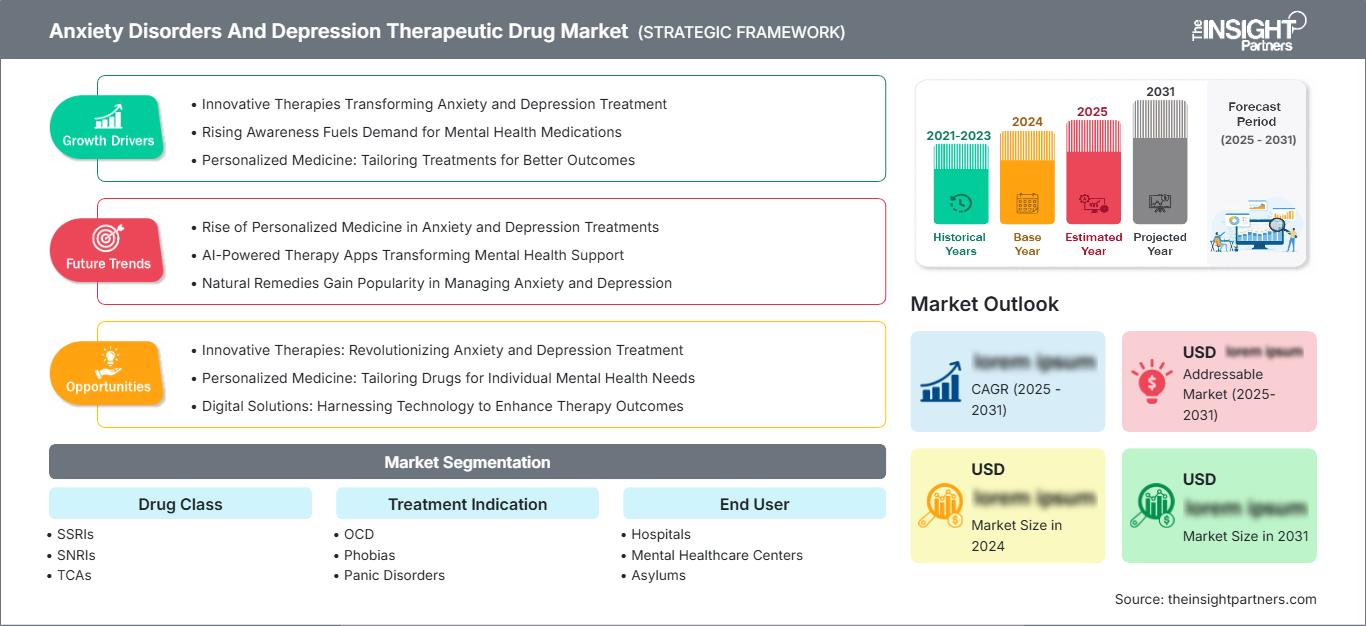
Anxiety Disorders And Depression Therapeutic Drug Market: Strategic Insights
Regional Insights
North America anxiety disorders and depression therapeutic drug market
North America is forecasted for 39–43% market share in 2025 and to register a CAGR of 2.4–3.0% during 2034. North America leads in regional sales due to heavy psychiatric prescribing, reimbursement, availability of specialists, and rapid commercialization of novel drugs. Canada drives sales through public drug insurance and expansion of mental health programs; however, price regulation reduces the intensity of sales compared to those in the US.
The market focuses increasingly on refractory depression, adjunct treatments, and agents with a focus on function impairment and hard-to-treat conditions. Big Pharma benefits from well-established commercial and payer networks, while small biotech companies provide novel targets. There is substantial regulatory scrutiny of psychiatric endpoints, meaning clinical differentiation and tolerability become key drivers of sales. Also, advanced generic penetration prevents unit price growth for older medicines.
U.S. anxiety disorders and depression therapeutic drug Market
The US represents approximately 82–86% of North American revenue in 2025 and is expected to grow at a 2.7–3.2% CAGR during 2026–2034. Strong specialist capacity, insurance coverage, telepsychiatry expansion, and increased recognition of treatment-resistant disease support demand. Johnson & Johnson Services, Inc., Eli Lilly and Company, Pfizer Inc., H. Lundbeck A/S, and other established companies maintain commercial or development exposure.
Application trends are evolving to include treatments for insufficient response, relapse prevention, sleep complaints, and functional effects. Brand medicines will be able to secure premium prices if they have differentiated evidence. The older SSRI/SNRI molecules have already seen competition from generics. Market success is now hinged upon establishing clinical value, gaining access through formularies, and implementing patient assistance programs.
Europe anxiety disorders and depression therapeutic drug Market
Europe has an estimated 25-29% market share in 2025 and is expected to witness growth at a CAGR of 2.1-2.7%. Germany is the leading country due to its large healthcare industry and high usage of medications. Other significant countries include the UK, France, Italy, and Spain. However, revenue generation varies across countries depending on the reimbursement process and generic substitution.
The UK has a well-established system of specialists and treatment paths for mental health disorders, which ensures steady use of antidepressants. Germany benefits from wide access to physicians and the reimbursement system. France and Spain have an advanced level of prescription along with increased focus on drug access and mental health treatments. In Europe, generic competitors keep the price of established compounds low, while novel compounds require proof of value for reimbursement.
APAC anxiety disorders and depression therapeutic drug Market
APAC represents approximately 18–22% share in 2025 and is expected to grow at a 3.0–3.6% CAGR. China is the leading market, followed by Japan, South Korea, India, and Australia. Rising diagnosis, urbanization, improving specialist availability, and broader mental-health policy implementation support pharmaceutical adoption.
China and India represent opportunities for future volumes, whereas Japan and South Korea provide mature prescribing environments. Australia will benefit from access to healthcare and mental health programs already in place. Generic production within the region ensures pricing within developing countries, while global corporations increasingly focus on differentiated products and specialty sales channels.
Middle East & Africa anxiety disorders and depression therapeutic drug Market
MEA is projected to expand at a 3.0–3.6% CAGR during 2026–2034, with Saudi Arabia representing a leading commercial market, followed by the UAE and South Africa. Public-sector healthcare investment, specialist infrastructure development, and increasing recognition of mental-health needs support pharmaceutical demand.
Saudi Arabia and the UAE benefit from healthcare modernization and investment in specialist services, while South Africa provides an established pharmaceutical distribution base. Rest of MEA remains more fragmented because access, affordability, and specialist availability vary substantially. Energy-sector economic strength in Gulf countries supports healthcare infrastructure investment and facilitates adoption of newer branded therapies.
Segmentation Analysis
Drug Class
The Drug Class segment remains central to treatment selection because physicians balance efficacy, tolerability, contraindications, previous response, and adherence. The segment is projected to grow at a 2.2–2.7% CAGR during 2026–2034. Established SSRIs retain broad utilization, while SNRIs and adjunctive strategies gain importance where symptom control or prior-treatment response is inadequate. The anxiety disorders and depression therapeutic drug market scope therefore spans both mature pharmacology and selective innovation.
- SSRIs: Maintain the strongest prescribing position because of extensive clinical familiarity, broad indications, generic availability, and established safety profiles. Their strategic importance remains high despite pricing pressure from generic competition.
- SNRIs: Benefit from utilization where combined serotonergic and noradrenergic activity is considered clinically useful, particularly for patients requiring broader symptom management or switching after inadequate response.
- TCAs: Retain a smaller but established role in selected patients because of clinical familiarity and therapeutic utility, although tolerability and safety considerations restrict broader first-line adoption.
- Buspirone: Serves a targeted anxiety-treatment role, particularly where non-sedating pharmacological management is preferred, creating a stable niche within established treatment pathways.
Treatment Indication
Treatment Indication is projected to grow at a 2.5–3.0% CAGR through 2034 as recognition of heterogeneous anxiety and depressive presentations improves. Treatment decisions increasingly consider symptom severity, comorbidities, previous medication exposure, and treatment resistance. The anxiety disorders and depression therapeutic drug market analysis therefore requires differentiation between broad depression treatment and specific anxiety-related indications.
- OCD: Represents a specialized indication requiring sustained pharmacological treatment and careful monitoring, supporting demand for established antidepressant classes and specialist-led management.
- Phobias: Generate targeted demand where persistent avoidance and functional impairment justify pharmacological intervention alongside behavioral approaches, maintaining a focused treatment opportunity.
- Panic Disorders: Require treatment strategies that address recurrent attacks and anticipatory anxiety, supporting continued use of established antidepressants and selected anxiolytic approaches.
End User
The End User segment is projected to grow at a 2.0–2.5% CAGR during 2026–2034. Hospitals remain important for severe or complex cases, while mental healthcare centers increasingly manage longitudinal treatment. Asylums represent a smaller institutional channel. The anxiety disorders and depression therapeutic drug market is consequently influenced by changes in care setting, referral patterns, and availability of psychiatric professionals.
- Hospitals: Concentrate severe, acute, comorbid, and treatment-resistant patients, making institutional procurement and specialist prescribing particularly important for complex therapy.
- Mental Healthcare Centers: Gain strategic relevance as outpatient and longitudinal psychiatric care expands, supporting medication initiation, monitoring, switching, and adherence management.
- Asylums: Represent a specialized institutional setting with comparatively limited market contribution, primarily associated with patients requiring extended supervised care and complex psychiatric management.
Opportunity Snapshot
| Segment Name | Revenue Contribution | Trend Tag | Adoption Stage |
|---|---|---|---|
| Hospitals | High | Acute Psychiatry | Mature |
| Mental Healthcare Centers | High | Outpatient Care | Scaling |
| Asylums | Low | Institutional Care | Mature |
Anxiety Disorders And Depression Therapeutic Drug Market Growth Drivers and Impact Analysis
Persistent Global Disease Burden Expands Treatment Addressability
According to WHO, more than 1 out of 7 individuals on the planet was suffering from a mental disorder in 2021, with anxiety and depression being among the most prevalent ones. This results in an enormous underlying need for treatment through drugs, especially when the symptoms affect work, family relations, studies, or even physical health. From the business perspective, the increased awareness translates to the development of the patient base from the group which was not treated before. The effect is most notable in cases when the rate of diagnosis exceeds the growth of population. Increased testing within primary care will lead to more usage of already existing drugs, while specialists will provide opportunities to sell new ones. But the process of turning patients into buyers will be limited by the factors of stigma, cost, and insufficient supply.
Growth in Treatment-Resistant and Inadequately Controlled Patients
A significant commercial opportunity is emerging around patients who do not achieve adequate symptom control with initial therapy. Repeated treatment attempts increase lifetime pharmaceutical exposure and create demand for switching strategies, augmentation, and differentiated mechanisms. This dynamic is particularly relevant for depression, where clinicians increasingly evaluate response quality, relapse, functioning, and tolerability rather than symptom reduction alone. Treatment-resistant populations can support premium pricing when therapies demonstrate meaningful incremental benefit and acceptable safety. The commercial implication extends beyond individual products because successful therapies may influence treatment algorithms and specialist referral patterns. Companies with evidence across multiple treatment lines can strengthen their position by addressing patients after first-line failure. This driver also encourages investment in clinical development designs that identify responder populations more precisely.
Expansion of Mental-Health Access Through Integrated Care
Mental-health treatment is progressively moving beyond isolated psychiatric settings toward primary care, community services, digital consultations, and multidisciplinary models. Greater integration can shorten the interval between symptom recognition, diagnosis, prescription, and follow-up. This expands the practical addressable population for pharmaceutical companies, especially in countries where psychiatrist supply is limited. Pharmacists, primary-care physicians, nurse practitioners, and community mental-health teams can contribute to medication management within defined protocols. For manufacturers, this creates opportunities to differentiate products through simpler dosing, tolerability, adherence support, and educational programs rather than relying solely on efficacy claims. Integrated care can also improve persistence by enabling earlier follow-up after initiation. The resulting commercial effect is likely to be gradual, with the strongest benefits in markets investing in coordinated mental-health infrastructure.
Anxiety Disorders And Depression Therapeutic Drug Market Future Trends
Precision Neuroscience and Biomarker-Guided Treatment Selection
Future development is likely to move toward greater biological segmentation of depression and anxiety rather than treating these conditions as uniform diagnoses. Advances in genetics, neuroimaging, digital phenotyping, and computational analysis may help identify patient characteristics associated with treatment response, relapse, or adverse effects. The anxiety disorders and depression therapeutic drug market trends will increasingly reflect attempts to connect clinical phenotypes with biological mechanisms. Pharmaceutical companies may design trials around narrower responder populations, enabling clearer efficacy signals and potentially reducing late-stage development risk. Biomarker-supported prescribing could also improve treatment sequencing by helping clinicians select therapies after previous treatment failure. Commercial adoption will depend on whether testing becomes affordable, reproducible, clinically actionable, and acceptable within routine care rather than remaining confined to research environments.
Rapid-Acting and Mechanistically Differentiated Therapies
The next wave of innovation is expected to emphasize speed of action, durability, reduced side-effect burden, and mechanisms beyond conventional monoamine modulation. Development programs are increasingly exploring neuroplasticity, receptor-specific pathways, and other approaches intended to produce clinically meaningful improvement for difficult-to-treat patients. Such therapies could alter treatment algorithms if benefits are sustained and administration requirements remain practical. The market may consequently become more segmented between high-volume generic maintenance therapies and specialty interventions requiring specialist supervision. Regulatory agencies and payers are likely to demand robust evidence covering durability, functional outcomes, safety, and healthcare utilization. Companies capable of demonstrating advantages across these dimensions may establish stronger differentiation, particularly in treatment-resistant populations where unmet need remains high.
Anxiety Disorders And Depression Therapeutic Drug Market Opportunities
Expansion Across Underpenetrated Asian Treatment Populations
Asia offers an attractive long-term opportunity because large populations coexist with comparatively uneven diagnosis and treatment access. The anxiety disorders and depression therapeutic drug market Forecasts indicate that commercialization strategies should prioritize countries where mental-health infrastructure, reimbursement, and specialist availability are improving simultaneously. China, India, South Korea, and selected Southeast Asian markets provide different entry conditions, requiring localized pricing and distribution strategies. Manufacturers can combine established generic portfolios with selected branded therapies to build physician relationships before introducing higher-value products. Partnerships with domestic distributors, hospitals, and mental-health networks can reduce market-entry friction. Digital follow-up platforms may further support medication persistence where specialist capacity is constrained. The strongest opportunities will arise where companies adapt portfolios to local affordability while retaining differentiated products for patients with inadequate response.
Specialty Portfolio Expansion Through Neuroscience Partnerships
The renewed strategic interest in neuroscience creates opportunities for pharmaceutical companies to access external innovation rather than relying exclusively on internal discovery. The anxiety disorders and depression therapeutic drug market can benefit from licensing, acquisitions, co-development agreements, and platform partnerships involving novel mechanisms, biomarkers, and rapid-acting therapies. Large pharmaceutical companies possess regulatory, manufacturing, and commercial capabilities that can accelerate commercialization of assets developed by smaller biotechnology companies. For investors, attractive targets are likely to combine validated biological mechanisms with differentiated clinical profiles and manageable administration requirements. Companies should prioritize assets addressing treatment-resistant populations, where unmet need and willingness to adopt differentiated therapy are stronger. Portfolio construction should also balance development risk by combining emerging assets with established revenue-generating products.
Recent Developments
- July 2026: Eli Lilly and Company announced a definitive agreement to acquire AtaiBeckley for approximately US$2.8 billion upfront, with additional contingent value rights. The transaction expands Lilly’s neuroscience pipeline with BPL-003 for treatment-resistant depression and additional mental-health programs, including VLS-01 and EMP-01. BPL-003 had initiated Phase 3 activities and received FDA Breakthrough Therapy Designation.
- January 2025: Johnson & Johnson Services, Inc. announced the acquisition of Intra-Cellular Therapies for approximately US$14.6 billion. The transaction added CAPLYTA and a neuroscience pipeline that included ITI-1284, which was being studied in generalized anxiety disorder, strengthening J&J’s position in neuropsychiatric therapeutics.
- June 2025: Bristol Myers Squibb Company highlighted a renewed neuroscience research strategy using human biology, biomarkers, computational science, artificial intelligence, and machine learning. Its neuroscience programs are intended to identify disease mechanisms and therapeutic targets across complex neurological and neuropsychiatric conditions, reinforcing the industry’s shift toward biologically informed drug discovery.
Frequently Asked Questions

- Comprehensive Market Sizing and Forecast Analysis
- Detailed Segmentation Analysis
- In-Depth Market Dynamics Assessment
- Regional and Country-Level Insights
- Competitive Landscape and Company Benchmarking
- Strategic Business Intelligence
Recent Reports
Testimonials

The Insight Partners' SCADA System Market report is comprehensive, with valuable insights on current trends and future forecasts. The team was highly professional, responsive, and supportive throughout. We are very satisfied and highly recommend their services.
RAN KEDEM Partner, Reali Technologies LTDs
I requested a report on a very specific software market and the team produced the report in a few days. The information was very relevant and well presented. I then requested some changes and additions to the report. The team was again very responsive and I got the final report in less than a week.
JEAN-HERVE JENN Chairman, Future Analytica
We worked with The Insight Partners for an important market study and forecast. They gave us clear insights into opportunities and risks, which helped shape our plans. Their research was easy to use and based on solid data. It helped us make smart, confident decisions. We highly recommend them.
PIYUSH NAGPAL Sr. Vice President, High Beam Global
The Insight Partners delivered insightful, well-structured market research with strong domain expertise. Their team was professional and responsive throughout. The user-friendly website made accessing industry reports seamless. We highly recommend them for reliable, high-quality research services
YUKIHIKO ADACHI CEO, Deep Blue, LLC.
This is the first time I have purchased a market report from The Insight Partners.While I was unsure at first, I visited their web site and felt more comfortable to take the risk and purchase a market report.I am completely satisfied with the quality of the report and customer service. I had several questions and comments with the initial report, but after a couple of dialogs over email with their analyst I believe I have a report that I can use as input to our strategic planning process.Thank you so much for taking the extra time and making this a positive experience.I will definitely recommend your service to others and you will be my first call when we need further market data.
JOHN SUZUKI President and Chief Executive Officer, Board Director, BK Technologies
I wish to appreciate your support and the professionalism you displayed in the course of attending to my request for information regarding to infectious disease IVD market in Nigeria. I appreciate your patience, your guidance, and the fact that you were willing to offer a discount, which eventually made it possible for us to close a deal. I look forward to engaging The Insight Partners in the future, all thanks to the impression you have created in me as a result of this first encounter.
DR CHIJIOKE ONYIA MANAGING DIRECTOR, PineCrest Healthcare Ltd.Reason to Buy
- Informed Decision-Making
- Understanding Market Dynamics
- Competitive Analysis
- Identifying Emerging Markets
- Customer Insights
- Market Forecasts
- Risk Mitigation
- Boosting Operational Efficiency
- Strategic Planning
- Investment Justification
- Tracking Industry Innovations
- Aligning with Regulatory Trends





 Get Free Sample for