
Appendiceal Cancer Treatment Market Demand, Share & Growth by 2034
Coverage: By Type (Neuroendocrine Tumors, Carcinomas); Treatment Type (Surgery, Medication, Chemotherapy, Radiation Therapy); End User (Hospitals, Cancer Research Institutes, Others) , and Geography (North America, Europe, Asia Pacific, and South and Central America)
- Status : Data Released
- Report Code : TIPRE00008535
- Category : Life Sciences
- No. of Pages : 150
- Available Report Formats :


- Last update date : August 25, 2026


2025 Market Size
US$ 5.65 Bn
Base year value
2034 Forecast
US$ 8.66 Bn
Projected by 2034
CAGR 2026-2034
4.86 %
Growth rate
Addressable Market
US$ 64.95 Bn
(2026-2034)
The appendiceal cancer treatment market is entering a period of measured expansion as diagnostic characterization, multidisciplinary oncology pathways, and treatment personalization improve. The market is valued at US$ 5.65 Billion in 2025 and is projected to reach US$ 8.66 Billion by 2034, registering a CAGR of 4.86% during 2026–2034. Growth is supported by increasing recognition of appendiceal neoplasms, specialized surgical management, and continued development of systemic therapies for advanced disease.
North America is expected to remain the principal regional contributor, supported by specialized cancer centers, established reimbursement systems, and increasing use of multidisciplinary treatment pathways. The appendiceal cancer treatment market size is also influenced by growing adoption of molecular diagnostics, clinical trial activity, and improved referral patterns for rare gastrointestinal malignancies. These factors support a modeled regional CAGR range of 4.9–5.3% during 2026–2034.
Appendiceal Cancer Treatment Market Assessment and Insights
- North America: North America is projected to account for a 38–42% share in 2025, supported by specialized oncology infrastructure and advanced cytoreductive surgery capabilities, while growing at a 4.9–5.3% CAGR between 2026–2034 as diagnosis and treatment referral improve.
- US: The US is expected to represent 82–86% of North America’s 2025 share, with a 5.0–5.4% CAGR between 2026–2034, supported by high-value oncology care and specialized treatment centers.
- Europe: Europe is estimated at a 27–31% share in 2025, led by Germany, the UK, France, Italy, and Spain, and is projected to expand at a 4.5–4.9% CAGR between 2026–2034 through specialized cancer networks.
- Asia Pacific: Asia Pacific is estimated to hold a 20–24% share in 2025, led by China, Japan, South Korea, and Australia, with a 5.3–5.8% CAGR between 2026–2034 as oncology capacity and diagnostic access broaden.
- Largest Segment: Carcinomas are estimated to hold a 68–72% market share in 2025, reflecting their treatment intensity, broader surgical requirements, and greater utilization of systemic and multimodal interventions.
- High Growth Segment: Medication is projected to hold a 16–20% market share in 2025 and grow at a 6.0–6.5% CAGR during 2026–2034, supported by targeted and biomarker-informed treatment development.
- Key companies analyzed in detail: Amgen; Novartis AG; Pfizer Inc.; AstraZeneca plc; Bristol-Myers Squibb Company; Bayer AG; Teva Pharmaceutical Industries Ltd.; Sanofi; F. Hoffmann-La Roche Ltd; Merck & Co., Inc.
Source: The Insight Partners' analysis based on proprietary research, government publications, company annual reports, investor presentations, industry databases, and expert interviews.
The current state of treatment regimens involves a shift towards a more refined combination of histopathological, radiological, medical, and peritoneal disease management modalities rather than just surgical interventions. The growing complexity of treatment regimens involves innovations in minimally invasive surgery, cytoreductive surgery, intraperitoneal chemotherapy, and molecular diagnosis. Similarly, production dynamics also need to move towards the manufacture of drugs with high precision, biologicals, and supportive medicines capable of targeting particular features of the disease without compromising multidisciplinary oncology strategies.
Emerging oncology centers within the APAC region and selected Middle East markets will play an increasing role in the expansion of specialist access over the forecast period. Investment needs to move towards diagnostics, clinical trial capabilities, precision oncology, and treatments of rare gastrointestinal cancer cases. Regulatory support for evidence generation for rare cancers may further expedite the development process, provided certain clinical endpoints are well-defined.
Appendiceal Cancer Treatment Market Report Scope
| Report Attribute | Details |
|---|---|
| Market size in 2025 | US$ 5.65 Billion |
| Market Size by 2034 | US$ 8.66 Billion |
| Global CAGR (2026 - 2034) | 4.86% |
| Historical Data | 2021-2024 |
| Forecast period | 2026-2034 |
Appendiceal Cancer Treatment Market Analysis
The appendiceal cancer treatment market growth is shaped by a rare-disease treatment ecosystem in which diagnosis frequently precedes referral to specialist centers. The value chain begins with imaging, pathology, and biomarker assessment and extends through surgery, systemic treatment, radiation, where clinically appropriate, supportive care, and longitudinal monitoring. Demand is therefore concentrated in tertiary hospitals and specialized cancer institutes capable of coordinating complex treatment pathways.
There is variation in the supply of care depending on the mode of therapy. Surgical care is determined by the availability of specialists, operating room space, and experience. On the other hand, the supply of drug therapy depends on the production, approval, and distribution of the drugs as well as their cost. Drug shortages and costs may affect the choice of therapy, especially when generics are available.
The appendiceal cancer treatment market analysis indicates a competitive structure extending beyond therapies specifically developed for appendiceal malignancies. Large pharmaceutical companies participate through broader oncology portfolios, while specialized centers differentiate through surgery, clinical research, and treatment integration. Amgen, Novartis AG, Pfizer Inc., AstraZeneca plc, Bristol-Myers Squibb Company, Bayer AG, Teva Pharmaceutical Industries Ltd., Sanofi, F. Hoffmann-La Roche Ltd, and Merck & Co., Inc. provide relevant capabilities across oncology medicines, biologics, targeted approaches, or supporting technologies.
Investment priorities increasingly emphasize platform technologies with applications across multiple solid tumors rather than appendiceal cancer alone. This approach reduces commercial exposure associated with small patient populations. Strategic positioning is therefore likely to depend on biomarker technologies, combination regimens, clinical evidence, and access to specialist treatment networks. Partnerships between pharmaceutical developers and academic cancer centers can improve patient recruitment and evidence generation for uncommon tumor subtypes.
● REPORT CUSTOMIZATION
Tailor This Report To Align With Your Specific Business Requirements
This report can be customized to align precisely with your business objectives, scope, and target markets. Customization options include tailored segmentation, geography, competitive analysis, and strategic insights to support informed decision-making.
Customize This Report →WHAT YOU CAN ADJUST
- ● Segmentations
- ● Geography
- ● Competitive Analysis
- ● Language Preferences
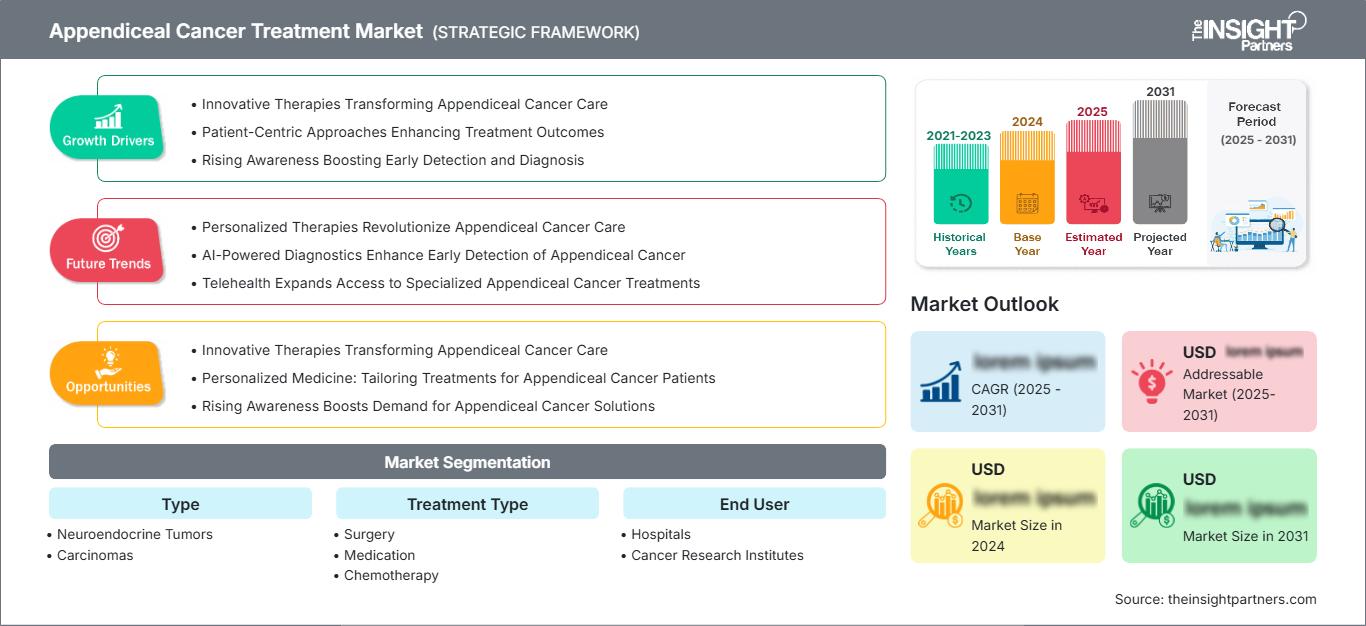
Appendiceal Cancer Treatment Market: Strategic Insights
Regional Insights
North America appendiceal cancer treatment market
North America is estimated to represent a 38–42% of the appendiceal cancer treatment market share in 2025 and is expected to expand at a 4.9–5.3% CAGR through 2034. The region benefits from concentrated expertise in rare gastrointestinal malignancies, high-capacity cancer hospitals, advanced imaging, and established multidisciplinary tumor boards. The US remains the principal contributor, while Canada provides additional demand through centralized cancer systems and specialist referral pathways.
Regional growth is supported by wider use of molecular pathology, specialized surgical management, and clinical research. The concentration of experienced centers allows patients with peritoneal dissemination to receive complex procedures that may require coordinated surgical and oncology teams. Reimbursement remains a major determinant of treatment access, particularly for expensive medicines and advanced interventions. Greater awareness among physicians is also improving referral of unusual appendiceal lesions to specialist institutions.
U.S. appendiceal cancer treatment Market
The US represents an estimated 82–86% of North America’s 2025 share and is projected to grow at a 5.0–5.4% CAGR through 2034. Its leadership reflects a large network of academic cancer centers, specialist surgeons, sophisticated pathology services, and broad availability of oncology medicines. Companies, including Amgen, Pfizer, Merck & Co., and Bristol-Myers Squibb, contribute through wider oncology portfolios relevant to treatment development.
Application trends increasingly emphasize disease classification before treatment selection. Surgery remains central for localized and selected peritoneal disease, while medication is more relevant when systemic treatment is clinically indicated. Clinical research networks also support the investigation of novel therapies for rare gastrointestinal cancers. The combination of specialist referral, private and public reimbursement, and high treatment intensity positions the US as the principal North American market.
Europe appendiceal cancer treatment Market
Europe is estimated to hold a 27–31% share of the appendiceal cancer treatment Market in 2025 and is projected to grow at a 4.5–4.9% CAGR, with Germany representing the leading country within the region. Established national cancer programs, specialist hospitals, and improved cross-border clinical collaboration support treatment access, although reimbursement differences create variation between countries.
The UK has developed specialized gastrointestinal oncology pathways and concentrated cancer expertise, supporting referral-based treatment for uncommon tumors. Germany benefits from a strong hospital network, specialist surgery, and advanced oncology infrastructure. France, Italy, and Spain contribute through national cancer centers, university hospitals, and expanding access to precision oncology. European demand is increasingly influenced by evidence-based treatment protocols, health technology assessment, and the availability of targeted therapies.
APAC appendiceal cancer treatment Market
APAC is estimated to account for a 20–24% share of the appendiceal cancer treatment Market in 2025 and is expected to register a 5.3–5.8% CAGR, according to the Appendiceal Cancer Treatment Market Report. China is the leading contributor, followed by Japan, South Korea, India, and Australia. Industrial investment in oncology infrastructure and expanding specialist capacity are improving diagnosis and treatment availability.
Japan and South Korea benefit from mature oncology systems, while China and India offer significant expansion potential through increasing cancer-center capacity. Australia contributes through advanced clinical services and research. Government investment in hospital infrastructure, local pharmaceutical production, and broader access to cancer diagnostics should support regional development, particularly in major urban centers.
Middle East & Africa appendiceal cancer treatment Market
The Middle East and Africa appendiceal cancer treatment Market is expected to grow at a modeled 4.0–4.5% CAGR, with Saudi Arabia leading regional demand, followed by the UAE and South Africa. Investment in tertiary hospitals and oncology infrastructure is gradually expanding specialist treatment capacity, although access remains uneven across countries.
Saudi Arabia and the UAE benefit from high healthcare investment and modern hospital infrastructure, while South Africa provides a regional hub for specialist cancer care. The rest of MEA markets remain constrained by specialist availability, diagnostic capacity, and treatment affordability. Energy revenues in Gulf economies support healthcare infrastructure investment, while broader public-sector development programs can improve access to oncology services over time.
Segmentation Analysis
Type
Type segmentation distinguishes the disease according to neuroendocrine tumors and carcinomas, creating different treatment requirements and clinical pathways. Carcinomas generally require greater treatment intensity because of their association with invasive or disseminated disease. The segment is projected to grow at a 4.6–5.0% CAGR during 2026–2034. The appendiceal cancer treatment market scope therefore, remains strongly influenced by histopathological classification.
- Neuroendocrine Tumors: Neuroendocrine tumors require differentiated surveillance and treatment strategies depending on grade, size, and metastatic behavior. Their clinical management supports demand for specialized pathology, imaging, surgery, and selected systemic therapies.
- Carcinomas: Carcinomas represent the dominant disease category because treatment may involve extensive surgery, systemic medication, chemotherapy, and coordinated management of peritoneal involvement, increasing institutional treatment intensity.
Treatment Type
Treatment Type is projected to expand at a 4.7–5.2% CAGR during 2026–2034, reflecting continued reliance on surgery alongside increasing therapeutic differentiation. Treatment decisions depend on histology, stage, dissemination, patient fitness, and treatment intent. Surgery remains foundational, while medication and chemotherapy provide systemic options when disease characteristics require additional intervention.
- Surgery: Surgery remains strategically important for localized tumors and selected disseminated cases. Specialized procedures require experienced surgeons, advanced operating facilities, and multidisciplinary planning, creating high-value demand within tertiary hospitals.
- Medication: Medication supports systemic disease management and is increasingly influenced by molecular characteristics, treatment line, and broader oncology drug development. Its strategic importance is rising as targeted approaches become more differentiated.
- Chemotherapy: Chemotherapy remains relevant for selected advanced or high-risk diseases, particularly when systemic disease control is required. Its use is shaped by treatment protocols, patient fitness, and combination strategies.
- Radiation Therapy: Radiation therapy has a more selective role because anatomical location and disease distribution can constrain applicability. Its importance is concentrated in clinically appropriate cases requiring local disease control.
End User
End-user segmentation is expected to expand at a 4.8–5.2% CAGR during 2026–2034 as specialized treatment becomes increasingly concentrated in institutions with multidisciplinary oncology capabilities. Hospitals remain the primary setting because they provide surgery, medication administration, imaging, pathology, and supportive care under one treatment ecosystem. The segment also supports the appendiceal cancer treatment market through specialist referral concentration.
- Hospitals: Hospitals represent the principal treatment setting, supported by operating facilities, oncology departments, pathology services, and inpatient capabilities. Large tertiary centers are particularly important for complex surgical and multimodal treatment.
- Cancer Research Institutes: Cancer research institutes contribute through clinical trials, translational research, biomarker studies, and the development of novel therapeutic strategies. Their role is strategically important for rare tumor populations requiring specialized evidence generation.
Opportunity Snapshot
| Segment Name | Revenue Contribution (High/Medium/Low) | Trend Tag (MAX 2 words) | Adoption Stage (Emerging/Scaling/Mature) |
| Hospitals | High | Multimodal Care | Mature |
| Cancer Research Institutes | Medium | Trial Expansion | Scaling |
Appendiceal Cancer Treatment Market Growth Drivers and Impact Analysis
Greater specialization in rare gastrointestinal cancer management
Concentration of rare gastrointestinal oncology care in specialist organizations enhances the quality of treatment and increases the demand for more advanced procedures. The treatment of appendiceal cancers requires cooperation of pathology, imaging, surgery, systemic treatment, and post-treatment activities. Institutional experience becomes a crucial factor in determining the choice of treatment. As the pathway of referrals becomes more developed, the patients tend to arrive at specialized centers where more complicated cases of the disease can be seen. This leads to the creation of demand for specialists such as surgeons, oncologists, oncologist pharmacists, molecular tests, and tumor boards. This situation is especially significant in North America, Western Europe, Japan, and major cities of the Asia Pacific region due to the development of tertiary oncology infrastructure in these countries.
Improving pathological and molecular characterization
Pathological classification is becoming an increasingly significant factor in determining the choice of therapy, given that appendiceal cancers include several biologically distinct types of disease. Improved immunohistochemical and molecular profiling techniques may decrease ambiguity and enable physicians to separate subtypes of cancer with varying treatment and prognosis implications. Improved classification may also assist in increasing accuracy in clinical trials for drugs based on target-specific and solid-tumor-based molecular biomarkers. There are additional market implications of better classification aside from increased sales of drugs, as diagnostic precision leads to increased use of pathology, specialized reagents, molecular diagnostics, and confirmatory tests. In the long run, treatment algorithms could become more specific to biological features of tumors as opposed to anatomical considerations. This trend will be favorable for companies able to leverage their diagnostic expertise to develop and prove the efficacy of drugs.
Expansion of oncology infrastructure in emerging economies
Expansion of tertiary oncology capacity across emerging economies can increase the addressable patient pool receiving specialist diagnosis and treatment. China, India, Southeast Asia, the Gulf states, and selected Latin American markets are investing in cancer hospitals, imaging systems, pathology laboratories, and specialist training. These investments can reduce geographic barriers that previously limited access to complex treatment. For the appendiceal cancer treatment market, the impact is likely to emerge gradually because rare tumors require referral systems and specialized expertise rather than infrastructure alone. Partnerships between established cancer centers, pharmaceutical companies, and local healthcare providers can accelerate knowledge transfer. Increasing availability of oncology medicines and diagnostic services should subsequently improve treatment continuity, while local manufacturing and procurement initiatives may influence affordability and product access.
Appendiceal Cancer Treatment Market Future Trends
Precision oncology will reshape treatment selection
Precision oncology is expected to become increasingly integrated into treatment decision-making as molecular characterization improves. For appendiceal tumors, broader use of genomic profiling could help identify actionable alterations, distinguish biologically distinct disease, and support enrollment into biomarker-selected clinical studies. The appendiceal cancer treatment market trends will therefore increasingly reflect the convergence of pathology, molecular diagnostics, and therapeutic development. Drug developers are expected to favor mechanisms that would apply broadly across several rare or solid tumor populations rather than develop products targeting appendiceal disease alone. The approach will allow for broadening business opportunities while allowing for small populations to enroll in basket trials. Clinical decision support systems will also be able to leverage real-world evidence for informing sequencing in the absence of direct randomized evidence due to the rarity of the diseases.
Multimodal care pathways will become more integrated
The future models of treatment will involve the combination of surgical, systemic, imaging, pathological and longitudinal approaches. It is possible to organize a digital case review that will allow for remote involvement of specialized surgeons, pathologists, radiologists, and oncologists and establish a connection between regional hospitals and expert centers. Treatment may also involve standardized assessment of disease, centralized pathological evaluation and standard follow-up. This will lead to a decrease in variance in care and help in the choice of treatment for rare cases. The pharmaceutical industry can organize clinical trials based on real multidisciplinary pathways rather than drug therapy alone. Meanwhile, the hospitals can optimize their resource management by concentrating on their high-volume centers. This will create a care model in favor of institutions that combine clinical skills, diagnostics, advanced surgery, and medicines for oncology.
Appendiceal Cancer Treatment Market Opportunities
Building specialist referral and clinical research networks
Expansion of specialist referral networks represents an important opportunity for healthcare providers and pharmaceutical companies seeking deeper access to rare tumor populations. A coordinated network can connect community hospitals with tertiary cancer centers for pathology review, imaging assessment, surgical consultation, and clinical trial screening. This approach improves patient identification while reducing fragmentation across treatment stages. The appendiceal cancer treatment market Forecasts are likely to favor models that combine specialist expertise with broader geographic reach. These investment areas could consist of diagnostic facilities, tele-oncology networks, clinical data infrastructures, and referral networks. The pharmaceutical companies can utilize such networks to facilitate trial recruitment and generate evidence from small populations. Furthermore, academic institutions can enhance their longitudinal registries, which offer information on treatment effects, recurrence trends, and health economic analysis.
Developing cross-indication therapeutic platforms
Commercial barriers to drug development for rare appendiceal cancers may be overcome by developing treatments that have applicability in the treatment of solid tumors in general. Antibody-drug conjugates, molecularly targeted drugs, immunotherapies, and molecularly selected drugs are potential candidates for such a strategy if there is an overlap of biological features. The approach will allow companies to build on existing research and commercial capabilities. Funding needs to focus on approaches that have a good translational rationale and biomarkers that can pick out responder patients. Partnership with expert cancer hospitals will enable the company to develop disease-specific evidence without the need for its own separate commercial capability. A combination of systemic approaches with surgical intervention may be considered.
Recent Developments
- July 2026: Novartis AG announced an agreement to acquire Myricx Bio, adding a next-generation antibody-drug conjugate platform using N-myristoyltransferase inhibitor payloads. The transaction strengthens Novartis’s oncology pipeline and expands its ability to pursue differentiated targeted therapies across solid tumors, supporting the broader industry shift toward payload innovation and biomarker-oriented oncology development.
- May 2026: Pfizer Inc. entered a global strategic collaboration with Innovent Biologics covering research and development of 12 early-stage cancer medicines, including antibody-drug conjugates and multispecific antibodies. The agreement expands Pfizer’s oncology innovation base and illustrates increasing pharmaceutical investment in differentiated mechanisms that can potentially address multiple solid-tumor settings.
- January 2026: Amgen acquired Dark Blue Therapeutics for up to US$840 million, adding an investigational targeted protein degrader to its oncology pipeline. The transaction demonstrates continued investment in novel small-molecule mechanisms and combination strategies designed to address treatment resistance, reinforcing the importance of platform-based oncology innovation.
Frequently Asked Questions

- Comprehensive Market Sizing and Forecast Analysis
- Detailed Segmentation Analysis
- In-Depth Market Dynamics Assessment
- Regional and Country-Level Insights
- Competitive Landscape and Company Benchmarking
- Strategic Business Intelligence
Recent Reports
Testimonials

The Insight Partners' SCADA System Market report is comprehensive, with valuable insights on current trends and future forecasts. The team was highly professional, responsive, and supportive throughout. We are very satisfied and highly recommend their services.
RAN KEDEM Partner, Reali Technologies LTDs
I requested a report on a very specific software market and the team produced the report in a few days. The information was very relevant and well presented. I then requested some changes and additions to the report. The team was again very responsive and I got the final report in less than a week.
JEAN-HERVE JENN Chairman, Future Analytica
We worked with The Insight Partners for an important market study and forecast. They gave us clear insights into opportunities and risks, which helped shape our plans. Their research was easy to use and based on solid data. It helped us make smart, confident decisions. We highly recommend them.
PIYUSH NAGPAL Sr. Vice President, High Beam Global
The Insight Partners delivered insightful, well-structured market research with strong domain expertise. Their team was professional and responsive throughout. The user-friendly website made accessing industry reports seamless. We highly recommend them for reliable, high-quality research services
YUKIHIKO ADACHI CEO, Deep Blue, LLC.
This is the first time I have purchased a market report from The Insight Partners.While I was unsure at first, I visited their web site and felt more comfortable to take the risk and purchase a market report.I am completely satisfied with the quality of the report and customer service. I had several questions and comments with the initial report, but after a couple of dialogs over email with their analyst I believe I have a report that I can use as input to our strategic planning process.Thank you so much for taking the extra time and making this a positive experience.I will definitely recommend your service to others and you will be my first call when we need further market data.
JOHN SUZUKI President and Chief Executive Officer, Board Director, BK Technologies
I wish to appreciate your support and the professionalism you displayed in the course of attending to my request for information regarding to infectious disease IVD market in Nigeria. I appreciate your patience, your guidance, and the fact that you were willing to offer a discount, which eventually made it possible for us to close a deal. I look forward to engaging The Insight Partners in the future, all thanks to the impression you have created in me as a result of this first encounter.
DR CHIJIOKE ONYIA MANAGING DIRECTOR, PineCrest Healthcare Ltd.Reason to Buy
- Informed Decision-Making
- Understanding Market Dynamics
- Competitive Analysis
- Identifying Emerging Markets
- Customer Insights
- Market Forecasts
- Risk Mitigation
- Boosting Operational Efficiency
- Strategic Planning
- Investment Justification
- Tracking Industry Innovations
- Aligning with Regulatory Trends





 Get Free Sample for